Australia ”Must
pp. 31-32 · Read in the full issue
Take Islands
Immigrants"
At the Cook Bi-centenary
Symposium in Sydney, sponsored
by the NSW Government, little time was taken on South Pacific Islands affairs. Most papers covered the problems and ambi tions of the powers on the Pacific perimeter. But here are the high lights of those matters affecting the Islands.
The most outspoken on immigra tion was Professor Keith Sinclair, Professor of History at the University of Auckland, who argued strongly that Australia should take Islanders as immigrants. Local resources in some territories could not support what was demanded, he said, and to relieve the pressure, migration was an answer, and he “did not see why New Zealand has to do it all”.
For a more detailed quote on Professor Sinclair’s views see Up Front With the Editor, p. 15.
On the same theme was Professor W. D. Borrie, Professor of Demo graphy at the Australian National University, who said, “What harm can come of having some New Guineans living among us and acquir ing knowledge and skills that they might return in due course to apply in their own country? We seem to argue that it is good for New Guinea to have Europeans living in New Guinea; why, then, should Aus tralians be so afraid of the reverse?
“I am suggesting a more flexible policy in which peoples from the Pacific region, with the requisite skills to support themselves and con tribute to our economic development, should be able to find a place among us.
“Emigration could be a major contribution to the solution of the demographic problems of the Pacific Islands territories. This is a very limited, but very important, goal we can help them to reach.”
Fewer marriages
Professor Borrie said that Fiji had the most dangerous population situ ation in the Islands. It was complex and potentially explosive.
The decline in Fiji’s birthrate in recent years was due, not so much to the colony’s family planning scheme, but to later and fewer mar-
Uncertain sugar market
riages among Indian women, follow ing cessation of the immigration of Indian males. The future was ex plosive because the Indians out numbered the Fijians and the Indians largely controlled the industrial and manufacturing sectors of the economy. There was limited land an uncertain market for sugar and 45 per cent, of rural Fijians were under the age of 15.
Professor Borrie added that in New Guinea there was a slow rate of population growth but it would increase before it fell away, as the territory’s population would double within the next 30 years. In New Guinea, as elsewhere in the Islands, there was urgency for high levels of investment in non-agricultural de velopments, as alternative avenues of employment for the growing younger population.
Although Dr. I. J. Fairburn, of the University of Newcastle, made no plea for migration to Australia, his paper underlined the economic pres sures in the Islands, and he was pessi mistic for their economic future.
Except for New Guinea and Fiji, he said, a state of economic stag nation of continuing regression was inevitable for Islands economies.
Gloomy prediction
Among the reasons he gave for his gloomy prediction were: • The rapid population increase in the Islands which tended to act as a negative economic factor. • The fact that the Islands were not unusually well endowed with natural resources. • A low level of savings, which in turn tended to reduce the growth potential of the Islands. • Heavy dependence on the export of a few agricultural products, or semi-processed and mineral products. • An overall need to modernise agricultural practices.
Secretary-General of the South Pacific Commission, Afioga Afoafou vale Misimoa, of Western Samoa, told the symposium that the key to the survival of the people of the South Pacific might lie in emigra tion to the Western countries at each end of the Pacific.
Likening the present situation to the old days of Pacific migration by canoe, Afoafouvale said dwindling food supplies and the rising popula tion meant that Polynesians, in par ticular, had already begun on a new course of migration. American Samoans were living in California,
Niueans, Tokelauans and Cook Islanders lived in New Zealand and large numbers of Wallisians and Tahitians lived in New Caledonia.
The imminent exhaustion of phos phate deposits on Ocean Island would soon create a serious problem in the Gilbert and Ellice Islands, which might be partly solved by mass migration. He went on: “Unless the production of food is increased, there is a danger that standards of nutrition and life itself would not merely re main static but would actually de cline.
“This danger has, of course, always been a very real one in the Pacific, and has been the driving force behind the ancient and more modern migra tion of Pacific peoples, and also led in the past to less acceptable forms of behaviour, such as inter-island warfare.”
He advocated greater efficiency of agriculture and better use of fisheries and timber resources, the development of secondary industries and tourism.
Tourism was another theme run ning through the conference. Afoa fouvale said that he himself “de plored tourism”. The development of tourism, he said, would require a deep seated change in the philosophy of Pacific Islanders, who were natur ally conservative people. He himself was an opponent of change for the sake of change, but he was conscious of the need to adapt his attitudes to the changing requirements of the Pacific.
“I would personally prefer not to have to rely on tourists as a source of overseas exchange,” said Afoafou vale. “I like Western Samoa very much as it is, and I fear that in order to provide the facilities legiti mately demanded by tourists, the Western Samoa that I love must suffer some changes.
“There must be a fairly consider able disruption of a way of life that has taken centuries to evolve.”
But tourism had its good side, he said. Apart from bringing in money it meant improvements in transport and communication, valuable contact with other people and their ideas, and a growth in understanding of the world at large. This understand ing was essential if the Pacific was to take its place in the world with out opting out of any of the duties and responsibilities that went with it.
Among other points made by speakers at the Sydney symposium were: • Mr. Kn u t Hammarskjold, director-general of the International Air Transport Association, said any general reduction in international air fares was “highly unlikely” and some increases would be necessary.
The best that could be hoped for was selective reductions in pro motional fares where sufficient public response was likely to be forth coming.
No free trade
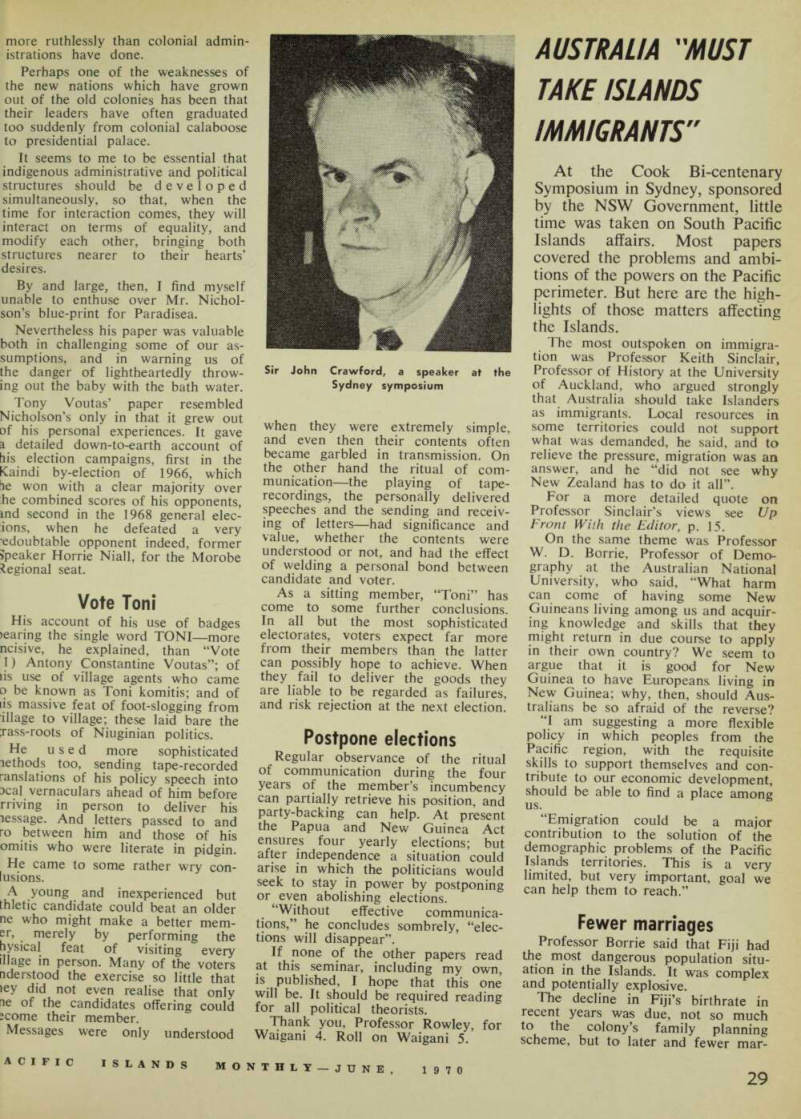
• Sir John Crawford, vice chancellor of the Australian National University, rejected suggestions that Australia should aim at a free trade association with Pacific territories, including New Guinea. Although he expected that New Guinea would have political independence within the next few years, Australian know how and investment would be needed for some time, despite indications that the territory had prospects of becoming economically independent within a decade or so.
He said that while there was scope for a free trade area between New Guinea, Fiji and New Caledonia, Australia should remain outside it, although allowing those territories free access to the Australian market.
Conversely the) countries involved should still have the right to protect their own markets from Australian competition.
From The
Moon To Nauru
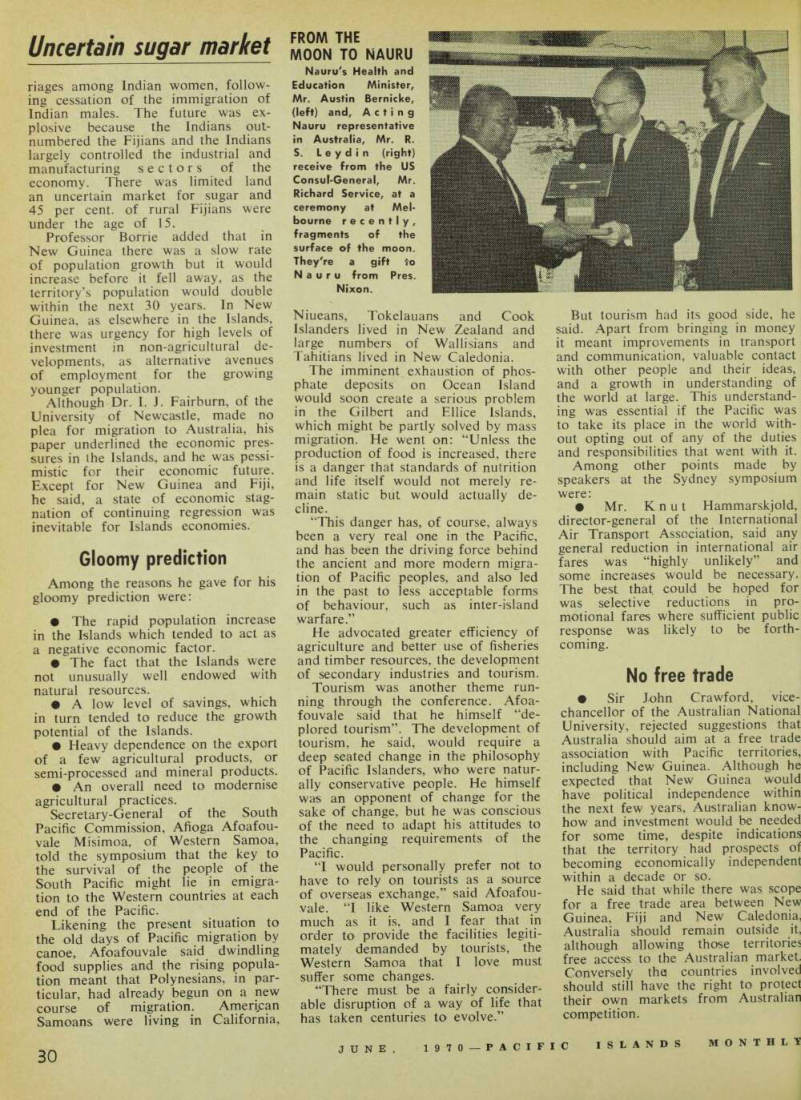
Nauru's Health and Education Minister, Mr. Austin Bernicke, (left) and, Acting Nauru representative in Australia, Mr. R.
S. Leydin (right) receive from the US Consul-General, Mr.
Richard Service, at a ceremony at Mel bourne recently, fragments of the surface of the moon.
They're a gift to Nauru from Pres.
Nixon.