They talked, talked, talked
pp. 30-31 · Read in the full issue
to some purpose
From PERCY CHATTERTON, in Port Moresby The Waigani Seminar is an annual event which was started in 1967. It is sponsored jointly by the University of Papua and New Guinea, the Australian National University, the P-NG Administra tive College, the Council on New Guinea Affairs and the Papua and New Guinea Society.
I have attended all the seminars to date and have read papers at three of them, and I have no hesitation in saying that the fourth of the series, held between May 9th and 15th, was the best so far.
There were several reasons for this. The spread of the seminar over a whole week instead of a long week end; the concentration on a single theme, instead of two pursued simultaneously; the venue —the univ ersity’s splendid lecture theatre with its air-conditioning, its perfect acoustics and its steeply tiered seats; and the large attendance of Niu ginians, drawn as by a magnet by the seminar’s theme “The Politics of Melanesia” —all these combined to make this a memorable occasion.
Wide ranging
The theatre seats over 400. For most of the sessions it was comfort ably full, and for a few, notably those on “Students in Politics” and “Trade Unions”, there was standing room only by the time the speakers took the rostrum, with indigenes heavily outnumbering Europeans.
Mr. George Warwick Smith, sec retary of the Department of External Territories, also attracted a capacity audience to the final session.
The seminar was wide ranging— both geographically and in subject matter. Speakers came from the British Solomons, the New Hebrides, Fiji, and Micronesia. Universities represented included Queensland.
Sydney and California, as well as those of the South Pacific and Papua- New Guinea.
Subjects covered traditional political systems, constitutions, in dustrial relations, localisation, political organisations, local government, trade unions, the rule of law and the indigenous Church. Of the 46 speakers, 16 were Melanesians and one a Micronesian.
Professor Charles Rowley of UPNG, who performed the mam
moth task of organising the seminar, wound it up with an incisive closing address. It was unfortunate that, following as it did on the heels of a long and rather pedestrian paper presented by Mr. Warwick Smith, it was not heard by more people.
To cover the whole range of papers in a single report is obviously im possible. Instead I propose to com ment on two which, in quite different ways, seemed to me to be particularly original and challenging.
They are Mr. I. F. Nicholson’s paper entitled “The Trouble with Constitutions —a Colonial Admin istrator's View”, and Mr. A. C.
Voutas’ on “Elections and Com munication”.
Mr. Nicholson’s paper was a forthright defence of British colonial administration. It had been, he claimed, constitutional, economical, flexible, close to the people and responsive to their demands, and democratic in the best sense of the word, far more democratic, in fact, than the regimes which had taken its place.
Rather than dismantle it, we should
bend all our efforts to effectively maintaining and rapidly localising it. This theme he developed vigorously, in considerable detail, and up to a point convincingly.
I am prepared to believe that, at its best, colonial administration was all he claims for it. But how often was it at this rose-tinted best? As regards former British colonies are concerned, I wouldn’t know. As far as Australia’s colony of Papua-New Guinea is concerned, 1 would say very rarely and only in the hands of exceptionally able and sympathetic officers. And I would guess that a localised administrative structure of this kind would be at its best even more rarely.
But Mr. Nicholson hadn’t finished with us yet. Not only should we bend all our endeavours to preserv ing and indigenising the colonial administrative structure, but we should declare a moratorium on political development.
"Naive 7
This could be left for Niuginians to talk over at their leisure and to mould nearer to their hearts’ desire.
Political structures as they emerged, could be left to “interact” with the administration.
This seems to me pretty naive. A strong and well entrenched indigenous administration faced with weak newly-hatched political organisations would be unlikely to be willing to “interact” with them. On the con trary, it would be likely to suppress them or drive them underground even
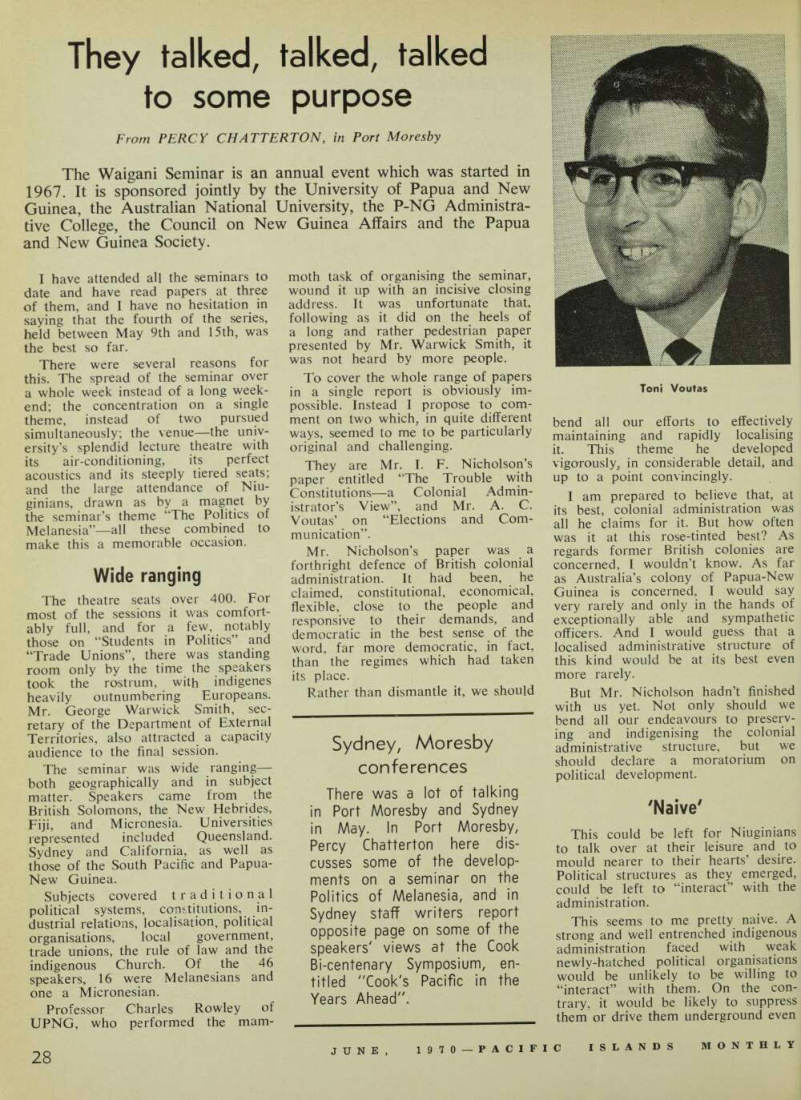
Toni Voutas
more ruthlessly than colonial admin istrations have done.
Perhaps one of the weaknesses of the new nations which have grown out of the old colonies has been that their leaders have often graduated too suddenly from colonial calaboose to presidential palace.
It seems to me to be essential that indigenous administrative and political structures should be developed simultaneously, so that, when the time for interaction comes, they will interact on terms of equality, and modify each other, bringing both structures nearer to their hearts’ desires.
By and large, then, I find myself unable to enthuse over Mr. Nichol son’s blue-print for Paradisea.
Nevertheless his paper was valuable both in challenging some of our as sumptions, and in warning us of the danger of lightheartedly throw ing out the baby with the bath water.
Tony Voutas’ paper resembled Nicholson’s only in that it grew out of his personal experiences. It gave a detailed down-to-earth account of his election campaigns, first in the Kaindi by-election of 1966, which he won with a clear majority over he combined scores of his opponents, md second in the 1968 general elec ions, when he defeated a very •edoubtable opponent indeed, former speaker Home Niall, for the Morobe Regional seat.
Vote Toni
His account of his use of badges >earing the single word TONl—more ncisive, he explained, than “Vote 1) Antony Constantine Voutas”; of lis use of village agents who came o be known as Toni komitis; and of lis massive feat of foot-slogging from illage to village; these laid bare the jass-roots of Niuginian politics.
He used more sophisticated lethods too, sending tape-recorded ranslations of his policy speech into rcal vernaculars ahead of him before rnving in person to deliver his lessage. And letters passed to and ro between him and those of his omitis who were literate in pidgin.
He came to some rather wry con lusions.
A young and inexperienced but thletic candidate could beat an older ne who might make a better mem er, merely by performing the □ysical feat of visiting every illage in person. Many of the voters nderstood the exercise so little that icy did not even realise that only ne of the candidates offering could ;come their member.
Messages were only understood
when they were extremely simple, and even then their contents often became garbled in transmission. On the other hand the ritual of com munication—the playing of tape recordings, the personally delivered speeches and the sending and receiv ing of letters—had significance and value, whether the contents were understood or not, and had the effect of welding a personal bond between candidate and voter.
As a sitting member, “Toni” has come to some further conclusions.
In all but the most sophisticated electorates, voters expect far more from their members than the latter can possibly hope to achieve. When they fail to deliver the goods they are liable to be regarded as failures, and risk rejection at the next election.
Postpone elections
Regular observance of the ritual of communication during the four years of the member’s incumbency can partially retrieve his position, and party-backing can help. At present the Papua and New Guinea Act ensures four yearly elections; but after independence a situation could arise in which the politicians would seek to stay in power by postponing or even abolishing elections.
“Without effective communica tions,” he concludes sombrely, “elec tions will disappear”.
If none of the other papers read at this seminar, including my own, is published, I hope that this one will be. It should be required reading for all political theorists.
Thank you, Professor Rowley, for Waigani 4. Roll on Waigani 5.
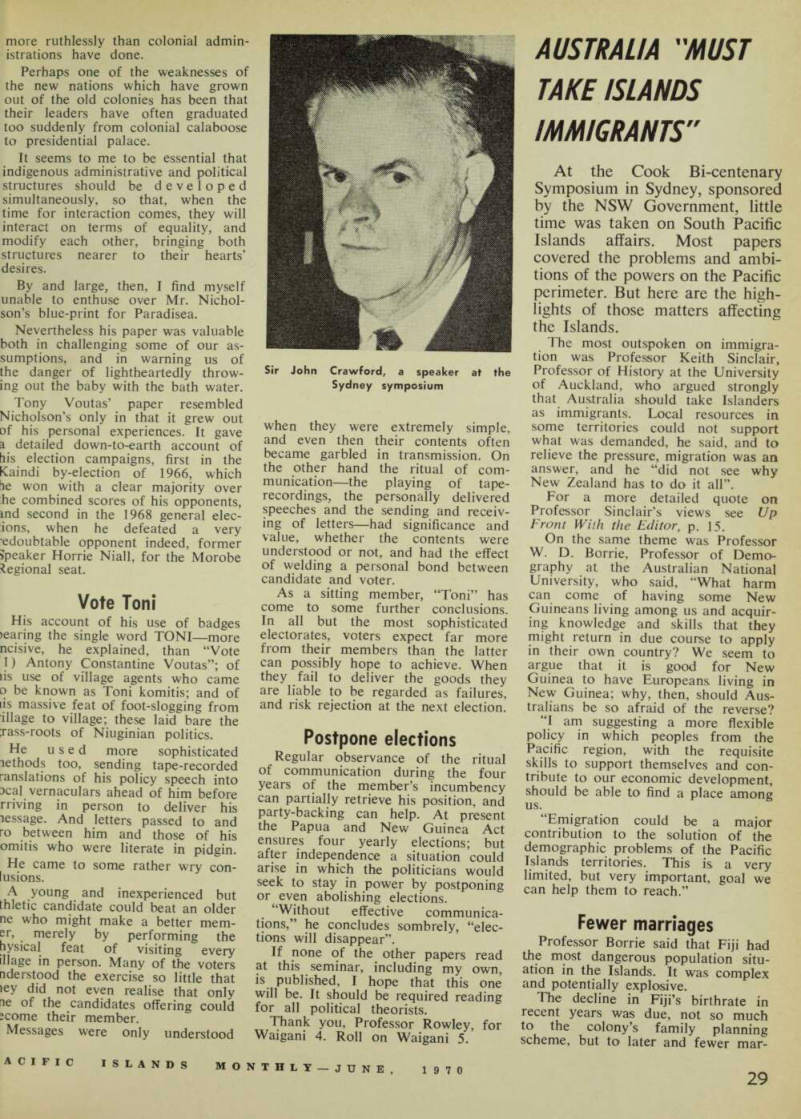
Sir John Crawford, a speaker at the Sydney symposium