Tropicalities
pp. 35-37 · Read in the full issue
The New Caledonian championship matrimonial acceptances are now open. Local newspapers state that Mr. Joseph Marsifi, a young Italian bachelor living for some years now in New Caledonia, has inherited from an uncle in America SUSI 7 million.
The uncle, Nicolas Marsifi, immigrated from Italy to the US in 1905. He worked as a miner, later joining the Chicago police force, from which he retired in 1955 as an Inspector.
He died in January at the age of 96. A widower early in life he never re-married and left no children.
His nephew had kept in touch with his uncle over many years but was quite surprised to find that he had inherited two big buildings and a personal residence, estimated by the internal revenue bureau at SUSI 7 million. Death duties came to about SUS 4 million which seems a very modest sum for such a fortune.
Unless a mistake has occurred in figures quoted, Inspector Nicolas Marsifi was still in harness in the Chicago police force at the age of 81. Even for Chicago police that seems stretching things a little.
The lucky heir confided to Noumea’s Bulletin du Commerce that he had received many requests for loans and even more requests for marriage. He intends ultimately to return to Italy. The fabulous “oncle from America”, has always been a dominant figure in European light literature.
Pot shot could
change the law
It’s still true in most of the United States that a man can “tote” a gun if he’s old enough to walk on two legs. The habit spread to American but a recent shooting may lave changed that. A cannery official vho got a .22 bullet in his shoulder hiring a recent jaunt near Satala Cemetery may be the unsung hero if future anti-gun legislators.
He stopped his car when a stray lullet hit him, made an effort to find vhere the bullet had come from and hen was driven to hospital.
The innocent-looking young iamoan who was picked up later yith a .22 calibre rifle in his posses ion, protested that he had purchased
An American
"Oncle" Leaves
Susi 7 Million
the lethal weapon earlier in the day, gone for a walk and was testing it by firing it across the bay.
Walter Friday is the man who collected the bullet in his shoulder.
Governor John Haydon has now stated he is considering an educational programme on the use of weapons and possibly will move to legally restrict the use of firearms.
Still, if the States are anything to go by, there could be a great deal of pressure placed on American Samoa’s legislature to keep the purchase of unlicensed and uncontrolled.
That’s the way manufacturers and retailers like it.
'Down the hatch' at
five cents a time!
“Champagnes, five cents, whisky tots, five cents, fluted beer tankards, 10 cents, heavy-based tumblers, five cents, straight-sided liqueurs, five cents. All glasses are etched with the insignia of the RAF”.
Such are the latest specials of the Gilbert and Ellice Islands’ biggest retailer, the Wholesale Society. The WS says the glasses, which should start appearing at Tarawa’s inevi table dinner parties in coming months, are “RAF surplus stocks from Christmas Island”.
Government hopes are the glasses will be used for consuming imported Aussie beer, and not the locally brewed potent sour toddy.
For cat lovers
So many people have asked us about the owner of that cat we featured on p. 40 of last month’s PIM, we feel bound to tell you. It’s Margaret Talbot, private secretary to Jean Brock, the Qantas man in New Cale donia,
Fruit salad export
for Tonga!
Tonga hopes that an exotic fruit originally from Mexico may turn out to be a money-spinner for Tonga.
King Taufa’ahau sees the “fruit salad plant” {Monster a deliciosa ) as a potential export for the country.
The plant has been bearing fruit in the royal palace and is said to thrive well against walls or fences.
It owes its delightful name to its taste when ripe. King Taufa’ahau believes the fruit was first brought to Tonga from Queensland, but it came originally from Mexico. It is familiar in Australia, growing in suburban backyards.
King Taufa’ahau, who, according to the Tongan Chronicle, also be lieves the local rock melon could be exported, says that the economy at present is too dependent on one or two crops, and plants such as these could provide valuable diversifi cation.
Watch out when you
say, 'thank-you'
Local Islands newsletters often delve with glee into the derivation of some of the more obscure phrases of their languages. The Niue newssheet for instance recently published an item suggesting an ingenious deriva tion for the Niuean expression, oue tulou (thank-you ).
The newssheet holds that “the Niuean fate in the early days of European settlement was of very small structure and the doors were narrow. Quite often when a Euro pean missionary entered, he ex claimed, ‘Oh, too low’. The host who did not understand English straightway thought that the words said meant, ‘thank-you’. So from that time up to now the word oue tulou was created.”
The newsletter’s account was fol lowed up by a (perhaps tongue-in cheek) reply from a local, with what he claimed was “the true story”.
“When the palagi (Europeans) came to Niue they convinced the people to work for them and get paid for it,” he wrote. “These poor chaps sweated in the hot sun all day and dreamed of the money they would get “When pay day came, the people lined up for their pay. As each one got his share, he looked at it and murmured, ‘Oh, too low’. It was the palagi who thought they were saying, ‘thank-you’, not the other way round.”
Tiny's yarns keep
the evenings short
After a lifetime working in the Pacific one great problem for the European is finding a place to retire, find comrades and live if not in the Pacific, at least close to it. There’s at least a dozen old Pacific hands in the War Veterans’ Home in Collaroy Plateau, Sydney, and king yam teller there is a lively 89-year-old six-footer called Simeon “Tiny” Lord.
Tiny administered justice in Fiji half a century ago. Now he finds himself one of 500 in the home— everyone of them likes to hear his tales of Fiji in the “old days”.
Tiny, he’s well over 6 ft and 200 lb, claims fifth generation ancestry as an Australian (the first Lord came with the First Fleet to Botany Bay), but you wouldn’t think so to hear his booming English accent cutting across the smoke-room.
He went to Fiji in 1902 and spent his first 10 years employed by CSR.
He then joined the government and after a short while became a magistrate.
He says he remembers when Japanese were indentured labourers on the sugar plantations. A good many died of beri-beri, he recalls.
Before becoming a magistrate Tiny worked in the Fiji emigration depart ment. It was there that he had an adventure that veterans at the home love to hear. In his own words: “There was this renegade, Apolosi, who threatened —there’s always one —to wipe out all the whites and drive them out of Fiji. When he heard we were coming after him he went to the Yasawas and when we arrived he was waiting for us with about 500 men.
“I was with a police inspector, Scotty Young, and some native policemen, but we were unarmed.
Scotty went towards Apolosi to serve him a warrant for his arrest when out of the blue his brother appeared and put his fist right through the warrant.
“Scotty was a fiery chap and he wanted to go in and take Apolosi.
I talked him out of it so we started to go back to the boat. We jumped in and got away and put in a tele phone call for reinforcements. I told him if we had gone in and someone had got hurt, we would be blamed for it no matter whose fault it was.
Anyway the reinforcements came and Apolosi as it happens surrendered without a fight. I think he got seven years.”
At the time of this story our PIM reporter was joined by two other old
Pacific hands—Doug Askew, with nearly half a century of service (mostly in the timber trade) in New Guinea and the Hebrides behind him, and George Ward, a resident of Vila for 15 years, most of them spent working for Burns Philp.
Between them (with another veteran. “Tiger” Goddard, late of New Guinea, not far awav) and us, we had Tiny really warming up.
Although Tiny was a white man living in Fiji at the turn of the century, his sympathies were tar from always on the side of the Europeans.
One European, he told us, brought before him for passing dud cheques, was given the option of a stiff fine or three months gaol.
“The fellow decided to take the fine,” said Tinv, “He looked at me and said. ‘Would you accept a cheque?’ I gave him gaol and almost slapped a contempt sentence on as well.”
Tiny wasn’t too fond of the local missionaries. “I was always in trouble trying to break down what I considered fences between the people of Fiji,” he said. “One time I got fed up with the missionaries who used to post themselves at every corner to my courthouse and try and “induce” the natives into giving them money.
“Finally I got my chief clerk to call them in. I told them they
couldn’t collect money within the courts. There was a hell of a row and I refused to stand down. So the chief missionary went straight up to the then Governor, Sir Ernest Bick ham Sweet Escort.
“The Governor and I didn’t really see eye to eye on this issue, I could tell that. In fact he said he was going to send a dispatch to the Secretary of State in England about this—and if it went against me I was in for the high jump.
“Anyway, he sent for me some time later and told me that the return dispatch supported my decision. But I can assure you I wasn’t very popular after that.”
Tiny, Doug, George and Tiger and a dozen more Pacific hands, find nothing better than whiling away the drizzly Sydney winter evenings like this —especially if there’s a bottle of rum about.
As Tiny says, “Kava’s very good for paralysing the legs, but there’s nothing like rum for doing the same thing to your head!”
Crime down in
West Samoa
While most of the Pacific, along with the rest of the world, seems to be plagued with increased crime and juvenile delinquency, the trend in Western Samoa appears to be towards greater peace and harmony. Statistics for the last three years show a significant decrease in most classes of crime.
Cases reported of various crimes over the past three years are as follows:
Murders were up from two each in ’67 and ’6B to six last year. Five of these killings were the result of incidents.
Police Commissioner A. L. Philipp said that the improvement in the number of cases was particularly pleasing in view of the rapid in crease of population, now estimated at about 146,000. It was also note worthy that Western Samoa had a very low ration of police per head
of population.
Western Samoa has one policeman to very 1,160 of the population. This compares to one to 950 in New Zea land, and roughly one to 400 in
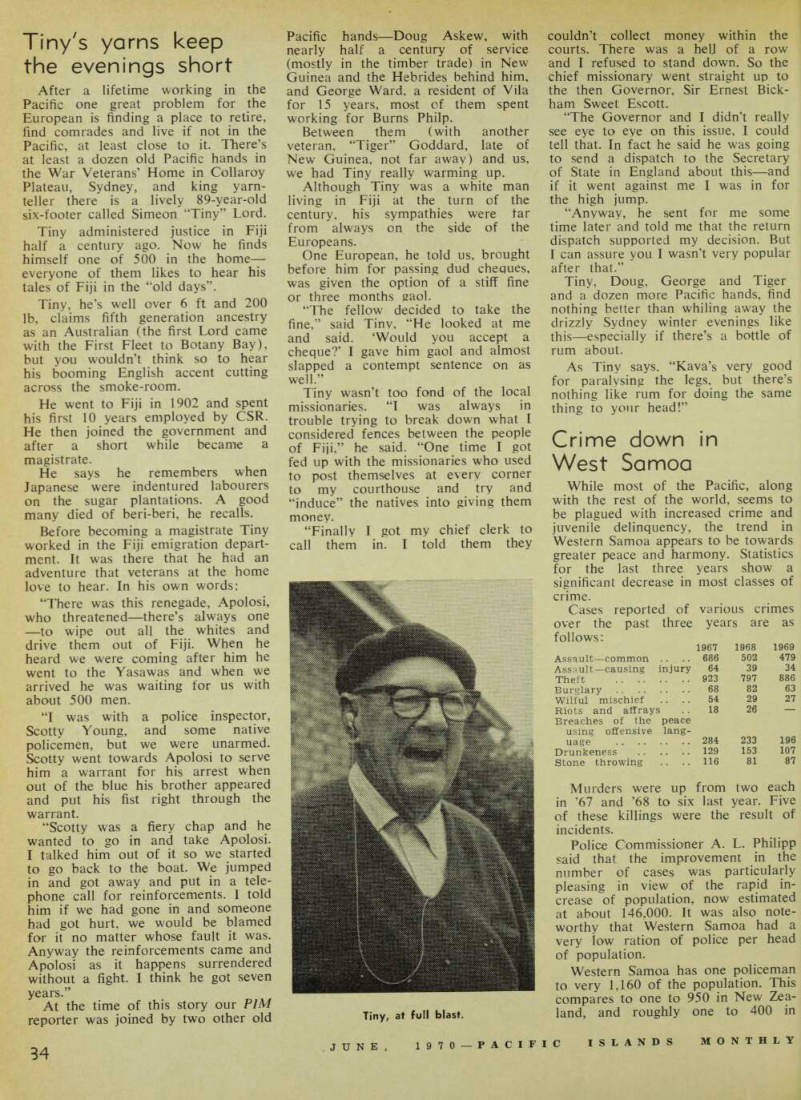
Tiny, at full blast.
1967 1968 1969 Assault—common .. .. 686 502 479 Assault—causing injury 64 39 34 Theft 923 797 886 Burglary 68 82 63 Wilful mischief ... 54 29 27 Riots and affrays 18 26 — Breaches of the peace using offensive language 284 233 196 Drunkeness 129 153 107 Stone throwing .. .. 116 81 87
American Samoa and one to 600 in Fiji.
He said that the drinking of home brew was the main cause of all serious trouble in Western Samoa.
“The three main factors behind the improvement are the increased quantity of locally grown foodstuffs, a better educated younger generation, and the strict control in the villages of the matoi, coupled with a strong influence of the churches,” said Commissioner Philipp.
He added that the police supported the Samoan social system as much as possible as a help in maintaining law and order. “The story of fading matai influence in the villages is a myth,” he said.
The oldest game
in the world!
For one-day cruise ship callers at Suva and Nukualofa there’s more for sale than dozens of tapa mats and handicrafts, at least according to a 26-year-old Sydney man.
The young man says that, without provocation, he was propositioned 10 times in these ports, by Fijians, part-Europeans and Tongans, vary ing from young boys to middle-aged women.
The question was either; “Want a lady?” or “Got a girl?”.
Venues were outside Suva shops, in the bar of a multi-million dollar resort just outside Suva, in a Suva nightclub, at villages around Tonga tapu and in the backstreets of Nukualofa township, within 200 yards of the royal palace.
“My ship, the Orcades, also called at Noumea, but women didn’t seem to be for sale there,” he said. “We
were warned on ship, Noumea residents weren’t friendly and told not to walk alone at night. However, I talked to several Noumeans and found this advice hogwash.
“I avoided all guided tours and the main tourist spots in Suva and Nukualofa because I wanted to see as much of local life as I could.
Perhaps I could have been mistaken by locals as a crewman rather than a tourist.”
Above the
call of duty
A series of aircraft diversions— not by highjackers, but by mercy flight operators—have hit New Cale donian headlines recently.
The first of this series of urgent medical evacuations was made by PanAm, when it diverted a San Francisco-Sydney flight to Noumea to pick up a critically injured child in March. The 10-year-old boy, Pascal Lemaire, suffered head injuries after falling from a basketball pole he had been climbing. Through the rapid intervention of the American airline, he was flown to Sydney for treat ment.
Shortly afterwards, a Qantas plane was held on the tarmac at Tontouta airport while an Air Caledonie plane flew up a dangerously ill woman from Noumea.
In a third incident in early May, a Qantas plane was. diverted on a US- Sydney flight, to pick up a five-day old baby in a critical condition from birth, and to fly him to Sydney.
One airline was reported, in the Caledonian newspapers, as saying it was planning to have a red cross painted on its wings!
Hair cutting for
cash on Niue
Niue’s newssheet, Tohi Tala Niue, reports the largest haircutting feast for a decade on Niue, at which 28 pigs, two sheep, 2,350 taros and two chickens were consumed at the women’s club hall in Alofi south.
As well as the above fare, at Mr. and Mrs. Swan Jessop’s feast, tables were piled with cakes, sandwiches, tinned fruits, ice-cream and “morning tea for all the guests”. The feast celebrated the cutting of the hair of their son for the first time.
Haircutting ceremonial feasts are common on the island, although not of that size. The feast is believed to be an introduced custom. When a son is born, the parents may decide to save the boy’s hair until he is five or six years old, when they will prepare a feast. The newsletter ex plains: “Relatives and friends are invited to come and cut the boy’s hair at the feast and also to bring gifts. The boy’s hair is usually cut by two or three specially invited guests, who customarily bring the biggest gifts of money. A pastor is also invited to bless the occasion and speeches are made by the parents and any members of the guests or relatives.
“A f ter the boy’s hair is cut, the food is divided in proportion to the amount of gifts or money each guest gives. The amounts of the gifts and money received are announced before guests disperse with their share of the food. The money received is normally banked under trust in the son’s name at the post office for him and his family’s needs in the future.”