7,000 Say Welcome Back The Samoan Way
pp. 30-31 · Read in the full issue
“This is beautiful. It was kinda’ cold up there for a while”—that’s what Apollo 13 astronaut, Fred Haise, told 7,000 wildly enthusiastic American Samoans when, with the two other astronauts, James Lovell and John Swigert, he arrived at Tafuna Airport after successfully returning from space on April 19.
The space mission—which would have been the third moon landing— was not successful, but the three astronauts looked well after having to turn their spacecraft back after a mystery explosion. The dramatic splashdown came 625 miles from Samoa. The US rescue ship Iwo Jima collected the astronauts and three naval helicopters whisked them to Tafuna Airport at 8.30 a.m.
Commander of the mission James Lovell, told the crowd, “There were times when we thought we would never get back”, and John Swigert told them that the most beautiful sight he saw was the earth getting bigger and bigger as they came back.
Fighting a losing battle against the whir of the helicopter blades, a choir of Samoans sang a traditional song of welcome. They gave the three Americans shell necklaces and the Governor, John Haydon, form ally welcomed them home, together with a line-up of top Samoan chiefs.
The astronauts smiled broadly at a welcome banner showing the stars
and stripes on the background of a huge yellow moon and bearing the names of Neil Armstrong and Buzz Aldrin, first men on the moon.
Another laugh came when two American Samoans introduced them selves wearing silver space suits be side the banner.
Governor Haydon told the astro nauts: “I just haven’t got the words to express what the people feel after all this worrying and waiting. We
really are glad to have you home safely to the very solid earth of American Samoa.”
He followed up this speech with the biggest laugh of the day. He handed John Swigert his 1969-70 income tax form, which Swigert had forgotten to fill out before leaving.
Governor Haydon said he believed Swigert had been worried for days about it. He added: “You can fill this up during the flight to Honolulu.
Perhaps you can give it to President Nixon to initial for you.”
Government Information Officer Ed Engledow and visiting Australian AAP reporter Jim Shrimpton had thought up the joke at a party the previous evening, and the Governor had happily gone along with it.
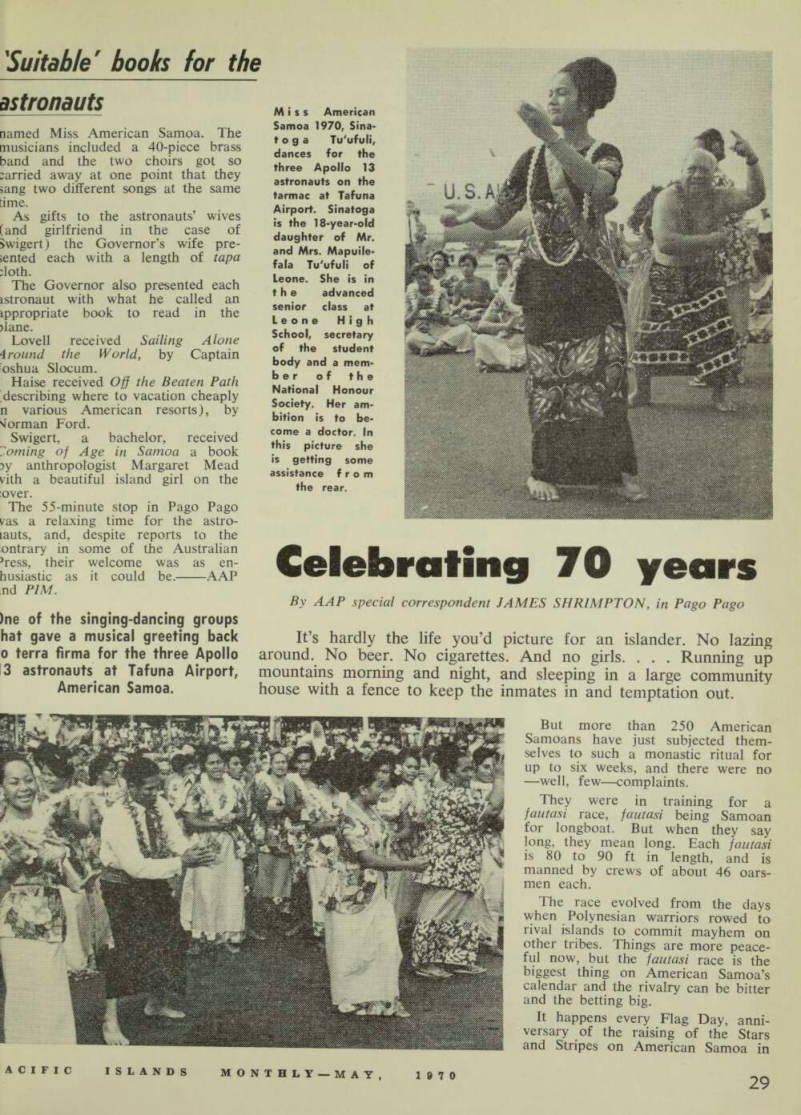
After the speechmaking, the three astronauts stood on a dais and watched a half-hour of singing and dancing by the Samoans. One, a hula, sung and expressed with the hands the adventures of the astro nauts. One of the dancers was 18year-old Sinatoga Tu’ufuli, just
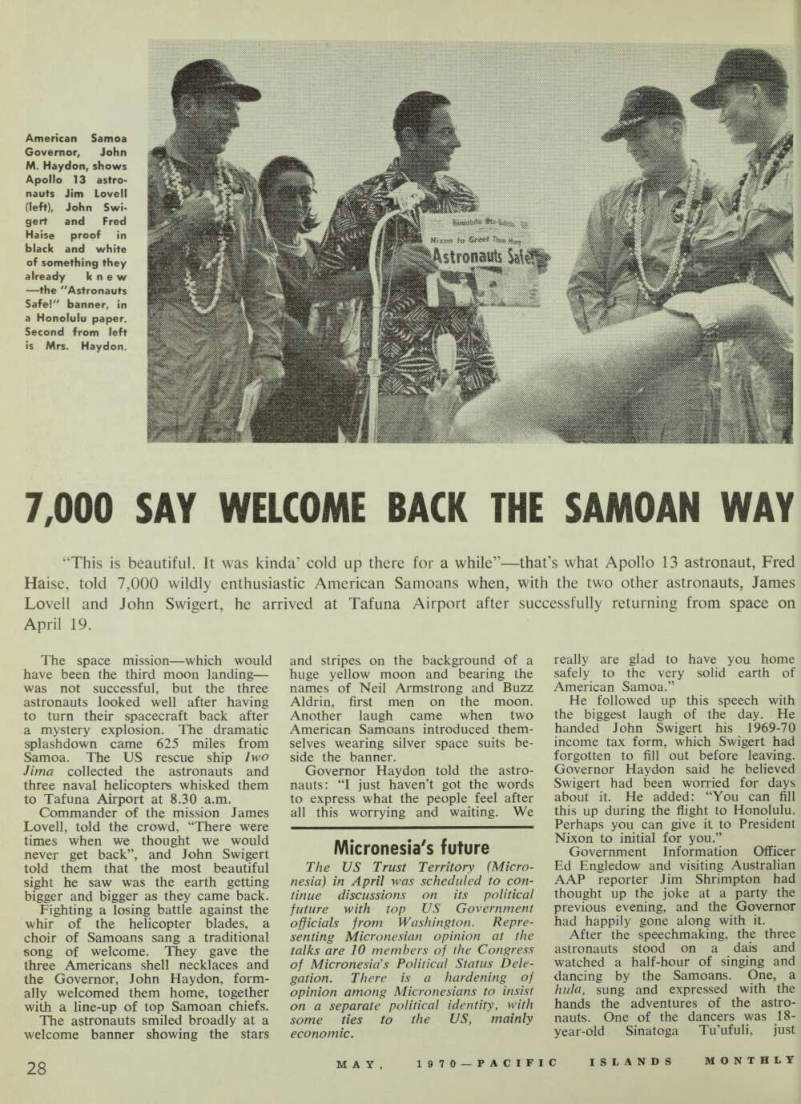
American Samoa Governor, John M. Haydon, shows Apollo 13 astro nauts Jim Lovell (left), John Swi gert and Fred Haise proof in black and white of something they
already knew
—the "Astronauts Safe!" banner, in a Honolulu paper.
Second from left is Mrs. Haydon.
books for the astronauts
named Miss American Samoa. The musicians included a 40-piece brass band and the two choirs got so carried away at one point that they sang two different songs at the same time.
As gifts to the astronauts’ wives (and girlfriend in the case of Swigert) the Governor’s wife pre sented each with a length of tapa doth.
The Governor also presented each istronaut with what he called an ippropriate book to read in the )lane.
Lovell received Sailing Alone Around the World, by Captain oshua Slocum.
Haise received Off the Beaten Path i describing where to vacation cheaply n various American resorts), by si or man Ford.
Swigert, a bachelor, received doming of Age in Samoa a book >y anthropologist Margaret Mead vith a beautiful island girl on the ;over.
The 55-minute stop in Pago Pago yas a relaxing time for the astro tauts, and, despite reports to the ontrary in some of the Australian ’ress, their welcome was as en husiastic as it could be. AAP nd PIM.