independence
p. 29 · Read in the full issue
Fiji hammers out its independence
From a Suva correspondent
Fiji’s constitutional conference, with delegates seated in red eather chairs under the glistening lights of three massive chandeliers, ?egan in the palatial conference room of London’s historic Marl borough House on April 20. Present were the Governor of Fiji, all 10 members of Fiji’s Legislative Council, and numerous British and 7 iji high officials.
The conference’s three principals, „ord Shepherd, British Minister of hate for Foreign and Commonwealth kffairs, Fiji’s Chief Minister, Ratu >ir Kamisese Mara, and the leader )f Fiji’s Opposition, Mr. S. M. Koya, lelivered opening speeches.
Mr. L. G. Usher (Mayor of Suva md editor of The Fiji Times) was jffered permission to go in as an ‘observer”, but declined when he earned that Lord Shepherd insisted hat all observers must give a pledge hat they would divulge nothing of inference proceedings except with jfficial permission.
Most of the details of the con titution had been settled at dis mssions in Suva with Lord Shepherd ;arly this year. Two vital points still nitstanding, however, were the nature md shape of the new legislature, md the electoral system on which it vould be based.
The Federation demanded the :ommon roll. The Alliance insisted hat the present system of communal oils and cross-voting continue.
The delegation had before it a iroposal for two houses of parlia nent; a lower house comprising 50 dected members, of whom 11 Fijians md 11 Indians would be elected on :ommunal rolls and 10 each by cross noting. Three other “general” candi iates would be elected from a com nunal roll and five by cross-voting. 3f the upper house, it was suggested dght members of a proposed 21 be lominated by the Fiji Council of
Chiefs, seven by the Fiji Prime Minister, five by the Leader of the Opposition and one by the Rotumans.
It was hoped that there could be a compromise and that final agree ment would be reached in London by April 24.
But it was soon apparent, that agreement wasn’t easy to reach, and the talks continued into early May.
Then came an announcement that the lower house will comprise 52 members—with 12 Indians and 12 Fijians, instead of 11, being elected on communal rolls.
No easy agreement
This will be an interim solution, and a Royal Commission on the electoral system will be set up after the next general election.
Later, came the most important news of all—that Fiji will attain complete independence within the Commonwealth on October 10. A formal announcement is awaited as this issue of PIM goes to press.
In between occasional stilted an nouncements, Fiji was not given any official information about what went on at these vital talks. The Fiji public expressed increasing resent ment at the “Shepherd blackout”.
Fortunately, Usher, and Matt Wilson (chief reporter of The Fiji Times), penetrated officialdom’s wall of silence; and this newspaper was able to let the people know
something of what was going on in the conference.
Commentators pointed out that it was obviously wrong that Fiji’s repre sentatives at this “constitutional con ference” should be only the members of the Legislative Council. Con stitutional issues of the kind under discussion, which will shape the long term future of an independent Fiji, were not predominant factors in the last Legislative Council election.
Consequently, the electors of Fiji never have had an opportunity of saying precisely what kind of con stitution they want.
The present constitution was shaped, under bitter stress, at a London conference in 1965, and much has happened since then.
Commentators say that Fiji delegates to this 1970 conference should have been elected at a convention in Fiji, called specially to deal with con stitutional issues.
One important point that emerged from the conference was an indica tion by Britain that an independent Fiji could not expect to receive generous free grants of developmental funds, as in the past. “A colony gets grants, but an independent country gets interest-bearing loans”, was how one official phrased it.
The Fiji delegates, obviously shaken, brought this matter up for further discussion. Matt Wilson, telegraphing The Fiji Times, said that Britain had given an undertaking that it would continue financial aid to Fiji, “for the time being, at least”. • See "Background to Fiji", p. 57.
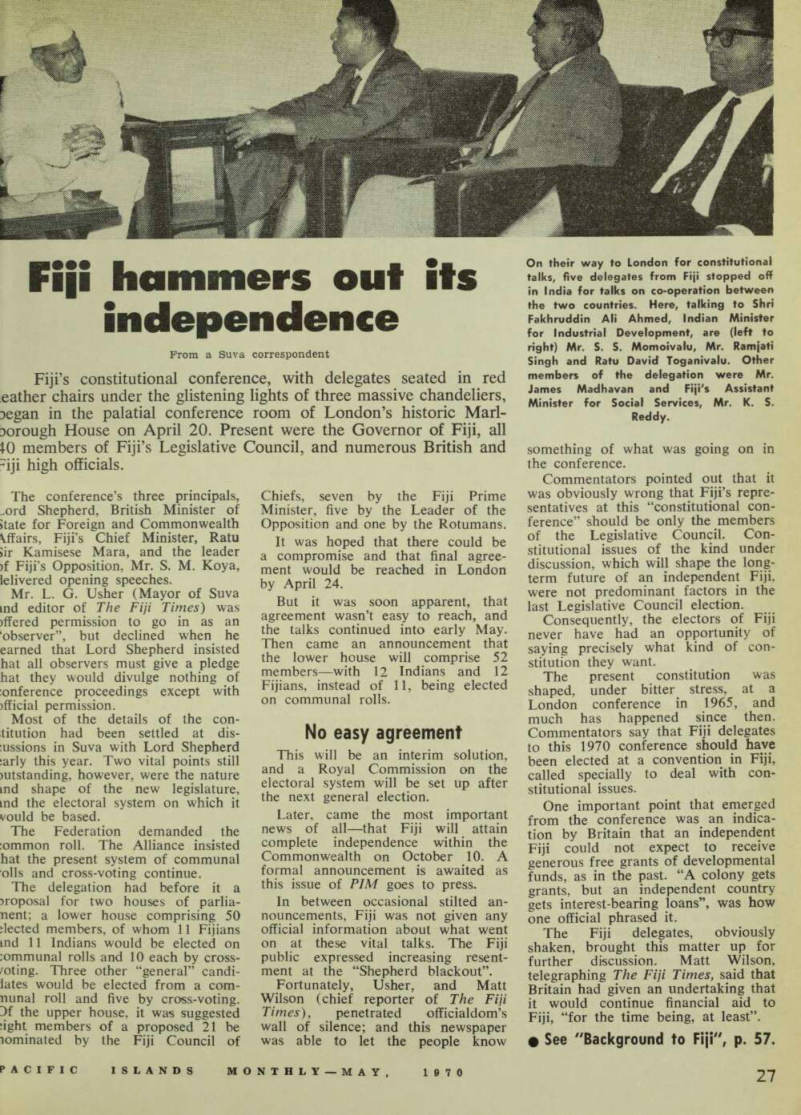
On their way to London for constitutional talks, five delegates from Fiji stopped off in India for talks on co-operation between the two countries. Here, talking to Shri Fakhruddin Ali Ahmed, Indian Minister for Industrial Development, are (left to right) Mr. S. S. Momoivalu, Mr. Ramjati Singh and Ratu David Toganivalu. Other members of the delegation were Mr.
James Madhavan and Fiji's Assistant Minister for Social Services, Mr. K. S.
Reddy.