Monthly
Pacific Islands
Registered at G.P.0., Sydney, for transmission by post as a newspaper.
May, 1970
News Magazine Of The South Pacific
• AUSTRALIA, 40c. • NEW ZEALAND, 45c. • U.S. PACIFIC TERRITORIES, 70c. • FRENCH PACIFIC ISLANDS. 65 FRCS. CFP. * P-NG FIJI AMD All otufb
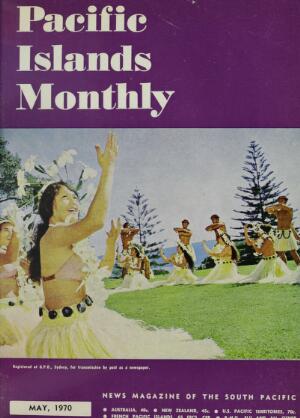
Our Cover
The Cook Islands made a colourful splash in Sydney in April, when members of the Cook Islands National Theatre staged Islands dances. Later the group went on tour of New South Wales country towns, and Brisbane. Air New Zealand, which helped the islanders get to Australia, captured them for our cover picture in a little “off duty" display. For a story and more pictures, see p. 53.
Advertisements & other items, pp. 2-16 (8 items)
TA As got you
covered
mi lw i m Ai All the way from Port Moresby to Lae, Madang, Rabaul, Goroka, Mt. Hagen fifty centres in all. The best connections in the Territory More coverage of Papua/New Guinea, flying air-conditioned twin prop-jets, than any other major airline. Plus the best connections to Australia flying 'Bird of Paradise’ T-Jets. More comfort, more flights, more places. That’s why more people fly TAA Contact your Travel Agent or TAA: Port Moresby 2101.
Lae 2311. Madang 2478. Rabaul 2567. Goroka 8. Mt. Hagen 4 or 301. Wewak 103.
TAA NoJ -the friendly one
919 2267/69
the pacific
HJI,SAMOA,TONGA,NIUE IS.NORFOIK Is.
BURNS PHILP
(SOOTH SEA] CO. LTD.
REGISTERED OFFICE: SUVA, FW
TELEPHONE NO: 22661
TELEX NO: FJ1127
Code Address: "BURNSOUTH'
SHIPPING AGENCIES
The New Zealand Shipping Co. Ltd.
Shaw Savill & Albion Co. Ltd.
Blue Star Port Line (Management) Ltd.
Bank Line Ltd.
General Steamship Corporation Ltd.
Compagnie des Messageries Maritimes Royal Interocean Lines Daiwa Navigation Company Ltd.
Sitmar Line Flotta Lauro (Lauro Lines) Australasia Pty. Ltd.
Tonga Shipping Agency.
EXCLUSIVE
DISTRIBUTORSHIPS
INCLUDE
Akai Taperecorders Dunlop Products Hitachi Electronics Holden Motor Vehicles Rolex Watches Revlon Cosmetics Pentax Cameras Ferguson Tractors Olympic Tyres Penfold Wines
AGENTS FOR
Queensland Insurance Co. Ltd.
Burns Philp Trustee Co. Ltd.
Shell Company (P. 1.) Ltd.
Bureau Veritas
ASSOCIATED COMPANIES
Burns Philp (New Hebrides) Ltd.
Automotive Supplies Co. Ltd.
Corrie & Co. Ltd.
Wrought Iron and Steel Construction Co. Ltd.
Bish Ltd.
SPECIALISED SERVICES
Expert advice on Shipping; Forwarding; Customs formalities; Insurance.
COMPLETE TRAVEL
SERVICE
accredited agents for the
INTERNATIONAL AIR
TRANSPORT ASSOCIATION
OVERSEAS AGENTS: SYDNEY* LONDON • SAN FRANCISCO
great bunch
of floors.
Robert Hutchinson makes the greatest bunch of flours in the Pacific. Bakers’ flour.
Superlite cake and sponge flours.
Biscuit flour and cracker flour.
Wheaten sharps and wheaten meal.
We’re particularly proud of our bunch of flours. So we have a technical advisory service to help you use them properly.
So next time you see a Robert Hutchinson flour (or even one of our Hutmill stock feeds), remember it’s just one of the bunch BM m % m
ROBERT
HUTCHINSON
LIMITED
the flour people
Hartington Street, Glenroy, Victoria, Australia. 3046. Telephone Melbourne 306 7261 «mo«
Australian building
materials go everywhere
What's in Australia for you? Some of the best building materials in the world. Last year, Australia spent over $A 2,000,000,000 (SUS 2,220,000,000) building skyscrapers, apartments, factories and homes. Australian building materials cover everything from hardboards to louvres, floor coverings to cement. All manufactured to the most modern standards. This is the year to look to Australia for building materials and fittings for homes, apartments and skyscrapers, competitively priced and available by fast, frequent sea and air services.
Auitralian Department o( Trade and Industry.
what’s in
Australia
for you ?
Find out today. All you have to do is contact the Australian Government Trade Commissioner who will put you in touch with suppliers of Australian products: A.N.Z. Bank Building, Cnr.
Pitt and Hunter Sts., SYDNEY. N.S.W. 2000.
Australia. Tel : 2 0372
LH/PC/BU/St7
world
quality
m m m m '/H m Y v M J 5* 1 f 1
one
Only the world’s finest Virginia tobaccos are blended to produce ...
PLAYER’S
GOLD
LEAF
of the gjmt cigarettes
8593/2/70
AV CONTENTS 50 MADE IN AUSTRALIA
Brymay Waterproof maters
Greenlites
mm
Bright new label
and still the only matches in
the world that light when wet.
Greenlites are made for your part of the world.
They’re tropical matches —waterproof matches.
Ask for them.
MADE IN AUSTRALIA BY BRYANT & MAY
SOME OF THE FIRMS
WE REPRESENT ARE:
A. W. Allens (Confectionery) Sunshine Biscuits Sunrise (Confectionery) Flamenco (Instant Coffee) Cremota (Quaker Oats, Jets Pet Foods) Merchants (Canned Soft Drinks) Lunchtime (Honey) South Pacific Canneries (Scallops, Aba lone) Safcol (Canned Tuna, Salmon) Hancock's (Spaghetti, Cereals) Melbourne Canning (Jams, Bleach) Water Wheel (Flour, Sharps, Wheat) General Food Corporation (Twisties, Twirlies) Edward Zorn (Margarine, Cooking Fats) Robert Timms (New Guinea Gold Coffees, Teas) Rodd (Cutlery) Nylon Palm (Mattresses) Esteel (Cookware) Vendolux (Cafe Bars) Mitchell's (Abrasives) Regent (Swiss Watches) Gainsborough (Furniture) Tamco (Melanie Crockery, Hardware) Elmaco (Plastic Household Goods, Electrical Fittings) Brownbuilt (Pre-Fabricated Houses) Ryline (Fluorescent Lights) Jex (Steel Wool) Austramax (Pressure Lamps) Preservene (Soap Products) Charles Tims (School Requisites) Ascow and Philadelphian (Shirts) Lawn Chair and Tubco (Garden Furniture) Sunrise Lustretone (S.S. Sinks, Plumbers' Supplies) Electronic Industries (Electrical Household Appliances)
S. E. TATHAM
& Co. Pty. Ltd.
MELBOURNE, AUSTRALIA
G.P.O. Box 8, Cables “SET”
Telephone 60-1125
EXPORT AGENTS
PACIFIC ISLANDS
AGENTS
Australian buying and shipping agents for the Gilbert and Ellice Islands Colony Wholesale Society ■ i
DIRECT ENQUIRIES WELCOMED
Associate Company
S. E. TATHAM (FIJI) LTD.
Suva, G.P.O. Box 671.
Lautoka, P.O. Box 366.
SINCI 1924
TRANSFER WITH AKAI!
Newest stereo sensation
Reel-to-reel transfer
—to Cartridge
—to Cassette
m % / * 3nly AKAI has been able to combine the )est stereo component features into one emarkable Instrument to bring you an >pen reel, cartridge and cassette tape reorder. AKAI's X-2000SD provides the easyo-operate transfer advantages of reel-toeel, reel to cartridge and reel to cassette. . Reel-to-reel—4 track stereo/monaural recordingand playback with AKAI's own unique CROSS-FIELD HEAD. (Also selector. Tape lifter.) . Cartridge—B track stereo recording and playback with a one-micron gap head. 1 hour continuous performance. Program indicator lamp.
Cassette—4 track stereo recording and playback with a one-micron gap head, panel, push-button controls, 1 hour continuous performance. Don't miss AKAI's once-in-a-lifetime exculusive tape recorder. »<i m m Model X2OOOSD Prove it by the sound! prove it with
AKAI
STRAUA: AKAI Australia Pty. Ltd., 276 Castlereagh St., Sydney. N.S.W. NEW ZEALAND; G. Glausiuss Coy. P.O. Box 640, Christchurch SUVA: Burns Philp (South Seal Ltd. LAUTOKA: Burns Philp (South Sea) Co.. Ltd, SAMOA: Burns Philp (South Sea) Co. Ltd., Pago Pago, American Samoa/Burns Philp (South Sea) Co., Ltd., la Western Samoa NORFOLK ISLANDS; Burns Philp (South Sea) Co., Ltd., Norfolk Island, South Pacific NEW HEBRIDES; Burns Philp (New Hebrides) Ltd Port Vila/ rns PMp (New Hebrides) Ltd., Santo NEW CALEDONIA: ‘Menard Freres”, P.O. Box 123, Noumea BRITISH SOLOMON ISLANDS: Mendana Enterprises (Solomon Island) laJ' 1 d iSU'rni J'. SJ ; P n H J URU: Nauru c °-° perative Society COOK ISLANDS: N.T. Napa (Avarua) Ltd., Rarotonga TAHITI: Ets. Comimpex., P.0.80x 200, peete PAPUA & NEW GUINEA: S.O. Svensson (N. 6.) Ltd., P.0.80x 705, Port Moresby TONGA: Burns Philp (South Sea) Co., Ltd., Nuku Alofa
When the best beer is called for, New Zealand’s favourite lager.
STEINLAGER
GENERAL
FOODS
...bring you the good things in life! tt. it
ICE CREAM
aTa
Good things like creamy smooth Tip Top ice cream. A whole range of flavours in take-home packs, in novelties, and in bulk. Tip Top another quality General Foods product.
Trade enquiries to General Foods Corporation (N.Z.) Ltd., P.O Box 722, Auckland, N.Z.
A 42
Cheezpop & Chickpop
mmmmm l|\l . mm
The happiest fun-foods
Cheezpop and Chickpop are great fun. Crisp . . . crackling . . . salty and flavoursome . . . pals to drinks . . . waken your palate . . . sharpen your taste for every frosty sip. Next party, snacktime or barbecue, nibble on Cheezpop or Chickpop. Or both.
They’re pop-pop-popping good fun.
For trade enquiries: Reckitt & Colman Pty. Ltd., Wharf Road, West Ryde, N.S.W., Australia. Cables: Reckitts, Sydney.
A RECKITT & COLMAN PRODUCT
H 81628
FUHUHO f FG 200 echosounder FRA 10 radar
Picking your way among
islands,reefs,and sea traffic?
FG 200
FRA 10
For further information please contact: Don't leave it to chance. Leave it to Furuno marine radars and echo sounders. Whether you pilot a fishing boat.pleasure boat.tug.or ferry, you need not leave navigation to chance. The precision Furuno Radar model FRA-10and the portable Furuno Echosounder model FG*2ooarethe ideal navigational aids for you!!
Why not take your chance with Furuno ?
Other main products: Radiotelephones, Loran Receivers, Fish Finders, Facsimile Receivers, Automatic Direction Finders, Sonars, etc.
0 FURUNO ELECTRIC 9 52,Ashihara-cho,Nishinomiya City,Japan.
CO., LTD. Cable: FURUNO NISHINOMIYA
Ideal for tropical conditioas
•• t • George and Ashton refrigerated fibreglass truck unit
DISTRIBUTORS
* BACON HAMS
* *SMAU6OODS
mainland 4
PRODUCTS LTD. u
uni l !
rj „>v These refrigerated truck units are fully approved by the New Zealand Departments of Health and Agriculture. They can be designed for use with any type of vehicle from pick-ups to semitrailers or they can be used as static storehouses using their own refrigerating units.
These units are made from moulded fibreglass tough, hygienic, colourful. There are no joints to harbour vermin and cleaning is guick, easy and efficient.
Enguiries welcomed.
GEORGE & ASHTON LTD.
P.o. Box 2056, Dunedin New Zealand Phone:42-779
FAST. BARGE
OUT OF DARWIN
-f ray ■ : s '.a.'
diesel powered
by CUMMINS*
the new 500-ton Fourcroy,
biggest modern barge built in Australia
Where Fourcroy operates, her engine's have got to be better than good.
Fully loaded with supplies, she makes more than 10 knots out of Darwin to Gove, Groote Eylandt, Weipa and other project areas to Australia's north—barging in strongly through shoals and shallows to land her cargo right on the beach.
Fourcroy's owners specified Cummins to ensure a tough, dependable engine for a tough, critical job—and because the full weight of Cummins' service is right there to back it.
Cummins parts and maintenance service reaches right round Australia's coastline and beyond, keeping every Cummins-powered workboat permanently and profitably on the job. * These fast, modern landing barges now opening up important new shipping lanes around Australia and New Guinea are 80% Cummins-powered.
DESIGNERS: Ekon & Doherty BUILDERS: Carrington Slipway OWNERS: Beagle Shipping Co.
POWER: Two Cummins Vl2-525-M diesels with two Cummins C-105-BIM 41.5KVA auxiliaries.
m - « m
TOYOTA MOTOR
DISTRIBUTORS: TERRITORY OF PAPUA & NEW GUINEA: ELA MOTORS LIMITED; Burns Philp House, Musgrave Street, Port Moresby, Papua / U.S. TRUST TERRITORY: MICROL CORPORATION: P.O. Box 234, Saipan, Mariana Islands, Trust Territory of the Pacific Islands / FIJI ISLAND: AUTOMOTIVE SUPPLIES CO., LTD., P.O. Box 143, Lautoka / AMERICAN SAMOA: BURNS PHILP (SOUTH SEA) CO., LTD., Pago Pago / WESTERN SAMOA: BURNS PHILP (SOUTH SEA) CO., LTD., Apia / GUAM: RICKY'S AUTO CO., P.O. Box 1458, Agana
(bur special island on the highway •••
TOYOTA CRO#N
- - C mm. m m m •ruise in comfort. In style.
In luxury you can afford.
Get behind the wheel of a Toyota Crown. Notice its new lower front grille. Its wall to wall carpeting. Its plush seats.
Its fresh air ventilation. Its gasoline economy. And, 115 engine horsepower, 3 or 4 gear shift and Toyoglide Automatic transmission, too. This is the Toyota Crown. A quality product by one of the six largest automobile manufacturers in the world. Test drive your special island soon.
■s> ■4 % h Is it:
Lunch size, snack size
SAO biscuits
are the right size!
Crisp, fresh Arnott’s Sac biscuits .. . right size to satisfy, right size for snack foods, too! Cheese for lunch? A big slice fits just right on Sao. So does a slice of ham or salami.
Prefer jam or spread? Or how about tomato? Simply serve with Sao —the right-size biscuit that makes all the crisp difference to lunches at home and at school or outof-doors. The triple-wrapped pack keens the biscuits crisp and fresh.
Qrnott's/® 0 ® Biscuits
There is no Substitute for Quality P 594
1
ACIFIC ISLANDS MONTHLY MAY, 1970
3
’ ACIFIC ISLANDS MONTHLY MAY, 1970
5
ACIFIC ISLANDS MONTHLY MAY. 1970
Acific Islands Monthly May, 1970
9
ACIFIC ISLANDS MONTHLY MAY, 1970
11
A C I F I C ISLANDS MONTHLY-MAY, 1970
13
’ACIFIC ISLANDS MONTHLY MAY, 1970
Pacific Islands
Monthly
Established 1930: 40th Year of Publication.
Owned And Published By
Pacific Publications (Aust.) Pty. Ltd.,
29 Alberta St., Sydney, N.S.W., 2000.
Postal Address: G.P.O. BOX 3408, SYDNEY,
N.S.W., 2001.
Telegraphic Address: PACPUB, Sydney.
Telephones: 61-9197, 61-7101, 61-4369.
Chief Executives: Managing Director: R. W. Robson.
Executive Director/Publisher; Judy Tudor.
Executive Director/Business Manager: Selwyn Hughes.
Executive Director/Chief Editor: Stuart Inder.
Pacific Islands Monthly
Editor: Stuart Inder.
Advertising Manager: W. A. Gasnier.
Branch Offices
Melbourne: Newspaper House, 247 Collins St., Victoria, 3000. Tel.; 63-7053.
Fiji: Pacific Publications (Fiji) Ltd., Fiji Times Building, 20 Gordon Street, Suva. Tel.: 25601.
Fiji Times Office, Vidilo Street, LAUTOKA.
Tel.: 60-422.
Papua-New Guinea: Pacific Publications (N.G.) Pty. Ltd. Representatives: PORT MORESBY. P.O.
Box 16; LAE, P.O. Box 227; RABAUL, Mr.
Steve Simpson, P.O. Box 433 (c/- Rabaul Photographic. Tel.: 2677).
Representatives
Queensland: Advertising—Beale Media Services, 232 St. Paul's Terrace, Fortitude Valley, Old., 4006. Tel.: 51-5827.
Hew Zealand: General.—J. D. Whitcombe, C.P.O.
Box 2229, Queen St., Auckland. Tel.: 456056.
Advertising.—John Bayldon, P.O. Box 366, Auckland. Tel.: 31569.
United Kingdom: S. R. Warman, Park House, 22 Park Street, Croydon, CR9 3NP. Tel.: 01-6884177.
H, A. Mackenzie, 4A Bloomsbury Square, London, W.C.I. Tel.: Holborn 3779. lapan: Advertising—Universal Media Corpora tion, C.P.O. Box 46, Tokyo. Tel.; 666-3036.
Agents
All main trading firms and stores in the Pacific Islands. •acific Publications Pty. Ltd. is the Australian agent for THE FIJI TIMES.
Subscription Rates:
'Pacific Islands Monthly" is air-freighted to ill subscribers and agents in the South Pacific; copies to other areas go by surface mail.
Australia (incl. Lord Howe Is., and Thursday s.): $4.50 Aust.; Papua-New Guinea, Norfolk s., Nauru, 8.5.1., G. & E. Group, Tonga and lew Hebrides: $4.00 Aust.; New Zealand: ’5.25 NZ; Cook Is., Niue and Western Samoa: ’4.00 (local currency); Fiji $4.00 (local urrency); American Samoa and U.S. Pacific erritories: $B.OO (local currency); French ’acific Territories—New Caledonia, Tahiti, etc.: '5O French Pacific francs; United States of unerica: $9.00 U.S.; United Kingdom and elsewhere; £2/15/- Stg. airmail postage to USA, UK and elsewhere is additional.
Copyright ©, 1970, Pacific Publications (Aust.) Pty. Ltd.
Up Front
with the Editor
A year or two ago I flew to Hong Kong for a visit, via Port Moresby, and while flying over that immense central range of New Guinea mountains I got into conversation about the island with one of the pleasant Qantas hostesses, whose name turned out to be Woodford.
Probably it was our choice of sub ject, plus our close proximity to the Melanesian islands below, that made me ask Miss Woodford whether she was related to a famous early ad ministrator of those parts—the energetic C. M. Woodford, the first Resident Deputy Commissioner to the Solomon Islands Protectorate, and whose story, as far as we know it, is interesting stuff.
Yes, said the pretty Miss Wood ford, she was a relative. The late C. M. Woodford was her grandfather.
Her father—C.M.’s son—had come to Australia from England many years ago and he was now living in the Sydney area.
“That]s extraordinary,” I said.
“And did your father bring any of C. M. Woodford’s papers with him to Australia? He was a prolific writer and I heard he had an unfinished manuscript, or certainly some notes.”
“Yes,” said Miss Woodford, in this aeroplane over New Guinea nearly 75 years after Woodford first took over the administration of the nearby Solomons. “Father still has his papers, which are all in a trunk at home.”
Naturally I was intensely interested in the contents of the trunk whose existence was revealed so un expectedly in this chance conversa tion, and back in Sydney PIM fol lowed up the matter.
But Mr. Woodford was reluctant to have anything to do with our inquiry. He valued both his privacy and his father’s papers—an approach that we could hardly condemn, in that presumably it had guaranteed the survival to date of those im portant historical documents.
But we on PIM didn’t feel the situation should rest there. Accidents happen, or documents later come into the possession of others who don’t see their significance and who lose sight of them.
We felt somebody with experience should at least examine them and evaluate them now they were known to be in existence, so we passed on the information to the School of Pacific Studies at the Australian National University.
They followed through with en thusiasm. They found that Mr.
Woodford and his wife both had a great interest in the papers, and cer tainly did not want to see them lost.
The Woodfords hoped they might eventually be held by a library, but meanwhile agreed that the university should sort and catalogue them and perhaps allow them to be used by scholars.
Their contents
The university has finished its cataloguing. Some of the material has in fact been studied by re searchers. C. M. Woodford’s papers are an interesting collection that should fill the gaps from time to time in the work of many people.
There are a number of letters, and there is also a fine collection of news paper clippings on the Western Pacific drawn from the Press of the time, and offprints of articles written by Woodford and his friends.
There is a lot of anthropological material and historical background to the area and an interesting diary of a visit Woodford made to the Gilbert and Ellice Islands in 1884. Wood ford did not become Resident Deputy Commissioner in the Solomons until 1896, but he had served briefly in Fiji in the early 1880’s, and before his appointment he made other expe ditions, including an expedition as a naturalist to the Solomons.
He published on the Solomons several scientific papers and a book.
In the book he commented that he knew of no place “where firm and
paternal government would sooner produce beneficial results than in the Solomons”. Here was “an object worthy indeed of the devotion of one’s life”.
As Deryck Scarr has helped to show in his recent book, Fragments of Empire (which is a history of the Western Pacific High Commission from 1877 to 1914) Woodford’s words weren’t empty. He was even able to convince the Colonial Office that it should deviate from its policy of avoiding expenditure in islands such as the Solomons, on the com mendable principle that they should pay for themeslves if they were worth having at all. In 1897 he got a grant in-aid of £1,200, with which to erect a residency on Tulagi, and establish the nucleus of a local administration.
Grants-in-aid these days, all of 75 years later, are still a fact of life in the Solomons, but for our future knowledge of what the first Resident Commissioner thought about it all we will be able to thank his son—and a lucky meeting aboard a Qantas 707 somewhere over New Guinea.
THIS subject of island administra tors reminds me of something.
I was again in New Guinea re cently, where I was depressed by the poor morale in the public service.
This is a subject I shall pursue else where in this issue, as it’s a compli cated one, but meanwhile the constant rumours to be found in New Guinea predicting an early departure from the scene of the Administrator himself, are not calculated to en courage his public servants to believe in their own permanency. During a couple of weeks in Port Moresby I was given, on the best authority, con flicting intelligence about the im minent resignation of Mr. David Hay. He was about to be appointed Australian Ambassador to Paris, Australian Ambassador to the United Nations, an Assistant Secretary in the Department of External Affairs, etc., etc. You name it and he was about to get it.
I suppose Administrators can al ways be removed from office, but I don’t believe there are any inten tions to remove Mr. Hay. And I will go out on a limb and say I don’t believe he has any intention of re signing. I suspect he has found some rough spots in New Guinea, and I believe that at one period he was ready to chuck it in. But I think that time has passed, and no announce ment is imminent that Administrator Hay is to stop administrating in that trouble spot. That’s how I read my crystal ball, anyway.
Advertisements & other items, pp. 17-22 (2 items)
15
ACIFIC ISLANDS MONTHLY-MAY, 1970
‘Australia’
m m r ; ■m (II He needs it —and so do you.
The blooming good health of
Australian Dairy Foods.
Growing children need the body-building goodness of Australian Dairy Products: concentrated energy from Australian butter, vital protein and calcium from Australian Cheese. Children need the natural health and strength that Australian Dairy Foods give and so do you.
Top quality Australian Dairy Products include: Butter, Ghee, Cheese, Full Cream, Skimmed and Malted Milk Powders, Baby and Invalid's Food.
Trade enquiries to: Your resident Australian Trade Commissioner or
AUSTRALIAN DAIRY PRODUCE BOARD,
G.P.O. Box 1657 N, Melbourne, Victoria, 3001. Australia.
AUSTRALIA
Always look
for the word
‘AUSTRALIA’
on the label.
SS7B
, Paris, Rome, Tokyo— wherever the jet routes meet, Peter Stuyvesant is there* A wide new world of taste.
Rich choice tobaccos.
Miracle Filter — 20 e so much more to enjoy! 1591
RICH
w t The International Passport to Smoking Pleasure.
WORLD COPYRIGHT.
THIS
END
UP
SIDEWAYS
That’s the way ... side port loading. No pilferage. No breakages.
The safest way to handle cargo. And it’s standard procedure on our “Coral Chief” and “Island Chief” providing fast, regular services from Sydney and Brisbane to Papua/New Guinea ports.
Allow us to show you our 20-minute film, “Cargo Revolution.”
You’ll see how easy it is to save time and money with the China Navigation fleet.
For specialised assistance, contact:
NEW GUINEA AUSTRALIA LINE
OF THE CHINA NAVIGATION COMPANY LTD.
CN CO
SYDNEY—SWIRE & GILCHRIST
PTY. LTD.
BRISBANE—WILLS, GILCHRIST PAPUA & NEW GUINEA—
& SANDERSON PTY. LTD. STEAMSHIPS TRADING CO. LTD.
9596/86/2 COL
Stone-Chance
World's
largest range
of light ana
sound
equipment
No one knows more about navigational aids than Stone- Chance. Whether for terminals, platforms, radio towers, off-shore obstructions, headlands, estuaries, islands or any other marine hazard, Stone-Chance have got total capability . . . and the experience to go with it. And that combination can work for you.
There’s a free consultancy service to advise you on the nest system for your needs. There’s also a complete project service from installation through to commissioning and subsequent servicing and maintenance.
Stone-Chance navigational aids are operationally sophisticated and they do the job they’re designed for dependably.
We think that’s the most Important consideration when you’re protecting the massive capital investment involved in marine installations.
Like to know more ? Send for our publications on short to medium range, and medium to long range navigational aids.
STONE-CHANCE NAVIGATIONAL AIDS
Stonc-Platt Australasia Pty. Ltd., 66 Helen Street, Sefton, N.S.W., Australia. 1. ZF 30 Lantern—Horizontal range up to 16 miles plus azimuth illumination. 2. Puwertone- Sound through 360° in horizontal plane—with down-sweep. 3. Diver—Glass fibre buoy also available with battery operated flashing light. 4. Gannet— Channel marker buoy in glass fibre (other types available in steel). 5. Osprey—Large general purpose buoy in glass fibre (10 other types available in steel). 6. Power Beam Beacon—A variety of flashing characters by revolving lens for static installations. 7. Albatross—Directional beam leading light. 1 • ■ V - ■■ ■
li^T
mi.
healthiest way to e Tastes just like fresh Orange Juice Easier to prepare than Orange Juice Contains more Vitamins C&Athan Orange Juice m % m » ■ ■ i If you like Orange Juice,
In This Issue
General
Nuclear pollution 33 Cook's relics in Russia 88 Fourth ship for Matson 103 BP's in court 105 Share prices fall 113 American Airlines delayed by Aust. .. 117 Games delay ... 143 Pacific populations 143 Starfish 143
American Samoa
Welcome for astronauts 28 70th Flag Day anniversary 30 Pres. Nixon praises Fitiutans 143
Cook Islands
Mr. Henry speaks out in Sydney, 31, 51 Hong Kong interests move in 31 US helicopters caused stir 39 Modern life "unkind" 48 Nutrition problem 49 Dancers in Sydney 53 Aitutaki water supply 143
Fiji
Localisation of public service 22 Fiji Airways cuts prices 26 Constitutional conference 27 Rabe's new "adviser" 32 Human bones on Bau and Lau 39 John Griffin sums up 57 Fashion pictures 100 Search for copper 121 Another look at manganese ... ... 121 Manpower seminar 143
French Polynesia
Letter from Assembly 35 360,000 visitors predicted 70
Gilbert And Ellice Islands
Rabe's adviser—and future 32 More about John O'Brien 36 New Betio gaol wanted 39 Christmas Is. an eyesore 46 "Good" King Binoka 81 New ship for Catholic mission ... 105 Typhoid outbreak 145
Guam
Telephone link with Nauru 143
Lord Howe Island
Feeding the fish 38 The airstrip problem 71 Islanders and non-islanders ... 96, 97
Nauru
Nancy Viviani's book reviewed ... 92 Another new ship 105 Telephone link with Guam 143 Hotel for sale 143
New Caledonia
Five strikes —more coming? 33 Fish tax! ... 38 Stronger radio Noumea 38 Housing shortage 47 Indonesian workers 113 Niaouli essence 115 Meat shortage, liquor sales 116 Drive-in bank 119
New Hebrides
Missile project 30 Agricultural education 145
Niue
Tourist go-ahead 71 Going to the pictures 85
Papua-New Guinea
Administrator Hay not leaving ... 16 Localisation 24, 25 What the drawings reveal 34 Discrimination in bars 37 Percy Chatterton's "Footnotes" ... 42 New town plan for Moresby 47 Two books on New Guinea ... 92, 93 Soldiers in civic action 98 Shipping additions 103 Papuan Rubber profit 115 ANG shares go up 121 More radio stations 147
Solomons
C. M. Woodford's papers 15 Localisation of public service 25 Nickel at Santa Isabel? 119 Undernourished child called "Cab bage" 143
Tonga
More letters on nobles 35 Letchi bears fruit 36 Poet with "new" philosophy 40 Tonga Association of Australia 54 $l,OOO prize for banana contest ... 139 No banana advice, so plant melons 141
Us Trust Territory
Constitutional talks 28 Report on Bikini atoll 44
Western Samoa
Weightlifting champion 41
Apprenticeships for Samoans 147
DEPARTMENTS: Up Front with the Editor, 15; Letters to the Editor, 35; Tropicalities, 38; Footnotes with Percy Chatterton, 42; From the Islands Press, 72; Magazine section, 81; Yesterday, 87; Book Reviews, 91; People, 101; Shipping, 103; Cruising Yachts, 109; Business and Development, 113; Produce Prices, 123; Shipping end Airways Schedules, 125; Deaths of Islands People, 131; Practical Planter, 137; South Seas in a Nutshell, 143.
Pacific Islands Monthly
They're Localising About
As Fast As They Can Go'
Prom a Suva correspondent “Inefficiency is one of the prices you have to pay for localisa tion. You have to make sacrifices.”
So said the deputy director of one of Fiji’s government departments during a recent conversation. He was quite ready to admit that localisa tion was having some fairly severe teething troubles—but he wouldn’t be named, because nobody much wants to be pronounced an expert on localisation in Fiji.
It’s one of the touchy questions of the day. The problem isn’t only one of replacing an expatriate work force with locals, some of them relatively untrained and certainly inexperienced.
There’s a question too of maintaining a racial balance, which is a compli cated factor in Fiji. Will your staff be Fijian or Indian?
Mostly the urge in Fiji is to localise as fast as possible, and there are in fact very few complaints about the speed of localisation here—which appears to be faster than in the Solomons or New Guinea.
Pace steps up
And the Chief Minister, Ratu Sir Kamisese Mara, wants the pace stepped up now that independence is looming close. There are even those in the government who say they would like to see the disappearance of all Europeans after independence, but this is not a view which is likely to be accepted. General view is that a small corps of overseas experts will be needed in an advisory capacity for a long time to come.
The bottom of the public service in Fiji is now entirely localised.
The top posts are being localised very rapidly—everybody agrees that rapidly is the right word—with not a paleface to be seen in the top ranks of several departments.
The middle group of posts still
has a substantial sprinkling of ex patriates, because one problem in Fiji is the lack of middle-rank profes sional men.
Although there is no specific blue print for localisation of the Fiji civil service, the colony has been working to some guide lines—unlike some other territories. Main guide line is Sir Richard Ramage’s report, “Localisation of the Civil Service”, which was published in May, 1968.
The man in the hot seat, with the task of implementing the programme, has been Mr. John Williams, a care ful veteran of the colonial service, who spent 12 years as an adminis trative officer in Sarawak before com ing to Fiji 2i years ago.
In Sarawak he was in charge of
"Localisation", "indigenis ation", there are several ugly words for the process of giving Islands' people control of their own affairs by seeing to it that they fill the important positions in the public service—and in commerce, too. How quickly is it happening? PIAA corres pondents in Fiji, Papua- New Guinea and the British Solomons give us the re ports on the next five pages.
It's not an entirely pleasing picture, except perhaps in Fiji, where the problem has been tackled with more per spicacity.
the management of the civil service, working closely with the localisation programme. In Fiji in 1967 he took the title of Director of Localisation and Training.
Mr. Williams, who leaves Fiji in May, stresses that he didn’t instigate today’s localisation programme, which has been going on slowly for 10 years. But certainly since his advent there has been a great leap forward.
With his departure, the 14-man Department of Localisation will con tinue for some time to come, although it may be reorganised. The depart ment isn’t responsible for actual ap pointments, but for training.
Mr. Williams says, “I don’t believe in sticking rigidly to a plan for localisation because you have to be flexible where the human factor is involved. But the Ramage report, which deals with each department, has served as a foundation.”
Policy began in 1956
Sir Richard Ramage’s definition of localisation is the employment on local terms of anybody permanently resident in the Fiji group, regardless of race or origin. But in practice localisation in Fiji has leant towards anybody born and resident in Fiji.
A policy of localisation of the public service was accepted as far back as 1956, but systematic recruit ment of locals actually dated only from the establishment of the Public Service Commission in 1960.
Of the 416 local graduates or diplomates at the time of the Ramage report, 60 were known to be over seas; 193 were in the civil service (including 100 in the Education De partment) and 163 were outside the service.
Priority has been given to attract ing as many of these “outsiders” as possible into the service, but still there are too few professional men
available. And those that are, lack experience.
The programme will receive a boost in September when the University of the South Pacific provides a course lasting two or three months for about 20 senior administrators, who will acquire additional skills to help with positions they will take up after inde pendence. Practical rather than academic aspects will be emphasised.
A group of overseas administration experts was in Suva in March dis cussing arrangements for the seminar, which will be directed by Mr. lan Nicholson, a Senior Lecturer in Public Administration at the Uni versity of Queensland.
Any conversation on localisation in Fiji tends to harken back to an article on “Fijian Power” which ap peared not long ago in the Alliance backed Fiji Nation Newsmagazine, and caused great tongue-clicking among the conservatives.
Have-nots
The term itself sounded disturbing but its real meaning was in the economic and educational sense. The article tried to say there would have to be discrimination for, not against, Fijians so they should no longer be the “have-nots” of the community.
A certain Fijian faction feels that a big percentage of jobs, scholarships and new business licences will have to be reserved for Fijians, even if they are not as qualified as members af other races.
The Ramage report recommended that the racial balance within civil service should be considered on an averall basis: any narrower interpre tation (i.e., department by depart ment) would be entirely contrary to the interests of efficiency. This recommendation is being followed.
Inevitably, there has been a slow ing down in the service. But Mr.
Williams contends that this doesn’t necessarily denote less efficiency.
“When someone is pitchforked into a post with high responsibilities, it’ll take him longer to do it properly if he hasn’t had the advantages of ex perience,” he said.
“There may be a short period of a year or two after independence when things will go a bit slowly, but I
wouldn’t say there’ll be a drop in standards.”
There are many who complain that localisation has meant a definite drop in efficiency in many spheres, but the real situation could be that the de partments in question were not very efficient in the first place. And many people confuse “inefficiency” with “frustration”—which is the hallmark of government departments every where.
One of the fastest-localising de partments in Fiji is the police force.
Since January 1, 1969, one local officer has been promoted to the rank of senior superintendent, three to superintendents, seven to assistant superintendents. Three were ap pointed as supernumerary (tem porary) superintendents and two as supernumerary assistant superinten dents.
Because of the promotions, six ex patriate officers have been offered premature retirements and of these six, three have gone overseas.
In March this year, there were only 20 expatriate officers remaining in the force. The Commissioner of Police, Mr. R. T. H. Henry, said it was the government’s plan to localise the whole force—including his own post.
The Bureau of Statistics was the first to be fully localised, with highly-qualified Mr. Mohammed Ali Sahib taking over from Mr. Michael Ward as Government Statistician when Mr. Ward left Fiji at the end of October after completing his contract.
There are now six local heads
of departments and more are pre dicted for 1970.
In 1965 there were 195 expatriates in the civil service on a permanent basis and 273 on contract or second ment. Last year there were 128 permanents and 299 on contract or secondment.
If expatriates who’ve been retired early feel any resentment about it, they haven’t aired their grouches publicly.
In general, they’re pretty satisfied with the “golden handshake” they’ve received, and they can’t complain that they haven’t seen the situation com ing. For several years now, the political atmosphere has given no alternative to localisation at the earliest date.
No target date
Mr. Williams told PIM that there was no real target date. The object was simply to localise the service without making a mess of it. “If we’ve got the trained people, we can localise. If we haven’t, we can’t,” he said.
“We’re all very much aware that Fiji people want to run their own show, and we’re helping them do it as fast as we can.”
With Mr. Williams’ departure (he says he is going back to Wales to find a nice quiet job in a university) he will have localised his own job.
The Department of Localisation will be headed by a Rotuman, Mr. A. F.
Varea, who is the assistant director. • Next page: The picture in P-NG.
Right, Fiji's Director of Training and Localisation, Mr. J. A.
Williams, with his secretary, Mrs. Agnes Bhai. Mr. Williams leaves in May, after having localised his own job.
But There's No Urgency In
Prejudiced' New Guinea
From a Port Moresby correspondent Localisation in Papua-New Guinea is a vexed question and the true picture of how it is going is blurred by self interest, prejudice and politics. But two things emerge: there is no overall plan, and localisation is not occurring very speedily.
The government is committed to seeing New Guineans in every public service job where it is reasonable to put them, but the emphasis is on the “reasonable” part. Administration spokesmen on the subject don’t like it thought that there is going to be any window-dressing in Papua-New Guinea and they insist that appointees should “maintain performance”. But this doesn’t take into account the fact that the Administration, through pressures, will be forced to localise far more quickly than it thinks.
The Administration’s view appears to be that New Guineans in the public service should work their way up from the bottom.
And there is an incapacity among some Australian public servants to believe that a New Guinean can think sufficiently well to take over his job one day. They complain about his “lack of sense of responsibility”, which is another way of saying that the New Guinean perhaps doesn’t think like Australians.
Short of educated
What New Guinea is seriously short of, and what prevents localisa tion from being the force it ought to be at this stage of New Guinea’s development, is educated New Guineans. An educated New Guinean, of course, won’t be expected to think like an Australian if it suits him not to. And an educated New Guinean, in a really top job, will see to it that the lower echelons are filled by more New Guineans.
Few top Administration personnel really know how serious this shortage of educated people is to any localisa tion drive. It’s vital that there be faster training for the top jobs.
The Public Service Training Centre in Port Moresby, the Higher Institute of Technology in Lae and the Uni versity of Papua-New Guinea are all filled with students—but none of those institutions existed until a few years ago, and it’s a case of too little too late.
Some government departments have localised more speedily than others, and the kind of man you have as a departmental head is mostly responsible for this. The Health Department, for instance, has four regional medical and dental officers who are local people.. The Department of Posts and Telegraphs has also been moving quickly in that direction, with Serei Pitoi recently acting as Director of Posts and Telegraphs in the director’s absence.
Paulius Matane has recently acted as Director of Lands. These two, together with Alkan Tololo (a former teacher and one of the first two New Guinean district inspectors ap pointed by the Education Depart ment) are members or, in Tololo’s case, an acting member, of the Public Service Board. But there are too few men in these key positions.
The Administration cleared the decks, in theory, for localisation, when in 1964 it introduced a contract system for any newly employed expatriate officers—granting a mini mum two-year contract to those in jobs which could be quickly localised, and about five years in the case of professional people. The Assistant Administrator, Mr. Les lohnson, who left New Guinea for another job in April, was on a five-year contract.
He left a year ahead of his time.
The P-NG Public Service Associa tion continues to be a great champion of expatriates who are overtaken, or threatened to be overtaken, by localisation. The PSA often attacks
the government over the vagueness of its policy—with good reason. It points out that because expatriates don’t know where they stand, there has been poor morale in the public service.
In the public service today there are 14,000 local officers and 6,800 overseas officers. Since 1964 they have all been part of an integrated public service. Until then, New Guineans comprised an auxiliary service. But of course most of the overseas officers hold the key positions.
Private enterprise slow
Meanwhile, although it certainly hasn’t got its own house in order, the Administration does a fair amount towards encouraging localisa tion in private enterprise. It operates an indigenous training incentive scheme, and it is continually attempt ing to encourage a private sector to accept greater responsibility for training its own people. Too many firms excuse the fact that they have not more native employees by claim ing, “We can’t compete for the educated ones . . . they can’t learn what we want to teach them anyway, because it takes years for them to get that kind of experience”.
There are only a handful or two of New Guineans who run sub stantial businesses of their own. After that, native commerce is mainly co operative, or small-time trade stores and trucking businesses.
There are many New Guinea office workers like this man, but will they be promoted to the top jobs quickly enough?
'We Can Only
Educate Half'
• Papua-New Guinea is facing an education crisis because of an acute shortage of young men and women wishing to train as teachers, Ministerial Member for Education, Mr. Matthias ToLiman said on April 21.
“We are only able to educate half the population now,” he said.
First P-NG 'victim' is the 'meat
'meat in the sandwich'
From JOHN RYAN, in Port Moresby
Australian public servant Robert Bryant has become the meat in the sandwich in New Guinea’s first major row over giving ‘Euro pean’ jobs to New Guineans.
Chief Electoral Officer R. R.
Bryant, 49, has just been “localised” by his Papuan deputy Chief Elec toral Officer, ex-journalist Simon Kaumi, 34 . . . meaning, in layman’s language, that Kaumi has been so well trained by Bryant that Bryant has worked himself out of a job.
But the complicating factors in this first major “localisation” case were fast approaching the hysterical stage at the end of April.
Kaumi had been offered a “plum” job as Conzinc Rio Tinto’s Person nel Officer on the Bougainville copper project—but he publicly declined the offer and decided to go on with his new job as Chief Electoral Officer. Kaumi’s basic pay jumps from $2,595 as Deputy Chief Electoral Officer, to $4,355 as chief,
Appeal caused trouble
Bryant, here since 1954 after being a major (with Korean service) in the Australian Regular Army, was promoted to a new job (Assistant Secretary) in the new Department af Social Development and Home Affairs. His basic pay moved from $9,220 (Chief Electoral Officer) to $9,556.
But 11 other Australians ap aealed, believing themselves better ;uited for the job. All 11 had greater Public Service seniority, and the Promotions Appeals Committee (an ndependent committee of public servants) found that three of the 11 vere better suited to the job given Bryant.
The Public Service Association then )egan demanding Unkles’s dismissal Vlr. Gerald Unkles) knocked it ?ack —Bryant was going to get the \ssistant Secretary’s job come what may.
The Public Service Association then )egan demanding Unkles’s dismissal o Australia, and lambasting the s ublic Service Board for ignoring he recommendation of the Pro notions Appeal Committee. The PSA telegramed Prime Minister
John Gorton, and sent Industrial Advocate Rodney Madgwick to Australia to seek Queen’s Counsel advice on whether the PSA could challenge the government in court.
And to top it all, the PSA ap pealed to Bryant to solve the entire issue by declining to accept his promotion to Assistant Secretary.
Bryant, perhaps understandably, was now no longer his smiling, affable self.
It seems quite clear that the As sistant Secretary job for Bryant is his special reward (from Canberra and the Public Service Board) for the concentrated four years of train ing he has given Kaumi.
Nobody has questioned Kaumi’s right to become Chief Electoral Officer—the only challenges are against Bryant’s “reward”, and those by the PSA against the govern ment’s decision to cut right across the traditional system of letting any public servant appeal against the government’s provisional promotions.
At month’s end, the PSA was clearly trying to force the govern ment into a policy decision affecting
all 7,000 Australian public servants in New Guinea. It wanted the government to activate the much vaunted Compensation Scheme (the golden handshake), which provides lump-sum cash compensation or a comparable job in Australia, for Australians “localised” in New Guinea. The principal ordinance exists for the compensation scheme, but nobody has yet got round to writing the essential regulations that will make it work.
But, at this stage, does the govern ment really want it to work? Many here believe it does not, and that Bryant will have to remain the un fortunate meat in the sandwich. Once localisation gets underway, there could be so many redundant Aus tralians in New Guinea that the government will have to step in with a sensible compensation scheme that will work. Meantime, Bryant is the first “victim”.
Simon Kaumi and Bob Bryant.
Photo: New Guinea News Service
It's Moving In The Solomons
Prom a Honiara correspondent Is the British Solomons localising or utilising? Is the protec torate truly localising its public service and its commerce, or is it simply utilising what local resources it has, so that the vast majority of Solomon Islanders are still being employed in, and still being trained for, jobs in which expatriates have never been used?
Most people have believed for years in the Solomons that the protectorate has had a localisation programme. Figures have shown the local civil service to be growing, and daily contacts in offices and shops have indicated that the com mercial world has not lagged behind.
And with three Melanesian bishops out of a total or six, the churches have undoubtedly been leaders in localisation.
But now people are not so sure, about the civil service, anyway.
There is vague dissatisfaction about the question, and it is growing.
“We hear about localisation on radio and in the news,” says Peter Kenilorea, the president of the Civil Service Association, “but we query the reality of it.”
His main concern is that the gov ernment in fact has no localisation
policy—no guide lines for depart mental heads to follow—no basis for future planning. Training schemes are meeting only the short term needs.
And now it seems that the govern ment itself has come to realise that “utilisation” does in fact better describe its programme than “localisa tion”. They are still training house boys, clerks, teachers, police con stables, agricultural assistants and nurses, just as the first missionaries and government officers started out to do.
What certainly is different is the quality of their training. The clerks are more efficient and the agri cultural assistants have better farm ing techniques, and in many cases the efficiency has been such that Solomon Islanders have been able to replace expatriates at the top.
But the percentage is small com pared with the total number of Solomon Islanders now employed by both government and private enter prise. And the number of expatriates employed has not declined notice ably.
This policy of utilisation, of pro gressive replacement, has not turned out administrators, or even the kind of clerks capable of becoming admin istrators in the future. The need now is for Solomon Islanders able to fill executive positions, and the stress is on the word now.
In "good time"
The present policy will allow the right Solomon Islanders to come along, “in time”, but that’s not good enough. One government officer has estimated that if the government follows its present non-programme, the Solomons Government might be localised “in about 145 years”.
Time, of course, is running out, and one of the difficulties in the Solomons is that little political steam has developed to push the need for urgency. Political steam pushed the need in Africa, but lessons of Africa are likely to be learned in the Solomons only the hard way, say some officers with African ex perience.
“The trouble is, people don‘t read enough about how localisation prob lems have been handled elsewhere,” says one officer who was closely involved with localisation in the Solomons. “People have to realise that progressive replacement is merely maintenance, and what the Solomons needs is reconstruction.
Reconstruction means planning, and the planning must be to train for the top.
“You train for the top, and you
use the fallout to fill the base positions. Local people have to fill the top jobs—they will want the naturaT ent r Now that there are men in the Solomons who think this, the Solomons may expect to see a true localisation programme begin to develop. It is, in fact, developing.
With the establishment last year of a Public Service Advisory Board, the government is now better able to assess past achievements and mistakes, and localisation policy is now being formulated which should have far reaching effects, both for the government and private enterprise.
Planning, to be intelligent, means the collection of facts and figures on population, school attendance, manpower use, etc. Before you can train for the top you have to know what your problems are, and organise your educational institutions to handle your requirements.
Some people feel that the Solomons has started so late on its localisation programme that it may not be able to achieve what is needed in the short time left, and a compromise plan may have to be adopted.
But the main thing is that something has started to happen.
Fiji Airways "goes jet" in 1972 and the BAC 111-475, pictured here in mock-up form, is one of three jets it may select from. Others are a new DC9 and the Boeing 737.
Advertisements & other items, p. 27 (1 item)
25
* A C I F I C ISLANDS MONTHLY MAY, 1970
Extraordinary
News: Air
Fare Cuts
Air fares on routes connecting eight Islands territories fell by up to 10 per cent, on single rates and about five per cent, on re turn rates from April 1.
The reductions apply to services operated by the British Common wealth-controlled and Fiji-based Fiji Airways Ltd. network. They are a small step in the right direction to reduce regional Islands fares, which remain among the world’s highest, With a fleet of three turbo-prop HS74B’s, Fiji Airways will “go pure jet” in 1972, with new equipment. It operates monopoly services on several of its runs and receives subsidies to fly to certain spots.
The territories affected by the lower fares are Papua-New Guinea, the Solomons, New Hebrides, Nauru, the Gilbert and Ellice Islands, Fiji, Western Samoa and Tonga, No reductions, however, have been made to Fiji Airways’ internal services within Fiji and the Gilbert and Ellice Islands, Examples of the new single fare regional rates out of Nadi, Fiji, are: Nauru, $235.50 (old fare, $262); Tarawa, $180.50 ($200.50); Port Moresby, $256.50 ($272.90); Tonga, unchanged at $52.20 and Vila, $71.40 ($79.30). Rates in Australian dollars.
independence
Fiji hammers out its independence
From a Suva correspondent
Fiji’s constitutional conference, with delegates seated in red eather chairs under the glistening lights of three massive chandeliers, ?egan in the palatial conference room of London’s historic Marl borough House on April 20. Present were the Governor of Fiji, all 10 members of Fiji’s Legislative Council, and numerous British and 7 iji high officials.
The conference’s three principals, „ord Shepherd, British Minister of hate for Foreign and Commonwealth kffairs, Fiji’s Chief Minister, Ratu >ir Kamisese Mara, and the leader )f Fiji’s Opposition, Mr. S. M. Koya, lelivered opening speeches.
Mr. L. G. Usher (Mayor of Suva md editor of The Fiji Times) was jffered permission to go in as an ‘observer”, but declined when he earned that Lord Shepherd insisted hat all observers must give a pledge hat they would divulge nothing of inference proceedings except with jfficial permission.
Most of the details of the con titution had been settled at dis mssions in Suva with Lord Shepherd ;arly this year. Two vital points still nitstanding, however, were the nature md shape of the new legislature, md the electoral system on which it vould be based.
The Federation demanded the :ommon roll. The Alliance insisted hat the present system of communal oils and cross-voting continue.
The delegation had before it a iroposal for two houses of parlia nent; a lower house comprising 50 dected members, of whom 11 Fijians md 11 Indians would be elected on :ommunal rolls and 10 each by cross noting. Three other “general” candi iates would be elected from a com nunal roll and five by cross-voting. 3f the upper house, it was suggested dght members of a proposed 21 be lominated by the Fiji Council of
Chiefs, seven by the Fiji Prime Minister, five by the Leader of the Opposition and one by the Rotumans.
It was hoped that there could be a compromise and that final agree ment would be reached in London by April 24.
But it was soon apparent, that agreement wasn’t easy to reach, and the talks continued into early May.
Then came an announcement that the lower house will comprise 52 members—with 12 Indians and 12 Fijians, instead of 11, being elected on communal rolls.
No easy agreement
This will be an interim solution, and a Royal Commission on the electoral system will be set up after the next general election.
Later, came the most important news of all—that Fiji will attain complete independence within the Commonwealth on October 10. A formal announcement is awaited as this issue of PIM goes to press.
In between occasional stilted an nouncements, Fiji was not given any official information about what went on at these vital talks. The Fiji public expressed increasing resent ment at the “Shepherd blackout”.
Fortunately, Usher, and Matt Wilson (chief reporter of The Fiji Times), penetrated officialdom’s wall of silence; and this newspaper was able to let the people know
something of what was going on in the conference.
Commentators pointed out that it was obviously wrong that Fiji’s repre sentatives at this “constitutional con ference” should be only the members of the Legislative Council. Con stitutional issues of the kind under discussion, which will shape the long term future of an independent Fiji, were not predominant factors in the last Legislative Council election.
Consequently, the electors of Fiji never have had an opportunity of saying precisely what kind of con stitution they want.
The present constitution was shaped, under bitter stress, at a London conference in 1965, and much has happened since then.
Commentators say that Fiji delegates to this 1970 conference should have been elected at a convention in Fiji, called specially to deal with con stitutional issues.
One important point that emerged from the conference was an indica tion by Britain that an independent Fiji could not expect to receive generous free grants of developmental funds, as in the past. “A colony gets grants, but an independent country gets interest-bearing loans”, was how one official phrased it.
The Fiji delegates, obviously shaken, brought this matter up for further discussion. Matt Wilson, telegraphing The Fiji Times, said that Britain had given an undertaking that it would continue financial aid to Fiji, “for the time being, at least”. • See "Background to Fiji", p. 57.
On their way to London for constitutional talks, five delegates from Fiji stopped off in India for talks on co-operation between the two countries. Here, talking to Shri Fakhruddin Ali Ahmed, Indian Minister for Industrial Development, are (left to right) Mr. S. S. Momoivalu, Mr. Ramjati Singh and Ratu David Toganivalu. Other members of the delegation were Mr.
James Madhavan and Fiji's Assistant Minister for Social Services, Mr. K. S.
Reddy.
7,000 Say Welcome Back The Samoan Way
“This is beautiful. It was kinda’ cold up there for a while”—that’s what Apollo 13 astronaut, Fred Haise, told 7,000 wildly enthusiastic American Samoans when, with the two other astronauts, James Lovell and John Swigert, he arrived at Tafuna Airport after successfully returning from space on April 19.
The space mission—which would have been the third moon landing— was not successful, but the three astronauts looked well after having to turn their spacecraft back after a mystery explosion. The dramatic splashdown came 625 miles from Samoa. The US rescue ship Iwo Jima collected the astronauts and three naval helicopters whisked them to Tafuna Airport at 8.30 a.m.
Commander of the mission James Lovell, told the crowd, “There were times when we thought we would never get back”, and John Swigert told them that the most beautiful sight he saw was the earth getting bigger and bigger as they came back.
Fighting a losing battle against the whir of the helicopter blades, a choir of Samoans sang a traditional song of welcome. They gave the three Americans shell necklaces and the Governor, John Haydon, form ally welcomed them home, together with a line-up of top Samoan chiefs.
The astronauts smiled broadly at a welcome banner showing the stars
and stripes on the background of a huge yellow moon and bearing the names of Neil Armstrong and Buzz Aldrin, first men on the moon.
Another laugh came when two American Samoans introduced them selves wearing silver space suits be side the banner.
Governor Haydon told the astro nauts: “I just haven’t got the words to express what the people feel after all this worrying and waiting. We
really are glad to have you home safely to the very solid earth of American Samoa.”
He followed up this speech with the biggest laugh of the day. He handed John Swigert his 1969-70 income tax form, which Swigert had forgotten to fill out before leaving.
Governor Haydon said he believed Swigert had been worried for days about it. He added: “You can fill this up during the flight to Honolulu.
Perhaps you can give it to President Nixon to initial for you.”
Government Information Officer Ed Engledow and visiting Australian AAP reporter Jim Shrimpton had thought up the joke at a party the previous evening, and the Governor had happily gone along with it.
After the speechmaking, the three astronauts stood on a dais and watched a half-hour of singing and dancing by the Samoans. One, a hula, sung and expressed with the hands the adventures of the astro nauts. One of the dancers was 18year-old Sinatoga Tu’ufuli, just
American Samoa Governor, John M. Haydon, shows Apollo 13 astro nauts Jim Lovell (left), John Swi gert and Fred Haise proof in black and white of something they
already knew
—the "Astronauts Safe!" banner, in a Honolulu paper.
Second from left is Mrs. Haydon.
books for the astronauts
named Miss American Samoa. The musicians included a 40-piece brass band and the two choirs got so carried away at one point that they sang two different songs at the same time.
As gifts to the astronauts’ wives (and girlfriend in the case of Swigert) the Governor’s wife pre sented each with a length of tapa doth.
The Governor also presented each istronaut with what he called an ippropriate book to read in the )lane.
Lovell received Sailing Alone Around the World, by Captain oshua Slocum.
Haise received Off the Beaten Path i describing where to vacation cheaply n various American resorts), by si or man Ford.
Swigert, a bachelor, received doming of Age in Samoa a book >y anthropologist Margaret Mead vith a beautiful island girl on the ;over.
The 55-minute stop in Pago Pago yas a relaxing time for the astro tauts, and, despite reports to the ontrary in some of the Australian ’ress, their welcome was as en husiastic as it could be. AAP nd PIM.
Micronesia's future
The US Trust Territory (Micro nesia) in April was scheduled to con tinue discussions on its political future with top US Government officials from Washington. Repre senting Micronesian opinion at the talks are 10 members of the Congress of Micronesia's Political Status Dele gation. There is a hardening of opinion among Micronesians to insist on a separate political identity, with some ties to the US, mainly economic.
mountains morning and night, and sleeping in a large community
Celebrating 70 years
By AAP special correspondent JAMES SHRIMPTON, in Pago Pago
It’s hardly the life you’d picture for an islander. No lazing around. No beer. No cigarettes. And no girls. . . . Running up mountains morning and night, and sleeping in a large community house with a fence to keep the inmates in and temptation out.
But more than 250 American Samoans have just subjected them selves to such a monastic ritual for up to six weeks, and there were no
—well, few—complaints.
They were in training for a fautasi race, fautasi being Samoan for longboat. But when they say long, they mean long. Each fautasi is 80 to 90 ft in length, and is manned by crews of about 46 oars men each.
The race evolved from the days when Polynesian warriors rowed to rival islands to commit mayhem on other tribes. Things are more peace ful now, but the fautasi race is the biggest thing on American Samoa’s calendar and the rivalry can be bitter and the betting big.
It happens every Flag Day, anni versary of the raising of the Stars and Stripes on American Samoa in
One of the singing-dancing groups hat gave a musical greeting back [?]o terra firma for the three Apollo [?]3 astronauts at Tafuna Airport, American Samoa.
Miss American Samoa 1970, Sina toga Tu'ufuli, dances for the three Apollo 13 astronauts on the tarmac at Tafuna Airport. Sinatoga is the 18-year-old daughter of Mr. and Mrs. Mapuile fala Tu'ufuli of Leone. She is in the advanced senior class at Leone High School, secretary of the student body and a mem ber of the National Honour Society. Her am bition is to be come a doctor. In this picture she is getting some assistance from the rear.
Cheering their boat
1900. The 70th anniversary was in April.
Most of the territory’s 27,000 population, plus thousands of visitors, lined Pago Pago’s spectacular harbour to watch the race and cheer their favourite boat.
The “field” comprised fautasis from six American Samoan villages plus three from the Independent State of Western Samoa.
The Western Samoan craft were towed 65 miles across a choppy stretch of the Pacific to take part in the race.
The fautasis themselves are the result of weeks of work by whole families assigned to the various village leaders. And they’re not cheap to build. The Pago Pago village is said to have put up more than SUS3,OOO for its new fautasi, named Aeto (“Eagle”), which nar rowly won this month’s race.
Boats must be slender to glide easily through the still harbour waters, and strong enough to accom modate 46 husky Samoans.
About six weeks before the race, the chosen crews go into a spartan training schedule that might faze an Olympic athlete. To build up their strength, there’s a ban on alcohol, smokes and sex. After work each day, the oarsmen are confined to a giant fale which is fenced off from
the outside world with sentries patrolling the gates.
At one village this year, the chief was reported to have slept nightly across the fale threshhold as an added precaution.
Muscles and wind are developed by training runs up the steep hills surrounding the harbour and beaches.
This years’ race produced a wildly exciting finish at the end of the 4i mile course, with Aeto just withstand ing a desperate finuish by the reigning champion, Televise, from Utulei.
After the presentation of the prize money, starting at $1,500 for the winner, victors and vanquished made off to celebrate and commiserate.
After six weeks without beer, cigarettes and girls, they quickly made up for lost time with 48-hour parties featuring liberal quantities of all three.
Bets were paid—one Pago Pago villager won a bet of $2OO at odds of 2/I—then plans began for the annual return race at Apia, Western Samoa, in June.
The race is on. Actually this boat, "Fealofani Samoa", came well back at the finish. But here, skippered by Tupuola Toane, it looks like it has a chance. All American Samoan pictures were taken by AAP.
Advertisements & other items, p. 31 (1 item)
Acific Islands Monthly May, 1970
Missile Programme
For New Hebrides
The New Hebrides concerned in a missile programme? It sounds like a wild fantasy, but in fact the New Hebrides have recently become con nected, somewhat remotely, with basic research, one of the results of which will be that intercontinental missiles can be aimed more accurately.
A party from the British Army, led by Major John Underwood of the Royal Engineers, arrived in Vila on April 16 to take part in a world-wide satellite “triangulation” programme being carried out by the US Coast and Geodetic Survey.
The party will take photographs of the satellite, PAGEOS (short for Passive Geodetic Earth Orbiting Satellite), an aluminium balloon with a 100 ft diameter.
Other photographs will be taken at Pago Pago, Thursday Island, In vercargill, Zamboanga and Japan, The year’s programme in basic re search will provide more information about the exact shape of the earth and will enable basic triangulation points in any country of the earth to be related exactly to basic triangu lation points in other countries.
The photographs will be taken from a site on Bauer airfield; equip ment will reach Vila on a US air force Cl3o Hercules aircraft.
Mr. Henry speaks out
By a staff writer
The Premier of the Cook Islands, Mr. Albert Henry, is all for “togetherness” in the South Pacific Commission, but he also sees danger in some territories having too great a say in SPC affairs.
He made this clear at a news conference in Sydney in April. He said he intended to visit Canberra to find out what Australia’s views were on the future of the commission, as he was “rather worried personally” about where the SPC was headed.
He said he believed in the original concept of the SPC, where politics were absent. But now politics were moving into it and the face of the SPC was changing—he thought unconstitutionally. The trouble was that as small territories grew up, they began to speak as a nation, and as a nation they began to talk too much politics. They pushed in a particular direction, and it was a pity if they were allowed to change the concept, j Asked whether he had m mind dominion and whose leader had been r s ' ? ,e M ™ £ r 'Z n lrinn. n d eS Jd the SPC, Mr Henry grinned, and said he wouidn t like to name any particular names. But he managed to give the impression that it was Fiji he had in mind.
He added: “Metropolitan governments should have another good look at the SPC. If we in the Pacific want to do something silly, should they let us do it? I think changes in the SPC might be coming, too soon. Ten or 20 years might be
time enough for changes. We shouldn’t move too fast”, Mr. Henry added that he would like to see the South Pacific terri tories and the metropolitan powers remain together in their thinking, and not merely agree every year at a conference table. “There is together ness around the South Pacific Con ference table, but it is lost when we get up from that table”, he said.
In New Zealand the previous month, the secretary-general of the South Pacific Commission, West Samoan Afoafouvale Misimoa, also had had a few pertinent words to say about the future of the corn mission, but he was more optimistic than Mr. Henry.
He told a Press conference that i s i an( j s delegates to the regular South Pacific Conferences had to have more in the affairs of , h commission because this was “P a « of the evolu tion of the commission-foreseen w h e n the commission was established in 194r > The sooner it came the better He t b oug ht it a good thing that delegates to the conference should change around, and he wouldn’t like to see any set pattern established for selecting them. He said he thought it was a good thing to have civil ser vants as well as politicians at the conferences.
The "Father", Mount Ulawun, on New Britain, had calmed down when Capt. H. R.
Janulis, acting superintendent of Marine, Port Moresby, took this picture from 8,000 ft.
The mountain (in February nearby workers had to be evacuated) was belching smoke and ash to a height of 20,000 ft. The Father is now settling down again.
Hong Kong interests
move into Cooks
Jardine Matheson, diversified Hong Kong trader which has made a $1 million timber invest ment in New Guinea, has now, with British bankers, taken up interests in three major Cook
Islands trading and shipping
companies.
With Lazard Bros, of London, Jardine has taken a 25 per cent, interest (121 per cent, each) in the 75-year-old Rarotonga-based Cook Islands Trading Corporation.
The corporation’s capital has been increased from SNZ2OO,OOO to SNZ6OO,OOO, and it has taken over the 88-year-old Rarotonga trading branch of NZ-based Island firm, A.
B. Donald Ltd. CITC also will main tain its 30 per cent, interest in the Cooks shipping company, Silk and Boyd Ltd., which operates three inter-island ships, Tagua, Akatere and Bodmer.
Jardine is also understood to be associated with the building of Rarotonga’s jet airport. In December last year, through a subsidiary, it took up a minority shareholding in the Malaysian business of Gammon (Hong Kong) Ltd.
Airport contract
As reported {PIM, Apr., p. 129), Gammon has since become the successful joint tenderer to build the airport at a cost of SNZS million.
Mr.. Neil McKegg, chairman of CITC, told PIM in Auckland in April that the McKegg family in terests in CITC would be maintained under its new shareholding arrange ments. The capital of the company had merely been increased consider ably. Jardine and Lazard have sub scribed funds.
He said the firm had been set up as a company in 1895. The late Mr.
Robert McKegg had taken it over in 1916 and made it a corporation.
Through a CITC subsidiary, Bradley British Overseas Ltd., the corporation had been associated with Jardine f or over 50 years.
Mr. McKegg said the corporation would concentrate on general trading and Donald would be a seller of building materials and hardware.
Jardines had nominated Mr. Duncan Cox, chairman of the NZ Hotel Corporation, to CITC’s board.
CITC was “interested” in hotel plans for Rarotonga but no proposals had yet been made, Mr. McKegg added.
Become A Guardian Angel
FROM FLEET ST. TO RARE - TO
From SUE WENDT in Suva “The Banabans don’t like the word ‘adviser’—they’ve had a succession of those. That’s why they’ve chosen to call me secretary.
I’ll be all sorts of things really, including publicity officer, a shoulder to cry on, writer of letters. . .”
Welshman, Mr. Bertram Jones, urbane product of the Fleet Street newspaper mill, has a rather unique new job. Now living on the island of Rabe, a long way from the Daily Express where he spent 18 years, he’s fulfilling the role of—even if the term isn’t popular—adviser and guide to the Banabans.
Mr. Jones first visited Rabe in March this year, having already made the decision to spend at least three years there. On that first oc casion he stayed for less than 24 hours (“It was enough to see that my wife and I would have a lot of adjusting to do”) before returning to Suva for the British Phosphate Com missioners’ talks concerning the price of Ocean Island phosphate. The Banabans’ share was not discussed at the meeting, he told PIM later.
“It wasn’t the time or the place.”
“However, the Banabans counted it as a historic occasion. For the first time, the chairman of the Rabe Island Council, Mr. Rotan Tito, was invited to air his views at the meeting of government representatives,” Mr.
Jones said.
“He spoke about the Banabans’ position and gave their views on the unfairness of the sharing out of phosphate proceeds from Ocean Island. The Banabans feel that the British, Australian and New Zealand Government representatives may now have a new understanding of their position.”
Sir Dingle
Also at the meeting in Suva was Sir Dingle Foot, who is legal adviser to the Banabans in London (legal counsel in Fiji comes from Mr. K. C.
Ramrakha, following the death of Mr. A. D. Patel). It will be Sir Dingle who will suggest the next move for the Banabans. So far, said Mr. Jones, there is nothing definite though they feel their their fight for a bigger share of the phosphate royalties has reached a critical stage.
“With the deposits running out in five or six years, they face a pretty
bleak future on Rabe unless they can find alternative means of earning money,” he said. “Ocean Island has been turned into a moon landscape —there’s no future for them there.
“They’re looking to copra growing and commercial fishing as revenue earners, but there’s a lot of finance needed. Tourism is a possibility too —but that has to be considered very carefully.
Modification of custom
“There’ll have to be a modification of custom on Rabe—custom plays a strong part in the lives of the people, but it can be a retarding influence.
The elected members of council have decided that progress MUST come to Rabe.”
Mr. Jones’ interest in the Rabe
people goes back to the early 1950’5, when he was based in Sydney. He was later posted to the Far East, but kept up with the Banabans and their fight for phosphate royalties through PIM, which he’s been reading regularly for 15 years.
“When the Rev. Tebuke Rotan,
Bertram Jones, in Suva.
manager of the Rabe Island Council, and his father, Rotan Tito, were in London in October, 1968, presenting their case to Whitehall for indepen dence for Ocean Island, I contacted them,” Mr. Jones explained.
“I wrote a fairly lengthy article about the Banabans for my news paper—a great many English people had never heard of them, of course.
But the Rev. Tebuke and his father liked the article, saw that I was sympathetic to their cause, and recently asked me to become sec retary of the Rabe Island Council.”
Mr. Jones is earning a salary for the job—but it’s less than he was getting in Fleet Street. Why then is he doing it? “Not for altruistic reasons really—l just feel strongly that the Banabans had a pretty rotten deal in the first place and that some thing should be done about it before the phosphate runs out.
“Seventy years ago anything went and the Banabans were persuaded to give up their phosphate on quite ludicrous terms. In London they were asking that the entire income from phosphate be paid to them for the remaining life of deposits. If this should mean any lowering of standards in the Gilbert and Ellice Is. Colony, then the British Govern ment should make it up. It was Britain that decreed the share out between the GEIC and the Bana bans.”
The 2,000 Banabans, whose home was once Ocean Island, claim they are not truly Gilbertese and there fore have no obligations to share out the phosphate found on their island.
Last payment to them was $400,000, they say, which represented about 15 per cent, of royalties.
After his first brief visit to Rabe, Mr. Jones came away with the im pression of a well-ordered community.
“The people have built a small hospital from the royalties, neat homes and schools in the four villages. There is also a narrow road—but feeder roads will have to be built if copra production is to be expanded,” he said.
“My wife is a registered nurse, so she hopes to help in the hospital and with women’s activities.
“At times it all seems a bit daunting—and then we say to our selves, look what a marvellous op portunity to experience things hundreds of people in London would give their eye teeth to experience!
“As far as I’m concerned it’s an open-ended assignment. I’ve come to do anything the people of Rabe ask me to do.”
Sir Dingle Foot.
Mara: "You are welcome"
Fiji’s Chief Minister, Ratu Sir Kamisese Mara, has strongly urged the Banabans of Rabe to register and vote in Fiji’s general elections.
In April when he visited the island, which is 45 minutes by launch from Vanua Levu’s Buca Bay, Ratu Sir Kamisese praised the effort of the Banabans in making a new home for themselves in what was a strange environment to them. , , You are wecome here as members of our Fiji family, he said, speaking as Chief Minister and as Cross Voting Member for the North Eastern Constituency, in which Rabe lies.
“Of course, you have your own customs and traditions. I hope you will cling to them and maintain them. They add to the rich diversity of Fiji, which is one of its greatest strengths.
“You have special skills, particularly in fishing. You can make a real contribution to Fiji.”
As citizens of Fiji, said the Chief Minister, it was the duty of the Banabans to take part in the country’s political life by voting in elections.
“Our constitution will continue to enshrine all the fundamental human rights. You can therefore be con fident that your rights as individuals and as a community will be re spected.”
Replying, the chairman of the Rabe Island Council, Mr. Rotan Tito, said the Banabans felt that their 1,000-mile migration to Rabe from Ocean Island had been a “most suc cessful transplant operation.”
This success was due to the manner in which the people of Fiji had com pletely accepted the Banabans, who had brought very different customs and traditions with them.
Nuclear Pollution
In The Pacific
While Apollo 13 travelled on its way to the moon, news was released in Tokyo that parts of the South Pacific have been polluted by nuclear fallout from a US military satellite which failed to orbit in April, 1964.
The claim is made by the Japanese Oceanological Society which adds that although fish remain quite edible in the South Pacific, accumulated fall-out could affect the health. Appar ently the satellite in question— the 331st. ever launched— burned up in a fiery re-entry to the earth and spilled Plutonium 238 nuclear generator fuel into the ocean.
Five strikes and "more coming"
In an exceptional wave of employment disputes, Caledonian workers in April staged their fifth strike this year.
The latest stopwork, on April 17, involved an estimated 3,000 public servants and resulted in the paralysing of all administrative activity for the day. There were no classes in primary schools, Customs and post offices were closed, public works employees downed their tools. Only an emergency security service was maintained.
The strike followed a four-point log of claims lodged last December with Governor Louis Verger. The public servants were demanding a minimum pay rise of 4,000 CEP (SUS4O) per month and improved medical benefits. They were also calling for a housing allowance for Caledonian employees, in view of the housing facilities already provided for public servants coming from metropolitan France. tv/t- d i , jr „ c r ‘ , .jk?? p^r 6n ’Q Secretary-
ployees’ Union 6 sL.ed C‘lf
strike. Minimum wage in (65 cents Amt 1 ?5 CF? h v cenis /\usi.j.
The public service strike of April 17 was less than one month after Governor Louis Verger had made his appeal, after returning from Paris talks, for “unity of work and effort” to develop the island’s future.
Other strikes this year began with the eight-day stoppage at the Societe Le Nickel in January. This resulted in a SUS29O bonus for 1969, among other benefits to workers, Next to strike were the primary school teachers on March 2. Theii dispute, over a sudden change pro posed in school hours, is now under negotiation between teachers, parents and the education department, Secondary school teachers struck shortly afterwards. They were pro testing over an education department decision not to extend the term of a metropolitan French teacher after three years in the territory. (Ironic all Y, metropolitan public servants re ceive significant financial benefits for the “inconvenience” of coming to Noumea, but if they are prepared to strike in order to be sent out again after their first leave home in France, conditions in New Caledonia cannot * S^ence^" 8 ‘°° food . n was a strike o£ bakery employees on Sunday, April 5. Cale donians are accustomed to calling at their local bakeries twice a day, Sun day included, to collect their fresh long loaf of “wife-beater”, The brief bread strike was thus probably the most inconvenient for the bon vivants Caledonians.
Studies in black and white
From a Canberra correspondent
An unusual collection of 48 drawings, which show what New Guinean teenagers think of Europeans, is to be exhibited at various centres in New Guinea over the next three months.
The drawings, which sometimes show marked hostility towards Euro peans, are part of a larger collection of more than 200 gathered by Mrs.
Ruth Finney in the course of a study of motivation in New Guinea.
Mrs. Finney, an American, is a psychological anthropologist with the New Guinea Research Unit of the Australian National University.
Specifically, she has been investigating whether New Guineans in several districts of varying degrees of economic development are different psychologically in wanting to be businessmen or not.
14-18 Age Group
Mrs. Finney’s drawings were col lected at secondary schools in four centres —Manus, Mt. Hagen, Goroka and East New Britain. All were done by boys in the 14-18 age group.
The boys, who did not know they were participants in a survey, were asked by their teachers to draw pictures of at least one New Guinean and one European “doing anything, doing nothing, thinking anything,
thinking nothing”. Afterwards, they were asked to write brief stories explaining their drawings.
Mrs. Finney has since divided the pictures and their accompanying stories into three groups—those emphasising co-operation between New Guineans and Europeans, those emphasising conflict, and those not expressing either view.
This analysis has revealed that 64 per cent, of the young New Guinean artists saw Europeans and New Guineans as working in co-operation, although most of them portrayed the Europeans as dominant—e.g., issuing orders or sitting down while the New Guineans listened or laboured physically.
AAore co-operation
Another feature of the pictures is that those drawn by students from well-developed areas portray the co operation theme more frequently than those from poorly developed areas.
Sometimes, it is not evident from the picture alone that the European has the dominant role. For example, the “conflict” picture reproduced on this page showing two Mt. Hagen men chasing a European is actually a portrait of European one-upman ship, as the story accompanying it makes clear: A European man was chased by
two Native men of Mt. Hagen.
Before we saw them in the picture, that European man was visiting the village and he killed the leader’s pig without giving him the pay. The two native men was thinking about to kill that European and that European man was trying to run away so he ran away. The European man ran away from the village and went to the police station and see the Police Officer and the two native were put in prison.
Essays as well
In addition to her pictures, Mrs.
Finney has collected essays from the same New Guinean secondary schoolchildren on what New Guineans think of Europeans and what Europeans think of them. These essays confirm what the drawings reveal—that there is “a statistically significant correlation between the degree of economic development and opportunity in a district and the extent to which students see Euro peans and New Guineans as being co-operative”.
Mrs. Finney found that 77 per cent, of students from the better developed areas wrote co-operation stories as. opposed to only 48 per cent, from the poorer areas. Yet even in the poorer areas, it was evident that the New Guineans thought Europeans were there to help them, and it was therefore in the interests of develop-
Studies in co-operation and conflict by New Guinean students from Manus (left) and Mt. Hagen. The picture at left shows a Euro pean patrol officer and a New Guinea villager building a road. Although the European is obviously dominant, the artist saw both figures as working in harmony. The other picture would seem to suggest that the two running axemen have the "drop" over the fleeing Europeans. But this is actually a portrait of European one-upmanship. (See below.)
“Basically,” Mrs. Finney says, “the New Guinean people have a lot of goodwill towards Europeans. They have very high expectations of what Europeans are going to do . . . and they are sharply disappointed when their hopes are not met.”
Mrs. Finney adds that the New Guineans’ chief complaint about Europeans is their attitude of superiority. The second concerns their motive for being in New Guinea, for whereas the New Guinean students feel that Europeans should be in their country to help them, they note that many Europeans come to their country specifically with the idea of making more money than they would at home.
More results
Mrs. Finney’s investigations have produced a heavy crop of other in teresting findings, all of which are to be published soon in a New Guinea Research Bulletin, As for the 48 drawings that are to be exhibited in New Guinea in the next three months, they will first be displayed at the University of Papua and New Guinea in Port Moresby during a seminar on “The Politics of Melanesia” beginning on May 11.
They will then go to Lae, Goroka, Mt. Hagen, Madang, Wew a k, Lorengau, Kavieng and Rabaul. • The Western Samoa Amateur Sports Federation is to ask the Samoan Government to offer Apia to the South Pacific Games Council, as venue for the 1978 South Pacific Games.
Mrs. Ruth Finney.
The Editor's Mailbag
Communication
From Tahiti
Sir, —Following the publication in your magazine dated January, 1970, p. 14, of an article entitled “Up Front With The Editor”, the 30 members of the Territorial Assembly of French Polynesia have been unanimous in expressing their sur prise that such an article could have been published. In fact, they are absolutely certain that this letter could not have come from one of them.
They have thus asked me to re quest you to be kind enough to send me a photocopy of this letter that you claim having received from a Territorial councillor and which was the focal point of the article published by your magazine.
To enable you to meet this re quest, you will find hereafter, to gether with their signatures, a list of the Territorial councillors of French Polynesia.
Should you be unable to grant this request, I shall be obliged to resort to other means, so that full light may be shed upon this affair.
John Teariki.
President of the Territorial Assembly, French Polynesia.
Papeete, April 6, • Mr. TearikVs letter to PIM, the general text of which was published in the Tahiti newspapers in early February, bears the signatures of the 30 members of the Territorial As sembly. Now the assembly’s letter has been received we have taken action on it, and have written to Mr.
Teariki, commenting on the points raised. We have asked him what the assembly considers untrue in the original letter as published in PIM, and to supply us with corrections.
Original text of Mr. Teariki’s letter is in French.
Coconut Milk
Sir, —Several points in your article on the production of substitute milk and milk by-products in Pacific Islands should be clarified (PIM, Feb., p. 118). The heading of your article “Coconut milk co. favours Nauru” will certainly be most mis leading to Island residents, to whom coconut milk clearly means the liquid
in green coconuts. There never has been any intent to produce and market such an item.
The milk, ice cream, and other products will use coconut oil in place of butter-fat, but the balance of the ingredients will be from non-coconut sources, so that the end product could hardly be correctly classed as coconut milk. The food item, especially the sweetened condensed milk, ice cream, and margarine, will be virtually indistinguishable from those made from cow’s milk.
Tonga was mentioned in the prospectus because officials there have exhibited an early interest in the production of margarine in the kingdom.
Since it is universally known that the shares of new enterprises are not traded on stock exchanges, any in ferences drawn from the statement, “No stock exchange listing is men tioned for Cocomilk’s shares” in the article should be ignored.
A. Hansvold
Uncle Sam Agency, Seattle, US • As "PIM” said (Feb., p. 119), the main source for Cocomilk Ltd.’s produce would be “dairy-type produc tion”', possibly in Tonga. It was not stated the milk would come from the liquid of green coconuts. Our state ment regarding stock exchange listing was made in the light of the 900 per cent, premium, Islanders are being offered for Cocomilk’s shares and its initial underwriting expenses of SUSIS,OOO. Ifs news to us that “the shares of new enterprises are not traded on stock exchangesthere’s been at least a dozen exceptions in Australia in recent years.
Magisi In Reply
Sir, —Re Betty Sanft’s letter (PIM, Apr., p. 42) concerning my article on Tonga in February PIM.
The sentence on trial—“ The nobles today are losing the respect of many, and that includes the king”—simply means that the king and nobles are losing the respect of many Tongans.
Anyone with healthy ears and eyes can see this after a brief stay in Tonga.
She says I should count my blessings, but how can I count my
blessings, when I see homeless youths curled up in sleep in a Nukualofa arcade; when several high-ranking people in the government operate lucrative sideline businesses despite civil service regulations prohibiting this; when several civil servants confide that they share my views, but they have to toe the line or possibly lose their jobs.
If I can’t count my blessings, I can try her other proposal, that I “stir up the soil under the banana palms”. But then I remember I have no land allotment although I’ve been eligible for many years and have faithfully kept up poll tax payments.
So I can only add that in all my writings on Tongan social changes, I have spoken from the heart, without being frightened of telling the truth.
This was the major reason for the Tongan Cabinet firing me last year from my job as incoming editor of the government-owned newspaper.
I write as I do because I love my people, my country and my king.
Through my writings I have hoped to make people a little more aware of the true state of the kingdom.
For the rest, I bow to Betty Sanft’s “more discerning” eye, her obviously pure sense of loyalty, and, most importantly, to her superior intellect.
Sio Magist
Nukualofa, Tonga • Young Tongan journalist Sio Magisi, some of whose articles in “PIM” have brought a strong reaction in Tonga, in April left Nukualofa for the United States, where he expects to live for several years.
“PIM” regrets his departure, Magisi has the impetuosity and impatience of youth, and hasn’t let learned that more flies are caught with honey than with vinegar. But that isn’t a fault, and we hope that meanwhile Tonga will develop other honest, construe live critics to fill his place. We wish Magisi the best of luck, and trust that he does not put aside his pen.
The "Letchi" Bears Fruit
Sir,—l am sending you a photo of the Rev. Father George Callet, parish priest of Vavau, Tonga. £ ather pallet works tirelessly to help bls P eo Pl e in their plantations, their houses and thelr social llfe - The fruit-tree in the photo is a letchi or litch'i. It originally grew in warm parts of the Continent, and bears a red fruit which contains a pulp deliciously perfumed. It is possible to dry it and preserve it.
If the tree is immersed in the sea after cutting its timber, it is prac tically everlasting. It is used for furniture and carts.
Father Callet, when in Noumea j n 1957 , noticed that the fruit of this tree was much appreciated in Noumea and brought a high price.
He therefore tried to import it into Tonga as there is nothing similar here. It exists in Tahiti, however, and in some other islands of the p ac jfi c He was told in New Caledonia that the letchi does not bear until seven or eight years old. He imported three small trees to Vavau in Sep-
tember, 1967. The officer of the French mine-sweeper who brought the trees told him he would have to wait for many years before they bore.
Hence the astonishment of Father Callet when one of the three trees, the one he planted at Leimatua, Vavau, flowered in September, 1969.
Roughly 70 small fruits were eventually obtained. The first fruits were sent to King Taufa’ahau.
Father Callet informed Noumea of the early bearing of the letchi in Leimatua and the “Office de Recherche Scientifique et Technique d’Outre Mer” said that to obtain fruit from a letchi after only two years was “un phenomene specialement precoce”.
J. H. M. Rodgers,
Bishop of Tonga Nukualofa, Tonga
More About John O'brien
Sir, —I refer to Peter Headley’s article on Funafuti ( PIM , Mar., p. 76) where he talks about Mr. John O’Brien.
The full story about John O’Brien, his family and activities can be read in Funafuti: or Three Months on a Coral Island (London, Murray, 1899).
This book was written by Mrs. David Edgeworth, the wife of Professor David Edgeworth, when carrying out an experiment on Funafuti to deter mine the nature of atoll structures.
My uncle—Mr. Ngalu O’Brien—a retired police officer and now a businessman, told me that John O’Brien was a trader and a saviour of the Funafuti people. Without him the people of Funafuti would have been kidnapped and murdered by the blackbirders who often visited and raided the atoll. Mr. O’Brien persuaded the islanders not to embark on the blackbirders’ ships or to trade with them. He even formed a little organisation to see that the black birders’ raids were stopped.
Some of the islanders, being stupid and ignorant, did not listen to him but embarked on the blackbirders’ ships. As soon as they were aboard, they were chained and taken into the hold—nobody ever heard of them again. Sometimes they were taken into the hold and told to dance.
While they were dancing, the ship heaved anchor and set sail. The dance was stopped and they were released from the hold as soon as the land was out of sight. To the islanders, grief, nothing could be done but to sit there and moan.
Mr. John O’Brien was also a Christian because had he been rogue,
Father Callet and his letchi tree.
Letters
he would have driven off and killed all the Funafuti people with his guns and muskets and claimed the atoll for himself. However, he didn’t do anything of that sort but introduced Christian principles, and also tried to implement the good and noble ways of the “white man”.
I am glad that Mr, Headley men tioned something about my ancestor because, at the moment, I am doing a little research on the various and complicated pedigrees of the O’Brien family on Funafuti.
Neemia O’Brien
Bikenibeu, Tarawa,
Geic.
'Tm All Right, Jack!"
Sir, —A most unusual change has been creeping slowly across Fiji’s mental life during the past six months. Chaps in the coumry areas have started to wake up, while fellows in the towns seem, more or less, to have fallen asleep.
The big shot-in-the-arm for the rustics was the launching of the current rural development campaign.
Government, having realised that the country populace is not recruited exclusively from nincompoops, chose to grant them a say in affairs. This benign and noble procedure is form ally defined as “listening in to the grass roots”.
It may not be everyone who has the brain-power to discover the exact strength of the compliment, in being likened to a lump of grass. However, let that go. What happens now if the grass roots say something that the government doesn’t wish them to say? (Not very polite of them, of course, but it could happen.) In that case the right governmental adage jogs along, I summise, roughly as follows: “We like to listen to grass roots— but only as, and when, it suits.”
Unfair? The good old question of roads on the isle of Vanua Levu should serve as a very apt thermo meter for taking the temperature of official interest in the feelings of grass roots.
Government, at this juncture, seems pretty well determined to bestow extremely expensive priority on a zig zagging highway linking Labasa with Savusavu. Mind you, this would be a notably pleasing road, scenic, and so forth, a road for happy characters who already have roads, who like
driving in different directions. In military diction you would call it, probably, the “I’m all right Jack” road. Very nice.
Yes, but how now about the poor blighters in Savusavu West, that totally roadless domain? Something like 3,000 people are wilting away across there like Communists carted off to Siberia. Their dilapidated track, which passes, not over, but right through the frequent rivers, might be labelled the “I’m nothing like all right, Jack” track.
Commentators could expand: “I am pushing ahead just in my under pants, Jack . . . There’s five feet of river water tickling my chin, Jack . . . Gosh, Jack, they’re a couple of sharks sniffing my knees . . . Any chance of a bit of a helping hand somewhere? Otherwise, I’ve just about had it, Jack.”
That strikes me as the gist of a recent boiled-down bulletin from the Savusavu West grass roots. This grass, by the way, is not just sensitive grass. It doesn’t simply collapse when squashed. But it could sting, too, a trifle—at some strange future date: let us say somewhere roughly round about the time of Fiji’s next general election.
M. E. Basden.
Savusavu, Fiji.
"Educate The Expatriates"
Sir, —During a stop over at Port Moresby recently 1 witnessed an incident in an hotel which makes me ask whether we should not be educat ing the expatriate rather than the indigene.
On the entrance door to a bar is a printed notice reminding gentlemen that the dress after 6.30 p.m. is slacks, shirt, tie, etc. At approximately 6.40 p.m. on March 14, among others drinking, were four Australians attired in day dress of shorts, etc., when an Asian, similarly attired, and incidentally who had just ar rived at the hotel, entered the bar and ordered a drink.
The barmaid politely informed him he was incorrectly dressed to be served in that bar at that hour of the day. He questioned this state ment and pointed to the other in correctly attired drinkers, whereupon one of these gentlemen informed him that he was not being refused service on account of his colour, but on account of his dress, and also that as long as a drink was ordered before 6.30 p.m. it was all right to finish the drink off. The notice cer tainly did not state this.
Three of the incorrectly attired gentlemen then left the bar at 6.45 p.m. suggesting to the fourth person
he do the same, but, as no doubt he was one of the educated expatriates and could interpret the true meaning of the notice, he stayed on till 6.58 p.m.
Surely an incident such as this does nothing but harm when we are striving to show there is no discrimi nation against coloured races.
I can well imagine how this Asian as he travels the world will tell his educated friends how Australians not only discriminate against the indigenes of New Guinea, but also against any coloured person.
R. Vickers.
Kirrawee, Sydney.
Study Of Japan And U.S.
Sir, —I am making a study of the relationship between the United States and Japan in the period im mediately prior to World War 11.
I have heard and read that reports exist of hostilities between American and Japanese naval vessels having occurred before December 7, 1941, but do not have any specific in formation.
I do not have reference to the Panay incident. If any of your readers are aware of any hostilities between US and Japanese naval vessels be fore December 7, 1941, I would be very grateful for any specific in formation.
J. W. Marchildon.
PO Box 16123, Phoenix, Arizonia 85011, US.
In Search Of Photographs
Sir, —We are gathering material for a book on New Guinea history.
This is to be published by Jacaranda Press of Brisbane and is to take the form of a text illustrated by maps and photographs.
We would be grateful for any help which your readers could give in letting us take copies of photo graphs in their possession. As far as possible we wish to use hitherto unpublished material. Photographs of historical events, of people, build ings, towns, ships, and industrial enterprise, would be of interest to us.
Any material lent to us would be carefully handled and returned promptly. Acknowledgement would be made in the publication of any material used according to the direc tions of the owner.
N. Gash, J. Whittaker,
Lecturers in History.
Australian School of Pacific Administration, Middle Head, Mosman, NSW 2088.
Advertisements & other items, pp. 40-43 (1 item)
TropicaIities
New Caledonian fishermen reacted rather sharply to the announcement in Noumea at the beginning of April of plans to impose a tax on all fish caught in the lagoon.
The tax was invoked as a means of protecting wildlife in territorial waters, where it is claimed that surplus catches of fish are being abandoned on the seashore.
The new fish tax was explained by newsman, Henri de Camaret, during a television interview on April 1. Mr. de Camaret introduced one of the proposed French fish in spectors, who was due to take up his post on May 1. The inspector showed viewers a table of tax rates to be applied to almost 20 varieties of local fish.
The rates ranged from two to seven francs per fish, with a special tax of 650 francs allocated to the Dawa, a particularly palatable fish, now facing extinction.
On rainy days, when no-one is likely to go fishing, viewers were told that the fish inspectors would feel free to visit Caledonian homes to inspect refrigerators and verify that any stocks of fish had been declared and paid for.
By this time. New Caledonian viewers were aghast and perplexed and the TV station had begun re ceiving numerous telephone calls.
At the end of the newscast, Mr. de Camaret was obliged to explain that any fish that had not been in cluded in the chart would be free of tax, and that included poisson d’Avril (April fish) —the French term for “April fools”.
It was all an April Fool’s joke: But the joke wouldn’t lie down, and next day the station had to stress that the previous evening’s interview was merely a very good spoof.
Have you picked
up Radio Noumea?
While on this subject of Radio Noumea and the fish it caught on April Fools Day, this is a good time to mention that Radio Noumea is, as it were, casting its net wider.
Since March it has been transmitting on shortwave from new installations on the small island of St. Marie off Noumea. It’s now interested to know if the broadcasts are being heard overseas satisfactorily.
The broadcasts are the same times
NEW FISH TAX
NETS A
REAL CATCH
as always heard in Noumea—three times a day from Monday to Saturday, i.e., 6-8 a.m.; 10.30 a.m. to 1 p.m.; 5-10 p.m.; with two sessions on Sundays, 8 a.m.-l p.m. and 5-10 p.m. Hours given are Caledonian time, which is one hour ahead of Sydney and one hour behind New Zealand and Fiji.
Transmissions are made on medium wave 670 kilocycles (450 metre band); tropical wave 3355 Kc/s (90 m) and shortwave 7170 Kc/s (42 m).
Mr. Georges Guesdon, Technical Director of the ORTF French radio in Noumea, is keen to hear from Islanders who have succeeded in picking up Radio Noumea.
He knows now that reception has improved in the New Hebrides and extends to Wallis. He is also grateful for the number of New Zealand listeners’ reports received, especially from medium wave reception. The broadcasts have also been picked up on shortwave from as far afield as Sweden, North America and Japan.
Mr, Guesdon has received one listener’s report from Brisbane and is anxious to know if other Aus tralian have picked up Radio Noumea.
Many Caledonians are already keen listeners to shortwave broadcasts in French language from both “Radio Australie” and “Radio Nederland”.
Tri shows them how
We don’t hear much about the dangers of trimarans these days, and so it was doubly pleasing to hear that one of the craft’s champions, Marvin Glenn, has won the NZ to Brisbane single-handed yacht race.
Marvin and his tri. Rebel, took part against seven conventional yacht owners.
"Stinkers like
toast," says Eddy
“Stinkers like toast and cheese, but mullet will eat anything.” You’d think you were hearing things if a fit looking old gentleman wearing only the briefest costume stopped you on the beach and gave this hurried information.
In fact, 67-year-old Eddy Rhoades on Lord Howe Island’s Ned’s Beach has been offering this advice for years —and his habit of feeding the fish off the beach, and their subsequent tameness, has made “fish feeding” a prime tourist attraction on the island.
So tame are “Eddy’s fish” that even if you aren’t carrying their favourite tit-bits they will rush you on entering the sea and form a spectacular mass of foam around your waist.
Eddy arrived on Lord Howe 14 years ago and started out hoping to reap a comfortable crop of lobsters and crayfish for the Australian market. It didn’t work out that way and six years ago Eddy started feed ing the fish. Now he still feeds the fish and makes a modest profit at the same time hiring scuba and snorkel gear to people who want to watch them.
“I first began feeding the fish when Sydney photographer Jim Bowes told me he couldn’t get parrot fish near enough to photograph, for love or money,” said Eddy. “I fed them with sea urchins for him and he soon had trouble getting them far enough
Eddy, feeding his fish.
away from his camera lens to photo graph them.” Eddy even has a tame parrot fish that follows him every where on the reef.
But Eddy is an adventurous sort of fellow and he feels his days on Lord Howe for various reasons are nearly over. “I’ll be on the way again soon,” he told us, “probably to Lizard Island on the Great Barrier Reef.” So if you’re passing Lizard Island one day, say next year, drop in and see if a sun-bronzed gentle man rubs shoulders with you and mutters: “Stinkers like toast . . .*’
Cold reception for
two helicopters
The Cook Islands were all set to make an international incident out of the landing in Aitutaki of two US helicopters in March.
The two helicopters were from the USS Burton Island and their arrival, without first obtaining official per mission from the Cook Islands Government, drew the following re action from Acting Premier, Mr.
William Estall: “I know the Americans are our friends and allies, but this does not give their aircraft or ships the right to land or call at any island on the Cook Group without first obtaining permission from the Cook Islands Government.
“I regard the action of the American helicopters as a definite violation of our sovereignty.”
He added that permission would have been granted readily, if immi gration, health and quarantine regu lations had been observed. An official complaint about the landings was lodged by the government in New Zealand.
Five days later it was learned that the first helicopter had landed be cause of a minor engine fault that was quickly rectified. After it had taken off, the second machine landed to find out what had happened to the first.
It appeared that USS Burton Island, an icebreaker, had broken a propeller shaft in the Antarctic ice and had been steaming on one screw since leaving the South Pole. The vessel belongs to the US Coastguard service and was about 12 miles west of Aitutaki when the helicopters landed.
The aircrews were given presents of fresh fruit by the people of Aitutaki. And a verbal thick ear by Mr. Estall.
A crop of
bony tales
Bones seem to be taking up a fair share of PIM these days. A couple of months ago we featured four pages on bones from the war. Now here are two more bony yarns, this time from Fiji.
Human bones have been found in the holes of the two main posts of Navatanitawake, the historic meeting house built on the chiefly island of Bau in the time of Ratu Seru Cako bau.
Workmen unearthed the bones while digging foundations for the meeting house during the current rebuilding programme being con ducted on Bau.
Various explanations have been advanced, among them the belief that the bones are those of prisoners of war. The practice in the early days was to place the unfortunate prisoners in the post holes of bures being built for a chief.
This, it was said, enabled the huge posts to slide in more easily. The practice was called na vakasobu ni duru.
Although this was normally prac tised only in in the Macuata area, Bau chiefs think that it may have occurred in the case of Navatanitawake.
Adi Litia Tavanavanua, of Bau, has suggested that the bones were those of Tongans killed in early battles near Bau and buried under the foundations of the meeting house.
Writer and photographer, Sheree Lipton, set off into the less-known areas of Fiji recently looking for material for a new book. She came across a burial cave on Vanua Balavu, Lau, and tried to get the villagers to come and explore it with her.
No-one wanted to join her for the trip but they had no objection to her taking a few pictures. She found rows of skulls on a high ledge. “Very interesting,” she reports.
Betio is fed up
with its prison
Betio, the tiny islet which is head quarters for several key Gilbert and Ellice Islands government depart ments and the Wholesale Society, also houses Tarawa’s prison, near the newly-built Betio Club.
With one of the densest popula tions in the Islands, residents feel it’s about time the prison was re located, perhaps to an islet on North Tarawa.
In the past three years at least three temporary escapes from the Betio prison have been made —the last in early April—and all have re sulted in European and Island residents being attacked before prisoners have been re-captured.
Two wives of European contract workers have been threatened and bitten by marauding escapees and the wife of an Island warder was re ported to have been raped.
Europeans on Betio say the attacks
Bones, found on the site of Navatanita wake. Photo by Stan Ritova.
What Sheree saw in the cave.
could deter overseas contract workers going to Betio with their wives and children. They claim not all the Gilbertese and Ellice Islanders at tacked by prisoners have reported the attacks to the police.
Most prisoners in Betio gaol are in on minor offences, such as petty theft and drunkenness.
Af-rs I i ! kv-, kv-1 i f TGI IMG llTirniyrurir ku.,, n~
TO IN GW
One-year-old Sammy, a pedigreed Siamese cat who immigrated to New Caledonia from Sydney at the age of six months, is only one of an increasing stream of immigrants there from the feline, canine, bovine and equine world Cattle and horses have been immigrating to New Caledonia since time immemorial. Recent research places the first importer of cows to New Caledonia as James Paddon, the Englishman who established a large trading station on lie Nou, fronting Noumea years before the French decided to make their capital there.
The animals imported by Paddon disported in the lush pastures at Paita, some 20 miles from Noumea.
Paddon had exchanged his land at He Nou for a considerable acreage at Paita; he is buried in a private cemetery there.
Local authorities have always encouraged animal immigration and, to further it, recently announced that some 100 cattle dogs, red and blues, were to be imported from Australia and made available to graziers at a price of about $9O each.
Thp Dllkp
c c
rCmGlTlbcrGcl
That the Duke of Edinburgh has a fine memory, no-one can deny.
When the Royal Family visited the Panorama of the Pacific building at ' h , e Royal Easter Show in Sydney on March 30, the Duke recognised young Taiana Finau, of Tonga, as one the girls he saw working in the royal shelter, while feasting was going on, at his last visit to Tonga.
The Duke stopped to chat with the thrilled 18-year-old, and then with Q ueen an d Prince Charles, moved on to stands from countries as diverse as China and the Cooks. The panorama was represented by stands from countries visited by Cook J llB f am °us v °y a B es - It was part °f the Cook bi-centenary celebrations m |ut while other countries had m things to offer> the Tongans were undoubted y stars of the show . whj|e many other stands contented themselves with photos and examples of handicraft , the Tongans put on a spontaneous floor show that included singing> guitar music> a dance or two, and Sione Aleki, the Tongan ukulele star written about in PIM, February, p. 46.
Sione and the Tongan musicians had the normally passive Australian crowds clapping and hopping up and down with the fun—and not a few of them were asking just where Tonga was and what was the best way to get there; public relations par excellence.
The Royal Family met and chatted to the rest of the Pacific representa tives however. At the Papua-New Guinea stand they were introduced
to Madang potter, Liton Pilu, and territory tourist board representative, Maraga Boe. They showed special interest in a large colour tableau of the House of Assembly meeting in Port Moresby.
According to a representative of the French territories in the Pacific stand, the Duke of Edinburgh handled a brassiere from Tahiti made of native materials and liberally decorated with shells. He mentioned that it might be uncomfortable to wear.
Toe Brekelman, in charge of the Cooks stand, said the Duke told her: “Your feet must be killing you!” and then admired some pearl shell lamps.
At the Norfolk Island stand, the Duke met Ken Westlake, who was studying in Sydney under a scholar ship scheme for Norfolk Islanders started by the Duke.
In all it was a memorable day for the Islanders and indeed for the rest of the crowds, for the Royal Family were at their most relaxed and in formal.
The panorama was a roaring success for all concerned and in particular the Tongans and the Cook Islanders had a whale of a time visit ing Sydney and dancing all over town, from orphanages to airports.
A Tongan poet with
a "new" philosophy
“Put down your cue Loloma And pick up your pen of wit . . whispered a voice as Loloma Mataele was brooding at the corner of a billiard table in Nukualofa eight years ago.
Since then Loloma has written over 1,000 poems and several short stories, including a brief treatise on Jesus Christ.
Daily scrawling away at the edge of his biliards table while seated rather precariously on a seemingly diminutive stool, this rotund, jolly, and occasionally bawdy, man of words has earned himself the title of “Billiard Saloon Poet” and “Tongan Poet of the Golden Apple”.
The name Golden Apple was given the billiard saloon by Loloma’s father, the late Siosaia Mataele, who was a member of parliament, poet, pianist and songwriter and reputed to have been one of the most success ful business pioneers in Tonga. Some of Mataele Sr.’s songs of love and romance are still top favourites today in kava or party circles in Tonga as well as on the radio.
In his own right, Loloma himself is a poet, songwriter, philosopher, short story writer, pianist, and . . . an expert in pool and billiards. He
Sammy, an immigrant to New Caledonia.
claims to be developing a philosophy “which will turn present philosophies upside down”.
Loloma believes the age of the United States, Russia, and China is over because they stubbornly believe they are taking the right road “with out careful analyses”.
Loloma is truly Tonga’s only poet who writes extensively in English.
He has been featured on BBC tele vision and has received letters of praise from Buckingham Palace for a poem written about the Queen, from a representative of the late President John F. Kennedy for a poem about Kennedy and the US, and from the director of President Nasser’s office for a goodwill poem dedicated to the Arabs.
“President Kennedy is a rare beautiful man Why has good God created such rare beautiful human?
Has Time a brave date with him anon Has God created him for immor tality . .
It was shortly after these lines were written that Loloma heard, amid tears, of President Kennedy’s untimely death.
Loloma was a former junior clerk at the Lands Office and the Premier’s Office and later worked as a wireless operator at the telegraphs department.
With such a vast literary accom plishment behind him and being a flowery and fluent conversationalist, many have wondered where 52-year old Loloma was educated and where
he picked up his flair for writing.
“I never had any education abroad,” explained Loloma, “but tinkling voices talk to me in the still of night. I also read the Bible a lot, so much in fact that the dog eared thing is beginning to scream at me every time I pick it up to read.
If you’ll allow a humble man to offer a little humble advice, try and read the Good Book through. You will find solace in it, I can assure you.”
Paul, from Apia, may
be the world's best
After years of treatment after fracturing his neck at Rugby, Paul Wallwork, originally from Apia, looks like fulfilling an ambition, to com pete in the world championships and the 1972 Olympic Games—as a weight-lifter.
Paul must rank as one of the most remarkable and courageous athletes to enrol at Sydney University. In 1959, while playing Rugby Union in New Zealand, he had his neck fractured. Then, writes fellow weight lifter, Robert Fay, commenced a long fight to recovery from being com pletely paralysed by the accident.
Flat on his back for a year with out being able to move, Paul then made up his mind to become a weightlifter—a top class one. For three years he went through agonis ing rehabilitation programmes to master the most rudimentary move ment. In 1963, he went through an intensive programme of weight-lift ing to restore his physique. From then on he was on his way.
He won contest after contest, in cluding the Auckland and Sydney championships. At his first inter national competition, the 1966 South Pacific Games in Noumea, he took the middle-weight gold medal with a lift of 700 lb, a Games record.
In 1968 he enrolled at Sydney Uni versity to study arts, and in the same year he won the inter-varsity championships.
Later, in 1968, he had to undergo another operation, but he was back again last year for the South Pacific Games in Port Moresby, where, of course, he took the middleweight gold in a record lift of 788 lb. for Western Samoa.
Now, with the Australian Cham pionships already tucked under his belt, Western Samoa’s Paul Wallwork, is looking ahead for the world championships in Ohio, USA, at the end of this year and the 1972 Olympics. He may well become Western Samoa’s first world and Olympic champion in any sport.
On the trail of
American whalers
Dr. John Cumpston, former historian for the Australian Depart ment of External Affairs, and one time Australian consul in Noumea, is still involved with both research and the Pacific in his retirement. In the next few months he is headed for New England, in the United States, to search out and microfilm records on Australia, New Zealand and the Pacific Islands held by libraries and museums there.
Some of the New England ports were bases for the American sealing and whaling ships that roamed the Pacific last century and Dr. Cump ston is interested in their log books, journals and correspondence.
He will be away six months on the search, which has been organised by the Pacific Manuscripts Bureau in Canberra and sponsored by 12 libraries in Australia, New Zealand and the Pacific Islands.
Loloma letting forth outside the Golden Apple.
Paul in action.
Photo by Robert Fay.
Footnotes
Despite all the pious pep-talk of “one name, one flag, one anthem” the cause of Niuginian national unity does not seem to be flourishing very well at present. Here, as in other parts of the world, it has been too facilely assumed that the end product of a series of colonial accidents will exhibit coherence when given the opportunity of becoming an independent nation.
The people themselves have, of course, never been asked what they wanted.
In 1884, what is now called Papua was proclaimed a British Protect orate. The people were not asked whether they wanted to be protected, and were told only in very general terms what they were to be protected from. As J. K. McCarthy suggested in his brilliant cartoon in the October, 1969, PIM, there was a lot of small print on the back.
In 1888 Britain annexed the place.
Its people were not asked whether they wanted to be annexed.
In the early years of this century Britain decided to give British New Guinea to Australia. Its inhabitants were not asked whether they wanted to be given away, or whether they liked the new name which Australia gave to their country.
No one them
what they wanted
After the 1939-45 war Australia decided to amalgamate Papua and New Guinea. She asked the UN for its permission to do so. But she didn’t ask Papuans, or New Guineans, whether this was what they wanted.
New Guineans, of course, have had an even more kaleidoscopic pattern of not being asked than Papuans.
Now they are being told, “Get yourselves a flag and a song and become a nation”. And scolded if they say, “We’re not sure we want to be one”.
The main causes of present unrest are not tribal but economic, and their latest manifestation comes from Papua as an aftermath of the UNDP Report, in which Papua gets scant attention. At the March meeting of the House of Assembly three mem bers representing Papuan electrorates expressed with considerable vigour their alarm and despondency at the
failure of any development plans to promote the development of the Papuan region.
All three were Europeans, but there is little doubt that, had the debate been allowed more time in the early stages of the meeting instead of being repeatedly adjourned and allowed to peter out incon clusively in its final hours, some of the Papuan members would have joined in the chorus of dissatisfaction.
From the point of view of pro moting national unity it’s just our bad luck that the areas of poor economic potential, and therefore the ones most likely to be neglected, are not scattered evenly throughout Niugini, but are concentrated in particular parts of it. It is even worse luck that most of them are con centrated in that part of Niugini which has for so long borne a dif ferent name, and which has had a different colonial history from the rest of the country. The MacGregor- Murray tradition in Papua and the German-Australian military tradition in New Guinea were both paternal istic, but they were two very different kinds of paternalism, and although both are now no more they engen dered attitudes and sentiments in the indigenous people which still live on.
It is an over-simplification to speak of the boundary between Papua and New Guinea as just a line on the map which can be rubbed out at will with a school-boy’s eraser. Perhaps the best way of getting rid of it would be to throw a road across it.
A road from the south coast of Papua to the north coast of mainland New Guinea, whether it ran from the Gulf of Papua through the Southern Highlands to connect with the Highlands Highway or from Port Moresby via Wau to Lae, would do more for Niuginian unity than the most beautifully designed national flag or the most tuneful and in spiring national anthem.
It looks as if our “National System of Education” is not going to have a completely trouble-free launching in spite of the chorus of
With Percy Chatterton
in Port Moresby
praise which greeted the Weedon Report. I share the heart-searching of some of the missionary educa tionalists.
As a mission teacher I spent 40 years wishing that I could tell the Administration where to go. Un fortunately the mission I worked for could never afford this luxury. Mis sions and churches can still less afford it now. The price of Admin istration grants is Administration control, and the bigger the grants the more the control. Church educa tion authorities are torn between the desire to get a better deal salary-wise for their teachers and the desire to retain a measure of that indepen dence which is after all the raison d’etre of the existence of church schools.
Any position in
any school
And this independence involves not only what is taught but who teaches it. It’s a pity that a proposal put forward by one of Niugini’s largest church bodies that, as in England, teachers should be free to apply for any position in any school, while school governing bodies should be free to specify the qualifications, both professional and non-profes sional, required of applicants, was not accepted by the Weedon Com mittee. Perhaps it’s not too late for this proposal to be re-examined.
Personally I am less concerned about the survival of church schools qua church schools than I am about the survival of independent schools qua independent schools. Too power ful and all-embracing a system of national education could easily be come an instrument of brain-wash ing, conformism and intolerance. If that were to happen, our university might well find that by the time the products of this system reached its campus, it would be too late to stimulate them to think for them selves.
The existence of independent
schools alongside a national school system is a sine qua non for a healthy democracy. Is the salt about to lose its savour? Perhaps the major churches of Niugini would do better to concentrate their combined resources on maintaining a few strong, truly independent, inter church schools instead of dissipating them on a proliferation of weak, over-controlled denominational ones. ★ After being first looked at askance and then “accepted in principle”, the making over of Port Moresby’s squatter settlements into no-covenant housing projects in slowly gathering speed; and the general principle of no-covenant areas, in which would be householders are allotted build ing blocks, provided with minimal services, and left to put up the best sort of dwelling they can afford, has received the blessing of the highly competent firms of consultants which produced the Port Moresby Urban Development Study, tabled at the March meeting of the House of As sembly.
Rerrf not only
reason for_ squatters^
A recent survey of one squatter settlement carried out by the Port Moresby Community Development Group suggests that inability to pay the rent demanded for even the cheapest Housing Commission house is not the only reason why people live in squatter settlements.
The group finds that “many could afford Housing Commission rents but prefer to live in a group with people of their own language group”, and advocates the resettlement of a group of 30 families on a four-acre block which is one of several cur rently being offered by the Admin istration for group re-settlement of this kind.
This represents a completely new departure which is to be highly commended. For too long we have assumed that Niuginians welcome western individualism. They don’t.
And perhaps they are right.
Advertisements & other items, p. 45 (1 item)
An Affair of the Heart
Whether Sydney comes but once a year, once a month or a week, stay close to everything that matters. Browse the Bonython Gallery (and a dozen others), and still be handy to nine gourmet restaurants. Tonight the Kings Cross night clubs. Tomorrow dine at the Summit and see if the Opera House is finished yet. You couldn’t do and see all there is to do and see without a central base like one of the Cosmopolitan Motor Inns—at Double Bay or uptown Edgecliff, in the big heart of Sydney.
The harbour’s a street away (and a luxury cruise is yours for the asking).
The leading fashion houses and boutiques are all around you, with a Parisian sidewalk cafe to visit and be seen at. This is the centre of Sydney society. This is the place to stay. You’ll be pampered with an air-conditioned room or suite, a rooftop pool, magnificent views, covered parking while you’re not gadding further afield. Relax if you like. Or walk out the door into the middle of Sydney life at its most exciting level. (In April next year another Inn to choose from at Bondi Junction.)
Its inn-keeping with charm,
in the Heart of Sydney
ditm
Q/nm
• • COSMOPOLITAN MOTOR INN, Knox Street, Double Bay, Sydney 2028. TEL.: 36-6871 (10 lines) • Telegraphic address: COSINN, Sydney • Telex: 21187 •• COSMOPOLITAN NOVA MOTOR INN, 230-238 New South Head Road, Edgecliff, Sydney 2027. TELEPHONE; 32-7977.
MA544 C/A
like home—even after
There's no place like home—even after a nuclear blasting
The beginning of a new era for the exiled Bikini Atoll people has arrived. They are now re turning to the atoll. This has been made possible by an announcement on August 12, 1968, that the atoll would no longer be needed for the nuclear weapons testing programme of the United States, and civilians could safely return there.
The Pacific Islanders had hoped and prayed for this day for over 20 years.
The announcement was the cul mination of a prolonged period of radiological and biological surveys by the Atomic Energy Commission, and a specific study in 1967 to deter mine whether the atoll was safe for human habitation.
The experts found that Bikini Island and Eneu Island, the largest in the atoll, are completely safe for human habitation and exploitation.
The other smaller islands can be visited, but are not yet safe for permanent habitation.
A survey visit to Bikini by ship was conducted in late August, 1968, headed by the High Commissioner, members of his staff and of the Marshalls District staff, and repre sentatives of the Bikini people.
Representatives of the Atomic Energy Commission, the Department of Defense, and the Department of Interior also participated in this inspection trip.
Intensive planning for clean-up
As the French move 11,000 men into the area to resume nuclear testing in the remote Gambier Islands of French Polynesia, we've received these two re ports on islands recovering from the effects of British and US bomb testing of the past. Bikini Atoll has been an nounced free of danger by the Americans, and Christmas Island has still plenty to remind us of British testing. The map in the heading is of Bikini Atoll. The report on Bikini was written by Dr. Jack A.
Tobin, in the official Trust Territory news sheet, "Highlights".
and clearing of debris and vegetation was done soon afterwards. Cost estimates were developed by the AEC for this herculian task. The TT developed estimates for replanting, redevelopment, and resettlement.
Other top level meetings followed, the final plans were approved and in February, 1969, the programme of the rehabilitation of Bikini Atoll began with the clean up phase.
A joint task force composed of
military, AEC, contractor personnel, and a TT representative, landed on Eneu Island, Bikini Atoll to begin the formidable assignment of pre paring the atoll for the return of its former inhabitants.
The prospect was not encouraging.
A dense, almost impenetrable jungle like growth of vegetation covered the surface of most of the islands of the atoll. Only a relatively few coconut trees remained on some of the islands. Rusted towers loomed high above the jungle which blanketed lower lying structures, and tons of debris.
The dazzling white beaches were littered with large quantities of scrap metal including rusted and deteriorated vehicles, landing craft, and machinery. It was a very depressing scene.
Certain islands had been severely damaged by the testing of nuclear weapons. Some of them had been partially destroyed, with portions missing. A few others had been reduced to sand spits or completely obliterated.
Arduous dean-up
The arduous task of cleanup began as soon as camp was set up. The gruelling work continued through the hot summer with its heavy rains, and was completed in September.
The rusted towers and other radio active or mechanically dangerous structures were removed, with dynamite where necessary, and dis posed of. Rusting equipment and other debris were cleared from the islands and reefs of the atoll. Large holes and culverts were filled and levelled. Roads were cut around the main islands, and also from lagoon to ocean where necessary.
The large islands of Eneu and Bikini were stripped in alternate rows in preparation for scientific planting of coconut trees.
The old airstrip on Eneu was cleared and prepared for the weekly supply plane which was to service the cleanup group, and for emergency air lifts in the future. The piers, which had badly deteriorated, were refurbished and made serviceable.
Bunkers and buildings that could be used by the returning islanders were cleaned up and repaired.
Representatives of the Bikini people, selected by the council on Killi Island, home of most of the exiles, also participated in the clean up operation. They assisted in the work and served in an advisory capacity as well.
Teem with life
These leaders expressed satisfaction with the work that had been done, realisation of the good potential of the atoll, and optimism for the future productivity of Bikini and its desira bility as a place in which to live.
The broad lagoon and adjacent ocean, and extensive reefs of Bikini teem with marine life of many kinds.
Seabirds abound, and large turtles frequent the beaches of the large atoll. All of the wildlife of Bikini is safe for human consumption ex cept for the coconut crabs. The condition of the marine life was an important factor in the optimistic attitude of the leaders. Tiny Killi, without a lagoon, and with a very limited ree: area, provides very little edible marine life.
The Agricultural Rehabilitation Phase began just prior to the departure of the Cleanup Task Force.
The Marshall Islands District Agri culturist, and staff members, assisted by Bikini representatives prepared a large coconut nursery on Eneu Island. Selected seed nuts were
planted and nurtured. These are to be transplanted when sprouted pro perly.
Thousands of nuts eventually will be planted. Copra production will be tremendously increased on Bikini due to scientific planting of selected seed nuts.
The second increment of seed nuts arrived on Bikini in mid-December.
They were brought up on a special field trip from the southern Marshall atolls of Jaluit and Namorik.
Twenty-three Bikini men boarded the ship at Killi and headed for their former Bikini home. These men will help replant the atoll.
Twelve members of the Killi (Bikini) Council also made the historically significant trip to their former home. Their task was to assist the district surveyors in
establishing the former boundaries of the lineage land holdings. Home and municipal building sites also were laid out.
The long range plan for agri cultural rehabilitation is to rotate workers, who have been selected by the Bikini leaders, from men who have land rights on Bikini. The workers will remain on Bikini approximately three months at a time. They will be paid by the gov ernment for the work that they do, and will be housed and fed as well.
The atoll will not be able to sup port the entire population until coco nut, breadfruit, pandanus, and other food plants have come into produc-
Roadways now encircle Bikini as well as running criss-cross the island.
Eneu Island, three miles from Bikini, is planned as a community centre for the returning Islanders. A hotel may be con structed and, with an airstrip and sandy beach already in place, tourism may also be on its way.
tion. Bikini will not be a very com fortable habitat until the trees have matured to the point where they provide shade as well as food.
Killi Island will be the “home base” until such time as a mass return to Bikini is possible. The sum of $U595,000 has been allocated to improve homes and other facilities on Killi, to make the island a more liveable place during the waiting period.
The last phase of the programme will be that of construction of homes and other facilities on Bikini. Plans for this have been made in close consultation with the Bikini people.
They have selected the house design, from the several developed at Saipan, which they feel is best suited to the environment and their needs and desires.
Plans for church
Plans for dispensaries, school buildings, a church, council house, and warehouse are being developed for final approval by the Bikinians.
A water catchment and storage system is, of course an integral part of the programme. Prototype units have been constructed on Eneu and Bikini islands and are presently being used by the small work force now on the islands.
Materials will be provided so that the Bikini men can build large sail ing canoes, and smaller paddling canoes. They will then be able to exploit the sea, lagoon, and reefs more efficiently in their search for food. They will once again be able to sail the broad waters of Bikini, and visit the many islands of the atoll.
The result of the Bikini Resettle ment Programme will be an extremely attractive and prosperous community.
The Bikini exiles on Killi and else where in the Marshalls eagerly look forward to their permanent return to their homeland. The future ap pears to be bright for them at long last.
The islands of Bikini Atoll were officially returned to the Trust Terri tory on March 17 when High Com missioner, Edward E. Johnston, countersigned the document accepting the island from the US Government.
The historic document, however, pro vides for the retaining of two small parcels of land, 260 ft by 160 ft, on Oroken and Eneman Islands.
What the US intends doing with the land is not known, but future inhabi tants of the area have been assured that it “will in no way interfere” with their normal livelihood.
Christmas Is. still a nuclear eyesore
A team of observers who made a visit to the Gilbert and Ellice island of Christmas re cently found the place littered with debris of the British Army force stationed on the island
during past nuclear testing pro
grammes.
The British used Christmas as a base for nuclear experiments in 1956 and 1958 and the debris probably dates back to that period. Americans carried out tests in 1962 but took most of their equipment to Canton with them when the garrison was officially abandoned in 1967.
The team members said they were shocked to find scores of fuel tanks for Hastings aircraft and hundreds of revolver pouches. They found storage sheds containing what was once good furniture. Vehicles were left jacked up and four fire engines were found in one hangar alone.
Rotting in the heat
Offices contained an interesting variety of documents.
Information officer for the GEIC, Guy Slatter, who was one of the ob servers, reported in the March 20 Colony Information Notes: “Alfred Hitchcock could have a marvellous time here shooting thrillers—the flapping of loose sheets of aluminium and the odd bangs echoing through deserted hangars would provide ready made sound effects.”
Mr. Philip Wilder, resident of Tarawa, had this to say on the material left on Christmas: “It was heartbreaking for the party, which travelled to Christmas Island by RAF Hercules, to see the vast amount of stores rotting in that hot salty environment.
“It is puzzling to me, as it must be sad for those workers from Christ mas Island who, over the last few years, tried to salvage a few knick knacks when returning home to these islands and were stopped by the authorities (from the District Com missioner down to the last island policeman). They were made to put it back.
“It is my opinion that there is something morally wrong in this state of affairs. I am sure many people share my sentiments in this matter.”
Continuing in the Colony Informa tion Notes, Mr. Slatter said: “There are two permanent settle ments on Christmas—London, where the majority of the people live, and Poland, where there are about 30 people. It’s about 50 miles between the two and once a week a lorry drives from London to Poland with supplies.
“London is a peculiar settlement — even the maneabas (meeting houses) have roofs of aluminium sheeting.
The islanders live in ex-service quarters, most of which are very spacious and well-furnished.
“They are incomparably more comfortable than civil service quarters on Tarawa—though they are made of wood and in time will rot. A lot have carpets, and some islanders even have ladders to climb up to get their toddy.
“Over the years, thousands and thousands of coconuts have been planted. One gathers, however, that a decision has yet to be taken whether to continue planting on the areas which have still not been touched or to consolidate what has been done so far.”
Meanwhile Christmas Island Plan tation Ltd., with a labour force of 112, copes with its 14,000 acres of coconuts. A small nucleus of men— officer-in-charge, Line Islands Dis trict, Gareth Ravell; manager of CIP, John Bryden; Ron Summers and Harry Denham, public works depart ment; and Dr. Simeona Peni, medical officer—see that things run smoothly.
Expansion Brings A Severe
Home Shortage To Noumea
From HELEN ROUSSEAU, in Noumea Yachtsmen arriving in Noumea, tempted by local prospects of highly-paid jobs, have to admit that the only way to stay in the territory is to bring their own housing.
The local mining expansion, bring ing a rapid increase in allied busi ness, is producing a severe housing shortage in Noumea.
Daily newspapers are now carry ing large advertisements from in dividual companies seeking homes, apartments or business premises for their staff. Average three-bedroom homes in the suburbs —if you can find one—are commanding rents from $4OO monthly.
As workers swell into Noumea, three large land-reclamation projects are under way within three miles of the centre of town, to allow for housing and commercial construction.
Low-lying marshland is being filled in with nickel slag and by simply bulldozing down nearby hills.
Latest project to be announced by the Territorial Assembly is the creation of an “emergency town” of temporary dwellings to house up to 1,000 builders/tradesmen.
Workers pour in
Bulldozers are already at work carving out a hillside for this town, opposite the Magenta domestic air port. The temporary lodgings to be erected there are for the exclusive use of building companies to accom modate their employees. The latter are expected to be recruited from Europe, the New Hebrides, Wallis Islands and New Zealand.
As for land reclamation work, this may be regarded as an extension of what has already happened in the past. Much of central Noumea, in cluding the park and Quatier Latin, is filled-in marshland.
More recently, the Societe Le Nickel has been reclaiming a large surface along its waterfront, in the present project to double the area of its Noumea smelting works. Blue grey slag from the factory is being dumped to fill in the shallow marshes.
Now, just one mile further out from town, the first houses are near ing completion in a large settlement
which includes further reclaimed marshland.
This Riviere Salee (Salt River) project, is planned ultimately to house over 10,000 people. It has been initially financed by the Ponds Social de I’Habitat (FSH) a semi-govern mental housing authority. Funds for this agency come from a 2 per cent, payroll-tax paid by employers in
• Although there is more than enough room in most Pacific Islands, the urban centres are getting more and more crowded. Here we report on the latest housing pressures in Noumea and plans laid to remedy them. Meanwhile Port Moresby hopes to cope with its problems by moving the city centre.
New Caledonia. (Employers pay an overall 25 per cent, payroll tax to cover housing, workers’ accident, child-endowment and old-age benefits, There is no individual income tax in the territory).
The Riviere Salee project is to be carried out in three stages. The first group of 200 individual homes is to be completed next year.
A New Port Moresby
From JOHN RYAN, in Port Moresby
Relocation of Jackson’s Air strip, a new city centre, suburbs designed for pedestrians, a popu lation nearing 300,000 . . . these are the factors in the biggest thing in New Guinea’s peacetime
history—an expert, modern town
plan for Port Moresby.
The plan was drawn up by con sultants, Maunsell and Partners (Mel bourne) and Alan M. Voorhees and Associates Incorporated of McLean, Virginia, and Melbourne, The New Guinea Administration has presented the plan to the public untouched, and the final version will depend to a large degree on public reaction.
The consultants considered five alternative regional plans for the long-term development of Greater Port Moresby, and they’ve put their plans on the ground for the 10-year period to 1980 and the 20 years to 1990. Total estimated cost is 5A20.300.000 about $1,000,000 a year for development over 20 years.
The major features: © The city centres, now ham strung in 75 acres bounded by the wharf, Ela Beach and Paga and Tuaguba Hills, should be shifted to a 500-acre site on Waigani Drive (Racecourse Road) midway between Hubert Murray Highway and the University of Papua-New Guinea.
The consultants say it would be ideal for the civic centre, including Supreme Court and House of As sembly. • Relocation of Jackson’s Air strip by 1985, to Haidana Island opposite Porebada Village, west of Port Moresby, Coral reefs would form part of the foundation for the new strip, and a causeway road would be built a short distance to the mainland at Porebada. The De partment of Civil Aviation already has a $13,000,000 investment in the existing Jackson’s Strip, and much of the total Port Moresby develop ment plan will hinge on DCA’s de cision (or otherwise) to go along with the plan. Existing Jackson’s Strip would be turned over for hous ing. ® All new suburbs (both for the 10-year and 20-year projections in the plan) have been designed for an urban community short of personal transport, and generally unable to afford regular public transport.
The suburbs have been designed as self-contained livework areas, so that people can get to work on foot. © Government headquarters, Kone dobu, should be shifted towards the proposed city centre on Waigani Drive.
Overall, the plan is to get the business and commercial centre away from the restrictions of the existing Port Moresby peninsula, and into the university valley, and into the new centres of native population.
Modern life (Hondas and DDT)
has been unkind to the Cooks
• Jackson Webb is an American who has a soft spot for the Cooks but is horrified at the problems he sees there. He sees the "garbage" of civilisation in a once un-spoilt island. It's not a new point of view, but he puts it well.
Over this past year in the Cook Islands, and particularly now that my own departure-date ap proaches, I feel a deep concern for what I have seen here. Now that I begin writing about it, I find that I constantly return to the word dream: dream-like, dreaming.
Not in the sense of a sleepy, easy life in the sun. But rather in the context of some unreality about the place, some kind of surrealistic dream-game in which the movements and sounds don’t fit the objects.
Slowly it takes shape in my mind as the past and, moreover, the present tragedy of all Polynesia.
You see it in the trading company stores, where the worn and gloomy clerks are standing dully, uncompre hendingly, under shelves filled with gay cheap goods. You see it on the deserted airport runway in Nikau village, where the tiny dots of children are running on the cut grass.
Or in three women riding glumly on a shiny blue Honda. Drums and drunken shouts and whoops mixing with the Sunday church bells. A gala opening of the new National Bank branch in an insanely beating rain. A sad, bewildered crowd of rainbow-coloured skirts and shirts under Soviet-like posters advertising the nightly American murder movies.
Concrete houses
A thatched kai cooking shack and an orange-flowering flame tree be hind a new concrete-slab house that is ill-suited to the climate, already gone old and sordid. A gang of stone breakers wearing flower-leis.
A statistical sort of dream is dreaming the Cook Islands these days. Even here, nobody quite be lieves what is happening. Sometimes it’s like a good joke: just $4O down and ride away a motorbike. Which is rather wonderful, when you don’t think about it. One day you’re riding one of the broken-down ponies from the village graveyard; the next day, you’re on a new motorbike that they say is yours. There are almost 2,000 motorbikes in Rarotonga alone.
Or you can build a cement or pasteboard-and-tin house in just a few days on government loan. Cheap and no leaks. The trading company of your choice will deliver the materials right to where your front door will be. A liquor store and two or three movie houses for every village. Just like New Zealand, only with the tropical sun and sea. Maybe even better than New Zealand. Al most America.
But other times, as with any good thing, the new dream-life sticks in the throat. The gossipy, quasi segregated European clubs, which offer a funny brick and tin parody of British India, could, I think, be called eyesores on two or three counts.
Tourist "boom"
And the international jet airport scheduled for mid-1972, the real coup-de-grace to the islands’ pre carious individuality, and the forth coming tourist boom, are sure to bring higher prices and a new money classed society. Natives, in their easy, slow native way, are just beginning to realise it.
Then, as always, there are the myriad larger problems of the modern age coming upon an un developed place in a haphazard, self interested rush. But these problems are still very hazy.
For example, who can say what will be the longrun harm of the nutrition robbing chemical fertilisers that are being added to the soil of the govern ment plantations? What will be the damage of even the most enlightened use of DDT and the dieldrin agri cultural pesticides which arrive in bulk from New Zealand, though they are considered dangerous enough to
be prohibited there, and in England, and in America?
Already one is lucky if one sees even a tiny prawn in Rarotonga’s poisoned inland streams, let alone in the lagoon, where fishing, which until quite recently was a major source of natural food, has now stopped almost completely. What about 10 years from now? What about next year?
What will be the effects of the mammoth Hong Kong concern slowly, quietly buying up control of various Cooks’ trading facilities? I don’t know myself, specifically.
A Rarotongan gets ready for dinner, with European utensils. Photo by Robert Johnson.
Still more important, what is being done to keep the old Maori customs and language alive through this storm of questionable modernities? Where are the beautiful woven mats, wood carving and tapa-cloth making of even 20 years ago?
Are pearl shells, flashy professional island dancing teams and New Zealand-trained Maori policemen and clerk - politicians the only items deemed worthy of cultural exchange between the Cooks and the outside?
Who, in fact, is watching the over all future of the Cook Islands in any selfless sort of way? New Zealand? Australia? The United Nations? The childish new self government?
Or the hordes of international de velopers, speculators, draftsmen and engineers pouring in and out of the little white Hotel Otera? The soul of the place seems to be slipping through many busy fingers.
Ironically, it’s the outlying places of the world like the Cooks that seem to most violently register the good and bad currents of the time.
"A new torpor?"
Why? Because they are most easily persuaded that this empty, ulcer ridden age of ours is the maxima of all human achievement. They are persuaded that they now can and must hurry to catch up with the time, and they accept in blocks and wholes what they physically need to do it.
Here, the few long-time European residents say that much of the fault lies in the premature self-government, established in 1964. It may or may
not be true. They talk especially about a new torpor and hopelessness almost a self-mockery that has settled over the islands, despite their faster pace of life.
The fields lie fallow, either from the unfamiliarity or unwillingness of the new generation to work them.
There are actually shortages of bread fruit and coconuts. The population is now almost wholly dependent upon inflation-prone, imported tin goods.
The effects of this vastly poorer diet, which includes an upsetting amount of canned dog food, are just begin ning to be seen.
Wider-spread thef. of an almost eerie cleverness is prohibitive to owning much of anything. And lastly, perhaps most indicative of all of the future, it’s well-known that one’s fastest way out of the Cook Islands is to publicly come up against this
increasingly nepotic, little govern ment.
Again, I realise it’s a matter of outlook. To me, there are both large and small forces that shape a setting.
The little forces are more or less administrative, treating, o’- not treat ing, the hydra-head problems of everyday civil life. The larger forces have to do with the whole will of the time, what it values and what it’s prepared to discard.
Since the early 1800’s there’s been no looking back for Polynesia. The past has been annihilated by greed, disease and religious opportunism.
Today there are simply no precedents.
Culture broken
With the cultural backbone broken, with its rich artistic and ritualistic sources of life cut off at the quick, what can the South Sea peoples do but turn completely, desperately to the present?
This. I believe, is the key to under standing the real modern-day pathos of the Cook Islands, known too long as the last “unspoiled” place in the South Pncific. It is a baffled gullible child that needs protection.
There a r e few warm scenes of warm family life here. T hes.e people are simply taking what are fuven. irregard l ess. And unless there is some kind of conscientious super vision, harsh climate of this time wi l ! decide again and again what that will be.
Avarua Harbour in Rarotonga, with its magnificent backdrop of rugged mountains. Who is keeping a selfless watch over these beauiiful islands? asks Jackson Webb.
Nutrition problem: Child deaths
Prom a Rarotonga correspondent Rarotonga and Aitutaki islands arc experiencing a major epidemic of gastro enteritis, which has already canted the deaths of nine children.
The outbreak is the result of malnutrition among the children complicated by a recent epidemic of measles, said the resident doctor in Aitutaki, Dr, Terepai Maorte. Extra medical staff and drugs have been sent to Aitutaki to assist him.
In Rarotonga, public funds have been raised for the purchase o f nrlk powder for undernourished children and the Child Welfare Associa ion is organising meetings in clinics to instruct parents on facts about nutrition.
Meanwhile the Health Department
has updated its estimate, made in February, that 60 per cent, of c*uld en of p-e-school age in Raro nre undernourished, ( PIM . n. 102). Its survey has found that over 80 per cent, are under •m-’-:shed. and that a greater pro n'Wm than had earlier been r e suffering eross under nourishment. Children suffering from mal-uTntion come from fanrTes as well as po~r ones, which indicates that ignorance and wasteful spending are factors.
Advertisements & other items, p. 52 (1 item)
Brownbuilt
Just about the only thing
we don’t make for offices
m w Bui Brownbuilt do manufacture Australia’s largest range of steel office equipment.
Brownbuilt make the most fashionable, efficient and colourful range of executive, typist, clerical desks, tables and credenzas, cupboards, wardrobes, card cabinets, vertical files, plan files, Compactus office file and storage units .. . phew!
Even waste paper bins.
And every piece of Browbuilt office equipment is tropic proofed to resist rust.
Call your Brownbuilt distributor now.
He can save you space, time and money.
Brownbuilt
lliiiiiiiiiiilillliillllllllllllllllllllllllllllllliiiiiinimililllllimiiilllll LIMITED iwiiiiiiiiiiiimiiin
STEEL EQUIPMENT DIVISION
Resident Representative for TPNG: John Dwyer, Saraga Street, Six Mile, Port Moresby. Phone: 53144.
Distributed by:
TERRITORY OF PAPUA AND NEW GUINEA
Steamships Trading Company Limited, Port Moresby. Phone: 2221; and at Goroka, Lae, Madang, Mt. Hagen, Popondetta, Rabaul and Samarai.
Rabaul Metal Industries Pty. Ltd., Rabaul. Phone: 2062.
FIJI
Reddy Construction Company Ltd., G.P.O. Box Suva 80.
Phone: 25643, and at Samabula and Lautoka.
NEW CALEDONIA
Ideal Meuble Metallique, Noumea. Phone: 37-82. 884084.FP
Tourism Now Isn't A Dirty
Word In The Cook Is.
The Cook Islands, the only nation to bear the name of Captain Cook, won itself a fair share of attention during the Cook Bi centenary celebrations in Sydney in April—thanks to Cook Islands Premier, Albert Henry.
Mr. Henry and his wife paid their first visit to Sydney at the invitation of the bi-centenary organisers, and the Premier soon became a well known figure as a result of Press, radio and TV interviews and public appearances at the theatre and department stores in support of the Cook Islands National Theatre, whose dancers were also in town.
Mr. Henry was guest of honour at the premiere of the National Theatre in Sydney, and a fortnight later was still in Sydney to farewell the team as they made a barnstorm ing series of one night stands in the country and interstate.
Mr. Henry got himself a good Press on the day of his arrival by Air New Zealand, when dancers gave him a colourful welcome at the airport while the television cameras whirred. At a news con ference there he told reporters that one of the reasons he was in Aus tralia was to tell people where the Cook Islands were, as he suspected Australians had never heard of them.
“We know New Zealand very well, but we don’t know Australia, and they don’t know us,” he said. “The world has got smaller, and the Pacific basin has got smaller. It is not now a case of the South Pacific or the North Pacific.
"One Pacific"
“The Equator is not a dividing line. There is one Pacific, and we smaller nations have been given the right to plan our future, and we think there must be togetherness in the Pacific. The Cook Islands have had no relations at all with the Austra lian Government—these are handled through New Zealand—but as a responsible person I also want to make my own contacts for the Cook Islands.”
Mr. Henry said Australian audiences would be fascinated by the National Theatre dancers, but it was not his government’s intention to export them. They were a sample of what tourists could expect to see in the Cook Islands by going there
themselves. The international airport at Rarotonga would open by the end of 1972 and the Cooks were now gearing up to welcome visitors.
Mr. Henry agreed something of the Cooks would be lost with tourism —“that unexpected leaves are often blown into your living room when the windows and doors are open wide, and we are opening ours very wide to the winds of tourism— perhaps too wide”. But it was a risk he was prepared to take. It was inevitable there would be changes.
Every time he visited Tahiti he saw something different which was not Tahiti—although he still continued to see the real islands outside of Papeete.
Tourist plans
At other interviews during his visit to Sydney Mr. Henry said he hoped to have 400 hotel and motel beds available in Rarotonga by 1972, in time for the opening of the airport.
He planned three types of accom modation beginning at $3 a day, with SB to $9 as a medium bracket, and $l2 to $l4 a day for high-class accommodation.
The government had amost finish ed putting in transient accommoda tion for 75 at Aitutaki, for aircraft passengers using Aitutaki when Raro tonga airport closes in about three months. And in the meantime Air New Zealand would fly to Aitutaki every four or five weeks, using either Electras or Hercules. An overnight voyage to take outgoing passengers and pick up incoming ones would be operated from Rarotonga by the Moana Roa, and the passengers would possibly spend the night at the transit centre.
When the international airport was opened the transit centre would be upgraded to full hotel standard, and possibly leased to private enterprise.
Mr. Henry said an internal air service woud come with tourism. Air New Zealand would operate it and airstrips had been surveyed at Mangaia, Atiu, Mitiaro and Mauke.
Although Mr. Henry made it clear
that tourism was now being looked upon by the Cook Islands Govern ment with a most friendly eye, the details of what accommodation will be available, and of who will build it, are still unsettled.
But it looks as if two new hotels will be built by 1972—0ne to replace the present government hotel, the Hotel Rarotonga, and another new one on one of the beaches. Private enterprise will certainly build the beach hotel, and Mr. Henry would like to see the Cook Islands Govern ment and private enterprise combine to replace the Hotel Rarotonga, but he is not insistent on this.
It has 40 beds at present, and it has been suggested that another 140 beds be built on adjoining land by 1972.
PIM understand there are at least four groups interested in building Rarotonga’s new hotel accommoda tion in time for the tourist influx.
Besides the Cook Islands Govern ment, they are Air New Zealand, a New Zealand firm Campbell and Ehrenfreid, the Cook Islands Trading Company and Travelodge Australia.
But at least one other New Zealand hotel chain, and a British chain of hotels are also understood to be interested.
Land interest
Some of these groups, led by Air New Zealand, last year had a New Zealand firm, Environmental Research Ltd., make a lengthy study of tourist potential, but Travelodge Australia is considering asking for its own feasibility study, to be under taken in the next three months.
Travelodge is not likely to make a definite proposal until it gets this report.
Within the Cook Islands there has been a rush for land and negotiations for hotel sites are still taking place.
The Native Land Court has been
swamped with hundreds of applica tions from landowners and others seeking occupation rights, and other legal rights. A correspondent says that, nevertheless, most Cook Islanders only have a vague under standing of what tourism will mean when it gets into full swing.
Sites being looked at for develop ment are the beautiful lagoon and beach area at Muri on the east coast of Rarotonga, and the McKegg lease hold in Titikaveka fronting the wide southern lagoon and reef flats. There has also been interest in a site in Arorangi, on the west side, for the development of a resort hotel.
Fullscale work on the Rarotonga airstrip will begin in the next few weeks. It’s expected the contractors.
Gammon and Milne, will use about 180 men for the construction, and many others will be needed, of course, when the hotels are being built.
Hotel training now
Present public accommodation in Rarotonga is only 40 beds at the Hotel Rarotonga and 30 other beds at several private motel units, all but one owned by Cook Islanders.
The Cook Islands Tourist Authority is gearing up for the 1972 influx.
The authority, whose general manager is Arthur Heim, licenses hotels restaurants, nightclubs, etc. The as sistant general manager, Percy Henderson, said in Sydney in April that the authority could control the numbers of tourists by restricting the numbers of rooms being built, and thus help to prevent things getting out of control. The authority’s policy was to see that tourist accommodation was designed to fit in with the local atmosphere, and it would not allow buildings more than two storeys high.
Added Mr. Henderson, “Three years ago, tourism was a dirty word in the Cooks, but now it is accepted.
We don’t intend to make the same mistakes as ethers. Control of architectural design will ensure that Rarotonga is not another Norfolk Island”.
Mr. Henderson said the authority had already started hotel training courses conducted by two ex perienced overseas people. The old hotel was being used as a training ground for waiters, housemaids, re ceptionists and barmen and those who passed the course would be given diplomas. The Tourist Authority would recommend only those with diplomas when new hotels wanted staff.
Advertisements & other items, p. 54 (1 item)
*)Man4 of fate
Tahitit
ROBERT LANGDON
'J Tahitians attacking the “Dolphin” in Matavai Bay, Tahiti.
The only book telling the vivid history of Tahiti from its discovery by Europeans to the present day.
CRITICS' PRAISE
The author writes in a pleasantly relaxed style . . . and has captured the essence and feel of the island. —Times Literary Supplement.
Vivid and often politically complex history . . . expertly documented.—George Farwell, The Advertiser, Adelaide.
PRICE: SOFT COVER; Australia and P.-N.G., $1.95 Aust., plus 25c posted; Pacific Islands and overseas countries, $1.95 Aust., plus 33c posted; U.S.A. $2.75 U.S. posted.
HARD COVER; Australia and P.-N.G.. $3.30 Aust., plus 25c posted; Pacific Islands and overseas countries, $3.30 Aust., plus 35c posted; U.S.A. $4.15 U.S. posted.
Order from the publisher, or direct from Islands or Australian booksellers. *
Pacific Publications
(Australia) Pty. Ltd.
29 Alberta Street, Sydney, 2000. (Box 3408, G.P.0., Sydney, N.S.W 2001).
in Sydney
Islanders in Sydney
The 34 Cook Islands' dancers who, in Sydney in April, staged the world premiere of the Cook Islands National Theatre, were personally as popular as their show. The Cook Islands Theatre was formed by Sydney dancer Beth Dean and her husband Victor Carrell, assisted by Cook Islands Premier, Albert Henry, and a host of islanders with skills and local lore. They staged traditional dances and their colourful costuming made a special impact on Australian theatre audiences. Below, TV and Press photo graphers were out in force at the airport for the dancers. At right, dance leader Ota Joseph warms up.
Just like home
It was just like home for the big crowd of Sydney based Tongans who crammed into a Sydney church hall in the middle of March to celebrate the success of the Tongan dancers who shared, with the Cook Islanders,- honours during their two week stay in Sydney for the Captain Cook bi-centenary celebra tions. The recently formed Tonga Assocation of Australia'gave the dancers a fine welcome and after a night of dancing, drinking and singing, there was a welcome cheque for the Tongan party of $5O from the grateful association. The evening was re laxed and happy. Below, these three Tongan dancers drew rounds of applause.
Pictures on this and preceding page by
Bruce Adams.
The traditional method of Tongan appreciation plac ing cash in the bodice of the prettiest dancer. This young lady (left) picked up quite a few Australian dollars before the end of the evening.
One of the prettiest dancers, was this en terprising young lady (right) who used a beer can to throw some light on her dance.
Bottom left, three Tongans taking a breather between dances, are obviously having a whale of a time.
Assistant secretary to the Tongan Gov ernment, John Kite (bottom right), relax ing on the dance floor. John was in charge of the Tongan group In Sydney— and a good job he did.
In Fiji's interior
In the deep interior of Vitu Levu, Fiji, two girls walk from their village bearing clay pot gifts for a wedding feast.
These Fijians have always lived harmoniously with the country's Indian population, but, writes John Griffin on the opposite page, in the towns it can be a different matter.
Picture by Sheree Lipton.
"Fijians And Indians Must Make
Friends: It's The Only Way!"
By John Griffin
Covering as it does more than a third of the world, the Pacific is big enough for several island groups to legitimately style themselves “crossroads”. However, none is better located or suited for the role in the South Pacific than the British crown colony of Fiji. It lies both on the border between Polynesia and Melanesia by the International Dateline, and between Hawaii 3,000 miles to the north, and Australia and New Zealand closer to the south.
Fiji has some 800 islands and islets with a total land area of 7,095 square miles, slightly larger than the Hawaiian chain.
Most of the islands are low coral atolls or limestone dots, often suited only for the growing of palms. Only 100 are inhabited. But Fiji also has “high” islands, built not just by gushing volcanos, as in Tahiti or Hawaii, but also by great upthrusts from the ocean floor.
These mineral-rich “continental” structures are another mark of Melanesia.
Two of these islands, Viti Levu and Vanua Levu, dominate the area in size and economic importance; they have about 90 per cent, of the total land area. Some three-quarters of the colony’s population lives on Viti Levu (“Great Fiji”). The capital and only major city of Suva, with 55.000 people and a fine harbour, lies some 70 miles across this circular, mountainous island from the inter national airport at Nadi and other larger towns of the coastal cane growing area.
It’s population embraces the econo mically and politically commanding Europeans, the Indians, Chinese shop keepers and traders, part-Europeans who over several generations have become a local sub-culture, Poly nesian natives of nearby Rotuma which is a dependency of Fiji, and a variety of other Pacific Islanders.
Latest population estimates a 513.000 total, broken down this way; Fiijans 215,000, Indians 257,000, Europeans 12,000, Part Europeans 10,000, Rotumans 6,000, Chinese 5,400, other Pacific Islanders 6,600.
It’s important to note that the immigrant Indians now make up just about half the total population while the native Fiijans are a 42 per cent.
minority. But more important is to understand that this is a multiracial society not really integrating yet. It is not a Hawaii situation where Hawaiians have become a colourful but depressed and relatively un influential minority. Fijians may eat Indian curry; Indians may sometimes take to the Fijian drink of kava or yaqona; all may like British tea and Australian beer. But the hard goals here now still involve setting up
means for peaceful coexistence that can lead to a more hopeful future.
So it is that race is the touchstone of almost everything else in Fiji today. It is possible to sensationalise the situation. One can exaggerate Fiji’s tensions when in fact it may be the lack of them is more notable, considering the situation; the average visitor is hardly disturbed.
Still it would be both perilous and impossible not to underscore the deep concern about Fiji’s racial situation. There is plenty of public lip-service to the idea of togetherness, but privately there are also plenty of statements such as these: “We have been pushed back enough. The time is coming when we will have to take care of them with this,” says a Fijian worker holding up a fist and indicating towards a couple of Indians drinking down the public bar.
“We may have to
get tougher”
That Fiijan worker may have been drunk and poor but he was not alone in his opinions. Two days later in an airconditioned office a respected Fijian chief and leader said very soberly: “It looks like we may have to get tougher. The Indians must see that one alternative they face is getting booted out . . . There could quite easily be trouble”.
A top Indian leader expressed concern that so many of his people were leaving Fiji out of uncertainty, concern for the future and a short age of opportunities. Yet he and others stressed that the big majority of Indians saw their future as people of Fiji, and, contrary to what some others might say, were not afraid to fight for their rights if necessary.
One of my more memorable meet ings was with an American with much experience in the islands. For an hour he told me about Fiji’s great economic prospects and the part he hoped to play. Then as we parted he
* John Griffin, of the “Honolulu Adver tiser”, wrote this report as an Alicia Patterson Fund winner. Fiji’s constitu tional future is at present being discussed at an important conference in London.
added: “There is going to be trouble here some day. I only hope it will be over quickly and will teach them a lesson that will last for 30 years”.
Another dimension was added by the wife of a prominent local Euro pean politician, who with her husband nodding assent said: “Most of the Fijians still show the old respect.
But there is a rise of anti-Euro peanism here that I find disturbing”.
On a more fundamental level, there is the remark of an anthropo logist who has lived in Fiji and studied the various Pacific peoples: “I don’t think you will find two less compatible races in any one place than the Fiijans and Indians. They really aren’t attracted to each other”.
“ Religion, not race,
is the barrier”
These differences run through race, type of culture, language, economic specialisation, school systems, and religion. (“It may be that religion rather than race is the big barrier,” says one social worker “Virtually all Fijians are Christians, mostly Methodists. But only 2 per cent, of the Indians are Christians. The rest are Hindus or Muslims”).
Everything considered, relations between people of two races have been mostly peaceful, especially among the rural Fijian villagers and Indian cane farmers. “You might say the people at the bottom get along while we at the top feud about their future,” said one leader. Said a European who works closely with all races: “In Suva and the towns there is division. People manage to work together on the job. There is some playing together in sports, but very little in social life. Attitudes are still far apart”.
Fiijan attitudes have been shaped by a mixture of cultural pride and
British paternalism. Traditional Fijian society is a Polynesian-Melanesian mixture. Its elements include rule by hereditary chiefs in various rankings, elaborate ceremony, large family units in rural villages, communal ownership of land, subsistence farm ing, and a share-and-share-alike philo sophy towards work and material goods. It is an integrated, tradition bound culture, one poorly equipped to cope with influences of the West.
For most of the past 95 years, British policy has been a mixture of first trying to preserve Fijian tradition and, more of late, helping Fijians meet modern challenges—admirable goals some see as cross purposes in practical effect over the years.
A safety valve for
Fijian frustrations
To pursue them, the British, shortly after taking over, set up a separate government within a government for Fijians. At the top of this tradition based Fijian Administration is the Great Council of Chiefs which reviews any government proposals relating to Fijians and sends two members to the legislature. There is no doubt this system has preserved much of the Fijian communal social structure. It may now act as sort of a safety valve for Fijian frustrations.
But the system has also been more of a security blanket than stimulant.
Says one important chief in the government: “It was a device where we came to let the British guide and protect us. Today our people lack the initiative to co-operate in a positive way against outside forces”.
One vital fact is that because of strict no-sale laws Fijian family groups still own 84 per cent, of the land. “That’s fine,” says one young Fijian official, “But what you some times see is Fijian villagers almost surrounded by their own land they had leased to Indian cane farmers.
They can’t get it back or sometimes even get on it—except to work for the Indian cutting cane in season for 50 cents a day. And the tragedy is a lot of Fijians are content to do just that”.
Patterns are changing, of course.
It’s estimated that more than one quarter of the Fijians are living out side the strict ties of traditional society. Some have managed the important transition to success as independent farmers. A few are successful in professions, and a
number are high in government.
Others have become urbanised workers in industry.
But many are in a transition period that means social and personal problems. Statistics tell part of the story. With just over 40 per cent, of the population, Fijians make up 72 per cent, of the inmates in prison.
Some 81 per cent, of all liquor offence convictions last year involved Fijians. A college-entrance-type examination saw 246 Indian can didates and only 29 Fijians. Of these, 65 per cent, of the Indians passed while only 45 per cent, of the Fijians got through.
Behind this are the difficulties of a people bred to a communal village culture but now faced with the challenges of a materialistic society with its different concepts of money, debt, and private property. Not only do working Fijians often face demands to share their affluence with many relatives, it’s also said many have a “big spender” compulsion to impress family, friends, and outsiders.
In this, they are a people generous to a fault.
“Things have turned
out against him”
Most notable to me in 1969 was what seemed an increasing Fijian bluntness in concern about their con dition in relation to both Indians and Europeans.
Wrote a young Fijian intellectual who graduated from an overseas university “The average Fijian is taking stock of his position, and inside he is aware of how things have turned out against him. The gravity of this development process should not be underestimated . . .
The Fijian sees himself increasingly as a loser . . . With their political awakening, the Fijians are becoming increasingly aware of the adverse economic position of their community . . . They used to be poor men in a poor country; now they are poor men in a relatively rich country.
Such a build-up provides conditions conducive to the growth of Fijian nationalism”.
On a more grass-roots level, a moderate and thoughtful Fijain district officer in a rural region commented: “Fijian feelings are strong but sub merged. We smile, are polite and cheerful, and pretend all is well. But inside, underneath, is a powder keg, to put it mildly. The Fijian is be coming more aware of politics and realises he is a cornered man. He is backed up and worried. This will come out. There will be trouble in one form or another . . .”
Contributing to the new Fijian
awareness, and so to the attendant tension in 1969, was The Nation, a magazine of the ruling Alliance Party which is directed by relatively moderate and progressive Fijians (although with varying European influence). The hired editor of the new magazine in 1969 was David Seidler, a young American TV pro ducer who had lived in Fiji before.
His style was outspoken, but there was no doubt the important articles were cleared and intended almost as informal leadership statements.
"If the Fijians were
to burn Suva . .
In May, for example, there was a controversial piece advocating “Fijian Power”, which began with the follow ing statement made in 1959 by Ratu Sir Kamisese Mara, Chief (Prime) Minister and head of the Alliance Party: “If the Fijians were to burn Suva to the ground they would lose nothing. They would gain by destroy ing the records of their debts.”
The article went on to spell out demands for “discrimination for Fijians”, a higher percentage of jobs, business licences, and scholarships to help close the gap. It said: ‘“Fijian Power’ is not meant to set Fijians against Indians and Europeans. The hatred and violence witnessed in other countries must be avoided at all costs. The cost is aiding the Fijian ‘have-nots’.
“There can be no stability in Fiji until the Fijian feels secure in his own nation. There can be no racial
equality until all races are indeed equal.”
Many in Fiji’s powerful European establishment, including some in the Alliance Party, were disturbed by the American Black Power overtones and various other suggestions that the Indians are hardly solely to blame for the situation of the Fijians today.
But more important is the feeling that such articles articulate a body of growing militancy among more educated Fijians.
The old rams or chiefs were not being pushed aside; if trouble really came, their power as leaders in the hierarchical system would be important. Ratu Mara added to his
high chiefly credentials with new titles last year.
Still the biggest and most positive changes, involved Fijian nationalism in the competitive area with other races. Dangers were apparent, but so was a hope to break the old cycle.
At any rate a Fijian legislator seemed to be stating a hope as much as a fact when he said “The old polite Fijian is on the way out”,
The Indians
Importing Indian labour was a con cession to European sugar planters, There was an understandable side:
Ratu Mara.
British policy was for colonies— even this colony by invitation—to be as economically self-supporting as possible. Fijians did not like sugar plantation work and did not have to do it for survival. In fact, a British aim was to protect them from being turned into what was termed “a col lection of migratory bands of hired labourers”.
So unsuccessful Fijian communal plantations were started. And, after a period when other Pacific Islanders were tried, the ambitious and im poverished Indians were imported from their homeland to work for Europeans.
These men and women from various areas of India came as indentured labourers under a system that developed abuses and hardships. Still most stayed after their contracts expired. After 1916 when the indenture system was broken up they became small tenant farmers, grow ing sugar on land leased from Fijians or the big Australian company that controls milling and marketing.
But increasing numbers have gone into the trades and service industry, dominating such fields as rural retail sales and road transportation. In addition, small but important groups came as free migrants, notably Gujerati businessmen from around Bombay.
Indians should never
have been sent?
It’s possible to argue that Indians should never have been brought to Fiji, that the seeds of potential racial tragedy are not worth the economic advantages. But the dominating fact now is that over 90 per cent, of Fiji’s quarter-million Indians were born there, and the great number see their future there.
If Fijian culture looks both very fragile and deceptively simple, Indian society in the islands presents readily apparent contradictions. This Indian community is far from homogeneous and unchanged. The original immigrants came from several areas in India. Most were Hindu, but perhaps 15 per cent, were Muslim and a small number Christians.
Although these religious differences continue, the Indian caste system was broken almost immediately by com munal conditions on immigrant ships and in the crowded, inadequate barracks on the plantations. There is a wide range of Indian attitudes among such diverse people as the “shirt tail farmer” scratching out a living on marginal land, the more prosperous cane farmers with set
leases on good land, the poor urban cab driver, and the fat cat owner of stores and other business, between the young student and his parents.
Indians themselves make the point they are a people given far more to splitting into factions than to unity.
In fact, it’s felt the key element in Indian economic success is his ability to operate as an individualist.
“Is wanting to
survive wrong?"
Still it‘s hard not to think about “the Indians” as a group. With thousands of years of tradition, the umbrella of general Indian culture remains in such things as religion, food, dress, and general togetherness; European policy and Fijian fears have reinforced it. In a basically com munal election system, it is not surprising to find evidence of Indian bloc voting. No matter what divides them, many Indians can still see a threat to them as a people in Fiji.
“I was born here,” says one young Indian. “Is wanting to survive and live as an equal in my own country so wrong?”
Some Indian statements reflect a superior view over Fijians. “Can you imagine looking as they did for somebody to give your country to?
This is the chief and culture they look up to?” “If it were not for us Indians there would be grass growing in the (British) governor’s bedroom.”
Both statements came from Indian leaders, but they are balanced by other more public remarks that Indians recognise Fijian historical rights to the land and their need for special help in catching up.
“Our people have never set out to harm the Fijians in any way; if anything, we have helped them,” says a top Indian leader. “All we want is to be equal, to be part of things here.”
“Fiji for the
Fijians!”
If oversimplified, that seems reason able enough. In fact, the present constitution guarantees citizenship rights to local born residents. Most Fijian leaders recognise the Indians are there to stay. But there are leaders —even moderate, respected leaders —who in anger and frustration at times talk of “Fiji for the Fijians”, of somehow deporting the Indians.
Thus, if the Fijian fears domination in his homeland, meaningful survival as Fiji citizens is a question for many Indians. “Balance” and “equality” have long been key and often con flicting words in a Fiji situation where Europeans set the rules; now as self
government approaches they are taking on new and added importance.
“When you talk about Europeans in Fiji,” said a leading local politician, “you’ve got to be careful to say which one”. It’s a worthy point.
Historically, the mixture includes escaped criminals, shipwrecked sailors, missionaries, blackbirding slave traders, honest and adventurous planters and businessmen, deadbeat officials and dedicated civil servants.
Today the group counts modern versions of the same types, plus fourth or fifth generation local Europeans called Kai Viti. Although the British presence is m)uch diminished—94 per cent, of the public service is now local born—there are now more Europeans in Fiji than ever before, largely Australian and New Zealand
businessmen or hired government workers.
Money, power, western skills and prestige have long given Europeans a dominant influence far beyond their relatively small numbers in Fiji. They control the top 80 per cent, of the economy (with most of the rest in the hands of Indian merchants).
Europeans also ran the government, and even now retain much influence and ultimate power. Moreover, because of the circumstances of cession and special treatment since, the Fijians have had an enormous loyalty to the British Crown as their great protector. This has usually translated into friendly feelings towards all Europeans.
The special-friendship factor may
be changing as many Fijians come to realise that not all white men have been or really are their great friends, and as some Europeans become nervous over “Fijian Power”. How ever, by and large the friendship still seems to work both ways. There are those who challenge whether the Fijian has been really understood, but Europeans generally find him most friendly, good humoured, open —and willing to follow European leadership.
Attitudes towards Indians are often something else. Some Kai Viti and other Europeans reflect acute dislike.
“Some of my
best friends . . .”
Others are more moderate. You get a lot of views that begin with, “Some of my best friends are Indians —but . . .” Part of the apprehension stems from the fact Indian advance ment can challenge European dominance. Others cite deeper factors.
Indians work hard, are individualists, enterprising and willing to sacrifice for their children, virtues high in Western Christian esteem.
Some Europeans feel they will hold on in power in an informal political alliance with Fijians. Others doubt that. Still their present economic strength and the growth of tourism and other investment indicates Euro peans will remain an important factor in a new era in Fiji. How well they both use their influence and step back from public dominance is bound to bear on hopes for a peaceful future.
There may very well be racial violence in Fiji. Some would argue it is much more likely than not, although most would bet and hope against a major conflict.
There are also some hopeful signs: progress away from racial schools is not fast enough, especially at lower, formative levels, but it is being made.
Intermarriage in the key area between Fijians and Indians is still so rare it is unimportant as an influence.
But there are social developments some find significant.
Said one European who works closely with youth: “The Fijian and Indian kids are getting out of the traditional Methodist and Hindu patterns; they are becoming more secularised. . . . That shakes up some parents, but give the kids one more generation and the things that separate them so much now will go.”
Whether Fiji can peacefully get to that next generation is now the big question. Here also there is room for hope because the situation is fluid and depends on the work of respected, moderate people on all sides.
John Griffin
Says. . .
Fiji is not like other Pacific places for several reasons besides the fact of its immigrant Indian majority.
Though linked with neighbor ing Polynesia, it is really the beginning of Melanesia, the big, dark islands of the south west Pacific that contain most of Oceania’s people and natural wealth. And, as the saying goes, Fiji is a political colony of Britain and an economic colony of Australia—as well as a partial cultural colony of New Zealand which has strongly influenced the educa tional system.
Perhaps the two most com mon judgments about Fiji in recent years are these: Violence is almost inevitable between the native Fijians and the Indians—a South Sea Cyprus situation, and, Fiji is in tourism going to be “the new Hawaii”, with the prosperity, pressures, and social dangers that implies. Although the two points don’t seem compatible, both could happen; certainly the ingredients for both are there as independence ap proaches and big tourism gains momentum.
Advertisements & other items, pp. 60-70 (1 item)
are flying
These new birds
with us now
T
ANSETT
t a*
FAPOA HEW
They’re the mighty prop-jet Twin Otter 300 series, the latest addition to Ansett Airlines of Papua New Guinea’s fleet of modern aircraft Right now they’re in service carrying our passengers more comfortably because the Twin Otter has been especially designed for operating in hot climates and at high altitudes. The Twin Otter is one of the most versatile aircraft in the world. Just another reason why it makes sense to fly with Ansett Airlines of Papua New Guinea.
AIMSE I I AIRLINES OF PAPUA NEW GUINEA in conjunction with Ansett Airlines of Australia.
MORE SERVICE/MORE
MORE OFTEN
CARGOES WITH
K€A RLJUVOER
THE SEVENTH SHIP JOINS THE
KARLANDER FLEET
Uf M.V. SALAMAUA. Incorporating the side-port loading technique. 345 feet 1 inch, bale capacity 219,560 cu. ft.
M.V. Slott 290 feet bale capacity 160,640 cu. ft.
P' r •<.
M.V. Slidre 258 feet bale capacity 97,900 cu. ft. r
x JL
M.V. Saidor 264 feet bale capacity 114,000 cu. ft.
M.V. Sletholm 264 feet bale capacity 127,443 cu. ft. r 7 M.V. Slidre Timur 240 feet M.V. Sletfjord 264 feet bale capacity 71,000 cu. ft. bale capacity 127,443 cu. ft.
Specialising in container services to and from: Melbourne • Sydney • Brisbane • Port Moresby • Rabaul • Lae • Samarai • Madang • Alexishafen • Wewak • Manus Is. • Buka • Kieta • Kavieng • Honiara
KARLANDER NEW GUINEA LTD.
MANAGING AGENTS: KARLANDER (AUSTRALIA) PTY. LTD.,
37-49 Pitt St. (6th Floor), Sydney, N.S.W., Australia. Tel.: 27-6301. MELBOURNE—F. H. Stephens (Vic.) Pty. Ltd., off 544 Flinders St. BRISBANE—F. H. Stephens Pty. Ltd., 30 Albert St.
Agents: Port Moresby—Steamships Trading Co. Ltd Samarai —Steamships Trading Co. Ltd.
Kieta —Breckwoldt & Co. (N.G.) Pty. Ltd.
Wewa/c —Breckwoldt & Co. (N.G.) Pty. Ltd.
Rabaul—Rabaul Trading Co. Ltd Madang — B. J. Back Pty. Ltd Lae — N.G.G. Trading Co. Ltd Honiara — E. V. Lawson Ltd.
I / v < liili ■■Si
DDB
I ik i mi ii;' v;#: 'll.. •U. : Now you can pick and choose when you fly - and how long you stay at your destination. Fiji Airways has added yet another HS 748 40-seater jet prop to its fleet.
In the smooth, sophisticated comfort of a Fiji Airways HS 748, you can fly the three thousand mile highway of the sky that links the territories of the South Pacific.
Now Fiji Airways flies a regular four times a week service from Suva to Tonga; three times a week service to Vila, Santo and Honiara; and weekly to Port Moresby, Apia, Funafuti, Tarawa and Nauru.
For details of routes, timetables and fares, etc. contact Fiji Airways, P.O. Box 112 Suva, Fiji, or your Travel Agent.
I.
WINGS OF THE SOUTH PACIFIC"
Victoria Parade, Suva. Offices at Nadi Airport and throughout the South West Pacific.
General Sales Agent for BOAC and Qantas in East Fiji and Tonga.
Now take your pick!
J
nad#
m m
Not
square
man-all
round
SHELLEY Cr SONS CORDIAL FACTORY PTY. LTD.,
SYDNEY, AUSTRALIA.
m m A holiday in Fiji is not complete without a stay at
KOROLEVU BEACH HOTEL
Korolevu, the South Pacific's most famous resort, is a must for all visitors to Fiji. Situated on the beautiful Coral Coast of Viti Levu, Korolevu is a holiday-maker's dream. The beautiful curving white sand beaches and the shimmering palm fronds make a stay at Korolevu a truly memorable occasion.
Other Northern Hotels at Suva, Sigatoka, Nadi, Lautoka, Ba and Tavua.
NORTHERN HOTELS LIMITED,
BOX 285, SUVA, FIJI.
Sales Representative: Shaul International, Hotel Representatives, 34th Floor, Australia Square, Sydney, N.S.W., 2000, Australia.
Telephone: 27-4601. Cable: "Rephotel'', Sydney.
Shaul International, 6th Floor, 330 Collins Street, Melbourne, 3000, Victoria, Australia.
a A c.
When Uniflat cargo . . i r~ - Wm a 000 . and AWP Line ships * . 5* get together— there's always a happy ending.
SHIP
Regular sailing between Australia and Papua/I\lew Guinea, Hong Kong, Taiwan, Sabah, the Philippines and Japan.
GENERAL AGENTS
SYDNEY: Wilh. Wilhelmsen Agency P/L-Ph. 20517 MELBOURNE: Wilh. Wilhelmsen Agency P/L-Ph. 613031 BRISBANE: Wilh. Wilhelmsen Agency P/L-Ph. 213316
A GREAT DEAL
AGENTS
ADELAIDE: Dalgety & New Zealand Loan Ltd.-Ph. 41191 RABAUL: Carpenter Shipping Agencies-Ph. 2609 LAE: Australia-West Pacific Line (N.G.) P/L-Ph. 2269 GOROKA: Collins & Leahy P/L-Ph. 67 PORT MORESBY: Carpenter Shipping Agencies-Ph. 2561 MT. HAGEN: Breckwoldt & Co. (N.G.) P/L-Ph. 392 MADANG: Carpenter Shipping Agencies—Ph. 2452
TRAVEL
A
LET US BOOK. YOU
ANYWHERE
ANY WAY
ANY TIME
FOR ALL TRAVEL ARRANGEMENTS
N. & R. TRAVEL AGENCY PTY. LTD.
197 CLARENCE STREET,
SYDNEY, N.S.W. 2000
Phone: 29-2871 Cables: "IVAN", Sydney New Guinea Representatives:
RABAUL TRADING CO. PTY. LIMITED
MADANG, LAE, RABAUL
Planning a trip to Honiara, Guadalcanal, Solomon Islands?
STAY AT BLUMS HOMETEL
Situated in the heart of Honiara.
Featuring modern self-contained rooms $6.00 single, $9.00 double.
Cafe service available all hours.
Hire cars.
Fascinating half day and all day tours available. Arranged
by KEITHIE TOURS.
Cable BLUM HONIARA or write to Box 39, Honiara, for further formation.
A PRIMER OF
POLICE MOTU
by Percy Chatterton, LCP, MHA.
Price is 60c, plus 5c postage within P-N6, 10c airmail to Australia.
Sole distributor: Percy Chatterton, P.O. Bon 572, Port Moresby, Papua.
a ‘X - :: ■ Anything you can do, I can do better.
They’re both right. And they both have their place on a Qantas jet. That’s why Qantas introduced stewards in the first place. Because they do some things better than hostesses. Then again, hostesses have a few things over stewards.
It all adds up to the best service you’ll find on an airline. That’s why we’re the world’s favourite.
a a nths
Australia’s round the world Airline.
QANTAS, with AIR INDIA, AIR NEW ZEALAND, BOAC, MSA and S.A.A. JW1.8217
SYDNEY
FLORIDA HARBOUR-SIDE
HOLIDAY MOTEL APARTMENTS,
2A HENRY LAWSON AVENUE, McMAHONS POINT.
All units have modern kitchens —phone—TV—radio—piped music. Modern laundries with washing machines, driers. Child's playground, cots, high chairs, baby sitter service available. Off-street under cover car parking. Most units have beautiful views of harbour and city. Complimentary tray of tea, coffee, milk and sugar in all units.
I) Vi
V S «
FLORIDA HARBOUR-SIDE
im v v
a is v
38 w
lln
m n ** ii
FERRY
WHARF
TO
CITY
RIGHT
ON
SYDNEY
HARBOUR
HOLIDAY APARTMENTS
One and two bedrooms.
Modern kitchen-bathroom.
Phone, T.V., radio —pipe music. 1 bedroom from $5O weekly. 2 bedroom from $7O weekly.
2 BEDROOM SERVICED APARTMENTS
TARIFF: From $9O per week—2 persons.
Accommodation up to 7 persons.
Full kitchen, bathroom, studio lounge—all with magnificent views of harbour and city.
NOTE: No animals permitted.
Tariff increases during Christmas and School Holiday periods.
EXECUTIVE OR SERVICED ONE
BEDROOM APARTMENTS
Accommodation up to s—consisting5—consisting of 1 bedroom (including bath), studio lounge, kitchen.
TARIFF:
Daily Weekly Double $11.50 $66.00 3 persons .. .. $14.50 $78.00 5 persons .. .. $19.50 $90.00 Florida Harbour-side, situated right on Sydney Harbour with swimming pool.
Only 7 minutes by ferry to Circular Quay or 5 minutes by electric train to Wynyard or Town Hall.
PHONE 92-90399 Telex Florida 21128 Post Code 2060
IN PORT MORESBY
It's So Easy to Mix Business with Pleasure When You Stay At The . . .
DAVARA
■ EL 1 a r New five-storey EXTENSION. 80 Luxurious Suites, wall-to-wall carpets.
New whisper-quiet, centrally-controlled air-conditioning system.
Special Features: & All suites equipped with instant dialling P.A.B.X. System telephones. • Refrigerator in each suite. • Fully licensed motel. • Swimming pool and poolside bar, • Same-day laundry service. • Sun deck and entertaining area on roof. • Five minutes walk from main business centre.
DAVARA MOTEL
ELA BEACH ROAD, PORT MORESBY, PAPUA/NEW GUINEA
P.O. BOX 799, PORT MORESBY.
Cables: "DAVARA". Phones: 2474, 2669.
CURRY & MOONEY PTY. LTD. R.E.I.Q.
BRISBANE'S MOST PROGRESSIVE LAND DEVELOPER
presents
REDLAND BAY TOWNSHIP ESTATE
• On the doorstep to AAoreton Bay and its hundreds of Islands to explore. Enjoy boating, fishing, ski-ing, swimming in a perfect climate. • Every block is over \ acre. Frontages to 176 ft grassed and mown. Elect,, phone, T/water.
Lovely brick and timber homes surround. • Over a 5 minute walk to shops, hotel, school, beachfront and island ferry service. • A modern express bus service takes you to the city in 40 minutes. • Prices for freehold title $1,550 to $1,695.
WIDE ACRES ESTATE
10 to 12 ACRE FARMLETS
Situated on the southside, 26 miles Brisbane G.P.O. All high well drained land, good soil. Some blocks partly cleared ready for cultivation. Road frontages from 330 ft to 1,000 ft. Prices for freehold title from $2,395 to $2,995.
WE HAVE MANY OTHER AREAS TO CHOOSE FROM
KENTUCKY STUD ESTATE
Panorama position. All blocks over acre. Priced from $1,350 to $1,750.
PACIFIC RANCH ESTATE
Between Brisbane and the Gold Coast. All large blocks designed for future subdivision into 2 blocks.
Frontages 117 ft, all amenities $2,350 to $2,695.
ROCHEDALE HIGHWAY ESTATE
2 minutes to Pacific Highway and all facilities. A fully developed area. Quality brick homes. Priced from $1,795 to $2,400.
BELLA VISTA ESTATE
On the bayside with every amenity hilltop outlook with superb views over bay and islands on one side to mountain ranges beyond Brisbane on the other side. Priced from $2,990.
PACIFIC PARK ESTATE
Large homesites. Frontages 75 ft to 107 ft. Priced from $1,990 to $2,295.
NORFOLK PARK ESTATE
Right in the heart of Woodridge. Just off Southcoast Highway. Top price $2,100.
Beachfront homesites on the northside of Brisbane $1,450-$ 1,495.
Pacific Highway Industrial land, shop sites.
ALL BLOCKS ARE AVAILABLE ON 20% DEPOSIT AND 5 YEARS TO PAY ALL ABOVE LAND HAS FREEHOLD TITLE (FEE SIMPLE)
SOLE AGENTS FOR FIJI ISLANDS:
PACIFIC REAL ESTATE, G.P.O. BOX 933, SUVA, FIJI Call on us if you visit Brisbane or write for further details to:—
CURRY & MOONEY PTY. LTD.
46 MERIVALE STREET, SOUTH BRISBANE, QUEENSLAND
TELEPHONE: 41-1771
I Nothing can tempt you away... once you experience k the unique flavour and distinctive aroma
of ERINMORE
I FINE I
m TOBACCOS I
SINCE 18101
More Americans
And Japanese
Everywhere
Recent figures released by
both Samoas, New Guinea and the US Trust Territory show im pressive rises in the number of visitors to these territories,
mostly Americans and Japanese.
American Samoa’s visitors for 1969 were 13,940, a 16 per cent, increase on 1968’s total of 11,784; Western Samoa’s visitors for 1969 were 14,584, an increase of 51 per cent, over 1968 figures and NG’s visitors numbered 28,326, nearly a 30 per cent, increase on 1968’s total of 21,819.
The US Trust Territory’s 12-month total to June 30 last year was about 14,700, a 17 per cent, rise on all of 1968. Hopes were, a total of 17,000 called for the whole of 1969.
American Samoa’s average tourist age for 1969 was 43, and the average stay, three days; Western Samoa’s average tourist age was 42, and the average stay, 3.3 days.
From West Coast
Americans totalled 5,282 of Western Samoa’s 1969 visitors, and most of them came from the US West Coast, California sending 1,800.
US visitors rose 52 per cent., American Samoan, 77 per cent., NZ 31 per cent., European, 125 per cent, and Australian, 26 per cent.
NG’s tourists included 1,500 who saw the South Pacific Games in August, 1969. During the year 3,071 Americans visited the territory, while the number of Japanese visitors rose from 425 in 1968 to 826 in 1969. • The Fiji Visitors Bureau has appointed a Tokyo representative, to distribute Fiji tourist material and advise the bureau on the characteris tics of Japanese tourists, in order to build up Japanese tourism to Fiji.
The bureau’s general manager, Mr, R. J. Scott, has said that in the last two years travel restrictions on the Japanese have been lifted and they were going overseas in growing numbers. Hawaii was getting about 25,000 Japanese tourists a month and Australia expected that by 1975 it would have more visitors from Japan than from any other country, Fiji last year received 170,838 visitors (about half of whom were staying longer than a day), an in crease of about 27 per cent, on the previous year.
Advertisements & other items, pp. 71-72 (1 item)
Complexion
Advertisement
Add Beauty
to your
Complexion
The soft, youthful splendour of your complexion is only fully revealed when you are conscientious about the simple rules of basic daily care. The processes for making skin look more beautiful are not difficult yet they can bring you a complexion of rarest loveliness and perfection.
The Peaches and Cream Look We all envy the lovely English countryside complexion enjoyed by women who live in moist cool climates. A hint to give the complexion cool climate moisture is to dampen a cloth with cold water from your refrigerator and press it over your face for a few minutes once or twice a day. Then to give the skin soft loveliness and help in softening away lines, smoothe on a film of moist tropical oil of Ulan. Besides protecting and softening your complexion this oil will ensure your final make-up has a perfect matt finish.
Give Lasting Beauty to Your Skin Beauty Facial for Dry Skin A beauty mask or face pack is the classical method for improving the texture of the skin. One of the best for a dry skin is the egg pack. Beat the egg well until it is fluffy, like light cream and then add two teaspoons of isotonic moist oil of Ulan and spread the mixture thickly over your face and neck.
Allow the pack to remain on the skin for fifteen minutes and •hen rinse it off with cold water. Finally, smoothe a film of the moist oil over the complexion after your face pack to hold the nourishment imparted to the skin. s kJ day with a tropical moist oil that has remarkable skin-beautifying properties. When this oil of Ulan is smoothed over your face and neck it is able to maintain the natural oil and moisture balance within your skin and prevent the development of dryness and wrinkles. A light film of Ulan oil should also be used as an invisible powder-base to ensure that your make-up will stay matt and flawless all through the day. aturate you complexion every
Keep your family safe
from mosquitoes
Tt is of the utmost importance to keep your family safe from mosquitoes. The spread of malaria, directly attributable to the bite of the female mosquito, is still one of the costliest diseases known to man, killing a million people a year.
Today malaria is fought on a global scale at its source— with the eradication of the mosquito itself. Programmes for control are made easier by the fact that the insects must breed in water. The elimination of any possible breeding sites near the home, such as old tins and bottles, roof gutters, flower pots, fire buckets and drains, is a natural precaution to observe.
The mosquito is also a carrier of such serious diseases as yellow fever, dengue, encephalitis and filariasis.
There is no need, however, for you or your family to run formidable risks. Tremendous scientific advances made by A.N.I. Chemical Research now place the powerful effects of high-potency Pea-Beu aerosol insecticide at your disposal, an ideal means for eliminating the mosquito menace and for rapidly killing all insect pests on a pattern similar to fumigation.
As mosquitoes prefer shadowed and darkened areas, always spray the Pea-Beu fine mist spray towards pelmets, curtaining, the shadowed sides of furniture and dark room corners where mosquitoes lurk. The wide “umbrella-spreading” action of this concentrated insecticide will keep all your home and family safe from these disease-carrying pests and ensure that every mosquito is killed off. Pea-Beu is pleasantly perfumed, and can be sprayed freely with safety throughout the home.
Tahiti predicts
360,000 tourists a year, and gets ready
By 1976, 360,000 visitors,
consisting of 265,000 air and 95,000 cruise passengers, would visit Tahiti a year, Mr. Alec Ata, director of the Tahiti Tourist
Development Board, said in
Papeete recently.
,^ r ' Ata has drawn up an extensive 1970-75 development plan for Tahiti and the outlying islands of French Polynesia.
Among projects underway is the 18-hole Atimaono golf course to open in July. It was the first of several courses planned during the next five years, he said.
The new 463-seat convention hall in Papeete, site of a travel convention April, provided modern meeting facilities with audio-visual and record ing equipment, instant translation booths for two languages, a print shop, bar and lounge.
More rooms
New international hotel accommo dations would provide an island total of 5,309 rooms, as compared to the 1,249 currently available.
Developments in the Tahiti Iti Peninsula and other areas would in clude home sites (sale subject to im migration regulations) and land and water recreational facilities.
Faa’a International Airport would double in size, increasing from two to six gates to accommodate a half million passengers annually by 1975.
The landing strip already could ac commodate the 747 or DC 10 tri-jet.
Airfields on all possible outer islands were underway. Manihi (northern Societies) was finished and Huahine was in progress. Strips on Tubuai (Australs) and the Mar quesas were also planned.
A massive harbour front renewal and block-by-block reconstruction of Papeete’s shopping district had begun.
A Tahiti Cultural Centre with 800seat auditorium was to be completed by 1975.
UTA, currently with five DCS flights weekly from Los Angeles to the South Pacific, would begin a DC 10 tri-jet service in 1973.
Airstrip Or No Tourism?
Lord Howe’s tiny population has good reason to be worried about the advent of an airstrip into the clear waters of its lagoon. The tiny island, 300 miles off the coast of New South Wales, is only seven miles long and less than a mile wide. The airstrip, due to take over from the Airlines of NSW flying-boat service, will, whatever its size, cut a scar across the middle of the island and project some way into the lagoon.
But the islanders are accepting the change; tourism has given the island a fine boost and virtually the entire population now depends on it for survival. The flying-boat service, romantic as it is, must close down soon. Ansett (which owns Airlines of NSW) claims it is losing money all the time on it, and there is pressure in Sydney’s harbour to close the Rose Bay launching area.
The islanders want the airstrip as the best of a bad choice, but the Australian Government has done nothing to start the airstrip, to take Fokker Fellowships. Discussions have been going on between the Federal and State Governments and Ansett over cost and suitability, while the islanders themselves have had to sit and wait while threats have been made that the flying-boat service will stop, with or without an alternative service, by June this year.
It seems certain now that the
flying-boat service will stay at least for a short time longer, but, in the words of Airlines of NSW general manager, Captain Stewart Middle miss, “we want the flying-boat service stopped as soon as we can; we can’t guarantee when, and we can’t guarantee it will be after work starts on a new airstrip”.
Dark words have been said on Lord Howe that the delay over the airstrip is pure politics. Their votes hardly count at election time in NSW.
Ansett, last year subsidised some $150,000 by a Federal grant to keep the flying-boat service going, has no plans to place any money in the airstrip. If it was offered an incentive in the form of some kind of tourism project in the island, it might be more interested. Cost of the airstrip is likely to be $3 million.
Time, usually a commodity easy to find on Lord Howe, is running out.
NEW GUINEA'S LATEST: Papua-New Guinea's latest hotel is the 40-room Rabaul Travelodge, overlooking the historic harbour. Its main restaurant is the Queen Emma Room, named after Rabaul's most famous figure. Murals depict some of the scenes of her time. Here, at the official opening recently, are, from left, Mr. C. A. Greenway, chairman of Travelodge of Australia, Mr. and Mrs. Allan Fry (he is the hotel's manager) and Mrs. Elizabeth Haines (wife of Travelodge company secretary, Mr. George Haines).
hotel for "1,000
Niue to build a hotel for "1,000 tourists a year"
Although commercial airline flights from other territories are not to arrive before March next year, the 100-mile square Poly nesian island of Niue has de cided to plan and encourage a
tourist industry.
After considerable debate, Niue’s 14-man Assembly gave tourism the go-ahead at a recent session.
An airstrip is under construction, expected to be capable of taking military aircraft from October this year, and to be upgraded for possible commercial use by between March and June next year.
Possible operators to Niue include Fiji Airways and Polynesian Airlines.
But officially, no carrier has applied for Niue “rights”.
Niue’s Assembly decided to try to achieve an initial target of 1,000 visitors a year after the first two years of commercial airline calls to Niue.
It called for an hotel, costing be tween SNZ 120,000 and $150,000 to be built in the proximity of the airstrip or Alofi township area, with between 24 and 28 rooms.
The Assembly decided to initially encourage private enterprise, rather than government, to own and operate the hotel, and that government only run the hotel should no suitable entrepreneur be found.
Liquor allowed
Sales of liquor to those staying at the hotel, and their friends, would be permitted, as would liquor sales to people visiting the hotel to have a meal.
Another decision was to amend the island’s entry permits system to allow visitors one month’s entry, provided outward bookings were pro duced.
The Assembly drew up a pro gramme of events for its tourism schedule: The only money currently avail able in Niue’s budget for tourism is a SNZ 100,000 grant from the NZ Government for 1970 and 1971.
From the Islands Press
M M fpHIS week Administration Mj M A officers explained the H implications of the proposed Port Moresby development plan to a representative gathering of village people from the Port Moresby urban area, the first of many meetings planned to ensure that villagers have the least possible understanding of what the town plan will mean to them and to Port Moresby.— Administration Press re lease, telling the truth with a ven geance. you dance? Can you twist and shake? If so, then why not come to KGV Hall on Saturday night at 8 p.m. and writhe to rhythms of the Brown Boys. Entrance fee is only 20 cents. Everybody who is someone will be there!”—Advertise ment in “Colony Information Notes”,
Geic.
WITH only two days of April gone by, present figures indicate that the island’s rainfall for the month could very well be a record. Since 1890, when rainfall statistics were first kept, the highest April figure recorded was 1,673 points in 1937.
Our present deluge started early Tuesday morning, and 9 a.m. on Tuesday to 5 p.m. on Thursday, a total of 1,584 points had been re corded. This figure, together with the 12 points recorded from Monday, 9 a.m. to Tuesday 9 a.m., gives a grand, although a very soggy, figure of 1,596 points for the week—and at the time of printing this front page, it is still raining.
Our annual average rainfall is 53 inches —rainfall so far this year totals 23 inches! Not to worry, there are plenty of raincoats and gumboots in the shops and a goodly supply of ark building materials readily available. — Item in the April 3 issue of “The Norfolk Islander”.
THE Tasmania Star arrived at 5.30 a.m. from Wellington with mail and six passengers. Once again we were disappointed store-wise as the Island’s supply of meat, eggs and butter failed to arrive on this ship. However the pineapples and melons are plentiful so we will all get by no doubt until “our ship comes in”.— ltem in “Pitcairn Miscellany”.
REQUESTS from many people in Niue to spray their houses against cockroaches are becoming so frequent we can not afford to do them all. Now, here are some simple measures to get rid of them in large numbers: Collect all egg packets, then burn
them all. By doing this you are destroying thousands of would-be live cockroaches, because there are 16-40 eggs in each.
Boiling water could also be used to flood them out from cookhouse corners. If they are not killed instantly, then it is up to you to finish them off with a broom. Please do this and keep on doing it for your own good, and save our country a few dollars.— ltem from “Tohi Tala Niue”.
AS a regular picture-goer, I want to bring to the notice of the public and, in particular, to two theatre managements in Suva, namely the Lilac and the Phoenix, this abhorrent practice of teenage boys who stand around in the foyers of the theatres asking for money to gain admission.
Why don‘t the proprietors take
some action against this flourishing business and bring it to a stop?
These boys have become pests to the customers. It is most disgusting and humiliating when one of them comes up to you and says; “Five cents please” or “Friend, can you spare me 10 cents?” in front of all the on lookers.
This sort of practice is deplorable in the eyes of the public. It is the responsibility of the proprietors and their staff to curb this practice.— Letter by Aneil Rajesh, Suva, to “The Fiji Times”.
DESPITE heavy rain on Good Friday, the Passion Play was held at Lawson Tama before a small but appreciative audience. Rain made the slopes of the hill behind Lawson Tama very slippery and the cast were often in difficulty when the cross was carried up to the top of the hill for the final scene. Because of the bad weather, darkness fell earlier than usual, but last minute lighting at the top of the hill revealed three figures on three crosses in a spectacular scene. — Item in BSIP “Newssheet".
TOURISM in a general sense is in evitable in view of our external connections. But we must be warned
against any deliberate promotion of such an industry at this stage because it will certainly be not in our national interest.
Our talk about tourism is prema ture. Why not wait until the next 50 or 100 years before talking about such a subject?— Letter from leremia Tabai in “Colony Information Notes”, Tarawa.
CAN anybody tell me what is the point of a small body of well meaning people organising a ball, when all most of the men do, is go straight to the bar and drink—and stay there?
It is a great shame to see the women and girls in their beautiful, quite expensive, ball gowns, hoping to have a good time and becoming drooping wallflowers. Drinking can be done at any time—why wait to attend a ball to do so?
In future, the only ball my family
will attend will be the Bounty Day Ball at which, thank heavens, there is no bar.— Letter from “Disgusted” in the “Norfolk Islander”.
AFTER reading almost everything
about typhoid—its causes, its dangers and its history—l am now fully aware that it is really a dan gerous disease and we must do our best to eradicate it.
The other day I went down to one of our local nakotaris to relieve myself. The tide was low and to my surprise, I saw hordes of flies sitting on faeces. Some were just about to fly shoreward with their feet and bodies full of faeces. The nearest house was about 10 yards away.
Moreover the public are not allowed to defacate or urinate near their houses, but they must use the naokotari. If you are seen defacating or urinating near your house, the police will arrest you.
We are told prevention is better than cure, but if the circumstances do not allow it then I think that CURE is better than PREVENTION. —Letter from a reader in ■■ WM the GEIC “Colony Informa- ■ H tion Notes”. m M
Advertisements & other items, pp. 75-86 (3 items)
Pacific Islands Monthly
IS A FASCINATING PACIFIC
PACKAGE . . .
. . . with concise reporting on the significant news of the South Pacific, penetrating background stories, bright informative magazine articles, big picture features, Pacific travel, profiles of Pacific personalities, a cruising yachtsman's department, Islands' business and development, reviews of the latest books and a special section for planters.
Take out a subscription and dip yourself each month into the real South Pacific.
USE THE FORM OVERLEAF TO BECOME A REGULAR READER
News magazine of the South Pacific
Australia incl. Lord Howe Is. and Thursday Is.
Papua-New Guinea, Norfolk Island, Nauru, 8.5.1. P., Throp Yaarc Ellice Is., Tonga and New Hebrides Islands, Niue and Western Samoa .
American Samoa and U.S. Pac. Territories ..
Gilbert and New Zealand Fiji, Cook
U - S A $9.00 US
French Pac. Territories—New Caledonia, Tahiti, etc.
United Kingdom and Elsewhere Please enrol me as a subscriber to “Pacific Islands Monthly”.
Attached find payment of for years
subscription.
□ NEW □ RENEWAL
(CAPITAL LETTERS)
NAME
ADDRESS
COUNTRY
PACIFIC ISLANDS MONTHLY
Box 3408, G.P.0., Sydney, N.S.W. 2001, Australia. 29 Alberta Street, Sydney, N.S.W. 2000.
B
ST-70 by Honda. The Load Up
And Whiz-Away Trail Blazer
X Here's Honda's answer to those who would escape from the ordinary —the remarkable ST- -70! Just fold it up or take it apart, place it in the boot of your car and away you go to adventure.
And when you get to the road's end you'll get to the beginning of pleasure —the Honda ST-70 way!
Unload it, unfold it —or put it together in minutes without tools and embark on an off-theroad adventure over the roughest terrain. The Honda ST-70 is built to twist, turn, and scramble its way to pleasure with sure-footed agility and rugged stamina. And the ST-70 fun-machine is a great favorite with the ladies too!
"Hi T« s#.
' - £ V - « ::% ■ aCi rfV# ■v- Its reliable Honda engine,3-speed gearbox, automatic centrifugal clutch, low-mounted seat and maximum stability make it so safety-engineered any woman can ride it —anywhere! So load up a Honda ST-70 and head out for the wilds —then Jpj unload and whiz away to pleasure!
WORLD'S LARGEST MOTORCYCLE MANUFACTURER
HONDA MOTOR CO, LTD. TOKYO, JAPAN
HI
mfA
PLUG IN YOUR NEW ELECTROLUX
- AND ENJOY A BETTER LIFE!
Think of it —cold drinks and fresh food whenever you want it.
Plenty of ice cubes from the large freezing compartment, and lots of meat and vegetables in the slim, modern cabinet. You open the door to a new way of enjoying life when you open your new Electrolux electric refrigerator.
The new all-electric refrigerators from Electrolux are built for tropical climate, and will work day and night with all the trouble-free performance that you have come to expect from an Electrolux product.
There is a size just right for your home. Call on us and see the
complete range.
B]
Electrolux
9
DISTRIBUTED BY
Modern, slim-line design at a price you can afford.
Quality built into every detail.
Large capacity for ice-making.
All-electric operation —very low running costs.
W. R. CARPENTER & CO. LTD.
and their agents NEW GUINEA CO. LTD., Rabaul, Madang, Lae, Mt. Hagen COMPTOIR FRANCAIS DES NOUVELLES HEBRIDES, Santo, Vila.
ISLANDS PRODUCTS LTD., Port Moresby. BURNS PHILP LTD., Vila, Santo, Norfolk Is.
MORRIS HEDSTROM LTD., Fiji, Western Samoa, Tonga E. V. LAWSON PTY. LTD., Honiara.
Mwnm
♦OZ.NET
fflppElPHifl
CREAM CHEESE
pasteurised k
m
•craft;
a V >:■ - W
Two great ways with PHILLY!
If you’d like another 42 write to Kraft.
Spread it. Top with it. Let your imagination run wild with it. Light, fresh PHILADELPHIA BRAND* Cream Cheese from rich farm cream.
Delicious on scones with your favourite KRAFT Conserve. Downright dreamy in our new chocolate cheese cake. Make it soon.
DEVONSHIRE SCONES
Split warm scones and spread with a fresh fruit KRAFT Conserve - Strawberry, Apricot, Raspberry or any flavour you fancy. Top with Philadelphia brand Cream Cheese whipped with a little milk to a rich creamy consistency.
NO BAKE CHOCOLATE CHEESE CAKE
Crumb Crust: 114 cups chocolate biscuit crumbs 2 oz. butter, melted Filling: 8 oz. Philadelphia BRAND Cream Cheese, softened at room temperature 4 oz. dark chocolate (semi-sweet), melted V 2 teaspoon vanilla essence 2 teaspoons gelatine 1 /4 cup sugar 2 eggs, separated V 2 cup milk 1 tablespoon castor sugar Crumb Crust: Combine biscuit crumbs and melted butter, press into a buttered 9 inch pie plate. Chill.
Filling: Beat the PHILADELPHIA BRAND Cream Cheese until smooth, gradually add melted chocolate and vanilla essence, beating constantly.
Combine gelatine and sugar in the top of a double boiler or in a small basin. Beat egg yolks and milk together and add to gelatine.
Cook over boiling water, stirring constantly until mixture thickens, about 10 to 15 minutes.
Gradually beat thickened mixture into cream cheese mixture.
Beat egg whites until stiff but not dry, gradually add castor sugar and continue beating until stiff peaks form. Fold into cream cheese mixture. Pour into prepared crumb crust.
Chill until firm. If liked decorate with whipped cream and grated chocolate or chocolate curls. 8 servings.
Free PHILLY Reeipe Book
44 wonderful
ways with
Philly in this
full colour
16 page
recipe book.
l. 44 a? mm Write to: Dept. P. Kraft Foods Limited,
Box 5065, G.P.0., Melbourne,
Victoria, Australia, 3001.
More good food ideas from
KRAFT
KR9I4
Something to blov
That’s DATSUN, and a great day on the beach.
Any good day is always better, if you’ve arrived in the exciting DATSUN 1600 luxury sedan!.
You get where you’re going smoother and quicker. Because the expensive OHC engine churns out 96 horses. So you move at 100 mph!
You're in a better mood when you’ve arrived in DATSUN. Because interiors are spacious, and foam bucket seats are body-contoured for comfort. Flow-through ventilation for fresh,! dust-free air.
And DATSUN drivers are alert, ready for action] Because they’re used to responsive sporty performance, swift-shifting, fully synchromeshecj transmission and enviable handling.
Last but not least, DATSUN drivers get the best companions! That’s because DATSUN has!
four horn about!
much more to give. In comforts, in safety, narvelous road holding over any road, nks to independent 4-wheel suspensions.
Available at: BOROKO MOTORS LTD. Port Moresby, Lae, Madang, Mt. Hagen.
RABAUL GARAGE LTD. Rabaul.
SUVA MOTORS LTD. Suva, Lautoka. the best days on the beach, get the best .exual companion of them all, DATSUN!
NISSAN MOTOR CO., LTD.
MORRIS HEDSTROM LTD. Apia
E.D. PENTECOST Noumea.
PENTECOST PACIFIC S.A. Port Vila, Santo.
R.C. SYMES PTY. LTD. Honiara.
B.F. KNEUBUHL Pago Pago rather remarkable sporty family sedan... DATSUNI6OO by Nissan
CO y* a * S
aB oVE» b TROS TED uc
F “ e »os» I'm
THt ..o aUDS-*
( to» c V,c a***-
(jilleApie A
m
HOR
ANCHOR
FLOUR
MAINTOP HIGH PROTEIN
BISCUIT FLOURS AND WHEATMEALS
Gillespie flours are milled from selected high quality Australian wheats and are entoleted for purity. Their consistent high quality has made them the best-known, most asked-for, brands of flour in the Islands. (Entoletion is a special purification process which reduces the risk of insect infection.)
GILLESPIE BROS. PTY. LTD.
HEAD OFFICE;
52 Union St., Pyrmont, Sydney, N.S.W (G.P.O. Box 2518, Sydney, 2001).
Phone: 660-4933
CABLE ADDRESS:
"GILLESPIE",
Sydney and Brisbane
BRISBANE OFFICE;
Albion, Brisbane, Queensland. (P.O. Box 8, Albion, Brisbane, 4010).
Phone: 6-1121
Your
happy-shareholder
pedal
It’s called a Monotrol Pedal.
Makes one heck of a difference around Annual Report time. The sort of difference that makes your shareholders and Board members smile contentedly. And you know what that kind of smile means to a young man’s promotion chances.
The Monotrol pedal is exclusive to Hyster lift trucks. Controls all driving functions except steering. Fast, effective, beautiful to watch.
And Monotrol is only one of many exclusive features that make Hyster the total-performance lift-truck.
Get Hyster. And you’ve got a good thing going for you.
HYSTER AUSTRALIA PTY. LTD.
ASHFORD AVENUE, MILPERRA, N.S.W. 2214
‘Hyster,’ ‘Monotrol’ and the company symbol are trademarks of Hyster Australia Pty. Ltd
Are you a DAIHATSU MAN?
■ I c
DAIHATSU
■ - ■ a I n m A man who greets every day as an adventure.
Who has learned that a rapport with his automobile is a warm, energizing thing.
Who's concerned with his image behind the wheel of his automobile.
Who demands personality in a truck —not just a tough 70HP motoring machine.
This man is very much part of an age when how we get there is as important as just getting there. If you're this man, take a test
run in DAIHATSU's NEW HI-LINE.
Emphatically for the man who's a mover.
DAIHATSU KOGYO CO., LTD.
DAIHATSU MOTOR SALES CD., LTD.
Osaka, Japan Sales Promotional Representative: DEMKA PTY., LTD., Sydney Distributors: Port Moresby; Tutt Bryant Pacific Ltd. Madang: Tutt Bryant Pacific Ltd. Rabaul; Tutt Bryant Pacific Ltd. Lae: Tutt Bryant Pacific Ltd. Goroka: Tutt Bryant Pacific Ltd. Wewak: Wewak Transport Service Ltd. B. Solomon: Zephyr Service Station Pty. Ltd. IM. Caledonia; Societe Caledon ienne d'Ent rep rises et de T ravaux Port Vila: Societe Melanesienne d'Ent reprises et de T ravaux Fiji: Island Motor Ltd. W. Samoa.
Motor Distributor (SAMOA) Ltd.
another Little Chimbu adventure story
UTTtE
B ALUS
C This is the story of a little aeroplane called Little Balus, in the strange land of New Guinea.
Little Balus has a pilot called Little Chimbu who, in another book (Little Chimbu), also lived in New Guinea and had many adventures.
Now, every morning, Ltitle Chimbu loads Little Balus up with freight, and sometimes Little Balus is stuffed so full he feels that he will burst.
This makes Little Balus very mad. One morning after he had left the ground, with his little engine puffing and his little propeller whirling angrily, he decided to play a trick on Little Chimbu. Little Balus flew UPSIDEDOWN.
Strange and sometimes terrible adventures follow.
FULLY ILLUSTRATED IN COLOUR AND BLACK-AND-WHITE.
USE THE FORM OVERLEAF WHEN ORDERING
Jbhhbhw ORDER FORM huh
"LITTLE BALUS" sells in Australia and P.-N.G. for $1.95 Aust., plus 15c posted; Pacific Islands and overseas countries, $1.95 Aust., plus 30c posted; U.S.A., $2.65 U.S., posted.
Please send copy(ies) “LITTLE BALUS ” to
|i NAME
I ADDRESS
(BLOCK LETTERS, PLEASE)
for which payment of is enclosed.
Pacific Publications (Australia) Pty. Ltd.
ft 29 Alberta Street, Sydney, N.S.W. 2000. (Postal address: Box 3408, G.P.0., Sydney, N.S.W. 2001) When ordering ask for our Pacific book catalogue
D
74
may, 1970 PACIFIC ISLANDS MONTHLI
May, 1970—Pacific Island's Monthly
Magazine Section
Cleaning Up The Memory
Of "Good" King Binoka
By Ken Mcgregor
“His corpulence is now portable; you would call him lusty rather than fat; but his gait is still dull, stumbling and elephantine . . . a beaked profile like Dante’s in the mask, a mane of long, black hair, the eye brilliant, imperious, and inquiring; for certain parts, and to one who could have used it, the face was a fortune. . . .
“I am told the king is a crack shot; that when he aims to kill, the grave may be got ready; and when he aims to miss, misses by so near a margin that the culprit tastes six times the bitterness of death. .
So Robert Louis Stevenson de scribed King Binoka, the last famous monarch of the Gilberts who ruled the central atolls of the group from the late 1860’s until his death on November 10, 1891. He had stayed two months as the guest of Binoka at his Abemama headquarters in 1890 and he was later to write seven chapters about his Abemama experi ences in one of his books, In the South Seas.
Binoka’s activities dominated these chapters and Stevenson’s account of the king is today the most detailed published account of the enigmatic ruler. But another account, by H. E.
Maude, will shortly be published in Canberra, in a new book, Pacific Island Portraits.
Fat despot?
Was Binoka a fat despot who shot people for fun? Was he a whisky soaked lover of all kinds of guns from muskets to cannon who ex ploited the Gilbertese by fear and the European traders of the day by threats and overwhelming shows of arms?
I think there is definitely another side of Binoka’s character—one which makes him a benevolent dictator who ruled his subjects by a just judiciary system, guarded at least three of the Gilbert atolls from decimation by unscrupulous black birders and bested Europeans at their own game—copra buying and trad ing.
I have visited three atolls which formed his empire—Abemama, Kuria and Aranuka—and four others which came under his influence—Tarawa, Abaiang, Maiana and Nonouti.
Gilbertese and descendants of Binoka’s family I talked to thought that the king had generally been maligned by writers like Stevenson and Louis Becke as well as European traders of his time (with the notable exception of the respected George Murdoch, who teamed up with the king for about three years in the early 1880’s).
They believe writers repeated un substantiated tales or invented their own about Binoka, They think traders manipulated the facts to blacken Binoka’s character and take over his trading empire, of which Abemama was one of the richest prizes of the atolls.
From my talks in the Gilberts, where I found that any resident with any interest in history was invari ably pro-Binoka, I feel the king did more good than harm, especially from the Islanders’ point of view.
It may, perhaps be too late —and the records too scarce—to give the leader the evaluation he deserves. 1 shall be interested to read H. E.
Maude.
On Abemama I talked to High Chief Paul Tokatake, current holder of the still-extensive Binoka family titles in the Central Gilberts. On Kuria I talked to Binatake, a direct descendant of Binoka’s brother Simon, and Bureteiti, at 93 a former em ployee of Binoka who can remember both Binoka and Stevenson.
On Tarawa I met David Murdoch, a son of George Murdoch, who re calls a lone, detailed book his father wrote on his 56 years in the Gilberts
which would, David said, have shown Binoka in a favourable light (George Murdoch willed that the book be destroyed, as it was, four days after his death in 1936).
All agreed that Binoka was a “man of his time.” The Gilberts in the late 1800’s saw many of the most bizarre and toughest characters in the Pacific arrive, including black birders for South America, Fiji and Queensland plantations and pirates like Bully Hayes.
While other kingships in the Gilberts and southwards in the Ellice collapsed under the wave of Euro pean influence the clever Binoka managed to survive, on his own terms.
When Europeans couldn’t dislodge the king, they slandered him by spreading extraordinary tales about his activities. Stories of him shoot-
Robert Louis Stevenson.
Tales were 'inventions'
ig Gilbertese out of trees for sport nd forcing couples to copulate on ibemama beaches in front of his ollowers were all “good stuff”.
As was the one of Binoka punish ig a Gilbertese who was seen to lance at one of his 36 wives, linoka was supposed to have had le man strapped underneath a bridge d a lagoon toilet and then had 0 men excrete on him before the lan was speared to death.
This particular yarn, when I re lied it to part-European residents f Tarawa, caused more than a few iughs at the Betio Club. It was invented”, I was told, by someone dio had a scant meeting with Binoka d a friend who had only heard molly tales of the king.
Binoka’s own life sheds some light n his many-sided character.
He is generally believed to have een the son of King Baitake of Lbemama, a small and warsome lonarch of the big atoll in the 860’s. However, Stevenson throws ome doubt on this and hints that tinoka was in reality the son of laitake’s brother, Binatake, a huge iilbertese who was a champion warrior and the real power of the amily.
Adopted nephew!
Stevenson wrote: “How if the heir of Baitake, like tie heir of Binoka himself, were not son, but an adopted nephew? . . . low if on the death of Baitake, the wo stronger natures, father and son, ;ing and kingmaker, clashed, and linoka, when he drove out his uncle, Irove out the author of his days?” lere is at least a tragedy four quare.
However, in my conversations in he Gilberts I was told that when linoka came to power on Baitake’s leath, he banished Binatake, pre umably to consolidate his own lewly-won power. In turn, when linoka died over 20 years later, be ;ause he left no children it was the on of his brother Simon who won iventual succession.
Kuria’s current-day Binatake told ne Binoka had a brother, Simon, md a sister, Tea. Neither Binoka lor Tea had any children, but Simon lad two—Paul (no children) and Rita one, Tokatake, who later had five :hildren, George, Binatake, Molly, Charles and John).
By the early 1870’s Binoka, from lis Abemama headquarters, had sstablished complete power over the learby atolls, Kuria and Aranuka.
He was running his own schooners, trading and buying all the coconut oil and later copra from these three atolls.
At first he employed two Euro peans—a German carpenter Hoffman and a boat-builder, Tom Ree.
In the 1880’s he was to employ many other Europeans for various periods. They included Sukong, a Chinese cook and steward, George Murdoch, as trader, supercargo and turtle-catcher, Captain Henty as master of one of his vessels, and Charlie Turk as a seaman.
Lavish homes
Binoka very early set about build ing himself lavish headquarters near the site of Abemama’s present-day government station as well as houses on Kuria and Aranuka. On Abemama he put up his palace, a big European style two storey building, several sheds and two trading stores to house big supplies of liquor, arms, trade goods and copra waiting for shipment overseas.
Vessels out of Australia, Fiji and New Zealand called regularly to drop off trade goods and collect copra.
Binoka sold copra measured in houseloads and bought almost any new possession he could lay his hands on. He was always in the market for guns of all descriptions and once bought a huge safe which was never used because it was subsequently locked with the key inside.
Twice —once by a German war ship and once by a British warship —all his cannon and guns were con fiscated and dumped into Abemama or Kuria’s deep lagoons. The war ships fined the king huge amounts of copra for keeping the guns.
Inevitably soon after, Binoka was armed again, once with the help of European traders from Butaritari, Bureteiti, who has lived most of his life on Kuria, told me Binoka had 36 wives. For them he had a massive pool built behind his Abemama palace. Water was carried to the pool by servants and pumped in half a mile from the lagoon by an elaborate pipe system.
Only Binoka was allowed to see his wives romping in the pool and men were strictly banned.
“He called the pool ‘Tekaburoro’. which means brain,” Bureteiti said.
“In Gilbertese the brain or head is sacred and the pool was sacred to evervone except the wives and Binoka.”
Bureteiti said playing cards was one of Binoka’s favourite pastimes. “The king divided his wives into two groups—a high and low class. Then he would play cards with wives
from each class separately for cash or tobacco.
“Binoka used to play against Stevenson in the Abemama palace on the floor. The king always won because he had choice of both hands of cards.”
Bureteiti and Binatake said Binoka fought only one “war” during his reign. A chief of Tarawa, Kalakalia, had gone to Honolulu and returned to the Gilberts with several followers.
Kalakalia had been trained in the use of firearms and brought many guns back with him.
“Kalakalia went to Nonouti, south of Abemama, with his men and killed the local leaders. The people of Nonouti fled in canoes to Kuria but they arrived at a time of great poverty in the 1870’s because all the islands were having a great drought,” Bureteiti said, “The Nonouti people put a great strain on Kuria’s food and land re sources so Binoka decided to act.
“Binoka chartered a schooner from Fiji with a New Zealand skipper and with the schooner and armed men from Abemama he re took Nonouti with the loss of four lives. The Nonouti people were able to return home in peace but Binoka didn’t take control of Nonouti.”
This version of the Nonouti “war” differs from the more-widely held story that Binoka invaded the island with his own men for plunder and women.
I believe the Nonouti war and several other tales were made up to discredit Binoka. Certainly he was harsh: he had to be, to survive in the early days of the Gilberts,
Advertisements & other items, p. 88 (1 item)
Bougainville
What it means to the Territory.
It is still two years before Bougainville
Copper is scheduled to begin production.
However, in that time a town capable of housing 10,000 people will be established.
It will be as up to date and fully equipped as modern engineering and planning techniques can make it. It will be serviced by main roads, a railway and airfield.
A major personnel training programme will have progressed a long way towards equipping 2500 people of the Territory with the skills required by a complex mining
operation.
From 1972 Bougainville Copper Pty. Limited will be producing 150,000 tons of contained copper in concentrate, and half a million ounces of gold a year. This will earn for the Territory more than $lOO million.
The administration will receive between $2OO million and $3OO million in the first 10 years of operation.
Bougainville Copper Pty. Limited.
Panguna, Bougainville.
A Member Company of the Conzinc Riotinto of Australia Limited Group.
A f
A Portrait Might
Have Existed
It’s possible there really was a life-size portrait of King Binoka, resplendent in a bartered admiral’s uniform with a cutlass and musket. It is believed that a framed portrait was carefully preserved on Abemama up till recent years.
A French missionary on the atoll was reputed then to have bought the portrait for $2O and had it shipped to Europe.
The portrait is now the only chance of getting a look at the elusive king. Despite inquiries in the GEIC, Australia and NZ photos, sketches or portraits of the king have not been found, and it is unlikely any will now turn up.
Advertisements & other items, p. 90 (1 item)
Established 1890
offering merchants in the Pacific, buying service giving prompt, careful and expert attention to all requirements.
For that service with a difference, cable "Success", Sydney I Sole Distributors in the Pacific for: Tilley lamps, Plastevic antifouling paints, Fulda tyres, Success & Tiara footwear, 4711 Eau de Cologne, Hilite batteries, Woodcemair prefab houses, Ross frozen foods, Balgay jams, Success canned fish, kerosene refrigerators, jute sacks, ice cream, torches, textiles, furniture, electric appliances.
N.B
HIGHEST PRICES OBTAINED ON WORLD MARKETS
FOR YOUR
SHELL - COCOA - COFFEE - COPRA - ETC.
31 MACQUARIE PLACE, SYDNEY, N.S.W. 2000
G.P.O. BOX 5315 SYDNEY 2001
'SUCCESS'—Sydney CABLE ADDRESSES 'TAlTCO'—Sydney
"Tarzan the Ape Man"—who
brings back fond memories
By J. Edward Brown
There are historical films which are historical for different reasons.
Battleship Potemkin was recently shown on Niue Island by the Film Society. But it didn’t get the audience that Tarzan The Ape Man got in Araura Hall 20 years after its original showing.
In February, 1949, it was the first commercial film screened on Niue. And an old man at Makefu village fell in love with Jane. I don’t think Jane ever knew any thing about it, but the old man left his wife because or her.
The Araura Hall picture theatre is on two levels.
There is one home-made rickety wooden chair by the main door on the ground floor for the fat old woman who takes the money from the affluent film-goers who can afford 20 cents for upstairs away from the mob downstairs, who pay 15 cents to squat on the floor or sit on the half-dozen long forms—if they get there early enough.
Peanut shells
The concrete floor is painted red, with marks for badminton courts obscured by peanut shells from previous film showings.
The wall at the end is painted white, the paint peeling in places.
This is the screen. A big crudely made box hung high in the rafters, houses the speaker which blasts the sound at the audience.
The big deep freezers in the lean-to, off to one side, pound as they keep the ice-creams cold.
Upstairs, there are forms on either side of the projection box, and one chair, a greasy armchair perhaps long ago removed from some European expatriate’s residence and now the offcial censor’s chair.
The projection box is lined with flattened galvanised roofing iron.
The two projectors are Japanese.
The record player, with its scratched discs, balances pre cariously on a rough shelf in a box made from a corned beef case.
It’s hot under the corrugated iron roof, and when it’s pounded by heavy tropical rain, not even the powerful Japanese amplifier can make the sound track audible above the roar.
The projectionist, a slim boy in a bright red and yellow and green shirt and shiny orange cheap Hong Kong trousers, barefooted, professionally the X-ray tech nician at the hospital, waits to start the show rolling.
Smoke from cooking fires rises from the houses in the coconut palms outside. Lights shine through the trees.
A policeman in khaki uniform holding a torch stands by the entrance, ostensibly to keep order, at the same time getting a free look at the film.
There are no school children in the audience, it is an offence against the Cinematograph Ordinance 1949 for school children to attend a public enter tainment when there is school the next day—and this is a Wednes day night.
The lights flick out and Tarzan The Ape Man loomed on to the screen. The audience roared at the animal stampedes and ram paging natives and echoed Tarzan as he swung throug the trees.
Battleship Potemkin didn’t get a reception like this.
The Niueans are very dis criminating in their film tastes, and unless it’s a Tarzan film or a cowboy film, or even a biblical epic, the takings from the peanuts and ice-creams are more than from the door.
First film in 1949
A curiously late date is 1949 for the first commercial film showing on Niue, but it wasn’t until Arumaki Strickland from the Cook Islands arrived here and started in business that the Niueans were introduced to the delights of Tarzan.
Arumaki had a bakery on Rarotonga, and a friend who had been to Niue on Boys Brigade
business said there was a good business opportunity there because there were no bakeries in any of the outer villages, and only a small quantity of bread baked in the main one of Alofi. So in 1947 he arrived and started bakeries.
In 1948 he got his projector and a mobile generator from the United States, and in February, 1949 Tarzan The Ape Man had arrived for showing. He had no where to screen it but he had hundreds of empty flour sacks and these were sewn together and used as walls in the open air to keep out people who hadn’t paid.
Early arrivals
On the first showing night in Alofi, people arrived from all over the island as early as 4 o’clock to buy tickets, even though the showing didn’t start until 7 o’clock. Arum a k i took £57, charging l/6d for admission, which is unchanged to this day.
And the next night when he show ed it at the village of Tuapa, the people from Alofi who had seen it the previous night went there.
And so it went all over the island.
Then Arumaki commenced showing films in a cargo shed above the wharf, before starting up at the Araura Hall, which he built and named after his school on his home island of Aitutaki, Papa, as he is often called, is a success. He brought the first bus to the island. He has bakeries, a big store in Alofi, other stores around the island. He has been the Member for Radio in the Executive Committee. But Tarzan The Ape Man is something worth while to be remembered for.
Advertisements & other items, p. 92 (1 item)
Do-It-Yourself Water Storage
AS «*■ * m
with FONTANA corrosion resistant FIBREGLASS TANKS
Fibreglass lightness and compact assembly kit means low shipping costs. Fontana tanks can be easily assembled on the site by non-skilled labour.
Fontana tanks are made entirely of fibreglass, consisting of moulded vertical ribs, wrapped PHOTOS: Left; tank being assembled at Seventh-day Adventist Mission,
TARAWA.
Right; Typical 2,000 gallon ribbed tank with reinforced cover.
Fontana Distributing Co.
RAILWAY PARADE, BANYO, QUEENSLAND,
AUSTRALIA.
P.O. BOX 54, BANYO, 4014
Telegraphic "FONTANK" around with a continuous length of jointless fibreglass rod with a tensile strength exceeding ordinary mild steel.
Nothing can rust or corrode No maintenance Guaranteed to outlast all others. Will not taint or stain water. Sizes from 100 to 20,000 gallons with reinforced top covers.
POST THIS
COUPON
Please send full information on
WATER STORAGE TANKS
NAME
ADDRESS
8.
P.I.M. 5.70
J
Yesterday
Gaol break in Tonga 20 years ago! The kingdom’s two most notorious criminals, Mahe Tupou (the Seadog) and Tupou Ngata (the Tiger), escaped from Matakieua Prison, Tongatapu, and evaded a massive police search. Mahe had escaped three times previously, including once in a crudely-made canoe to Fijis Lau Group, and Ngata had escaped once, during which he sailed to Eua Island m frail canoe. In the latest escape, the pair disappeared in a stolen 14 tt sailing boat.
Other news in PIM, for May, 1950, 20-years-ago, included: The cost of oil search in Dutch and Australian New Guinea was £A27 million so far, Mr. Harold Rabling, managing director of Vacuum Oil Co. of Australia, said. Of this, £7 million had been spent in Papua.
Mr. N. B. Theodore, son of the late Mr. E. G. Theodore, was ap pointed to fill the vacancies on the boards of Emperor Gold Mines Ltd. and Loloma (Fiji) Gold Mines NL, caused by his father’s death.
The natives of the Ninigo Islands, west of Manus in the New Guinea Islands, were dying out and losing an interest in life because a tired soil would produce no food. Plantations were deserted and no boats were calling at the group.
American Samoa celebrated 50 years under the US flag. Admiral A.
Radford, Commander of the US Pacific fleet, arrived from Hawaii, and 9,000 locals and Western Samoans took part in dancing, festi vals, singing, school competitions and sports.
Despite a week-long inquest, Mr. B.
Faithorn, Port Moresby coroner, found that Mrs. Mavis Conron, 26, died “from an unknown cause”. She was found unconscious in the grass, 75 yards from her Moresby home, and died in hospital three hours later.
Witnesses said she was a sleep walker. Police said she had stumbled after a fall.
An American cargo vessel of 8,000 tons, Pioneer Glen, went aground on the reef off Port Moresby. She closely followed the Burns Philp Mangold , which grounded nearby. Pioneer Glen was carrying oil drilling equipment. Both ships were refloated soon after grounding.
Seven people got together in the Solomons and formed a Solomon Islands Planters’ and Commercial Association. Members were Messrs.
R. C. Symes, J. C. Hammett, L. F.
Gill, J. A. Johnstone, K. Dalrymple Hay, R. G. Hodge and Father Palmer.
PIM said there were rumours that Tahitian politican, Pouvanaa a Oopa, “had become a member of the Com munist Party”, which was awaiting his arrival in Paris. Oopa had just won the local election to represent French Polynesia, as a deputy in the French Parliament, and, PlM’s correspondent at Papeete said, Oopa
had received support in his election campaign from a communist from overseas.
It was really wet in Rabaul. Rains razed the Methodist Church, unroofed a Colyer Watson store, brought down telephone and power lines and damaged many famous old trees in Mango Avenue. From January I to May 5, 80 inches were reported, and at last count, PlM’s man said, squalls of gale force were continuing.
It was announced in May, 20-years ago, that Midway Island in the central Pacific was to be abandoned by the US Navy, who had built an air-naval station there in time to repel a Japanese attack launched on August 7, 1941. In 1950 the Ameri cans were ready to leave Midway to the gooney birds who formed its only indigenous population—but today the Americans are back, al though what they are doing is largely a mystery.
Midway actually consists of two islands, Eastern (39 ft above sea-level in places) and Sand (only 12 ft above sea level), and they are encircled by a 15-mile reef. It lies 1,300 miles north-west of Honolulu and roughly half-way between the US and Asia mid-way indeed. Note the US Navy installations in this 1950 picture.
(via Cook) found
How Pacific treasure (via Cook) found its way to Russia
When the “Resolution” and the “Discovery” were on their way to try and force a northern passage back to England during Captain Cook’s third, fateful, voyage round the world, they put in to the Russian port of Petropavlovsk-on-Kamchatka for provisions and repairs. In ap preciation of their kindness, the new commander of the expedition (follow ing Cook’s death in Hawaii) Clerke, gave the Russians a number of presents from the Pacific.
The Russian port was to become better known not long after. In January, 1780, the London Gazette announced that Captain Clerke had reached the harbour of St. Peter and St. Paul, Kamtschatka, and had reported to the Admiralty the sad news of Cook’s death.
Captain Clerke also gave a letter of gratitude, a gold medal and a silver cup, in thanks to the Russian Empress, Catherine 11, and the Kamchatka Governor, Magnus Bern.
The two ships failed in their attempt to pass from the Bering Straits through a north passage and returned to Kamchatka bearing the body of Captain Clerke, who died of consumption, and was buried there.
The Russians were well pleased with their gifts from the Pacific and from Kamchatka the collection was taken to the capital St. Petersburg (now Leningrad) and placed in Peter I’s curio chamber. After two centuries it still rests in the curio chamber, now re-named the Museum of Anthropology and Ethnography, and the Russians—in Cook’s bi-centenary year—have been reminding the world of their own close connection with
the great navigator.
There are several rare Hawaiian capes in the Leningrad collection and Polynesian headpieces made of fine twigs overset by feathers. The Russians were surprised at the resemblance of the headpieces to those used by the ancient Greeks.
A recent news report from Russia describing the items says an honoured piece in the collection is a bracelet, given to Cook by a Hawaiian chief, made of two rows of boar teeth. As Cook understood it, the bracelet had been handed down through many generations before arriving on this chiefs wrist; it was only worn while dancing.
From Tonga there are lace-like mats decorated with triangular patterns and combs made of sharp sticks. The collection also includes the breast-plate of a Hawaiian Giva, a costume used during burial ceremonies. The breast-plate is made of thin, narrow, mother-of-pearl plates, formed so well that they seem solid, but displaying great variety of colours when moving.
There is also a large fan made of the tail feathers of the frigate bird, a fan covered with several layers of greyish tapa, a dancing rod in the form of a stick with a white dog-tail spread on it, a sleeping mat, a double weave bag made of rope and a light bench used as a pillow in Tonga.
Among weapons in the collection are a dagger with a rope noose, to fasten round the hand allowing a warrior to strike with great precision, and a wooden instrument lined with sharks’ teeth, for disembowelling an opponent.
The Leningrad collection is highly prized by scholars outside Russia, as well as within.
A stone axe from Hawaii, in the Russian collection.
A Polynesian fishing hook made of tortoise shell. Both photos by V. Tselik.
Advertisements & other items, pp. 94-96 (1 item)
bbbbb
FIAT
CONCESSIONAIRE
American Samoa Silver Star Transport Inc.,
P.O. Box 40, BA.
New Caledonia Agence Automobile S.A.,
P.O. BOX 842, NOUMEA.
New Guinea H.C. Motors,
P.O. Box 431, LAE.
Andersens (Pacific) Trading Co. Pty. Ltd.,
P.O. Box 223, RABAUL.
New Hebrides Societe Bourgeois & Cie.,
P.O. Box 28, PORT, VILA.
New Zealand Torino Motors Ltd.,
P.O. Box 6240, AUCKLAND.
Norfolk Island Red Rental Ltd.,
P.O. BOX 147,.NORFOLK ISLAN
Papua John Buchan Motors Pty. Ltd.
P.O. BOX 102, PORT MORESBY.
Solomon Islands Chan Wing Motors Ltd.,
P.O. BOX 820, HONIARA.
Tahiti Societe Poroi & Wan,
P.O. BOX 83, PAPEETE.
Western Samoa E. A. Coxon & Co. Ltd., P.O. Box 38, Apia.
P.O. Box CB-4, PAGO PAGO,
Fiji * iji Motibhai & Co. Ltd,.
bbbbb
88888
I 4 <&> M L k £
Everyone should have at least
one Italian love affair.
(With a Rat.)
Of all the cars in your life you will always remember your Fiat.
Made in Italy for people who love cars.
Fast, beautiful and responsive.
When will your Italian love affair begin?
Fiat 850 Sport Coupe: 52 bhp, twin choke carb., 4 speed floor mounted all synchro gearshift, over 90 mph, front disc brakes, heater/demister.
anna
BBBSs:
88888 88888 6367
Totally new and totally unique speakers, from Sansui, japan's foremost audio only specialist.
Speakers you spoke up for. You needed them, we built them.
Speakers for the high and mighty receivers of today, reproducing with flawless clarity the high and mighty sounds of the '7os.
Take the 60 watt SP-1500 3-way 5speaker systems. There's never been anything to approach them in their power and price range. Behind those beautiful hand-carved exclusive Sansui I I
The high and
the mighty.
fretwork grilles are carefully positioned a powerful 12-inch woofer, 6>£-inch and 5-inch midranges for extraordinary midrange clarity and newly-designed 1-inch domed tweeters for truly transparent highs. Crossovers are ideally situated at 600 and 6,000 Hz. All in rich traditional walnut cabinetry.
You get the same fine furniture finish and "Kumiko" grilles with the SP- -1000, too. Each of these 50 watt 3-way 4-speaker systems features a 10-inch woofer, a new 6)£-inch midrange with an aluminum domed radiator and a pair of 2-inch horn tweeters for exceptionally pristine trebles. Crossovers are at 900 and 7,000 Hz.
And the nicest thing about these powerful new systems is that, for all of their advanced features, they're not priced so high and mighty as you might think.
Hear them perform soon at your nearest authorized Sansui dealer.
Mighty soon.
SartsuJL Matching components, matchless stereo.
PRABHU BROTHERS LTD. P.O. Box 183, Nadi, Fiji Islands Tel. 70183 / SERVONNAT Rue des Polius, Tahitiens Papeete, Tahiti. Tel. 03-29 SANSUI ELECTRIC CO., LTD. 14-1, 2-chome, Izumi, Suginami-ku, Tokyo, Japan
Book Reviews
Nauru: Independence And
Triumph, Now What?
The Republic of Nauru has its problems. Having attained independence in 1968 after a campaign conducted with great skill and great speed in David and Goliath fashion, the architects of victory have yet to consolidate.
The Nauruans are short of able, local administrators and the turn over in key expatriate staff in the last 12 months has pointed up the fact that there are pitfalls in buying your own experts.
But two years is not a long time— certainly too short a time for any body to know what sort of fist the Nauruans are likely to make of independence. Meanwhile, in Nauru: Phosphate and Political Progress , we have a timely record of the back ground to independence, and an interesting study of how European influences have helped mould the Nauruan character so far.
'Big brother 7
H. E. Maude, in a foreword, says that on the whole it is “not a picture in which Australia can take an un mixed pride”. And he continues, “The Administration, both in Canberra and Nauru, exhibited the typical syndrome of colonialism: ‘Big brother knows best; while at the same time being clearly unwilling to subordinate Aus tralian interests to Nauruan. A few Administrators, such as General Griffiths, were prepared to stand up for the islanders vis-a-vis the British Phosphate Commissioners, but others were more concerned with the public recognition of their personal status.
It was paternalism at best and a quarterdeck autocracy at worst; while the Phosphate Commissioners, like
monopolists the world over, main tained a complacent taciturnity which not even the United Nations could penetrate.”
Mr. Maude in fact is far more outspoken in his views than is the author, Nancy Viviani, who is a research assistant in the Department of Economics of the Research School of Pacific Studies at the Australian National University. Her writing ap proach is probably too academic for the book to attract the casual reader, although, at times, snatches of her material can be of absorbing interest.
Miss Viviani lived on Nauru for a time while gathering the facts, and as a result has been able to make use of many first-hand accounts of events. As for instance her account of the founding of the Nauru Co operative Society, which is based
almost entirely on the evidence of present-day Nauruans, including Pre sident Deßoburt (whose father was a leading exponent), Jacob Aroi and Buraro Detudamo, whose father was gaoled for his part in the foundation.
When the Boston Board of Mis sions Church on Nauru was taken over by the LMS in 1917, the celebrated missionary, the Rev. P. A.
Delaporte, went back to the USA, taking with him a young Nauruan, Timothy Detudamo, to help him complete his Nauruan translations.
Four years in America impressed Detudamo with the example of free enterprise and on his return he urged Nauruans to start their own store so that the British Phosphate Com missioners’ trading monopoly would be broken and the price of goods reduced.
The BPC and the Administrator, then Mr. Smith-Rewse, found the Nauruans intention to found a store “unbelievable and intolerable”. When
This scene, of a prosperous white family in Nauru, was used in the book, having been lent by PIM.
Photographed in 1907, the group (left to right) are A. H. Gaze, Elsie Gaze, Ethel Gaze and Captain Fleet (or Theet). Note the Chinese servants.
President DeRoburt.
Gaoled for two years
the Nauruans insisted, Detudamo was charged with disturbing the peace and was gaoled for two years. Other chiefs were also charged in court.
The situation was resolved only by the arrival of Administrator Griffiths (1921-1927) who gave the Nauruans permission to start the co operative and the store, which was done in 1922, with £BOO subscribed by the Nauruans.
The author has also made good use of local informants in re-creating the picture of World War 11, during which the Japanese deported, to Truk, 1,201 Nauruans, and would have deported the rest had not the ship intended for the task been torpedoed.
The men were put to work build ing an airstrip but the food situation grew very difficult and, in 1944 and 1945, 463 Nuruans died—or more than one-third of all Nauruans on Truk. Every family lost at least one member.
One of two priests. Father Kayser, died as a result of ill treatment and malnutrition (the other. Father Clivas, still lives an active life on Nauru) and some Nauruans were killed and injured by air raids by Allied planes operating from Tarawa.
The deportation of two-thirds of the Nauruans and the death of nearly 500, mostly the old and the young, left the society, after the war, with a gap in generations and a disrup tion of family life. The Nauruan population had fallen well below the 1,500 level which the Nauruans them selves regarded as a minimum for survival.
Turning point
Writes Miss Viviani: “The remain ing Nauruans greeted the return of the Australian Administration with joy, and yet this was a turning point for them. For half a century, secure in their social separation they had endured German and British oc cupation with a kind of indifference, but the wartime upheaval in their economic and social life forced them for the first time to look outwards as a people.”
Her book helps show that the fight for control of the phosphate, and eventual independence, were in evitable from that time, but the process was speeded up once De- Roburt was elected Head Chief in 1955. He was keenly aware of the changes wrought by the war and already saw the future welfare of
the Nauruan people as a problem that must be faced as soon as
possible.
“Deßoburt,” she says, “shares the genial nature and pleasant manners of his people, but he has a shrewdness and strength-of-purpose that has enabled him to swing the, at times, apathetic Nauruans behind him in the struggle with the BPC and the Administration. His strength as a leader and as a negotiator is based firmly on the Nauruan people’s trust.”
It was Deßoburt, who as far back as 1963 set a pattern of negotiating which was extraordinarily successful.
When at the conference table BPC or Canberra would reject a Nauruan proposal, the Nauruans would reply, not by compromising, but by raising their demands.
The details of those long series of negotiations are very well documented here and the book also has an ap pendix of useful facts and figures, copious notes, a bibliography and index.—Sl.
T Nauru: Phosphate And Political
PROGRESS. Australian National Univer sity Press. $5.00).
This is one of a variety of draw ings by Australian artist, Elizabeth Durack, for a new book, "Face Value, Women In Papua - New Guinea". Commissioned by the Australian Department of External Territories to portray and write about the womenfolk of the terri tory, Miss Durack travelled every where drawing, talking and some times just looking. Published by Ure Smith, Sydney, it costs $3.95.
What made the Dutch
use force of arms in the Indies
Two books about Indonesia from different viewpoints are
The Mask of Time, by James
Murray, and The Contest For
North Sumatra, by Anthony
Reid.
Anthony Reid’s book is an interest ing exercise in taking a thorough look at an apparently uninteresting and obscure piece of East Indies history and coming to a conclusion which explains to an extent the rise of Indonesian nationalism.
North Sumatra, under the sultanate of Atjeh, was just one of hundreds of petty principalities within the mighty collection of islands now known as Indonesia. But that sultanate, facing both the British, Straits Settlements and the Dutch East Indies, was a vital cog in the machine which brought fortunes to Holland or Britain, depending on who had the upper hand.
Dutch took over
After the Indians, the Arabs and the Portuguese had been left behind, the Dutch and British had the arena to themselves. It was the Dutch who were able to take Sumatra into its East Indies, and try to monopolise its pepper industry, which at one time exported half the world’s supply.
Batavia (capital of the Dutch empire) could not allow Atjeh’s in dependence, and war broke out be tween the sultanate and the Dutch.
The sultanate drew sympathy from many parts of the world in its bitter struggles with the Dutch, but by 1898 it was all over.
Mr. Reid points out that this was more than a petty war between an uncaring European power and a small but proudly independent sultanate.
The Dutch after the war decided that the rule of force was more expedient than diplomacy. It wielded its East Indies into a nation centred around Batavia, which later became Indonesia with Djakarta its capital.
Mr. Reid’s book is a fascinating glimpse of how history can spring from the most unexpected quarters; it is written in a scholarly fashion but with an eye to what is relevant in today’s world.
The Mask Of Time is like visiting Indonesia through the eyes of a
romantic poet of the last century.
James Murray means well and his efforts to make contact with the Indonesians are more sincere than those of any other travel writer about
the place, recently published.
But for all his good intentions he gives the impression of being more tourist than the average tourist. He refuses to eat the Indonesian delicacies on the grounds that he doesn’t know where the meat comes from and when confronted by a poor, but pestering, painting seller, he says: “I’ll take six and any will do”.
Besides being insulted, the seller probably thought he was quite a mug.
Photographs by Lance Nelson are in mood with the author’s style. They are very beautiful and evocative.
But the writer gets a little carried away.—JSE.
(The Contest For North
SUMATRA, Oxford University Press, $l2.
THE MASK OF TIME, Ure Smith Pty.
Ltd., $5,951.
Unremarkable book on something
something or other!
The dust jacket of “In One Life time” says that the book is “more than just another general view of the territory of Papua New Guinea”.
But having said what the book isn’t, the writer of the blurb unfortunately does not say what the book is.
It’s a book of text and pictures, neither of which dominates and neither of which is remarkable.
Maslyn Williams gives us a half dozen brief biographical sketches of New Guineans who have achieved something, and although he describes them himself as “simple essays”, his style is often so simple as to make one wonder whether he is directing his text at high school students. His biographies, to be sure, are invariably illustrated by some of the pictures— but the addition of others is not always relevant.
It’s not luxurious enough to be a coffee table book and probably too expensive to give away at trade fairs.
Probably it would be most at home in the waiting rooms and libraries of Australian Government offices abroad where it might hope to show somebody that New Guinea is a big island, with a lot of different people in it, all progressing towards some thing or other.—Sl. (IN ONE LIFETIME. F. W. Cheshire. 54.95).
A potted look
at 19th century Islanders
Islanders of the 19th century
—all types of Islanders, black,
brown and white—are the sub ject of a book to be published in Canberra in late July.
The book, Pacific Islands Portraits, is a collection of short studies of Islands identities of the time, about half of them native, half European.
It is edited by I. W. Davidson and Deryk Scarr of the Australian National University, and is to be published by ANU Press, Professor Davidson describes the book as “an attempt to cover the varieties of human experience in the Islands in the 19th century”.
Contributors, besides Davidson and Scarr, include H. E. Maude, Sione Latukefu, Peter Corris, David Hilliard, Hugh Laracy, Niel Gunson, John Young and Caroline Ralston.
Portraits include those of Peter Dillon, King Cakobau, Ma’afu, King Binoka, Bishop Patteson, Father Xavier Montrouzier (mainly about New Caledonia), George Tupou I, Kwaisulia (a Solomon Islander re cruited to work in Queensland and who later returned to the Solomons to become a recruiter himself), and a West Samoan rebel, Lauaki (a supporter of traditional Samoan cul ture who attempted to overthrow German rule and was exiled to Saipan in 1909, where he died).
Group portrait
Caroline Ralston does a group portrait, “Beach Communities”, about early settlers in such towns as Levuka, Apia and Papeete. John Young’s contribution is also a group portrait, of the Fiji cotton planting community.
Niel Gunson’s contribution, “Devi ations of a Missionary Family”, takes a close look at the peculiarities of the family of William Henry, one of the Duff missionaries, and comes up with some pretty fascinating stuff.
In all, there are 12 portraits in the book.
Just Enjoying
Outer Fiji
Inside the Reef, by Victor Barker, is a pleasant little series of chapters on the author’s ex periences just wandering around Fiji, enjoying himself. He has the pleasant ability of being able to convey his enthusiasm to the reader and he makes his chance encounters with all manner of people seem larger than life.
He manages to get tipsy drink ing yaquona and “home brew” in at least two chapters, buys the usual carvings with the greatest glee and meets some strange characters, including a man who makes friends with fish and a seven foot dancer. For anyone interested in a light hearted look at Fiji from well outside the walls of an air conditioned hotel, this is the book. (INSIDE THE REEF. Lansdowne. $3.50.)
The "Bounty" story
in blank verse
The Pacific’s most famous story, The mutiny on the Bounty has been turned into a film on four different occasions. It has been depicted on the stage. It has provided several novelists with profitable themes. And it has been the subject of countless factual books and articles.
But it is only now that an epic poem has been made of it.
The poet is Dr. I. M. Couper, a Scot, who came to Australia in 1951 and now holds the post of Senior Lecturer in English at Macquarie University, Sydney.
Dr. Couper’s poem, called The Book of Bligh, runs to 88 pages of blank verse. Here is a sample: Bligh eyed his men in the bowels [of the boat, their scattered dumb despair, their limbs and [other limbs at odds, all comfortless, like [slag of shale or slate askew, slid into a [quarry on Exmoor where the brisk Roman traders [came, so smart, their galleys below in the bay, but [now neglect oozes and festers no better than [dough in the rain.
Advertisements & other items, pp. 100-101 (2 items)
94
MAY, 1970 PACIFIC ISLANDS MONTHLI
Now! Personal Choice Ltd Bring
TO HELP YOU TO FASTER PROGRESS AND SUCCESS
TEACH YOURSELF FARMING
3-VOLUME LIBRARY OF ESSENTIAL INFORMATION
These three books comprise the most compact and helpful guide to farming success of its kind: (1) FARMING, by V. C. Fishwick (revised by J. A. Merridew) is one of the clearest works ever written to explain the basic essentials (2) GOOD SOIL, by S. G. Brade-Birks gives detailed information about the many different kinds of soil, the best treatment for each, crop rotation etc.: (3) MODERN POULTRY KEEPING, based on the work of C. E. Fermor, deals with the successful rearing of table birds, orotection against diseases feeding, etc. PRICE Three volumes; £ ? 15 0
PRACTICAL
PHOTOGRAPHY
& FILM MAKING
Condenses an enormous amount of 'know-how' into one comprehensive volume Nothing necessary to the beginner is omitted, nothing useful to the advanced worker ignored. 476 pages with over 100 gravure illustrations and 16 fullcolour plates. £2 5 0 a
YOUR
HOROSCOPE
AND DREAMS
Covers every aspect of fortune forecasting by astrology—with 25,000 interpretations of messages received in dreams and the predictions of sun, moon and stars —what to expect from husband or wife, likely success in business, etc.
Nearly 100 illustrations. 768 pages Price C 2 10 0
PRACTICAL
AUTOMOBILE
ENGINEERING
Invaluable to motorists, students, engineers and mechanics Deals with overhaul, maintenance and repair, auto design and construction in every aspect Over 500 pages, more than 450 drawings, diagrams and photographs Price £2.0.0
tit*
m m
MAXWELL’S ALLCOLOUR
DICTIONARY
IN TWO VOLUMES
More than 800 pages, over 30.000 entries and over 2,000 colour illustrations. Key to pronunciations.
Colour on every page. Ideal for young and old.
Each volume 9"xsJ"and thick. Only just published.
PRICE £4 10s. Od.
I 'RAIAOTCD' f"f6Dch Spanish MAoICH German Italian
LANGUAGE COURSES
4 long-playing 33j records, language-English dictionary, workbook and study cards. The latest in language learning by sight and sound. With exercises and grammar notes. (Indicate language required) PRICE (per course) €8 10s. Od.
THE
TEACH YOURSELF
BUSINESS ENCYCLOP/EDIA
Covers, in detail. Banking, Business Organization, Economics, Insurance, Law, Management, Salesmanship, Money etc. (8 vols) Published by English Universities Press Each volume handy pocket size. 8 Volumes PRICE C 4 ss. Od. per set
MARRIAGE,SEX AND
HAPPINESS
How to achieve contentment in marriage through complete emotional and sexual harmony including reliable methods of family planning, discussed frankly and expertly by a distinguished Harley Street, London, specialist. A book that can vitally affect .all your life.
Price: £1.15.0
PICTORIAL
ENCYCLOPAEDIA
OF FASHION
Packed full of fascinating information about fashion through the ages, this fine 592-page volume has nearly 1,000 black-andwhite pictures and over 30 pages in colour. A unique work of both cultural and practical interest. u
A CCEPT THIS OPPORTUNITY NOW
Price! £1 15 0
YOU AUTHORITATIVE BOOKS
DIRECT FROM LONDON
Here for the first time in your locality, is an invitation to you to enjoy the unique direct "satisfaction-guaranteed" book service which already aids alert clear-thinking men and women all over the world to secure some of the finest of today's up-to-the-minute mformative books. Now, without leaving your chair, you can choose, in privacy, from fine standard works that are helping thousands to widen their horizons, get more pleasure and profit from life Books ordered on the convenient form below are sent immediately by sea-mail direct to your address. All the prices INCLUDE packing and postage. Remember! most of these books can be obtained readily in NO OTHER WAY. As with all good things, supplies are limited. Take action NOW—your order will have our instant attention.
THE ENCYCLOPAEDIA OF
BUSINESS MANAGEMENT
Deals with every aspect of company formation and operatio n , accounts, insurance, sales, purchasing, etc. Extensively illustrated and indexed. Invaluable in every office and works.
PRICE £8 Bs. Od.
0<
THE WESTMINSTER
STUDY
BIBLE
One of the most informative editions of the Bible (Revised Standard Version) ever published, containing historical commentaries and detailed explanatory notes. 1,700 pages: 16 pp full-colour maps. Large, clear type.
PRICE E 3 10 0
'CUT HERE: COMPI El E AND POST NOW
your personal choice order
To: PERSONAL CHOICE LTD, Dept.
Dear Sirs,
P I M
Please deliver to me IMPORTANT: This Order Form must be signed and is not subject to suspension or cancellation.
(SELECTIONS MARKED "X")
Enclosed please find my remittance for € being Payment in Full for the above order.
DELIVER TO: (NAME)
PLEASE
ADDRESS ‘N CLEAR
LETTERS
DATE SIGNATURE
PLACE IN ENVELOPE AND POSTTO PERSONAL CHOICE LTD. Dept P J 117 KING STREET, HAMMERSMITH, LONDON, W. 6. DO THIS NOWI
When An Islander Is
Not An Islander
By JOHN ECCLES, just back from Lord Howe.
Lord Howe Island, part of New South Wales and lying about 300 miles off the main land, is a recreational paradise for jaded Australian tourists. But on the tiny island, seven miles long and just over a mile wide, the tourists remain largely un aware that the small population is split into two camps, Islanders and non-islanders.
The 70-odd non-Islanders who re side more-or-less permanently on Lord Howe have had to live with this label since the Lord Howe Island Act was passed in 1953 giving only residents who leased land before the act the right to call themselves Islanders, with all the advantages that go with the title. But the 70 have now become more articulate and, with an eye to the tourist boom which has hit the island, have formed them selves into a Non-Islanders Associ ation, dedicated to having the act changed.
At the island’s only “pub”, the Bowling Club, you’d never think there was any friction. There, all are welcome and non-islander rubs shoulders happily with the most jingoistic Islander. But in matters of land and status there is plenty of bitterness.
I asked Nick Potter, who runs a thriving store not far from the beach, what it meant to be a non-islander on Lord Howe. The answer came
back that to those who are Islanders there is an automatic free “perpetual lease” of five acres (all land is owned by the crown) for residential pur poses and a loan of $8,500 for development. Islanders alone serve on the Island Committee (the only body to advise the Lord Howe Island Board of Control, which runs the island as part of NSW). Islanders have priority over the purchase of land and under law they can buy any land up for sale at a nominal price, even though a non-islander is pre pared to pay more.
Protects the island
The act was passed to protect the Islanders, their island and the quiet, easy-go-lucky life which goes with it. Hie Islanders claim this is exactly what it does do.
The non-islanders, some of whom have been on the island for as long as 14 years, say it is a ridiculous situation that an Islander may leave Lord Howe and settle in Australia and yet his wife and children will remain Islanders, while a non islander may remain on the island all his life and even his descendants have no chance of being called Islanders—and all because of a piece of legislation.
Tourism, a new airstrip and general prosperity are coming to Lord Howe and the subject of land, who owns it, and who gets the chance to reap the most benefit from the tourist dollar, is now a matter of paramount importance. The non-islanders want: © All non-islanders to become Islanders after 10 years residence
on the island. Subsequent absence from the island for more than six consecutive years would revoke Islander status. This, says the asso ciation, would mean Islandership im mediately for only seven or eight people, but it would bring a sense of belonging to residents who might otherwise remain “different” for all time. • All non-islanders to be entitled to enrol for island elections after a 12 months’ residence. • Non-Islanders to be entitled to be elected to the Island Committee after three years residence, and to the board after five years. • All leaseholders, regardless of status, to pay the same land rent as Islanders from the date of initial occupancy. • All non-islanders to have equal claim to the transfer of existing leases with Islanders after three years resi dence.
Many of these proposed changes deal with land questions. The Islanders feel, with plenty of examples to support their point, that islands which give “foreigners” a finger in the land pie, end up with nothing to call their own and a place to live which bears little relation to the happy place they once knew.
First priority
The act, they say, gives them first priority to do what they like with their own land and gives them the right to run the island their own way, instead of being swamped by a spreading population from the main land. That population problem can be further complicated, theoretically by the fact that any Commonwealth subject can work and stay on Lord Howe as long as he likes. In fact, few visitors are even allowed to board the flying-boat to Lord Howe unless they have evidence of a place to stay and money to pay for it.
The non-islanders in this war claim, of course, that not all Islanders are angels. They are just as capable of making a mess of the place as any one else, and are just as capable of selling the island out to make money as any visitor.
Whatever the merits of either argu ment, some sort of change is needed in the status of non-islander residents on Lord Howe.
Talking about islanders of Lord Howe, this picture of Blinky Beach, on the non-lagoon side of the island, was taken around 1910. It shows Lord Howe personality, Cobby Roberts (left) out fishing in the days when everyone was an islander, if he chose that title. Picture here and those on opposite page are supplied courtesy of Cobby.
getting areund lord Howe
Fifty years ago on Lord Howe Island the most common and most sensible mode of transport was the sled. In the above picture, taken 1910, the ringht-hanb horse is bearing a sled, the other is pulling a "spring cart".
Personalities in this picture are also interest ing: The lady on the right is Mary, the daughter of one of Lord Howe's first resi dents, Nathan Thompson, an American whaling man. Nathan had married a Gilbertese girl. The lady, left, is Mary's daughter, Elsie, from her marriage to another famous Islander family, the Wilsons. Elsie Wilson married a Young, to give birth to Brian Young, the island's present milkman.
Lord Howe's roads are rough and 50-years ago they were even rougher, as the above picture shows. This young man, his girl friend, and his sled, are taking a fast bend round Windy Point on what is now Lagoon Road. Things haven't changed much. The historic picture at left shows the island's first post office with postmaster. Jack Stevens, in the doorway. On the sled is Frank Payten (a carpenter when not delivering mail) and the large bundle represents the island's mail for .the month, freshly collected from the Burns Philp ship that serviced the island in 1910. Coral Court guesthouse now stands in place of the old post office.
supervision
Overhead
from a parakeet
Giving this poor fellow the bird in the shape of a little overhead supervision obviously hasn't increased his chances of fixing that outboard motor. Corporal Patrick Bana of Bougainville took it all in good part but the strain began to tell after a few minutes. The parakeet was impressed by his civic action, which was just as well as he was helping the people of Kikori and Ihu in Papua, in a community pro ject.
Army medicine
It's not much fun having a tropical ear infection, as this little girl (right) from Kikori in the Gulf District of Papua, is quite aware. She's receiving attention from medical assistant Cpl. Lomus Manna of the Pacific Islands Regiment, during a "civic action patrol" in the area. The soldiers helped out in a number of ways in Kikori and Ihu and won many friends—not the least of them being eight year-old Nomi, above, being treated at the Kikori Hospital, by army medical assistant Sgt. Sam Pasen.
Helen dresses fijia[?]
University student from New Zealand, Helen Kedgely, spent a couple of happy months in Fiji recently. One of her "dis coveries" was Suva clothes designer, Cherie Whiteside. The feeling was mutual and Cherie prevailed on Helen to model clothes for her. Here is Helen in two new Whiteside creations.
Left, no less than the mini-tabana, the "tabana" being the Fijian word for wings. The wing-like effect is achieved by the arm panels which reach an abbreviated hem. The mini is self evident. Below, casual culottes in deep blue with an over print of etched white hibiscus.
People
• After 11 years in the sunny Pacific, South Pacific Commission demographer, Dr. Hans Zwart, de parted for Holland in March, sadly returning to a European winter and, as he put it, “fields of frozen potatoes”.
Mr. Zwart has worked since 1959 at census and population studies in West Irian, Auckland, Fiji and the Gilbert and Ellice Islands. He is succeeded at the SPC in Noumea by fellow Dutchman Dr. Ko Groene wegen, formerly at the University of Auckland. One of Mr. Groenewegen’s first tasks is to work on the census held in the British Solomon Islands on February 1. • Mr. L. W. Bergstrand, last of the early directors of Pacific Islands Mines Ltd., Misima Island, Papua, minerals explorer, resigned recently after nine years on the board. He will remain in close association to PI Mines as “alternate” to deputy :hairman, Mr. J. G. Fuller.
Mr. Bergstrand, an engineer, first went to New Guinea from San Francisco in 1931 to construct dredges for Bulolo Gold. He retired Prom Bulolo in 1957 and moved to Sydney. • Twelve members of the Papua- New Guinea House of Assembly left on a three-week political tour of Fiji and Australia on April 3. They were first to visit Fiji for five days, then fly to Sydney for the remainder of the tour. This brings the number of elected members of the House who have visited Australia up to 42 of a total of 84. • Commander G, J. B. Simeon (RN ret.), project manager of the UN Development Programme survey of the transport system in Fiji, returned to Suva on March 7 after three months leave in the UK and New York.
Although the project was concluded last year, it has been extended for two years to continue hydrographic work initiated under the project.
During his leave, Commander Simeon discussed with the British Minister of Defence the purchase of a hydro graphic vessel for the project. • Terry Shick has become (it is believed) the first Lord Howe Islander to be called up for national service in the Australian Army.
• Mr. Donald H. Crothers, 46, of Fargo, North Caroline, has been appointed Chief Justice of American Samoa, succeeding the territory’s Chief Justice since 1965, Judge H.
Edward Hyden. • The Bishop of Melanesia, the Rt. Rev. J. W. Chisholm, is a busy man judging by a recent trip he made to the New Hebrides. During the tour he travelled more than 2,000 miles by sea, made innumerable bush walks and climbed dozens of hills to inland villages. He made 15 con firmations, dedicated three schools, seven churches and a hospital clinic, preached more than 50 sermons, con ducted three ordinations, addressed more than 20 public meetings, held a three-day staff conference—and took a week off, • Professor A. B. Weston has been appointed Professor of Law at the University of Papua and New Guinea.
The Foundation Professor of Law, Professor P. G. Nash, resigned in October, 1969, and will shortly take up an appointment as Professor of
Law at Monash University. Professor Weston, who has held teaching posts in several Canadian universities, has been Professor of Law in the Uni versity of East Africa at Dar es Salaam since 1961 and was Dean of the Faculty from 1961-1968, He takes up his appointment in June. • Dr. Mary McDonald of Canadian University Service Over seas (CUSO), left the New Hebrides at the end of March, at the same time as Mr. Gordon Skipper, sec retary of the New Zealand Voluntary Service Association. Both had had discussions about the possibility of sending volunteers to work in the Hebrides. 9 Papua-New Guinea’s Assistant Police Commissioner, Mr. B. J.
Holloway, took control of the terri tory’s police from April 1 as Acting Commissioner, following the resigna tion of Commissioner, Mr, R. W.
Whitrod. Commissioner Whitrod left Moresby in late March to become Police Commissioner in Queensland.
He had been in NG less than a year ( PIM, Feb., p. 29). • Mr. Gerard Chenais, Condo minium Assistant Statistician, was due to leave the New Hebrides at the beginning of April for Noumea to attend a Sonth Pacific Commission Statistics Conference, • Mr. lan Mance, Public Admin istration Liaison Officer at Britain’s Ministry of Overseas Development, spent three days in the New Hebrides at the end of March after visiting Fiji in connection with administrative training at its university. A specialist in training for localisation, he had discussions with officials at the British Secondary School in Port Vila. • The Pope has appointed the very Rev, Father Desmond Charles Moore, of the Missionaries of the Sacred Heart, Bishop of Sideia, Papua-New Guinea, in succession to the Most Rev. John Doyle, who has resigned his office owing to age and ill-health. • The Rev, Bernard G. Thorogood left Rarotonga in the Cooks with his wife and family in early March to take up a new appointment in London. He is to become the assis tant to the general secretary of the Congregational Council for World Mission, with a view to succeeding him on his retirement in 1971.
Mr. Thorogood first went to Raro tonga in 1953 as a member of the London Missionary Society (later, the Cook Islands Christian Church).
Fiji Military Forces officer cadet, Alexander Eastgate, was due to begin a two-year course at the Royal Military Academy at Sandhurst on April 27.
Since September last year he has been attending a series of army courses in New Zealand.
Mr. Eastgate, who represented Fiji in the 200 metres at last year's South Pacific Games, is the son of Mr. and Mrs. Reg Eastgate of Suva.
Advertisements & other items, p. 108 (1 item)
Mudmbs
MILLERS LIMITED
MARINE & GENERAL ENGINEERS
BOILERMAKERS FOUNDRYMEN
BOAT-BUILDERS SHIP-REPAIRERS
>' ■V w . -tv VESSELS UP TO 500 TONS GROSS CAN BE OVERHAULED AND FITTED OUT AT OUR WHARF. SLIPPING FACILITIES FOR VESSELS TO 1,000 TONS GROSS CAN BE HANDLED AT THE GOVERNMENT SLIPWAY, WHICH IS AVAILABLE TO US.
Modern Mochinery Largest Work Shops in Colony Providing Efficient Service
MUdMBS
P.O. BOX 296, SUVA, FIJI
Pacific Shipping
Matson, with too much work, may go for a fourth ship
Changes are likely to Matson Lines’ trans-Pacific cargo runs before the company begins operating two new container-ships in sarly 1973.
The company’s vessels, Sonoma, nerra and Ventura can’t cope with 'rowing cargoes and Matson may mt on a fourth ship, or replace these ihips with bigger vessels.
Currently they operate monthly, :alling at Hawaii and Pago Pago, :n route from Los Angeles to east :oast Australian ports.
Matson would like a bigger lercentage of American Samoa’s fish ixports, despite the Polynesia Line, so t’s feasible a bigger ship may call it Pago Pago to compete with Poly icsia’s Graziella Zeta. Meantime, the leta could also be replaced.
For their two containerships, datson are still considering schedules.
'Jo facilities exist at Pago Pago, Suva, »r Papeete to handle containers at iresent but this is not an inhibiting actor as these facilities could exist >y 1973; or Matson ships could carry heir own cranes, etc., to offload he containers without help from hore.
Matson recently won a US Govern nent subsidy to build these ships, vhich will be identical to the com lany’s new 720 ft Hawaiian Enter prise.
Enterprise has 638 regular 24 ft ontainers and 318, 40 footers, in luding 282 reefer containers.
The advent of a couple of ships if this nature in ports like Suva and 'apeete could revolutionise cargo handling faster than the advent of [nits and side-loading has taken New juinea ports by storm over the past hree years.
No word yet has been heard as to whether Matson’s proposals for con ainer handling at Pago Pago have ieen approved or rejected ( PIM, an., p. 97).
Vorld Arrivals To P-Ng
Ihipping Register
Twenty-five ships from 13 countries yere added to New Guinea’s shipping egister during 1968-69. Most were
cargo or fishing boats; 10 came from Australia and their gross tonnages varied from 17 to 1,701.
Australian-origin ships were Julie Ross, owner, Mr. M. Ross; Peter Ikori, Steamies; Elian, Chin Pak; Eugowra, W. Cunningham, Baia, BP’s; Junel, J. Licciardo; Explorer, M. Steer, Davara, Arawe and Alepa, all NG Administration.
American ships were Bulolo I and Bulolo 11, both owned by Territory Fisheries Pty. Ltd.; Mexican ships were Universal II and Taroob 11, both owned by Gulf Fisheries (NG) Pty. Ltd. and NG ships were Baken, NG Administration, and Klaus, Catholic Mission.
The other ships were; Arasjo, Norway, W. Cunningham; Hokianga, NZ, M. McCormack; Lemana, Scotland, Hetherington-Kingsbury; Sletholm, Hong Kong, Karlander;
Guinea Gas, Japan, Boston Invest ments; Rashid X, Britain, Gulf Fisheries; Reyad 111, France, Gulf Fisheries, and Nambuto, Germany, Nana Shipping Pty. Ltd.
Arasjo, Bpvand Unions
Clash In Sydney
Burns Philp and maritime unions clashed in a bitter dispute in Sydney in April over the sale of a five-year-
The 120-ton Taiwan fishing boat "Tein Loon No. 201", pictured before she was pulled off the reef at the eastern side of Suva passage after perching there for more than 24 hours in March. One of a small fleet of Taiwan fishing boats on contract to the Pacific Fishing Company in Levuka to supply fish to Its processing factory, she was on her way to Suva for engine repairs when she hit the reef. Photo by Stan Ritova.
old Australian vessel of BP’s, the 4,000-ton Moresby.
The parties met in the court of the Commonwealth Arbitration Commis sion following a strike on board the Moresby and another BP vessel, Tulagi. The strike, by Australian seamen, delayed the Tulagi’s sailing to the Solomons and Hebrides by a day, and the Moresby’s sailing to New Guinea by at least a week.
The unions, led by the Seamen’s Union of Australia, claimed that the Moresby, which was built with a considerable Australian Government subsidy, shouldn’t be sold.
BP’s disagreed, and went ahead with the sale to a subsidiary of the Singapore Government, Nepture Orient Line, for over $500,000. After a delay, the Australian Government gave permission for the sale, “with regrets”. But in late April, with 900 tons of NG cargo, she remained strike bound in Sydney.
Australians aboard the Tulagi wanted a $l5 a week “hard-living allowance” and 46 Australian officers, seamen and greasers aboard the Moresby claimed four weeks severance pay for every year of BP service. The arbitration court award ed them three weeks pay and BP’s agreed.
BP’s best-known master, Brett Milder, also took BP’s to court in April, claiming severance pay ex ceeding the 17 years’ service BP’s offered him.
Captain Milder, by far BP’s longest serving master, went “on leave” in April, with his dispute and the BP’s unions disputes unresolved.
Another (Luxury) Ship
For Nauru
Another ship—a 9,336-tonner with luxury accommodation for 111 people —has been bought by the Nauru Local Government Council.
Formerly the Princess Margreit, she was purchased from Holland America Line and will be delivered in late August or early September.
Plans are to use her to supplement Nauruan services on Australia-NG- Fiji runs.
The Nauruans will rename her Enna G. They have also decided to rename their earlier purchase, Triaster ( PIM, Apr., p. Ill) Rosie D.
Rosie D was expected to begin runs out of Melbourne in mid-May, Mr. J. Greig, shipping agency man ager for the council, told PIM.
However, where the Nauruans will operate to in NG or Fiji hasn’t yet been stated.
Geic Catholic Mission
Orders A New Boat
An order has been placed with Fiji shipyards for a faster boat with greater cargo capacity, costing $166,000, to replace the Gilbert and Ellice Islands Catholic Mission’s Santa Teretia 11.
The Santa Teretia was grounded on a reef off western Nauru in early January and despite several attempts to refloat her (P/M, Mar., p. 113) she was abandoned in late March.
It’s hoped to salvage her new engine.
Delivery of a replacement from Fiji will be in early 1971, and until then, the Protestant Mission in the GEIC will assist with its mission ship, John Williams VII.
Shipping Briefs
• Captain Jim Wilby, master of the New Guinea Australia Line’s Island Chief , was recently presented with an “Excellence Award” by Mr.
Victor Bahr, NSW director of the Bureau of Meteorology.
The award, in citation form, is made annually by the bureau to the ship providing the greatest contribu tion to the overall availability of meteorological data. Captain Wilby has been master of the Island Chief since August, 1968 and he’s well known in New Guinea. • About $F 100,000 left over from a just-completed five-year survey of Fiji’s land, sea and air transport systems by the United Nations
"Kashan", a 74 ft workboat built by S.
G. White Pty. Ltd. of New South Wales, was delivered to its owners, Placer Pros pecting, in Lae, NG, recently. She'll be used as an explora tion landing barge and her equipment
includes geological
survey gear.
Development Programme will be spent on surveys for the improve nent of reef passages and naviga ions within reefs in the colony. • Three people were drowned vhen heavy seas swamped a canoe n the Vitiaz Strait, between Rooke [sland and the New Guinea main and, in early April. A 45 ft vessel, )per a te d by the Seventh-day \dventist Mission, was forced to shelter nearby and return to Kavieng, “4ew Ireland. • Mr. Robert Siliko and the late First Officer Geoffrey Clifford Bye lave been awarded the George Medal md the Albert Medal for gallantry luring a fire aboard the trader Frisia, in Rabaul Harbour on May 5, 1968. Mr. Bye died from injuries aiding two people in the fire, and Mr.
Siliko, of Nissan Island, won his nedal for helping his cabin mate to safety during the fire. • Alterations have started to the Hillers Ltd. engineering shed at Walu Bay, Suva, to permit the build ing of steel ships up to 100 ft long and 200 tons deadweight. Current orders include a 50 ft tug and a 100 ft barge for Marine Pacific Ltd., several barges up to 75 ft for Fiji Forest Industries Ltd. and others, a 16 ft self-propelled barge for the Cook Islands and a barge capable if handling 50 to 60 tons of copra and cattle. A possibility is a 90 ft steel ship for the Gilbert and Ellice Islands. • Sere-ni-Wai, a Fiji gamefishing launch, was recently laid-up at the Frade winds Hotel marina, Suva, pending a dispute over her ownership between Mr. Graham Wallace and Fradewinds Marine Ltd. • The wreckage of an 85 ft ship, reputed to be no more than three months old, has been identified as lapanese. It was washed up on the beach about eight miles from Rabaul, in north New Britain. The name of the ship has been withheld, pending notification with the Japanese Embassy in Canberra, Australia. • A 82 ft, 120 tons $lOO,OOO barge owned by Coastal Shipping Company, of Rabaul, New Britain, was to be launched in May. It will carry 1,100 bags of copra and 19,000 gallons of fuel in bulk tanks around the NG Islands, out of Rabaul.
• The keel was to be laid in late April on the building berth of the Fiji Government Slipyard, Suva, for a second government landing barge—which will be 20 ft longer than the first, Duiyabaki. Its construction will follow the recent launching of a new hospital ship for the Fiji Medical Department, the 92 ft Vuniwai. • Because of improved schedules with New Guinea’s berth reservation scheme, Australia West Pacific Line has reduced passenger fare prices with its ships, Delos and Nimos.
Round trip on the Delos has decreased from $420 to $320.
• Mrs. Dulcie Wort, manager of Alotau guesthouse, in New Guinea’s Milne Bay District, is operating a commercial boat run between Atolau and Samarai, with a 25 ft launch, The launch carries up to 10 passengers and has cut the usual four hour trip to two hours. • Mitiaro, southern Cooks, has a new tow boat. Mr. Raui Pokoati, Member of the Legislative Assembly for the islands, and the island’s councillors recently paid SNZSOO to buy the boat from Mr. Tiakana Numanga, Minister of Education and Mr. Apanera Short, Minister of Economic Development.
• Micronesian Interocean Line’s new 130 ft tug Hecate and its copra barge BHI have arrived at Majuro, Marshall Islands. Hecate has gone on the Kwajalein-Ebeye-Kusaie run.
Another MILI ship, Six Stars, recently carried 11 Indonesians from Koror to Singapore. The Indonesians had made an abortive attempt to settle on one of the uninhabited islands of northern- Indonesia—their small boat had instead been driven onto an island in south Palau, Caroline Islands. • A Russian ship, Tamango, called in at Honiara, Solomons, on March 25, for fuel and provisions.
The ship had engine failure on its way in and had to be helped by the port authority vessel. Iris. Some assistance in interpreting was given by Miss Christine Salt, acting schools’ broadcasting officer, who, having an Oxford degree in modern languages, speaks Russian well. ® Warwick Hood, naval architect who has designed workboats for Niue and the Cook Islands, has designed the “imbi”, a 10 ft by 5 ft fibreglass polystyrene-coated pleasure craft weighing 102 lb. He says she won’t sink or tip over, and can be used as a mini-yacht, rowing boat or outboard. • Sofrana of Noumea, which operates the Capitaine Cook every five weeks from Auckland to the New Hebrides, Fiji and New Cale donia, will introduce another vessel, Capitaine Wallis, on the run in early June. Wallis will provide an extra call at Lautoka and a direct call to Wallis. • The Melanesian Mission vessel, Fauabu Twomey, struck the reef at the village of Narovorovo, Maewo, New Hebrides, in high winds on April 1. The ship was a total wreck but only one passenger suffered injury —a broken rib. On the same night the Japanese South Pacific Fishing Com pany fishing vessel, Santo No. 3, went aground on a reef in the Torres Islands.
Mentioned This Month
Alepa Arasjo Arawe Baia Baken Blanquita Bulolo I & II Capitaine Cook Capitaine Wallis Davara Delos Derwent Hunter Duiyabaki Elian Enna G Eugowra Explorer Fortuna Four Winds Frisia Graziella Zeta Guinea Gas Hawaiian Enterprise Hecate Hokianga Houhere Ignore Iris Island Chief John Williams VII Julie Ross Junel Kashan Kelasa Claus Lemana
Maristela Moresby Nambuto New Horizons Nimos Nomad Oberon One and All Peter Ikori Princess Margreit Rashid X Resolution Reyad 111 Rosie D Santa Teretia II Sawankhloke Sere-ni-Wai Sierra Six Stars Sletholm Sonoma Stormbird Tamango Taroob II Tiare Tein Loon No. 29 Triaster Tulagi Uhuru Universal II Ventura Venture Vuniwai Weir Whitewake Youth
Advertisements & other items, pp. 109-114 (2 items)
103
> A C 1 F I C ISLANDS MONTHLY MAY, 1970
Nedlloyd Lines
. NEDERLAND LINE • ROYAL DUTCH MAIL • AMSTERDAM
MANAGERS • royal ROTTERDAM LLOYD ROTTERDAM
REGULAR SAILINGS BY FAST, MODERN, CARGO VESSELS
from CONTINENTAL PORTS via PANAMA to
PAPEETE, APIA, SUVA, LAUTOKA, NOUMEA and
NEW ZEALAND.
other ports called at subject to sufficient inducement
heavy-lift facilities —refrigerated space—cargo deeptanks
Ets. Donald Tahiti, Papeete.
Carpenter's Fiji Ltd., Suva.
For further particulars apply to agents
O. F. Nelson & Co. Ltd., Burns Philp (South Sea) Co. Ltd., Agence Maritime Pentecost, Apia. Nukualofa. Noumea.
Russell & Somers (Wellington) Ltd., Wellington, N.Z.
Look what crammond have designed
The New SUPER 70 MARINE TRANSCEIVER
incorporating latest components and developmental techniques
TYHI by p.m.g. laboratories to
MEET MARINE TRANSCEIVER SPECIFICATION RB2OB.
MODEL CTR7O, 12 VOLT
Features: • Two tone colour styling. • Single knob channel selection.
No dip and load controls. • Dynamic microphone for clear crisp voice. • Tuning meter plus tuning light. • 10 channel crystal locked plus 3 tuneable band transceiver. © 10 channels —65 watts input. ® Broadcast band. ® Other well tried and reliable Crammond marine transceivers are Models CTR 66A —10 channel; and Model CTR 6 channel; and for 25 watt land based services Model
CTR66L.
MCDZL CTR7OA, 24 VOLT
• Full reverse polarity protection. • Low battery drain. • Aerial tuning control for peak transmitter output under all conditions. • Loads efficiently into whip aerials. • Field effect transistors and ceramic filters provide high receiver performance, and excellent selectivity and reliability. • Weight 30 lbs; Height 9 in.; Depth 13 in.; Width 17 in.
Crammond Radio
MNFG. CO. PTY. LTD.
463 VULTURE STREET
EAST BRISBANE
'w QLD., AUSTRALIA
ALL ENQUIRIES DIRECT, OR SEE
YOUR LOCAL AGENT.
For sales & service in the NEW GUINEA area, contact:
AMALGAMATED ELECTRONICS
LIMITED,
P O BOX 193 PORT MORESBY.
Please forward complete literature
NAME I
• ADDRESS - I
1 1
if it*B a
better
Mtum
you 9 re
wanting
sny
IVs blended Overproof, underproof, in quarts, pints & 5 or. flasks.
BLENDED AND BOTTLED BY JOHN WALKER AND SONS LTD JC.
o < °°<v
When you buy chocolate
always say—‘l want Cadbury’s’
Nothing else has got that Cadbury taste because there is a glass and a half of pure, fresh, full-cream milk in every half-pound of Cadbury Dairy Milk Chocolate.
Look for the famous purple wrapper.
CADBURY
DAIRY MILK CHOCOLATE
the biggest selling block chocolate in Australia
MDS/32/0
Introducing
CORRASCOPE FILMS
in Beautiful Colour!
50 ft. (8 mm.) 100 ft. (16 mm.)
200 DIFFERENT SUBJECTS
Japan Hong Kong Philippines Vietnam Bangkok Singapore Borneo Ceylon India Teheran Greece France Italy Spain Switzerland Netherlands England U.S.A. Panama Peru Bolivia Honolulu Tahiti Fiji, Etc.
Catalogues Upon Request
FILMO DEPOT
313 Marina House, Hong Kong.
OlandsMadeYouhg
Vigour Renewed
WITHOUT OPERATION
II you feel old before your time or suffer from nerves, brain and physical weakness, you will find new happiness and health in an American medical discovery which restores youthful rim and vigour quicker than gland operation. It is a simpls home treatment in tablet form, discovered by an American doctor. Absolutely harmless and easy to take, but the newest and most powerful Invlgorator known to science. It acts directly on your glands, nerves and vital organs, builds new, pure blood, and works so fast that you can see and feel new body power and vigour in 24 to 40 hours. Because of its natural action on glands and nerves, your power and memory often improve amazingly.
And this amazing new gland and vigour restorer, called Vl- Stim, has been tested and proved by thousands in America, and is now available at all chemists here. Get Vi-Stlm from your chemist to-day. Put it to the test. See the big improvement in 24 hours. Take the full bottle under the guarantee that it must make you full of vim, vigour and energy, and feel 10 to 20 years younger, or money back.
Vi-Stim
To restore Vim and L Vigour
NEED A BOAT?
„.-v / ; -' ''■ - ' "'*>"' ' ' ""' \ >|l, s v >n rs, i«*i»Siiliiii |K S cf r* ; V*‘* -^4?'
SFI
L.
JW P?-1
we build 'em all
in steel
■ TRAWLERS ■ CARGO BOATS
■ WORK BOATS ■ LAUNCHES
SHIP REPAIRS WHARF & SLIP ACCOMMODATION
LLI
HORN
ENGINEERING
PTY. LIMITED
ROTHERHAM ST., KANGAROO POINT, BRISBANE 4169 PH. 91 5544
I need rest
baby’s exhausted, too
What would you do?
I’ve tried to be an attentive mother but so many times I’ve felt at a loss to know just how to comfort my little one.
Baby, having arrived so much later than Tim and Jen, I’d really forgotten the distressing symptoms that come with teething troubles.
Then, in desperation I remembered Fisher’s Teething Powder.
You’d be amazed what an effective and soothing aid they are to baby’s sore gums, digestive disturbances and intestinal upsets which are natural teething disorders.
Another great virtue of Fisher’s Teething Powders is their safety. They do not contain Calomel, Opiates, Bromides or any harmful substances. Even if the babe by mischance should eat several, they could do no harm.
By giving your baby a Fisher’s Teething Powder as needed, you not only keep the little one happy and well, but save yourself all those upsets and nervous tensions that beset a mother when her baby suffers distress. Be sure to get a supply of Fisher’s Teething Powders from your chemist or store. Only 30 cents for 20 powders. If you have any difficulty buying Fisher’s Teething Powders, write direct to Fisher & Co., Manufacturing Chemists, 17 May St., St. Peters, N.S.W.
Postcode 2044.
HEMSSY BRANDT
ESTABLISHED IN COGNAC SINCE 1765
Over 200 years of experience and the finest stocks of aged Cognac in the world. hinnesst
Visiting
South Africa
By JOHN PRAGNELL, secretary of Point Yacht Club, Durban.
Yachtsmen who arrive here in-announced are sometimes astonished that they are not *iven VIP treatment and the ’reedom of South Africa.
From my experience the South \frican Department of the Interior reats visiting yachtsmen very well.
Jut, yachtsmen tend to bring prob ems with them.
One has to face the fact that many :ruising yachtsmen sailing round the vorld are doing it on a shoestring, fhere is possibly no country in the vorld where you can arrive with ittle or no money in your pocket, 10 return ticket, and be accepted for in indefinite stay.
South Africa is no exception and f one expects to be permitted to :nter the country or visit neighbour ng territories, as opposed to being confined to a port and one’s boat, )ne should have sufficient funds to jover one’s maintenance and to pay he fare back to one’s country of >rigin.
Yacht owners are surprised that i yacht is not looked on as a return icket, but strange as it may appear, nany owners cannot prove that they >wn their boats.
The few incidents that have been eported have, I think, been caused >y an unreasonable attitude by the Yachtsman himself. One has only to isk oneself what the position would >e if one arrived in one of the Aus ralasian ports under similar con litions.
Skippers should be particularly careful of crew they expect to sign iff in South Africa. Although they nay all set off friends it frequently lappens that after a long voyage the :rew wants to leave, so this should )e borne in mind.
Only if the crewman has sufficient ; unds or a return travel ticket can he skipper hope to shed respon sibility, otherwise the crewman is ied to the boat and the skipper must ake him on with him.
Another point that skippers should ?ear in mind is that if they stay in Jouth Africa for longer than a year, hey may be called on to deposit Customs duty on their boat.
Cruising
Yachts
• ONE AND ALL, 75 ft ketch rigged yacht built in Tasmania in 1878, was to arrive in Sydney from Adelaide in late April with a new owner, Sydney caterer, John Huie.
Future plans are undecided, but they could include the Islands.
She was sold for an undisclosed sum by Captain Van Gelder and Co. of Sydney, who has reported a recent US demand for old yachts of 75 to 100 ft. US buyers, Gelder says, are trying to buy the yachts “on the cheap”, for private cruising.
• Sawankhloke (C. And A.
Heding), KELASA (Harry Gilbert), YOUTH (Alan Quigley), FORTUNA (Ken Furley), NOMAD (B. Williams), WEIR (R. Perkins) and MARI STELA (John Morrison) were in Durban in late March. • UHURU, 26 ft sloop, arrived at Rarotonga from Bora Bora on
Vpril 14 with James Lee Ulrich, his vife Mary, and their children Steven md Cynthia, on board. Previous lorts of call included Acapulco and laiatea. • TIARE arrived at Rarotonga vith Paul de Smet and Vaea Tanetoa in board on April 14. Previous ports if call included the Galapagos, laiatea, Maupiti and Bora Bora. • WHITEWAKE, with Dr. Barry Vhite, his wife Elizabeth and their hree children arrived at Rarotonga rom Tahiti on April 4. • NEW HORIZONS, 38 ft tri nth Charles Bruni and his wiffe jloria arrived at Rarotonga from "ahiti on April 4 Next stops were Ututaki, Palmerston and Niue. • FOUR WINDS, 42 ft yawl with larold and Mary Ann Seal of San r rancisco, arrived at Rarotonga April from Bora Bora. • RESOLUTION, with Horst )eltjem, his wife Susan, and Bill ngersoll, arrived at Rarotonga from lora Bora and Papeete on March 0. She was slipped at Avatiu on kpril 9, and plans were to call at •almerston Island, Tonga and Fiji. • OBERON, with B. E. lumphreys, of Auckland, made a all at Durban in January and umours were Frank Melhop, of Auckland, on board Taurangi was to larry in April before continuing his ircumnavigation. • STORMBIRD . 74-ton auxiliary etch, grounded on Sek Island, tlexishafen, New Guinea, on Novem ber 4, 1968, is not forgotten and her last, steering wheel and compass /ill go to the Orbost Historical Society of Victoria.
Built in 1874, she worked the east nd south coast Australian runs efore she was bought in the mid 960’s by Mr. Jim McCormick for tie Moresby-Daru-Era run. Her last iwner was Mr. Jim McKinnon.
When lost, on a trip from Madang d Wewak, her master was Captain 'eter Yemen. His father and two hildren lost their lives in the mishap. • HOUHERE, 39 ft yacht with hree Aussies, John and Warren fyler and Ronald Smith, was to leave 7 iji in late May for Tahiti, via ither Samoa or Tonga. Houhere’s on he way to the US where the boys lope to sell her.
• Derwent Hunter , 24-
year-old 75 ft gaff-rigged schooner owned by Sydney businessman Lloyd Hughes, could be Islands cruising about October for charter ventures.
Known in Fiji, Norfolk and Lord Howe Islands, she’s currently undergoing extensive repair work in Sydney. • Mr. Colin Philp, 63. managing director of Suva’s Tradewinds Hotel, is having built in the hotel’s marine section I 85 ft all-steel ketch with twin hulls. Construction is expected to take two years and when completed, the yacht will be used for pleasure cruising.
• A 9 ft sailing dinghy, in perfect condition, was found at Mangaia, southern Cooks, on Good Friday, The white-painted hull was covered with tiny shellfish, indicating that it had been at sea for some months, and the name Ignor was painted on the counter.
Inquiries revealed that it belonged to Mr - f ß( *ert E. Amos, skipper °w“" J n e !° s * the dingh y last November when it was in tow and he was sailing Bfanqmta from the Society Islands to Tahltl m very o gh seas ' The dinghy took five months to drift about 1,000 miles westward.
Advertisements & other items, pp. 115-118 (2 items)
Learn Navigation
m
Easily
By Post
CORRESPONDENCE COURSE IN
NAVIGATION
BY CAPTAIN G. W. DUNSFORD
New Revised Edition Especially Suitable for Small Craft Owners Fishermen and Island Traders Our course in navigation which is handsomely bound in bronze blue and gold is complete with practice chart and instruments.
The course which is posted to all parts of the Pacific is divided into two sections, Ocean and Coastal. With Martellis tables you should be able to work your sight in 12 minutes using only addition and subtraction.
Write now for full information:
TRANS PACIFIC MARINE LTD.,
31 Fort Street, Auckland, P.O. Box 3269 Auckland, New Zealand
mt-m ■mm
£JVlasti
A new GRP fibreglass cruiser.) Hand laid in excess of Lloyds rules for construction. The engine ... a standard T 6354 Perkins 145 h.p. alternator. Sleeps six. Shower, head, basin and hot and cold water. Many more luxuries are standard throughout, and the Masters 34 is also available as a Sports fisherman.
Selected Franchises available contact Howard Marine, 24 Sandgate Road, Albion, Brisbane, 4010,Queensland, Australia.
FOR FIRE, MARINE
ACCIDENT INSURANCE
Queensland
Insurance
Company Limited
(INCORPORATED 1886 IN AUSTRALIA)
HEAD OFFICE; 82 Pitt Street, Sydney Fiji—Branch Office, Suva, Manager for Fiji: K. Galloway.
LAUTOKA, BA, LEVUKA, LABASA—Burns Philp (South Sea) Co.
Limited. Resident Officer at Lautoka: U. Singh.
PAPUA & NEW GUlNEA—Branch Office, Port Moresby: Manager for Papua & New Guinea: D. J. Granter.
PORT MORESBY, SAMARAI, LAE, MADANG, RABAUL,
KAVIENG —Burns Philp (New Guinea) Limited. Resident Officer at Rabaul: J. S. Bell, Resident Officer at Lae: J. D. Maclean.
Resident Officer at Mt. Hagen: G. F. Donnelly.
HONIARA (8.5.1. P.) —Breckwoldt & Company (5.1.) Pty. Limited.
NOUMEA—W. Johnston.
VlLA—Burns Philp (New Hebrides) Limited.
SANTO—Burns Philp (New Hebrides) Limited.
NORFOLK ISLAND—Burns Philp (South Sea) Co. Limited.
OTHER SOUTH SEA ISLANDS—Burns Philp (South Sea) Co. Limited.
Assets exceed $A50,000,000 F 317
BRAYBON
DIESEL DRIVEN
ALTERNATING SETS
For prompt deliveries in capacities from 2K.V.A. to 25K.V.A.
Larger sets quoted to specification
• MANUAL START ‘REMOTE START
• ELECTRIC START .FULLY AUTOMATIC
REPRESENTED IN ALL STATES & T.P.N.G.
IJJLLI
MANUFACTURED BY
BRAYBON BROS
27-33 WASHINGTON STREET, SYDNEY - PHONE: 61 6853 (4 LINES)
PTY.
r. LTD.
7-5 K.V.A. UNIT
ILLUSTRATED
I & D
Represented By . . .
STEAMSHIPS TRADING, PORT MORESBY. LAE ELECTRICAL SERVICES, LAE. JORDAN LIGHTING, RABAUL.
m m m l
Continental Tyres
Famous throughout the World for Troublefree Service - High Mileage Outstanding Quality - Superior Comfort - Maximum Safety Proved under all climatic conditions on every kind of road in more than a hundred countries <onlinenlal Ciummi Werke Akliengesellschafl Hannover Largest and Leading Tyre Manufacturers in the Federal Republic of Germany One of the World's Oldest, but Most Modern Tyre Factor
Sole Distributors:
BRECKWOLDT & CO. (N.G.) PTY. LTD.
P.O. Box 222,
RABAUL
P.O. Box 1549, Boroko,
PORT MORESBY.
P.O. Box 185, P.O. Box 557,
MADANG. LAE.
P.O. Box 72,
KIETA.
P.O. Box 237,
MT. HAGEN.
P.O. Box 178,
WEWAK.
BRECKWOLDT & CO.
P.O. Box 47, APIA.
BRECKWOLDT & CO. (5.1.) LTD.
P.O. Box C 5, HONIARA.
111
ACIFIC ISLANDS MONTHLY MAY, 1970
Business and Development
Political Events Hurt The
Big Islands Traders
By Ken Mcgregor
Share prices of the three major Islands traders, BP’s, Carpen ers and Steamies, hit their lowest levels in two years in April, ronically, the reasons for the falls weren’t poor prospects or trading, /hich is buoyant, but political and indirect.
Fiji’s coming independence and le intense political discussion fol
ding the Australian Opposition
eader, Mr. Gough Whitlam’s, anuary visit to New Guinea has weakened share market confidence i the big firms, particularly BP’s nd Steamies.
And the announcement of the 1972 ullout from Fiji of the huge Aus alian sugar refiner, CSR, has made IP’s and Carpenters re-evaluate their onsiderable financial stakes in the olony.
Carpenters, in particular, is pes imistic of Fiji prospects. A year ago n unsuccessful attempt was made y it to sell its three major copra lantations outside Viti Levu for bout 5F240,000 to an American roup, and at around this price, the states remain for sale.
Increased taxes
Late last year ( PIM, Dec., 1969, . 31), Carpenters and BP’s protested dthout avail to the Fiji Government ver an increased tax of profit ividends remitted overseas from 'iji.
Although BP’s has become a minor artner in Fiji hotels (Travelodge), Carpenters has not and has preferred o invest heavily instead in hotels in Australia.
Under an independent Fiji, both an expect to be taxed heavier, partic ularly on profits made in Fiji lestined for re-allocation overseas.
In April, BP’s $1 shares fell to !3.40, from a high earlier this year >f 54.30. They lost 30 cents in two lays and looked to be falling to lear the S 3 mark. Carpenters 50 «nt shares decreased from a ’7O ugh of 52.60 to 52.10.
Steamies 50 cent shares made a pirited rise to 74 cents following an
excellent interim report, before receding to 67 cents, where they had languished for several weeks.
In their interim, while declaring the usual five per cent, payout, Steamies directors said: “Problems have been highlighted by statements made from within and without New Guinea and directors again express their concern at the effect some of these statements, which do not always reflect a balanced view, have had on the in vestment image of the territory.
“Directors have confidence in the part that private enterprise must play in the territory’s future.”
For the six months ended Dec ember 31, 1969, they said group turnover and unaudited net profit were “well in excess” of the cor responding period of last year.
Turnover in merchandising and industrial divisions increased eight per cent, and the unaudited net profit showed an increase of 121 per cent.
Improved results came from these divisions and also from hotels, ship ping and stevedoring.
Directors expected this trend to continue in the current half year with the coffee operations in parti cular showing “considerable improve ment.”
PIM understands Steamies’ rubber interests will also pick up.
Carpenters interim said the group achieved a “steady net profit” for the six months to December 31.
Merchandise turnover increased by Si per cent, but seasonal and climatic conditions and commodity prices affected primary products.
Copra and cocoa production on the group’s estates was lower, but coffee and tea production was up.
Dividend was increased from nine to 10 per cent, indicating main tenance of the 20 per cent, annual payout.
As usual, BP’s didn’t issue an interim report, but it paid out. 6i per cent., indicating a 12i per cent, annual rate.
For investors wishing to buy in or increase their BP’s-Carpenters hold ings, the downtrend in these com pany’s prices is likely to continue to S 3 and S 2 levels. They then will be good buys.
Steamies shares, with over a seven per cent, yield are unlikely to fall further, much to the relief of that company’s directors.
Caledonia to import
Indonesian workers
Governor of New Caledonia, Louis Verger, recently told a Noumea Press conference that the territory will need to build over 13,000 dwellings within the next five years.
This will be necessary to house a Caledonian work force, expected to increase 50 per cent, during that period, from the present 38,000 to 57,000.
The Governor was discussing France’s plans for the island, fol lowing his three week visit to Paris in March. France is determined to develop the island’s nickel resources, so that last year’s production of 39,000 tons will have risen to 180,000 to 200,000 tons by 1975. This would be one-quarter of the world’s pro duction.
After a top-level French cabinet
Mr. David Burns, chairman of Burns Philp and Co. Ltd.
neeting on March 9, presided over >y President Georges Pompidou, the jovernor declared that a high level our-man French Government mission yould visit the island “in early Vpril” to recommend credits neces ary for development projects.
This mission would hand in its eport early May, in time for another op level cabinet meeting. In June, he French Minister for Overseas rerritories, Mr. Henri Rey, would isit New Caledonia, Mr. Verger de lared.
In the meantime, the Governor idmitted that the territory is “poorly irepared for the expansion which waits it.” He referred to the in idequacies of roads, Noumea harbour ind Tontouta international airport, elephone services and housing.
As a first step, the Governor stated hat construction of the new Ton outa passenger terminal will begin n July. (This project, originally esti nated to cost about SA3 million, has >een hanging in suspense for two r ears, awaiting loan money).
To recruit labour, the Governor tated that Paris has given approval or “several hundred” Indonesians o come and work in the territory, in one-year contracts.
The total 19.000 workers required vould be sought in French Pacific erritories, France and Europe, be ides other Pacific islands.
From its mixed population, Gov irnor Verger stated that “New Caledonia should be an example of vhat France can do with a multi acial society”.
For "Nioouli" now
read "Gomenol"
Visitors who travel along New Caledonia’s west coast—including Noumea and the international air jort—often remark that the land icape is not unlike the Australian cutback.
With only 40 inches annual rain fall on this side (the lush east coast las 80 inches) the scenery is rather ?are, except for a sprinkling of »narled paper bark trees —niaouli to he Caledonians, Melaleuca laucaden iron to the botanists.
The bark of this tree was originally ased to make roofing material on ;arly settlers’ homes. Some years ago, he Japanese had plans for using this :imber as woodshavings, to be made into brown paper in Japan. Already m essence was being extracted from he leaf of the tree, for pharmaceut ical use.
The Japanese never reached agree ment with the French over this project and it seems their paper pulp nterest has been successfully trans
planted to timber in Papua-New Guinea.
However, the Territorial Assembly has just made a move to promote the manufacture of niaouli essence, It seems there are half a dozen settlers in the north of the island who are interested in developing this business, which in 1968 earned about SA 10,000 on the export market.
The assembly has thus voted a subsidy of over 5A5,000 to help labour costs. This grant is to ensure a price of 4 francs per kilogramme of niaouli leaves picked and 340 francs (about $3) for every litre
(1.8 pints) of essence produced.
Gomenol, which is the trade name for this essence, is said to have antiseptic properties and is used against colds.
Papuan rubber
profits up
Reflecting improved world prices for natural rubber, four Papuan rubber producers have announced greatly increased profits for the year ending December 31, 1969. One company has maintained annual
dividend at 10 per cent, and the other three have re-introduced dividends after breaks of up to four years.
Rubberlands Ltd. increased profit from 57,380 to $24,220, to return 12.1 on capital. It’s re-introduced dividend at 5 per cent. Kerema Rubber Ltd. increased profit by $30,561 to $39,324 and re-intro duced dividend at 7i per cent.
Mariboi Rubber Ltd.’s profit rose $19,846 to $32,502, and an interim payout of 2i per cent, will be paid.
Sogeri Rubber Plantations Ltd. lifted profit by about $12,000 in the six months to December 31 and held interim dividend at 2i per cent., in line with the annual payout of 10 per cent.
With all, except Sogeri, selling at well below par value on Australian stock exchanges, their dividend yields must be attractive for investors.
Meat shortage
in Caledonia
Special cargo jets were flown to Noumea in April to help overcome the meat and vegetable shortage.
The first Qantas Boeing brought 32 tons of meat. The second flight, a week later, brought meat and vege tables.
Last year, Qantas regular passenger flights flew nearly 700 tons freight into Noumea from Australia, main items being foodstuffs.
Between them, UTA and PanAm flew in over 300 tons from Aus tralia, while 200 tons were freighted on by Air New Zealand, from Auck land.
In the meantime, to overcome the shortage of another item difficult to procure in France, the local authorities have now completely liberalised the import of rice.
Record liquor sales
in New Caledonia
After a particularly hot and water less summer, Noumea’s brewery is registering record sales and prepar ing to increase its output five-fold.
The “Grande Brasserie Cale donienne” last year produced over 270,000 gallons, or 2.7 gallons for every person in the territory. In addition, New Caledonia imported over 900,000 gallons of beer from Europe. If one adds to this figure the amount of wine and spirits im ported—B7o,ooo gallons—one reaches an average of 20 gallons alcoholic beverages for every man, woman and child in the territory, which is almost half a pint daily.
Before drawing too many hasty
conclusions, however, one must re member that a certain quantity of this liquor (an undetermined quantity, however) is consumed by visitors or ships taking on supplies. The Noumea brewery is also exporting some of its beer, as yet in minor quantities, to the Wallis Islands and New Hebrides.
The brewery adopted its new “Ancre Export” label last December, following affiliation with the Esper ance Brewery in Alsace, France.
Since Christmas, Tahiti also has been producing Ancre beer.
Master brewer, Claude Fertig, a jovial young Swiss, who has worked in German-Swiss and French breweries, told PIM this his Noumea plant flies samples every month to Alsace, to make sure the Noumea beer matches the home product. He said the beer has a 3-4 per cent, alcoholic content, in keeping with the warm Caledonian climate. He finds Ancre less bitter than some beer he tasted in Australia. The Grande Brasserie Caledonienne im ports malt from Australia, hops from France and Germany, and filtration material from the US. The company is currently awaiting automatic brew ing equipment from Germany, which will permit a possible five-fold in crease in production.
Meanwhile, Ancre is the only brand selling draught beer in Noumea. The usual glass is un demi, containing 25 centilitres (nearly half a pint).
To order his drink, “un demi, pression” is all a beer-fancier has to ask a French barmaid.
American finds Aust.
playing tough
American Airlines will probably not begin its South Pacific flights in June, although New Zealand has given the airline permission to operate two flights a week into Auckland from that date.
One NZ flight is to be via Hawaii and American Samoa, and the other, via Hawaii and Fiji (with permission already granted by the Fiji Govern ment).
American Airlines is being held up by Australia. To May, despite prolonged and tough talks among a myriad of officials of the US and Australian Governments, Qantas, PanAm and American, no schedule of flights for American into Aus tralia had been agreed.
American doesn’t want to begin South Pacific flights without calls to Australia finalised, and it will probably delay its NZ inaugurals until this happens.
The bargaining for Australian schedules saw Australia’s Department
of Civil Aviation give little away.
Qantas urged the department to argue that American and PanAm divide the US’s current nine flights a week between them —the department did so.
PanAm, of course, taking losses on operations and finding competition increasing on many of its world-wide runs, is hardly happy with proceed ings.
In late April, American’s Fiji man, Mr. Ron Hunt, announced in Suva that the Australian Government had granted the US four extra flights a week into Australia. This means, PIM understands, the US Civil Aviation Board has to award the flights to a US carrier, or hold them over to a later date.
Most probable is that American will be given all four flights and PanAm will keep its current nine flights.
Drive-in bank
for Noumea
Noumea’s latest bank, fully air conditioned and with drive-in facili ties, was opened on March 16.
Tlie new building, on the corner of Rue de I’Alma and Avenue Marechal Foch, was the new headquarters of the Banque de I’lndochine. This be comes the bank’s fourth new office opened in Noumea in the last five years. The Bank of Indochina also recently opened its first inland bank at La Foa. Second bank to enter the territory was the Banque Nationale de Paris, which began operations in Noumea at the begin ning of last year.
Is there nickel in
Santa Isabel?
Have the nickel traces on southern Santa Isabel, Solomons, proved to be mere traces, or do they represent real deposits for a commercial min ing operation?
Many Solomons residents were asking these questions recently. Inco, the world’s biggest producer of nickel, had relinquished its 10-year prospecting licence over 112-square miles of the area.
The Solomons Government had declared the area “protected”, and, in the words of the BSIP News sheet, “had stopped prospecting
operations until a definite proposal for mining can be made”.
Inco in Sydney wouldn’t say if it had proposed a mining operation to the government. The company, how ever, didn’t consider it had “lost” the area and a spokesman said the pro tected area status didn’t rule out “further developments at a later date”.
Inco said it had applied for and received from the Solomons Govern ment an area close to the southern Isabel-San Jorge area, amounting to 322 square miles. A reconnaissance permit had been granted and, in April, “field explorations had begun”.
To residents, it seemed unlikely
Mr. Guy Stockdale, manager in Australia of American Airlines.
Inco would have let its original licence lapse if indeed commercial deposits of nickel had been located.
Government thoughts on a nickel find were pessimistic.
On the other hand, government thinking could be that if nickel was there in the 112 square miles, it would be more discreet not to leave it all in the licence of one firm.
There was also the feeling Inco was not conducting exploration quick enough, Inco has prospected the area for several years. It reported a “dis covery of important quantities of nickel and associated metals” in late ’67 ( PIM, Jan., 1968, p. 124). Then it said it would mine and stockpile 50,000 tons from the area and studies would be made later.
Search for copper
•p• • •
in Fiji
Copper in them there hills? That’s the hope of Barringer Fiji Ltd., which has taken over a Nadi mining prospect called the Kingston Mine.
Barringer Fiji Ltd. is a subsidiary of the Canadian company which is currently carrying out a SF2 million aerial minerals search in Fiji.
Dr. A. R. Barringer, president of Barringer Research Ltd., said Kingston held “interesting potential for copper”.
He said his company had also completed an option agreement with Sharma Syndicate, of Ba, for a detailed exploration programme on a prospect near Balevuto.
He said the aerial search was “proceeding well”. Total coverage of Viti Levu was to be completed by July.
Ten thousand rock samples had been gathered and analysed. Detailed map-making was being done with the help of a computer in Toronto, Canada, where magnetic tapes re corded during sweeps of Viti Levu and Vanua Levu were sent daily.
ANG shores go
up at- last
It was a good thing ANG Holdings’ $1 shares picked up from a three-year low price of 82 cents, to reach $1.12 in April.
With poor results and no dividends in its first three years, ANG in late March announced an issue of one share of $1 at par for every three shares held on April 17.
The issue, to raise paid-up capital from $914,000 to $1.3 million, was primarily to provide new funds for a joint venture with Morobe Construc tions Pty. Ltd. to build 446 houses at Arawa, the copper project town
at Bougainville.
The Arawa contract, worth $7 million, was strategically announced two weeks before the share issue.
Had ANG’s share prices remained below $l, in the light of its performance so far, it would have had trouble raising its $386,000.
Its interests include coffee growing, rubber planting, timber, shipping and office leasing in Moresby.
Anr»fh<ir Innlr nf MllOTner BOOK, ar Fin FIJI manganese An Australian company, Nchenga Mines Pty. Ltd., is planning plants
in Fiji for upgrading manganese ore from abandoned mines, A network of small plants is planned, with the first one for 1972.
A Nchenga director, Mr. J. F.
Blackburn, said several small mines on Viti Levu had been worked out of high-grade ore but there had been no organised market for their low grade ore.
It seemed that a large amount of low-grade ore could be upgraded.
The company had applied the special prospecting licences covering 26,000 acres in Nadroga/Navosa and 33,000 acres in the Y asawas. An airborne geophysical survey of the Yasawas was planned.
Commerce briefs
wummcnc uncr* . 11™ u™ • Magellan Petroleum Co. has been granted a personal authorisation in the New Hebrides, giving it the right to apply for prospecting and mining leases in the condominium, except Tanna. It’s the first time an oil company has shown interest in the Hebrides. • Southland Mining Ltd., Fiji manganese exporter, hasn’t lived up to prospectus forecasts for its output of manganese, but the operation would still be “highly profitable”,
the com P an y’s Chairman, Mr. M.
Messara, said in April. Meantime, Southland’s shares on Australian t k exchan p es crashed recently
S recently,
fallm S from slo ' 7o t 0 s4 ' • Australia may spend $1.3 million on improvements to Manus naval base, New Guinea, according to Port Moresby’s Post Courier, and not $3.5 million, as announced in 1967 ( PIM , May, 1967, p. 105). The paper says the original big Manus plan has been scrapped for a similar project at Madang, on the NG main land.
• Savoy Corporation Ltd., the Melbourne-based group examining timber potential behind Vanimo, New Guinea, with Japanese paper company, Oji Paper Co., says negotiations have begun with the NG Administration for a “multi-million dollar project” which could give it “very big returns”. The company’s Sydney representative said he “didn’t know” how far plans had gone to develop the timberlands. • As reported in PIM for Feb ruary, page 122, demand for trochus shell is strong. Burns Philp (New Hebrides) Ltd. and World Trading Company, Star House, Hong Kong, are now buyers.
BP’s are offering Sioo a ton for good clean shells between 3 and 5 in. World Trading is after 20 tons monthly for shells 3 to 5 in. No price is stipulated but the company wants a maximum two per cent, defective shells and no dead or worm eaten shells. Shells should be packed in strong gunny bags. Papuan trochus is drawing the highest price—$170 a ton. • A conference among the six oil companies given permission to form a consortium to explore oil possibili ties in Tonga (Shell, BP, Aquitane, Republic, Gulf and Ampol), the Tongan Government and its UK oil advisors will be held in Nukualofa in May. It will determine the final consortium agreement. • Dylup Plantations Ltd., New Guinea cocoa and copra producer, has reduced dividend for the year to January 31 from 17i per cent, to 15 per cent., following a 41.3 profit decline. Profit for 1969 was $79,182, compared with $135,054 in 1968. Cocoa, copra, and shell carbon production all fell in ’69; coir fibre production rose. • American - controlled Cottees Passiona (NG) Ltd. recently began using new processing facilities at its Goroka plant in the New Guinea Highlands. New machines will handle the passionfruit crop from the four Highlands Districts and it’s hoped fruit worth $lOO,OOO and producing 120,000 gallons of juice extract will be reached by 1973. Concentrated export juice by then should be worth about $500,000. • The Honiara - based BSIP Chamber of Commerce has an nounced it opposes any government attempt to introduce price control in
More Commerce on p. 129
he Solomons. This follows a gov ;rnment decision to set up a com nittee to investigate price control.
Allegations were some traders were jiving preferential prices to Euro leans and variations in prices accord ng to times of monthly pay days. • Australians working on Nauru vill avoid home taxes after all.
Australia has agreed, following pro onged talks dating back to mid ast year {PIM, Oct., 1969, p. 119), :o extend the special transitional ncome tax agreements currently in ? orce, up to June 30, 1975.
These arrangements allow re nission of Australian income tax layable on Nauruan earnings by •esidents of Australia working on Nauru has no income tax. • New South Wales’ Department :>f Decentralisation and Development is organising a delegation of about 15 representatives from small manu facturing firms in NSW to put in a three-week trade mission to New Guinea, the Solomons and Fiji in September-October. • The Bainings and Gazelle local government councils recently began reviewing applications on behalf of the New Guinea Administration for 302 land development blocks in the Keravat area of the Gazelle Peninsula, west of Rabaul.
The blocks, covering about 9,000 acres, will be suitable for cocoa and :opra production, as well as market gardening crops.
There are four sections involved —three undeveloped plantations, Japlik, Vunapaladig and Mandres, and 5,600 acres from a forestry reserve. Blocks will be from 20 to 90 acres and the Administration will build 13 miles of medium standard roads to the area, giving access to all blocks, except those on Mandres. • Mr. Derek Lumbers, master of the Cook Islands trading bessel, MV Bodmer, was fined a total of SNZ2SO in the High Court at Avarua in mid- April for smuggling offences.
The charges followed the seizure of liquor, cigarettes and perfume by Customs officers on February 16
after the return of the Bodmer to Rarotonga from Tahiti.
Mr. Lumbers defended himself against 14 charges the main ones of which were smuggling, knowingly making a false declaration with intent to defraud the revenue of Customs, and unlawfully importing liquor into the Cook Islands.
Chief Judge J. A. Fraser convicted Lumbers on the three principal offences. Convictions were entered on other charges but no penalties imposed and the remaining charges were dismissed.
O Mr. S. L. M. Eskell, former chairman of New Guinea newspapers South Pacific Post and Times Courier, and a director of Sangara (Holdings) Ltd., appeared in Sydney’s Central Court in April charged with various offences against the Companies Act, with two other directors of Australian Factors Ltd.
He was associated with early moves by NG’s recently-formed Territory United Brewery Ltd., but was omitted from its board ( PIM , Feb., p. 119).
Advertisements & other items, pp. 119-128 (3 items)
113
•ACIFIC ISLANDS MONTHLY MAY, 1970
International Trucks
Call it ACCO for short. Drive it long, drive it hard, anywhere I m AT
INTERNATIONAL ACCOD-1820
is made for men who like to make money These big International ACCOD-1820s are the toughest, most profitable trucks you'll ever lay your hands on. They'll handle any kind of load, haul up to 46,000 lb. GCW and never miss a beat. They're tough like a tank, in fact they're developed from a vehicle built to military specifications. Up front, a big 131 h.p. Perkins diesel gives you more pull on less fuel and the 5-speed synchro transmissions (with overdrive or direct in fifth) makes it a dream to drive There's no sweat, no strain on you or your ACCOD-1820. It's the big tough truck that makes big money for the men who own them.
Have your International dealer show you how
INTERNATIONAL TRUCKS
INTERNATIONAL HARVESTER COMPANY OF AUSTRALIA PTY. LTD.
Full details from SOLOMON ISLANDS: Solomon Motors Ltd., Honiara.
NEW HEBRIDES; Kerr Bros. Pty. Ltd., Sydney.
FIJI: Niranjan's Auto Port, Suva and Lautoka.
NEW CALEDONIA: Marine Agricole Electrique, Noumea.
TAHITI: Ets Bredin Freres, Papeete.
NEW GUINEA: N.G.G. Trading Co., Lae.
Steamships Trading Co. Ltd., Rabaul.
New Guinea Goldfields Ltd., Wau.
Wewak Engineers, Wewak.
Govt. Council, Mt. Hagen.
PAPUA: Steamships Trading Co. Ltd., Port Moresby. ssee/E/»a
LEN BUTTERWORTH MAKER OF AUSTRALIA'S FINEST
RODS IS NOW MAKING RODS DESIGNED SPECIFICALLY
FOR PACIFIC ISLAND FISHING NEEDS
Write for our free brochure showing over 100 models.
DHUBOY; One-piece 5 ft. Reef Rod.
Screw winch, non - wearing runners, REEFER: One-piece short heavy boat rod 4 ft. Ideal for attaching reef reels with nylon line from 40 lb up.
Ideal tor 20-30 lb test lines.
S.s. ring, heavy duty tip.
PRESIDENT DELUXE: Game rod in jet black glass. 20 lb, 50 lb or 80 lb models fitted with Fiji non-wearing colour guides, roller top, screw winch with double locking nut.
SEA PRINCE: Two-piece 7 ft. mediumweight rod ideal for 20 to 40 lb nylon lines. Fitted with non-wearing guides and tip, screw winch. 369 STANLEY STREET, SOUTH BRISBANE, Q. 4101 Here are just a few.
GOOD GEAR
THIS
BY LEN
BUTTERWORTH
SYD HILL SADDLES
Syd Hill & Sons are Aus* tralia's largest manufacturers of Saddles and Saddlery.
Range includes Stock Saddles, Rodeo, Show, Hunting, Dressage, Polo, Race and Exercise Saddles.
BARCOO FOLEY (illustrated)
Built on Syd Hill's patented ARRA saddle tree, this saddle can be made to fit any size rider. Knee pads can be made to fit the following heights— -2 in., 2jr in., 3 in., 3i in., 4 in. A 3 in. knee pad on the Barcoo Poley is equal in grip to a in. knee pad on conventional saddles. Thigh pads can be flat, H in., 2 in. or 2\ in. dip in seat plain type, semi or full roll, 3i in., 4 in., 4£ in., 5 in. with super soft seat. Saddle made from special Chrome Buff Hide or Kip.
WRITE FOR
FREE
CATALOGUE
SYD HILL zr
458 QUEEN STREET, BRISBANE, QUEENSLAND.
Wenger Swiss Army
unique in precision
PtP
Sole Importers:
PETER FISHER
TRADING PTY.LTD
88 Liverpool Street
SYDNEY
Telephone 26 1109 a
Knives,
and efficiency
WENGER
Established Cable Address:
1870 “ WEYSEAS, SYDNEY "
Place yourselves in the hands of Specialists for your requirements in
FRESH FRUIT & VEGETABLES
POTATOES & ONIONS
★ We invite your enquiries WEYMARK & SON (Overseas) Pty. Ltd.,
14-18 STEAMMILL STREET, SYDNEY, N.S.W. 2000
SOUTHERN PACIFIC INSURANCE
COMPANY LIMITED
Head Office: The Wales House, 66 Pitt Street, Sydney.
Specialising in Pacific Island Insurance requirements for over 30 years. • FIRE • FIRE AND VOLCANIC ERUPTION • HOUSEHOLD COMPREHENSIVE • MOTOR VEHICLE • COMPULSORY THIRD PARTY • COMPULSORY WORKERS' COMPENSATION
• PUBLIC LIABILITY • MARINE
Enquiries invited for all classes of insurance from special representatives at: RABAUL: Jack T. Ray—Manager for Papua & New Guinea, Mango Avenue P.O Box 123 IAE: Alex B Barker—Manager at Lae, Kam Hong's Building, Coronation Drive. PO.
Box 758 PORT MORESBY: John L. Pardey—Manager at Port Moresby, Maloney's Building, Cuthbertson Street. P.O. Box 136 SUVA-FIJI: L. M. Rolls—Manager for Fiji, McGowan's Building, Margaret Street. P.O. Box 521. se
DRUM
TALK
The word gets around about Drum Ready Rubbed Tobacco. Drum guarantees a perfect smoke every time, stays fresh and smooth right to the last cigarette. It’s a skilful blend of light and dark cigarette tobaccos in a pouch that keeps it factory fresh. i o •I w
READY RUBBED CIGARETTE TOBACCO
MEN SMOKE DRUM
A PRODUCT OF DOUWE EGBERTS TOBACCO COMPANY, UTRECHT, HOLLAND 5A395/I
J. Stanley Johnston & Festival Records Australia
PRESENT to our ISLAND CUSTOMERS
"BEST OF BUDDY MERRILL". Impossible Dream / I Will Wait For You / Hava Nagila / Ode To Billy Joe. Wonderful guitar record. 933585 only $5.75.
"PETULA CLARKE in Paris" includes La Nie En Rose / Cherry Pink and Apple Blossom White / Nigalle and many more vocal favourites. 933616 only $5.75.
"Working on a Groovy Thing"—NElL SEDAKA. This great L.P. includes his big hit "Wheeling West Virginia" and 11 more exciting songs. 933616 only $5.75.
JOHNNY CASH, "Original Golden Hits Vol.
I". I Walk The Line / Folsom Prison Blues, etc. 933565 only $5.75.
Australia's Top Talent. 14 tracks from Australia's best known artists. R 66 687 only $2.95.
"Slim" SLIM WHITMAN—this excellent Country and Western album includes:— Walking In The Sunshine / My Special Angel / Little Arrows and other numbers. 933 420 only $5.75.
OUR PICK OF THE WEEK ALBUM
"Best of the BEE GEES". Swinging album with all their hits. 933482. Don't miss it for only $5.75.
ONLY THE BESTIVAL RECORD ON FESTIVAL
Needles, Cleaning Cloths, Platter Racks, Record Cases, anything to do with records all available.
Many more records available, free pamphlets dispatched at your request.
SPECIAL PURCHASE OF THE MONTH
PORTABLE RECORD PLAYER—battery operated. Only $57 plus freight.
Postage charge up to 3 lb is 80c—POST YOUR ORDER NOW TO:—
LJ. zlmcei/
f / PTY. LTD.
437-439 GEORGE
STREET, SYDNEY
N.S.W. 2000
PHONE: 29-5252
ja m '///'>’ / / r 7 9 * r /y 'm n *y . *
‘Va 'VV
\ $1 mr <<
V/y/X/y /i
Make every year a bountiful year.
Increase your crop yields with Showa Denko's fertilizers. And make every year a year of abundant harvests. A leading producer of chemical fertilizers, Showa Denko is prepared to meet all your plant nutrient requirements. Its urea, diammonium phosphate, 15 : 15 ; 15 and other N-P-K formulations are your guarantee of bigger, better, more beautiful crops.
For detailed information on how Showa Denko's fertilizers can help you , we invite your inquiry to Showa Denko or its agents in your area. ♦SHOW# DENKO K.K ■ 34, Shiba Miyamoto-cho, Minato-ku, Tokyo Distributed by: THEO THOMAS & C 0 PTYLTD. Rabaul Office: P.O. Box 536 TEL: 2261
m
HELLABY’S
CANNED MEATS
" CROWN ”
” PACIFIC”
"ARROW
*RO 11 m
HIUAfiP
CORKS®***
I’ve got one lighter made out of two Victorian pennies.
It’s never worked.
I’ve got another that I bought as a holiday souvenir. That went for a week.
I’ve got three other jobs that only need a new little ratchet thingummy.
I’ve got a lighter with a wick like a pyjama cord that lights in a gale and nowhere else.
Lighters ?
I’ve got a drawer full of them.
And a sore thumb.
Somebody
please give me
a Ronson
One of these will do nicely
Premier top-selling gas lighter Windmaster gas lighter Adonis slim gas lighter Comet gas lighter To givers of Ronson gas lighters. A filling can last for nr»i l O IV i months. Re-fuelling lasts 5 seconds. The lighter-with its adjustable flame - could easily last forever. ■ r
Travel or retire
without a care
in the world
With Burns Philp Trustees at your service, getting away for a hardearned rest is easy. No fuss, no worries—simply appoint us to act as your Agents or Attorneys. There's nobody better qualified to handle the day-to-day management of your business, real-estate and other investments and assets. And you'll find nobody to take a more personal and professional interest in your financial affairs.
Then, of course, there are the services we provide to help you do the very most for the security of your family. Services like Will planning; farm, portfolio and business management; action as your Executor. For further information, or for the free (and obligationfree) brochure explaining our services more fully, contact:
BURNS PHILP TRUSTEE COMPANY LIMITED £
Th fc In Fiji: Mr. A. W. Cooper (Resident Manager), In Papua-New Guinea: Senior Trustee Executives regularly visit main centres.
Write to us at Head Office.
Fiji Board of Directors: Sir Maurice Scott, C.8.E., D.F.C., D. M. N. McFarlane CB E H. A. Baker. ' * *' Fiji Manager: A. W.. Cooper. Fiji Office: Rodwell Road, SUVA. Telephone 2-4661.
Directors: J. D. 0. Burns, P. T. W. Black, E. P. Lee, L. N. Stanford, A. H. E. Furze.
Managing Director: A. H. E. Furze. Secretary: J. M. MacCallum.
Head Office: 51 Pitt Street, Sydney, Australia, 2000.
Telephone: 241-1021. Telegrams: "BURNSTRUST", Sydney.
Branch Offices: 446 Collins Street, MELBOURNE. Also Registered Offices at BRISBANE PORT MORESBY (Papua) and VILA (New Hebrides).
Canberra Agent: BURNS PHILP TRUSTEE COMPANY (CANBERRA) LIMITED, 86 Northbourne Avenue, Canberra City, A.C.T., 2601..
A TOTAL JOB
BY HUNGERFORD REFRIGERATION PTY. LTD.
PORT MORESBY 56033, LAE 3472.
• Refrigeration and air conditioning engineers and contractors. • Rudnev pre-fabricated freezers and cold rooms. • Rudney pre-fabricated freezers and cold rooms. • Westinghouse air conditioning. • "Bitzer" refrigeration plant. • Hussman self-service cases. • Refrigerated cabinets for all applications.
DESIGN • INSTALLATION • MAINTENANCE • SERVICE
A Magazine of Fact and Ideas!
NEW
AND AUSTRALIA,
AND SOUTH-EAST ASIA
Don’t miss reading in the
latest issue now on sale . . ★ Many problems of a New Guinea constitution A. C. Ross ★ The rootless Port Moresby mob B. A. Santamaria ★ Is urbanisation a threat or promise? Marian W. Ward 75 cents a copy ($2.80 Aust. a year) at your bookstore, or direct from: THE SYDNEY AND MELBOURNE PUBLISHING CO. PTY. LTD.
29 ALBERTA STREET, SYDNEY, N.S.W. 2000.
(Postal Address: Box 1813, G.P.0., Sydney, N.S.W. 2001.)
GUINEA
THE PACIFIC
115
* A C I F I C ISLANDS MONTHLY MAY, 1970
Produce Prices
(Unless otherwise stated, quotations are in Australian currency. Australian dollar equals $l.OO New Zealand; 98-99 cents Fiji; 98 French Pacific francs; 80 cents Western Samoa; $l.OO Tonga; 9/3 sterling and $1.12 USA).
Copra
Copra industries are controlled through copra boards in NG, the Solomons, the GEIC, both Samoas, Fiji, Tonga and the US Trust Territory.
New Hebrides, the Cooks, French Polynesia and New Caledonia don't have boards and copra is either sold individually by growers to overseas buyers or used for local making of soap, etc.
The boards were born after World War II and their functions, which vary among terri tories, include orderly selling overseas, main taining stabilisation funds, raising government revenue and developing copra on long-term bases.
NEW GUINEA: The board, with planters' reps, directs distribution and sales and pays planters. Buyers include; Unilever, of the UK, Australia and Japan, and coconut oil and desiccated coconut mills (controlled by Car penters) on New Britain.
Apr. prices, delivered main ports, were: hot air dried, $l4O per ton; FMS, $137 per ton; smoke-dried, $135 per ton.
FIJI: —The board fixes prices on Philippines •copra, taking into account freight, taxes, selling costs, shrinkage, etc. Prices recently were: Ist grade, $F165.25; 2nd grade, $F155.25; CAS, $F 135.75.
WESTERN SAMOA:—The board makes pay ments to producers through its agents—local firms—and sells the copra on the open market with a portion of Abels Ltd., NZ. Recent prices were SWSII7 for Ist grade, SWSII7 for Ist grade sun dried, and SWSIO4 for 2nd grade.
TONGA: All copra is sold to the board which sends it to Europe and the open market. Recent prices to growers were STII3 Ist grade and STIOI 2nd grade, per ton.
SOLOMON IS.: —All production through board at prices based on Philippines rates. Output goes to the UK, Japan, Australia and the rest to the open market. Apr. prices were: Ist grade, $126; 2nd grade, $122; 3rd grade, $ll2 per ton, BSIP ports (Honiara, Yandina and Gizo).
Exchange Rates
FlJl.— Through Bank of NSW, ANZ Bank, Bank of NZ, Bank of Baroda. Sterling dollar on Fiji dollar, buying £Stg.l = $F2.085; selling $2.11. Aust. dollar on Fiji dollar, buying $A1.0117 = SFI; selling $A1.0288
= Sfi.
WESTERN SAMOA.— Through Bank of Western Samoa, controlled from NZ, seller SAI to SWS Tala 1.2470.
Norfolk Is., Papua-New Guinea. Aus
tralian currency used: no exchange payable in transactions with Australia.
FRENCH PACIFIC COLONIES.— Pacific francs (CFP) are used in New Caledonia, New Hebrides (jointly with Australian dollars), Wallis and Futuna Islands and Fr. Polynesia. French Bank, Sydney, on Apr. 22, quoted: Selling, Noumea and Papeete, 130 Pac. francs to $ Aust.; approx. 100 Pac. francs to US $; Noumea 18 Pac. francs to 1 French franc (conversion rate: 1 Pac. franc equals 0.055 French franc). Paris- London: Buying 13.31 francs to £Stg. Also, £Stg. equals 215.50 Pac. francs.
GILBERT AND ELLICE:—Board pays growers $78.40 per ton and receives $143.05 per ton overseas; 2nd grade price per Ib.
NEW HEBRIDES:—Copra sold direct by planters to France and Japan. Official market price in Apr. was $9O (9,000 Pac. francs).
COOK IS.: —Copra goes to Abels, Ltd., of Auckland, who operates NZ's copra crushing mill. Prices for Apr., May and June were fixed, subject to freight adjustment, at $NZ189.27 Ist grade, hot air dried; $NZ187.20 Ist grade, sun dried, and $NZ185.63 standard grade.
US TRUST TERRITORY:—Board pays $U5112.50 per ton, grade 1; $lOO per ton, outer islands.
Other Produce
BECHE-DE-MER: Chang Sing Loong Co., Suva, quote F2oc (4 in. to 7 in.) to F3oc (9 in. to 11 in.) Ib for "Sucuwalu" and "Loaloa" varieties.
Honiara. —Live slugs, over six inches, black six for 10c, other colours —12 for 10c.
CHILLIES.—SoIomons, Honiara, Tabasco, grade one, dried 22c per Ib, wet, 6c per lb; long red, grade one, dried, 12c per Ib, long red, wet, 3c per Ib.
COCOA. —lslands rates are based on Ghana prices. Ghana price on Apr. 22 was £Stg.322/10/- per ton, c.i.f., UK Spot.
On Apr, 23, Quote No. 1: In store Rabaul, export quality $530 per ton, delivered ex wharf Sydney $595. Quote No. 2: Best quality ex-wharf Sydney $5BO, in store NG ports $502 (for UK, Continent and USA shipments).
W. Samoa. —Latest price quoted in Sydney in Apr. was Ist grade, £Stg.3oo; 2nd grade, £Stg.2Bo, f.o.b. per ton, and unchanged.
New Hebrides. —beach, Vila, Santo, $3OO per ton.
Solomons. —s cents a Ib delivered to a fermentary, 4 cents a Ib at buying points.
COFFEE.— P-NG: On Apr. 23, Quote No. 1, good quality A grade 52c per Ib; B grade 48£c; C grade 46c; X grade 48£c and native X grade 45c (ex-store Sydney).
CROCODILE SKINS. On Apr. 22, Sydney buyers quoted for 12 in. and over, Ist grade quality as follows; P-NG —s3.os per in., f.o.b. main ports, small scale (salt water); large scale (fresh water] $2.10 per in. 8.5.1., Honiara: $l.BO to $2.20 per in.; Gizo: $2,10 per in.
GREEN SNAIL SHELL. Very little demand from Japan, Europe and the US. Price not quoted: Honiara: 5c to 6c per Ib.
PAPUAN GUM; Graded gum $lB5 per ton, f.0.b., NG ports.
PASSIONFRUIT. — Cook Islands, Islands Foods Ltd. pays growers NZ2.5c per Ib for good fruit.
PEANUTS. P-NG: Sydney agents reported Apr. 23, f.0.b., Lae; Kernels —white Spanish 17.25 c Ib.
PEARL SHELL. — Thurs. Is. out of season, production to resume July. Solomons. —Honiara, mother of pearl blacklip 15c Ib, goldlip 20c Ib. Cook Islands. —Manihiki, 40c-46c per Ib; delivered Rarotonga, 50c-56c per Ib. French Polynesia.—Tuamotu, Gambier shells, to $l,OOO per ton, Papeete.
PYRETHRUM. — NG growers 17c Ib, flowers.
RICE (Aust.): Prices, until Mar. 31, 1971, are—P-NG; Dried brown rice, $132 per ton, f.o.w. Sydney. Vitamin-enriched white rice, $146.50 per ton. Other Pacific Islands: Polished white (56 Ib bags) or dried brown rice (112 Ib bags), $156 per ton, f.o.w.
RUBBER. —P-NG price is based on Singapore rates which on Apr. 22 were: Prompt nominal shipment 57£ Malayan cents per lb; May, Ms7| cents per lb and June, MsBj| cents per lb (all about 19i Aust. cents per lb).
SANDALWOOD.—New Hebrides, landed on the beach, Vila and Santo, $250 a ton.
SHARK FINS: Chang Sing Loong Co., Suva, offers F4sc per lb for well-dried fins of commercial quality.
TROCHUS.— Apr. 22—Papua—$160-$l7O per ton—Honiara—slso-$! 60 per ton, f.o.b. Islands port—direct shipment overseas—NG —sl3o-$135 per ton —Hebrides—$100 per ton— US Territory —World Trading, Hong Kong, after sellers.
TURTLE SHELL.—BSI: First grade unmarked 60c to $1.50 a ib at Gizo.
VANILLA BEANS.— Victor Karp Tulk & Co., Sydney, buy mainly from Tahiti for Sydney and Melbourne essence makers. Prices on Apr. 23 were: White and yellow label processed standard packs, $7.10; green label $7, c.i.f., Sydney. Tonga. —sT4.2o, f.0.b., Nukualofa; $T4.50, Melbourne.
Uk, Us Quotes
COPRA: LONDON, Apr. 22, Philippines, in bulk, SUS 243 per long ton, c.i.f., UK/Nth.
European ports; US Pacific coast SUS2OO, buyer, SUS2IS, seller.
Coconut Oil; London, Apr. 22, Ceylon,
1% in bulk, about £Stg.l69 per ton, c.i.f., UK/Nth. European ports.
Rubber; London, Apr. 22, Spot 20-5/16D
Stg. Ib; May 20|d Stg. lb; June 20-l/16d Stg.
Stock Market
Sydney stock exchange share price index for ordinaries on Apr. 22 was 566.77. On Mar. 24 it was 598.02.
Last Sales
Sydney
Mar. 24 Apr. 22 ANG Hold. 1.00 . . 1.00 1.10 Bali Plantations .50 .77 .75 Burns Philp 1,00 . . 4.05 3.50 Burns Philp (SS) 2.05 3.10 3.05 Carpenter .50 . . . 2.30 2.05 Choiseul Plntn. 1.00 3.70 2.80
C.S.R. 1.00 ...
7.30 6.94 Dylup Plntn. .50 . . .83 .60 Fiji Industries 1.02 . 2.35 2,60 Kerema Rubber .50 . .29 .30 Koitaki Rubber .50 . .77 .73 Lolorua Rubber .50 . .40 .40 Makurapau Plntn. .50 .69 .69 Mariboi Rubber .50 . .29 .29 P-NG Motors .50 . . .60 .60 Plantation Hldgs. .50 .74 .74 Queensland Ins. 1.00 4.40 3.70 Rubberlands .50 . . .25 .28 Sogeri Rubber .50 , .60 .54 Sth. Pac. Ins. .50 1.60 1.53 Steamships Tdg. .50 .71 .66 Territory Brewery .50 .43 .32
Oil And Mining Shares
Buka Min. .10 . . .11 .09
C.R.A. .50 ... .
21.20 18.00 Cultus Pacific .25 . .65 .55 Emperor .10 ... . 1.20 1.03 Highland Gold .20 . .40 .30 NG Gold Ltd. .35 . .60 .57 Oil Search .50 . . . .44 .38 Pacific 1. Mines .25 .49 .38 Papuan Apin. .50 . . .45 .30 Placer Dev.* . . . 42.00 42.00 Southland .25 . . * No par value 5.60 4.95
Advertisements & other items, p. 130 (1 item)
The Bank Line
MONTHLY SERVICES
U.K., CONTINENT to PAPUA-NEW GUINEA & SOLOMON ISLANDS PAPUA, NEW GUINEA to NORTH AMERICA & U.K., CONTINENT SOLOMON ISLANDS, FIJI, TONGA, SAMOA AND TARAWA to U.K.,
CONTINENT
☆ U.S. GULF/AUSTRALASIA VESSELS CALL AT FIJI WHEN REQUIRED
FOR PARTICULARS APPLY:
THE BANK LINE (AUSTRALASIA) PTY. LTD., SYDNEY, N.S.W.
SOUTHERN CROSS-NORTHERN STAR
Linking the
PACIFIC ISLANDS with . . .
England, West Indies, New Zealand, Australia and South Africa • One Class liners, Southern Cross (20,000 tons) and Northern Star (24,000 tons) —airconditioned with the latest in amenities.
Regular sailings approximately every six weeks via Panama Canal and South Africa, calling at a selection of the following ports: Fiji, Rarotonga, Tahiti, Acapulco, Balboa, Curacao, Trinidad, Barbados, Miami (Pt. Everglades), Bermuda, Lisbon, Southampton, Las Palmas, Cape Town, Durban, Fremantle, Melbourne, Sydney, Wellington, Auckland.
For full particulars apply: — Fiji—Any branch or agency of Burns Philp (South Sea Co. Ltd.).
Cable Address: Burphil.
Tahiti. Messageries Maritimes, Papeete.
Cable Address: Messagerie Papeete.
SHAW SAVILL LINE
Shipping
& Airways Information
Australia - Fiji - North America
Pacific-Australia Direct Line operates monthly run, leaving east coast Australian ports for Nth. America, via Lautoka and Suva.
Details from Trans-Austral Shipping Pty. Ltd., 275 George Street, Sydney (29-2551).
Sydney - West Irian • Indonesia
P.N. Djakarta Lloyd Shipping Company operates a monthly cargo service from Indo nesia to Brisbane, Sydney and Melbourne; there are inducement calls at Djayapura.
Details from John Manners and Co. (Aust.) Pty. Ltd., 4 Bridge Street, Sydney (27-9164).
Sydney - Fiji
CSR operates a passenger/cargo run with the MV Rona, departing Sydney every three to four weeks for Suva and Lautoka and return.
Details from Colonial Sugar Refining Co.
Ltd., 1 O'Connell Street, Sydney (2-0515).
SYDNEY - NZ ■ FIJl/TAHITI - UK Chandris Australis and Ellinis maintain a two-monthly passenger service from Sydney via NZ, Suva (Australis), Papeete (Ellinis) to Britain.
Details from Chandris Line, 135 King Street, Sydney (28-2451).
Sitmar Line, with three liners, operates a monthly passenger service from Sydney, Mel bourne or Brisbane to Southampton, UK via Balboa, Panama, via NZ or Papeete.
Details from Sitmar Line, 22 Bridge Street, Sydney (27-4521).
SYDNEY - LORD HOWE - NORFOLK IS. ■
New Caledonia
Jacques del Mar II (owned by Societe Maritime Caledonienne, Noumea), operates a three weekly passenger-cargo voyage from Sydney to Lord Howe, Norfolk and Noumea.
Details from F. H. Stephens Pty. Ltd., 5 Macquarie Place, Sydney (27-8311).
Chargeurs Caledoniens, with the Vide de Noumea, operates three-weekly Devonport- Brisbane-Sydney-Noumea.
Details: Hetherington Kingsbury Pty. Ltd., 4 Bridge Street, Sydney (27-1671).
Sydney - Geic - Honolulu
Columbus Lines operate monthly passenger cargo sailings from West Coast, US to Aus tralasia, returning via Tarawa, GEIC (with transhipments to Majuro, Marshall Islands) and Honolulu to Nth, America.
Details from Shiptraco Sea Transport Services Pty. Ltd., 19 Bridge Street, Sydney (27-4149).
Sydney - New Caledonia - New
Hebrides - French Polynesia
Messageries Maritimes Line passenger-cargo vessels, Tahitian and Caledonien from Mar seilles, via West Indies and Panama, call regularly at Papeete, Taiohae (Marquesas Group), Vila, Noumea and Sydney, and return to France via S. Africa or Panama.
Polynesia maintains three-weekly passenger sailings—Sydney, Noumea, Vila and Santo.
Details from Messageries Maritimes, 2 Young Street, Sydney (27-2654).
SYDNEY ■ NZ - FIJI - HAWAII
Canada - Uk
P. and 0. liners call monthly at Auckland, Suva and Honolulu on eastbound and westbound voyages between Sydney and the US; occasional calls at Pago Pago and Tonga.
Details from P. and 0. Lines of Aust. Pty.
Ltd., 55 Hunter Street, Sydney (2-0317).
SYDNEY/NZ - FIJI/COOKS - TAHITI - UK Shaw Savill's five passenger vessels each make four round-the-world voyages per year, from Southampton, UK, alternatively via South Africa and Panama, calling at Sydney, Welling ton, Auckland, Rarotonga, Suva, and Papeete.
Details from Shaw Savill Line, 8a Castlereagh Street, Sydney (28-1828).
SYDNEY - NORFOLK - HEBRIDES - BSI MV Tulagi (passenger-cargo) leaves Sydney about every six weeks for Norfolk Is., Vila, Santo, Honiara and BSI ports.
Details from Burns, Philp and Cos. Ltd., 7 Bridge Street, Sydney (2-0547).
Australia ■ P-Ng
Australia-West Pacific Line operates a fort nightly cargo/passenger service from Sydney and Brisbane to Port Moresby, Lae and Madang with two ships.
Details from With. Wilhelmsen Agency Pty.
Ltd., 13 Bridge Street, Sydney (2-0517).
Burns Philp's Montoro sails every four weeks from Sydney to Brisbane, Pt. Moresby, Samarai.
Marsina sails every three weeks from Sydney to Rabaul and Kavieng, and return. On alternate trips she calls at Honiara instead of Kavieng.
Details from Burns, Philp and Cos. Ltd., 7 Bridge Street, Sydney (2-0547).
NG Aust.'s Coral Chief operates every 17/18 days from Sydney to Brisbane, Port Moresby and Samarai; Island Chief operates every 21 days from Sydney to Brisbane, Lae, Madang and Rabaul.
Details from Swire and Gilchrist, 8 Spring Street, Sydney (27-4701).
Karlander New Guinea Line's seven cargo vessels call at Brisbane, Pt. Moresby, Samarai, Rabaul, Lae, Madang, Wewak, Kieta, Fulleborn, Honiara, Buka, Manus. Three carry passengers.
Details from F. H. Stephens Pty. Ltd., 5 Macquarie Place, Sydney (27-8311).
Amplex NG, with Jette Bue, operates monthly
Sydney-Rabaul-Lae, occasionally Fulleborn.
Details: Hetherington Kingsbury, 4 Bridge Street, Sydney (27-1671).
Nauru Pacific Shipping Line operates regu largly from Melbourne to Portland, Rabaul, Lae and Moresby.
Details from W. R. Carpenter and Cos., Pitt Street, Sydney (25-5421),
Australia - P-Ng - Far East
Austasia, with Malaysia, runs two-monthly Aust. ports Moresby - Djakarta - Singapore.
Details: Macquarie Travel, 183 Macquarie Street, Sydney (221-3799).
NYK, with Atsuta Maru, operates six-weekly Melbourne - Sydney - Brisbane - Moresby • Lae - Madang - Rabaul - Kieta - Japan.
Details from Burns Philp, 7 Bridge Street, Sydney (2-0547).
FAR EAST - FIJI - NEW ZEALAND China Navigation operates a monthly cargo service from Hong Kong to Lautoka, Suva, NZ ports, Manila, Kaohsuing, Keelung, Hong Kong.
Details from Swire and Gilchrist, 8 Spring Street, Sydney (27-4701).
EUROPE - TAHITI - W. SAMOA ■ TONGA -
Fiji - N. Caledonia - Nz
Nedlloyd Lines operates from Europe three weekly via Panama to Tahiti, Apia, Fiji and New Caledonia; every alternate month from the Continent to Tahiti, New Caledonia and NZ.
Details from Royal Interocean Lines, 261 George Street, Sydney (2-0573).
Germany - London - Panama -
New Caledonia - New Guinea
Columbus Line operates monthly from Europe through Panama to Noumea, Port Moresby, Lae, Madang and Rabaul and return via Panama.
Details from Breckwoldt & Cos. Pty. Ltd., 324 Pitt Street, Sydney (61-7110).
FAR EAST - NEW GUINEA - AUSTRALIA China Navigation Cos. Ltd. operates monthly from Japan to NG ports and Australian ports.
Details from Swire and Gilchrist, 8 Spring Street, Sydney (27-4701).
EUROPE - TAHITI - NEW CALEDONIA -
Australasia
Messageries Maritimes' eight vessels (three cargo only) run monthly between France and Australasia, via Panama and South Africa, calling at Noumea and Papeete.
Details from Messageries Maritimes, 2 Young Street, Sydney (27-2654).
Far East - Fiji - Nz
Royal Interocean Lines operates monthly with three ships from Manila, Pt. Swettenham, Singapore to Suva, Lautoka and NZ.
Details from Royal Interocean Lines, 261 George Street, Sydney (2-0573).
FAR EAST - P-NG - BSI - NEW HEBRIDES -
New Caledonia - Tahiti ■ American
Samoa - Fiji
China Navigation vessel Chengtu operates monthly from Japan and Hong Kong to Rabaul, Kavieng, Madang, Lae, Samarai, Moresby, with regular calls at Wewak, Honiara, Santo, Papeete, Pago Pago, Apia, Suva, Lautoka and Noumea returning to Japan direct.
Details from Swire and Gilchrist, 8 Spring Street, Sydney (27-4701).
Geic - Hebrides - Sydney
The GEIC Wholesale Society operates a 12-weekly cargo service between Tarawa and Sydney, using Moanaraoi. Passengers taken and
occasional southward calls at Santo or Vila.
Details from Kerr Bros., 65 York Street, Sydney (29-5703).
JAPAN - SAMOA - FIJI - N. CALEDONIA -
Geic - N. Hebrides - Bsi
Daiwa Line runs a monthly passenger/cargo service from Japan via Guam to Apia, Pago Pago, Suva, Labasa, Lautoka, Noumea, Vila, Santo and Honiara. Alternate trips—Tarawa.
Details from Burns Philp (SS), Suva.
Japan - New Guinea
Mitsui and China Nav. vessels provide fortnightly services from major Japanese cities to major NG ports, and return.
Details from Swire and Gilchrist, 8 Spring Street, Sydney (27-4701).
New Zealand - Cook Is.
NZGS Moana Roa (40 passengers) makes monthly trips from Auckland to Rarotonga with calls at Niue and other Cook Islands when cargo warrants.
Details from NZ Department of Island Territories, Wellington (71-846) or any office of Union SS Cos. of NZ, Ltd.
NZ - FIJI - TONGA - SAMOAS Union Steam Ship passenger-cargo vessels Tofua and Taveuni (cargo only) leave Auckland alternately every two weeks. Tofua calls at Suva, Niue, Pago Pago, Apia, Vavau, Nukua lofa, Suva and Auckland. Taveuni calls at Lautoka Suva, Pago Pago, Apia, Nukualofa, Suva and Auckland.
Details from USS, Quay and Commerce Streets, Auckland (379450).
NZ - N. CALEDONIA - NG - NORFOLK NZ Export Line operates a 14-day service from Auckland to Noumea, Pt. Moresby, Lae, Rabaul, Norfolk Island, and return.
Details from Maritimes Services Ltd., 22 Kitchener Street, Auckland, or Shiptraco, Sydney (27-4149).
Holm and Co.'s vessel Holmburn operates fortnightly between Auckland and Noumea.
Details from Holm and Cos. Ltd., Customs Street East, Auckland (49930).
NZ - NORFOLK IS. - NEW CALEDONIA
New Hebrides - Fiji
Sofrana, with Capitaine Cook, operates monthly out of Auckland to Tauranga (NZ), Noumea, Vila, Santo, Suva, Futuna, Wallis, and return. Another ship expected June.
Details from Trans Pacific Marine Ltd., 29 Fort St., Auckland (41-873).
NTH AMERICA - TAHITI - AM. SAMOA Polynesia Line vessel Graziella Zeta operates seven-weekly from Los Angeles, San Francisco, Coos Bay (British Columbia) to Papeete and Pago Pago and return.
Details from American Trading, Box 168, GPO, Sydney (25-5421).
Tonga ■ Fiji - Australia
Tonga Copra Board vessel Niuvakai operates a six-week cargo service from Nukualofa, Apia, Suva, Lautoka, Melbourne and Sydney.
Details from Burns Philp and Cos. Ltd., 7 Bridge Street, Sydney (2-0547).
UK - PANAMA - SAMOA - FIJI The Fiji Direct Service is maintained by Conference vessels, sailing at regular monthly intervals out of London, via Panama, for Apia, Suva and Lautoka.
Details from Burns Philp (SS), Suva.
UK - PAPUA - NG - BSI Bank Line operates a monthly direct service from Europe via South Africa to Pt. Moresby, Samarai, Lae, Madang, Wewak, Kavieng, Rabaul and Honiara, occasionally extending to Tarawa, GEIC, Vila and Santo, New Hebrides, Noumea, Kieta, Djayapura and Yandina.
Details from Bank Line (A/asia.) Pty. Ltd 269 George Street, Sydney (27-2041).
Us/Japan ■ Micronesia
MILI, with several inter-island passenger cargo ships, operates regular services out of the US west coast and Japan, via Honolulu and Guam, to all major Micronesian ports, including Saipan, Yap, Koror, Ponape, Truk, Kusaie, Kwajelein, and Majuro.
Details from American Trading, Box 168, GPO, Sydney (25-5421).
Us - Hawaii/Samoa ■ Australia
Matson operates monthly service from Los Angeles with the Sonoma, Sierra (no passengers) and Ventura to Sydney, Brisbane, Melbourne, Pago Pago and Honolulu.
Details from Matson Lines, 50 Young Street Sydney (27-4272).
Us ■ Fiji/Tahiti - Australia
Bank Line Ltd., operates regular services from US Gulf ports to Australia and NZ.
Calls at Suva, Lautoka and Papeete on demand.
Details from Bank Line (A/asia.) Pty. Ltd., 269 George Street, Sydney (27-2041).
Matson liners Mariposa and Monterey operate three-weekly from San Francisco, Los Angeles, Bora Bora, Papeete, Rarotonga, Auckland, Sydney, and return via Suva, Niuafoou, Pago Pago and Honolulu to San Francisco.
Details from Matson Lines, 50 Young Street, Sydney (27-4272).
USA - TAHITI - SAMOA ■ FIJI - NEW
Caledonia
Pacific Islands Transport's Thorsgaard and Thor I operate monthly from West Coast Nth.
American ports to Papeete, Pago Pago, Apia, Suva, Noumea, and occasionally Santo, Vila.
Details from Trans-Austral Shipping Pty.
Ltd., 275 George Street, Sydney (29-2551).
Airways
Trans Pacific Services
SYDNEY - BRISBANE - HAWAII - US Qantas, with 707's, operates weekly from Sydney and San Francisco, departing on Thurs.
SYDNEY ■ FIJI - TAHITI - MEXICO Qantas, with 707's, operates weekly services out of Sydney on Wed. and return out of Mexico City on Sat. Stops at Acapulco.
SYDNEY - FIJI - HAWAII - CANADA CP Air, with DCB's, operates weekly services out of Sydney on Sat. and Vancouver on Thurs.
SYDNEY - NZ ■ HAWAII or TAHITI - USA Air-NZ, with DCB's, operates out of Sydney and Los Angeles on Wed., Fri. and Sun.
SYDNEY ■ FIJI - HAWAII - USA Qantas, with 707's, operates daily services, from Sydney to San Francisco, and from San Francisco daily, except Thurs. Sat. flights by-pass Fiji.
BOAC, with VClO's, operates from Sydney to Los Angeles on Mon., Tues., Wed., Thurs., and Sat., and Los Angeles on Mon., Tues., Thurs., Sat. and Sun.
SYDNEY or NOUMEA - USA (via FIJI,
Nz Or Tahiti)
UTA, with DCB's, operates out of Sydney on Fri., and Noumea on Mon. and Thurs. Thurs. flights operate Los Angeles direct to Sydney.
SYDNEY - USA (VIA N. CAL, NZ, FIJI,
Am. Samoa Or Hawaii)
PanAm, with 707's, operates daily return Irans-Pacific services out of Sydney and Los Angeles. Also, extra Wed. and Sat. flights out of Sydney terminate at Hawaii and Wed. and Sat. flights out of Hawaii terminate at Sydney.
Jets connect with services to the Far East, New York and London, Jets fly Sydney-Hawaii non-stop both wavs Mon., Tues., Thurs. and Sat.
NZ • AM. SAMOA ■ TAHITI OR HAWAII
Usa
PanAm, with 707's, operates out of Auck land on Mon., Wed., Thurs., Fri.; out of San Francisco on Tues., Wed. and Sat. Mon. flights departs Honolulu for Auckland, via Pago Pago.
Indonesia Or Malaya - Usa (Via
Darwin, Noumea, Nz Or Tahiti)
UTA, with DCB's, operates a weekly service out of Djakarta to Los Angeles on Wed. and return on Sun. A non-stop Noumea-Singapore flight operates on Thurs.
Australia-Far East
Sydney - P-Ng - Far East
Qantas, with 707's, operates services out of Sydney on Wed. to Port Moresby and Hong Kong on Sat. to Port Moresby, Manila and Hong Kong, and return from Hong Kong on Wed. and Sun.
Australia-New Zealand
Qantas, Air-NZ, BOAC and PanAm operate regular trans-Tasman services. The Qantas and Air-NZ services link major NZ cities with Australian east coast cities.
Australia-Pacific Islands
(For other schedules touching these island* see also trans-Pacific services.)
Brisbane - Nauru
Air Nauru, with a Falcon Fan jet, operates fortnightly Brisbane-Honiara-Nauru and takes no passengers for Honiara (Solomons).
Details: Nauruan Government Office, 227 Collins St., Melbourne.
Sydney - Fiji
Air-lndia, with 707's, operates weekly services to Nadi on lues., returning to Sydney on Wed. Qantas, with 707's, operates weekly on Sat. to Nadi, returns Sydney same day
Sydney - Lord Howe Is.
Airlines of NSW, with flying-boats, operates twice weekly, return services from Rose Bay, Sydney, to Lord Howe. Extras on holidays.
Sydney - New Caledonia
Qantas/UTA, with 707's and DCB's, operate* return services on Mon., lues., Thurs. and Sun.
Qantas operates Mon. and Thurs., UTA oe Tues. and Sun.
Sydney - New Zealand ■ Fiji
BOAC, with 707's, operates services out of ydney on Mon. and Sat./ and out of Nadi n Tues. and Sun. NZ call is at Auckland.
Sydney - Norfolk Is.
Qantas, with UC4's, operates at least twice reekly. More in holiday periods.
Australia - P Ng
TAA and Ansett, with 727'5, operate 11 imes a week from Sydney or Melbourne to t. Moresby. Ansett doesn't operate on Tues. r Thurs., TAA doesn't operate on Wed.
Queensland • Papua
TAA and Ansett, with Fokkers, operate reekly services. TAA leaves Townsville, via aims, for Pt. Moresby on Tues. and returns n Thurs. Ansett leaves Cairns on Thurs. for Moresby and returns on Fri.
New Zealand-Pacific Is.
(For other schedules touching these islands »e also trans-Pacific services.)
Nz - Am. Samoa
PanAm, with 707's, operates from Auckland 3 Pago Pago on Wed. and Thurs., and returns n Mon. and Wed.
Nz - Cooks
No commercial services but RNZAF planes take regular calls, Auckland-Rarotonga return, assengers are carried.
Nz • Fiji
Air-NZ, with DCB's, operates daily return ervices from Auckland to Nadi with BOAC, ising 707's.
Nz - Fiji ■ Am. Samoa
Air-NZ, with DCB's, operates services out of Auckland on Tues. and Sat. and from Pago Pago on Tues. and Fri.
Nz ■ Tahiti
UTA, with DCB's, operates from Auckland on Thurs. and from Papeete on Tues. Air-NZ, with DCB's, operates from Auckland on Sun. and from Papeete on Sat.
Nz - New Caledonia
UTA, with Caravelles, operates weekly from Auckland on Sat. and return, Air-NZ, with DCB's, operates weekly from Auckland on Sun., returning same day.
Nz ■ Norfolk Is.
Air-NZ, with chartered Qantas DC4's, operates a weekly service, leaving Nl on Sat. and Auckland on Sun.
Inter - Territory Services
Chile - Easter Is. - Tahiti
Lan-Chile, with 707's, operates weekly, leaving Santiago on Thurs., leaving Papeete on Fri. (returning to Santiago on Sat.). Stop over at Easter Island is about six hours.
Details from Lan-Chile, 88 Pitt Street, Sydney (28-9629).
Fiji - Geic - Nauru
Fiji Airways, with 748's, operates weekly return services to Nauru, leaving Nadi on Fri. and making stops en route at Funafuti and Tarawa. Planes return from Nauru on Sat.
Fiji - Western Samoa
Fiji Airways, with 748's, operates from Fiji on Thurs., returning on Wed. from Apia.
FIJI - NEW HEBRIDES - BSIP - NG Fiji Airways, with 748's, operates from Nadi on Wed., Fri. and Sun., via Vila and Santo, to Honiara. Planes leave Honiara on Tues., Thurs. and Sat. for Nadi. On Mon. 748's fly di-rect to Pt. Moresby from Honiara and return to Honiara same day; staying overnight before flying to Fiji Tues.
Fiji - Tonga
Fiji Airways, with 748's, operates from Suva to Nukualofa four times a week.
Hawaii - Am. Samoa
PanAm, with 707's, operates from Honolulu on Mon., Wed., Thurs., Sat., and Sun. and operates from Pago Pago on Mon., Thurs., Fri. and Sat.
Hawaii - Am. Samoa - Tahiti
PanAm, with 707's, operates from Honolulu on Thurs. and Sat. and from Papeete on Thurs.
A Sun. flight from Papeete overflies Pago.
Hawaii - Nauru - Micronesia
Air Micronesia, with 727'5, operates from Honolulu on Wed. and Sat., via Johnston Is., Majuro, Kwajalein, Ponape, Truk, Guam and Saipan, and returns on Thurs. and Sat. Nauru calls fortnightly, alternate Thurs., from Majuro.
New Caledonia - New Hebrides
UTA, with DC4's, operates two return services a week, out of Noumea on Tues. and Fri., making calls at Santo and Vila.
NEW CAI. - WALLIS IS. - NEW CAL.
UTA, with DC4's, operates a fortnightly service, leaving Noumea on the second Wed. of the month.
New Guinea - West Irian
TAA, with DC3's, leaves Madang on alternate Wed. for Djayapura and returns the same day.
P-Ng - Solomons
TAA, with Fokkers and DC3's, operates twice weekly. Fri. planes leave Moresby via Munda to Honiara, returning Sat. Tues. leave Rabaul via Buka, Kieta, Munda, Yandina to Honiara, returning Wed.
Tahiti - Usa
UTA, with DCB's, operates on Mon., Thurs., Fri., Sun. non-stop from Papeete to Los An geles, and return, the same day. The same flight on Sat. out of Papeete makes an extra call, at Honolulu.
PanAm, with 707's, operates to Los Angeles from Papeete on Mon., Thurs., Fri. and Sun.
The Thurs. flight takes in Pago Pago and Honolulu; the Sun. flight is via Honolulu.
Planes return from San Francisco on Wed Thurs., Sat. and Sun.
Air-NZ, with DCB's, flies to Los Angeles from Papeete on Sun., leaves Los Angeles Fri.
W. Samoa - Am. Samoa
Polynesian Airlines, with DC3's, operates between Apia and Pago Pago at least twice a day (all flights, 45 min.).
W. Samoa ■ Tonga
Polynesian Airlines, with 748's, operates twice weekly Apia-Nukualofa.
W. Samoa - Fiji
Polynesian Airlines, with 748's, operates from Apia on Sun., returning to Nadi on Mon.
Internal Services
Am. Samoa - West Samoa
Three charterers operate; Air Samoa Ltd. of Apia and South Seas Airways and Air Samoa Inc. of Pago Pago.
Apia's firm, with Islanders, flies Fagalii, Faleolo and Asau; South Seas, with a Cherokee seaplane, to Pago, Manua, Rose and Swains and Air Samoa Inc., with Cessnas, to Pago and Faleolo.
Fiji
Fiji Airways, with Herons, DC3's and HS74B's operates regular services to Labasa, Matei, Nadi, Nausori and Savusavu.
Details: Qantas, BOAC or Air-NZ.
Air Pacific, with Beech Barons, operates to Ovalau Island, Korolevu, Natadola, Ba and Vatu koula and with Grumman Mallard Amphibian to Vanua M'Balavu, Kadavu and Lakeba.
Details from Air Pacific Ltd., P.O. Box 1259, Suva (Telephone: 22666).
French Polynesia
Air Polynesia, with DC4's, Twin Otters and a Bermuda flying-boat, operates to Bora Bora, Huahine, Moorea, Papeete, Raiatea and Rangiroa.
Details from RAI, Quai Bir Hakeim, Papeete, or any UTA office.
Air Tahiti and Air Moorea, with light air craft, operate charter services from Papeete to Moorea, Raiatea and Bora Bora.
Gilbert And Ellice Islands
Fiji Airways, with Herons, operates regular services among Tarawa, Butaritari, North Tabiteuea and Abemama.
Guam - Us Trust Territory
Air Micronesia, with 727's and DC6's, operates regular services to Guam, Koror, Kwajalein, Majuro, Ponape, Rota, Saipan and Yap.
Details from Continental Airlines, Inter national Airport, Los Angeles, California.
Papua - New Guinea
TAA, operates to Baimuru, Baiyer R., Balimo, Banz, Euin, Bulolo, Buka, Cape Gloucester, Cape Hoskins, Chimbu, Daru, Jacquinot Bay, Kainantu, Kandrian, Kavieng, Kerema, Kieta, Kikori, Lae, Madang, Malalau, Manus, Mini, Misima, Mt. Hagen, Munda, Nanatanai, Nissan Is., Popondetta, Pt. Moresby, Rabaul, Talasea, Valimo, Wabag, Wakunai, Wau, Wapenamanda and Wewak.
Ansett, operates to Aitape, Ambunti, Angoram, Banz, Buin, Buka, Bulolo, Brave, Goroka, Hay field, lalibu, Kainantu, Kagua, Kavieng, Kieta, Kundiawa, Lae, Lumi, Madang ,Mendi, Minj, Mt.
Hagen, Momote, Nuku, Pt. Moresby, Rabaul, Tari, Telefomin, Vanimo, Wabag, Wapenamanda, Wau, Wewak and Yangoru.
Papuan Airlines operates to Aroa, Balimo, Bereina, Cape Rodney, Daru, Gurney, Kairuku, Kokoda, Losuia, Mendi, Mt. Hagen, Paili, Popondetta, Pt. Moresby, Rorona, Tapini, Vivigani, Wanigela and Woitape.
Also, Aerial Tours operate in the Sepik area, and Territory Airlines in the Highlands.
New Caledonia
Air Caledonie, with Twin Otters, Herons and Islanders operates regular services to Hienghene, Houailou, Isle of Pines, Isle Ouen, Kone, Kouaoua, Koumac, Lifou, Mare, Noumea, Ouvea, Poindimie, Touho, Voh.
Details from Air Caledonie, Noumea.
New Hebrides
Air Melanesia, with Piper Aztec and Navajo lircraft, operates to Erromanga, Lamap, .ongana, Lonorore, Norsup, Santo, Tanna, fongoa, Vila and Walaha.
Solomon Islands
Solair, with Beech Barons and Doves, iperates to Auki, Avu Avu, Barakoma, Gizo, toniara, Kira Kira, Marau, Munda, Parosi, Sege md Yandina.
Details from Solomon Islands Airways Ltd., lox C 25, Honiara, BSIP.
Advertisements & other items, pp. 133-138 (2 items)
Micronesia Interocean Line Inc
Regular freight and passenger service between
U.S. PACIFIC PORTS - HAWAII - JAPAN - MICRONESIA Home Office: Micronesia Interocean Line, Inc., P.O. Box 471, Saipan, Mariana Islands, 96950, Trust Territory of the Pacific Cables: 'Mili'
(OTHER PORTS ON INDUCEMENT)
U.S. General Agents; Interocean Steamship Corp., 680 Beach Street, San Francisco, California 94109, 'Phone (415)-771-6400
TWX 910-372-7388 RCA 27-337
Cables: 'lnterco' Hawaii Agents: Hawaii Feight Lines Inc.
P.O. Box 1601, Honolulu, Hawaii 96806.
'phone 567-031 Telex: 723-407 Cables: 'Freight' Far East General Agents: Interocean Shipping Corporation, Room 627, lino Bldg., 1-1, Uchisaiwai Cho, 2-Chome, Chiyoda-ku, Tokyo, Japan.
Telex: 781-2335 Cables: 'Oceaninter'
POLYNESIA LINE LTD.
Regular freight and passenger service between
U.S. PACIFIC PORTS - CANADA - TAHITI - SAMOA U.S. General Agents: Interocean Steamship Corp., 680 Beach Street, San Francisco, California 94109, 'phone (415)-771-6400
TWX 910-372-7388 RCA 27-337
Cables: 'lnterco'
(OTHER PORTS ON INDUCEMENT)
Tahiti Agents: Maison Morgan-Vernex, Papeete.
Cables: 'Morex' Samoa Agents: B. F. Kneubuhl, Pago Pago.
Cables: 'Kneubuhlinc' Australian Agents: American Trading Shipping Co. (Pty.) Ltd., G.P.O. Box 168, Sydney, N.S.W., 2001, Australia Telephone No.: 25-5421 Telex; AA20486 Cable; 'Amtraco', Sydney
UNION STEAM SHIP CO. of N.Z.
LIMITED
Serving the Pacific for nearly 100 years.
Regular Sailings by Modern Vessels
From Auckland to Lautoka, Suva, Pago Pago, Apia, Niue, Vavau, Nukualofa. Also from Lyttleton, Tauranga to Lautoka, Suva, Apia, Nukualofa. Regular sailings from Australia to New Zealand to enable transhipment of cargo to all the above ports.
Ship your cargo by a Union Company Vessel.
BRANCHES AT ALL MAIN AUSTRALIAN, NEW ZEALAND AND ISLAND PORTS.
PACIFIC ISLANDS TRANSPORT LINE
Owners: Thor Dahls Hvalfangerselskap A/S —Sandefjord, Norway.
Motor Vessels "THORSGAARD" and 'THOR I"
Regular Freight and Passenger Services between Pacific
Coast Ports of U.S.A. and Canada
and
TAHITI - SAMOA - TONGA - FIJI - NEW CALEDONIA
NEW HEBRIDES
GENERAL STEAMSHIP CORPORATION LTD.
400 California Street, San Francisco, California, U.S.A.
APlA—Burns Philp (South Sea) Company, SYDNEY—Trans-Austral Shipping Pty. Ltd.
General Agents
Ltd.
PAPEETE Agence Maritime Inter- SUVA —Borns Philp (South Sea) Company, Ltd.
LAE/RABAUL—Burns Philp (New Guinea) Ltd. nationale Tahiti.
PAGO PAGO—G. H. C. Reid & Co.
NOUMEA—Etablissements Ballande.
PORT VILA Comptoirs Francais de Nouvelles Hebrides.
IP
DAIWA LINE
DIRECT MONTHLY SERVICE
JAPAN/GUAIVI & SOUTH PACIFIC
M.V. "FIJI MARU" V-27
Guam June 5-5 Pago Pago June 15-16 Apia June 16-17 Suva June 20-21
M.V. "ELLICE
Guam June 19-20 Suva June 29-30 Lautoka June 22-23 Noumea June 26-27 Vila July 7-7 Santo July 8-9
MARU" V-18
Lautoka July 1-2 Noumea July 5-7 Heavy lift and reefer cargo space available.
Subject to alternation with or without notice.
Next sailing-M.V. "SAMOA MARL/" Voy. No. 17. Middle in June.
THE DAIWA NAVIGATION CO., LTD.
OSAKA: "DAILINE" TOKYO: "FUNEDAILINE"
AGENTS: GUAM: Atkins, Kroll (Guam) Ltd.
APIA; Burns Philp (South Sea) Company, Ltd.
PAGO PAGO: B.F. Kneubuhl., Inc.
NUKUALOFA: Tonga Shipping Agency.
SUVA: Burns Philp (South Sea) Co.,Ltd.
LAUTOKA: Burns Philp (South Sea) Co., Ltd.
NOUMEA: Agence Maritime Pentecost.
SANTO: South Pacific Fishing Co. (N.H.) Pty.Ltd.
VILA: Burns Philp (New Hebrides) Ltd.
HONIARA: British Solomons Trading Company Ltd.
PAPEETE; Etablissements Baldwin.
m - ■
Rapid and independent
orientation with the Wild GAKI
Gyro Attachment
Geographic North to ±3O” (1 C ) in approximately 20 minutes in any weather, uninfluenced by the earth’s magnetic field.
Handy and light, the Wild GAKI Gyro Attachment fits on the Wild TIA, Tl 6 and T 2 theodolites.
It is especially suited for the orientation of long traverses and azimuth checks thereon for the transfer of bearings in shafts,
WILD
HEERBRUGG
galleries and tunnels (no need for double plumbing) for the orientation of directions in large civil engineering projects, in power dams, at airports, in forests, and in other, similar applications for the determination of photogrammetric control points by polar surveying methods.
Please ask for brochure G 1413
WILD (AUSTRALIA) PTY. LTD.
291-295 SUSSEX STREET, SYDNEY, N.S.W. 26-6945
5 ERROL STREET, EAST PRAHRAN, VICTORIA. 51-9101
INTERSTATE AGENTS
S.A.: E. Treliving and Son Pty. Ltd., W.A.: Henderson Inst. Co. Pty. Ltd., Adelaide. Subiaco.
TAS.: J. Walch & Sons Pty. Ltd., Hobart. N.T.: J. R. Roe & Co. Ltd., Cfarwin.
OLD.: Watson Victor Ltd., East Brisbane. T.P.N.G.; B. Bell & Co. Pty. Ltd., Boroko.
TENDERS
TENDERS are invited for the purchase of the 45 ft steel fishing vessel Henrietta as is, where is. The vessel lies in 100 feet of water off Kaiangaroa Harbour, in the Chatham Islands, and is clearly buoyed and close in-shore. Very little damage has been sustained and the underwater detailed photographs are available on application, together with a diver’s report as to condition and situation. Tenders close on May 31, 1970, and are to be addressed to Henrietta, P.O. Box 120, Dunedin, NZ. Highest or any tender not necessarily accepted.
TRADE ENQUIRIES
MAIL ORDER. Whatever you might want from Hong King (Photographic and Cine Equipment, Transistor Radios, Household Appliances, Chinese Brocades. Plastic Flowers, Cultured Pearls, etc.) we can supply you. Right prices and personal care assured. Please write us for quotations. Filmo Depot Ltd,. 313 Marina House, Hong Kong. Established in Hong Kong since 1936.
C. S. & JOHNSON YOUNG CO., 191-3 Johnston Road, 4/F., Hong Kong, Export: general goods. Import: fungus, shell, sharkfin, Island Products. Banker: Bank of N.S.W., Sydney,
STAMPS, SHELLS, COINS
TOP PRICES PAID FOR ISLAND
STAMPS. Current issues, old accumulations (used or unused), covers, collections.
Seven Seas Stamps Pty. Ltd., Sterling Street, Dubbo, N.S.W., 2830, Aust.
POSITION WANTED
SINGLE MAN, age 42, reliable and of good moral standards, seeks a position in agriculture, trained in horticulture at Kew Gardens, last 10 years in tropical agriculture in New Guinea. Would consider a caretaker position in agriculture. Has a good knowledge of farm machinery.
Please reply to: “F”, c/- Box 3408, G.P.0., Sydney, 2001.
FOR SALE
CONCRETE BLOCK MACHINE. Makes
blocks, flags, edgings, screen-blocks, garden stools —up to 8 at once and 96 an hour.
SAB3 c.i.f. main ports. Send for leaflets.
Forest Farm Research, Londonderry,
N.S.W., 2753.
BODEN’S BOAT DESIGNS PTY. LTD.,
695 George Street, Sydney, 2000. Get your New Boden’s Boat Building Books from Newsagents and Booksellers everywhere. Posted direct $3.40, $3.95 airmail.
OCEAN GOING V.I.P. charter boat, 65 ft x 16 ft x 4 ft, hard chine hull, 2 x 165 H.P. G.M. diesels, 14 knots, fully fitted out for tourist cruises day and sleeping (13 berths including 2 staterooms), very large deck space. For sale $A55,000 or charter.
OCEAN GOING 65 ft, suitable for passengers, survey work, etc. Fitted 2 x 230 H.P. brand new Mercedes Benz marine diesels (unused). $A50,000 or charter.
Full particulars: A. K. Horbury, V.I.P.
Cruises, 32 Melbourne Road, Lindfield, N.S.W., 2070. Phone; 46-4887.
FLEETS. 48 ft carvel passenger boat, profess, bit. 1968, hardwood hull in survey, mar. diesel 3:1 reduction, installed new, seats 94 persons. 2 way radio, Public Address System, rafts, etc. $21,000. Fleets, Rowes Bldg., Edward Street, Brisbane.
Cable: “Fleets”, Brisbane.
Classified Advertisments
Per line, 85c Aust.; Minimum rate. 4 lines.
BOOKS, MAGAZINES, ETC.
LL BOOKS AND JOURNALS ON AUS-
RALASIA AND THE PACIFIC BOUGHT
ND SOLD. Catalogues issued and sent ee on application. Correspondence inted. Berkelouw, 114 King St., Sydney. )00. Telephone: 28-7874.
ACCOMMODATION
INGSCLIFFE, N.S.W. “Koolmurra” Flats, 14 Marine Parade. Modern brick 2 B/R. .C. Maximum accom. 5. All carpeted, eptlc, 2 mins, beach. Opposite bowling [ub. Brochure available. Harry and [argaret Prosser. Telephone: 74-1114, [ingscliffe. [INGSCLIFFE, N.S.W. 15 minutes Gold oast, “Carellen” Flats. On beach, comjrtable, family accom., modern amenities, tted for TV, carports, fishing, bowls, jnnis. Special off-season tariff: Enquiries: 111 and Anne Diamond, 78 Marine Parade, [ingscliffe, N.S.W., 2413.
OR FIRST CLASS ACCOMMODATION,
looloolaba, Alexandra Headland on lueensland’s sunshine coast. Contact: W. f, Perraton, Esplanade, Mooloolaba, Qld., 557. rOODWIN TOWERS, Gold Coast, Queensland. Completed August, 1969. 35 luxury ome units with panoramic views of the rold Coast from each one. Off-season ariff: $5O per week. We have many other ats, home units, houses and motels rom $lB p.w. off season. All tariffs are übject to special rates for long term ookings. Write for brochure. Personal ttention to every inquiry. Pat Long, rading as A.E.T.S. (R.E.1.Q.), Box 197, lurleigh Heads, 4220. Phone 5-2112 or -2375. Gold Coast. •ANORAMA MOTEL. Luxury suites and loliday flats, air conditioned, T.V., radio, >rivate telephone, piped music, guest aundry, swimming pool, fishing, roof 'arden and restaurant. 21 Dudley Street, lighgate Hill, Brisbane, Qld. Phone i-4801.
‘GARFIELD” OCEAN FRONT UNITS,
Jarfield Terrace—Surfers Paradise. 10 itoreyed (2 lifts) overlooking patrolled >each magnificient hinterland views, extremely well equipped units, each » squares. TV, Music, Pool. Underground jarking. Manager: Bob Kerrigan Tel.: 19-9081.
TAHITI SHELLS
We buy, sell and exchange specimen shells for collection (actual and fossils).
Free list on request.
P.O. BOX 1610, PAPEETE, TAHITI
BUY IN BRISBANE
SHIPCHANDLERY—YACHT FITTINGS
Rigging work a specialty at
THE SMALL SHIPS CENTRE
177 Wellington Rd., East Brisbane, Queensland, 4169, Australia.
PROMPT MAIL ORDER SERVICE.
FOR LEASE OR SALE
FREEHOLD LAND at Satala, Pago Pago, American Samoa. Zoned part industrial, part residential. Approximately 4V 2 acres (four and half acres). For further information contact: L. A. Groves, 65A Anzac Parade, Wanganui, New Zealand.
FOR SALE
(NEW & USED)
LATEST JUKE BOXES
AMUSEMENT MACHINES
FAIRYFLOSS nS MACHINES
All types of coin-operated machines: • Pin Ball machines • Flippers • Shooting Games • Kiddie Rides (Horses, Elephants, Motorcycles, etc.)
SUTHERLAND TRADING ENTERPRISES
109 Musgrave Road, Red Hill, Queensland 4059. Phone: 36-4675.
IMPORTERS DISTRIBUTORS OPERATORS
(Established 25 years)
Stay at —
JOHN OXLEY
MOTEL
491 WICKHAM TERRACE,
BRISBANE.
(750 yards City Hall) Every possible facility.
At very sensible rates.
SEND FOR BROCHURE
POWER PLANT GENERATORS. Two com-
plete 69KVA Brush alternators, with exciters, 415 V., 90 Amps per phase 50 Cycle, 240 V. between phases and neutral. Each unit driven by a 100 HP Russell Newbury Diesel 1,000 RPM, radiator cooled electric start, direct coupled, each mounted on a H. Iron base. Complete with switch board, Amp and Volt meters, etc. Units now connected through switchbord, to give parallel operation if required at 180 Amps per phase. Automatic or manual Voltage control. Both units now redundant and were used for factory emergency stand by power. Condition good. Complete power Hse plant ready for work $7,000.00, f.0.b., Sydney. Apply: Pittwater Electrics, 1046 Barrenjoey Rd., Palm Beach, N.S.W. 2108.
COFFEE PLANTATION. “Kiloparoka”, Goroka, New Guinea. Leasehold Land: 108 acres. Planted Area, Mature Coffee: 93 acres. Annual Yield: Production figures available on application. Buildings: Residence, 26 squares. Labour compounds, Coffee factory, Storage shed, two diesel electric power units, piped running water continuous to overhead tanks and reservoir/swimming pool for factory and house use. Situation: Asaro River, 4 miles from Goroka. All weather road. Town electricity, available in near future.
Earliest handover date: 31st October, 1970.
Purchase price and other information available on application. Highland Coffee Estates (N.G.) Limited, P.O. Box 17 Goroka, T.P.N.G.
WANTED
PLANTATION wanted, New Guinea or New Hebrides. Lease with option. Full details: Advertiser, C/- P.O. Box 18, Kieta, Bougainville, T.Q.N.G.
EDUCATIONAL
RATIONALISM needs you if; You have abandoned religion as retrograde in today’s world. You are willing to follow the path of reason and not afraid to accept the truth. You believe in adopting an attitude of progressive realism to the world about you. Would you be interested in a Rationalist organisation based in New Guinea? If so we invite you to write to Rationalist Federation of Australasia and Pacific Countries, Box C 330, Clarence St., P. 0., Sydney, 2000, N.S.W., Australia.
WANTED TO BUY
SMALL SHIP. Prefer currently engaged on run. Prefer to take over as going concern. Must be sound value and in current survey. Existing crew kept on if satisfactory. Photo, full detail with G. A. sketch to J. Parker, 3/67 Poamcrest Avenue, Newport Beach, Sydney, N.S.W. 2106.
BUSINESS INVESTMENT
ENERGETIC ex. New Zealand building contractor, age 38 yrs., finishing contract P.W.D. Construction, October, 1970.
Looking purchase, partnership or working directorship of suitable established business or future projects in Pacific Islands.
Hotels, Trading, Shipping, construction, etc. Finance up to $70,000.00 available.
All propositions considered, replies to B. J. Hards, C/- P.W.D., Betio, Tarawa, Gilbert & Ellice Islands Colony.
129
PACIFIC ISLANDS MONTHLY MAY, 1970
Commerce briefs from p. 122
Deaths Of Islands People
Mrs. Olive Betham Mrs. Olive Betham, wife of Mr.
G. D. Betham, MP, and Western Samoa’s former Minister for Finance, died recently, aged 58.
The second-eldest daughter of the late trader, O. F. Nelson, she gained a law degree at Auckland University and became the Island’s first woman barrister and solicitor, winning the Butterworth Prize. She is survived by her husband, and their two chil dren.
Mrs. Betham was an extremely popular personality and hostess of Apia. She took a keen interest in local culture and as the wife of one of Samoa’s former government men she was more than an asset to Mr.
Betham. The couple married in 1942.
Mr. Tsang Sang
Mr. Tsang Sang, New Guinea Islands hotelier, trader and planter, died in Kavieng, New Ireland, re cently. He was 79.
He arrived at Rabaul from Canton, China, in 1903 and lived at Nama tanai, New Ireland. He owned the Kavieng Hotel up to World War U. After the war he ran the hotel briefly before starting his own trading business. A widower, Mr. Sang had 10 children.
Mr. Louis Peyroux Well-known Rarotonga resident, Louis Heitiare Peyroux, 29, was drowned while spear fishing at night on February 10. He was married with three children.
He and three other men were underwater fishing in a reef passage near Arorangi School. When the other three returned to the reef after fishing outside it they discovered that Louis Peyroux was missing.
They searched for him, unsuccess
fully, then called in help from Arorangi village. Mr. Peyroux’s body was found floating in the lagoon.
Louis Peyroux was born in Tahiti and educated in Rarotonga and New Zealand. He returned to Rarotonga from NZ in 1964 where he worked in the post office and was appointed supervisor, a post he held until last year.
Since then, he was a clerk in the Premier’s Department. He was a keen fisherman and musician, and founded and played for two well known local bands. He introduced electronic instruments to Rarotonga from Tahiti—the first to do so.
Viliam! Molofaha Viliami Molofaha, a prominent leader of Tonga’s northern Vavau Group, died recently. The Vavau member on the kingdom’s Agricul tural Council and a former Vavau People’s representative in Tonga’s Legislative Assembly, he was an out standing athlete.
Viliami served for many years in the Tongan Police Department and is survived by his wife, Aulola, and one daughter, Ilaisaane.
William Daniel Allen William Daniel Allen, a retired senior administrative officer who served in the Papua-New Guinea Ad ministration for 20 years, died in April, aged 52.
From Sydney, he joined the Ad ministration in 1946 as a patrol officer. He served in various districts and worked his way up to an acting district commissioner before becom ing a senior administrative officer with the Department of Native Affairs in 1961.
He later became departmental lands officer and district inspector. In 1966, he resigned to become general secre tary to the Australian Council of Tobacco Growers, based in Canberra.
In 1968, he moved to Brisbane, and purchased a small business.
High Chief Rapi Sotoa
High Chief Rapi Sotoa, an American Samoan civil servant who rose from sanitation inspector in 1949 to advisory assistant to the Governor in 1968, has died in Pago Pago. From 1958 to 1968 he was president of the Samoan Senate, and in this capacity he made several trips to the US, and to other Islands territories, where he made many friends.
Advertisements & other items, pp. 138-142 (2 items)
Wanted
Battery Lead Scrap, all types of Lead, Tin, Antimony, Scraps, Residues and Drosses.
BERJAK & PARTNERS,
424 ST. KILDA ROAD, MELBOURNE,
VICTORIA, 3004.
-1
New! Easy-to-open can
Now the Carnation can has a raised rim.
It’s easy to open with any can opener.
Double your coffee enjoyment...
Add Carnation Evaporated Milk. Creamy Carnation makes every cup of coffee richer, tastier.
Thai’s because Carnation Evaporated Milk is twice as rich as ordinary milk. Try Carnation next time you have coffee.
It’s so simple to use. Just punch and pour, stir and enjoy.
Carnation . . . the milk ‘from contented cows’.
Iff
NOT ONLY
Australia's
largest range of
electric
generating plants
BUT ALSO
Battery chargers Belt driven alernators D/C Motors Dunlite are not only proud of their large range of generating equipment . . . they're Australia's undisputed leaders in this field. Over 30 years of continuous research and development is proof! There are over 200 models in the power plant range —engine operated, wind-driven, portable, mobile and stationary units . . . including the first Australian designed and produced BRUSHLESS alternators. Whatever your power requirements Dunlite can supply a unit to suit. The dependability of Dunlite plants is borne out by the long list of exacting users who demand real efficiency: P.M.G., Fighting Forces, Antarctic Expeditions, Heavy Industry, Radio Stations, Town Lighting Authorities.
Ask your nearest distributor for any information.
DUNLITE ELECTRICAL CO. PTY. LTD.
21-27 Frome St., Adelaide, Sth. Aust., 5000 Cables /Telegrams: “Dunliteco”, Adelaide.
Distributed by:
• Rural Services Pty. Ltd., 65 Ipswich Road, Woollongabba, Brisbane. 9 N.G.G. Trading Company Ltd., Lae. • New Britain Electrical Co., Rabaul. • Colyer Watson (N.G.) Ltd., Goroka.
m 10 Enjoy the rich goodness of
HEINZ
TOMATO
SAUCE...
more tomatoes in every bottle Now, added new flavour to favourite foods like steak and chops, hamburgers and barbecue franks. Heinz Tomato Sauce brings you all the goodness of the best tomatoes... goes further, too.
YOU KNOW IT'S GOOD —BECAUSE IT'S HEINZ
es
Ss»*iccff£
New chunky
capture all the
natural flavour
of choice
coffee beans
Nescafe has developed completely new kind o£&flfee You can see the difference. New Nescafe takes all the flavour of those famous 43 beans and turns them into instant coffa granules big chunky granules that melt instantly your cup to give you the biggest coffee flavour the coffiest coffee you’ve ever tasted. ■ .
NLS9I6I
133
ACIFIC ISLANDS MONTHLY MAY, 1970
The Practical Planter
Banana pests and their control
From "Banana Production in the South Pacific" Commission handbook edited by MICHEL LAMBERT.
Banana beetle borer. This is the most serious insect pest of bananas in the South Pacific. It also ccurs in Central and South America, in Africa, Madagascar, Southern India, Indonesia Taiwan nd Australia. It has other common names such as the banana borer and banana weevil, but the :ientific name is Cosmopolites sordidus Germ.
The full-grown adult is a true r eevil about half an inch long with long snout. It changes colour from ;ddish-brown to black as it gets Ider and has a hard shell. When ;moved from the moist tissue of le banana plant, it dries out to a rey colour.
The adult female lays its pure rhite eggs in cavities in the corm ist about ground-level during the ight. The weevils feed at night too, nd hide during the daytime. The ggs hatch in about eight days and ie young grubs which are creamy dike in colour, legless and with a ody that is distinctly curved and wollen in the middle, and measuring bout half an inch long when latured, immediately start to bore awards, making tunnels as they go.
These tunnels get bigger as the rubs mature and often have a iameter of half an inch. The grubs tore through the corm towards the lutside as they mature and finally lupate just below the surface.
It’s about eight days before the idult emerges.
How it spreads
Injury to the banana corm is ;aused by the grub as it feeds and unnels through the tissue. The corm tecomes riddled with tunnels which lecay and turn it into a mass of otted material. This kind of injury >revents nourishment moving into the ilant and the leaves wither and die. rleavily infested plants can easily be lushed over and bunches of fruit become small.
The spread of beetle borer takes slace in two main ways; in infested planting material being moved from me place to another, or by crawling into adjacent areas. The first mentioned means of spread is by far the most important and the second would only occur after the introduc
tion of infested material in the first pj ace> There is no authentic evidence to support the suggestion that adult weevils move by flight, even though they have fully developed wings.
It may not be easy to detect light infestations, and backward plants or those showing premature withering of leaves, should be examined by slicing the corm with a knife or machete and thoroughly searching for tunnels or grubs. Traps may be prepared in the plantation using the corm of a freshly harvested plant; the stem is cut off about a foot above ground leaving the corm which is split parallel to the ground at ground level. It is then lifted and propped open about one inch with a stone or stick. Adult beetles will seek the shelter of this cavity and may be collected and destroyed.
Control : Prevention of introduction of the pest to beetle-free areas:— • Vigorous plants should be obtained from plantations free of beetle-borer, and be removed from the plantation soon after digging.
O Examine all planting material very carefully and discard suspect la £ ts 3 • Pare corms by removing a thin slice of surface tissue. • Dip plants prepared as above in either 0.1 per cent. Dieldrin or 0.2 per cent. Aldrin.
• Plant the treated material as soon as possible. © Do not replant old areas until all remaining plants and corms have been removed.
Control measures using insecticides ? irec^i.?i a i5 st n H?® ®«“iV WeeVll Stage m established plantations. ,
Properly prepared
. , , , Plantations should be properly pr pared for application of insecticides by removing dead leaves and trash fr° m ar o un(l t b. e base of plants, Regular desuckenng and removal of old plant material will greatly assist in the control of the pest. Spray ap plications should be made at the rate of one pint per plant ot: 0.05 per cent, active ingredient Dieldnn, or . CCnt ‘ actn,e mgredient Aldrm, or .. . 0.1 per cent. active ingredient Heptachlor. . Misting machine applications may be used to apply Dieldnn at the rate eight gallons per acre of a dilution oj 10 fluid ounces of 15 per cent, Dieldnn per two gallons of water.
The motor of the machine should be run at low revolutions to be effective.
These sprays should be applied thoroughly to the bases of plants including the suckers and to 12
The adult banana beetle borer, four times its actual size.
Note the beetle, life size at the bottom of the picture.
void contact with these materials
dies of soil around the plants, in » periods of greatest adult activity, lis usually occurs in the spring and tumn months and sprays should applied in the September to yvember period and again between arch and May in the first year, lereafter an application during each ring is necessary and this may be luced to once every two years after 0 or three successive applications infestations have been reduced to low level.
When using Dieldrin, Aldrin or sptachlor, care must be taken to oid contact of these materials with t skin and the precautions printed 1 the container should be read care lly and strictly observed.
A serious pest
Banana scab moth: This is a rious pest in the islands of the mth-West Pacific and also occurs tropical North Queensland and the alay Archipelaga—it’s not found in e Cook Islands or in Hawaii. It’s mmonly called scab moth but its ientific name is Nacoleia octasema deyr.).
Both wild and cultivated bananas e attacked by this pest as well as Manila hemp, pandanus, nipa palm, diconia and maize, all of which ay provide an alternate host.
The adult has a wing span of )out three-quarters of an inch and buff coloured with two dark brown arks in each wing. It is rarely seen the daytime except when disturbed om the shelter of the plant.
The female scab moth lays its fle greenish-white eggs in clusters i the flag leaf or in that area just ■ior to the emergence of the bunch, hatching occurs in about four days id the small transparent yellow floured caterpillars crawl under the nopened bracts of the emerging imch and commence feeding.
As the caterpillar grows it changes flour to a pale pinkish shade and iaracteristic spots appear on its ody close to the head. In the course E feeding the pest causes the typical :abby appearance of the fruit and eposits masses of dark frass between le fingers and hands on the bunch, /hen fully fed after about 14 days le caterpillar enters its pupal stage i a drop-shaped case among the ry rubbish.
After about eight days the adult 10th emerges and the life cycle is ompleted in about 28 days.
Injury is caused to the banana ruits by the caterpillars which feed n the skin and this damage results
in the typical dry, scabby appear ance of the fruit on the maturing bunches.
Scab moth damaged fruit is not acceptable for export and its main use is for local consumption, hence it is very important to control the pest. This is best attempted at the stage when the caterpillars first enter the bunch.
Control : The application of in secticides just before the bunch emerges has been the most successful method yet devised. Attempts to introduce a parasite which would attack this pest have not been success ful so far, but the thorough and timely application of insecticides will reduce damage very considerably.
Successful control depends on strictly carrying out the following operations:— • Apply a 2 per cent. DDT dust at the rate of 1 lb per 50 to 100 bunches, depending on size. • The first application of insec ticide should be timed to be made to the bunch as the flag leaf emerges. • Lifting of the bracts and blow ing the insecticide dust into each hand of developing fruit. • Repeat treatment weekly until the fingers of bananas are well separated.
Anew method of applying DDT to emerging bunches has been developed recently in Western Samoa.
This consists of a long rod with a hooked outlet to which an injector type nozzle is fitted which is used to penetrate the “cob” or emerging bunch, and through which is applied an injection of DDT emulsion.
The advantages of this method are that it can be applied from the ground and is much quicker than dusting.
Nematodes (eelworm) : Several types of nematodes have been found attacking banana plants, and these are mainly found on the roots. The most serious one is a burrowing kind known as Radopholus similis whose larvae or eelworms burrow into the roots where they feed and multiply in large numbers.
Tiny holes
The tiny holes left by the burrow ing activity of the nematodes allow fungi which normally live in the soil to enter and cause the rcKfls to rot.
This nematode only lives on a few kinds of plants of which the banana and sugarcane are two of the most important, and does not survive in the soil by itself for very long.
Infestations are easily identified by examination of the roots. Those which have been attacked will show small hollows or sunken areas, which are often dark in colour and when scraped or cut show reddish brown coloured areas near the surface.
Infested plants often appear in patches and do not respond to fertilisers, irrigation or other atten tion.
To control this nematode it is important to:— • Select healthy plants for plant ing. • Plant in nematode free soils — that is in soil in which bananas have not been grown before or which has been completely free of banana plants for at least one year. • Treat planting material, by completely immersing in hot water after cleaning them of all roots and soil at a temperature of 128 deg.
Fahr. for a period of 20 minutes after which the plants should be allowed to cool and be planted without delay.
Another way is by severely paring off all roots and a layer of outside corm followed by dipping in a mixture of 2i pints DBCP (nemagon 90 (R >) to 100 gallons of water prior to planting.
The root knot nematode (Meloido gyne incognita) is common to bananas and many other plants. It causes swellings to appear on plant roots which may be quite large and form in bunches.
In warm soils a long period of activity may be expected, but this rarely results in the killing of plant tissue, and in the case of large plants like bananas, growth is not affected to any extent. This nematode is not considered to be serious enough to warrant the application of control measures.
Banana aphid ; This insect is
phids spread the virus
portant because it is the carrier of 3 virus causing bunchy top in nanas and related species of plants. itself it does little damage, but bids having fed on bunchy top :ected plants are quite capable of jvement to healthy plants to which ; virus is readily transmitted when ;ding commences.
Its most common name is the nana aphid, but it is sometimes lied the bunchy top aphid, and is own by the scientific name of ntalonia nigronervosa.
The adult aphid is a small dark own insect about the size of a i head, which usually has no wings. the spring months of July to ptember however, some of the
insects have wings and move by this means from plant to plant.
It is not economical to apply insecticides to the whole plantation but it is of utmost importance to kill all aphids on bunchy top infected plants, and on the plants which surround them.
A cheap and effective method of killing the insects on bunchy top plants is to spray thoroughly with power kerosene. This also assists in the destruction of the plants. In treat ment of infested healthy plants, insecticides such as Metasystox< R ) at 0.02 per cent, or Rogor( R ) at 0.02 per cent, may be used.
These insecticidal treatments are very useful if the establishment of virus-free banana plant nurseries is being attempted.
Other pests
Other pests : Several other pests attack bananas at times but their actively is rarely serious enough to warrant the application of insec ticides for their control.
The case moth or bagmoth may be troublesome on bananas which are interplanted among cocoa which is one of the main host plants for this pest. The caterpillars live within a case of dead leaf pieces which they make from the plants on which they are feeding. Good control is obtained using sprays of DDT at 0.1 per cent, or Carbaryl (Seven < R )) at 0.1 per cent., repeated after two or three weeks if necessary.
Growers should be on the alert for other pests as some, such as banana rust, thrips and red spider, which are present in Australia do not occur in the Pacific Islands. The discovery of any unusual insect or condition suspected of being the result of insect activity should be brought to the attention of an authority for identification.
Hereunder are listed the safe hold ing periods for fruit after it has been treated with insecticides most likely to be used on bananas.
BHC, Lindane; not recommended between flowering and picking because of possible tainting. Carbaryl, three days. DDT, four weeks.
Demeton-S-methyl, three weeks.
Dieldrin, must not be applied to fruit at any time. Dimethoate, one week.
Endrin, must not be applied to fruit at any time. Fenthion, two weeks.
Maldison, one week (safe after three days but may cause off-flavour if interval less than seven days).
Mevinphos, three days. Tetradifon, three days.
Advertisements & other items, p. 144 (1 item)
Today, the major components
for low-cost buildings
are made by...
urn
m W Your Brownbuilt distributor is now a one-stop shop for your industrial building and housing needs. Brownbuilt don’t just make one or two building components . . . they make the lot.
Cladding, decking, purlins, girts, wall panels, ceiling systems, feature gutters, U-Foam insulation and building panels . . . everything.
And they’re all made for each other.
Brownbuilt
LIMITED
Building Products Division
6 Brunker Road Chullora NSW 2190 Resident Representative JOHN DWYER Saraga Street Six Mile Port Moresby Telephone 53144 Designed to fit together quickly and easily.
So your building’s up fast.
And remember, only Brownbuilt offers the protection of Colorarmor.
So next time you’re thinking of building ... or extending, call in and see your Brownbuilt distributor and save yourself a run-around.
DISTRIBUTORS
Port Moresby Morobe Constructions Pty Limited John Stubbs & Sons (Papua) Limited D. C. Watkins. Limited Fiji Reddy Construction Company (Fiji) Limited Narain Construction Company Limited Rabaul Rabaul Metal Industries Pty Limited Lae Lae Plumbing Limited Watkins (Overseas) Limited Madang Madang Building Supplies Mt. Hagen South Pacific Hardware Distributors Honiara Tischler Constructions Pty Limited
BB;P2B
$1,000 Prize In Tongan
Banana Contest
Tonga’s banana industry—so per cent, damaged by hurricane and black leaf, streak —is to get a shot in the arm in the form of a $l,OOO competition for the best managed plantation.
Tongan sawmiller, Mr. Walter Skudder, is putting up the money, aided by other traders in the area.
The prizes will be distributed among the four main districts, Eua Island, eastern, western and central Tongatapu. If the scheme catches on, it may become an annual fixture.
Advertisements & other items, pp. 145-146 (2 items)
139
ACIFIC ISLANDS MONTHLY —MAY, 1970
The right toolbar for the {oh
1^ f n u K m a m '4 L M w se % m w
the right tractor for the toolbar
(MFS6O toolbar and MFI3S tractor) The MFS6O is strong and versatile. It’s a fullymounted toolbar that’s easy to build-up for any job. Aerating, weeding and general cultivating.
Choose the straight bar from 5' 6" to 12' or the arched bar for rowcrop work—from 5' 6" to 7' 6".
The MFI3S is the world’s top selling tractor because it’s best in value and performance. It’s got power in the forties and full Ferguson System Hydraulics for greater lift and precise implement control. It’s economical to run and comfortable to drive. And it has automatic weight transfer for more traction with 3 point mounted implements.
And you can have Multi-Power transmission for 12 forward speeds and change-on-the-move.
Put the MFS6O and the MFI3S together and you’ve got a great job-matched team.
MASSEF-FERGUSON
See your Massey-Ferguson Distributor now New Hebrides Fiji, Tonga, Condominium; Western Samoa Pentecost Pacific S.A., and other South Pacific Santo and Vila. territories: Burns Philp (South Sea) Co. Ltd.
New Caledonia: Pacific Motors S.A., Noumea.
Tahiti: Ets. Donald, Papeete.
Papua and New Guinea: Ela Motors Limited.
British Solomon Islands: R. C. Symes Pty. Ltd., Honiara, Guadalcanal.
MFIOIB
“We need advice,”
say growers
Tongans, disillusioned by lack of help to combat the diseases and pests ravaging their banana plantations, are giving up and taking to planting melons, pea nuts, and tomatoes. This was said by a member of the Tonga Agriculture Council at a meeting in Nukualofa in March.
Because of heavy criticism by growers, the council agreed to set up a special committee in Tonga to look into the possibility of raising the price being paid to growers for bananas packed for export.
This is an important issue to Tonga which relies on bananas and copra as its big gest export items.
The formation of the com mittee is the latest move of the council to satisfy growing dissatisfaction among growers of the way the Produce Board is operating.
During the meeting of the Agricultural Council, members criticised the board and the Agriculture Department, the former for the amount paid to growers and the delay in pay ing growers their bonus, and the latter for not providing sufficient expert advice on how to protect their crops from the diseases and pests at present rife throughout the kingdom.
Advertisements & other items, pp. 147-148 (3 items)
141
ACIFIC ISLANDS MONTHLY MAY, 1970
a beautiful job
We could have done
on Noah's Ark
But •«*» weren't around then.
Even so, we were the first on the marine scene to start using Fiberglass. That was 18 years ago, and since then we've come quite a long way.
Now we're the largest and most experienced fiberglass firm in the southern hemisphere—we've got everything in the way of fiberglass in stock —and th«* knowhow to put it to good use.
We make "ARMOURGLASS" —most permanent hull protector on the market, which can also be used instead of varnish or
lacquer . . . "plastiFOAM"—for marker
buoys, pontoons, buoyancy and life rafts . . . "TRED" non-slip—to give a sure footing on decks, jetties and pontoons.
If you haven't got the time to call and see all this, why not write —we'll send you all the information you're likely to need —without any obligation.
(A/ASIA.) PTY. LTD.,
150 Mowbray Road, Willoughby,
N.S.W. 2068. Australia
Fiberglass is here for GOOD!
m A y
OTHER HANOI PRODUCTS!
'Handi' range of quality products also includes: a portable Twin-Burner Stovette and 'Handi' Pumpless Petrol Iron.
I
Keep a
handy!
No need to fumble and fume! Throw light on the subject with a 'Handi'. It's twice as bright as electric light. Completely stormproof. Simple and safe to use.
PRESSURE OPERATED
One filling gives 12 hours of brilliant 300 candle-power lighting. Built to last, with chromed, rust-proofed finish. Petrol or Kerosene models.
Ask for Handi! Everywhere!
HANOI WORKS PTY. LTD.
Compo Rd., Salisbury North - Ph, 472122
BRISBANE, QUEENSLAND, AUSTRALIA
Stewarts and Lloyds supplies the Pacific
All pipe,tube and fittings
for tropic
conditions
• Steel Pipe—galvanised, ungalvanised, screwed and socketed or plain end— for pressure and structural applications. • Steel and malleable screwed pipe fittings • Linepipe and buttwelding fittings for welded pipe installations. • Steel piling tubes. • Cast iron pipes. • Electrical conduit—steel and P.V.C. • Light-gauge precision steel tube. • Plastic pipes—P.V.C. and low and high density polythene. • Rectangular Hollow Section Tubes.
ENQUIRIES AND SUPPLIES:
Bum* Philp (New Guinea) Company Ltd.
Bums Philp (South Sea) Company Ltd.
Morris Hedstrom Ltd.
W. R. Carpenter (Suva) Ltd.
Millers Ltd.
I. H. Carruthers Ltd. 0. F. Nelson & Co. Ltd., Steamship Trading Co.
Island Products Ltd.
The New Guinea Company Ltd.
Rabaul Metal Industries Ltd.
Stewarts and Lloyds
(Australia) Pty. Lid.
Distributors Division
Herbert Street, St. Leonards, N.S.W. 2065
SLISIA
142
MAY, 1970—PACIFIC ISLANDS MONTHLI
South Seas in a nutshell
icific population
Some interesting facts on popula m and the Pacific are revealed in April United Nations hand-out. reveals that of the seven nations the world with the highest popu ions, five of them have direct cess to the Pacific. They are China, e Soviet Union, the United States, donesia and Japan. Only India and ikistan stay outside.
Total population of these countries 1,383 million —and they face :eania (islands adjacent to and thin the Pacific) which has a total ipulation of just 18.5 million.
The information, taken from the N’s Demographic Yearbook, also veals, however, that Oceania has ic of the world’s highest birth-rates 2 per cent., only surpassed by Prica and Latin America (2.9 per nt. and 2.4 per cent.).
ixon praises Fitiutans
The villagers of Fitiuta on Ta’u, merican Samoa, have been praised r President Nixon for their efforts reach a downed plane which made forced landing on a reef there cently.
Manua District Governor, Misaale a T., has received the following tter signed by the President “The jroic actions of the people of itiuta in their effort to assist the lot of a plane which had crashed i a reef near their village has come i my attention and I want to com end them for their bravery. I under and that despite very rough seas, the Hagers and a doctor set out in a ng boat for the reef and that some ,en were nearly drowned when the lat was demolished by waves. I hope 5u will convey to the villagers my jep appreciation for their courage id unselfishness.”
uam-Nauru by telephone
A radio-telephone service between ruam and Nauru recently began perating, under arrangements with merican Telephone and Telegraph ompany. The rate is 53.60 per linute.
outh Pacific Games delay
The Fourth South Pacific rames has been postponed two eeks—now from September 8 to 19 ext year—because hotel bookings >r tourists in Papeete in the selected eriod are particularly heavy.
Manpower seminar
A seminar on “Manpower planning in the South Pacific” will be held at the University of the South Pacific, Suva, from July 15 to 18. Organisers hope to get an “international figure” to deliver a survey paper.
"Cabbage" on the mend “Cabbage” is on the mend. Such is the news from the Solomons Atoifi Adventist hospital on Malaita.
A malnourished child, “truly a living skeleton”, who weighed 9 lb 7 oz at 13 months old, is now eating enthusiastically and putting on pounds from a special infant food prepared at the hospital’s new diet kitchen.
For an unexplained reason, every body at the hospital calls the child “Cabbage”.
Hotel for sale on Nauru The Government of Nauru has put up for sale the half-completed hotel described in last month’s PIM (p. 39) as a “white elephant”. The hotel, formerly owned by Pacific Sporting Pools Ltd. and Central Pacific Hotels Ltd. which were wound up in October last year, is described as including “certain construction and other materials, furnishings and other equipment, already purchased and on the site or installed.
“The structure, which is situated on land held on a 25 year lease from October 31, 1968, is located at the south-eastern tip of Anibare Bay within two miles of the airfield, on a site commanding fine views of the foreshore, and is well placed to take advantage of any tourist potential of the island”. It may not be a “white elephant” much longer. 150 starfish caught That $3 starfish bounty offered by the Nauruan Government had cost them $450 by March 16. Crown of thorns starfish caught by that date numbered 150 and fishermen and enthusiasts were showing no signs of flagging in efforts to catch this profitable, 20-legged fellow. The crown of thorns starfish has been accused of destroying large areas of reef, and the Nauruan Government appears to be taking no chances on that score.
A start on Aitutaki's water scheme Work has begun on the Cook Island of Aitutaki’s water supply scheme, designed by Mr. A. L.
jrstensen, second public health ineer of the South Pacific Colli sion, and costing SNZ3O,OOO.
Tie water will be drawn from p wells equipped with automated :tric submersible pumps lowered yn the wells and controlled by :trodes installed in well - head •rvoirs.
monster spearing
K 440-lb groper was caught by . Gilbert Bonnefant off the beach Koumac, Noumea, recently. Mr, inefant speared the giant, nearly feet long, during an underwater ing party. The fish fought for eral hours before it could be ded. riculture in New Hebrides iVork is well in progress on the Iding of an agricultural depart nt to Onesua High School in •th-east Efate in the New Hebrides, part of the scheme to increase icultural knowledge in the country, ) additional acres of school pro ty are being made available for tivation, more cattle are being im •ted for breeding and a further ) acres is being devoted to live ck training of pupils. Cost of the icme has been met partly by the undation of the Peoples of the nth Pacific. w Sydney branch of Foundation A Sydney branch of the Founda n for the Peoples of the South cific, a fund-raising organisation inched in the US, has been opened Sydney to handle general opera ns. It is under the administra n of Mr. Bill O’Donnell, who is qualified accountant. phoid outbreak in Gilberts A. typhoid outbreak in the Gilbert d Ellice Islands has resulted in the iss vaccinating of children and ults. Nine cases of typhoid were covered recently and investiga ns showed that a surprising num r of islanders had immunity. As munity can only be achieved by ving had the disease in the past • by vaccination) it is now thought it mild typhoid has been wide read in the area for some time.
iol for drunk police
Two young policemen who had en drinking, took a police vehicle r a midnight drive around Suva, id crashed in it. Both were gaoled r three months and barred from fding a driving licence for a year.
The men were trapped inside the hide when it crashed and had to :eive hospital treatment. Both said
>y were very drunk and did not ow what they were doing when ;y took the vehicle.
YG radio priorities
A list for establishing more P-NG [ministration radio stations has ;n set up; the towns in order of iority are Madang, Lae, Popon tta, Kundiawa, Port Moresby, ivieng, Mendi, Kimbe, Vanimo d Lorengau. i Airways makes a profit For the first time, this year and t, Fiji Airways has made a small Dfit. Chairman, Captain G. U. len reported in March that the line was now out of the red.
He said that after running at a >s, the airline, in which six South cific governments and three inter tional airlines are partners, reached ; break-even point two years ago.
“It has been agreed among the ajor shareholders that instead of ying a dividend, we will deflect □fits towards the improvement of rvices and, as soon as it is pos )le, in adjustments to fares where omalies occur,” he said, book and stamps from Fiji A 100 years of organised postal rvice in Fiji will be commemorated November this year. A year before e government ran postal services Fiji, on November 1, 1870, The ji Times began to run a postal rvice. The stamps issued then, “The iji Times Express” stamps, have >w become valuable collectors’ ;ms. The centenary will be com emorated by the issue of three amps, in denominations of 4 mts, 15 cents and 20 cents, and will 5 available on November 2.
The Philatelic Society of Fiji will iblish a book about the same time ititled Stamps and postal history of iji from 1870 to 1875.
Two other special stamps will be sued in Fiji in 1970—one in April • May commemorating the closing : Makogai as a leper colony; and ie other in July covering discoverers id explorers of Fiji.
No doubt, if Fiji does become a >minion this year, there will be Jfier stamps to commemorate that. pprentice scheme as memorial Fletcher Construction Co. in New ealand is offering two apprenticeship :holarships to Western Samoans in lemory of two Samoan Fletcher mployees who died in the plane rash at Faleolo in January.
The scholarships will be worth bout $4OO each, with air fares paid > NZ and subsidised accommodation i the first year.
Advertisements & other items, pp. 149-160 (10 items)
143
•ACIFIC ISLANDS MONTHLY —MAY. 1070
Milt
ffidKidneysof
PDisons&Adds
If you suffer from Rheumatism, Sleepless Nights, Leg Pains, Backache, Lumbago, Nervousness, Headaches and Colds.
Dizziness, Circles Under Eyes, Swollen Ankles, Loss of Appetite or Energy, you should know that your system is being poisoned because germs are Impairing the vital process of your kidneys.
Ordinary medicines can’t help much, because you must kill the germs which cause these troubles and blood can’t be pure till kidneys function normally.
Stop troubles by attacking cause with Cystex—the new scientific discovery which starts benefit In 2 hours. Cystex must prove entirely satisfactory and be exactly the medicine you need or money back Is guaranteed. Get Cystex from your chemist or store today.
Milt
SlffllliAM
If you cough, wheese, can’t breathe or sleep well due to Asthma, Catarrh or Bronchitis attacks, get MENDACO from ▼our chemist or store today.
MENDACO works through the blood and bronchial tubes to dissolve and remove offending phlegm congestion. Then your cough Is curbed, you can breaths freely, sleep like a baby, and regain natural energy.
Satisfaction or money back is guaranteed. Save this notice.
TiehyEczema
PlmpleV Acn*. *Wnfs
worm, Psoriasis, Blackheads Or Itching. Cracking. Peeling, Burning 8 Kin Troubles make life miserable and spoil your ton.
Don’t be embarrassed and feel inferior because of a bad skin.
How every chemist has a new American Hospital Discovery tailed Nixoderm that stops the Itch In 1 minutes, kills germ* and fungus and in 24 hours begins to heal the skin clear, soft and smooth. No matter how leaf Cu have suffered or what yoi ,ve tried, get Nlxederm front yeur chemist to-day under positive guarantee to retain petW money If not entirely MMN.
GET GREATER RECOVERY FROM LOGS IN THE FOREST • OBVIATE EXPENSIVE HANDLING OF LOGS • REDUCE TIMBER TO EASILY HANDLED SIZES • SIMPLIF TRUCKING PROBLEMS • ONLY TWO MEN REQUIRED FOR ALL OPERATIONS « PRODUCTION CAPACITY 11
TO 8000 SUPER FEET PER DAY
WITH A
FORESTMIL” PORTABLE SAW
LATEST MODEL 3022 "FOREST-
MIL" FEATURES MANY IM-
PROVEMENTS INCLUDING NEW
DESIGN HEAVY DUTY GEAR-
BOX, FASTER CUTTING SPEED
FREE OF VIBRATION.
The "Forestmil" is portable and completely self-contained, including saw teeth sharpener.
Two inserted tooth saws cut at right angles removing the flitch in one operation, maintaining extreme accuracy.
Any size timber up to 12 in. x 6 in. including boards can be cut from logs any diameter.
Jf m ■ tvfcLi illustration shows the machine cutting a flitcl The four support corner posts are fitted wil winches for raising and lowering to desired cuttin depth. The operator is holding the power fee lever which is variable speed.
Standard machine cuts from logs up to 18 ft. long. Specie units are available for cutting longer than 18 ft.
The "Forestmil" will cut timber 12 in. x 6 in. at 50 f.p.rr and remove the cut section at 60 f.p.m.
Forestmils solve timber-producing problems for the Ausl ralian Army in South Vietnam and other areas. They ar exported to 23 countries, including U.S.A. and Canada.
Illustration shows latest model 3022 gearbox with power feed box mounte between the fuel and water tank and gearbox.
Manufactured by:
MACRUARRIE INDUSTRIES PTY. LTD.
133-135 BAKERS ROAD, NORTH COBURG, VICTORIA, AUSTRALIA PHONE: 354012, 35-612'
o /7\
tVi eta 3
%ritme
TIME TO TURN
GRASS
INTO LAWN!
A model available to suit all conditions and every purpose.
Obtainable from:
SUVA MOTORS LTD.
Suva, Lautoka.
ISLAND PRODUCTS LTD.
Port Moresby.
NEW GUINEA CO. LTD.
Rabaul, Madang, Lae, Moui Hagen, Minj, Goroka.
THE
YORKSHIRE INSURANCE
CO. LTD.
(Incorporated in England)
A MEMBER OF THE GENERAL ACCIDENT GROUP OF COMPANIES
ALL CLASSES OF INSURANCE
AUSTRALIAN HEAD OFFICE: 10-12 Spring Street, Sydney.
Group Manager for Australia: R. M. Trotter.
PAPUA AND NEW GUINEA BRANCH: Douglas Street, Port Moresby.
Manager: J. L. Walters, A.A.1.1.
CHIEF ISLAND REPRESENTATIVES
Port Moresby, James Services Pty. Ltd.; Rabaul, A.S.P. (N.G.) Ltd.; Lae, Radio Cabs (Lae) Pty.
Ltd.; Madang, W. Stokes; Manus, Edgell & Whiteley Ltd.; Honiara, 8.5.1. P., E. V. Lawson, Ltd.; Suva, Williams & Gosling Ltd.; Noumea, R. Laubreaux; Norfolk Island, Martin's Agencies; Apia, E. A. Coxon & Co.
A-N-Z
f A'N-Z BANK
CHEQUE ACCOUNTS
SAVINGS ACCOUNTS
*USTRAU«_AHB ZEALAND BANK lIMITED AUSTRALIA AND NEW ZEALAND SAVIWBS BANK lIMITFn V I y
A COMPREHENSIVE AND PROGRESSIVE SERVICE
THROUGHOUT THE SOUTH WEST PACIFIC
IS PROVIDED AT THE FOLLOWING A.N.Z. BANK BRANCHES PORT MORESBY, A.N.G. House, Hunter and Douglas Streets. BOROKO (Sub-branch), Hubert Murray Highway Port Moresby. LAE: Cnr Coronation Drive andl 7th Street. BANZ (Agency), Highland Farmers’ and Settlers’ Association Clubrooms. MADANG, Kasagten Road. MOUNT HAGEN, Main Street. RABAUL, Mango Avenue. LAUTOKA, Naviti Street NADI (Agency) Queens Road. Nadi. SUVA, Victoria Parade. SAMABULA (Agency). HONIARA, British Solomon Islands Protectorate. VILA, New Hebrides.
ANZ.975.A
SPECIALIST EXPORTERS
POTATOES ONIONS
GARLIC BLUEPEAS
FRESH FRUIT AND VEGETABLES
N.Z. DAIRY BOARD GHEE
GERRARD WIRE TYING EQUIPMENT
GENERAL MERCHANDISE COOLER
FREEZER
Current Quotations from;
Turners Supply Company Limited
P.O. Box 1370, AUCKLAND. Cables "TUSCO" Auckland.
PACIFIC EXPORT DIVISION of TURNERS & GROWERS LTD. Wholesale Fruit and Produce Merchants, Auckland, New Zealand.
AIRVIEWS OF
NEW ZEALAND
Photographs of every district , . . also pictorial ground scenes. Representative views of South Pacific Islands.
Pictures supplied for use in books or feature articles—send for price list.
WHITES AVIATION LTD.
C.P.O. Box 2040, Auckland, New Zealand.
D
lapua new guinea
printing co. ply. ltd.
Supplying the Territory with;
• COMMERCIAL JOB PRINTING
• PAPER RULING
• STATIONERY REQUIREMENTS
• RUBBER STAMPS
Mail Orders Invited P.O. Box 633, Port Moresby Cables & Telegrams: P.O. Box 759, Lae Printer Port Moresby P.O. Box 30, Mount Hagen and Lae
MICK SIMMONS
AUSTRALIA'S 'HOME OF SPORT'
FOR ALL SPORTING REQUIREMENTS AND EQUIPMENT
• Football shorts, guernseys and a wide assortment of football boots. • Hunting, shooting and fishing. • Scuba diving equipment. Tennis, squash and badminton rackets. • Golf clubs, bags, buggies and balls. • Boxing gloves. • Bar-bells and weights.
SPECIAL BULK BUYING FACILITIES FOR TEAM SUPPLIERS.
Orders and enquiries to Mick Simmons, 720 George Street, Haymarket, N.S.W. 2000, Australia.
YOUR NEXT LEAVE
Modern up to the minute homes at Palm Beach, Avalon, Newport, Church Point, Mona Vale, etc., available to Island Residents for Holidays. Write for information
J. T. STAPLETON PTY. LTD.
ESTATE AGENTS,
133 PITT STREET, SYDNEY, 2000. 25-5305, 25-1737 or any of the Branch Offices located at Mona Vale, Newport, Avalon, Palm Beach.
BRITISH SOLOMONS TRADING CO. LTD.
P.O. BOX 94, HONIARA, CABLES: "TRADE" GIZO,
GUADALCANAL. WESTERN SOLOMONS
WHOLESALE and RETAIL MERCHANTS SHIPOWNERS, TRAVEL AGENTS, INSURANCE AGENTS, IMPORTERS and EXPORTERS, SHIPPING AGENTS, etc.
AUSTRALIA:
D. A. Gubbay Pty. Ltd., 149 Castlereagh Street,
SYDNEY 2000.
Overhead
JAPAN:
Mitsui & Co., P.O. Box 822,
TOKYO.
U.S.A.:
Burns Philp Company,
311 California Street,
SAN FRANCISCO.
UNITED KINGDOM;
Morris Hedstrom, Candlewick House, Cannon Street, LONDON.
Guadalcanal travel
fuaaaicanal ravel service For travel around the World. Tours of Guadalcanal and outer Islands of the Solomons.
INTERNATIONAL AIR TRANSPORT ASSOCIATION REPRESENTATIVES. MEMBERS: P.A.T.A.
AGENTS FOR THE FOLLOWING
Bank Line Ltd.
China Navigation Co. Ltd.
Daiwa Line Karlander Line (Gizo) Lloyds Triestino Messageries Maritimes Pacific Islands Transport Line P. & 0. Orient Line Royal Interocean Lines Shaw Savill & Alibi-on Co. Ltd.
Sitmar Line A.M.P. Life Assurance Lloyd's of London Yorkshire Insurance (Sub-Agents) A.N.Z. Bank (Gizo) British Motor Corporation Honda Scooters & Motor Cycles Ford Tractors McCulloch Chain Saws Remington Small Arms Johnson Outboard Motors Shell Co. (P. 1.) Ltd.
Hawker De Havilland Taubman's Paints Little Ships Boat Finishes Selleys Products Black & Decker Pty. Ltd.
Coseley Prefab. Buildings C.S.R. Building Materials
SUPPLIERS TO THE
Cyclone Products Klinkii Plywood Taft Industries Beefeaters Gin Dewars Whisky Gordons Gin Heinekins Beer Martell Brandy San Miguel Beer Tooheys Brewery Long Life Milk Noritake China Willow Ware Mikimoto Pearls
8.5.1. P. GOVERNMENT.
Fitwear Knitwear Canon Cameras
EMAIL Ltd.
Westinghouse Hoover Ltd.
Longines Watches Rolex Watches Seiko Watches MMM (Aust.) Pty. Ltd.
Philips Electrical Co.
Toshiba Radios, etc.
Weston Electronics 8.5.1. P. Copra Board British Phosphate Commission Burns Philp & Co. Ltd.
Alfred Grant (Real Estate)
FOR CONSISTENT HIGH QUALITY
akßtw Iwm Terry Road, Dulwich Hill, N.S.W. 2203 r I ■ • LI Cables; "Beacon and Brunton". Phone: 56*1448.
Established 1868 Australia’s oldest export millers.
W. H. GROVE & SONS LTD.
Established 1896
EXPORTERS
P.O. Box 490, Auckland, New Zealand.
Telegraphic and Cable Address: 'Grove' Auckland. • Entrust your requirements to the firm with more than 70 years' practical experience in exporting to the Pacific Islands.
Accredited Agents for The New Zealand Dairy Board, The New Zealand Apple and Pear Marketing Board and exporters of all classes of New Zealand manufactured goods and produce. • IN FIJI as W. H. GROVE & SONS (FIJI) LTD.
SARI
Sandals and Thongs
The international look
FOR MEN, WOMEN
AND CHILDREN
Available at all leading shoe stores
0
OCKA
Reg. Design No. 53411 Sole Distributors: F. I. CHARTERS & CO. PTY. LTD. ’ ?
MERIVALE ST., STH. BRISBANE, QID., 4101.
0. BOX 175, STH. BRISBANE, OLD., 4101.
* SULLIVAN EXPORT SERVICE *
C. SULLIVAN (EXPORT) PTY. LTD.
4th Floor, Kemblo Building,
60 MARGARET STREET, SYDNEY, 2000, N.S.W.
Telephone: 29-8144 (6 lines). Telegrams and Cables: CHASULL, Sydney.
MELBOURNE
C. SULLIVAN (EXPORT)
PTY. LTD.
59 William Street, Melbourne, 3000, Vic.
Telephone: 62-6600.
Cables and Telegrams: CHASULL, Melbourne.
BRISBANE
C. SULLIVAN (Q'LAND)
PTY. LTD.
Empire House, cnr. Queen & Wharf Sts., Brisbane. 4000 (G.P.O. Box 1697 V, Brisbane, 4001.) Telephone: 24958.
Cables and Telegrams: CHASULL, Brisbane.
NEW ZEALAND
C. SULLIVAN (N.Z.)
LTD.
Levein Building, cnr. Paul & Airdale Sts., Auckland, 1.
Telephone: 36-0472.
Cables and Telegrams: CHASULL, Auckland.
Also at: PORT MORESBY • LAE • RABAUL • SUVA • LAUTOKA • LONDON • SAN FRANCISCO
OFFERING A COMPREHENSIVE BUYING SERVICE
TO ISLANDS CLIENTS
• To Islands Cordial-makers . . . Pastrycooks
FOLLOW THE EXAMPLE OF
AUSTRALIA'S LEADING FOOD PROCESSORS
WHO FOR 30 YEARS HAVE CONSISTENTLY USED
GOLD BADGE
FINE QUALITY
ESSENCES and EDIBLE COLOURS
Confectioners . . .Canners . .
BRAND
AND
CO.LTO.
Samples are available for manufacturers We are Flavouring Specialists producing highly concentrated soluble essences for the fo( industries and invite your enquiries, either direct or through your usual buying channels.
KEITH HARRIS & CO. LTD
Sefton Road, Thornleigh, N.S.W.
Cables: Kehar, Sydney 1015 Ann Street, Valley N.l, Ql Cables: Keharbris, Brisbane
MORRIS
HEDSTROM
LIMITED
HEAD OFFICE: SUVA, FIJI
GENERAL MERCHANTS
MEAT PROCESSING
FACTORY
PRODUCE BUYERS
IMPORTERS AND EXPORTERS
PLANTATION OWNERS
COMMISSION AND
INSURANCE AGENTS
LONDON OFFICE:
MORRIS HEDSTROM LTD.,
Park House, 22 Park Street, Croydon,
CR9 BNP
AUSTRALIAN
REPRESENTATIVE:
W. R. CARPENTER 6* CO. LTD.,
(Merchandise Division) the A. Cr N.Z. Building, 68 Pitt Street, Sydney, 2000 Registered Cable Addresses: DEUBA-SUVA • AAORRISHED-LEVUKA • CAMOHE-SYDNEY • SUVAMARK-LONDON • MORRISCO-NUKU'ALOFA • DEUBA-APIA • CODES: ALL
AGENTS AND DISTRIBUTORS FOR:
• Adhesive Tapes Ltd. • Bacardi International • China Navigation Co. • John Dewar Gr Sons Ltd. • Electrolux Limited • Evinrude Outboard Motors • Ford Motor Co. • General Electric Co. Ltd. • Glaxo Laboratories • Goodyear Tyre Gr Rubber Co. • Guinness Exports Ltd. • Imperial Chemical Industries • Matson Navigation Company • Mobil Oil Australia Pty. Ltd. • Max Factor Gr Co. Inc. • Napier Bros. Ltd. • Parker Pen Company • Proctor Gr Gamble • Rootes Ltd. • Rowntree Gr Co Ltd. • Smiths English Clocks Ltd. • Tanqueray Gordon G r Co. Ltd. • Taubmans Ltd. • Yorkshire Imperial Metals Ltd.
Morris Hedstrom Ltd. are LLOYD'S AGENTS in FIJI and SAMOA For friendly service and complete satisfaction it's Morris Hedstrom Ltd. in
FIJI - SAMOA - TONGA
3
TRANSARC
ng JVM fffli. r ■s©
Industrial Gases
Comweld
Gas welding and cutting.
Plants, Rods and Fluxes, Flame Cleaning,' Flame, hardening and flame heating equipment EMF Electric
Welding Equipment
Arc welding machines Automatic welding machines Automatic wires and- fluxes Electr o.des
Arnold-DeVilbiss spray
painting equipment
including spray guns, air filters and compressors, multi-purpose units with spray booths, and a full : ran ge' of: automatic ■•equipment:/;: :
OG FOR ALL
YOUR WELDING &
SPRAY PAINTING
EQUIPMENT
CIG
CIG supply centres throughout Papua-New Guinea
LAE: CIG New Guinea Pty Ltd, Phone 2641
PORT MORESBY:
CIG New Guinea Pty Ltd, Boroko Phone 5 3870 MADANG: Madang Slipways Pty Ltd, RABAUL: Rabaul Metal Industries Pty Ltd, WEWAK: B & G Motors SAMARAI: Belesana Pty Ltd, GOROKA: Collins and Leahy Pty Ltd, KAINANTU: Kainantu Trading Co Ltd, KUNDIAWA; Collins & Leahy Pty Ltd,
MT. HAGEN:
Kala Motors Pty Ltd, CIG Fiji Ltd. Cnr. Vetaia & Nukuwatu Streets Lami Suva Slipways Pty Ltd, BANZ; Kamarl Coffee Plantation
LORENGAU:
Edgell & Whiteley Ltd, KIETA: Breckwoldt & Co (NG) Pty. Ltd,
CG4380A70
1 1 111 I -1
' AVa
ll* SB Mm
aIIM
pHlli^OUlHt he
lead Office: PORT MO RESBY/PAPUACabIe:BURPHIL
agents for Burns Philp Trustee Co. Ltd.
Queensland Insurance Co. Ltd.
Lloyds of London Stewarts & Lloyds Distributors Pty. Ltd.
Shell Company (Pacific Islands) Ltd. overseas agents Burns Philp & Co., all Australian States Burns Philp & Co. Ltd., London Burns Philp Co. of San Francisco Inc.
TRADE INQUIRIES INVITED
shipping agents for Austasia Line Bank Line Ltd.
Burns Philp & Co. Ltd.
Cogedar Line Campagnie Des Messageries Maritimes Chandris Line Cunard Steamships Co. Ltd.
Nederland Line Royal Dutch Mail P.&O. Orient Line Royal Rotterdam Lloyd The Indo-China Steam Navigation Co. Ltd Union Steamship Co. of N.Z. Ltd. air line agents for Ansett-A.N.A.
Trans-Australia Airlines Qantas Empire Airways International Air Transport Representatives travel department Consult our experienced personnel for planning world wide travel ■an distributorships include Beresford Pumps Briggs & Stratton Engines British Paints Buckingham and Carnatic Textiles Citizen Watches “Cecoco” Machinery Conditionaire Air Curtain Doors Hardie’s Building Products International Majora Paints “John” Valves Joseph Lucas Electrical & C.A.V. Equipment Massey-Ferguson Tractors and Equipment Mikimoto Pearls National Radios & Appliances Noritake Chinaware Rover Power Mowers Sunbeam Appliances Tempair Air Conditioners Vauxhall Cars & Bedford Trucks exporters of Coffee & Cocoa Beans, Peanuts, Rubber & Trochus Shell branches and shopping centres PAPUA: Port Moresby, Boroko, Samarai, Popondetta and Daru NEW GUINEA: Rabaul, Kokopo, Kavieng, Lae, Wewak, Madang, Goroka, Wau, Bulolo, Kainantu and Mt. Hagen RID BURNS PH lIP (New Guinea) LTD. 1 Head Office Port Moresby Telex PM 116 \jy Telegrams all centres Burphil
ARPENTER S CO.LTI
s*l V m
GENERAL MERCHANTS
For more than 50 years the W. R. Carpenter Group has brought progress and service to the Pacific Islands—as wholesalers and retailers; as buyers of island produce such as copra, coffee and cocoa beans; and by creating industries and facilities which have contributed to the econ( Associated companies of Group in the Pacific Islai include:
ment of the area.
The Group is a buyer of merchandise f
and holds many valuable agencies. These
\ \BRa ry 0/C v 2: m NT de
PAPUA/NEW GUINEA
Island Products Limited New Guinea Company Limited oconut Products Limited Boroko Motors Limited
ELECTROLUX • NISSAN/DATSUN • DEWARS WHISKY
• FORD • GORDON'S GIN • VICTA MOWERS
• EVINRUDE OUTBOARD MOTORS • CHRYSLER
FIJI
Carpenters Fiji Ltd.
Morris Hedstrom Limited Island Industries Limited Suva Motors Limited
W. R. CARPENTER & CO. LTI
HEAD OFFICE: 68 PITT STREET, SYDNEY, N.S.W., AUSTRALIA
CABLE ADDRESS:
"CAMOHE"
TELEPHONE:
25-5421.
U.K. OFFICE;
22 PARK ST., CROYDON, CR9 3NP.
144
MAY, 1970—PACIFIC ISLANDS MONTHLI
145
ACIFIC ISLANDS MONTHLY MAY, 1970
147
ACIFIC ISLANDS MONTHLY MAY, 1970
148
MAY, 1970 PACIFIC ISLANDS MONTHLI
149
kCIFIC ISLANDS MONTHLY MAY, 1970
150
MAY, 1970—PACIFIC ISLANDS MONTHL
Published by PACIFIC PUBLICATIONS (AUST.) PTY. LTD., 29 Alberta Street, Sydney, 2000. (Telephone: 61-9197). Wholly set
and printed in Australia by The Sydney and Melbourne Publishing Co. Pty. Ltd., 29 Alberta Street, Sydney, 2000.
Cific Islands Monthly May 1970
Page scans (160)
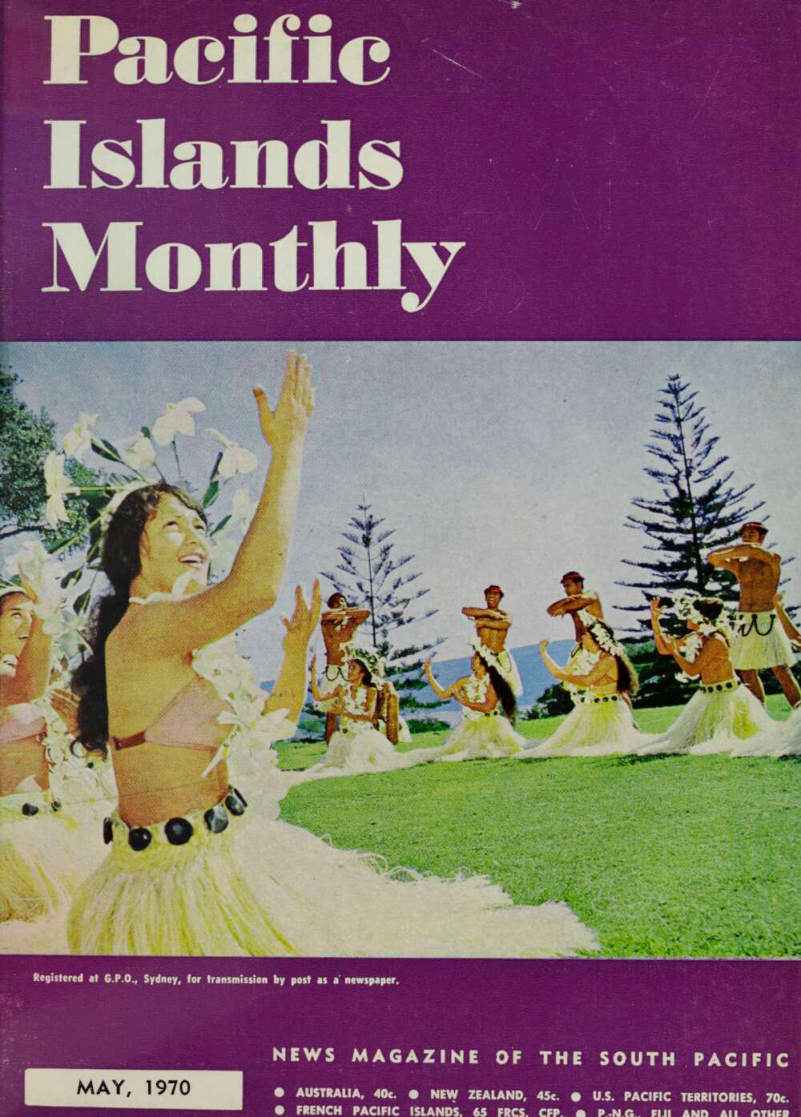 1
1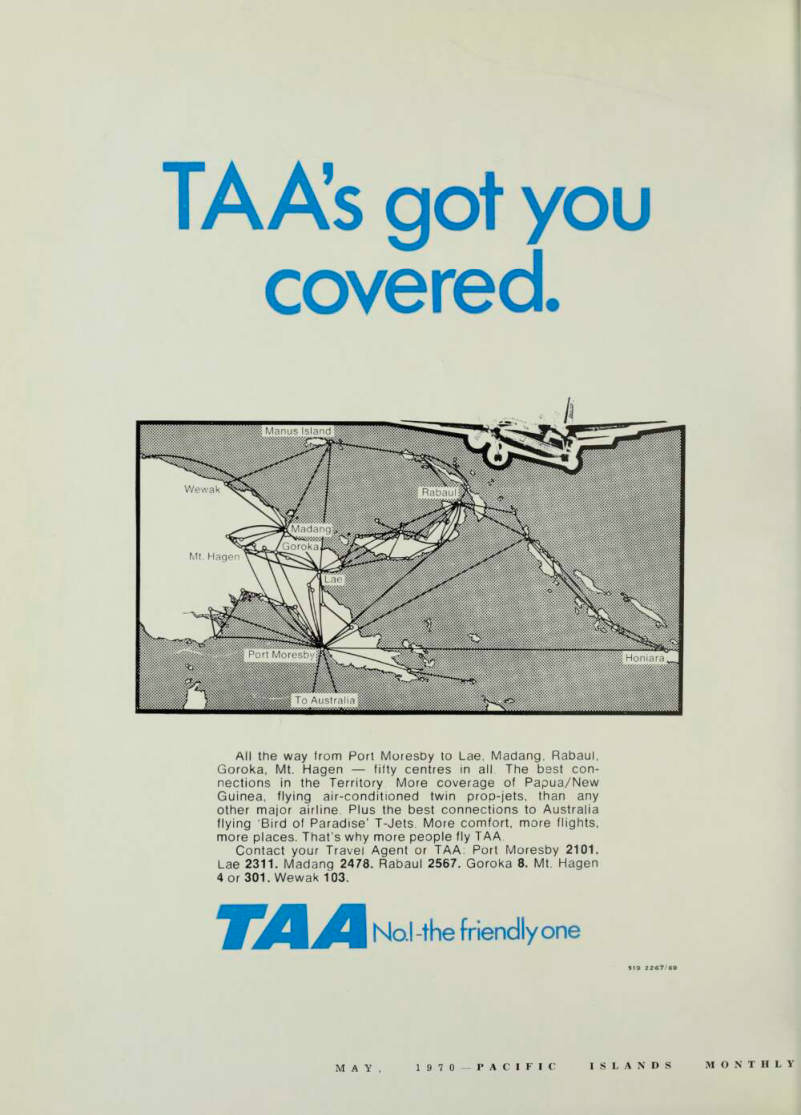 2
2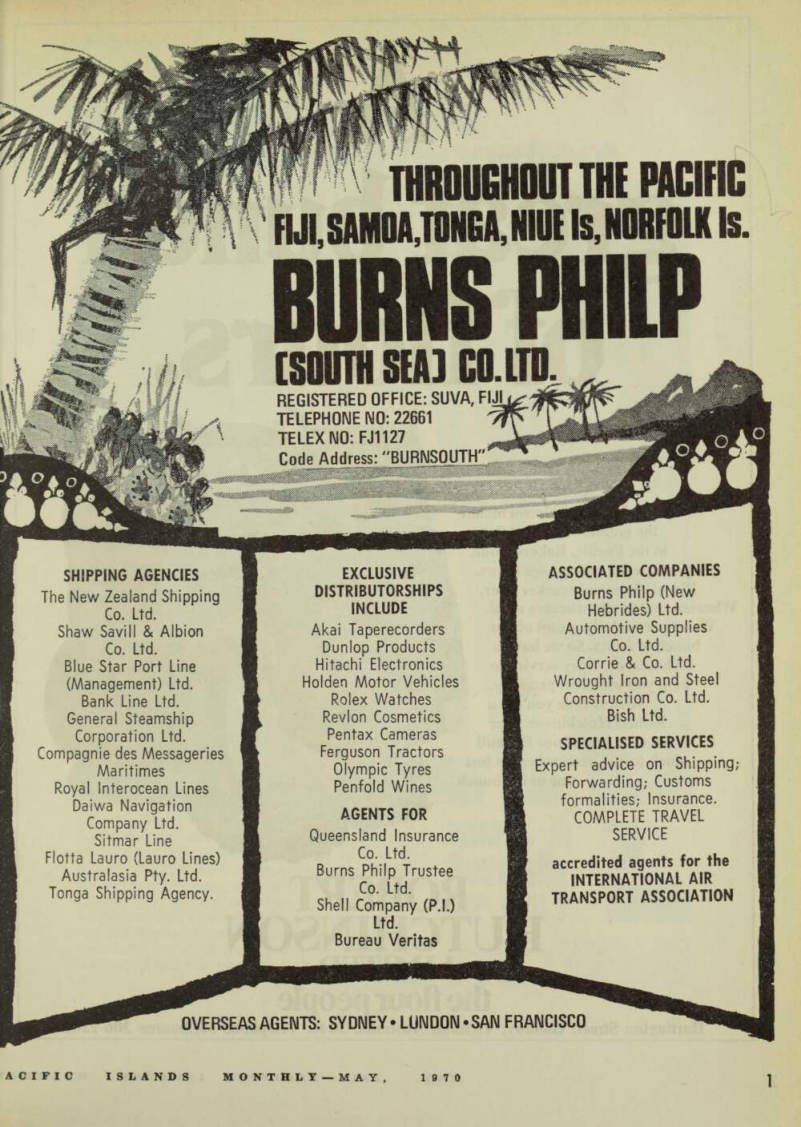 3
3 4
4 5
5 6
6 7
7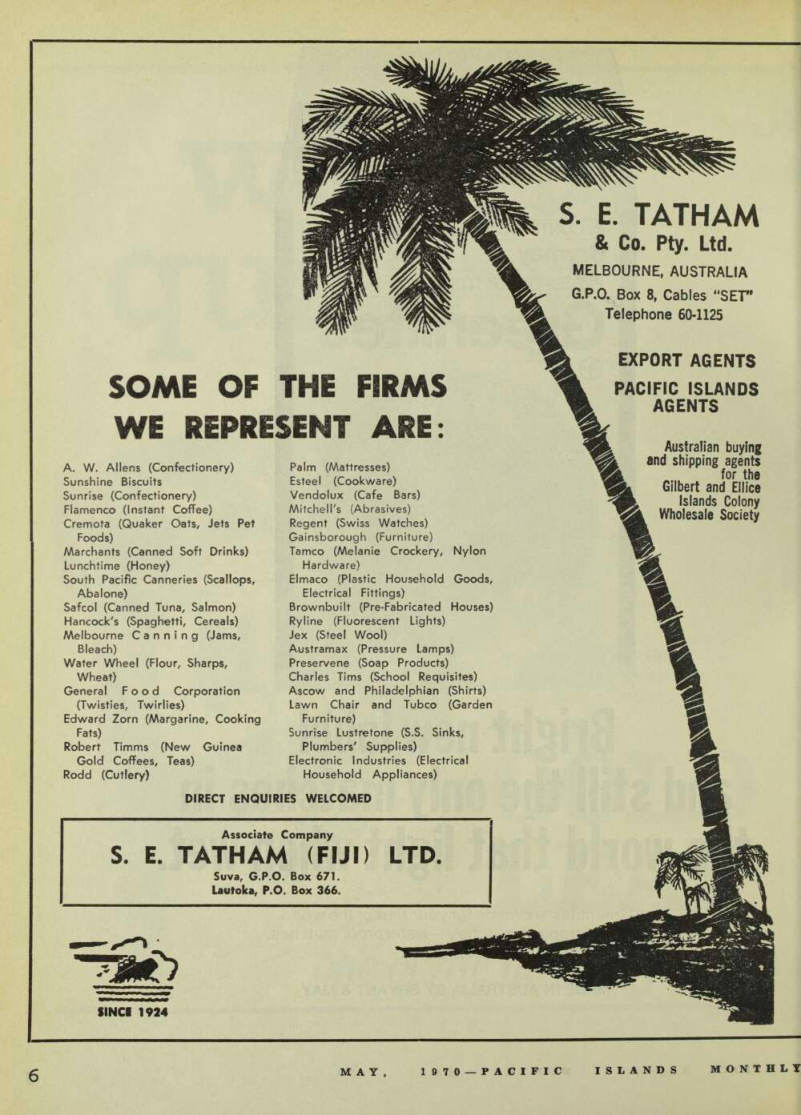 8
8 9
9 10
10 11
11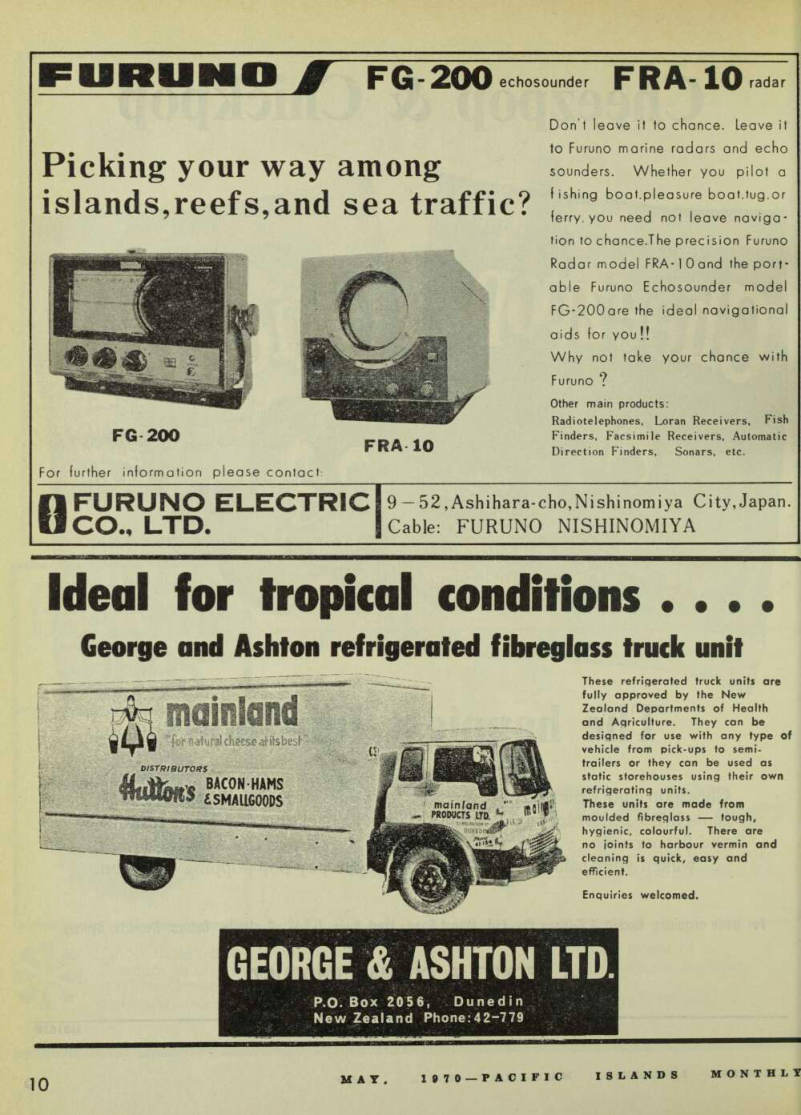 12
12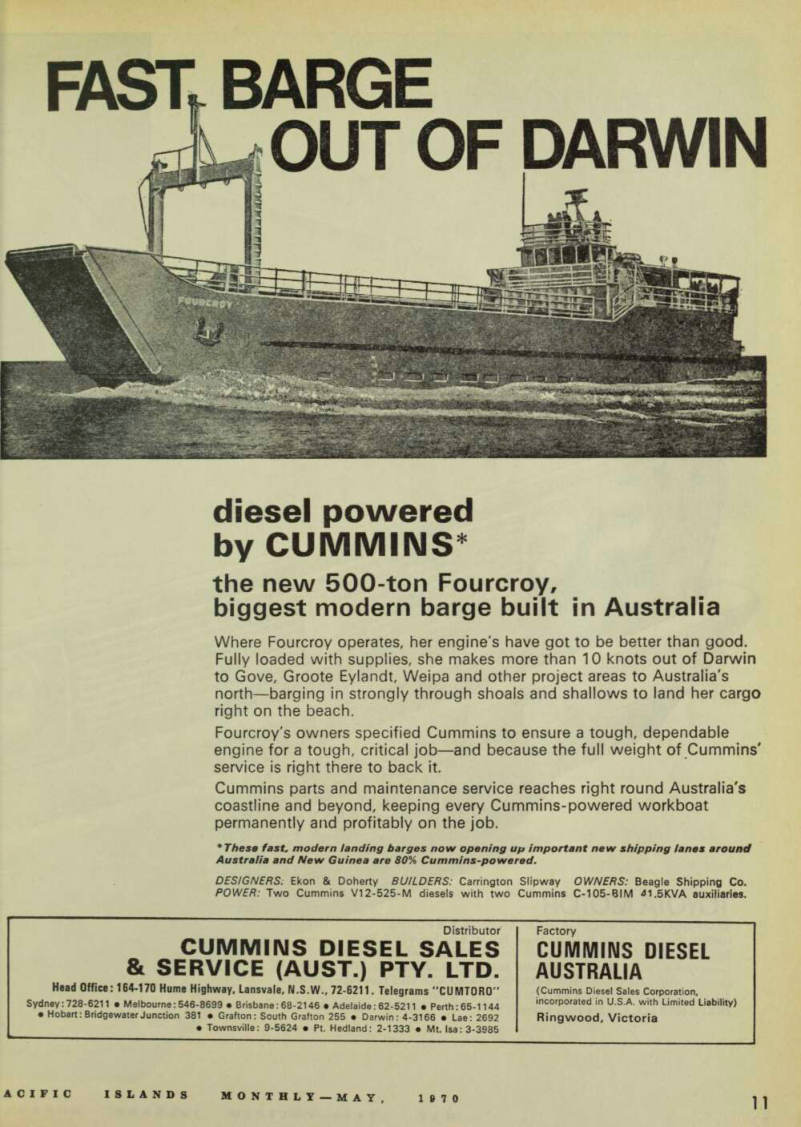 13
13 14
14 15
15 16
16 17
17 18
18 19
19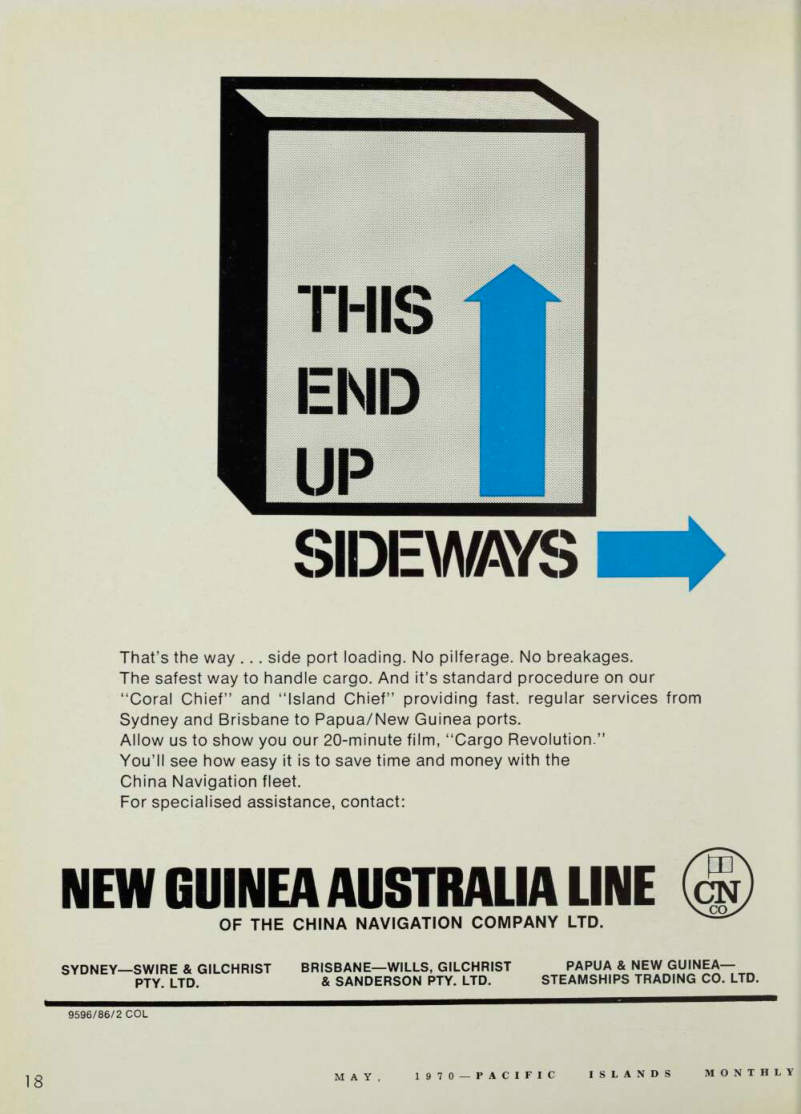 20
20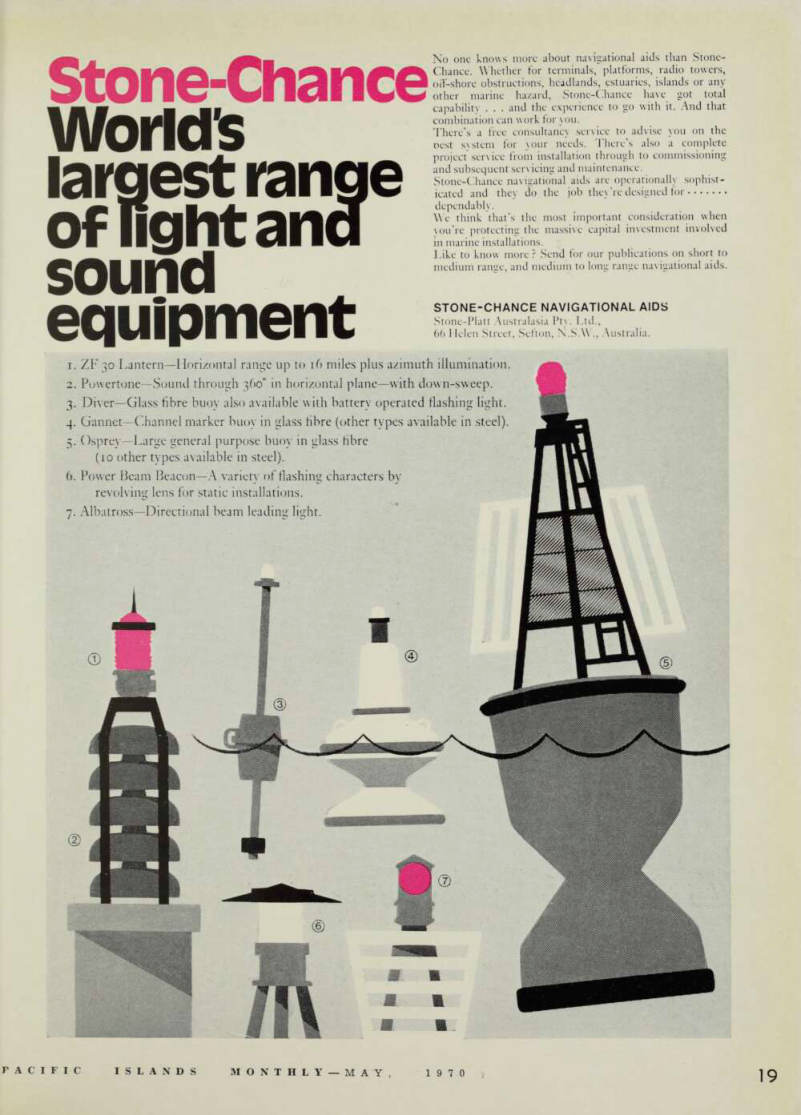 21
21 22
22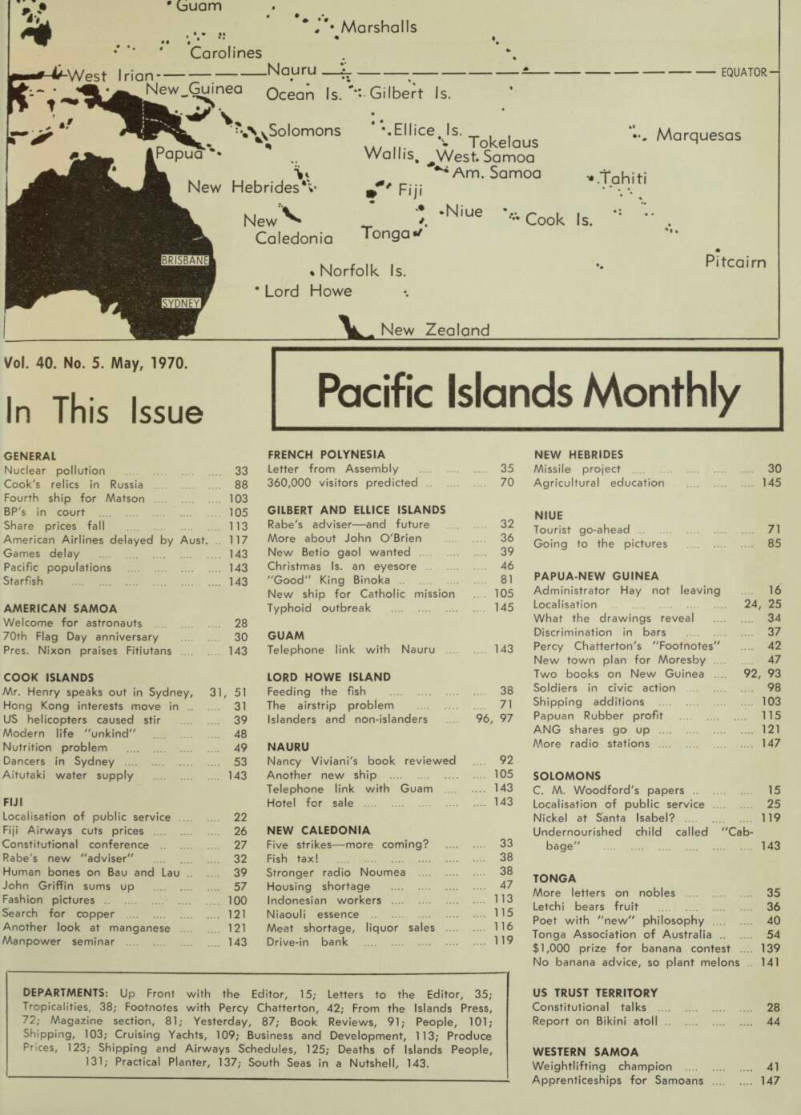 23
23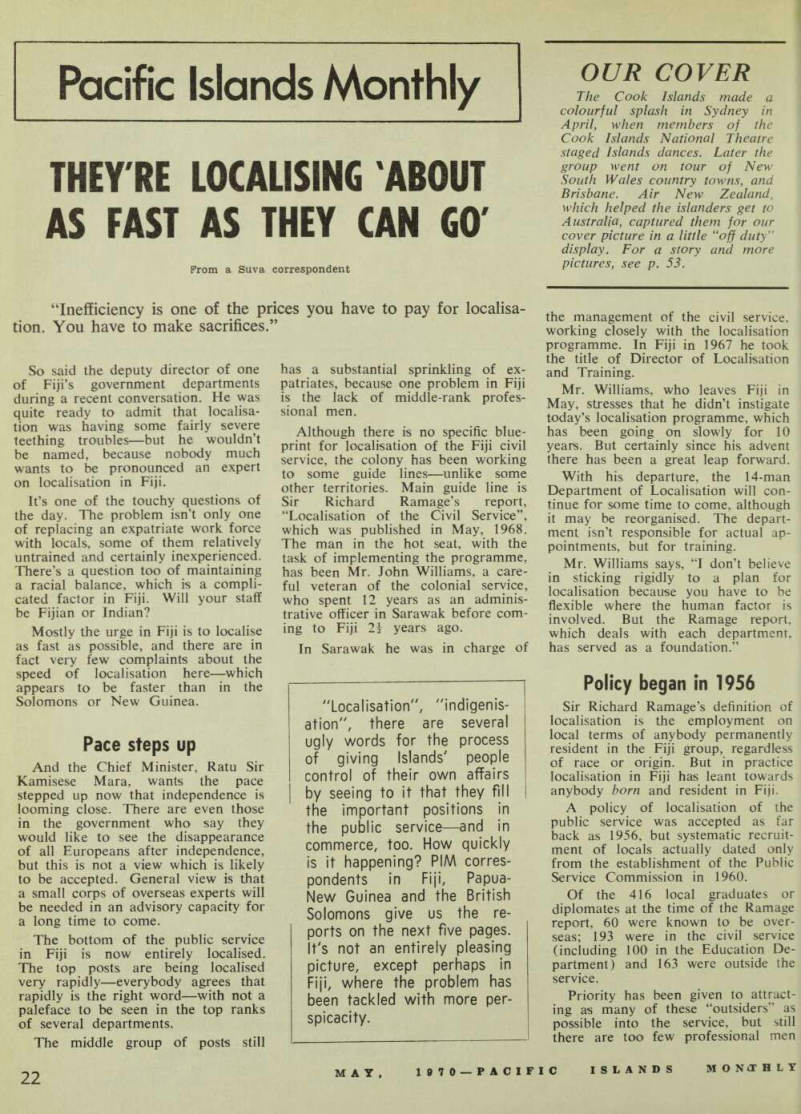 24
24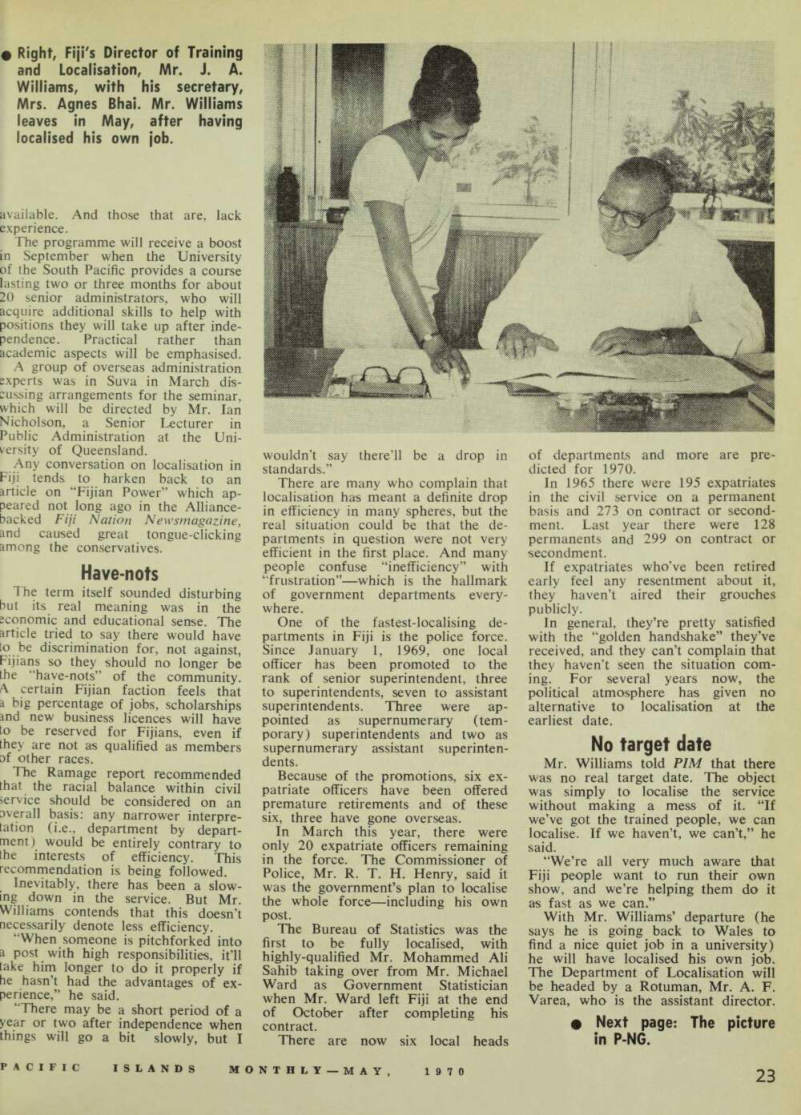 25
25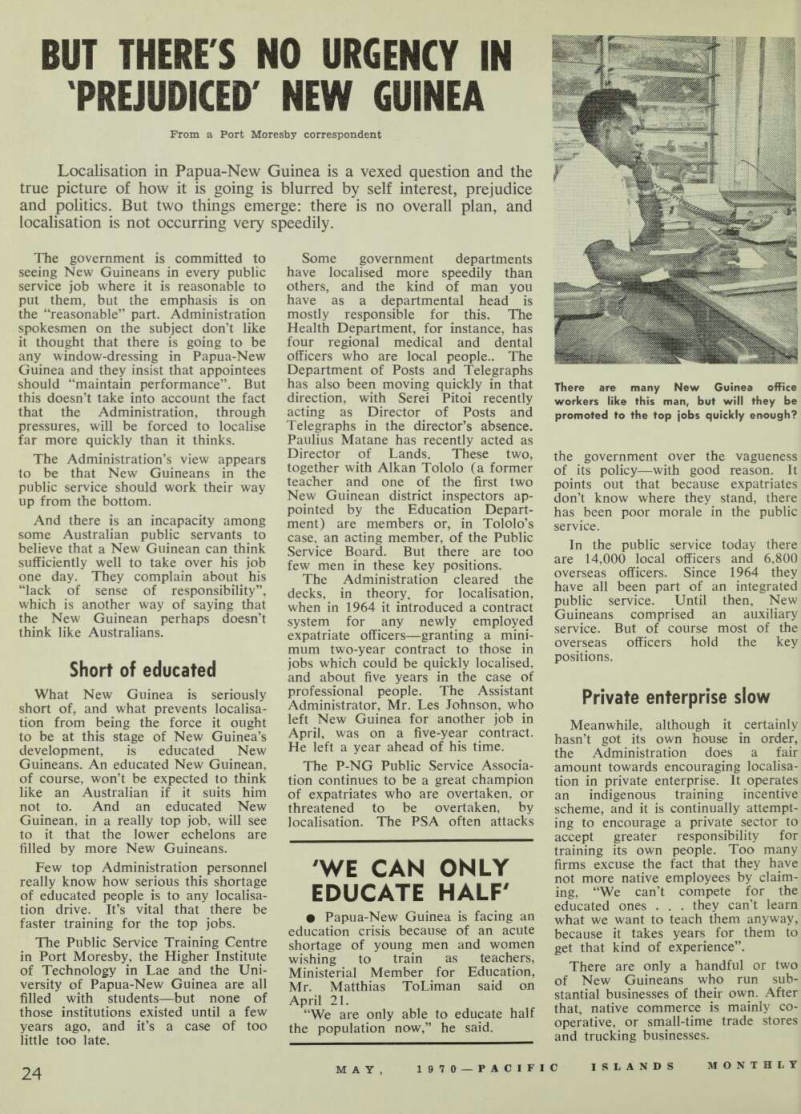 26
26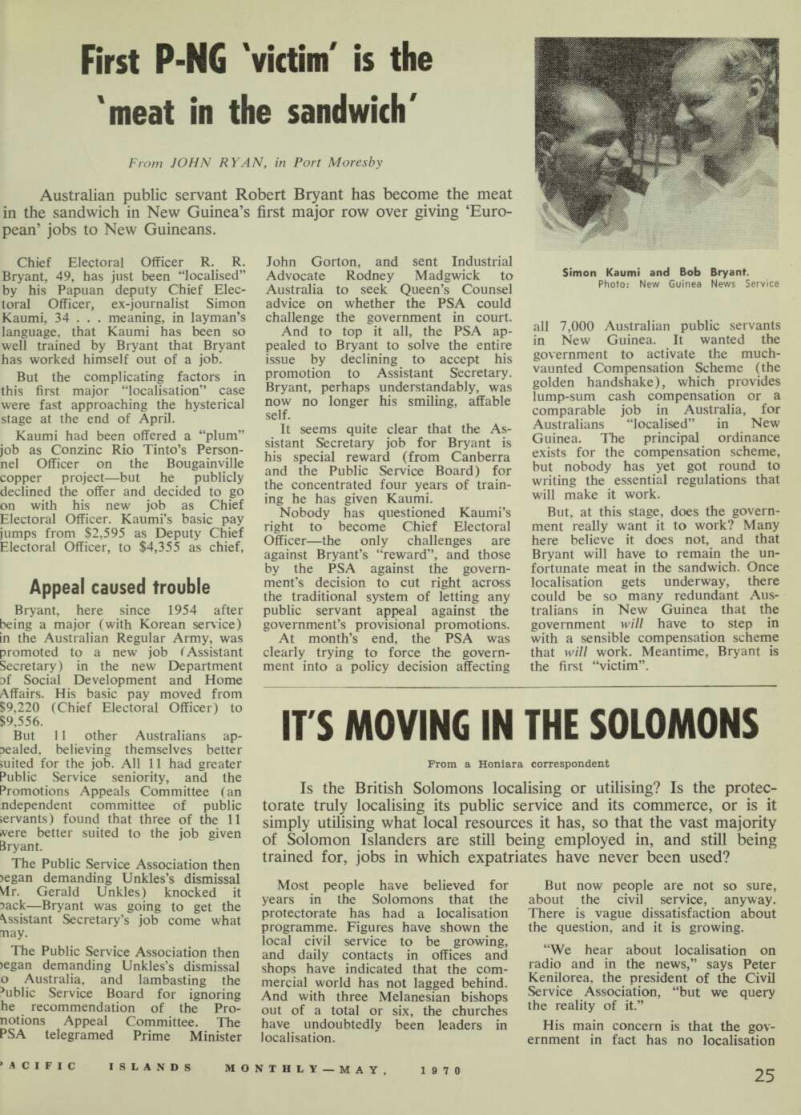 27
27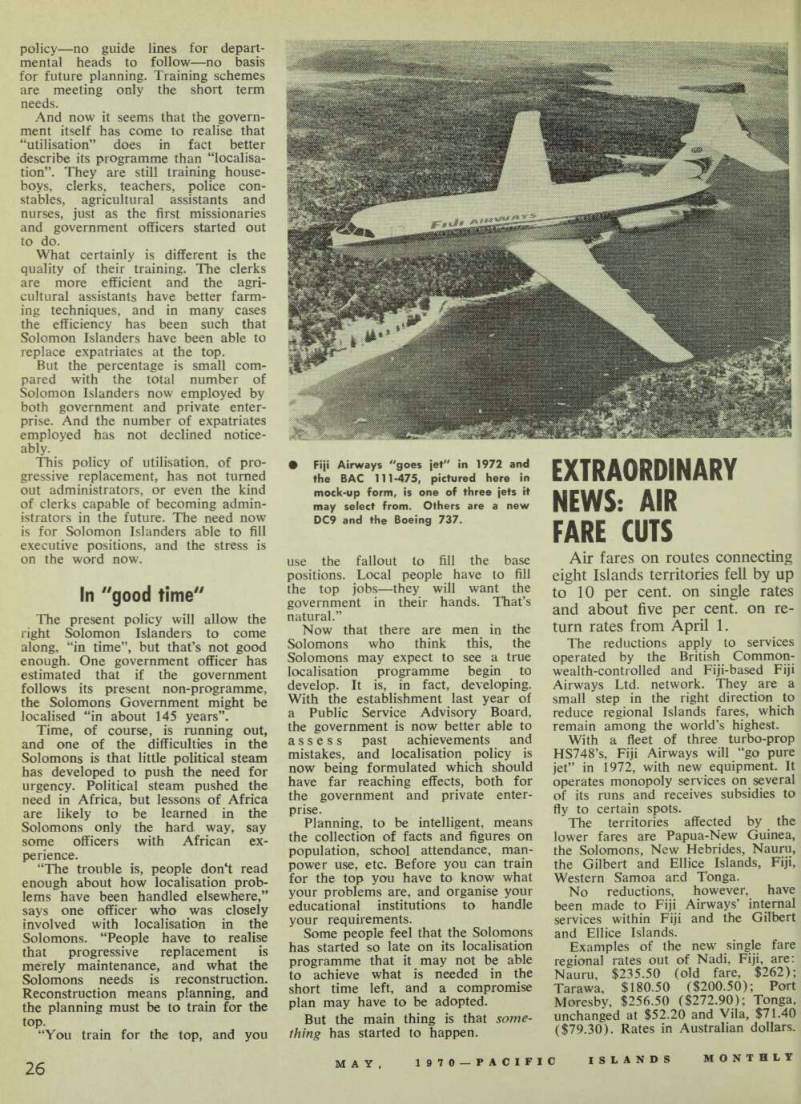 28
28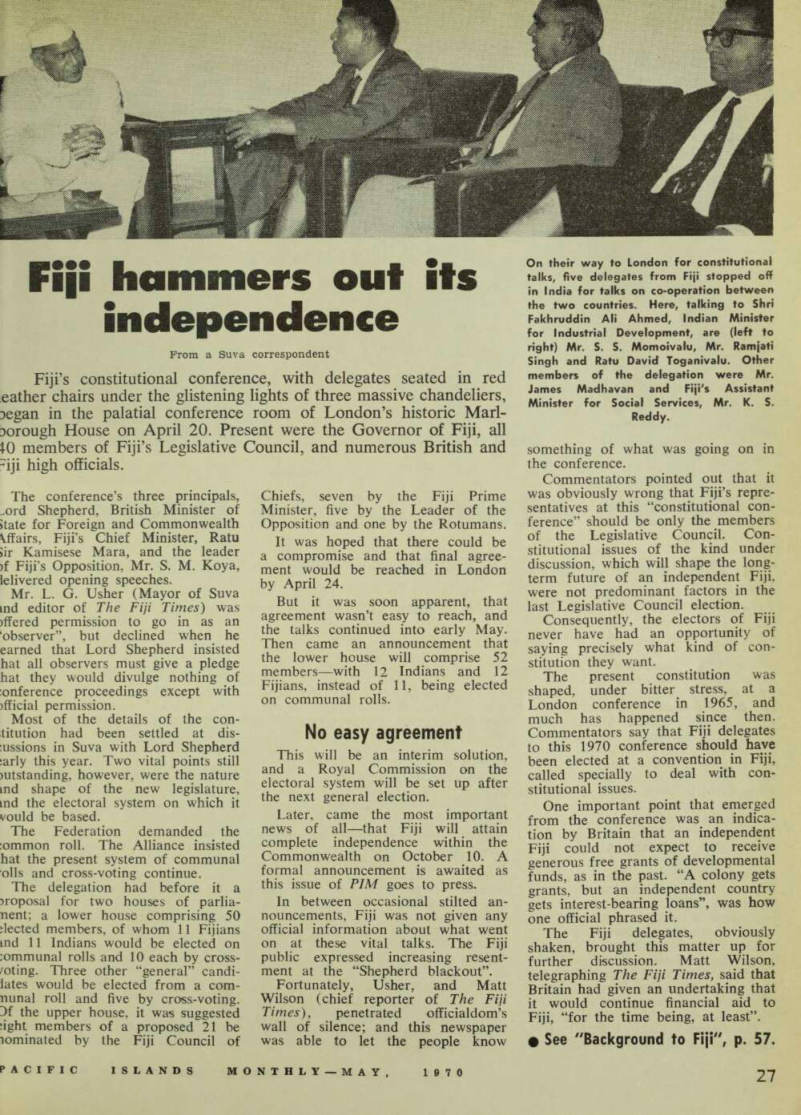 29
29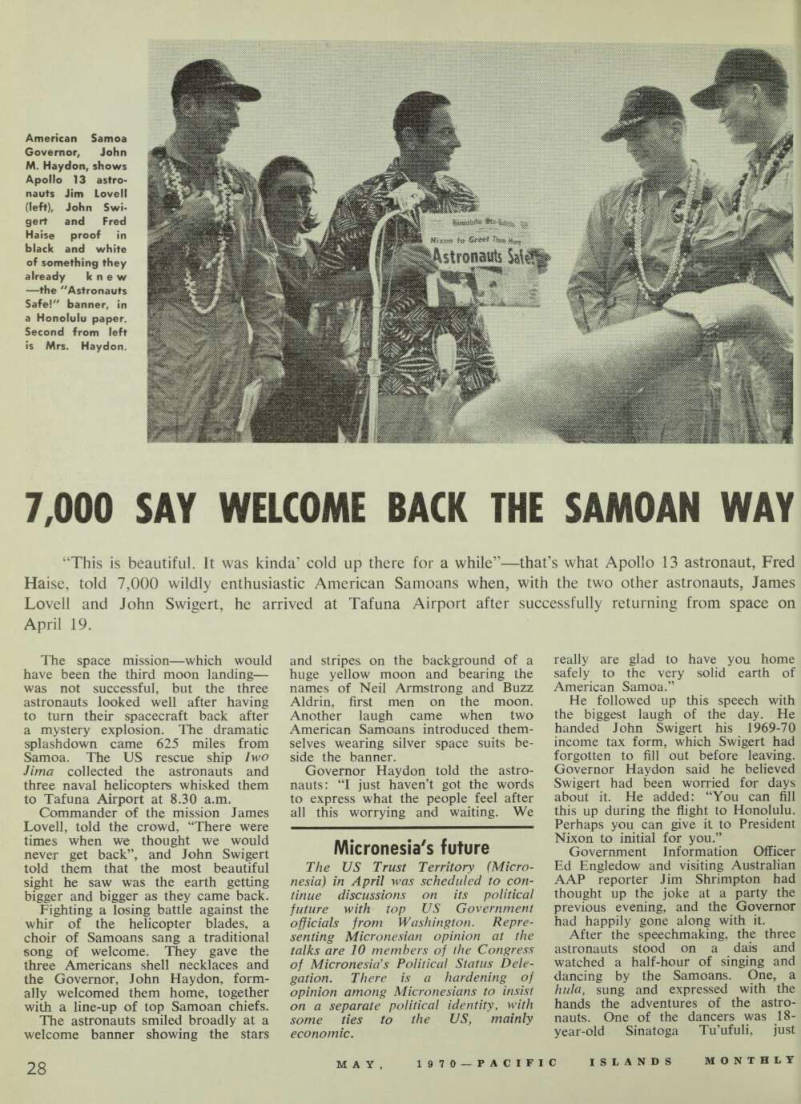 30
30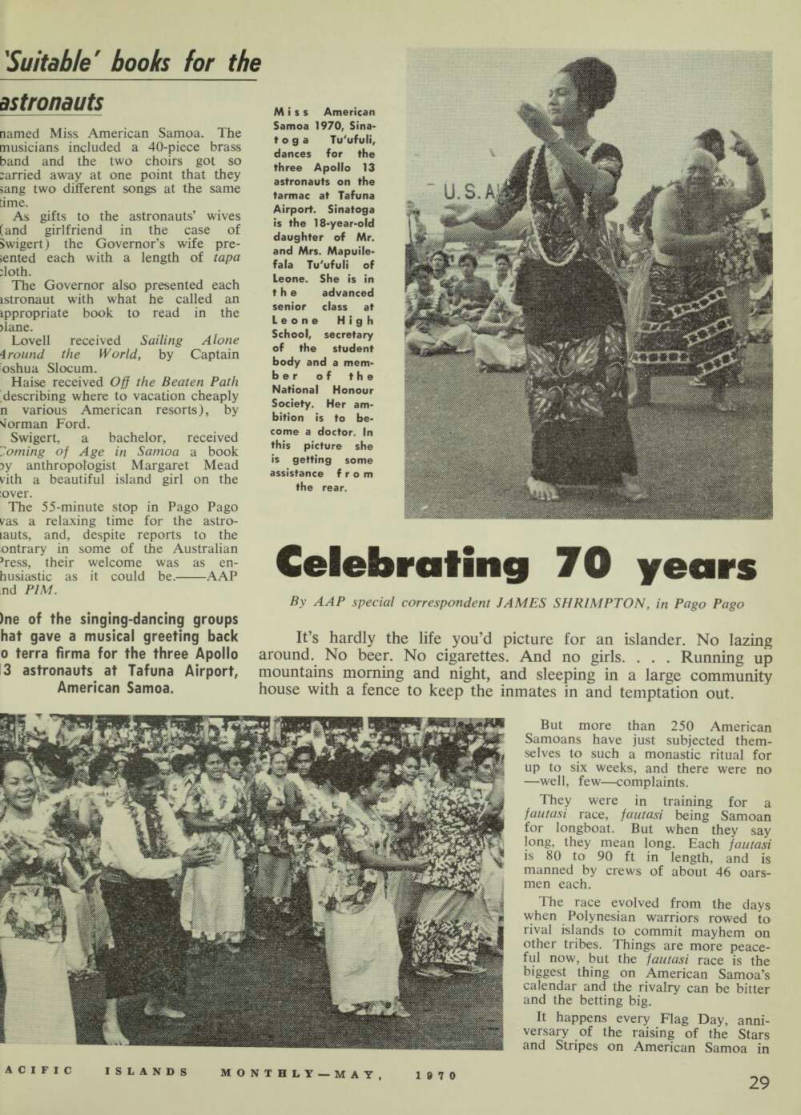 31
31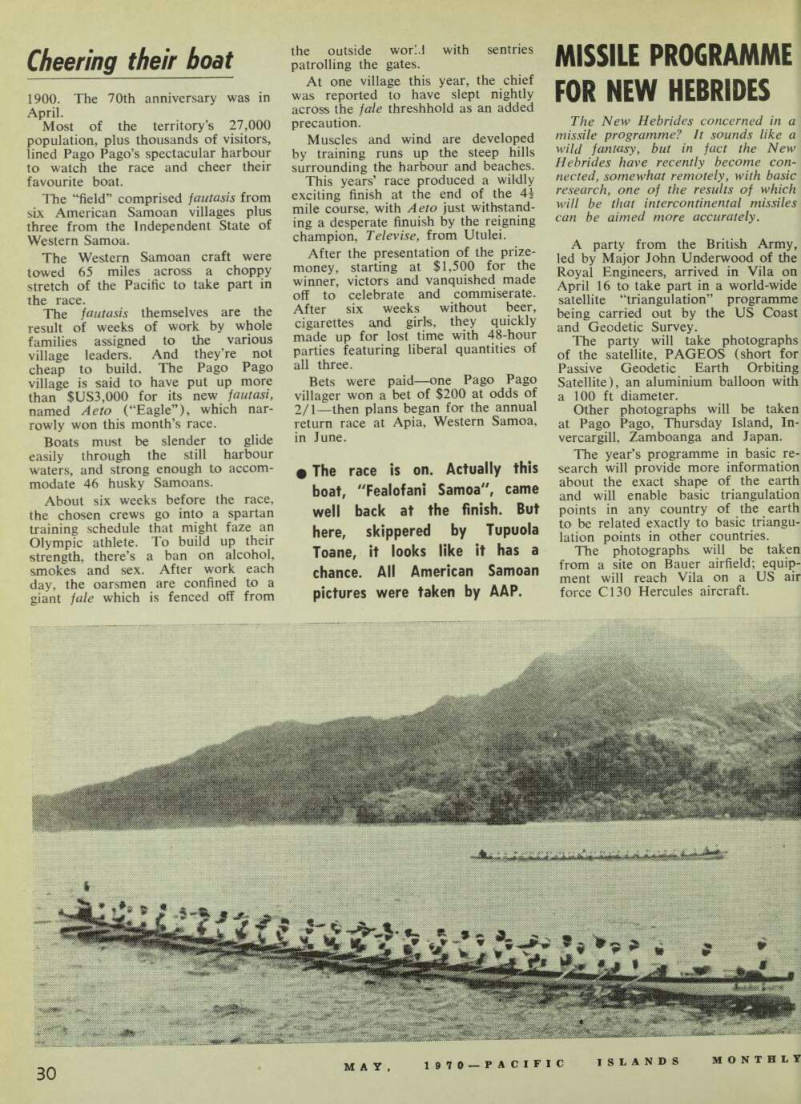 32
32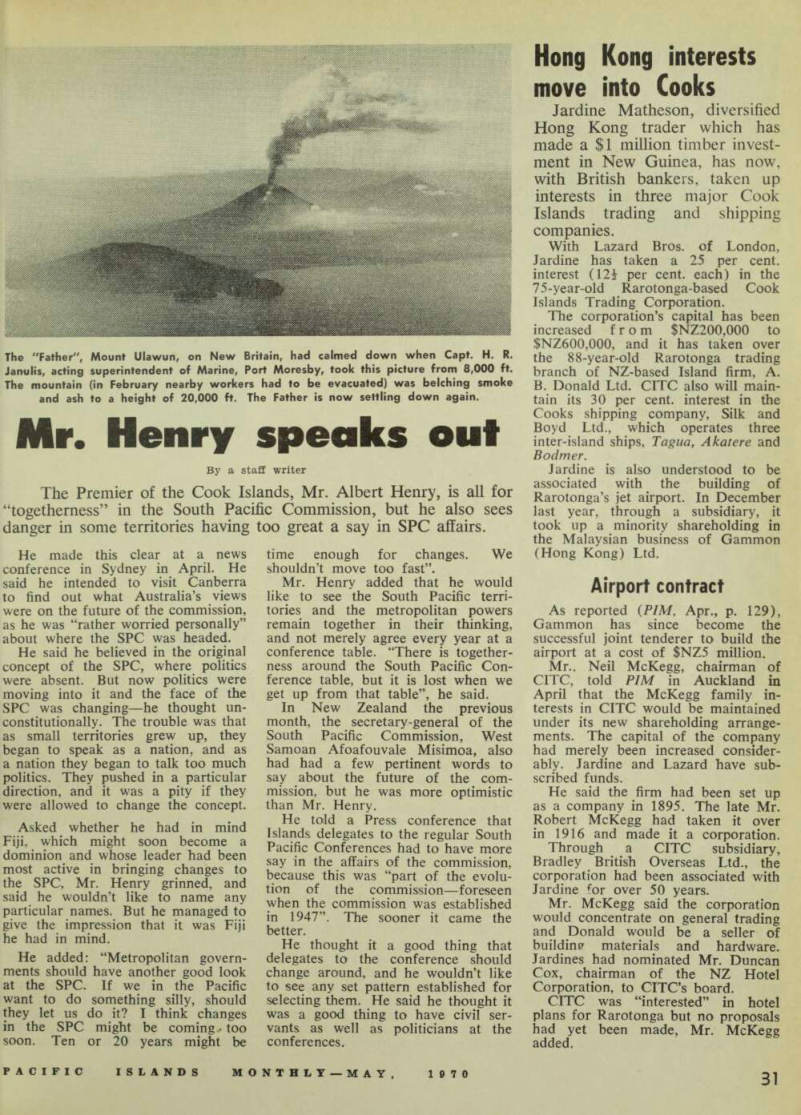 33
33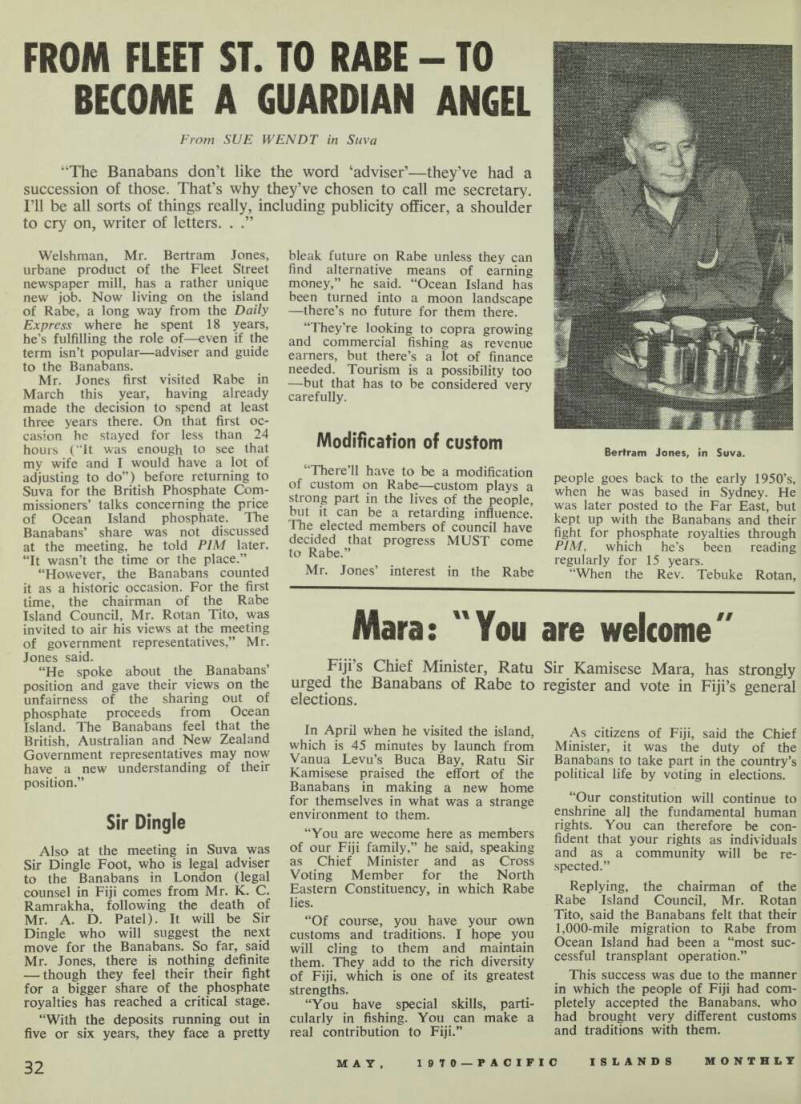 34
34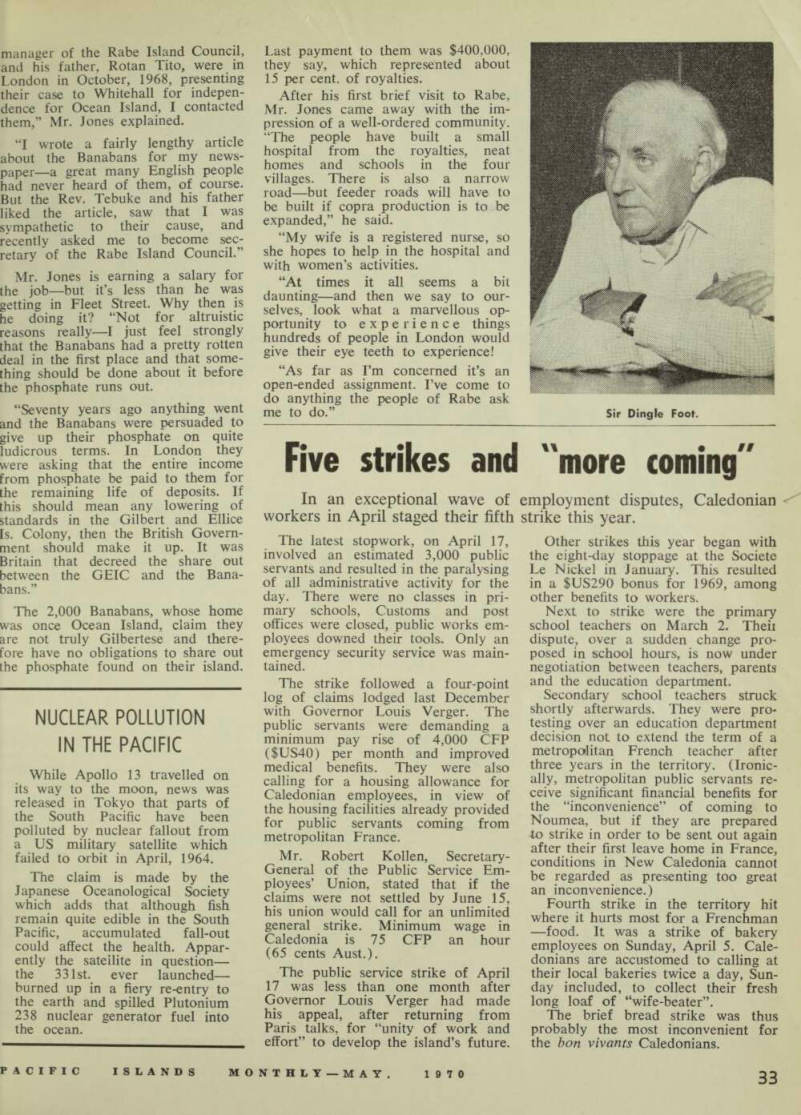 35
35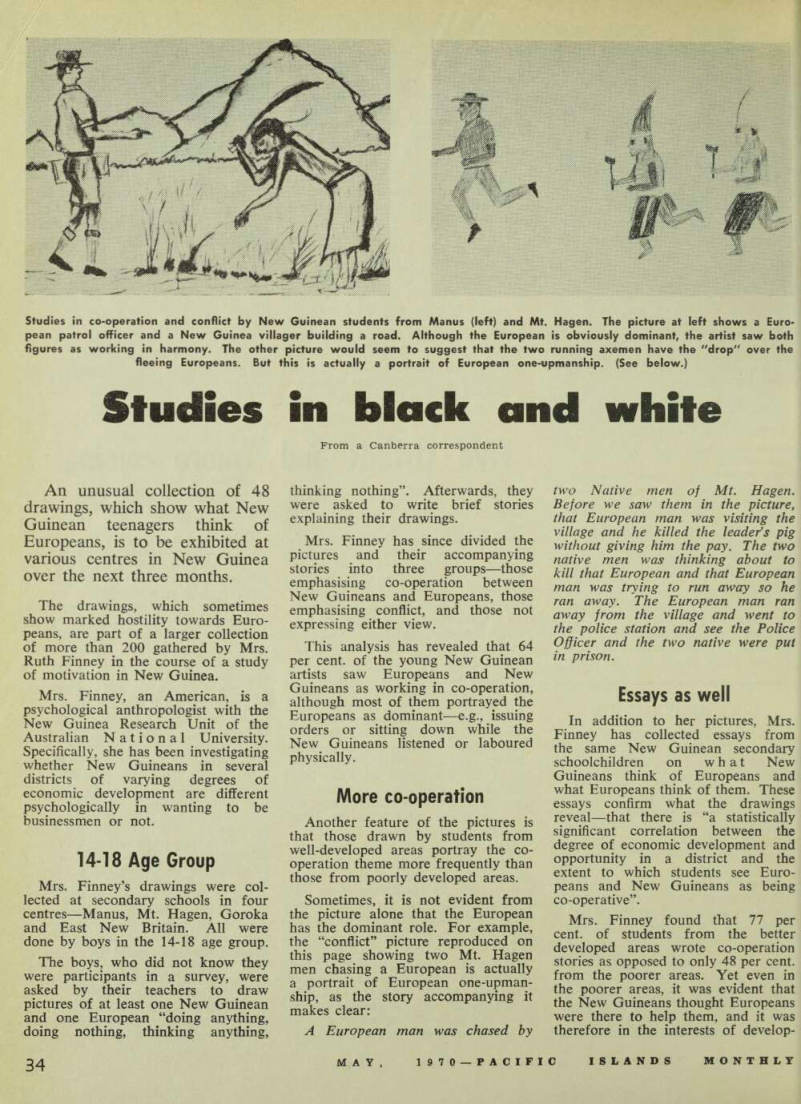 36
36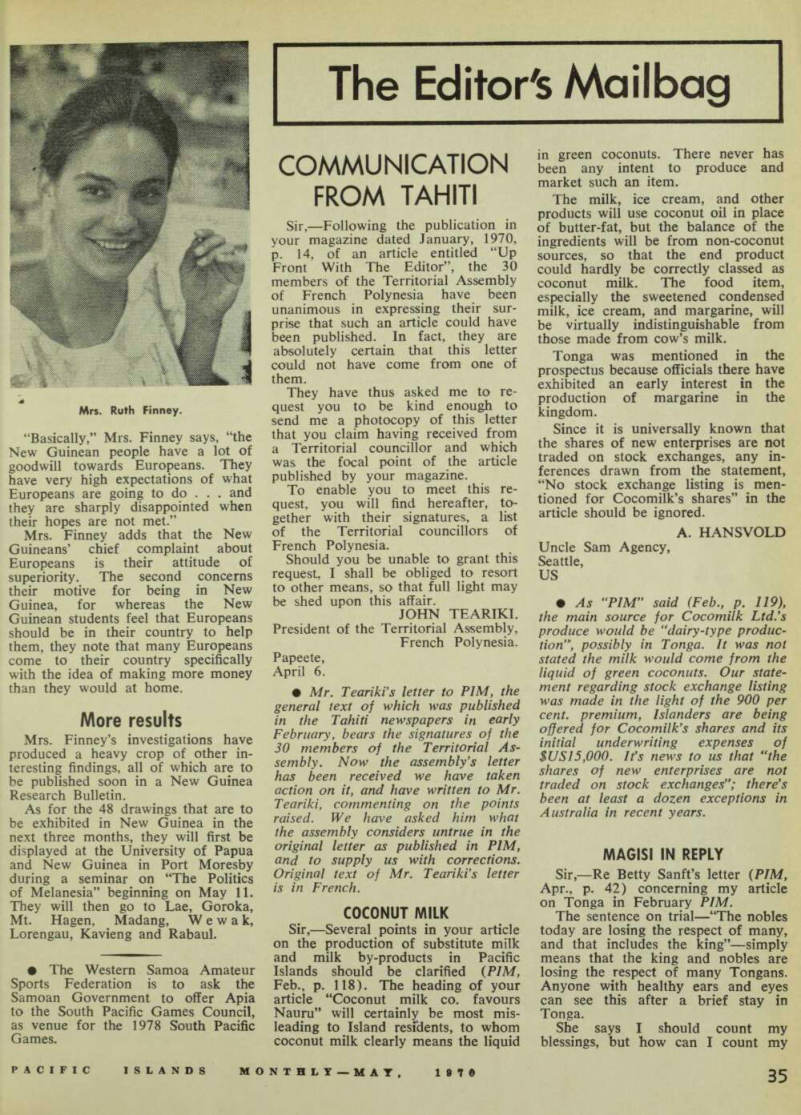 37
37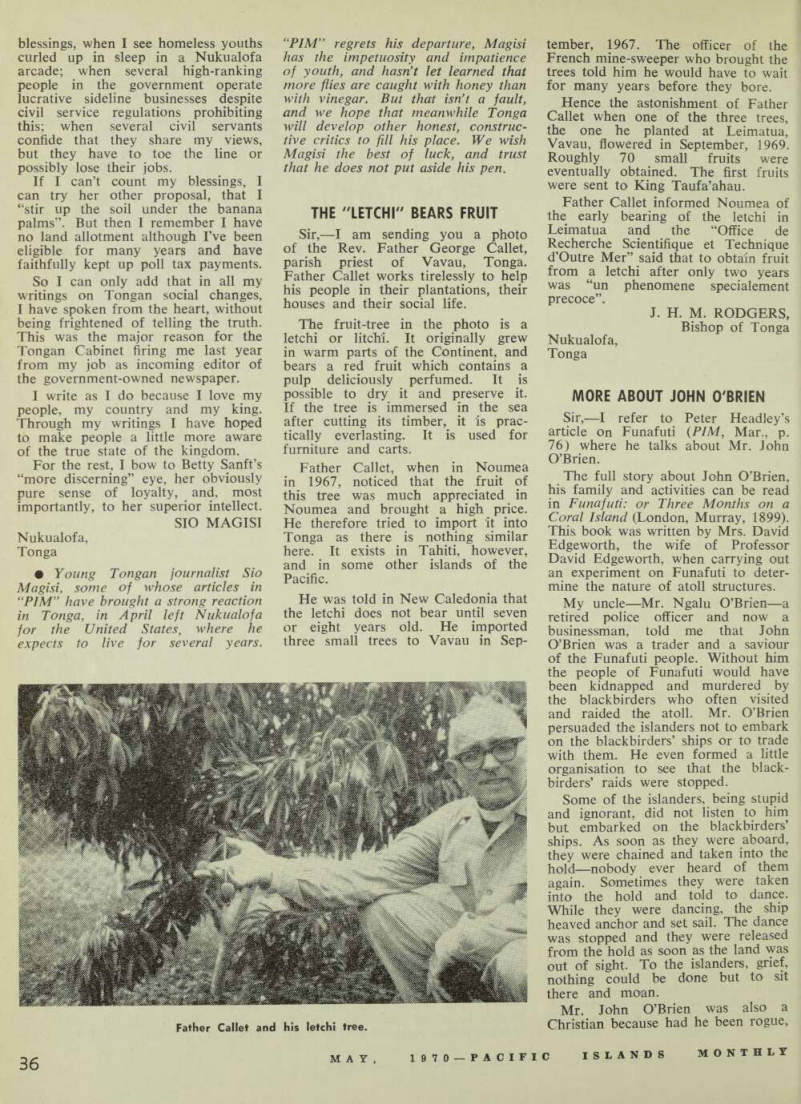 38
38 39
39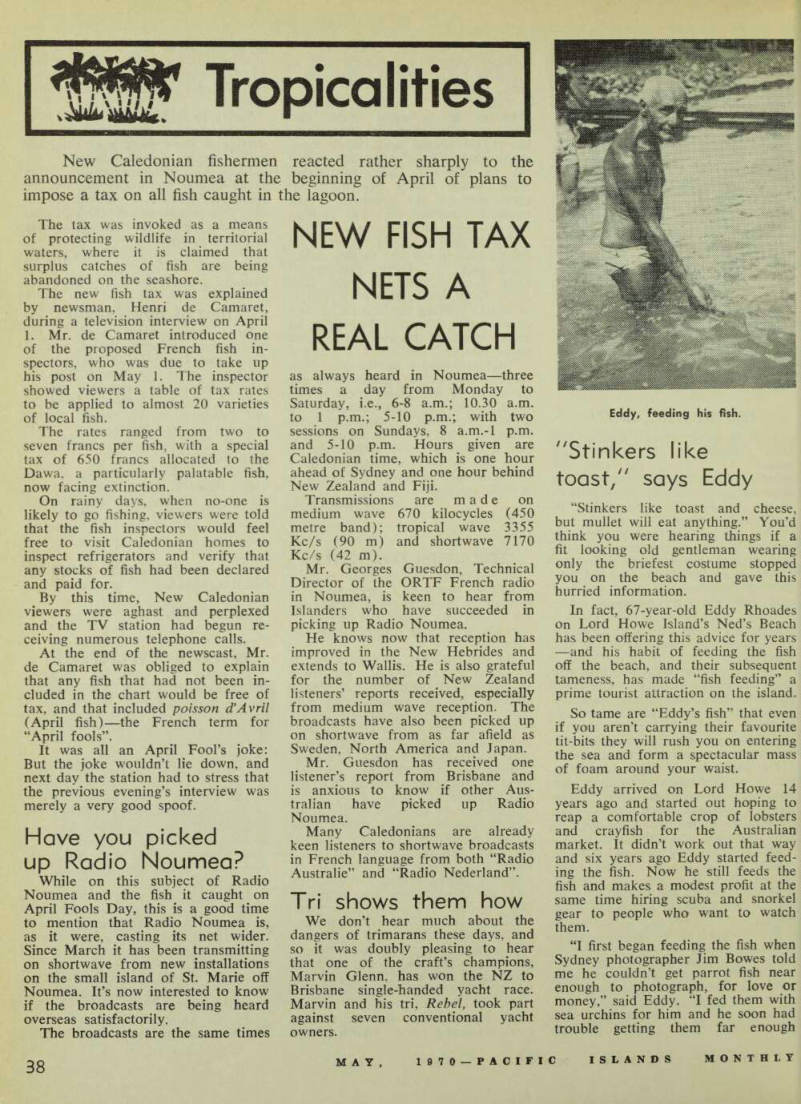 40
40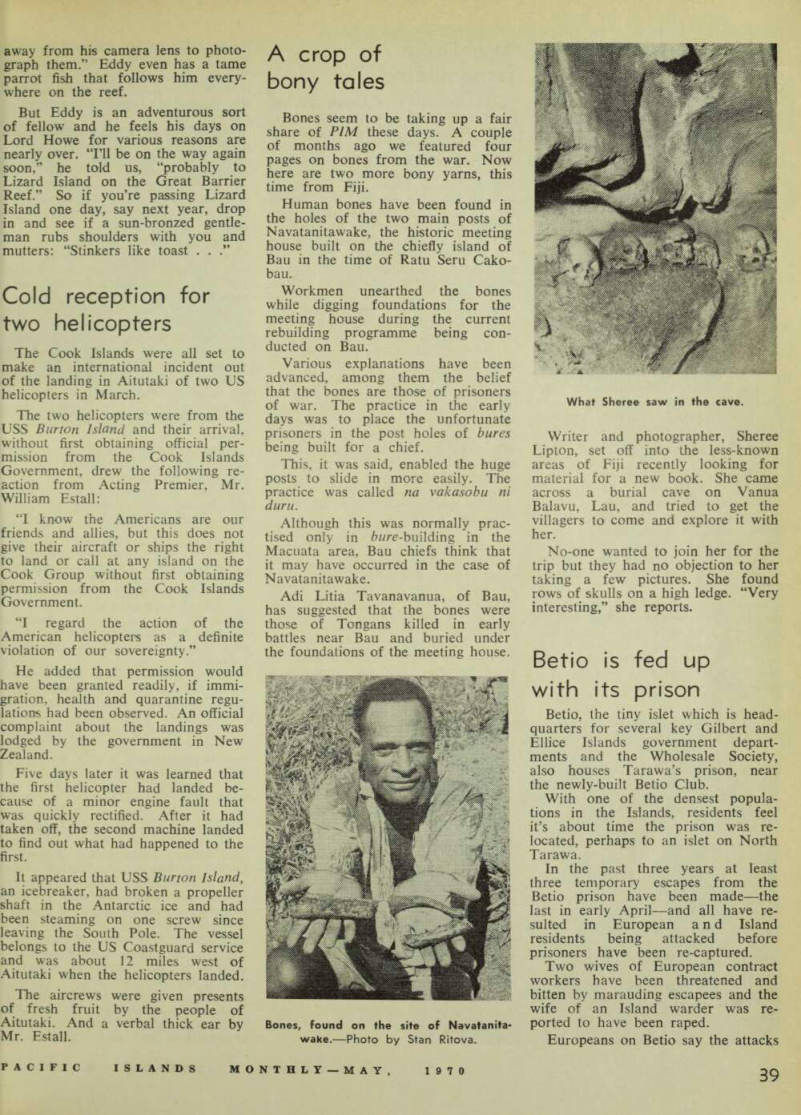 41
41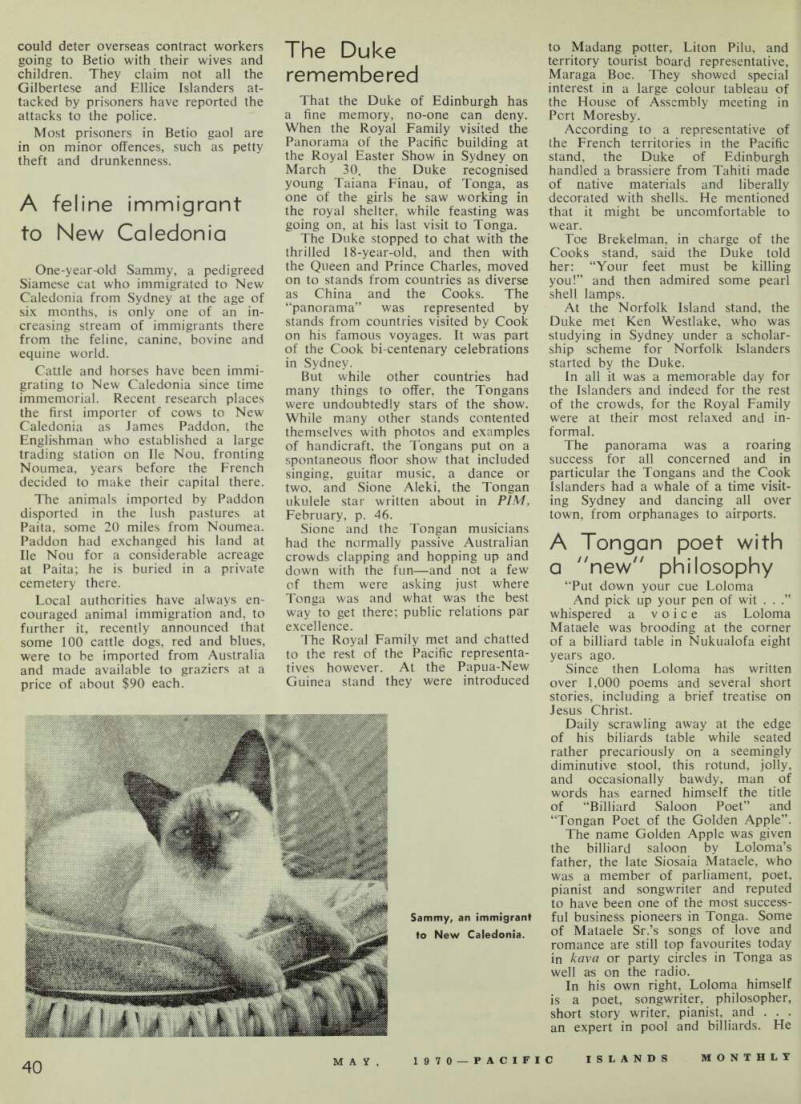 42
42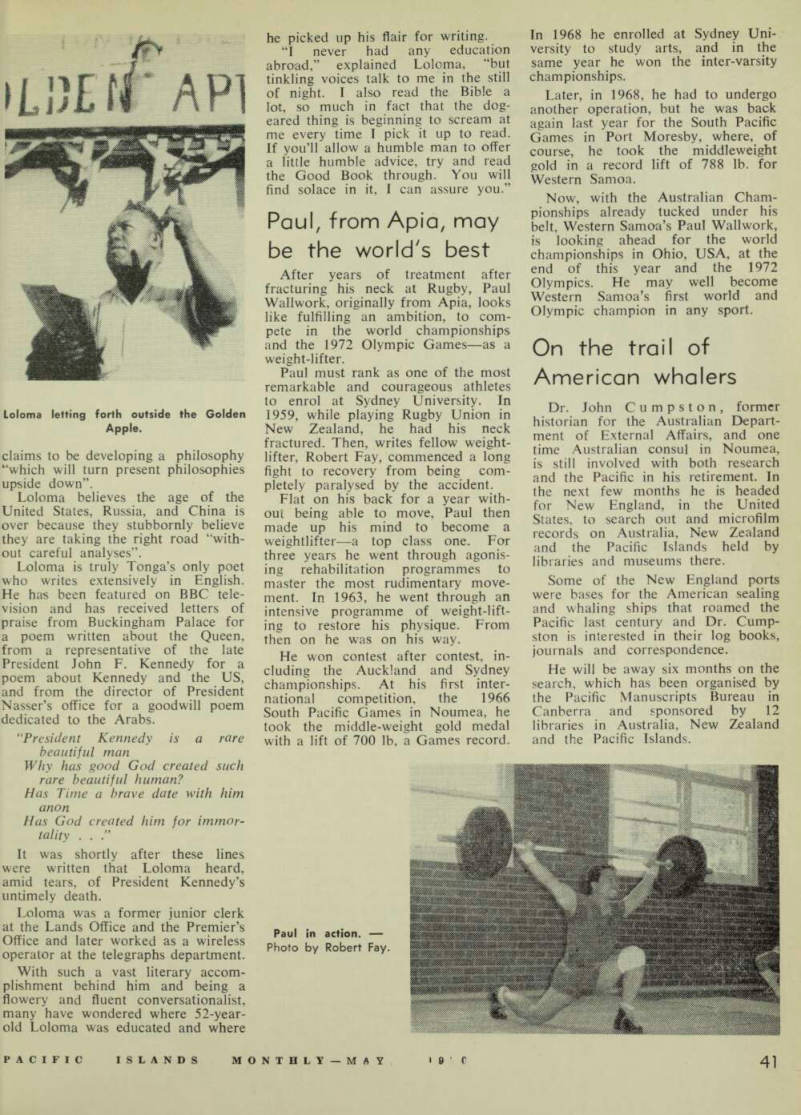 43
43 44
44 45
45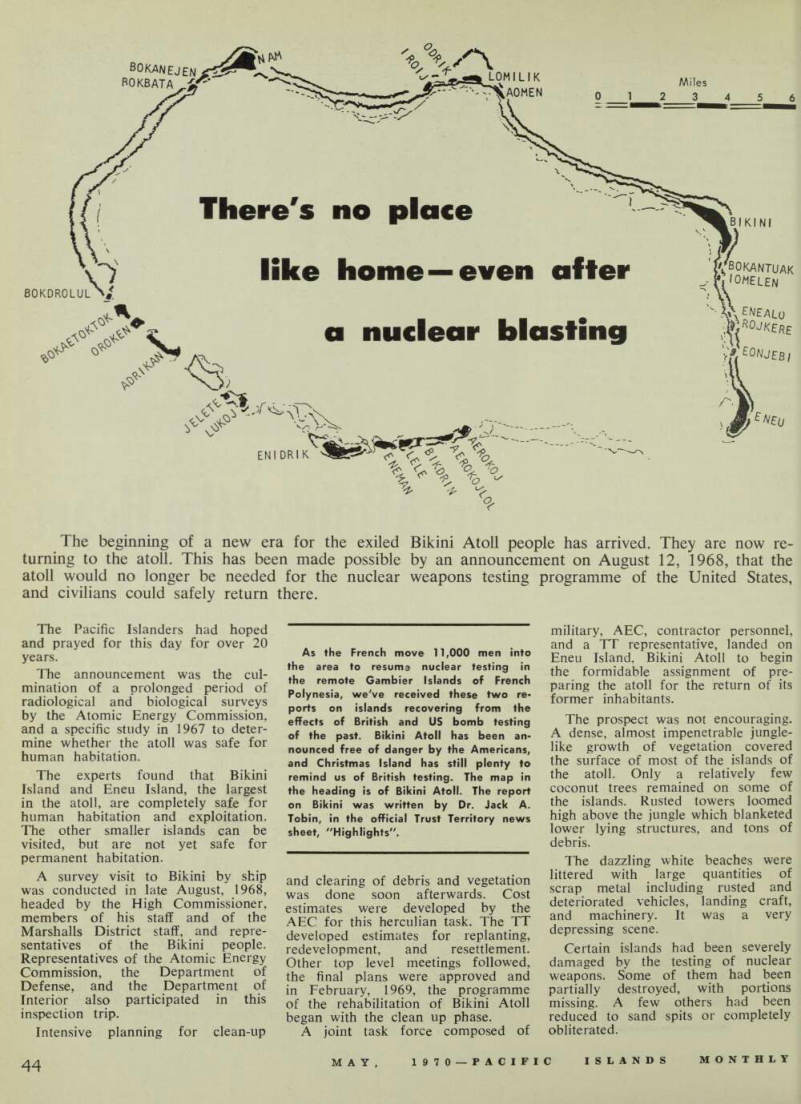 46
46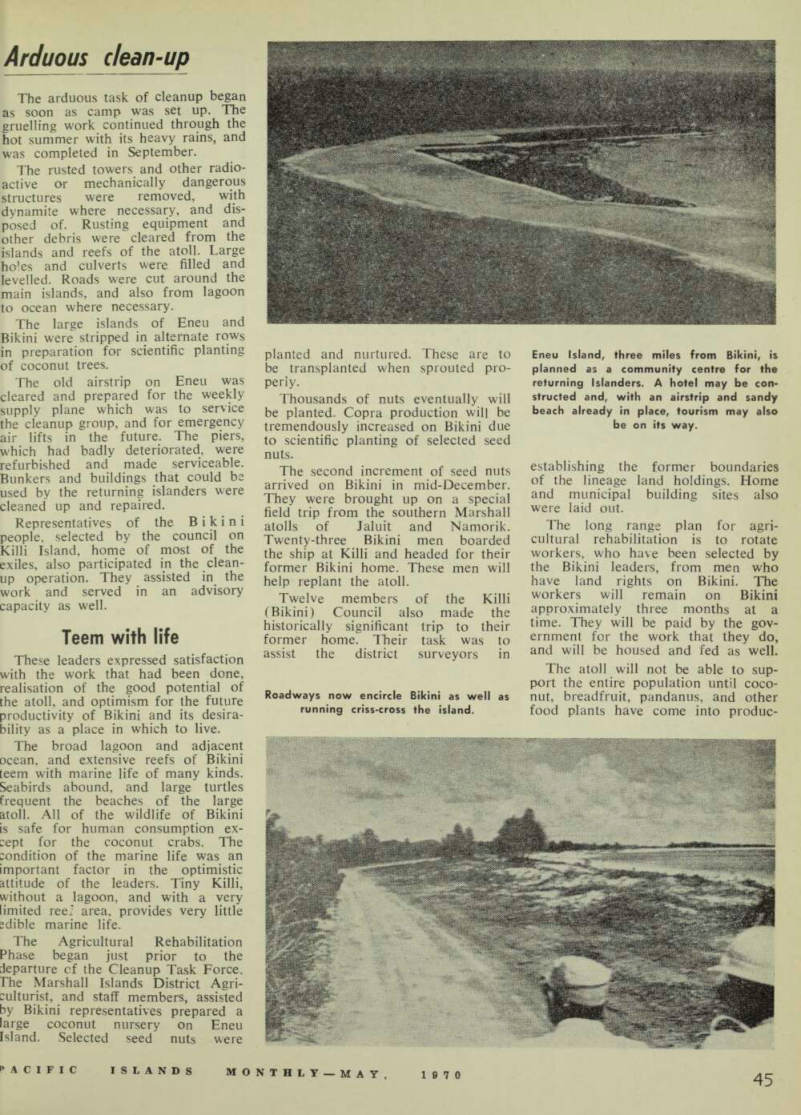 47
47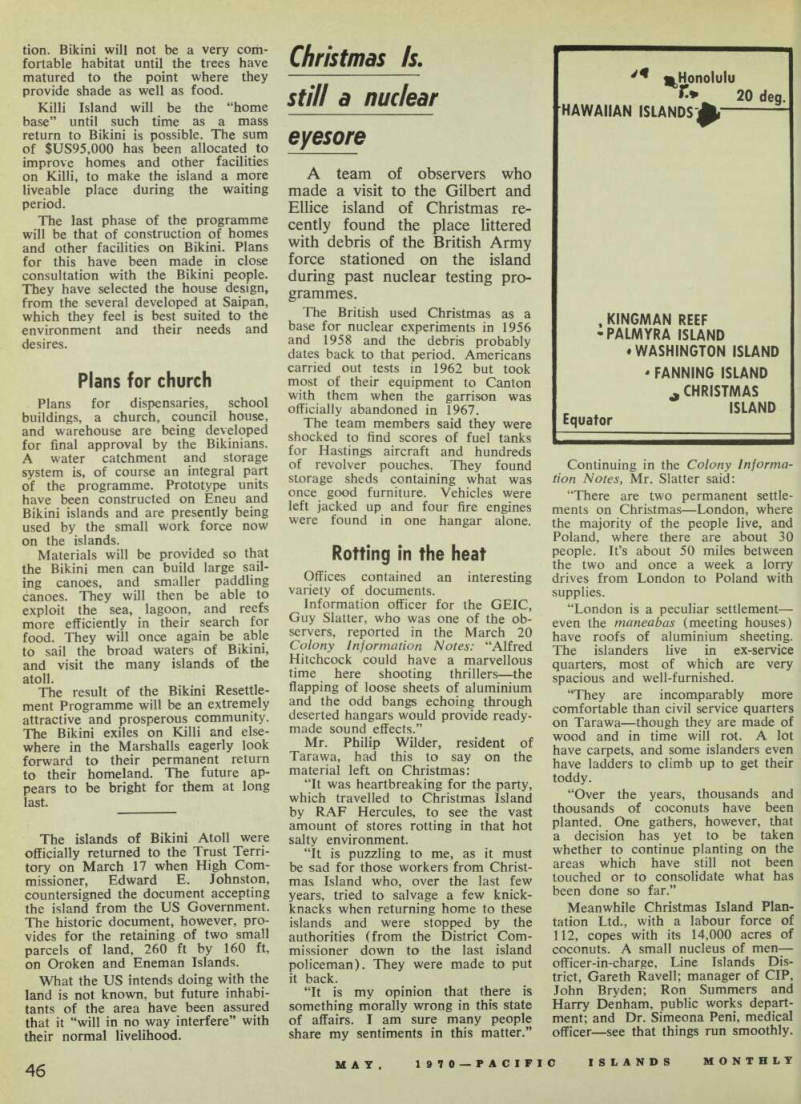 48
48 49
49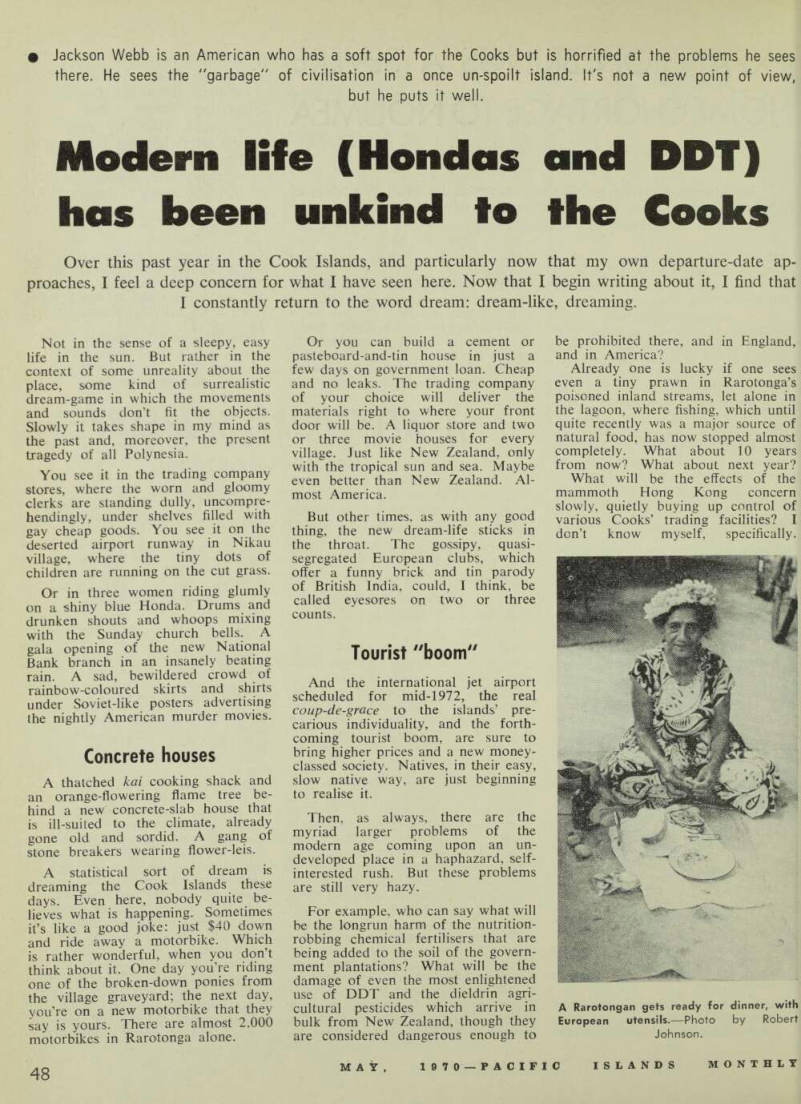 50
50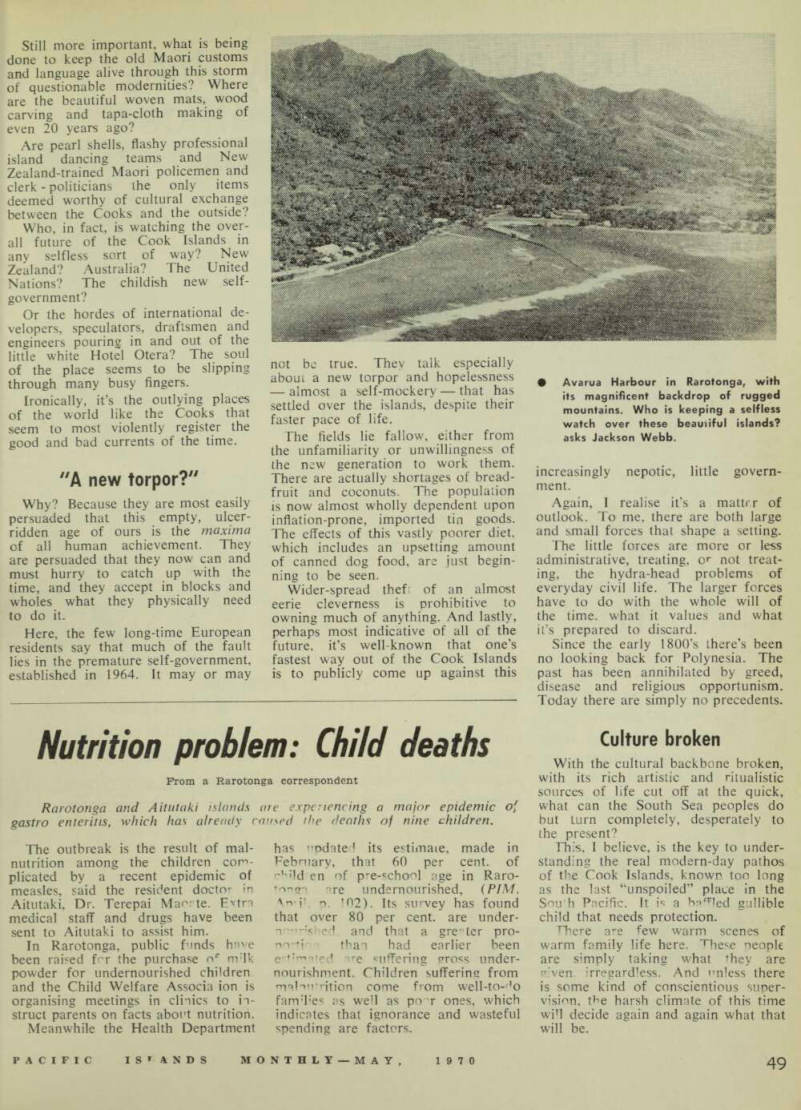 51
51 52
52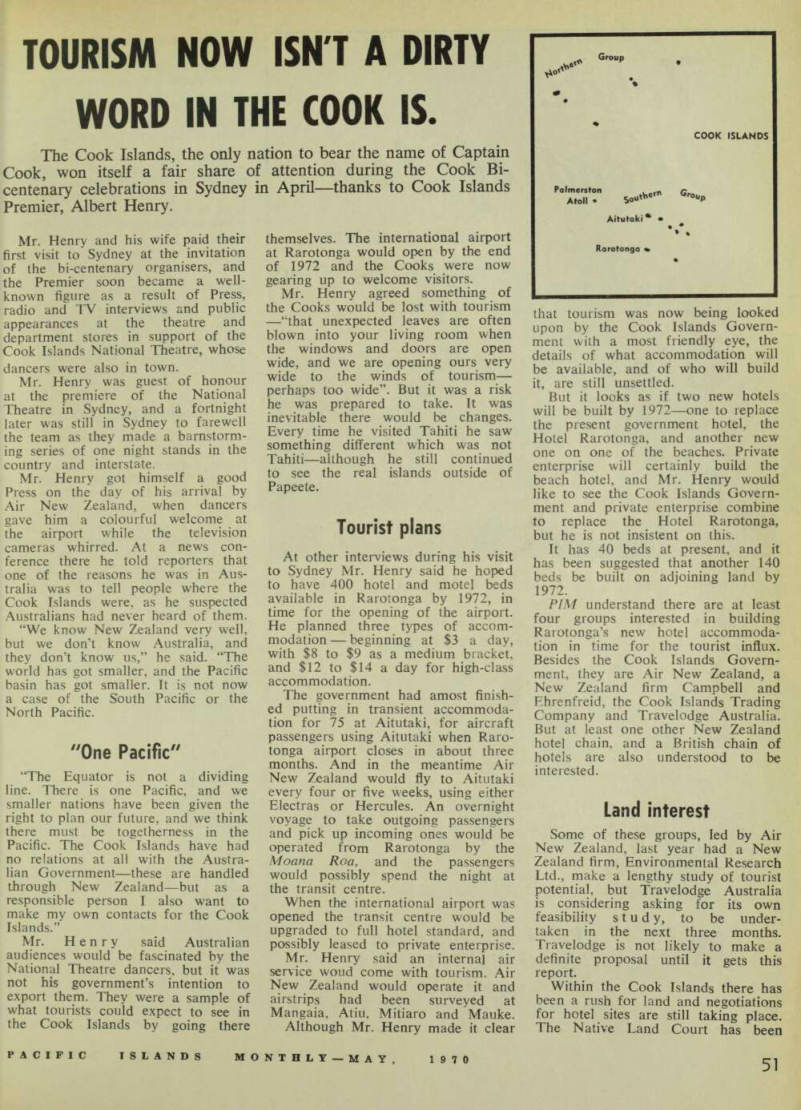 53
53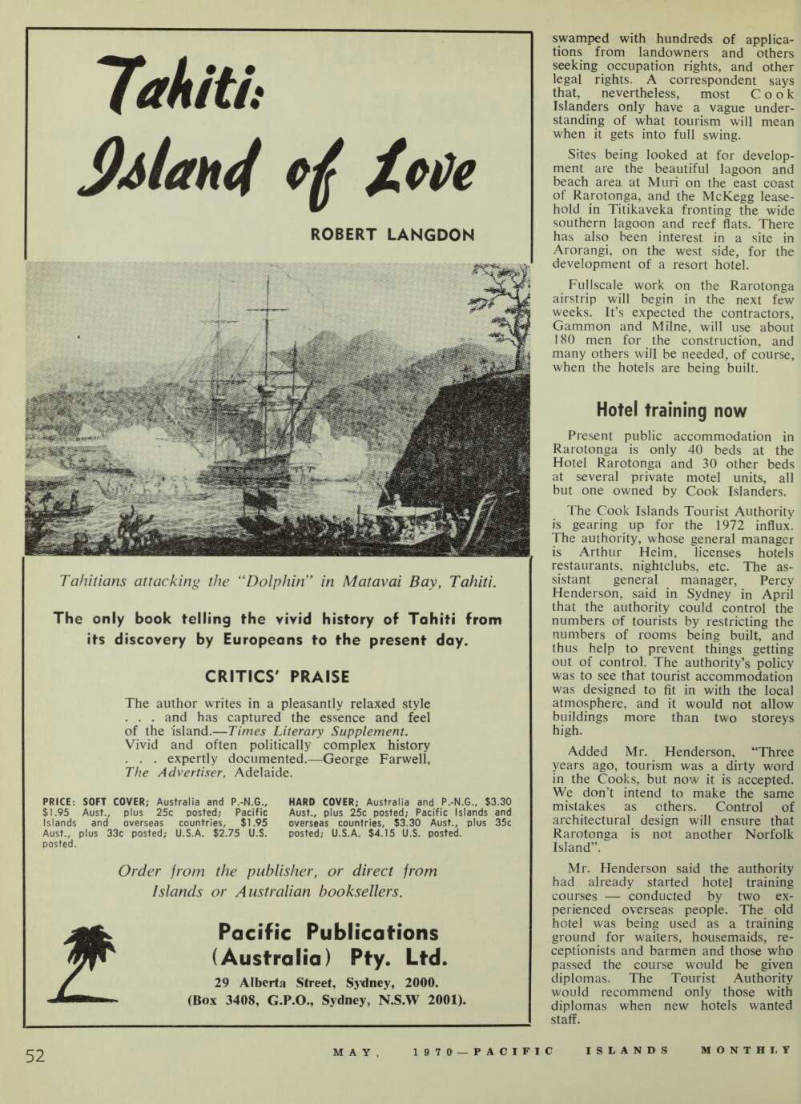 54
54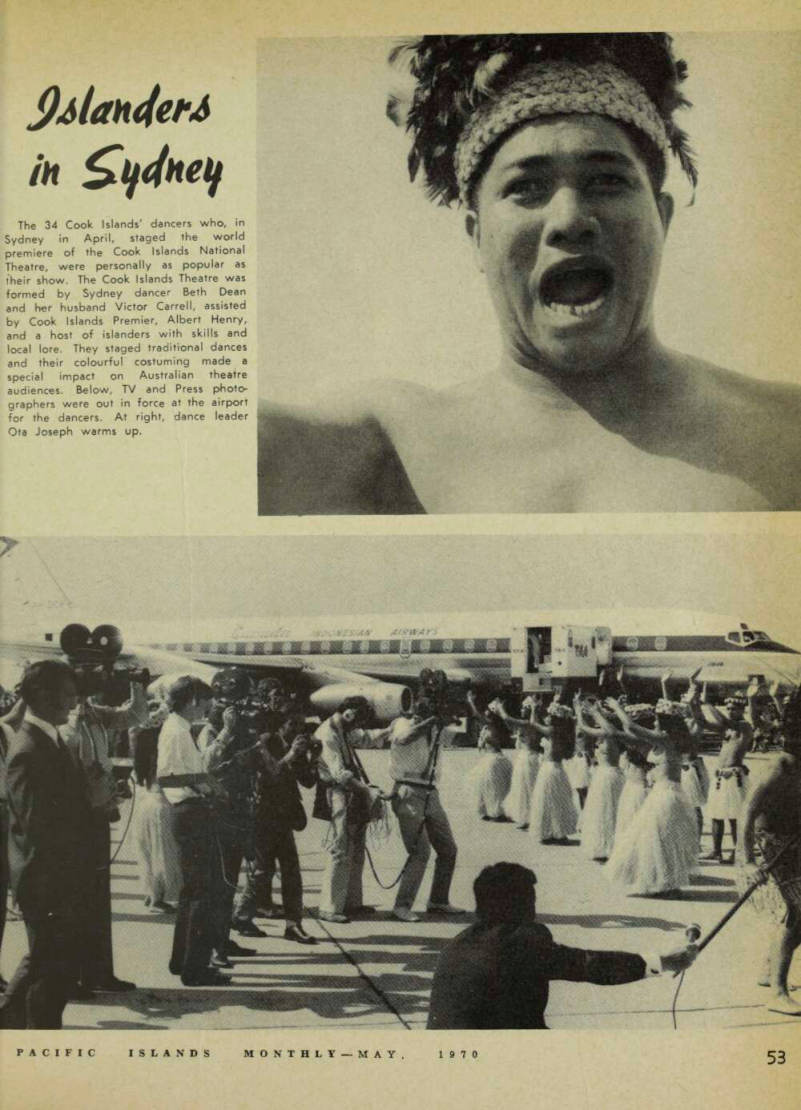 55
55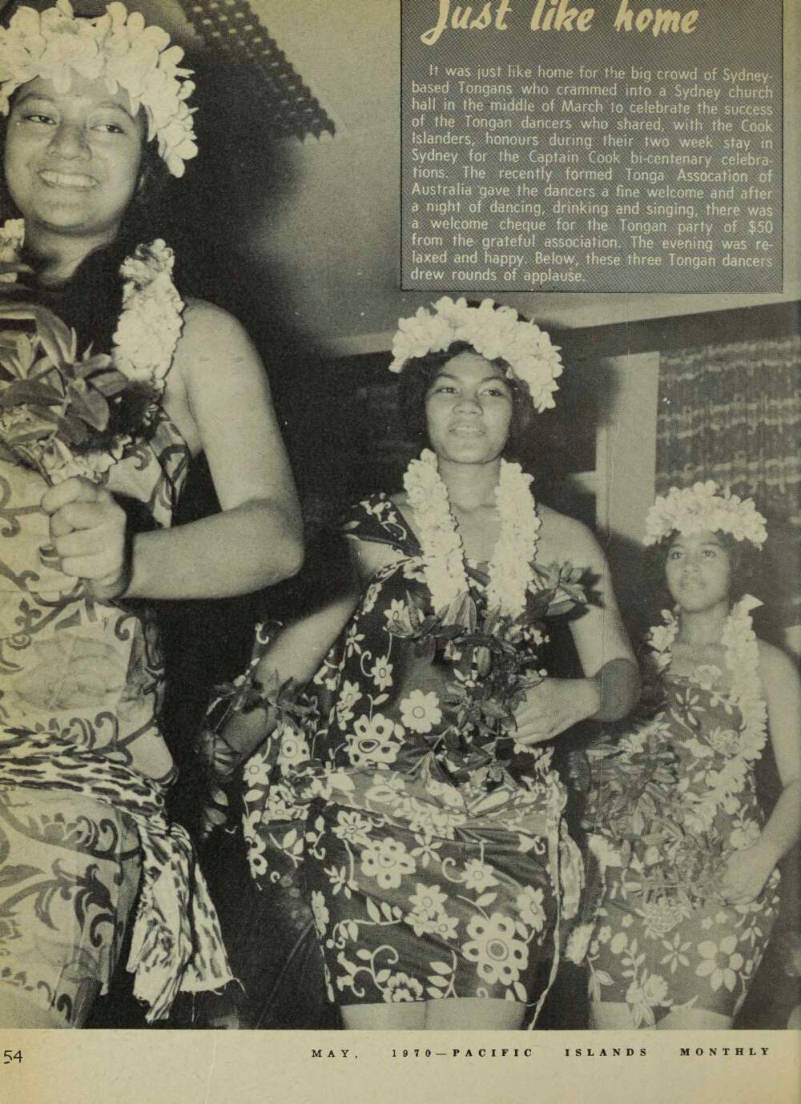 56
56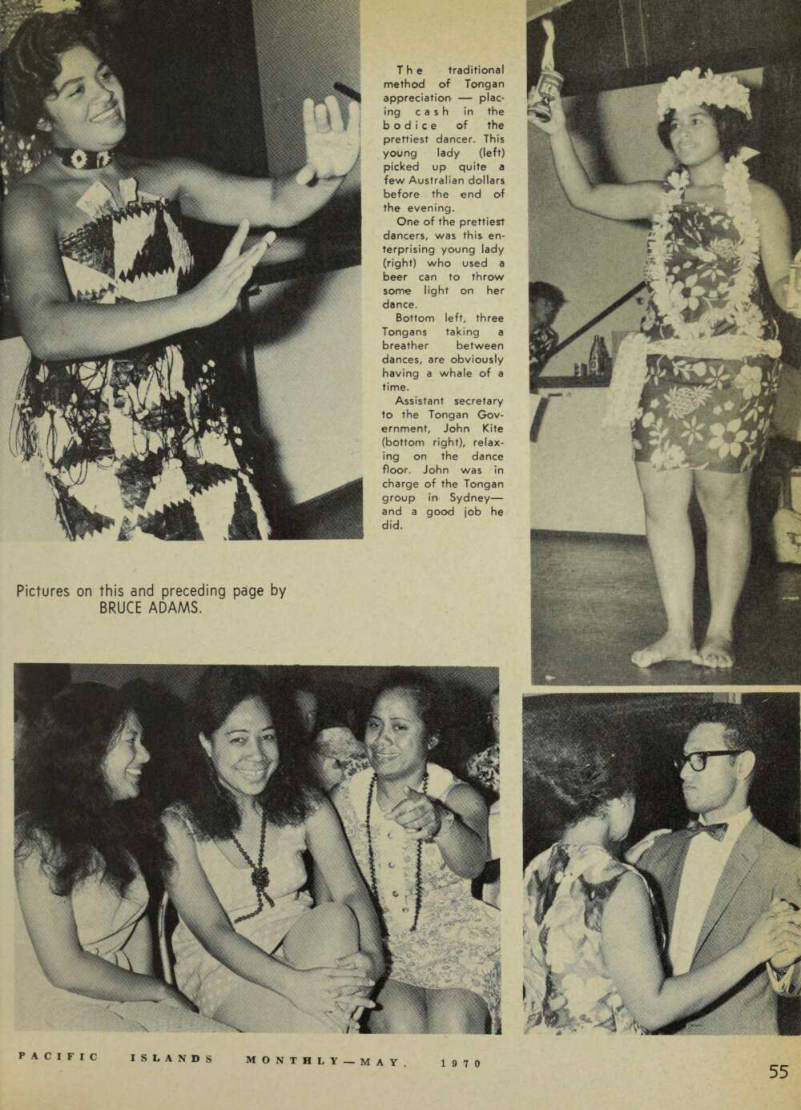 57
57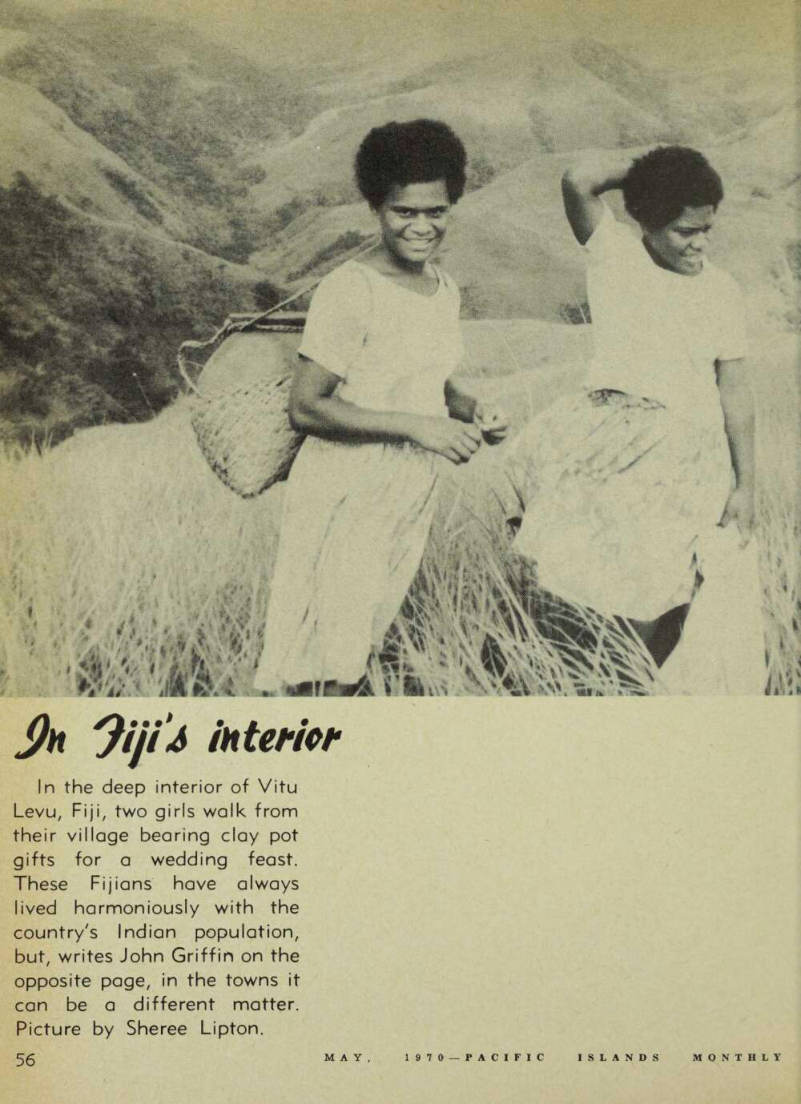 58
58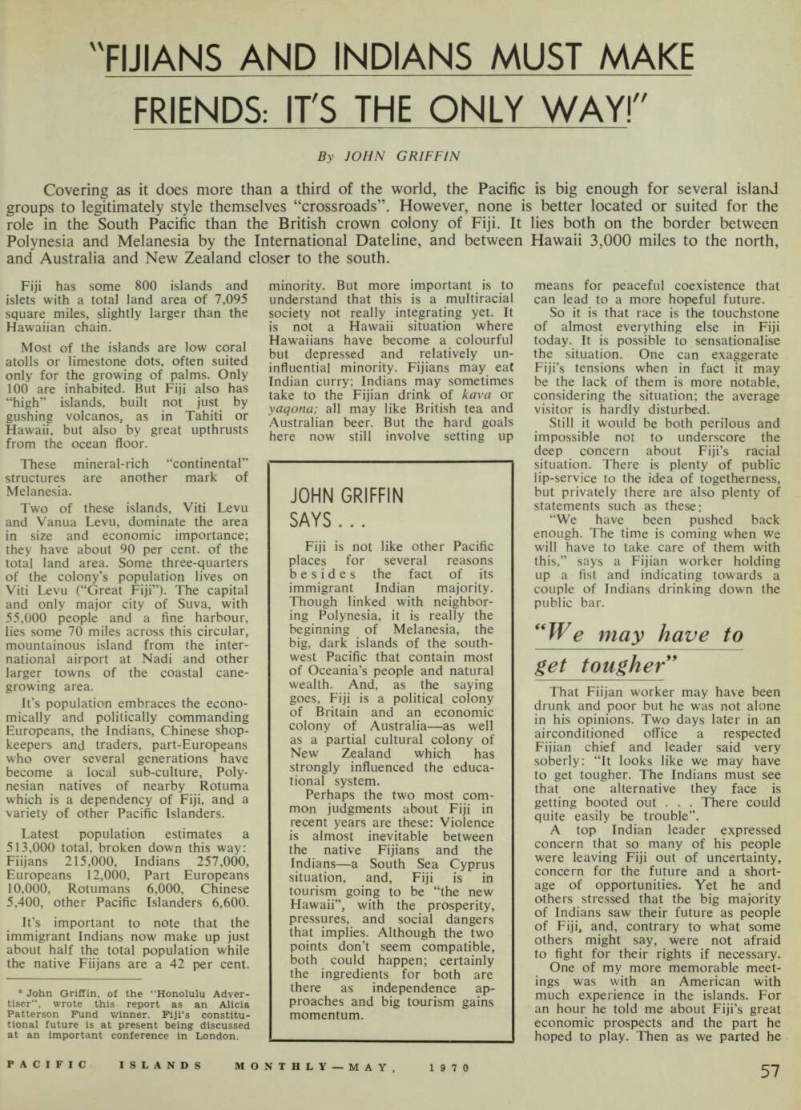 59
59 60
60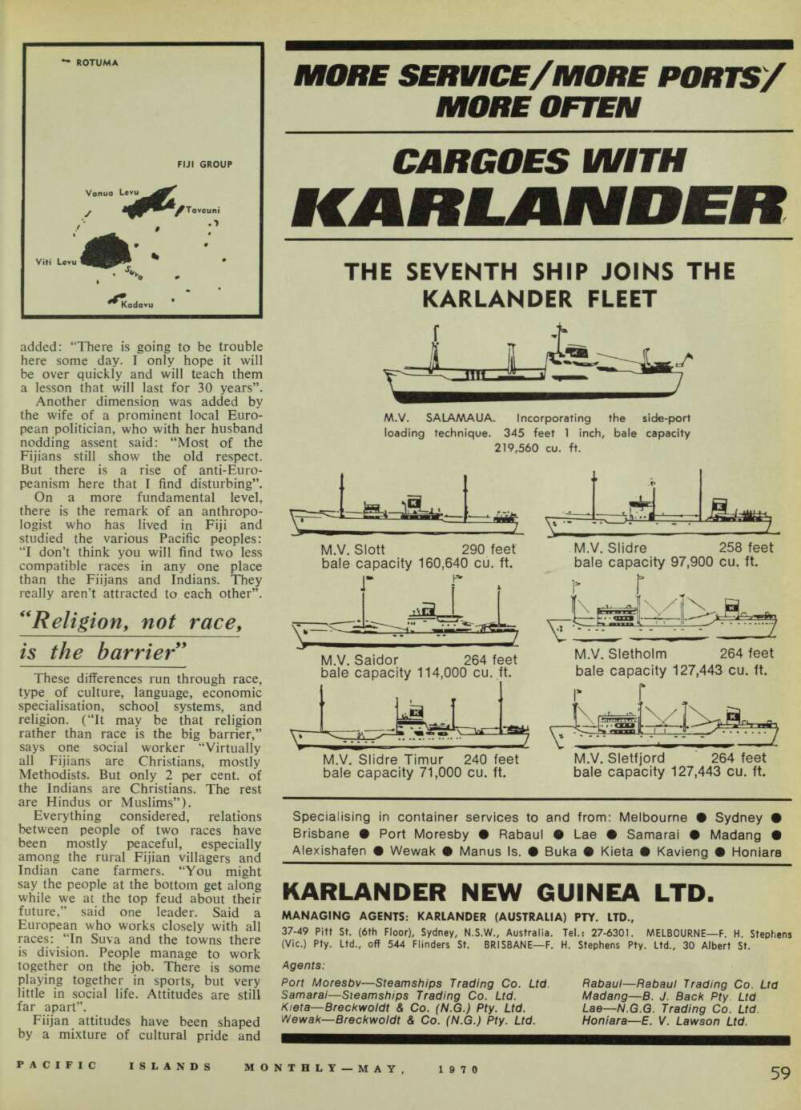 61
61 62
62 63
63 64
64 65
65 66
66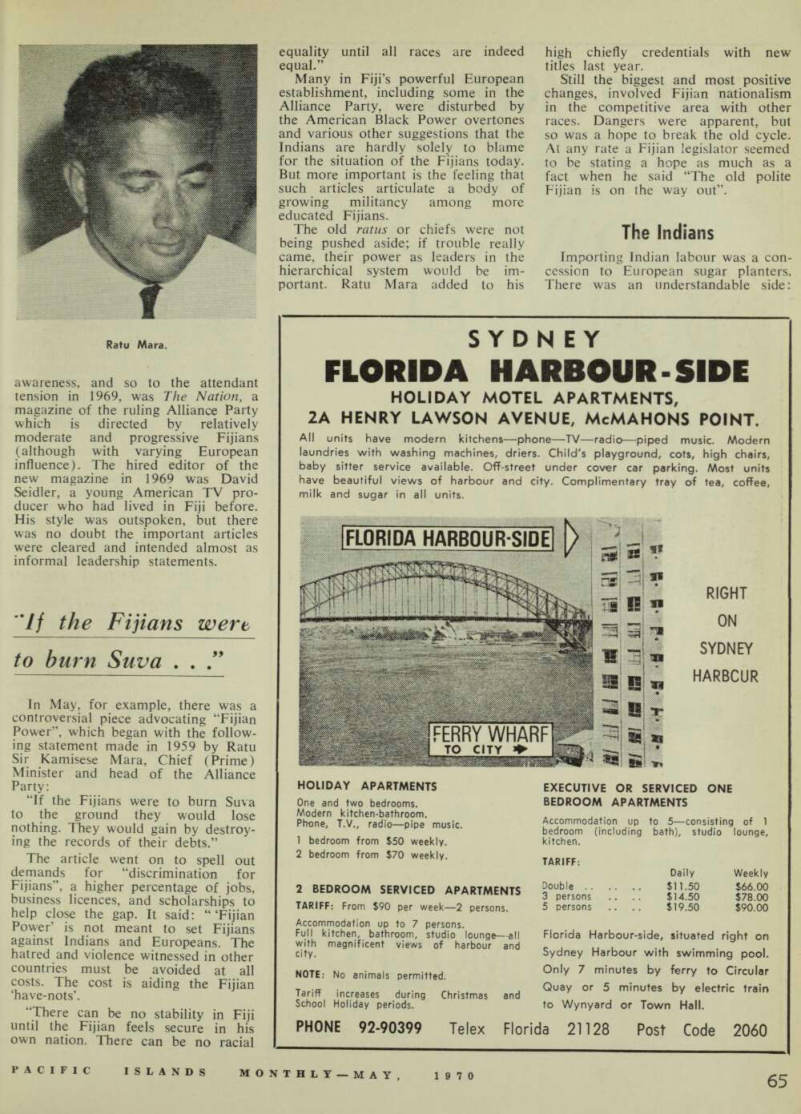 67
67 68
68 69
69 70
70 71
71 72
72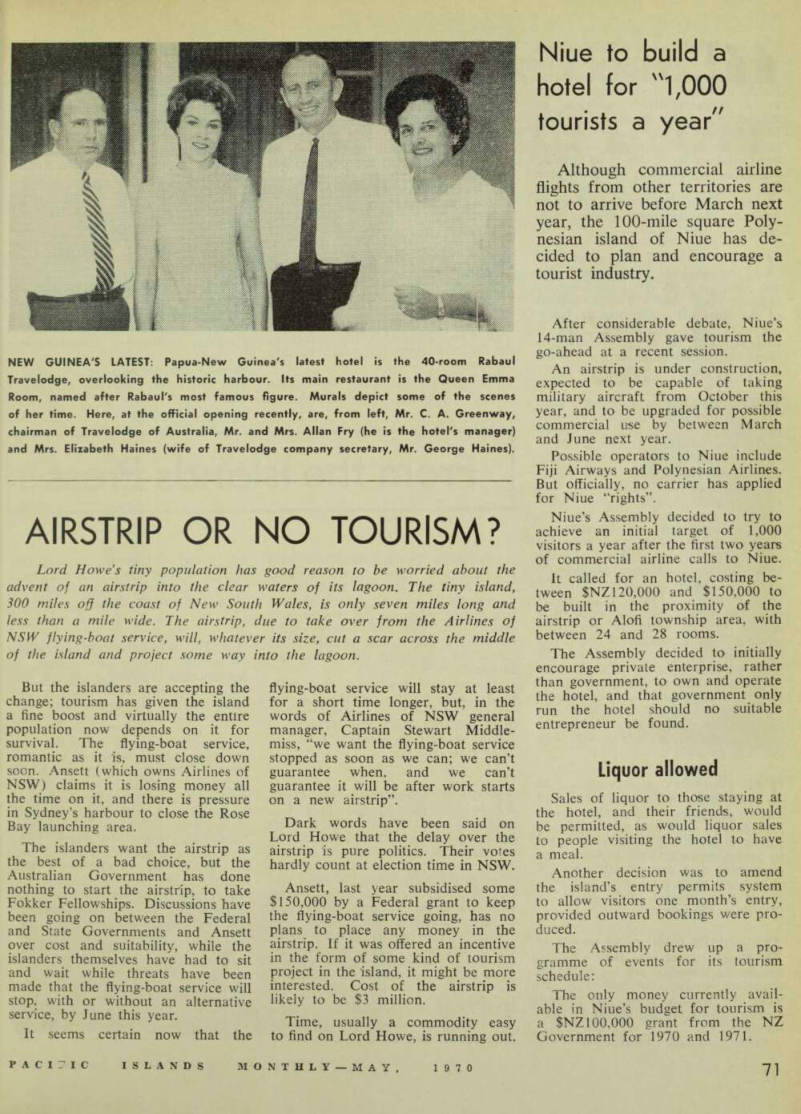 73
73 74
74 75
75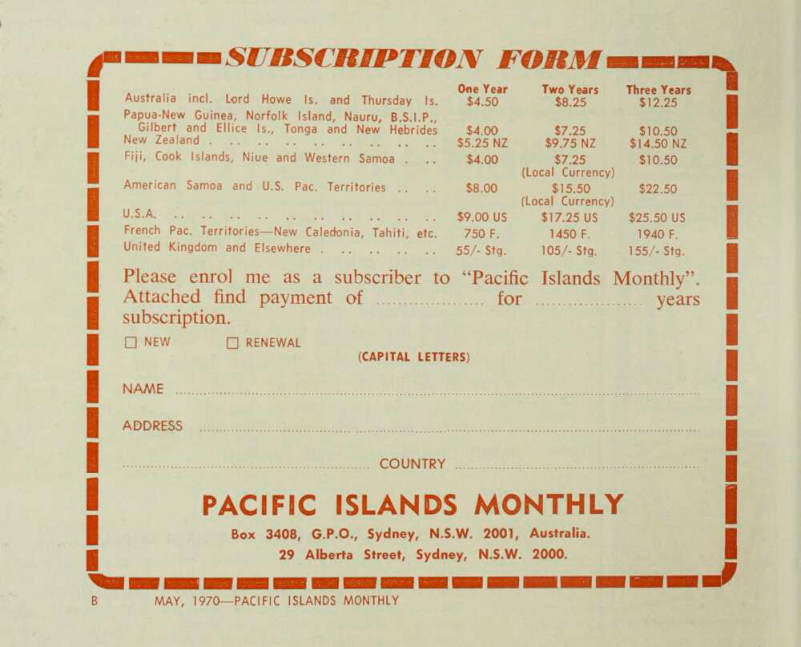 76
76 77
77 78
78 79
79 80
80 81
81 82
82 83
83 84
84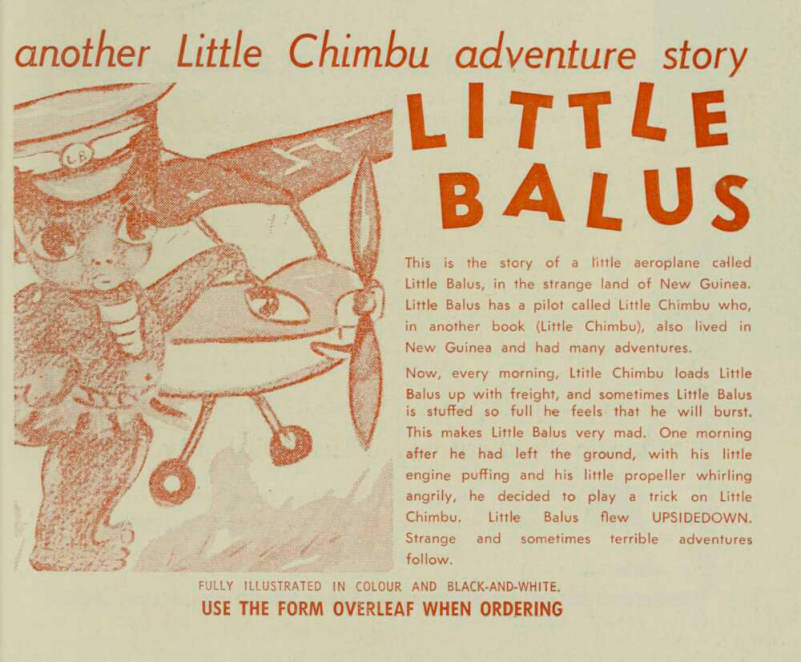 85
85 86
86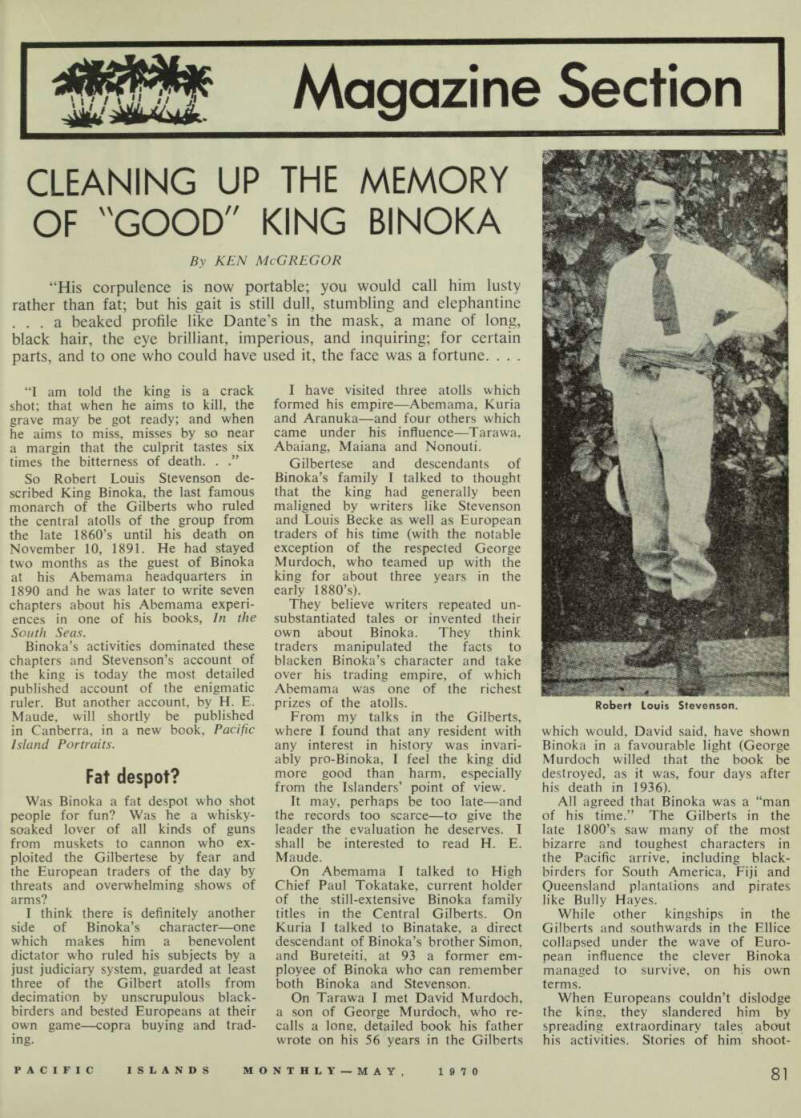 87
87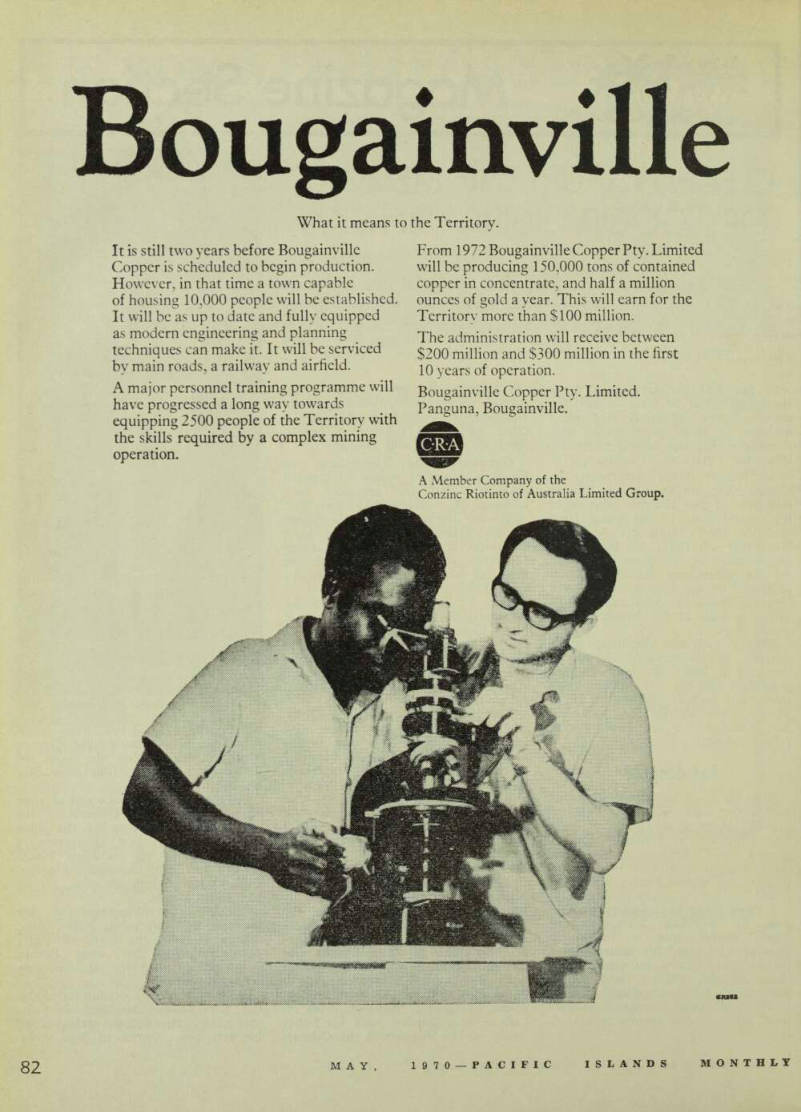 88
88 89
89 90
90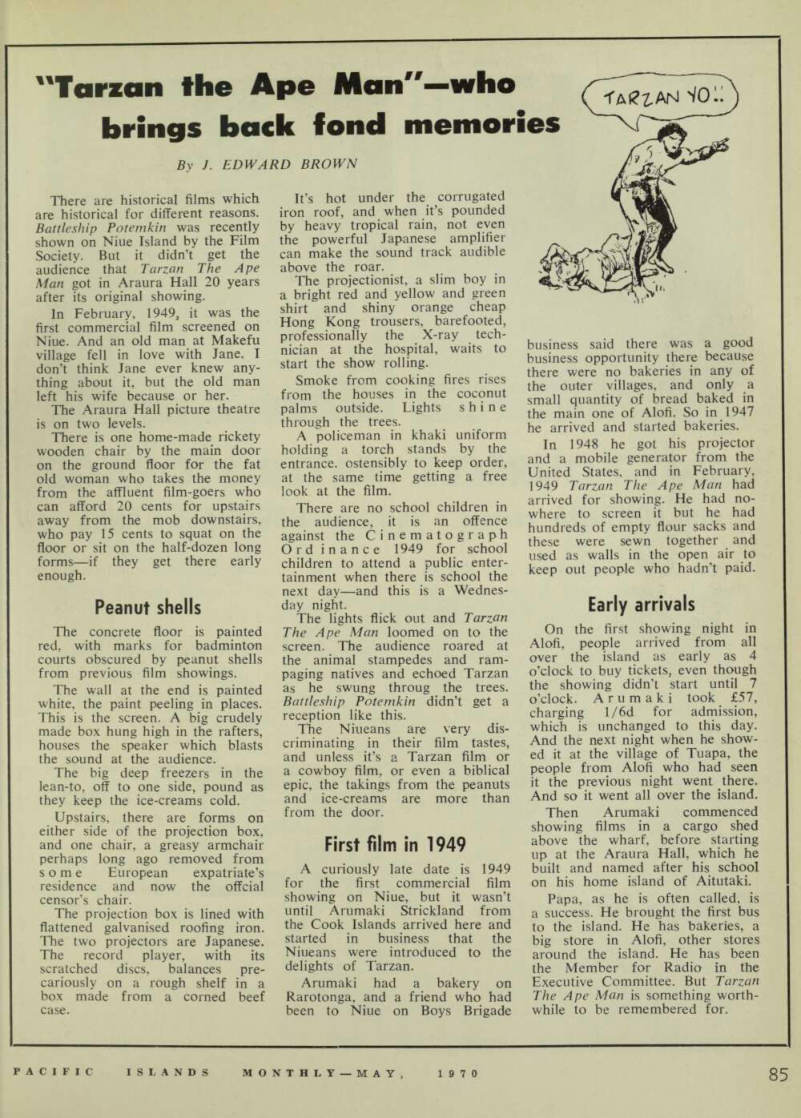 91
91 92
92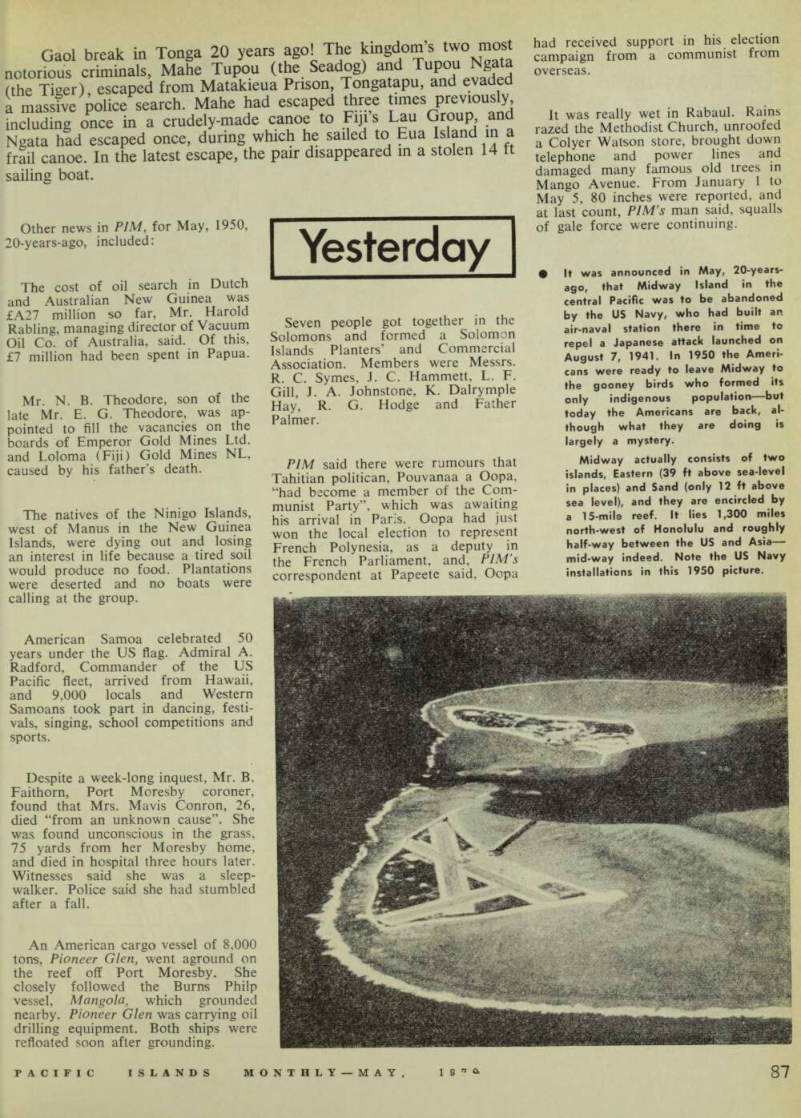 93
93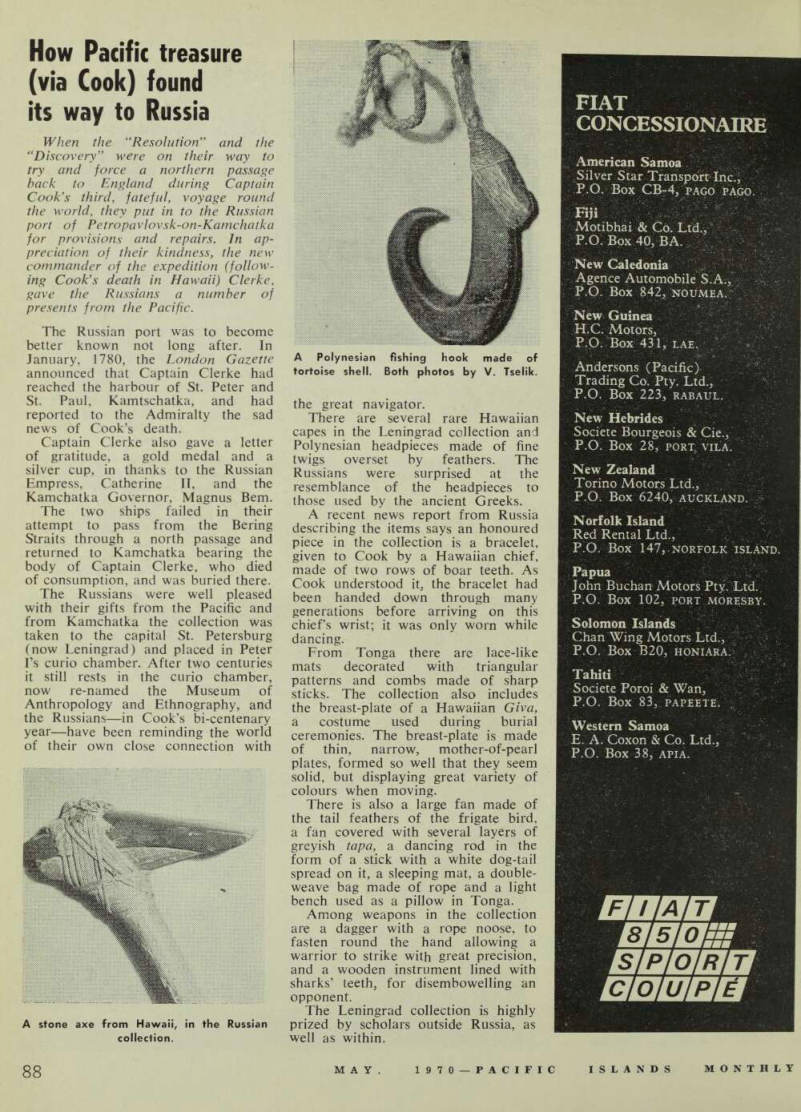 94
94 95
95 96
96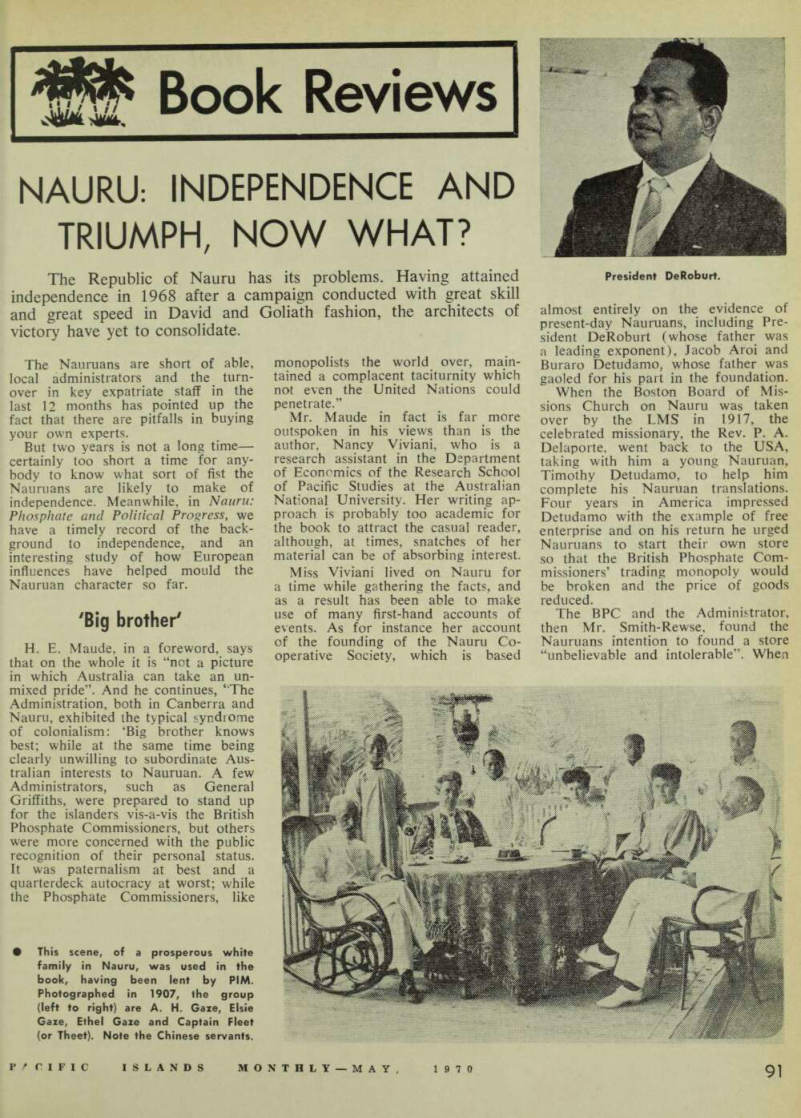 97
97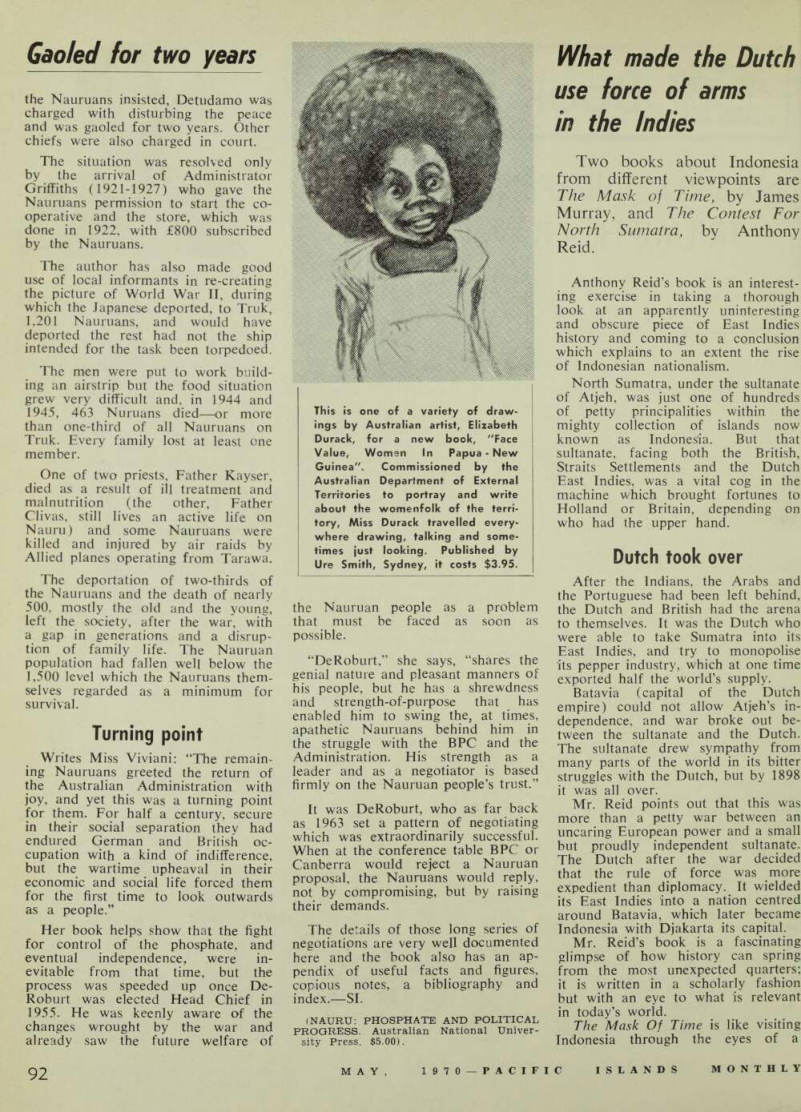 98
98 99
99 100
100 101
101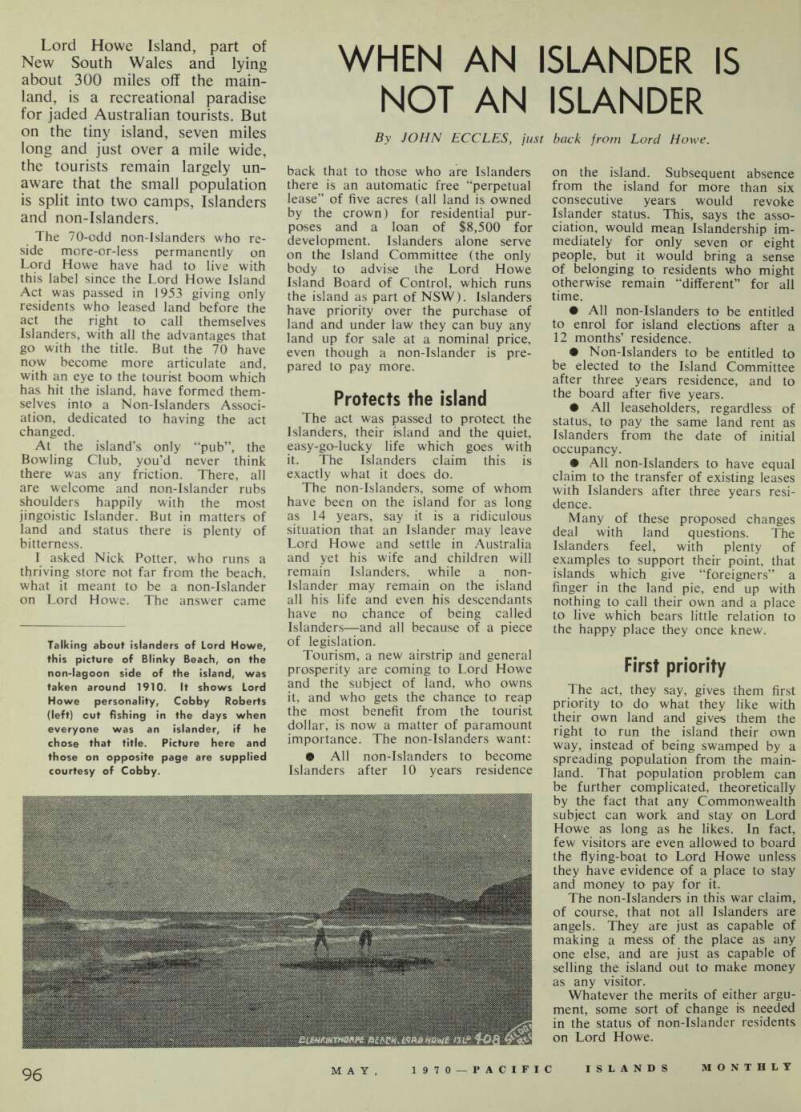 102
102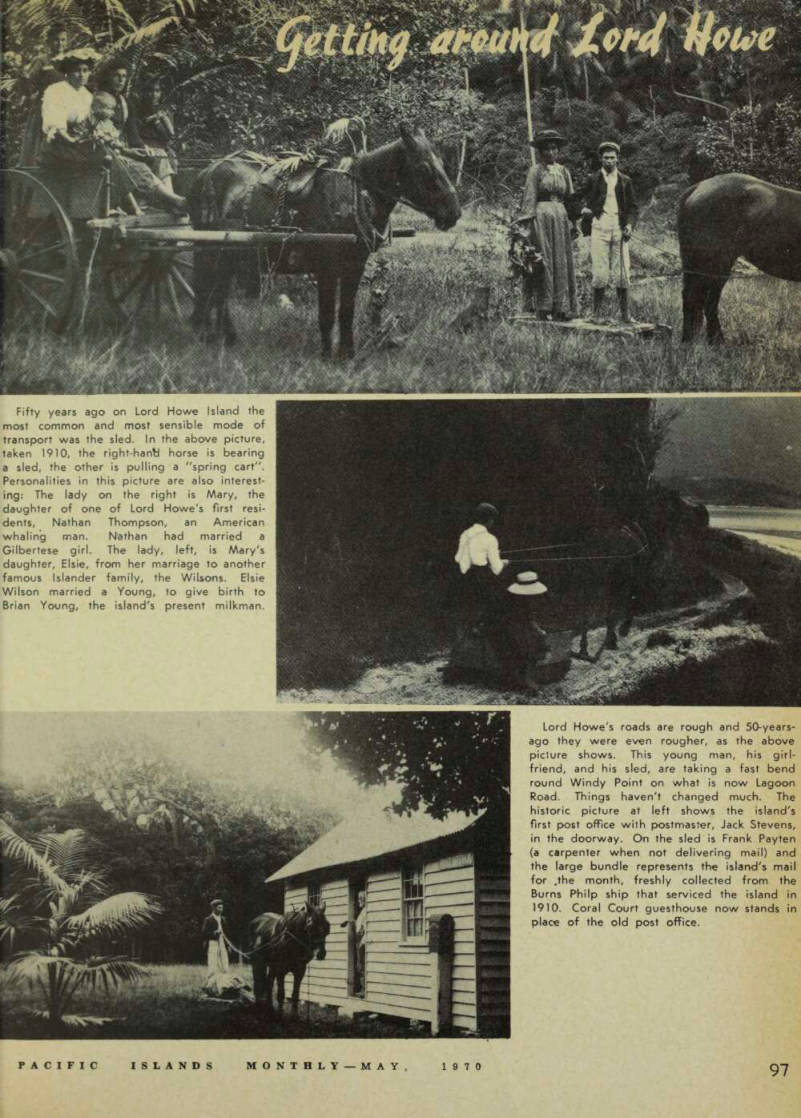 103
103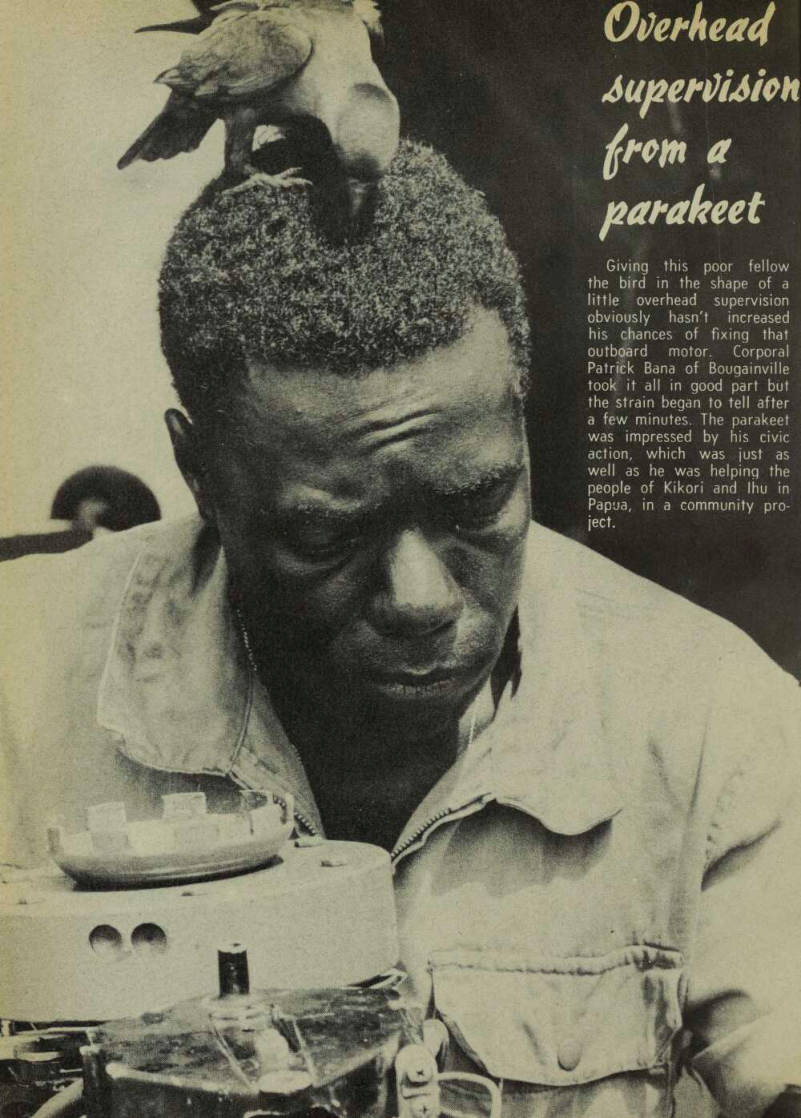 104
104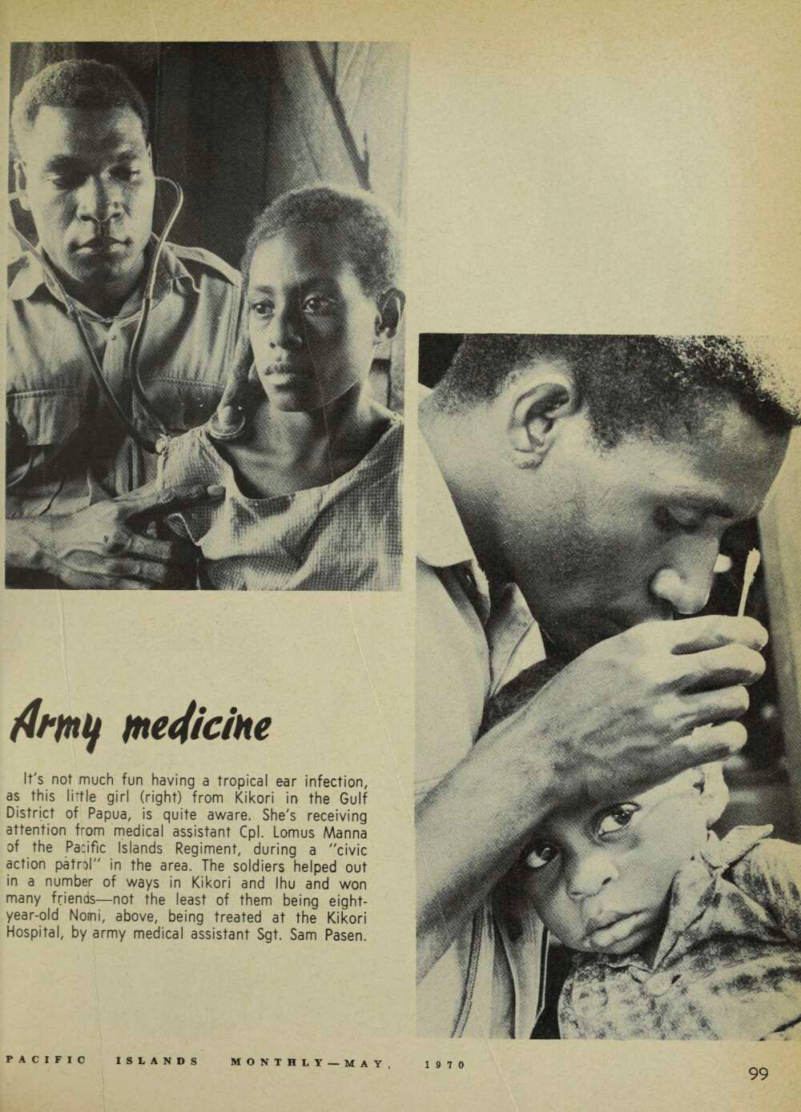 105
105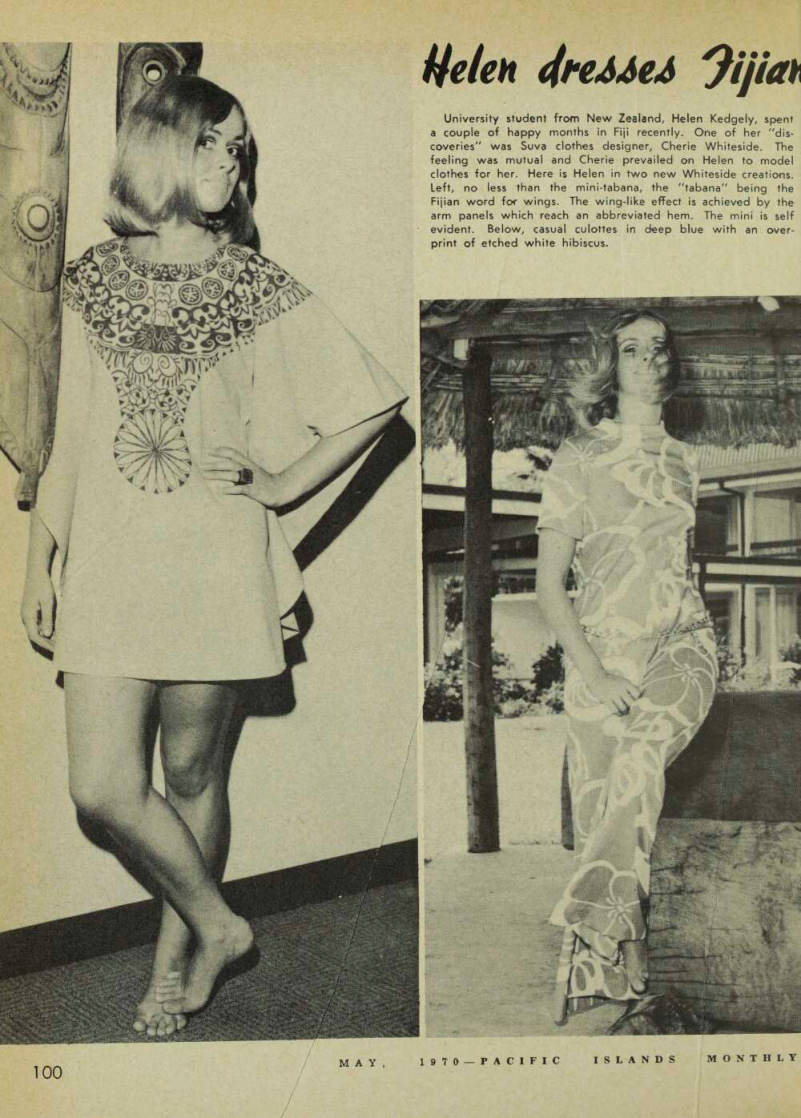 106
106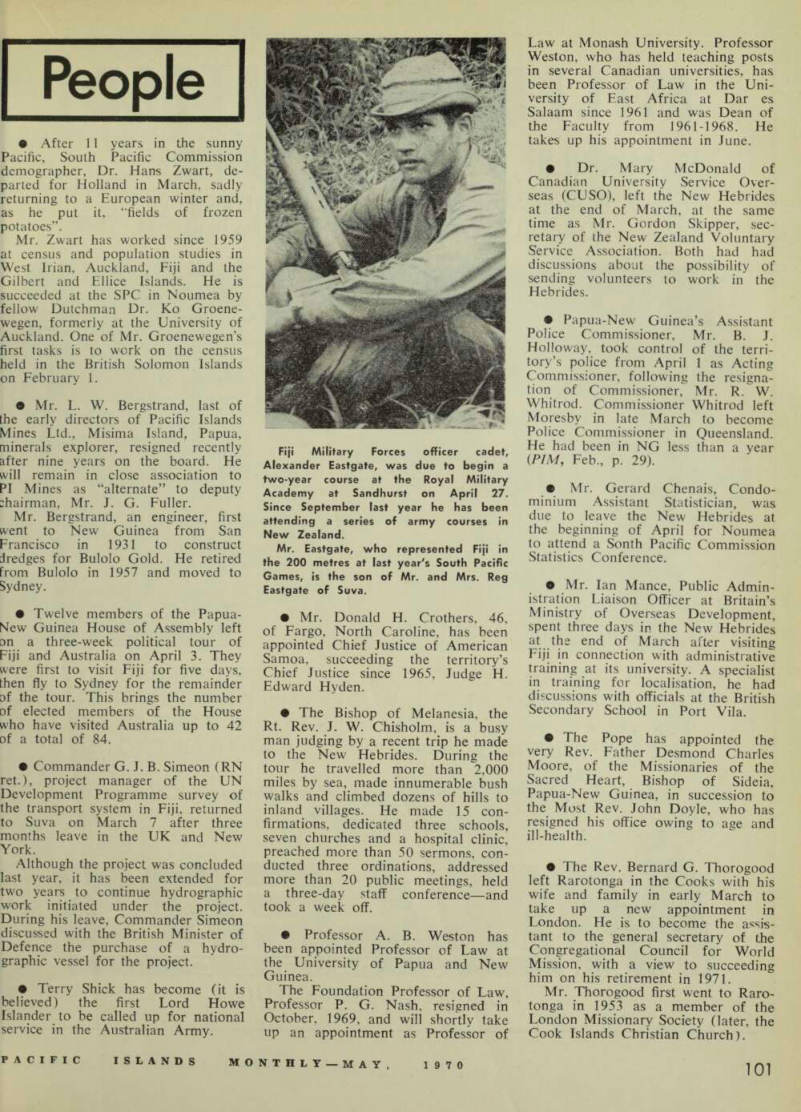 107
107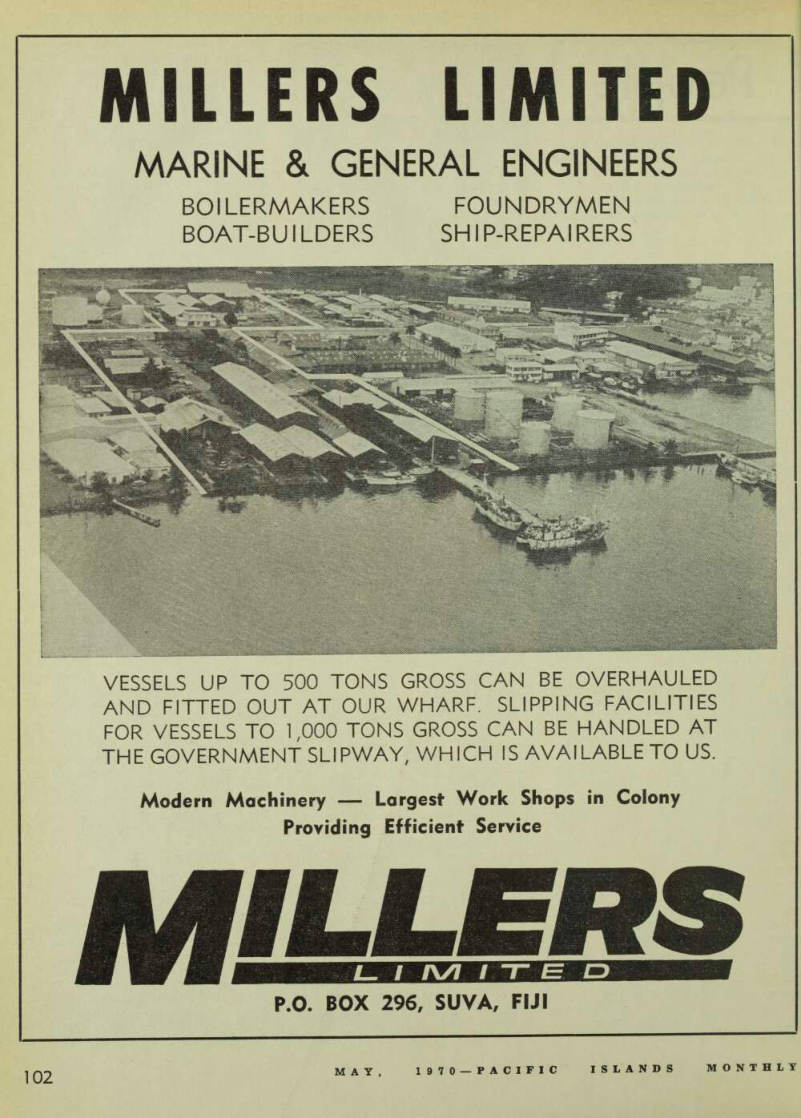 108
108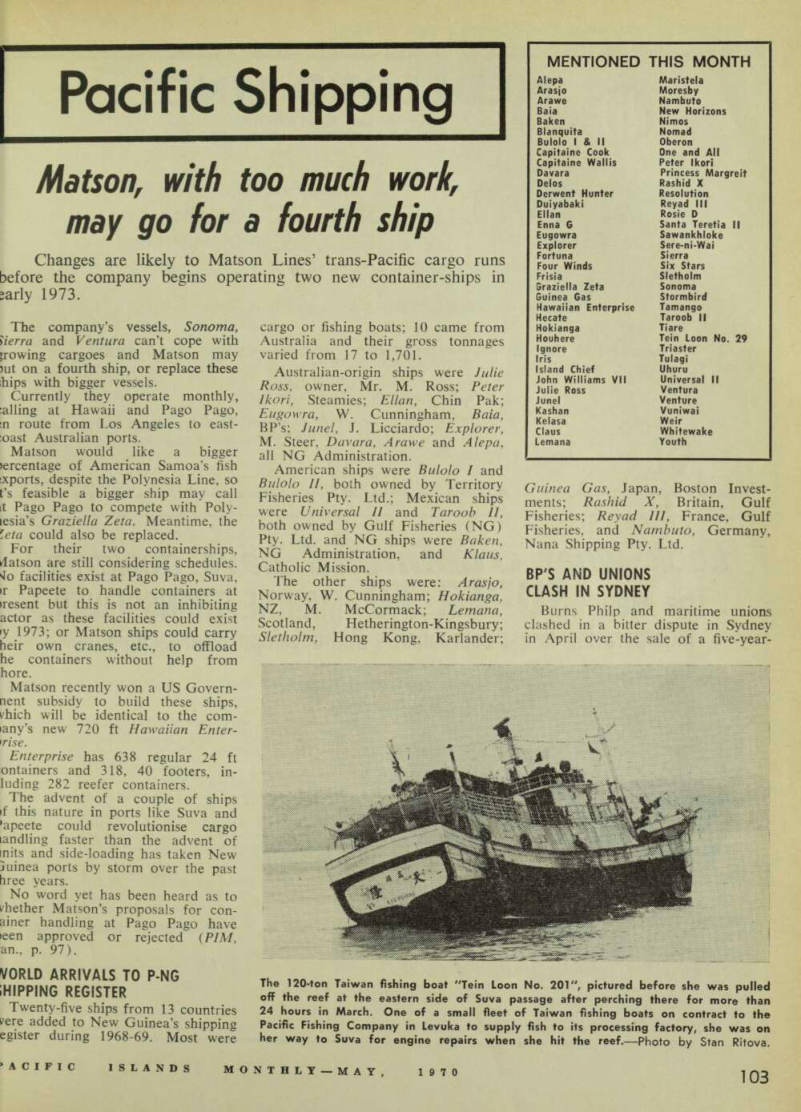 109
109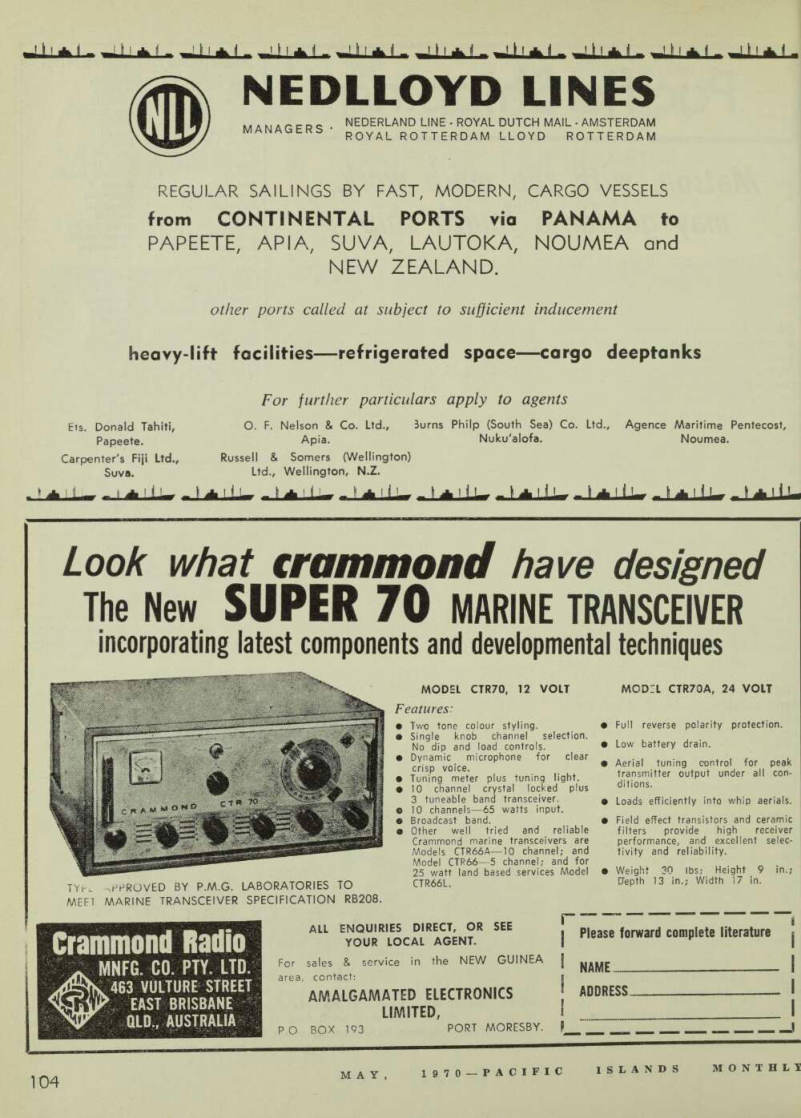 110
110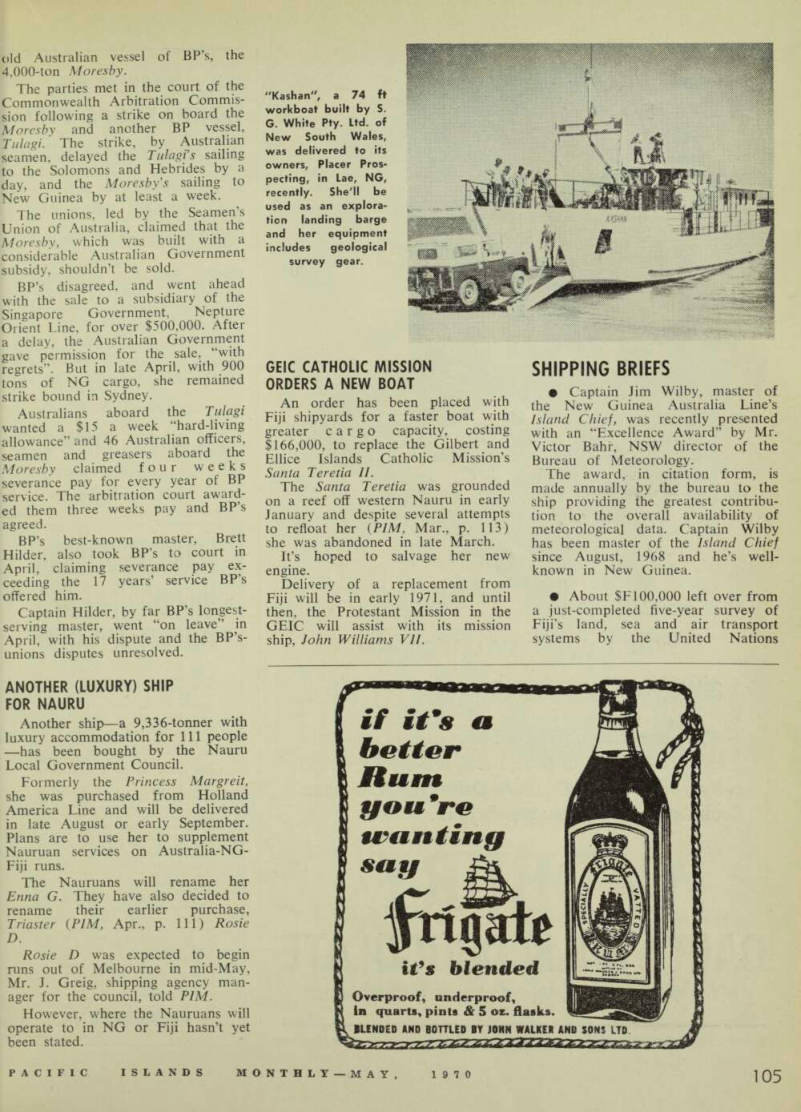 111
111 112
112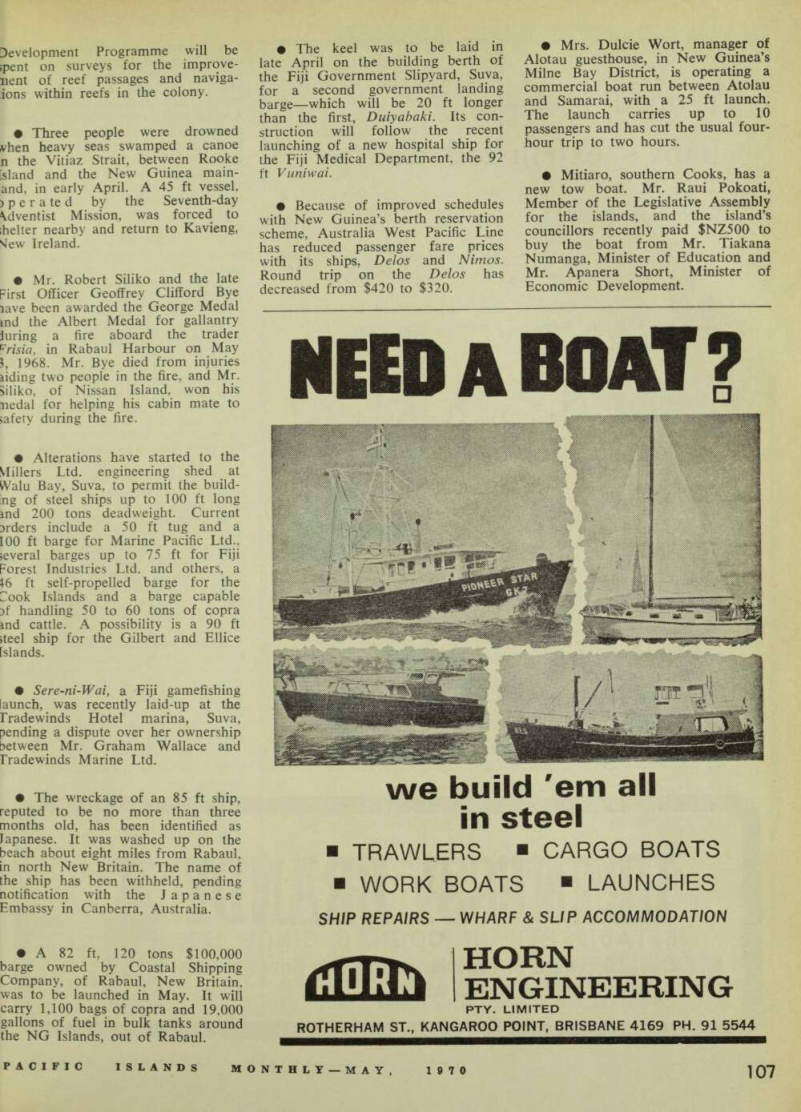 113
113 114
114 115
115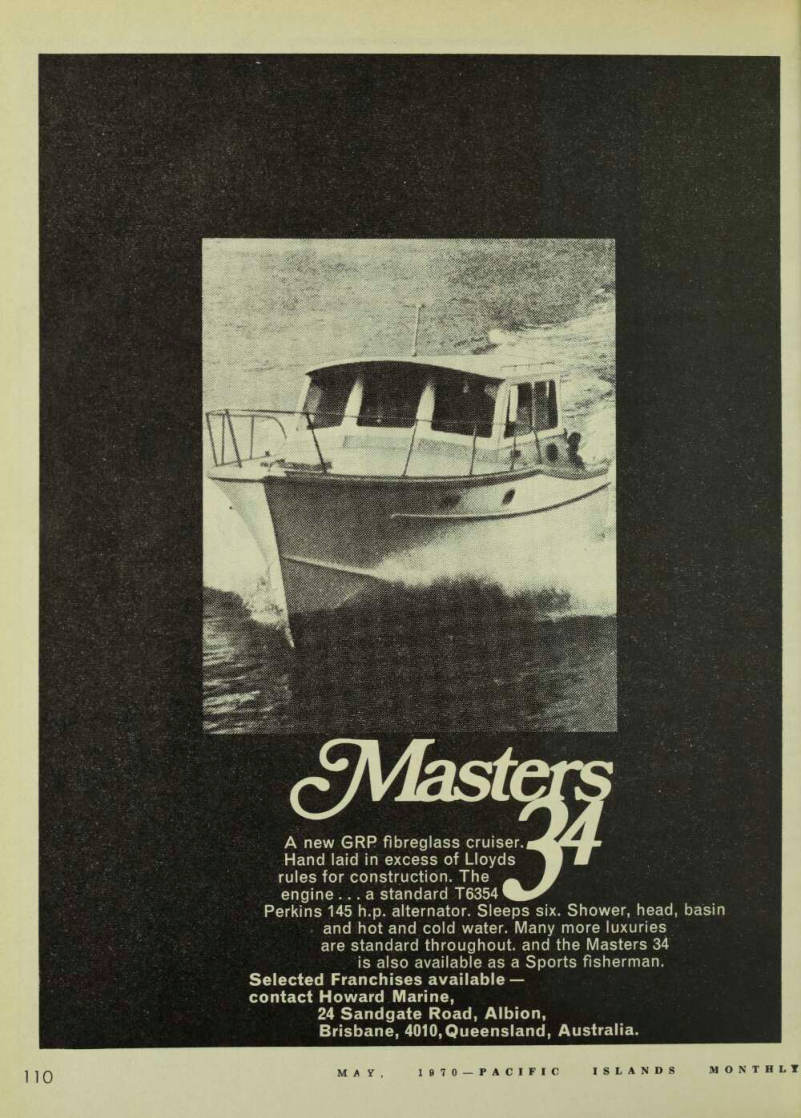 116
116 117
117 118
118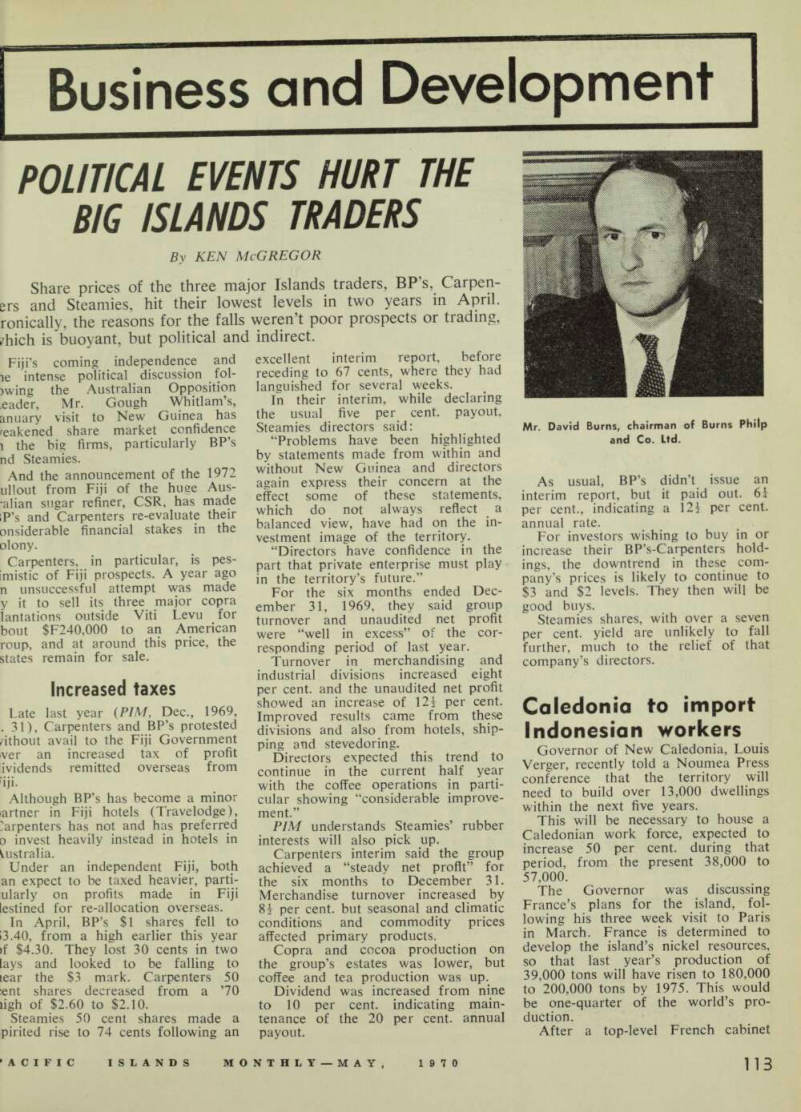 119
119 120
120 121
121 122
122 123
123 124
124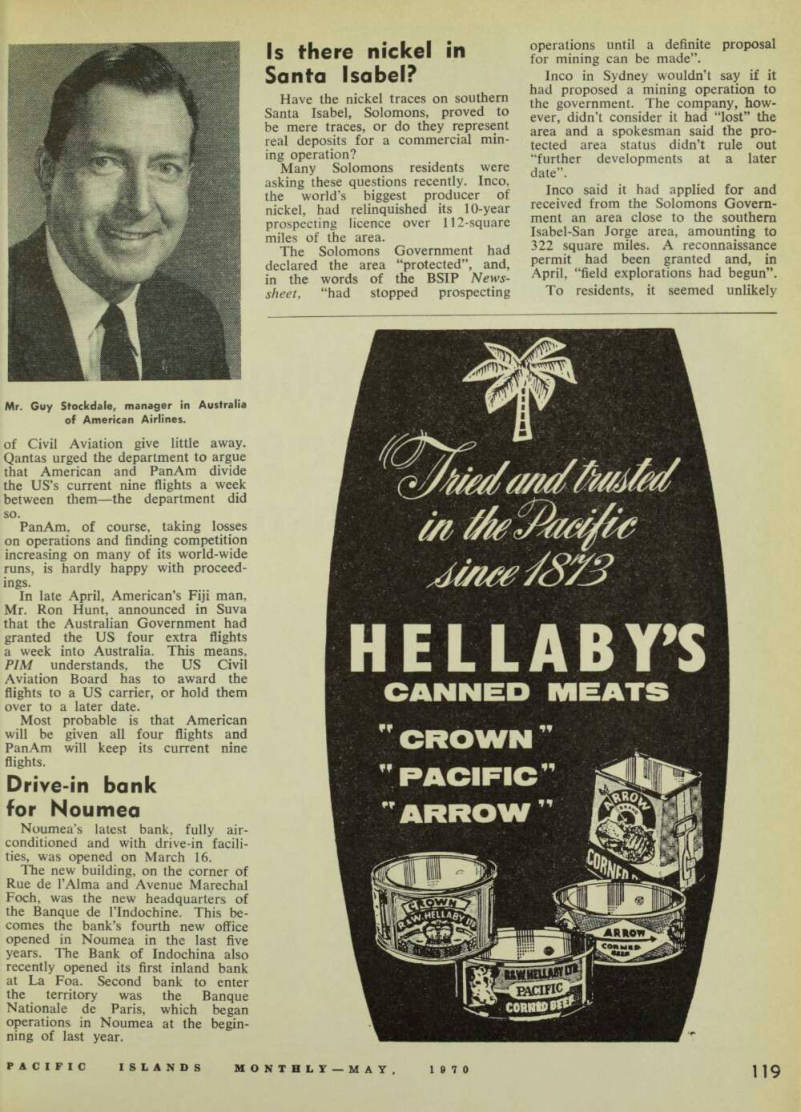 125
125 126
126 127
127 128
128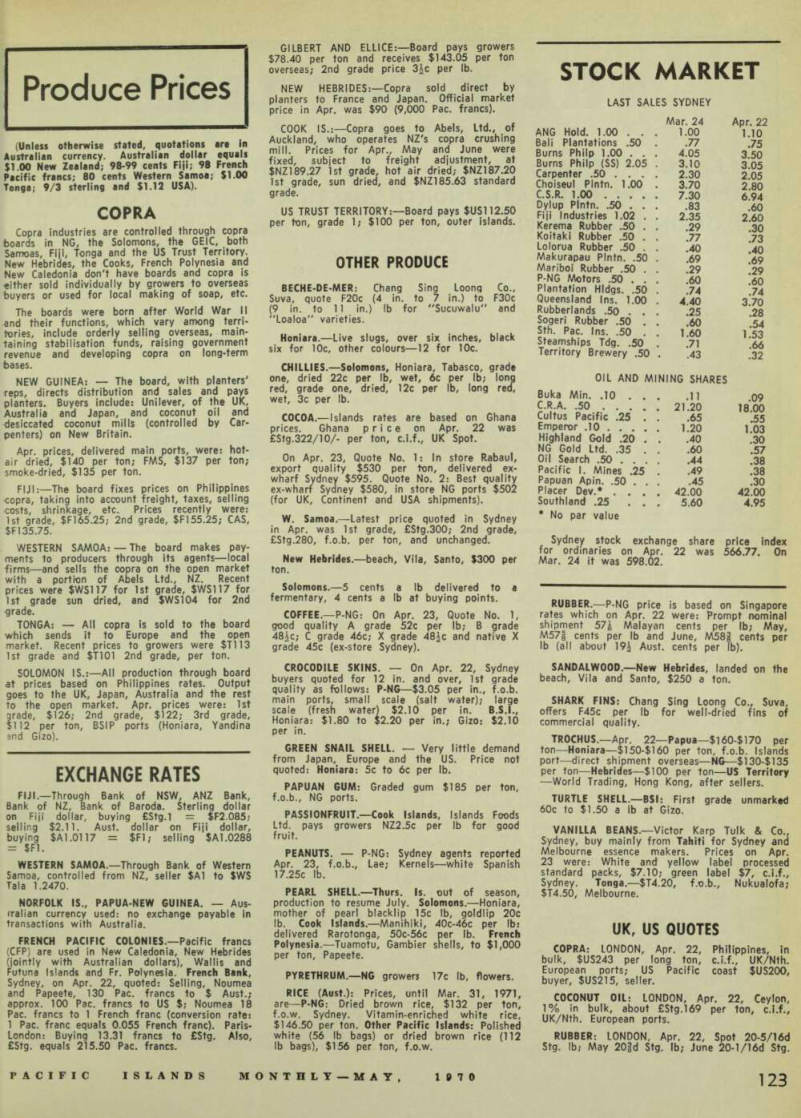 129
129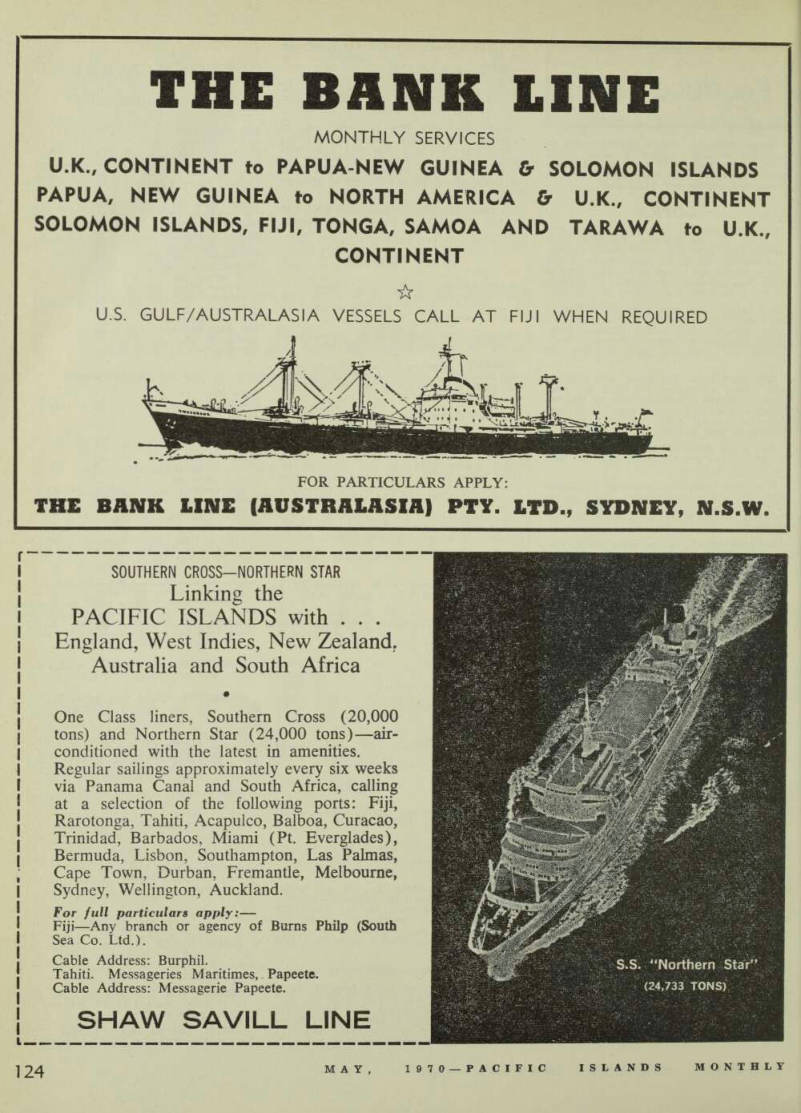 130
130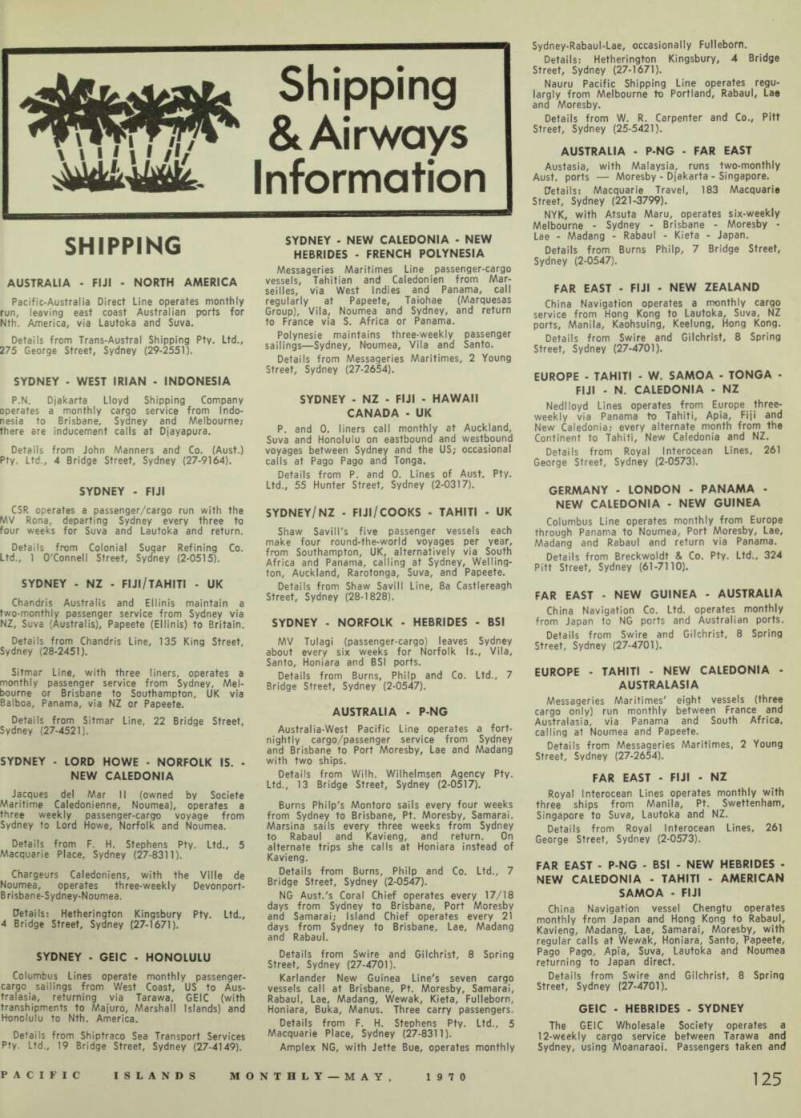 131
131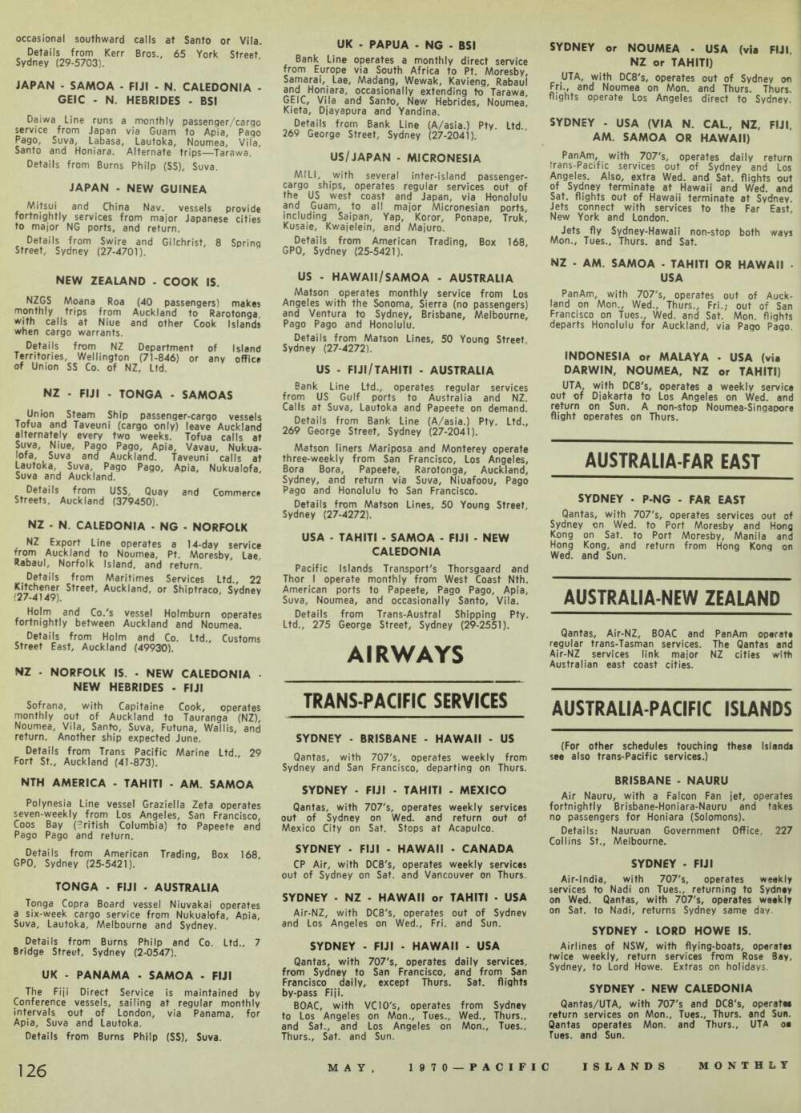 132
132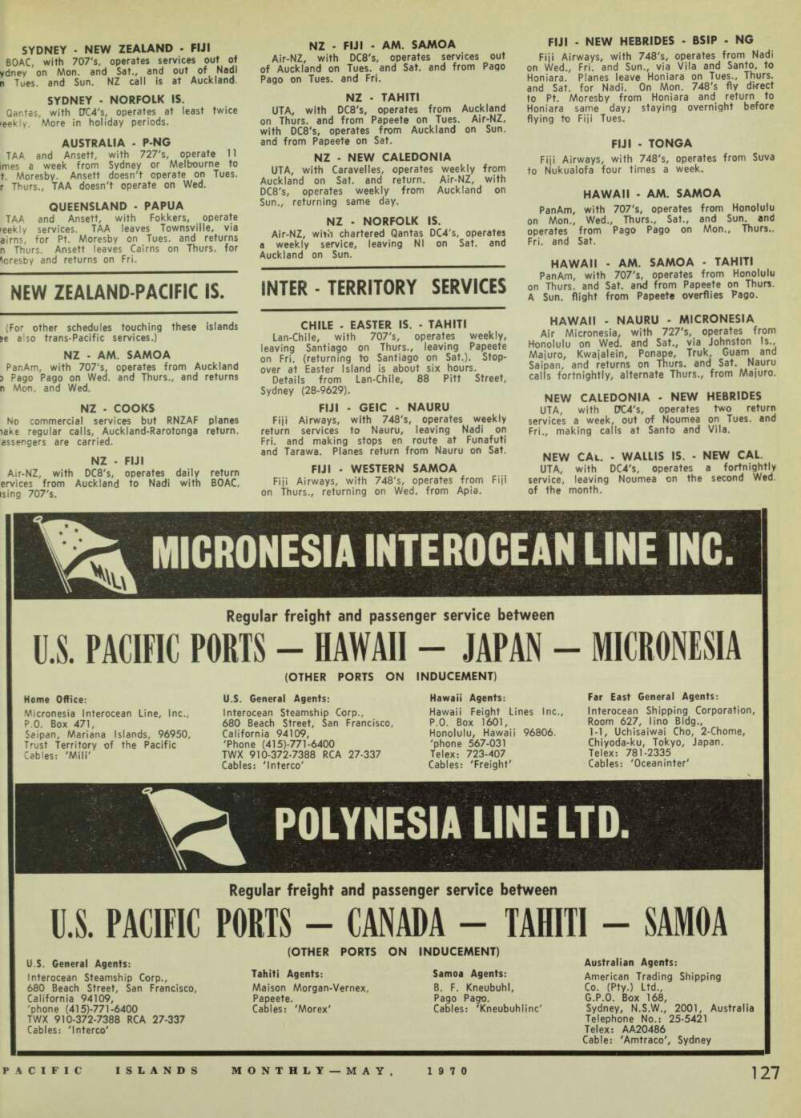 133
133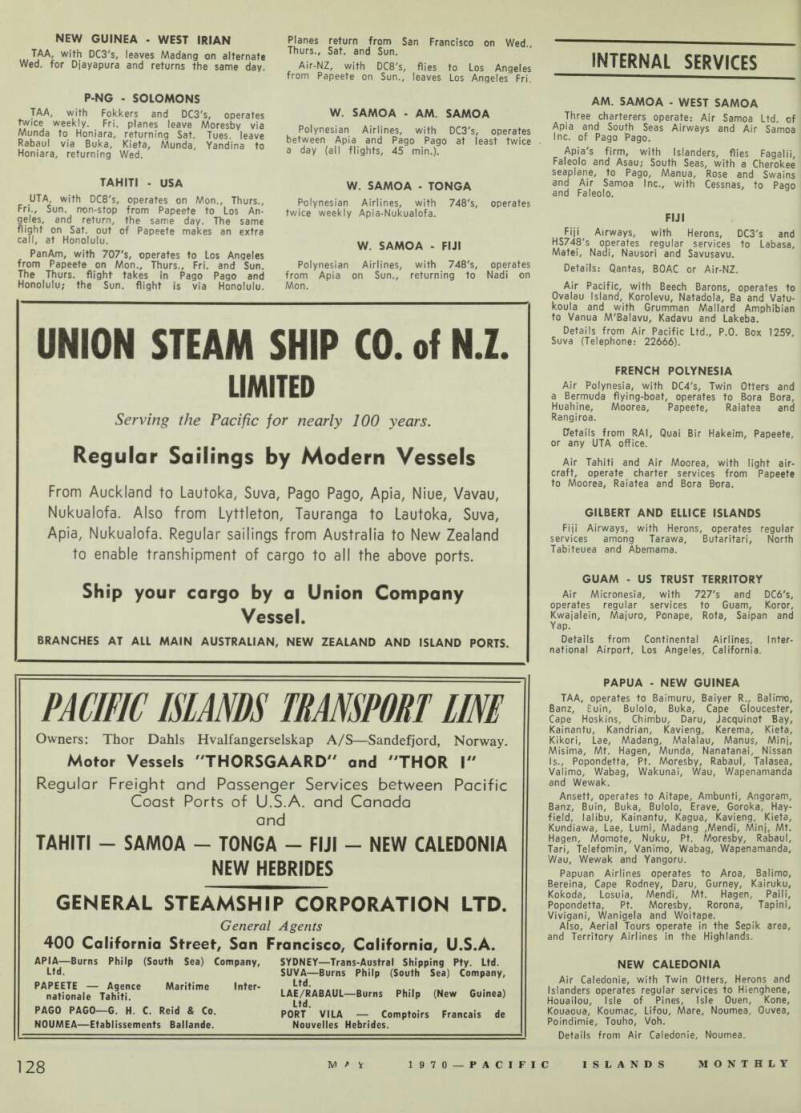 134
134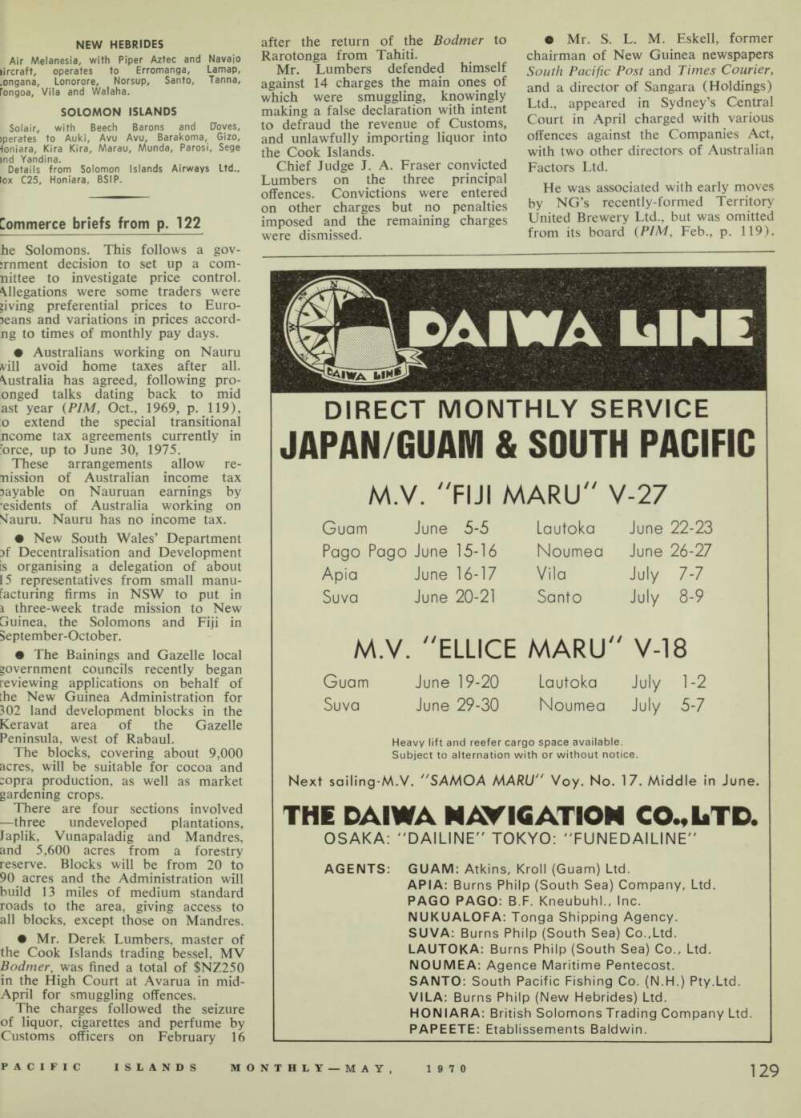 135
135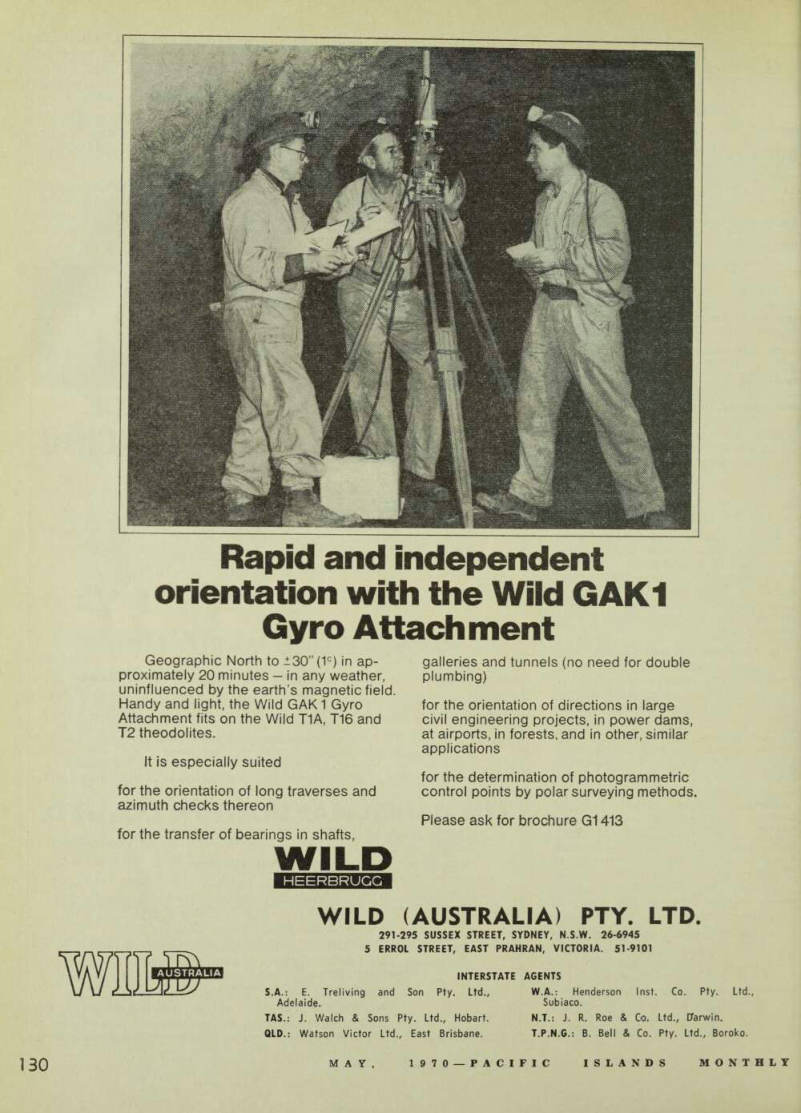 136
136 137
137 138
138 139
139 140
140 141
141 142
142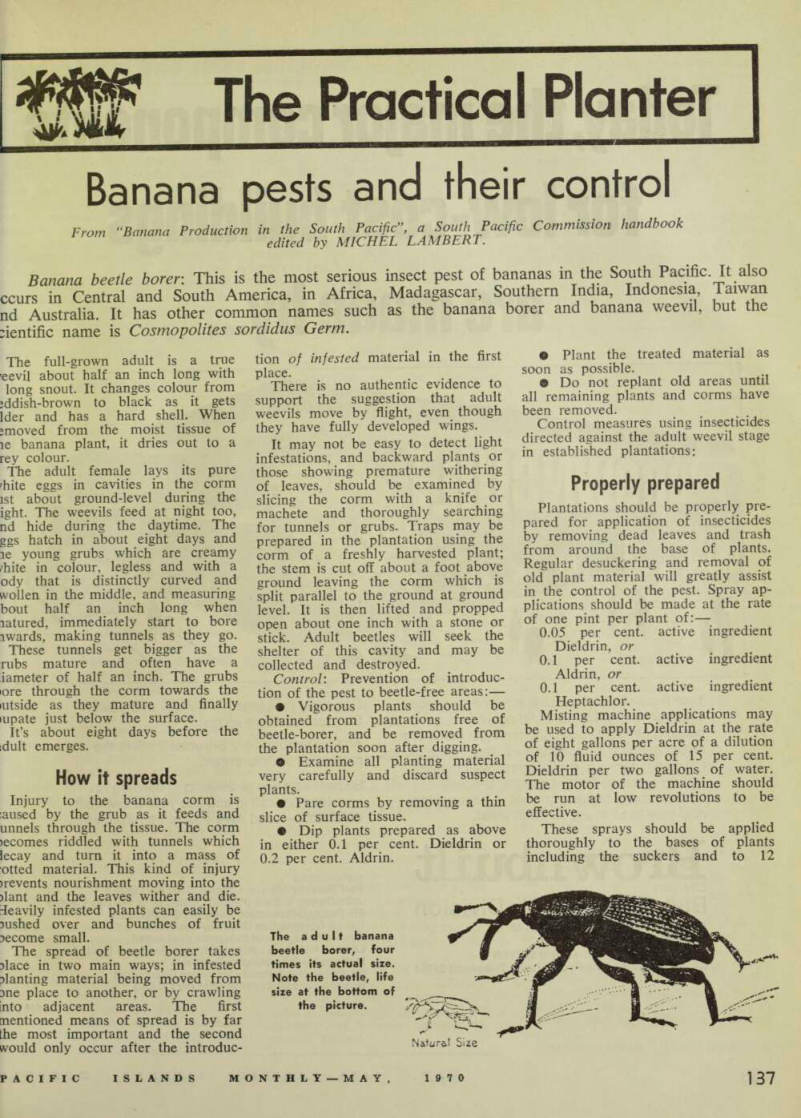 143
143 144
144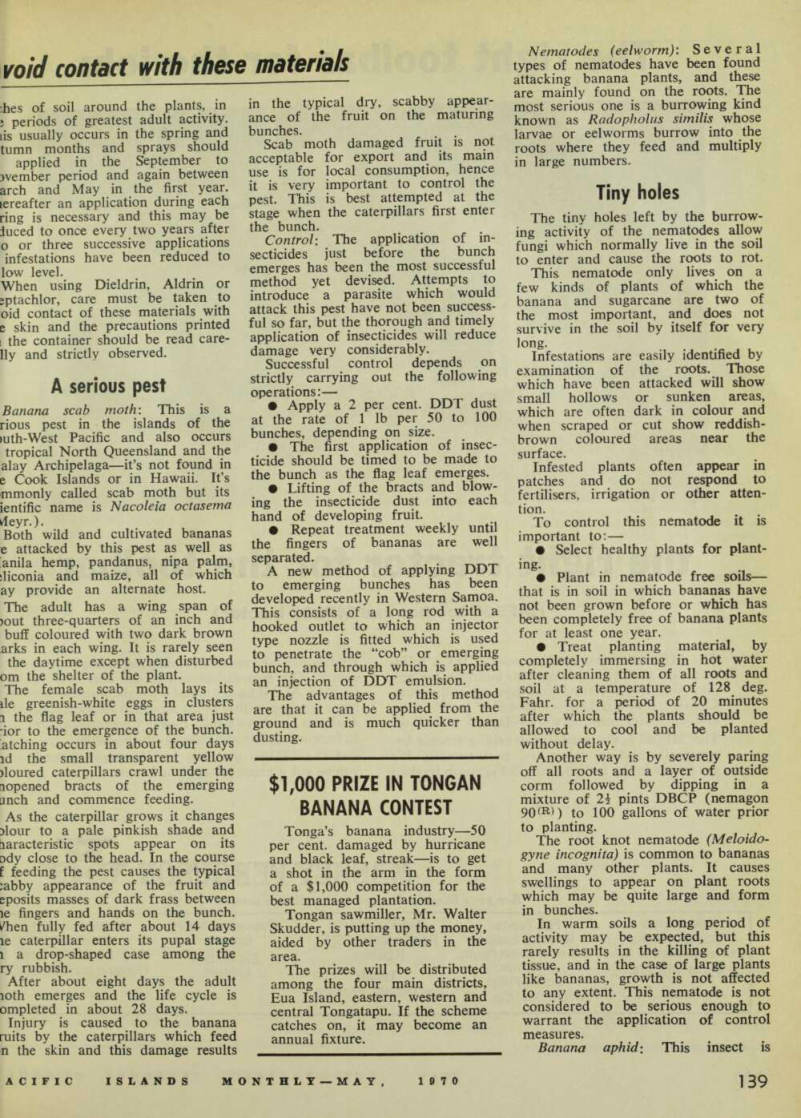 145
145 146
146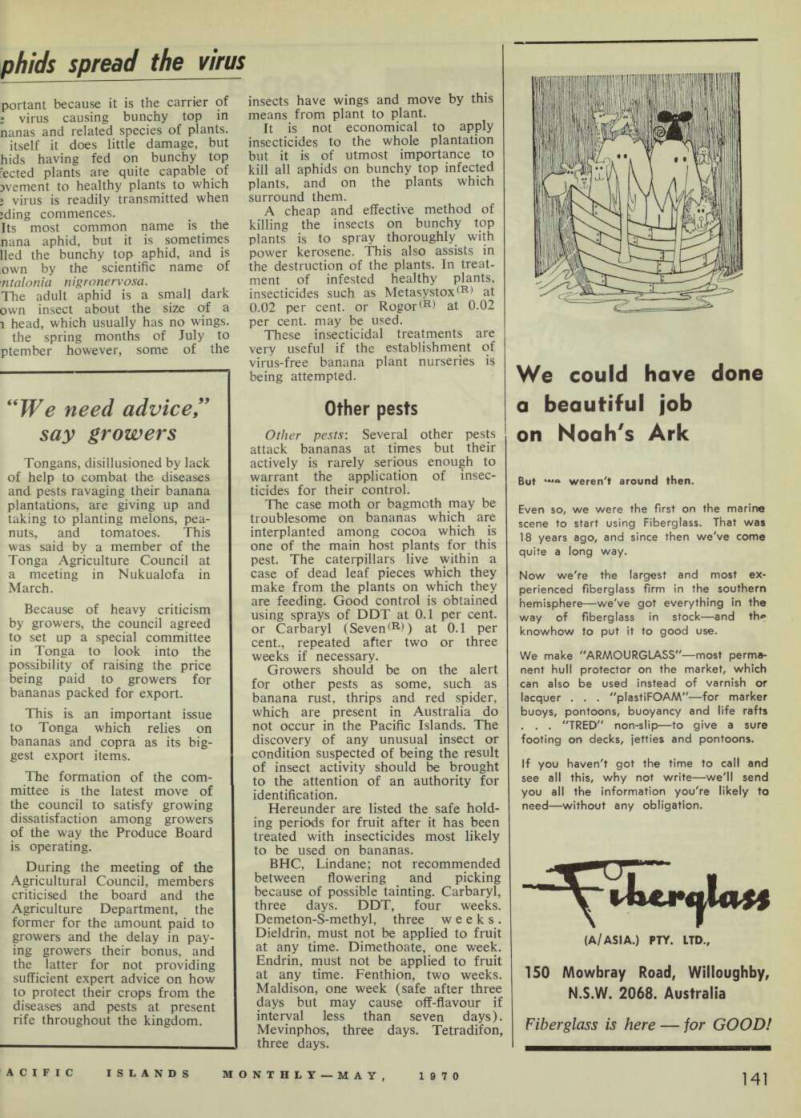 147
147 148
148 149
149 150
150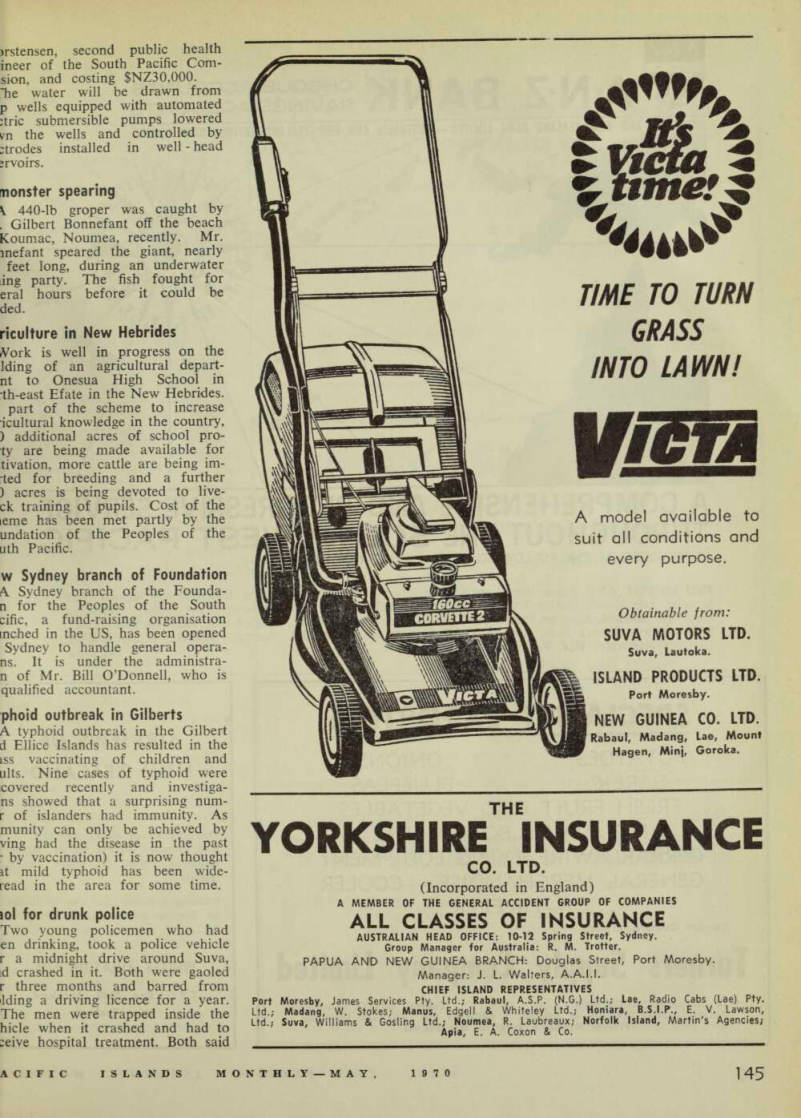 151
151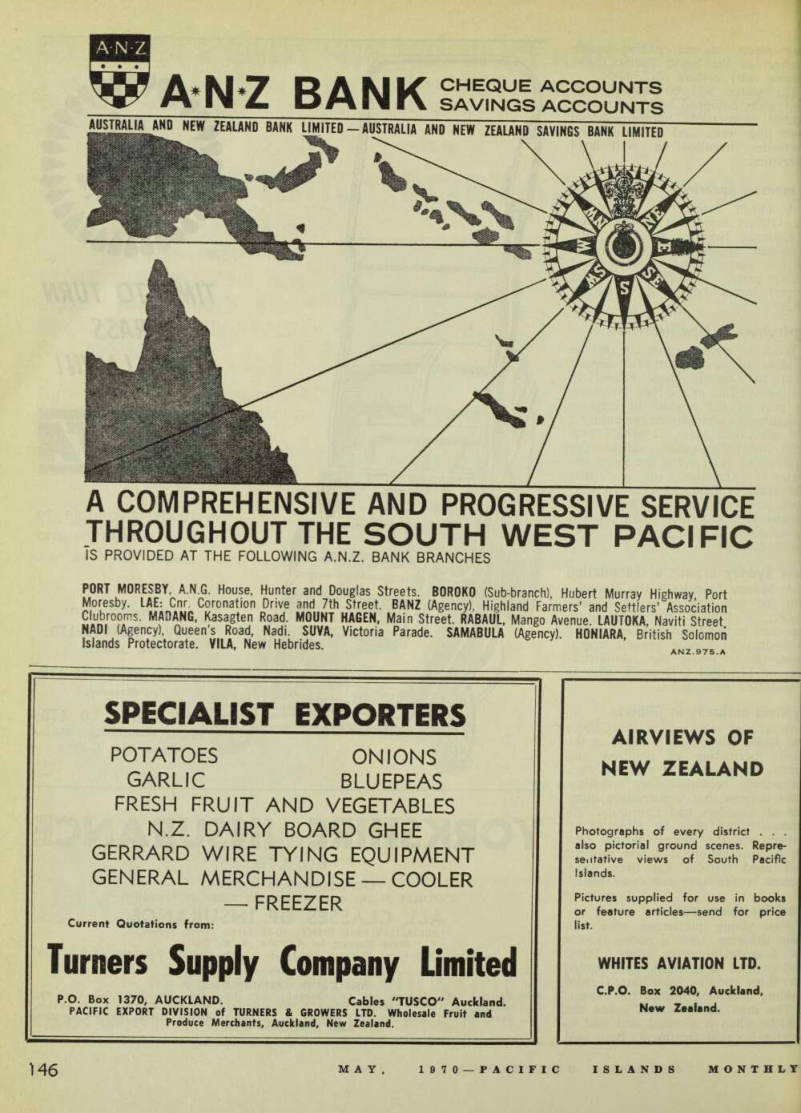 152
152 153
153 154
154 155
155 156
156 157
157 158
158 159
159 160
160