mountains morning and night, and sleeping in a large community
pp. 31-32 · Read in the full issue
Celebrating 70 years
By AAP special correspondent JAMES SHRIMPTON, in Pago Pago
It’s hardly the life you’d picture for an islander. No lazing around. No beer. No cigarettes. And no girls. . . . Running up mountains morning and night, and sleeping in a large community house with a fence to keep the inmates in and temptation out.
But more than 250 American Samoans have just subjected them selves to such a monastic ritual for up to six weeks, and there were no
—well, few—complaints.
They were in training for a fautasi race, fautasi being Samoan for longboat. But when they say long, they mean long. Each fautasi is 80 to 90 ft in length, and is manned by crews of about 46 oars men each.
The race evolved from the days when Polynesian warriors rowed to rival islands to commit mayhem on other tribes. Things are more peace ful now, but the fautasi race is the biggest thing on American Samoa’s calendar and the rivalry can be bitter and the betting big.
It happens every Flag Day, anni versary of the raising of the Stars and Stripes on American Samoa in
One of the singing-dancing groups hat gave a musical greeting back [?]o terra firma for the three Apollo [?]3 astronauts at Tafuna Airport, American Samoa.
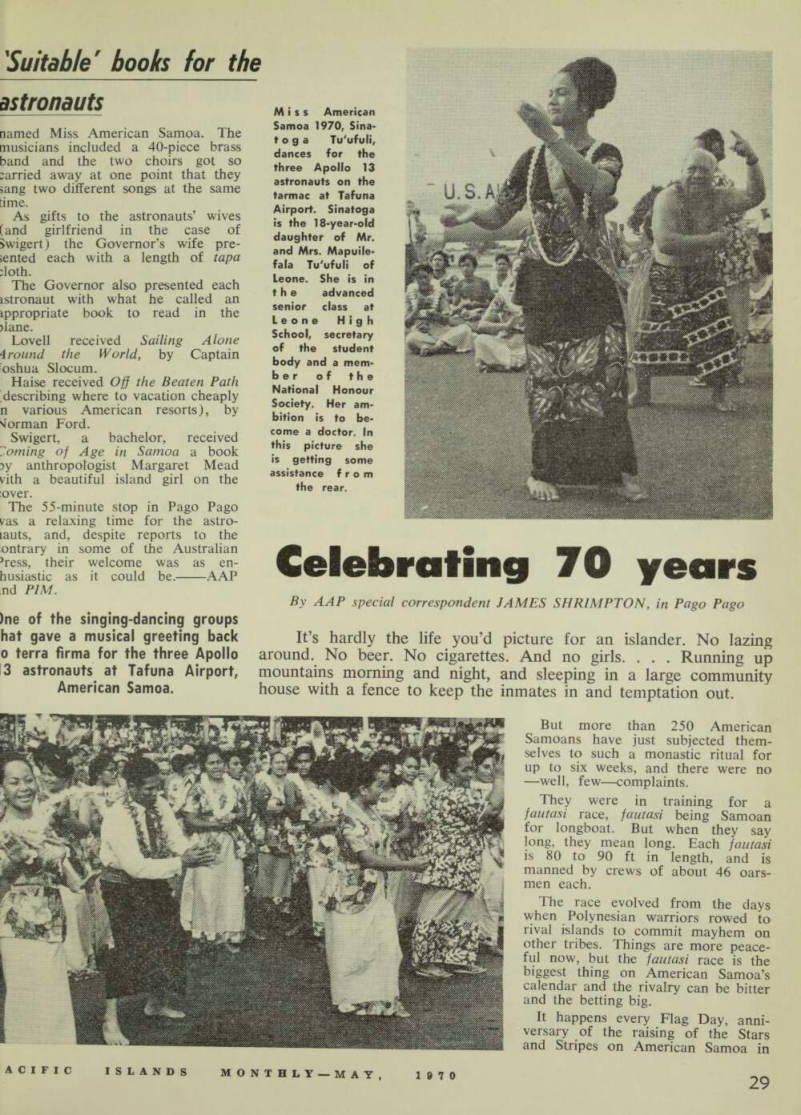
Miss American Samoa 1970, Sina toga Tu'ufuli, dances for the three Apollo 13 astronauts on the tarmac at Tafuna Airport. Sinatoga is the 18-year-old daughter of Mr. and Mrs. Mapuile fala Tu'ufuli of Leone. She is in the advanced senior class at Leone High School, secretary of the student body and a mem ber of the National Honour Society. Her am bition is to be come a doctor. In this picture she is getting some assistance from the rear.
Cheering their boat
1900. The 70th anniversary was in April.
Most of the territory’s 27,000 population, plus thousands of visitors, lined Pago Pago’s spectacular harbour to watch the race and cheer their favourite boat.
The “field” comprised fautasis from six American Samoan villages plus three from the Independent State of Western Samoa.
The Western Samoan craft were towed 65 miles across a choppy stretch of the Pacific to take part in the race.
The fautasis themselves are the result of weeks of work by whole families assigned to the various village leaders. And they’re not cheap to build. The Pago Pago village is said to have put up more than SUS3,OOO for its new fautasi, named Aeto (“Eagle”), which nar rowly won this month’s race.
Boats must be slender to glide easily through the still harbour waters, and strong enough to accom modate 46 husky Samoans.
About six weeks before the race, the chosen crews go into a spartan training schedule that might faze an Olympic athlete. To build up their strength, there’s a ban on alcohol, smokes and sex. After work each day, the oarsmen are confined to a giant fale which is fenced off from
the outside world with sentries patrolling the gates.
At one village this year, the chief was reported to have slept nightly across the fale threshhold as an added precaution.
Muscles and wind are developed by training runs up the steep hills surrounding the harbour and beaches.
This years’ race produced a wildly exciting finish at the end of the 4i mile course, with Aeto just withstand ing a desperate finuish by the reigning champion, Televise, from Utulei.
After the presentation of the prize money, starting at $1,500 for the winner, victors and vanquished made off to celebrate and commiserate.
After six weeks without beer, cigarettes and girls, they quickly made up for lost time with 48-hour parties featuring liberal quantities of all three.
Bets were paid—one Pago Pago villager won a bet of $2OO at odds of 2/I—then plans began for the annual return race at Apia, Western Samoa, in June.
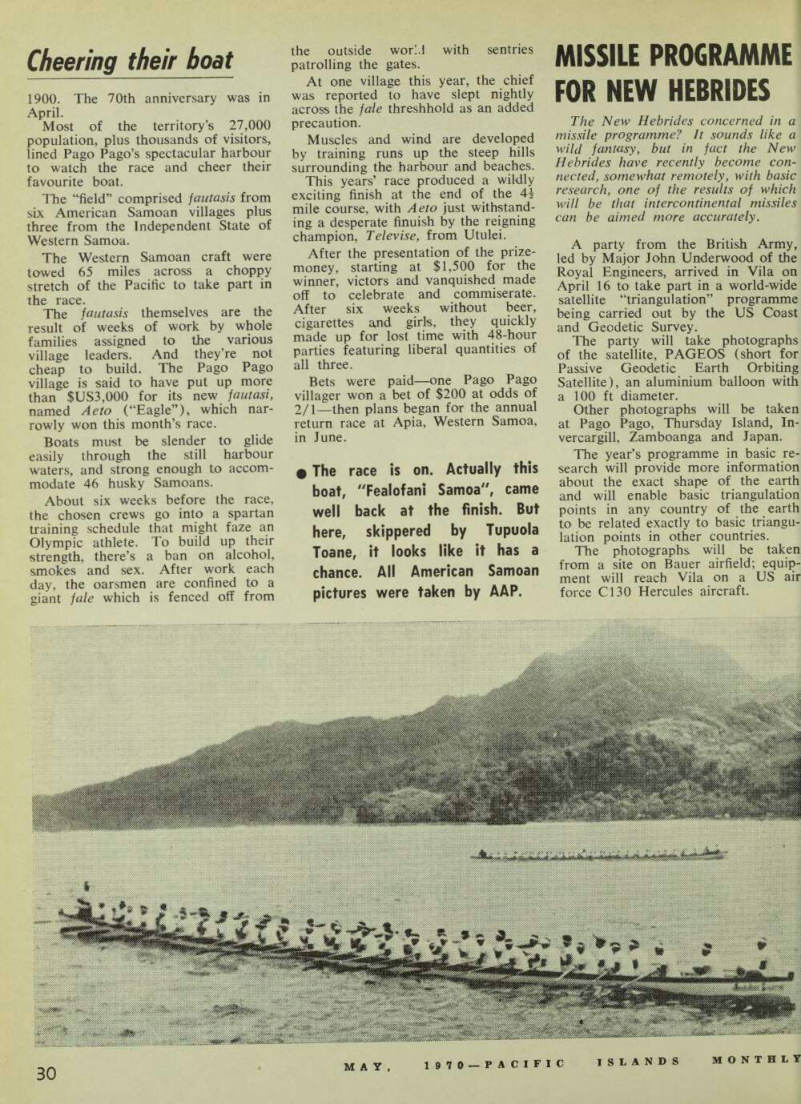
The race is on. Actually this boat, "Fealofani Samoa", came well back at the finish. But here, skippered by Tupuola Toane, it looks like it has a chance. All American Samoan pictures were taken by AAP.