captured by the Spanish
pp. 99-101 · Read in the full issue
Robbed, shipwrecked and captured by the Spanish on his first command
By Captain Stan Brown
Many an American brig set sail in the 1800’s looking for a share of the lucrative Pacific trade. But none could have had such a calamitous time as the ill-fated Eliza, with the equally ill-fated Captain Ebenezer Corry in command. The brig became a byword in the history of Fiji. The name still evokes thoughts of a cargo of a vast number of silver dollars said to be buried “somewhere on Nairai island”, where she met her end. These still occasionally turn up.
That the Eliza accomplished no part of its mission successfully and finally became wrecked on a reef in Fiji, is only half the story. Captain Correy went on to arrest by the Spanish for aiding the British in South America, another shipwreck and finally a miserable death in Guam on his way home.
The good captain probably had visions of both profit and pleasure when he received orders from the owners of the Eliza in 1807 to head for the South Seas to trade. The owners, Messrs. Brown and Ives, of Providence, Rhode Island, held bills of exchange purchased in Port Jack son in 1802 by one of their captains, and Correy was instructed to collect the debt, which, with interest, amounted to £2,546.
His first command
Correy was in command for the first time, and his orders were in general terms, giving him consider able discretion on how and where he traded. He was advised to drop in first at South American ports to cover expenses of the outward journey, then to go on to Fiji to take part in what was believed to be the lucrative sandalwood trade, then return home with a load of coffee from Batavia (now Djakarta).
Pleasant prospects indeed; but it must have seemed to Correy when he stepped on board the Eliza on January 19, 1807, that a Jonah had come aboard with the orders.
On the first day out, while carry ing only moderate sail, the head of the Eliza’s foremast was badly sprung. This was apparently an old defect that had not been made good during the ship’s stay in port.
As a result, sail was reduced as a
safety measure, and, in strong winds, was taken in altogether. In these conditions it took nearly three months to reach the first port of call, Rio de Janeiro.
Correy had hoped that a fleet of British warships would be in Rio, and had stocked his ship with stores for sale to the warships. But the British were busy attacking ports in the River Plate, and as there was no one else to buy his stores, Correy had to find the money to fit a new fore mast. With this finally stepped, Correy sailed for Montevideo, which had just been taken by the British.
Although the main fleet had not then arrived, prospects for trading were good.
But just when he was about to get down to business, the British admiral commandeered him to pilot his ships through the tricky channels of the River Plate (where he had previously served) to Buenos Aires.
Correy was away from his brig for three full weeks and when he re turned from an abortive attempt to take Buenos Aires, he had to wait a further period to receive pay for the goods he landed.
Worse still, he was now persona non-grata with the Spanish authorities for his unwilling aid to the British.
It was September, 1807, before the Eliza sailed from the port. She reached Port Jackson on February 9, 1808. In a letter to Brown and Ives written two months later, Correy had nothing but bad news to report.
He said that the person who had held his bills of exchange was dead, and his trustees were all in England, and that besides having had an un lucky voyage, it looked as if it would entail a big financial loss.
Having brought his owners up to date, Correy forwarded the bills
to the owner’s agents in London, and then made inquiries about entering the new sandalwood trade.
Most of his information on the new trade came from a fellow-Yankee Captain William Dorr, of the brig Jenny. Dorr talked enthusiastically about the sandalwood business, and suggested a plan to cut their com bined expenses.
Correy cheated
Instead of bidding against each other for trade, and so putting up the prices, Dorr said he would buy up all the available trade goods on behalf of the two ships. Correy agreed to this scheme and put up the necessary money. But he failed to keep a sharp enough eye on his countryman, and Dorr eventually sailed with all the trade goods in the hold of the Jenny.
Correy thus had to put up a second lot of money for his trade goods and it was not until April 22 that the Eliza sailed for Tongatabu. From there the brig followed the old route of the Bounty's castaways’ launch towards Fiji.
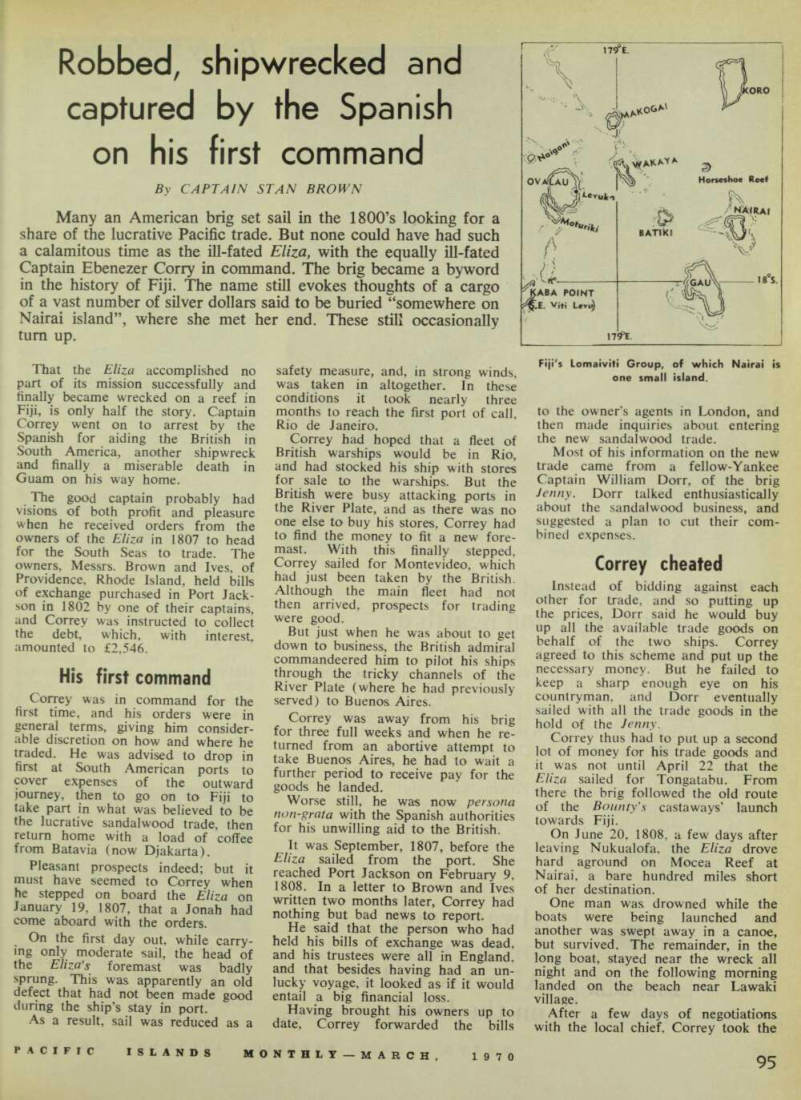
On June 20, 1808. a few days after leaving Nukualofa, the Eliza drove hard aground on Mocea Reef at Nairai, a bare hundred miles short of her destination.
One man was drowned while the boats were being launched and another was swept away in a canoe, but survived. The remainder, in the long boat, stayed near the wreck all night and on the following morning landed on the beach near Lawaki village.
After a few days of negotiations with the local chief, Correy took the
Fiji's Lomaiviti Group, of which Nairai is one small island.
Dreary Sandalwood Bay
longboat and four of his men, and finally reached a mangrove-rimmed bay. This dreary place was Bua Bay, the fabled Sandalwood Bay of the Americans’ imagination.
An American ship lay at anchor and to this they headed. She proved to be the Jenny, with Correy’s bete noir, Captain Dorr, on board.
But Dorr seemed disposed to be friendly, and allowed his mate, William Lockerby, to arm a boat’s crew and return with Correy to Nairai, the stated object being to rescue the remainder of the Eliza’s ~rew.
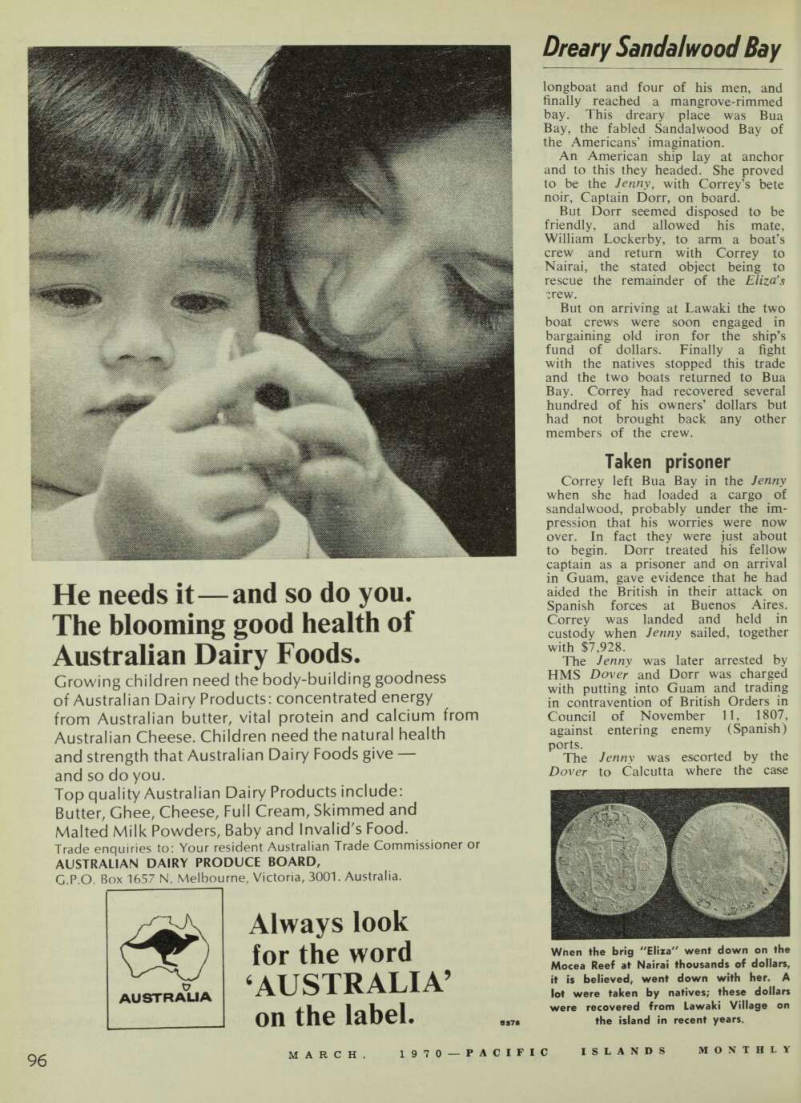
But on arriving at Lawaki the two boat crews were soon engaged in bargaining old iron for the ship’s fund of dollars. Finally a fight with the natives stopped this trade and the two boats returned to Bua Bay. Correy had recovered several hundred of his owners’ dollars but had not brought back any other members of the crew.
Taken prisoner
Correy left Bua Bay in the Jenny when she had loaded a cargo of sandalwood, probably under the im pression that his worries were now over. In fact they were just about to begin. Dorr treated his fellow captain as a prisoner and on arrival in Guam, gave evidence that he had aided the British in their attack on Spanish forces at Buenos Aires.
Correy was landed and held in custody when Jenny sailed, together with $7,928.
The Jenny was later arrested by HMS Dover and Dorr was charged with putting into Guam and trading in contravention of British Orders in Council of November 11, 1807, against entering enemy (Spanish) ports.
The Jenny was escorted by the Dover to Calcutta where the case
When the brig "Elira" went down on the Mocea Reef at Nairai thousands of dollars, it is believed, went down with her. A lot were taken by natives; these dollars were recovered from Lawaki Village on the island in recent years.
against Dorr was heard. In his de fence, Dorr said he had been many months at sea in outlandish parts; that neither he nor any of his officers knew, nor could have known, of the Orders in Council; and that the Jenny was a neutral vessel subject to a neutral power.
Despite all this, the captain of the Dover was adjudged to have acted correctly in arresting the Jenny, and Dorr’s ship was condemned and put up for auction as a prize, he was informed that he was to pro- Meanwhile, under arrest by the Spanish, Correy’s funds were meticu lously recorded and he was informed that he was to proceed to Manila, for trial. Both his papers and his dollars were placed aboard the ship Santa Gertrudis on which he was to travel.
On the morning of December 30 when the ship stranded on a reef, being completely wrecked. Correy lost everything that he owned.
Ninety-nine of the 138 souls aboard
were lost. Correy was in the water 40 hours clinging to planks which badly lacerated his legs.
He was finally washed ashore on a small island, where for several days he existed without food and with his legs badly swollen by infection.
Destitute
A wandering canoe crew picked him up and took him to their village, from which he was rescued by the mayor of a nearby town. Finally on an other ship he was to reach Manila.
He surrendered himself to the Governor, but had to wait for months before his case was called.
But the delay brought him at
last, a measure of luck. During the waiting period Spain had become an ally of Britain, and he was acquitted of all charges.
But he was now destitute, and the sympathies of the Spanish did not include the provision of a passage to America. Correy obtained command of a Spanish vessel bound on a round trip to Mexico. He wrote to Brown and Ives and asked them to care for his wife and family, saying that he expected to be able to buy a passage home with the earnings from this voyage.
On the return voyage Correy was taken desperately ill and landed at Guam. He died 10 days later, 2\ years after the wreck of the Eliza.
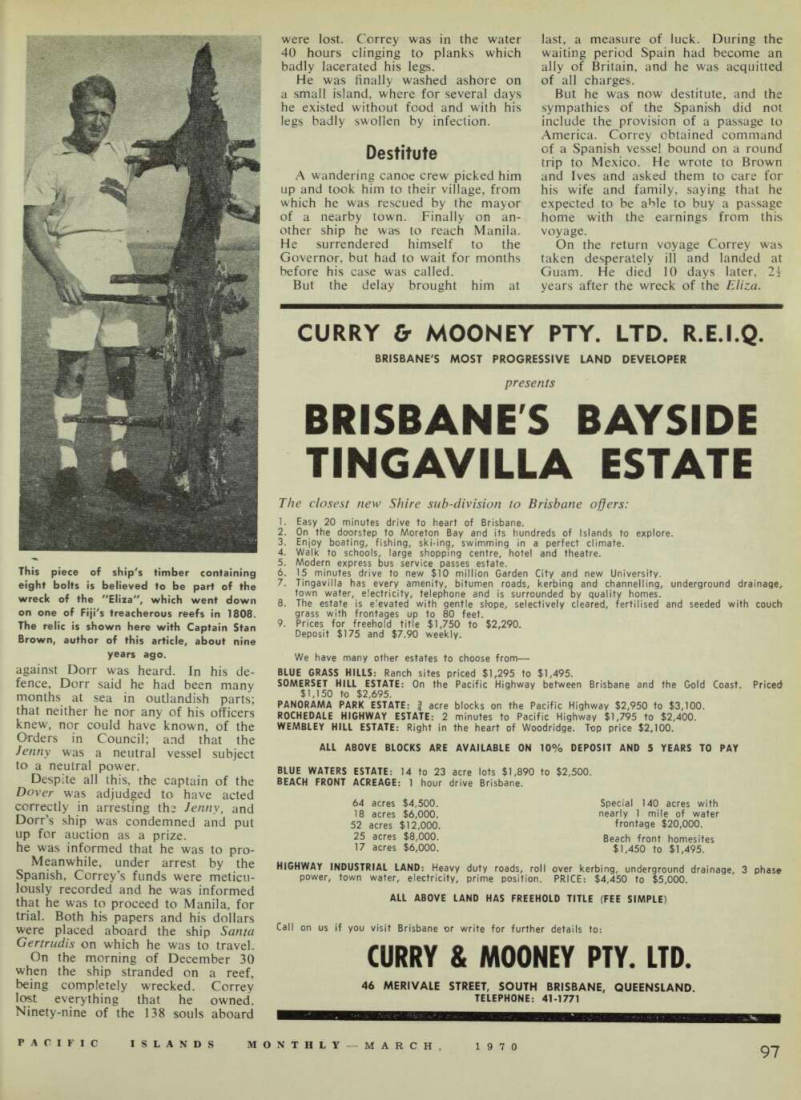
This piece of ship's timber containing eight bolts is believed to be part of the wreck of the "Eliza", which went down on one of Fiji's treacherous reefs in 1808.
The relic is shown here with Captain Stan Brown, author of this article, about nine years ago.