Robert Head, 1867: A Man Who Loved,
pp. 95-97 · Read in the full issue
And Was Loved By, The Niueans
By Ken Mcgregor
It’s rather sad that the name of Robert Henry Head is hardly remembered on Niue. Seventy years ago he was the best known and probably the best loved European on this isolated Polynesian speck.
Besides producing 15 children on Niue, he acted as doctor and adviser and even, it is rumoured, championed the Niueans’ cause against the notorious blackbirder, Bully Hayes.
A seaman who left the British Navy in disgust after watching a flogging aboard ship, Head reached Niue in 1867, shipwrecked off the stricken mission ship John Williams 11.
He stayed, as so many other stranded Europeans did in those early days of isolation in the out liers of the Islands, to marry a local lass, father a huge family, trade and advise local chiefs in their dealings with blackbirders, privateers, warships, missionaries and foreign powers.
He remained on Niue, except for a couple of schooner trips to New Zealand, until 1921, when a back injury and the tragic loss of a son, Frank, were major reasons for his death, at 88, at Tuapa, Niue.
Unfortunately little is recorded today about either Head or early Niue. A grand-daughter of Head, Joye Taylor of New Zealand, in recent years wrote a small booklet
called Henry Head of Niue Island.
But the booklet contains few con crete facts on Head.
Second line generation descendants are mostly either in NZ or Austra lia. In Sydney, a grand-daughter, Mrs. Trixy Beard, is gathering together information on the Niue pioneer. She told me that, through correspondence, she had found hardly anyone now remembers the famous man on Niue.
Little contact
Niue, in the 50 years after its discovery by Captain Cook in late June, 1774, had little European con tact.
Missionary John Williams called in 1830 but did not stay. Blackbirders for plantations in Samoa, Tahiti and South America, made sporadic raids to kidnap many Islanders.
There is a story of a man thrown
overboard from a whaler in the early 1800’s, off Niue, which was then known as “Savage Island” because of the hostile reception Niueans had given Captain Cook.
The stranded man was reputedly taken ashore by Niueans in a canoe.
Later the natives set him adrift in a big canoe loaded with coconuts and bananas. His canoe relanded on Niue. He hid around the coastline for several nights and managed to get on board a visiting whaler.
Native missionaries from Samoa and Aitutaki stayed for varying periods on Niue in the 1840’s and 1850’s and when the first two Euro pean pastors, the Revs. G. Pratt and W. G, Lawes arrived to settle in the 1860’s most Niueans were already Christianised.
Head’s period on Niue began soon after.
Born in 1833, he joined the Royal Navy at an early age and travelled
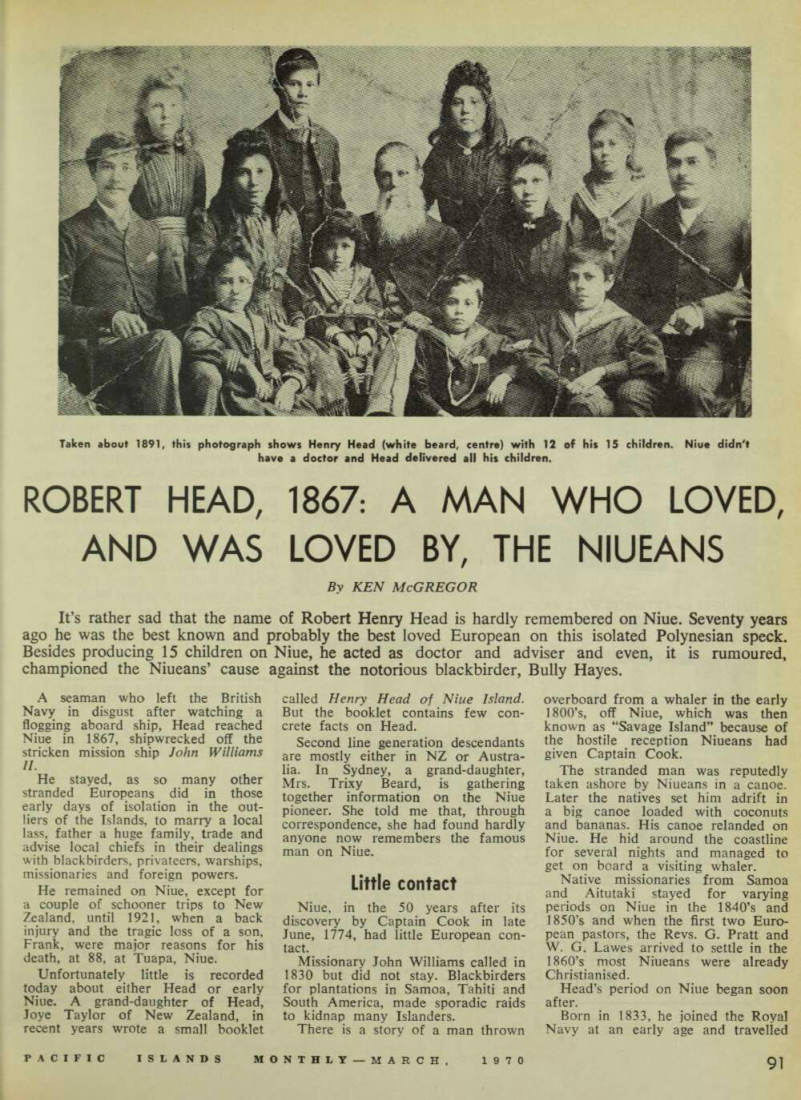
Taken about 1891, this photograph shows Henry Head (white beard, centre) with 12 of his 15 children. Niue didn't have a doctor and Head delivered all his children.
Unofficial midwife, doctor and dentist
widely, with a “yearning to see the storied isles of the South Seas”.
The only recorded trader to settle on Niue before him was H. W.
Patterson, who came in 1866 as an agent for the expanding German group. J. C. Godeffroy & Son.
With the navy, Head himself visited Niue in 1862. He wrote later to say he had seen a boy lashed hand and foot to a bamboo tree for several days as a punishment for tattooing himself Samoan fashion.
His 1867 return came soon after he had left the navy and won a job as mate on the John Williams. The vessel, less than two years old, went aground in swelling seas on January 8 and Head, with the other survivors, clambered ashore to get a warm welcome from Mr. Lawes.
Two weeks later, Bully Hayes, with a notorious reputation for blackbirding and stealing ships, arrived in his brig, Rona.
Hayes bought the hulk and stores of the John Williams and trans ported the vessel’s missionaries and crew to Tahiti, Rarotonga and Samoa. Head, however, decided to stay.
A good-looking 34-year-old bach elor, he bought a little land near the island’s current town of Alofi and began to trade. He bought fungus and coconut oil from locals and sold cloth, knives and tobacco.
Passing ships bought his produce and provided his stores.
Successful marriage
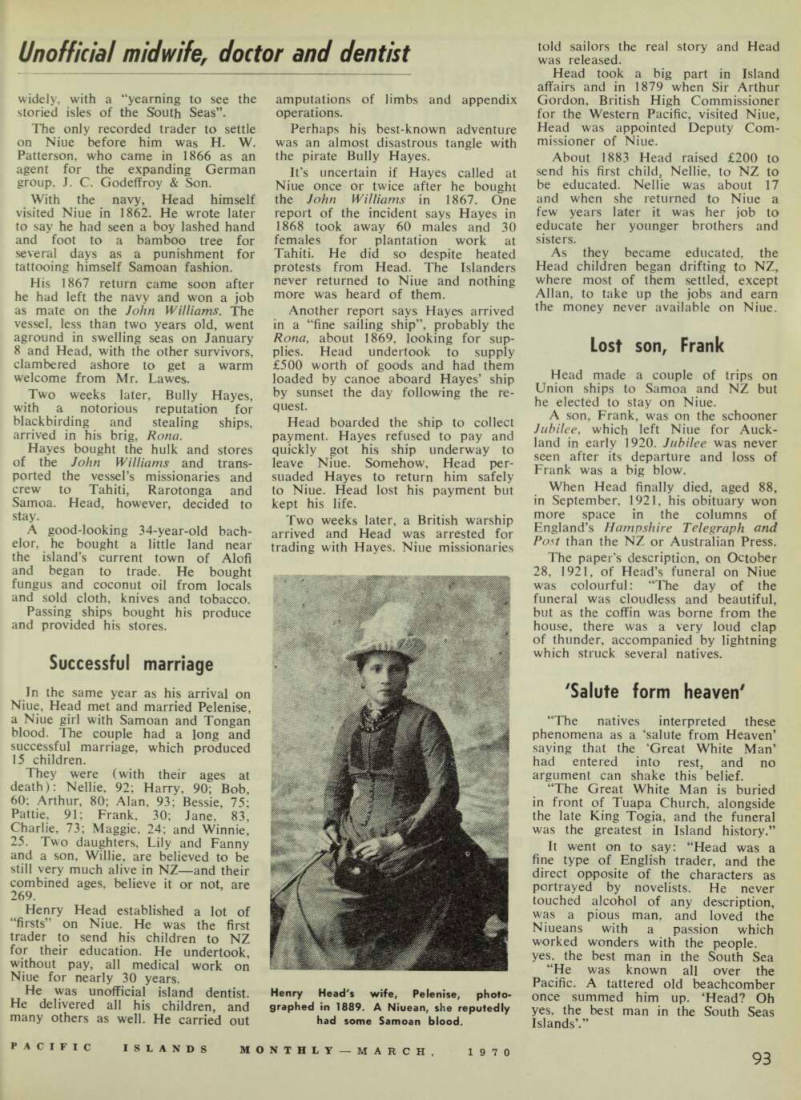
In the same year as his arrival on Niue, Head met and married Pelenise, a Niue girl with Samoan and Tongan blood. The couple had a long and successful marriage, which produced 15 children.
They were (with their ages at death): Nellie, 92; Harry, 90; Bob, 60; Arthur, 80; Alan. 93; Bessie, 75; Pattie, 91; Frank, 30; Jane, 83, Charlie, 73; Maggie. 24; and Winnie, 25. Two daughters, Lily and Fanny and a son, Willie, are believed to be still very much alive in NZ—and their combined ages, believe it or not, are 269.
Henry Head established a lot of “firsts” on Niue. He was the first trader to send his children to NZ for their education. He undertook, without pay, all medical work on Niue for nearly 30 years.
He was unofficial island dentist.
He delivered all his children, and many others as well. He carried out
amputations of limbs and appendix operations.
Perhaps his best-known adventure was an almost disastrous tangle with the pirate Bully Hayes.
It’s uncertain if Hayes called at Niue once or twice after he bought the John Williams in 1867. One report of the incident says Hayes in 1868 took away 60 males and 30 females for plantation work at Tahiti. He did so despite heated protests from Head. The Islanders never returned to Niue and nothing more was heard of them.
Another report says Hayes arrived in a “fine sailing ship”, probably the Rona, about 1869, looking for sup plies, Head undertook to supply £5OO worth of goods and had them loaded by canoe aboard Hayes’ ship by sunset the day following the re quest.
Head boarded the ship to collect payment. Hayes refused to pay and quickly got his ship underway to leave Niue. Somehow, Head per suaded Hayes to return him safely to Niue. Head lost his payment but kept his life.
Two weeks later, a British warship arrived and Head was arrested for trading with Hayes. Niue missionaries
told sailors the real story and Head was released.
Head took a big part in Island affairs and in 1879 when Sir Arthur Gordon, British High Commissioner for the Western Pacific, visited Niue, Head was appointed Deputy Com missioner of Niue.
About 1883 Head raised £2OO to send his first child, Nellie, to NZ to be educated. Nellie was about 17 and when she returned to Niue a few years later it was her job to educate her younger brothers and sisters.
As they became educated, the Head children began drifting to NZ, where most of them settled, except Allan, to take up the jobs and earn the money never available on Niue.
Lost son, Frank
Head made a couple of trips on Union ships to Samoa and NZ but he elected to stay on Niue.
A son, Frank, was on the schooner Jubilee, which left Niue for Auck land in early 1920. Jubilee was never seen after its departure and loss of Frank was a big blow.
When Head finally died, aged 88, in September, 1921, his obituary won more space in the columns of England’s Hampshire Telegraph and Post than the NZ or Australian Press.
The paper’s description, on October 28, 1921, of Head’s funeral on Niue was colourful: “The day of the funeral was cloudless and beautiful, but as the coffin was borne from the house, there was a very loud clap of thunder, accompanied by lightning which struck several natives.
'Salute form heaven'
“The natives interpreted these phenomena as a ‘salute from Heaven’ saying that the ‘Great White Man’ had entered into rest, and no argument can shake this belief.
“The Great White Man is buried in front of Tuapa Church, alongside the late King Togia, and the funeral was the greatest in Island history.”
It went on to say: “Head was a fine type of English trader, and the direct opposite of the characters as portrayed by novelists. He never touched alcohol of any description, was a pious man, and loved the Niueans with a passion which worked wonders with the people, yes. the best man in the South Sea “He was known all over the Pacific. A tattered old beachcomber once summed him up. ‘Head? Oh yes, the best man in the South Seas Islands’.”
Henry Head's wife, Pelenise, photo graphed in 1889. A Niuean, she reputedly had some Samoan blood.