Magazine Section
pp. 89-92 · Read in the full issue

Conversion By Trial
And Error
e The journal of the famous missionary voyage the Pacific of the Revs. John Williams and Robert Bourne nearly 150 years ago has just come into the possession of the Pacific Manu scripts Bureau. The journal, which has been microfilmed by the bureau, describes the voyages from Raiatea to Aitutaki, Mangaia, Atiu, Mitiaro, Mauke and Rarotonga in the Cooks, and is the oldest Pacific document to date to come into the bureau’s hands.
In the very first days of missionary exploration very little was known of the Islander in his Pacific home. European bringers of “Christ’s message” had to learn by trial and error in what way the people could be best won over to accepting them and their “gift”.
The Revs. Williams and Bourne had plenty of zeal but little real ex perience of the Cook Islanders and feared, with what turned out to be good reason, the worst.
The journal reveals that Bourne and Williams left Raiatea for the islands to the westward on July 4, 1823, in the schooner Endeavour, “a vessel belonging to the united chiefs in the Leeward Islands” of the Society Group. They had on board si x native teachers Paumoana, Mataitai, Vahineino, Fanauara (from Raiatea) and Haavi and Tauaa (from Tahaa). Also with them were the teachers’ wives.
They reached Aitutaki after a voyage of four days, and soon learned that Christianity had made rapid progress on that island since two native teachers had been landed there two years earlier.
Some Rarotongans, whom Williams and Bourne had heard of earlier, were still living on the island, and it was proposed that these people, together with one of the native teachers, Papeiha, should be taken to Rarotonga in an attempt to introduce the Gospel there. How ever, Bourne and Williams learned some details about Rarotonga “rather of an alarming nature”.
These were that the Rarotongans
were “a very ferocious people and cannibals;” that they had tried to cut off a ship on one occasion [the Cumberland] and had succeeded in killing four of the crew, including a woman; that they were not afraid of muskets, but would rush forward in the face of them; and that they were “a very treacherous people” who would behave with great kindness until all suspicion had subsided, when they would “accomplish their evil designs”.
'Every precaution'
Despite all this, Bourne and Williams agreed that missionary work must begin at Rarotonga at some time; that go there they must.
But they decided to “take every necessary precaution”.
“We determined,” their journal says, “. . . to purchase a canoe at Aitutake, and when we arrived at Rarotonga to run close to the shore and send the Rarotonga people with the Teacher from Aitutake on shore in the Canoe with instructions to call a meeting of the chiefs and people to state *he object of our visit, to tell them what had been done at Aitutake, and say that there were two teachers with their wives selected and sent by the Church at Raiatea on purpose for them, to
get their answers and return on board as soon as possible, bringing with them the principal chief, but to state if more than their own Canoe and another came off we should bear away to sea suspecting some evil intention.”
At a meeting at which their plan of action was discussed, Bourne and Williams learned that the Aitutakians had heard of a number of islands in their vicinity, but as they were “not an enterprising people” they had little more than traditions about them. The islands that the Aitu takians named were; Manuae (a few inhabitants), Atiu, Auau and Rarotonga (numerous inhabitants), Takutea (no inhabitants), Manihiki, Rakahanga, Pakaiara, Motukaute and Anuanu (no particular information except that they were inhabited).
Bourne and Williams speculated that Motukaute might be Palmerston Island, but they made no guesses about Auau, which is an old name for Mangaia, nor about Paikaira and Anuanu, which seem never to have figured on European maps.
On leaving Aitutaki on July 10, 1823, the Endeavour set sail in quest of Rarotonga. However, the Raro tongans, on board were by no means certain about the direction in which
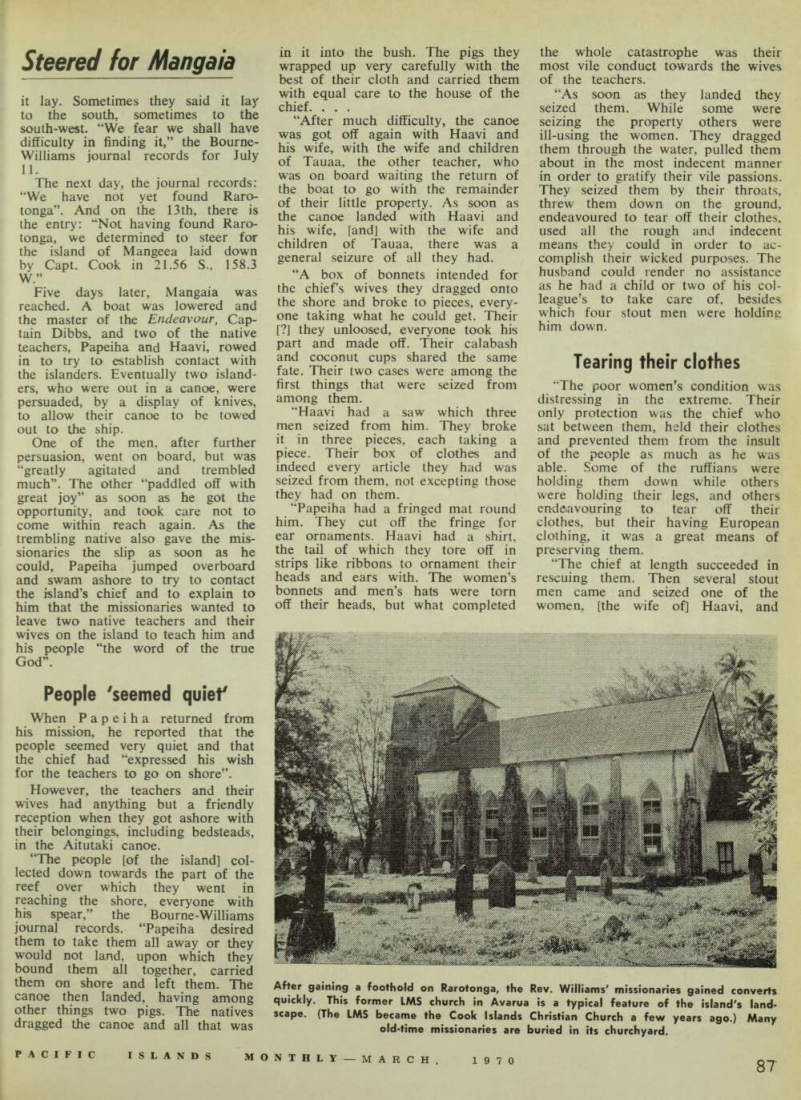
The Rev. John Williams.
Steered for Mangaia
it lay. Sometimes they said it lay to the south, sometimes to the south-west. “We fear we shall have difficulty in finding it,” the Bourne- Williams journal records for July 11.
The next day, the journal records: “We have not yet found Raro tonga”. And on the 13th, there is the entry: “Not having found Raro tonga, we determined to steer for the island of Mangeea laid down by Capt. Cook in 21.56 S., 158.3 W.”
Five days later, Mangaia was reached. A boat was lowered and the master of the Endeavour, Cap tain Dibbs, and two of the native teachers, Papeiha and Haavi, rowed in to try to establish contact with the islanders. Eventually two island ers, who were out in a canoe, were persuaded, by a display of knives, to allow their canoe to be towed out to the ship.
One of the men, after further persuasion, went on board, but was “greatly agitated and trembled much”. The other “paddled off with great joy” as soon as he got the opportunity, and took care not to come within reach again. As the trembling native also gave the mis sionaries the slip as soon as he could, Papeiha jumped overboard and swam ashore to try to contact the island’s chief and to explain to him that the missionaries wanted to leave two native teachers and their wives on the island to teach him and his people “the word of the true God”.
People 'seemed quiet 7
When Papeiha returned from his mission, he reported that the people seemed very quiet and that the chief had “expressed his wish for the teachers to go on shore”.
However, the teachers and their wives had anything but a friendly reception when they got ashore with their belongings, including bedsteads, in the Aitutaki canoe.
“The people [of the island] col lected down towards the part of the reef over which they went in reaching the shore, everyone with his spear,” the Bourne-Williams journal records. “Papeiha desired them to take them all away or they would not land, upon which they bound them all together, carried them on shore and left them. The canoe then landed, having among other things two pigs. The natives dragged the canoe and all that was
in it into the bush. The pigs they wrapped up very carefully with the best of their cloth and carried them with equal care to the house of the chief. . . .
“After much difficulty, the canoe was got off again with Haavi and his wife, with the wife and children of Tauaa, the other teacher, who was on board waiting the return of the boat to go with the remainder of their little property. As soon as the canoe landed with Haavi and his wife, [and] with the wife and children of Tauaa, there was a general seizure of all they had.
“A box of bonnets intended for the chiefs wives they dragged onto the shore and broke to pieces, every one taking what he could get. Their [?] they unloosed, everyone took his part and made off. Their calabash and coconut cups shared the same fate. Their two cases were among the first things that were seized from among them.
“Haavi had a saw which three men seized from him. They broke it in three pieces, each taking a piece. Their box of clothes and indeed every article they had was seized from them, not excepting those they had on them.
“Papeiha had a fringed mat round him. They cut off the fringe for ear ornaments. Haavi had a shirt, the tail of which they tore off in strips like ribbons to ornament their heads and ears with. The women’s bonnets and men’s hats were torn off their heads, but what completed
the whole catastrophe was their most vile conduct towards the wives of the teachers.
“As soon as they landed they seized them. While some were seizing the property others were ill-using the women. They dragged them through the water, pulled them about in the most indecent manner in order to gratify their vile passions.
They seized them by their throats, threw them down on the ground, endeavoured to tear off their clothes, used all the rough and indecent means they could in order to ac complish their wicked purposes. The husband could render no assistance as he had a child or two of his col league’s to take care of, besides which four stout men were holding him down.
Tearing their clothes
“The poor women’s condition was distressing in the extreme. Their only protection was the chief who sat between them, held their clothes and prevented them from the insult of the people as much as he was able. Some of the ruffians were holding them down while others were holding their legs, and others endeavouring to tear off their clothes, but their having European clothing, it was a great means of preserving them.
“The chief at length succeeded in rescuing them. Then several stout men came and seized one of the women, [the wife of] Haavi, and
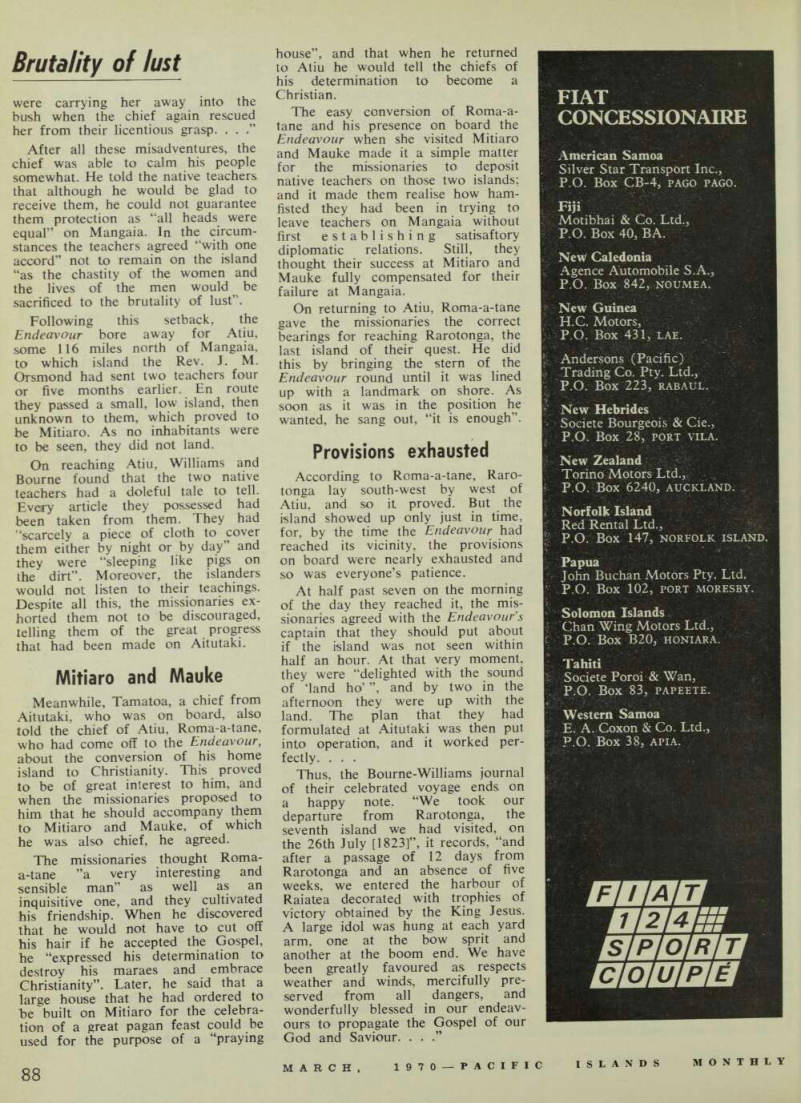
After gaining a foothold on Rarotonga, the Rev. Williams' missionaries gained converts quickly. This former LMS church in Avarua is a typical feature of the island's land scape. (The LMS became the Cook Islands Christian Church a few years ago.) Many old-time missionaries are buried in its churchyard.
Brutality of lust
were carrying her away into the bush when the chief again rescued her from their licentious grasp. . . .”
After all these misadventures, the chief was able to calm his people somewhat. He told the native teachers that although he would be glad to receive them, he could not guarantee them protection as “all heads were equal” on Mangaia. In the circum stances the teachers agreed “with one accord” not to remain on the island “as the chastity of the women and the lives of the men would be sacrificed to the brutality of lust”.
Following this setback, the Endeavour bore away for Atiu, some 116 miles north of Mangaia, to which island the Rev. J. M.
Osmond had sent two teachers four or five months earlier. En route they passed a small, low island, then unknown to them, which proved to be Mitiaro. As no inhabitants were to be seen, they did not land.
On reaching Atiu, Williams and Bourne found that the two native teachers had a doleful tale to tell.
Every article they possessed had been taken from them. They had “scarcely a piece of cloth to cover them either by night or by day” and they were “sleeping like pigs on the dirt”. Moreover, the islanders would not listen to their teachings.
Despite all this, the missionaries ex horted them not to be discouraged, telling them of the great progress that had been made on Aitutaki.
Mitiaro and Mauke
Meanwhile, Tamatoa, a chief from Aitutaki, who was on board, also told the chief of Atiu, Roma-a-tane, who had come off to the Endeavour , about the conversion of his home island to Christianity. This proved to be of great interest to him, and when the missionaries proposed to him that he should accompany them to Mitiaro and Mauke, of which he was also chief, he agreed.
The missionaries thought Roma a-tane ”a very interesting and sensible man” as well as an inquisitive one, and they cultivated his friendship. When he discovered that he would not have to cut off his hair if he accepted the Gospel, he “expressed his determination to destroy his maraes and embrace Christianity”. Later, he said that a large house that he had ordered to be built on Mitiaro for the celebra tion of a great pagan feast could be used for the purpose of a “praying
house”, and that when he returned to Atiu he would tell the chiefs of his determination to become a Christian.
The easy conversion of Roma-a tane and his presence on board the Endeavour when she visited Mitiaro and Mauke made it a simple matter for the missionaries to deposit native teachers on those two islands; and it made them realise how ham fisted they had been in trying to leave teachers on Mangaia without first establishing satisaftory diplomatic relations. Still, they thought their success at Mitiaro and Mauke fully compensated for their failure at Mangaia.
On returning to Atiu, Roma-a-tane gave the missionaries the correct bearings for reaching Rarotonga, the last island of their quest. He did this by bringing the stem of the Endeavour round until it was lined up with a landmark on shore. As soon as it was in the position he wanted, he sang out, “it is enough”.
Provisions exhausted
According to Roma-a-tane, Raro tonga lay south-west by west of Atiu, and so it proved. But the island showed up only just in time, for, by the time the Endeavour had reached its vicinity, the provisions on board were nearly exhausted and so was everyone’s patience.
At half past seven on the morning of the day they reached it, the mis sionaries agreed with the Endeavour’s captain that they should put about if the island was not seen within half an hour. At that very moment, they were “delighted with the sound of ‘land ho’ ”, and by two in the afternoon they were up with the land. The plan that they had formulated at Aitutaki was then pul into operation, and it worked per fectly. . . .
Thus, the Bourne-Williams journal of their celebrated voyage ends on a happy note. “We took our departure from Rarotonga, the seventh island we had visited, on the 26th July [1823]”, it records, “and after a passage of 12 days from Rarotonga and an absence of five weeks, we entered the harbour of Raiatea decorated with trophies of victory obtained by the King Jesus.
A large idol was hung at each yard arm, one at the bow sprit and another at the boom end. We have been greatly favoured as respects weather and winds, mercifully pre served from all dangers, and wonderfully blessed in our endeav ours to propagate the Gospel of our God and Saviour. . . .”