under the airstrip
p. 78 · Read in the full issue
Where O'Brien keeps a friendly eye open under the airstrip
By Peter Headley
The cool, clear, morning
breeze in Funafuti, main atoll of the Ellice Islands, is something I shan’t forget in a hurry. And the blue-green waters of its lagoon and the white coral sand is about as untouched as it could be by the hand of “progress”— and it’s only 650 miles from
Fiji.
I managed to tear myself away from the view on arrival, long enough to get installed, with fellow-travellers Derek Cudmore and his wife, in the local guest house, Vaiku Langi (“heavenly place” in the local tongue) and indeed it was just as the name suggests. The only hard thing to get used to was the food which, particularly for our lady com panion, was a little strange, but never distasteful.
The people on Funafuti are Poly nesian, although many of them have mixed with Western Samoan stock.
There are three main family groups in the population of 800—who were wonderfully hospitable and kind to us—the most predominant being O’Brien. When we recovered from the shock we discovered that O’Brien was apparently an Irishman who settled there in the 1860’s.
Stopped blackbirders
He brought with him several muskets and with these and a little organisation, he and the denuded population managed to stop black birders’ raids, which were having a serious effect on the island’s popula tion.
He now lies in the old cemetery beneath the airstrip. T hope he keeps a friendly eye on fellow Euro pean travellers who chance to visit this lovely spot. Later I came across an old cannon about 3 ft long and with a rather large touch hole; but no-one could tell me if it belonged to this era.
At the southern end of the atoll is a picturesque village called Funafala of about 30 people. The houses here are almost all of native design and materials. These, with the shaded pathways of coconut and breadfruit and the ever blowing east wind, makes the spot beautiful.
At both ends of the main islet are
dumps left from the Pacific war, such as barges, fuel drums, vehicle and aircraft engines, aircraft sections, ammunition, instruments and weapons. In the lagoon are several crashed American and Japanese air craft and landing craft.
Apart from the meteorological station, Funafuti has no other activity apart from copra, and there is little of this as many of the able bodied men are phosphate workers on Nauru. Many of the coconuts on the outer islets are left to rot.
The poor coral soil will not support
much apart from coconuts, bread fruit and ground vines. Bananas, barpi (starchy tuber) and sweet potato can be grown in a few selec ted fertile spots.
Work is being done to ascertain the feasibility of introducing some sorghum strains and results so far are encouraging.
Not that the people here —or for that matter the tourists—need much more. They are happy and forever smiling. And it’s not surprising when you take in the climate, the view and the pace of living.
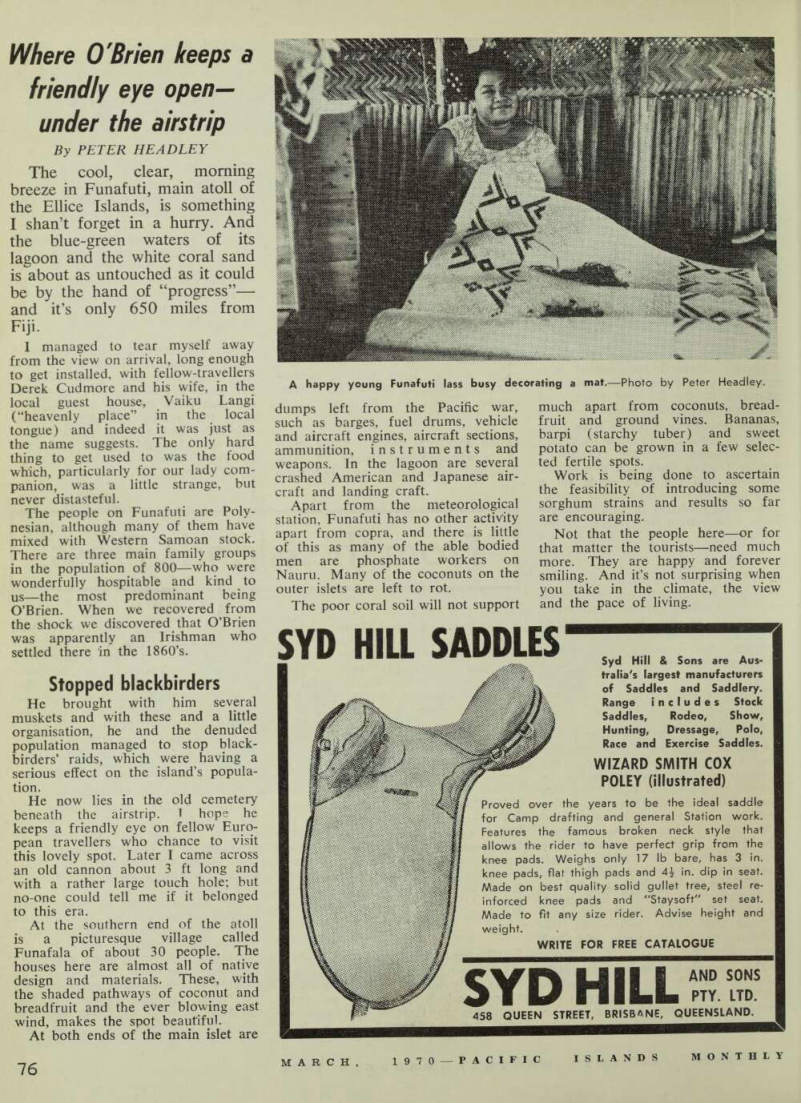
A happy young Funafuti lass busy decorating a mat.— Photo by Peter Headley.