Book Reviews
pp. 102-103 · Read in the full issue
A Debtor's Prison For
Missionary To Tahiti
Reading the pages of PIM over the years our readers will know by now that missionaries to the Pacific, although stem in their demands on Islanders, often committed grave errors them selves. Stories of seduction, monopolist trading and plain politicking we’ve had by the score. This is the story of a missionary who was arrested in New South Wales for embezzlement and cast into a debtor’s prison. He escaped but was returned to gaol until a passing captain started an appeal to pay his debts and have him released.
This same missionary, William Smith, had arrived in Tahiti in 1797 as part of the London Missionary Society crew on board the Duff to convert the people of “Otaheite”.
Smith was listed as linen draper on board the ship and with the rest of the 18 was soon busy working among the people of this “second paradise planted in the watery waste”.
The community had its ups and downs in Tahiti and by the next year 11 of them were ready to sail on board the Nautilus bound for Botany Bay. Frank Clune in his latest book, The Scottish Martyrs takes up the story as Smith saw his first sight of Australia.
Grant of land
Governor Hunter of the colony made the missionaries welcome and offered them the usual grant of land.
Smith received 100 acres on Prospect Hill, but not keen on farming he turned to business, in which it ap peared he had had more experience.
He presented himself to one Robert Campbell whose barque, Hunter, had arrived in 1798 soon after the Nautilus. The Hunter was loaded with goods but the military monopo lists controlling the colony refused to buy from him except on their terms which were low. Campbell rejected their offer and decided to return to India on the transport Barwell.
Before he left he appointed mis sionary Smith as his agent and in structed him to transfer the Hunter cargo into a store on the west side of Circular Quay and sell it on better terms.
Wrote Smith (quoted by Clune
from his Journal of a Voyage in the Missionary Ship “Duff”): “Mr.
Campbell instructed me to sell the remainder of the cargo and collect his debts. He gave me power of attorney and expressed the intention of returning to the colony in nine he did not return for 17 months.”
Smith made many sales during
d“y he^T
vited to a party in the country after whi h he re turned to his store in Cove find thieves had p f unde y red it A large amount of the loot was f oun( i “j n a pig-sty covered with fifth” The thieves were dis covered and secured. “They had made free with the rum bottle to which was attributed their detection, An inspection of the stock was made and there appeared a deficiency of between two and three hundred pounds.”
The other missionaries who had left Tahiti with Smith had mixed fortunes on Australian soil. Samuel Clode, who had been on board the Duff as a whitesmith and gardener, was axed to death in July, 1798, by a soldier, Jones, and two accomplices.
The house where the murder was committed was burnt to ashes and “ a temporary gallows was erected on the spot and these three inhuman wretches were taken out of prison an d conveyed in a cart to the place where they were launched into eternity, more execrated than pltle d by a multitude of spectators .
But Smith was also in trouble, Mr. Campbell finally returned from India and when he entered his house in what is now Circular Quay, his nose, he claimed, was “saluted with
the smell of Spanish liquor which had been accidentally spilled on the floor. The house was more like a grog shop than the residence of an East-India merchant”. Worse still, Campbell found a large amount of money missing.
A suit was brought before the civil court in Sydney and Smith found himself “in the hands of the inexor able creditor, who showed a determi nation to confine the poor debtor till the utmost farthing was paid.
The Provost-Marshall received his warrant to commit me to prison where one of the tenants observed that ‘when I had counted all the stones, bars and bolts of the prison house I might then expect to be liberated'.”
The next part of the story concerns some of the main characters of The Scottish Martyrs. The “martyrs” were five free-thinkers who had the misfortune to preach universal suff rage in England while the French Revolution was raging on the other side of the Channel.
The men, William Skirving, Joseph Gerrald, Thomas Muir, the Rev.
Thomas Palmer and Maurice Mar garet, were hailed as “martyrs” by British liberals when they were sen tenced to up to 14 years transporta tion to Botany Bay after being found guilty of sedition. . Muir escaped from Sydney Har bour, adventured across the Pacific, North-West America and Mexico and after a sea battle with the British Navy arrived in France to be acclaimed a hero. William Skir ving and Joseph Gerrald died in New South Wales and only Margaret
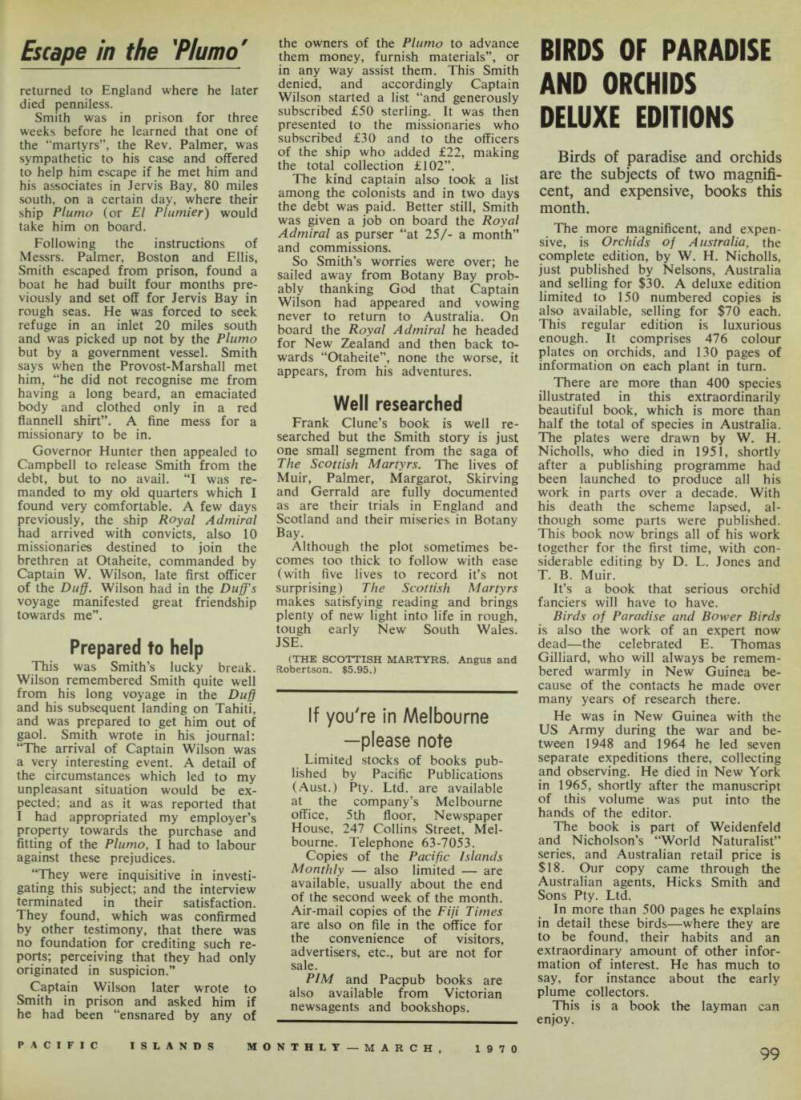
The Rev. Thomas Palmer.
Escape in the 'Plumo'
returned to England where he later died penniless.
Smith was in prison for three weeks before he learned that one of the “martyrs”, the Rev. Palmer, was sympathetic to his case and offered to help him escape if he met him and his associates in Jervis Bay, 80 miles south, on a certain day, where their ship Plumo (or El Plumier ) would take him on board.
Following the instructions of Messrs. Palmer, Boston and Ellis, Smith escaped from prison, found a boat he had built four months pre viously and set off for Jervis Bay in rough seas. He was forced to seek refuge in an inlet 20 miles south and was picked up not by the Plumo but by a government vessel. Smith says when the Provost-Marshall met him, “he did not recognise me from having a long beard, an emaciated body and clothed only in a red flannell shirt”. A fine mess for a missionary to be in.
Governor Hunter then appealed to Campbell to release Smith from the debt, but to no avail. “I was re manded to my old quarters which I found very comfortable. A few days previously, the ship Royal Admiral had arrived with convicts, also 10 missionaries destined to join the brethren at Otaheite, commanded by Captain W. Wilson, late first officer of the Duff. Wilson had in the Duff's voyage manifested great friendship towards me”.
Prepared to help
This was Smith’s lucky break.
Wilson remembered Smith quite well from his long voyage in the Duff and his subsequent landing on Tahiti, and was prepared to get him out of gaol. Smith wrote in his journal: “The arrival of Captain Wilson was a very interesting event. A detail of the circumstances which led to my unpleasant situation would be ex pected; and as it was reported that I had appropriated my employer’s property towards the purchase and fitting of the Plumo, I had to labour against these prejudices, “They were inquisitive in investi gating this subject; and the interview terminated in their satisfaction.
They found, which was confirmed by other testimony, that there was no foundation for crediting such re ports; perceiving that they had only originated in suspicion.”
Captain Wilson later wrote to Smith in prison and asked him if he had been “ensnared by any of
the owners of the Plume to advance them money, furnish materials”, or in any way assist them. This Smith denied, and accordingly Captain Wilson started a list “and generously subscribed £5O sterling. It was then presented to the missionaries who subscribed £3O and to the officers of the ship who added £22, making the total collection £102”.
The kind captain also took a list among the colonists and in two days the debt was paid. Better still, Smith was given a job on board the Royal Admiral as purser “at 25/- a month” and commissions.
So Smith’s worries were over; he sailed away from Botany Bay prob ably thanking God that Captain Wilson had appeared and vowing never to return to Australia. On board the Royal Admiral he headed for New Zealand and then back to wards “Otaheite”, none the worse, it appears, from his adventures.
Well researched
Frank dune’s book is well re searched but the Smith story is just one small segment from the saga of The Scottish Martyrs. The lives of Muir, Palmer, Margaret, Skirving and Gerrald are fully documented as are their trials in England and Scotland and their miseries in Botany Bay.
Although the plot sometimes be comes too thick to follow with ease (with five lives to record it’s not surprising) The Scottish Martyrs makes satisfying reading and brings plenty of new light into life in rough, tough early New South Wales.
Jse.
(The Scottish Martyrs. Angus And
Robertson. $5.95.)