Yesterday
p. 57 · Read in the full issue
Queen Salote of Tonga was celebrating her 50th birthday in early 1950 after 32 years of benevolent rule on the throne. Of the queen, PIM said: “Queen Salote Tupou is an outstanding example of a wise and good native monarch ruling benevolently over a native community. Apart from her position as head of the ruling house of Tonga, she has a sense of quiet natural dignity that has created in the world at large great respect for, not only Tongans and Tonga, but Polynesia as a whole.”
Other items in PIM for March, 1950, 20-years-ago this month, included; The first crude oil from the Sorong field, Dutch New Guinea, reached the Vacuum Oil Co’s refinery at Altona, Melbourne. Three hundred Australian businessmen later watched the first gallons of lubricating oil distilled from the crude.
Mr. Graziani, a New Caledonian living at Santo, New Hebrides, was reported to have invented a machine for de-husking coconuts. It was claimed that the machine worked by one man did the work of seven natives, which was a big considera tion at a time when labour in the Condominium was even harder to get than usual.
Commandeering a heavy transport lorry without the owner’s permission, an Indian on March 1 went hurtling through Suva and up the by-pass road above Walu Bay. The truck ran into a private car and spun it com pletely around, all but demolished a small parked van, ran over an elderly Fijian who was walking on the footpath, went over a sandpile and smashed into a fence.
The Fijian victim died in hospital a few hours later. Charged with manslaughter and with taking the lorry without authority, the Indian was next day remanded in custody so that the question of his sanity could be settled.
The suggestion that the long chain of coral reefs and sand banks that made up the Gilbert and Ellice Islands should be attached to the large group of atolls that constitute the US Trust Territory District of the Marshalls, and handed over to the US Administration had something to commend it, PIM said in March, 1950.
In the matter of illegal fishing with dynamite, New Caledonians had long been among the worst offenders in the South Pacific, PIM said. Such fishing often took place in full view of the Noumea beaches and the Amedee Lighthouse. The Admin istration was taking steps to protect fishing in the island’s rivers against
such methods, as well as the use of poison and artificial barrages.
Journalist and author, James Michener, after having spent six months wandering the South Pacific with his wife, wrote to the editor of PIM to thank the “multitude of people who made my visit to these waters so happy and constructive”.
He added; “You may be interested in a few brief impressions; The place my wife wants to re-visit—New Guinea; the place I would like to see more of—Guadalcanal; the place I remember best—Rabaul; The best houses I saw—the government houses on the ridge at Honiara; the best public living—the remarkably fine Club Civil at Espiritu Santo.”
He went on; “The best singing I heard—Tonga; The most surprising thing I saw—two Chinese basketball teams in Tahiti playing as well as
most American high school teams; the intellectual thing which excited me most—the chance that Fred Archer might some day write a book; The most gifted man I met—Cap tain Brett Hilder; The most beautiful girls—still Tahiti; my most pleasant surprise—the wonderful care I got at the hospital in Espiritu Santo where I had malaria.”
There could be no excuse for couples in Papua-New Guinea dis pensing with the blessing of the church. In a gazette some 380 clergymen were listed, all of whom were registered to celebrate marriages in the two territories—2so of them in New Guinea.
The importation of labour from Java had not been the solution to New Caledonia’s labour problem that had been hoped. Most of the trouble appeared to be, said PIM, that the labourers could change their employment at will. Of the 450 Javanese workers who arrived in the colony early in 1949, 112 had left their original employment more than once as well as showing a lack of keenness.
The UK Ministry of Food had increased the price to be paid for Fiji sugar by £Stg.3/5/- more per ton than paid in 1949. This was equivalent to a FOB price value in Fiji currency of £3l per ton.
The CSR and growers were negotiat ing a price for cane.
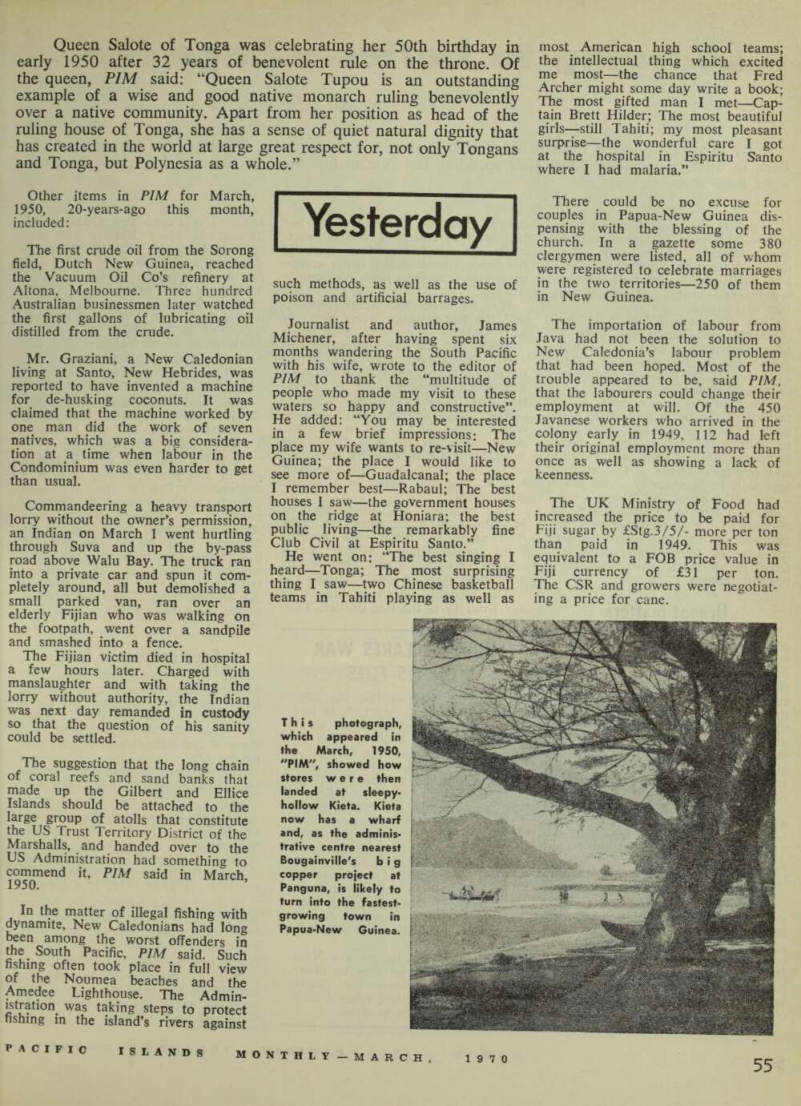
This photograph, which appeared in the March, 1950, "PIM", showed how stores were then landed at sleepy hollow Kieta. Kieta now has a wharf and, as the adminis trative centre nearest Bougainville's big copper project at Panguna, is likely to turn into the fastest growing town in Papua-New Guinea.