Learning to better village life . .
pp. 58-59 · Read in the full issue
From SUE WENDT in Suva By now, 19 students from seven Pacific territories and Australia, Thailand and Sarawak will be back in their own commiunites, after spending last year in Fiji. Some of them, perhaps, may be quail ing a little at the task ahead.
After all, it’s one thing to attend classes, however practical, at the South Pacific Commission Com munity Education Training Centre in Suva—it’s quite another to return to villages and towns and impart what they’ve learned.
Mrs. Elizabeth Eden, who both mothered and taught the girls, be lieves they’ll do it well. And she has great faith in the worth of centres as a means of assisting community development over a wide area.
“I believe this kind of work is best tackled at the grass roots level,” she said. “These girls have gone home to work among villagers, raising standards of nutrition, child health and hygiene. Theirs is the practical approach to community development —and we’ve proof that it does work.”
Mrs. Eden, who has been the director of the home economics pro gramme at the centre for the past seven years, tells of the three girls from the Gilberts who attended a
previous course.
Urgent matters
“They have established 130 offices of an organisation called the Home makers’ Club —an astonishing result in such a small and scattered place,” she said, with pride. “The girls cir culate to get people interested in these clubs, so that they can gather together and decide which are the most urgent matters needing attention in a village community. Then the girls set up a programme; nutrition and child care are the first considera tions.” . , . , One of the Gilbertese girls had done a year’s teacher training before being selected for the course in Suva.
The other two were untrained —but they had the necessary qualities of leadership and intelligence.
Among those who attended the last course and who are iust now tackling the job ahead is a Thai woman, Mrs.
Bupha Pinii, who has a BA in social administration and who worked previ ously in the Ministry of Community Development in Thailand. She is now stationed at a community de velopment regional centre in her country. , Bupha was one of the most suc
cessful students, of course, but her high-level of education wasn’t neces sarily the most important requisite for those attending the year’s couree in home economics and community work.
It’s the leadership that counts — and the perseverence when they re turn home.
Since the centre’s beginnings in 1963, 106 young women from 16 territories have been trained in home economics, learning how to utilise the most meagre facilities.
They were taught every cooking method from the hay-box to the wood stove, and how to grow their own vegetable gardens, how to sew, plan a family, bring up children —even how to plan the layout of a village community.
The majority are now employed in education programmes in their own countries, some with govern ment organisations, others with church groups, youth bodies or vocational training establishments.
The students last year ranged in age from 19 to the late thirties. They
included a Papua-New Guinea girl, 21-year-old Mary Youga, who was sponsored by the Country Women’s Association of NSW. She works now in the programme section of the YWCA in Port Moresby.
Then there was Mrs. Vi Stanton, a 39-year-old part-Aboriginal woman, sponsored by the PPSEAWAX. The The mother of six children, she was formerly home management in structress at the Bagot Aboriginal Settlement, seven miles from Darwin.
Now, on her return to Australia, she is home management instructress in social welfare for the Northern Territory Administration.
Terani Aisake, the only Rotuman girl in last year’s course, is now a deaconess within the Methodist Church, with community develop ment as a specialty. Fijian Mrs.
Asenaca Inomae, who was doing domestic work before she attended the centre, now plans to assist with women’s groups in the Solomon Islands or in Fiji. All the students are making a significant contribution to the standard of living in their own areas.
Four converted huts
The SPC Community Education Training Programme is conducted in four converted Army huts, for which the staff is provided by the UN Food and Agricultural Organisation and the rent and administration costs paid by the SPC.
The students live in the Nawela Hostel in Suva’s Botanical Gardens.
Last year was Mrs. Eden’s final one in Fiji. She has been posted to Malawi, Africa. The bustling Scotswoman, a graduate of the Glasgow College of Domestic Science, should adjust well—for she spent 15 years, from 1944-1959, in Ghana.
“I don’t mind returning to Africa, but I’ve enjoved my seven years in Fiji,” she said. “Community work has a head-start here because women in Fiji are recognised as a real power.
“But we don’t want to split the community into men and women! We want to encourage the menfolk to work with us.”
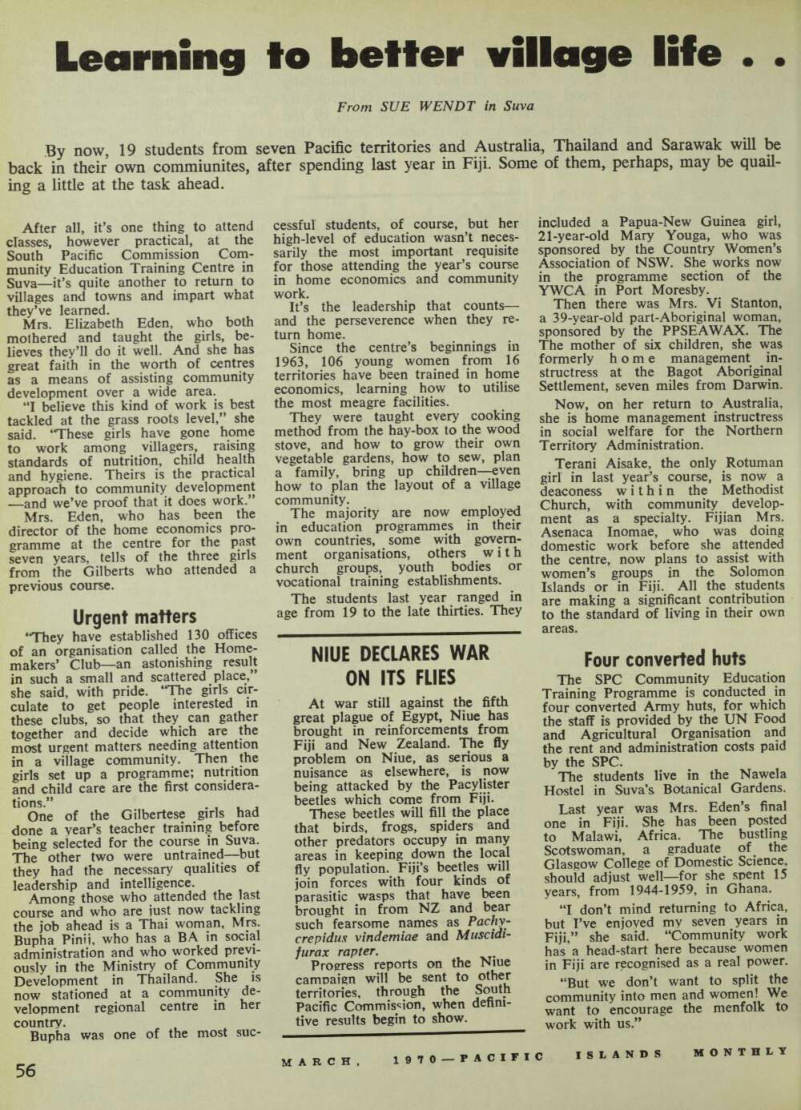
Life at the allege is varied: Above, learning to make a Thai dish are (left) Veronique Tahimili of New Caledonia, Mrs. Asenaca Inomae of Fiji, Nirundorn Chuencharoen of Thailand and Ane Aneuea of the GEIC. Right, Tarani Aisake of Rotuma demons:rates a well-planned village as part of an exhibit on environmental sanitation.
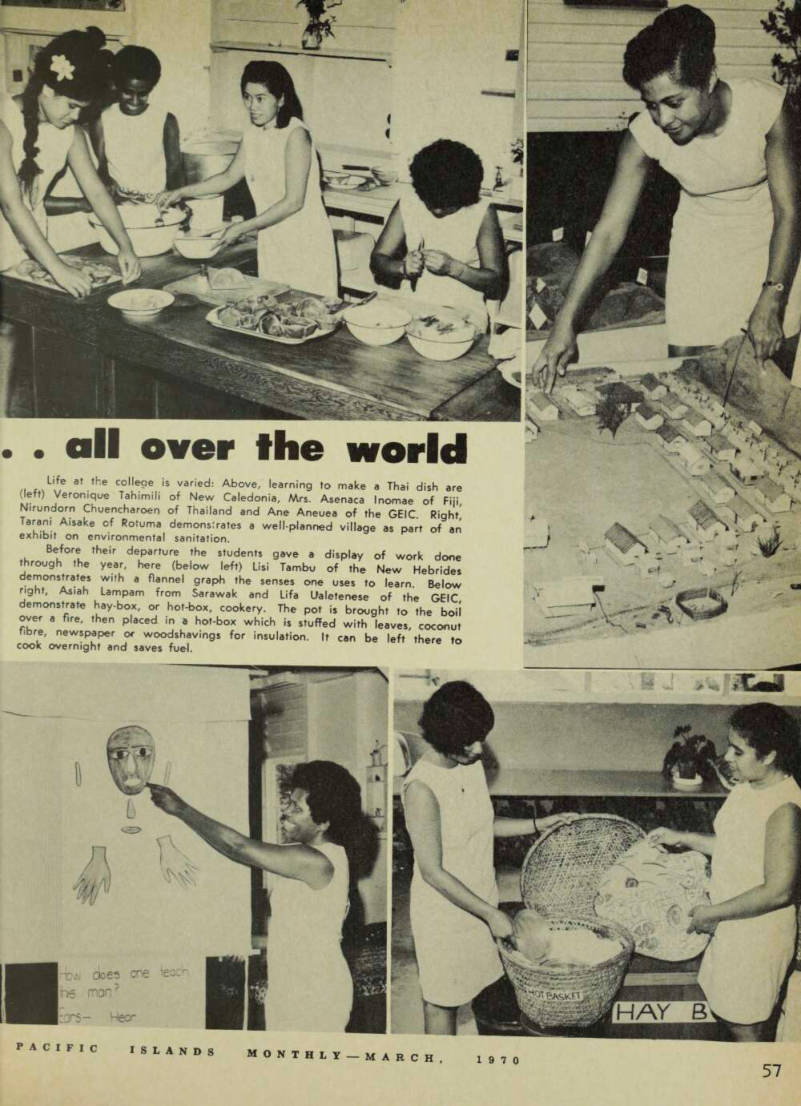
Before their departure the students gave a display of work done through the year, here (below left) Lisi Tambu of the New Hebrides demonstrates with a flannel graph the senses one uses to learn. Below right, Asiah Lampam from Sarawak and Life Ualetenese of the GBIC, demonstrate hay-box, or hot-box, cookery. The pot is brought to the boil over a fire, then placed in a hot-box which is stuffed with leaves, coconut fibre, newspaper or woodshavings for insulation. It can be left there to cook overnight and saves fuel.