Tahiti: romance and reality
pp. 49-55 · Read in the full issue

as new decade opens
By John Griffin
Tahiti is far more than just the capital of French Polynesia—six small island groups scattered over a Europe-sized portion of the Southeast Pacific. Despite time and tarnish, it remains the capital of the Pacific dream—one of life’s magic words that triggers images of South Sea beauty and love.
The reality of Tahiti has never been in full accord with the romance, of course. Nor is it today: Choking traffic jams mark the rush hours in the crowded capital of Papeete. . . . High prices hit both visitors and local folk . . .
The French and Tahitians are always greeting each other with kisses on the cheeks but most aren’t very friendly to ordinary visitors. . . .
Even the famous women may have changed; explained one local expert: “Too many French servicemen and tourists. The girls have better teeth than ten years ago, but they’re also tougher, or maybe more sophisti cated. . .
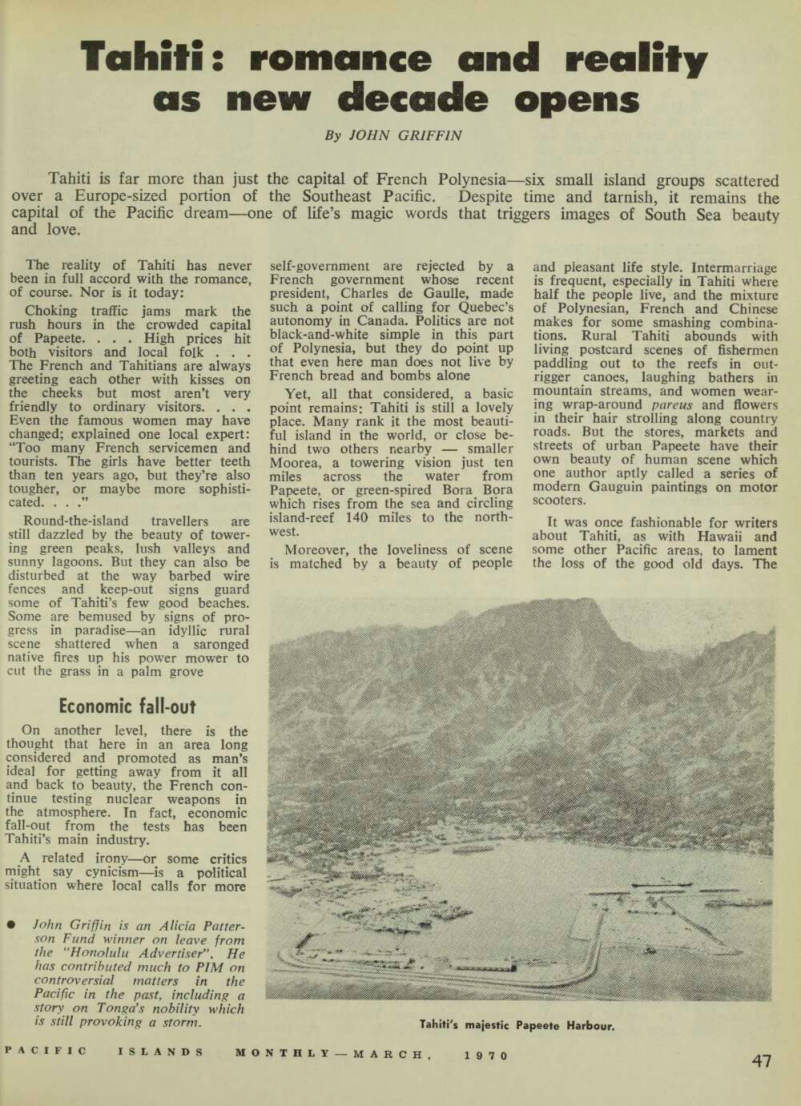
Round-the-island travellers are still dazzled by the beauty of tower ing green peaks, lush valleys and sunny lagoons. But they can also be disturbed at the way barbed wire fences and keep-out signs guard some of Tahiti’s few good beaches.
Some are bemused by signs of pro gress in paradise—an idyllic rural scene shattered when a saronged native fires up his power mower to cut the grass in a palm grove
Economic fall-out
On another level, there is the thought that here in an area long considered and promoted as man’s ideal for getting away from it all and back to beauty, the French con tinue testing nuclear weapons in the atmosphere. In fact, economic fall-out from the tests has been Tahiti’s main industry.
A related irony—or some critics might say cynicism—is a political situation where local calls for more
self-government are rejected by a French government whose recent president, Charles de Gaulle, made such a point of calling for Quebec’s autonomy in Canada. Politics are not black-and-white simple in this part of Polynesia, but they do point up that even here man does not live by French bread and bombs alone Yet, all that considered, a basic point remains; Tahiti is still a lovely place. Many rank it the most beautiful island in the world, or close behind two others nearby smaller Moorea, a towering vision just ten miles across the water from Papeete, or green-spired Bora B<3ra which rises from the sea and circling island-reef 140 miles to the northwest - Moreover, the loveliness of scene is matched by a beauty of people
and pleasant life style. Intermarriage is frequent, especially in Tahiti where half the people live, and the mixture of Polynesian, French and Chinese makes for some smashing combina tions. Rural Tahiti abounds with living postcard scenes of fishermen paddling out to the reefs in out rigger canoes, laughing bathers in mountain streams, and women wear jn§ wrap-around pareus and flowers in their hair strolling along country r °ads. But the stores, markets and streets of urban Papeete have their own beauty of human scene which one author aptly called a series of modern Gauguin paintings on motor scooters.
It was once fashionable for writers about Tahiti, as with Hawaii and some other Pacific areas, to lament the loss of the good old days. The
John Griffin is an Alicia Patter son Fund winner on leave from the “Honolulu Advertiser”. He has contributed much to PIM on controversial matters in the Pacific in the past, including a story on Tonga’s nobility which is still provoking a storm.
Tahiti's majestic Papeete Harbour.
Not so good old days
newer thing is to knock the lamenters, making the points that the old days weren’t so good, im provements have been made, and that the past is gone anyway; there are even jokes such as the one about Captain Cook arriving on his second visit 190 years ago and telling a fellow officer, “This place sure has changed; you should have seen it before.”
That considered, however, it’s still worth noting that Tahiti had what writers agree were some pretty good old days, some more recent bad days, and is now in an uncertain era of change, economically, socially and perhaps politically.
Tahiti’s early European history was marked, as were other Pacific Islands, with roistering sailors, disease that decimated the popula tion, English-French rivalry for both political influence with local leaders and predominance of Protestant and Catholic missionaries, and finally the end of native political power. France took effective control of Tahiti in 1843 and gradually established rule over the entire area.
Queen Pomare
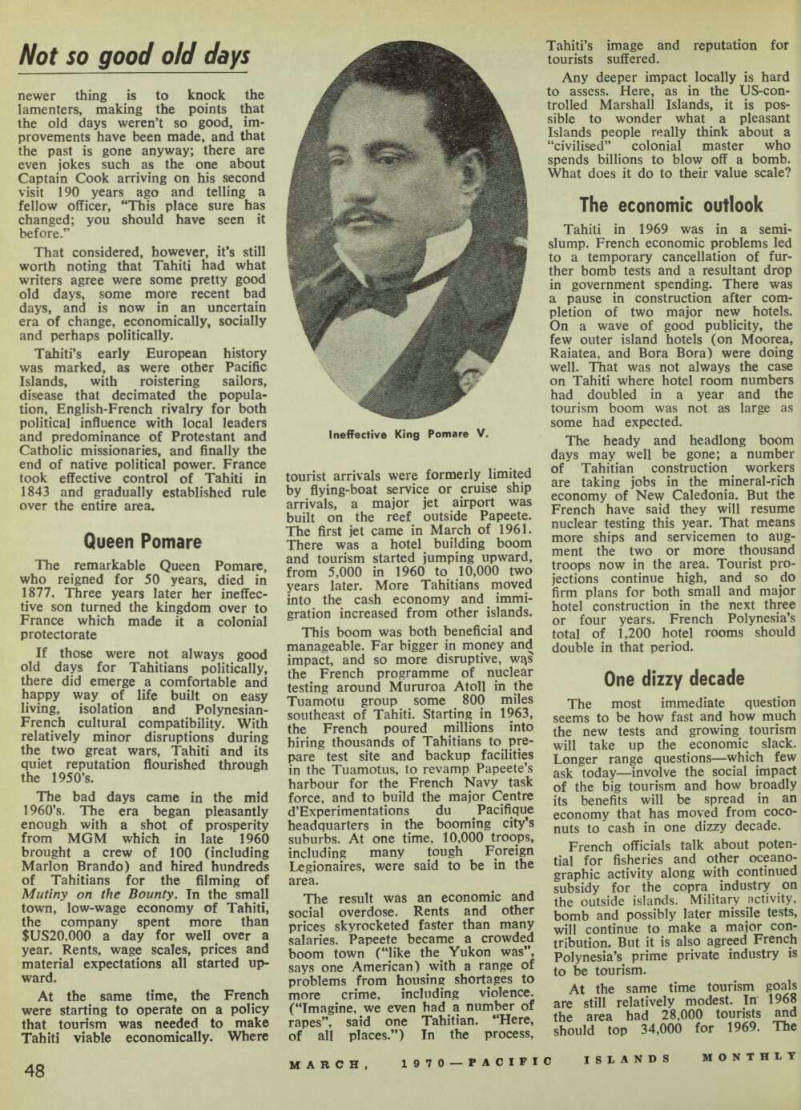
The remarkable Queen Pomare, who reigned for 50 years, died in 1877. Three years later her ineffec tive son turned the kingdom over to France which made it a colonial protectorate If those were not always good old days for Tahitians politically, there did emerge a comfortable and happy way of life built on easy living, isolation and Polynesian- French cultural compatibility. With relatively minor disruptions during the two great wars, Tahiti and its quiet reputation flourished through the 1950’s.
The bad days came in the mid 1960’s. The era began pleasantly enough with a shot of prosperity from MGM which in late 1960 brought a crew of 100 (including Marlon Brando) and hired hundreds of Tahitians for the filming of Mutiny on the Bounty. In the small town, low-wage economy of Tahiti, the company spent more than SUS20.000 a day for well over a year. Rents, wage scales, prices and material expectations all started up ward.
At the same time, the French were starting to operate on a policy that tourism was needed to make Tahiti viable economically. Where
tourist arrivals were formerly limited by flying-boat service or cruise ship arrivals, a major jet airport was built on the reef outside Papeete.
The first jet came in March of 1961.
There was a hotel building boom and tourism started jumping upward, from 5,000 in 1960 to 10,000 two years later. More Tahitians moved into the cash economy and immi gration increased from other islands.
This boom was both beneficial and manageable. Far bigger in money and impact, and so more disruptive, the French programme of nuclear testing around Mururoa Atoll in the Tuamotu group some 800 miles southeast of Tahiti. Starting in 1963, the French poured millions into hiring thousands of Tahitians to pre pare test site and backup facilities in the Tuamotus, to revamp Papeete’s harbour for the French Navy task force, and to build the major Centre d’Experimentations du headquarters in the booming city’s suburbs. At one time, 10,000 troops, including many tough Foreign Legionaires, were said to be in the area.
The result was an economic and social overdose. Rents and other prices skyrocketed faster than many salaries. Papeete became a crowded boom town (“like Yukon was”, says one American) with a range of problems from housing shortages to more crime, including violence. (“Imagine, we even had a number of rapes”, said one Tahitian. “Here, of all places.”) In the process,
Tahiti’s image and reputation for tourists suffered.
Any deeper impact locally is hard to assess. Here, as in the US-con trolled Marshall Islands, it is pos sible to wonder what a pleasant Islands people really think about a “civilised” colonial master who spends billions to blow off a bomb.
What does it do to their value scale?
The economic outlook
Tahiti in 1969 was in a semi slump. French economic problems led to a temporary cancellation of fur ther bomb tests and a resultant drop in government spending. There was a pause in construction after com pletion of two major new hotels.
On a wave of good publicity, the few outer island hotels (on Moorea, Raiatea, and Bora Bora) were doing well. That was not always the case on Tahiti where hotel room numbers had doubled in a year and the tourism boom was not as large as some had expected.
The heady and headlong boom days may well be gone; a number of Tahitian construction workers are taking jobs in the mineral-rich economy of New Caledonia. But the French have said they will resume nuclear testing this year. That means more ships and servicemen to aug ment the two or more thousand troops now in the area. Tourist pro jections continue high, and so do firm plans for both small and major hotel construction in the next three or four years. French Polynesia’s total of 1,200 hotel rooms should double in that period.
One dizzy decade
The most immediate question seems to be how fast and how much the new tests and growing tourism will take up the economic slack.
Longer range questions—which few ask today—involve the social impact of the big tourism and how broadly its benefits will be spread in an economy that has moved from coco nuts to cash in one dizzy decade.
French officials talk about poten tial for fisheries and other oceano graphic activity along with continued subsidy for the copra industry on the outside islands. Military activity, bomb and possibly later missile tests, will continue to make a major con tribution. But it is also agreed French Polynesia’s prime private industry is to be tourism.
At the same time tourism goals are still relatively modest. In 1968 the area had 28,000 tourists and should top 34,000 for 1969. The
Ineffective King Pomare V.
Prime industry tourism
most ambitious forecasts are for 250-300,000 tourists a year by 1977, and some doubted if the South Pacific’s high plane fares and this area’s lack of utilities would make that possible. (Hawaii, by compari son, already has 1.4 million visitors a year—but nobody in Tahiti was talking about becoming another Hawaii).
Because the industry has become so vital, tourism is now promoted, guided, and even partly controlled by a super agency right under the appointed French Governor, the Tahiti Tourism Development Board.
This TTDB has broad powers that range from helping arrange financ ing and cutting red tape for approved developers, to controlling building sites and even signs.
The TlDß’s manager and top executive is Alex Ata, an ambitious and controversial figure with good political connections and an urge for development that lets him see virtue in some of the worst sections of Honolulu’s Waikiki. His goal, how ever, is hardly to create another Waikiki.
In fact, he hopes to sell TTDB members on a policy of focusing the next round of development off Tahiti, so that some 65 per cent of the hotel rooms would be in the outer islands by 1975. The goal would be to both spread economic benefits and to check the migration to Tahiti, which already has over half :>f French Polynesia’s 100,000 popu lation. This is no small project; for vhile the outer islands are often imong the world’s most lovely, they ilso lack amenities ranging from air >orts to running water.
Politics and Pouvanaa
Tahiti’s economic surge has over hadowed or at least muted political levelopments during much of the 960’s. French security consciousness lue to the nuclear tests has also een a restraining factor. But a level f dissatisfaction is indicated by the 'ay Tahiti voted “no” in last April’s sferendum that brought down ’resident de Gaulle; and for Alain oher against Gaullist Georges Pom idou in the June presidential elec on. Moreover, Tahiti does not lack )r active and articulate critics of rench policy; at this point the pposition controls elective politics.
The central—-or certainly the most embolic —political figure in French olynesia in the last 20 years has
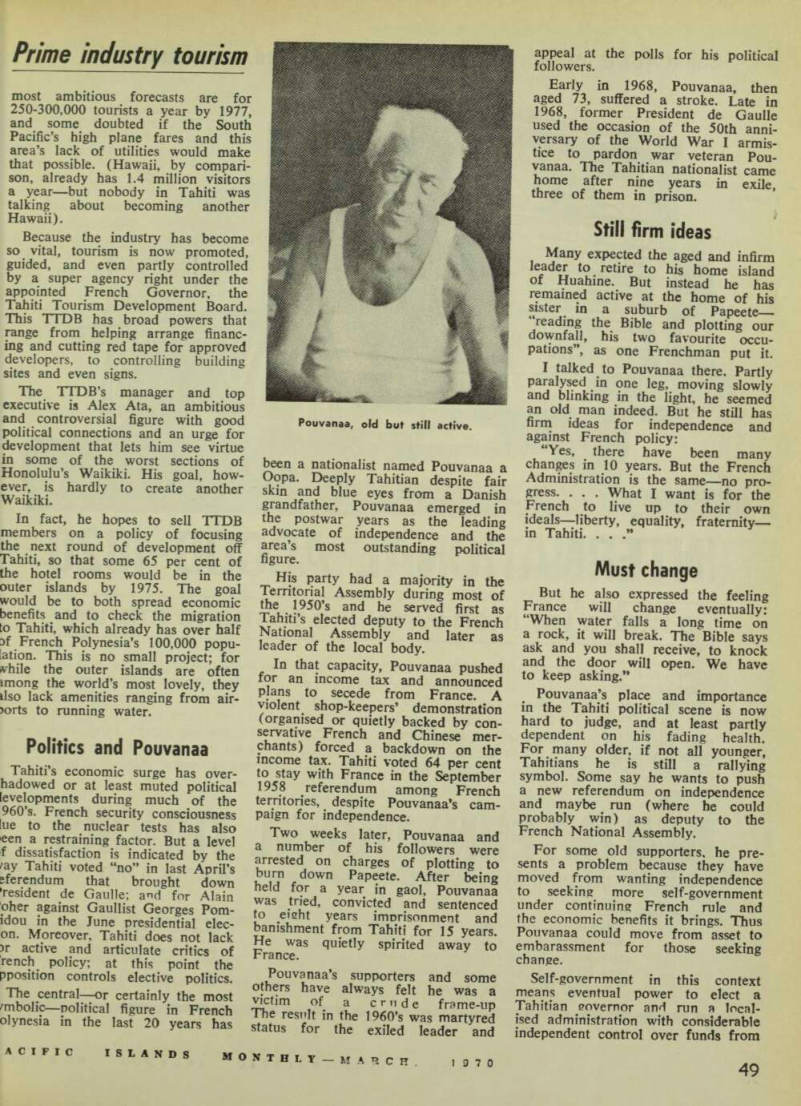
been a nationalist named Pouvanaa a Oopa. Deeply Tahitian despite fair skin and blue eyes from a Danish grandfather, Pouvanaa emerged in the postwar years as the leading advocate of independence and the area’s most outstanding political figure.
His party had a majority in the Territorial Assembly during most of the 1950’s and he served first as Tahiti’s elected deputy to the French National Assembly and later as leader of the local body.
In that capacity, Pouvanaa pushed for an income tax and announced plans to secede from France. A violent shop-keepers’ demonstration (organised or quietly backed by con servative French and Chinese mer chants) forced a backdown on the income tax. Tahiti voted 64 per cent to stay with France in the September 1958 referendum among French temtories, despite Pouvanaa’s cam paign for independence.
Two weeks later, Pouvanaa and a number of his followers were arrested on charges of plotting to * down Papeete. After being held for a year in gaol, Pouvanaa was tried, convicted and sentenced to eieht years imorisonment and banishment from Tahiti for 15 years.
He was quietly spirited away to France.
Pouvanaa’s supporters and some others have always felt he was a victim of a crude frame-up The result in the 1960’s was martyred status for the exiled leader and
appeal at the polls for his political followers.
Early in 1968, Pouvanaa, then aged 73, suffered a stroke. Late in 1968, former President de Gaulle used the occasion of the 50th anni versary of the World War I armis tice to pardon war veteran Pou vanaa. The Tahitian nationalist came home after nine years in exile, three of them in prison.
Still firm ideas
Many expected the aged and infirm leader to retire to his home island of Huahine. But instead he has remained active at the home of his sister in a suburb of Papeete reading the Bible and plotting our downfall, his two favourite occu pations”, as one Frenchman put it.
I talked to Pouvanaa there. Partly paralysed in one leg, moving slowly and blinking in the light, he seemed an old man indeed. But he still has firm ideas for independence and against French policy: “Yes, there have been many changes in 10 years. But the French Administration is the same—no pro gress. . . . What I want is for the French to live up to their own ideals—liberty, equality, fraternity— in Tahiti. . . .”
Must change
But he also expressed the feeling France will change eventually: “When water falls a long time on a rock, it will break. The Bible says ask and you shall receive, to knock and the door will open. We have to keep asking.”
Pouvanaa’s place and importance in the Tahiti political scene is now hard to judge, and at least partly dependent on his fading health.
For many older, if not all younger, Tahitians he is still a rallying symbol. Some say he wants to push a new referendum on independence and maybe run (where he could probably win) as deputy to the French National Assembly.
For some old supporters, he pre sents a problem because they have moved from wanting independence to seeking more self-government under continuing French rule and the economic benefits it brings. Thus Pouvanaa could move from asset to embarassment for those seeking change.
Self-government in this context means eventual power to elect a Tahitian governor and run a local ised administration with considerable independent control over funds from
Pouvanaa, old but still active.
Key colonial figure
Paris. Now the French governor— with control of funds, a basically French administration, and the mili tary presence—remains a key colonial figure. There is a government com mittee of five members selected by the Territorial Assembly which is important administratively, but the governor has a veto.
The 30-member Territorial As sembly has relatively wide legisla tive powers (although the fact most of its members oppose the French bomb tests dramatises its limitations).
Power in the assembly is held by a coalition of two parties, both strong for more self-government and in cluding old followers of Pouvanaa.
Rural strength
One, with nine elected members, is headed by Francis Sanford, the French-Tahitian elected Deputy to the French National Assembly; Sanford’s party includes a number of the many part-French government workers and generally urbanised residents.
The other is headed by Assembly President John Teariki, a Tahitian; it is essentially Pouvanaa’s party, gets most of its strength from rural Tahitian elements, and is oriented to their land and other probems.
The next election is in 1972, so it would seem that any major political development in Tahiti would relate to a shift in French policy toward granting more self-government. That did not seem likely during my visit.
For one thing, the French have made huge investment facilities and were planning to continue nuclear tests.
Some suggested President Pompidou was even less sympathetic than was de Gaulle on self-government.
Said one official: “President Pompidou has said our policy to wards territories is the same. We are going to stay in the Pacific; there is no doubt about it.”
He went on to explain that the French feel real autonomy can only come when an area is economically viable, and Tahiti still requires much French aid. “Now imports are ten times more than what comes from exports, including money from tour ism.”
Does that mean France would look more favourably on more internal autonomy if and when Tahiti’s economy grows?
No, he indicated. “Even in the
future our idea is that Tahiti is a part of France. ... It would be foolish, it would be madness for the Tahitians to want to change.”
It is hard to escape the feeling that the basic French interests are to protect the security of their bomb tests and to keep control in an area that can be both strategic ally useful and a source of needed dollars from American tourists.
They both remember the problems with the old Pouvanaa and aren’t sure about the present opposition.
“There are more secret police here than any French area”, said one knowledgeable source, “You have probably been followed at times.”
Said Deputy Francis Sanford: “We know we can’t afford indepen dence. We are for internal autonomy.
We would still have the French flag, but we want more say in our own affairs. . . .
“The French have reacted very badly to our requests. I suppose they are afraid we would do all we can to stop their atomic tests . . .
I think they don’t trust us enough.
They are afraid that behind our re quest for autonomy is a desire for independence.”
Others charge that the French realise most of Tahiti’s people want to remain with France and use that fact as a means to hold back any change. Said one politician: “The French exaggerate by saying that those who call for self-government really want independence. French officials say that if we insist they may pull out of Tahiti completely like they did in Guinea 10 years ago.
That, of course, would be tragic because they have done some good things here and will do more.”
In this mixture of distrust, in trigue and nuclear security, there is also the view of those who support the French regime. Yet even here there are some differences. Says Gaston Flosse, the young and ener getic mayor of Pirae, outside Papeete, and a member of the minority that President Pompidou’s party has in the local assembly:
More power wanted
“Our first objective is for our territory to stay under the French Government. We oppose internal autonomy—but we want the French Government to give more power to local people.”
He outlines a goal of enhancing the powers of the Government Com mittee, the five members selected by the assembly to work with the governor on administration. . . .
“We can’t have internal autonomy because we don’t have the economy or industry.”
Flosse, considered by some as the most promising pro-government figure, adds that the local branch of the French ruling party is against the bomb tests, “but what can we do?”
So it is that economic and social change—and the lack of political change—are the strong impressions of French Polynesia as the 1970’s open.
Not everything has happened for the best this hectic decade. But after the bomb boom, big tourism seems
Away from politics, the real Tahiti—a pretty girl and a lush green valley.
More Chinese interests
front roadway park and tourism complex are definite improvements.
If there has been severe social disruption, for many there has also been evolution of a positive nature.
For example, Tahiti’s Chinese, some 10 per cent of the population, still have 80 per cent or more of the commerce; this broad economic scope is still too often accompanied by narrow views of social and poli tical responsibility. But there has been outstanding change in this situa tion in the last decade. Most Chinese are now French citizens in fact and, especially with the young, people of Tahiti in spirit. Social contacts and intermarriage are increasing. A full Chinese and a half-Chinese (a nephew of Pouvanaa) were elected to the Territorial Assembly.
Military dominates
It is, of course, possible to be concerned about Tahiti’s political future. Even for many who seek to understand the concept of Tahiti as part of France, the French seem to have been unimaginative and strategically selfish. As with the US Trust Territory, military considera tions appear to dominate legitimate local political options.
But virtually everyone I talked with indicated no political trouble of any consequence is now expected.
They pointed to such diverse things as a basic Tahitian happy apathy, a general preoccupation with the economic situation, the presence of French troops, and a reservoir of appreciation for France. Certainly, the idea of having an income tax seemed a more heated issue than internal self-government.
Still, Tahiti in changing. As many feel the controversial income tax will eventually have to come, it may be that local political pressures on the French will again start evolv ing as they did in the 1950’5. Now even more than then, France has the power to put down anything or anyone in Tahiti. But now also more than during those quieter non tourist colonial days, some more imaginative, and certainly more demo cratic solutions might be expected.
Political reality and romance are too far apart today in this lovely part of a changing Pacific. more hopeful and manageable than awesome. Papeete may have lost some charm but the new clean-up drive won’t hurt, and the new water-