Yesterday
p. 95 · Read in the full issue
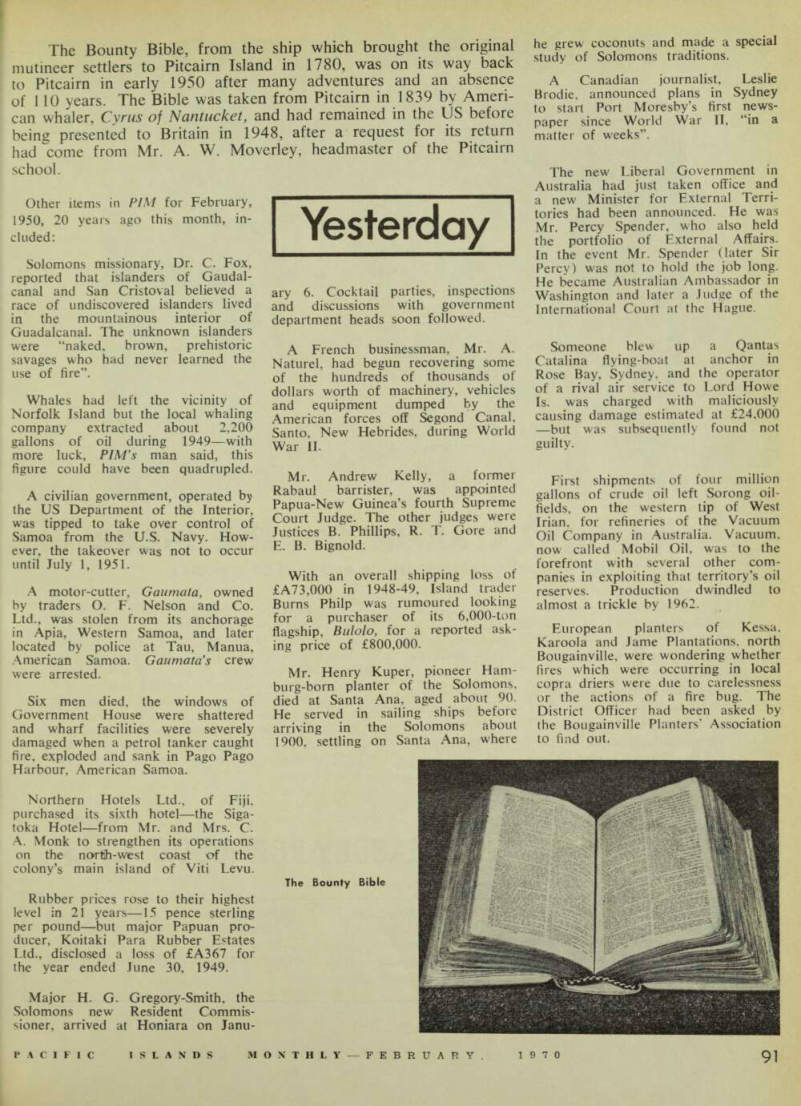
The Bounty Bible, from the ship which brought the original mutineer settlers to Pitcairn Island in 1780, was on its way back to Pitcairn in early 1950 after many adventures and an absence of 110 years. The Bible was taken from Pitcairn in 1839 by Ameri can whaler, Cyrus of Nantucket , and had remained in the US before being presented to Britain in 1948, after a request for its return had come from Mr. A. W. Moverley, headmaster of the Pitcairn school.
Other items in PIM for February, 1950, 20 years ago this month, in cluded: Solomons missionary, Dr. C. Fox, reported that islanders of Gaudal canal and San Cristoval believed a race of undiscovered islanders lived in the mountainous interior of Guadalcanal. The unknown islanders were “naked, brown, prehistoric savages who had never learned the use of fire”.
Whales had left the vicinity of Norfolk Island but the local whaling company extracted about 2,200 gallons of oil during 1949—with more luck, PlM’s man said, this figure could have been quadrupled.
A civilian government, operated by the US Department of the Interior, was tipped to take over control of Samoa from the U.S. Navy. How ever, the takeover was not to occur until July 1, 1951.
A motor-cutter, Gaumata, owned by traders O. F. Nelson and Co.
Ltd., was stolen from its anchorage in Apia, Western Samoa, and later located by police at Tau, Manua, American Samoa. Gaumata’s crew were arrested.
Six men died, the windows of Government House were shattered and wharf facilities were severely damaged when a petrol tanker caught fire, exploded and sank in Pago Pago Harbour, American Samoa.
Northern Hotels Ltd., of Fiji, purchased its sixth hotel—the Siga toka Hotel—from Mr. and Mrs. C.
A. Monk to strengthen its operations on the north-west coast of the colony’s main island of Viti Levu.
Rubber prices rose to their highest level in 21 years—ls pence sterling per pound—but major Papuan pro ducer, Koitaki Para Rubber Estates Ltd., disclosed a loss of £A367 for the year ended June 30, 1949.
Major H. G. Gregory-Smith, the Solomons new Resident Commis sioner, arrived at Honiara on Janu
ary 6. Cocktail parties, inspections and discussions with government department heads soon followed.
A French businessman, Mr. A.
Naturel, had begun recovering some of the hundreds of thousands of dollars worth of machinery, vehicles and equipment dumped by the American forces off Segond Canal.
Santo, New Hebrides, during World War 11.
Mr. Andrew Kelly, a former Rabaul barrister, was appointed Papua-New Guinea’s fourth Supreme Court Judge. The other judges were Justices B. Phillips, R. T. Gore and E. B. Bignold.
With an overall shipping loss of £A73,000 in 1948-49, Island trader Burns Philp was rumoured looking for a purchaser of its 6,000-ton flagship, Bulolo, for a reported ask ing price of £BOO,OOO.
Mr. Henry Kuper, pioneer Ham burg-born planter of the Solomons, died at Santa Ana, aged about 90.
He served in sailing ships before arriving in the Solomons about 1900. settling on Santa Ana, where
he grew coconuts and made a special study of Solomons traditions.
A Canadian journalist, Leslie Brodie, announced plans in Sydney to start Port Moresby’s first news paper since World War 11, “in a matter of weeks”.
The new Liberal Government in Australia had just taken office and a new Minister for External Terri tories had been announced. He was Mr. Percy Spender, who also held the portfolio of External Affairs.
In the event Mr. Spender (later Sir Percy) was not to hold the job long.
He became Australian Ambassador in Washington and later a Judge of the International Court at the Hague.
Someone blew up a Qantas Catalina flying-boat at anchor in Rose Bay, Sydney, and the operator of a rival air service to Lord Howe Is. was charged with maliciously causing damage estimated at £24,000 —but was subsequently found not guilty.
First shipments of four million gallons of crude oil left Sorong oil fields, on the western tip of West Irian, for refineries of the Vacuum Oil Company in Australia. Vacuum, now called Mobil Oil, was to the forefront with several other com panies in exploiting that territory’s oil reserves. Production dwindled to almost a trickle by 1962.
European planters of Kessa, Karoola and Jame Plantations, north Bougainville, were wondering whether fires which were occurring in local copra driers were due to carelessness or the actions of a fire bug. The District Officer had been asked by the Bougainville Planters’ Association to find out.
The Bounty Bible