Book Reviews
pp. 97-99 · Read in the full issue
Why Those Australians
Don't Go Home
It’s likely that if he based his judgment solely on Peter Hasting’s New Guinea —Problems and Prospects , no sane Aust ralian would stay in that country or invest money in it.
But having said that, it must also be said that this latest book about the state of the Papua-New Guinea non-nation, is more coldly analytical and valid than many of the others that have flooded off the presses in the last few years.
Fortunately, or unfortunately, for Papua-New Guinea, most people approach the territory in anything but a coldly analytical frame of mind.
Most non-native residents suffer from some sort of euphoria about the place, and always have.
Although pre-war governments wished for nothing more spectacular than keeping the status quo and the breath of scandal out of Australian newspapers, post-World War II gov ernments have suffered their own brand of euphoria in imagining that they could leave P-NG, at independ ence, a nationalistic whole, complete with Westminster type government, flag, anthem and a fond affection for Australia.
He helped design it
Although we seem to remember that the author, in the early post war years, was one of the select band of back-room boys who helped de sign the new style New Guinea, he now maintains that present govern ment policies, based on transplanting Western forms of political govern ment onto Melanesian culture, are misplaced. He feels that there must be radical changes in Australian policies to meet the problems of in dependence, now only a few years away.
He suggests that rather than try to weld the hundreds of mutually suspicious tribal groupings into one national entity—the success of which he (and many others) seriously doubt —that there may be practical benefits all round if Australia deliberately promoted secession of parts of the
present combined territory. He sug gests that Manus, New Ireland, New Britain and Bougainville might form one unit, to be joined ultimately by the British Solomons, the people of which are ethnically akin to Bougain ville. This grouping would be part of a Federation in which the other State or States would be the rest of present Papua-New Guinea.
On the question of the present and future economy of the territory he quotes copiously from people who are regarded, or regard themselves, as experts.
Impractical ideas
He outlines the various suggestions that have been made to give in digenes a bigger slice of the economic cake (most of them impractical, I should say, from an investor’s point of view); and makes the comment that even if it means cutting off its nose to spite its face, a newly in dependent New Guinea would not tolerate for long a situation where commerce, airline, shipping, banking, manufacturing and plantation in terests are controlled by a foreign minority. As some New Guinean politicians have already opened their mouths on the same subject it is obvious that there are already a few knives being sharpened in the nose disposal department.
Mr. Hastings also has a lot to say about the insoluble business of race relationships. He disposes of the Australian myth that there has been some “special relationship” between Australians and Papuans and New Guineans; that Australians, because of their mateyness, have made a better job of it than other colonial powers. Most of this “special re lationship” Hastings dismisses as paternalism.
All boiled down, what it seems to amount to is that there is no real
compatability between the while “haves” and the brown or black New Guinea “have nots”. The gap is too wide and fundamental to be bridged, in this century at least, and possibly not ever.
"We hate white men"
Some indigenes, like Albert Maori Kiki, one of the most vocal of Papuan politicians, has said publicly that: “We have hatred for the white man in our hearts.” Others, not so articulate, have feelings of resentment that are far from specific. Many have feelings of inferiority because they are confronted continually by white assurance and achievement, not to say material possessions.
Nonetheless, it is interesting to note some of the specific resentments as listed by the author: The fact that Europeans keep dogs to guard un fenced houses against theft by natives; that some of the waiters in some of the hotels still are clothed “without dignity” in lap-laps; that courses on hotel menus are still numbered
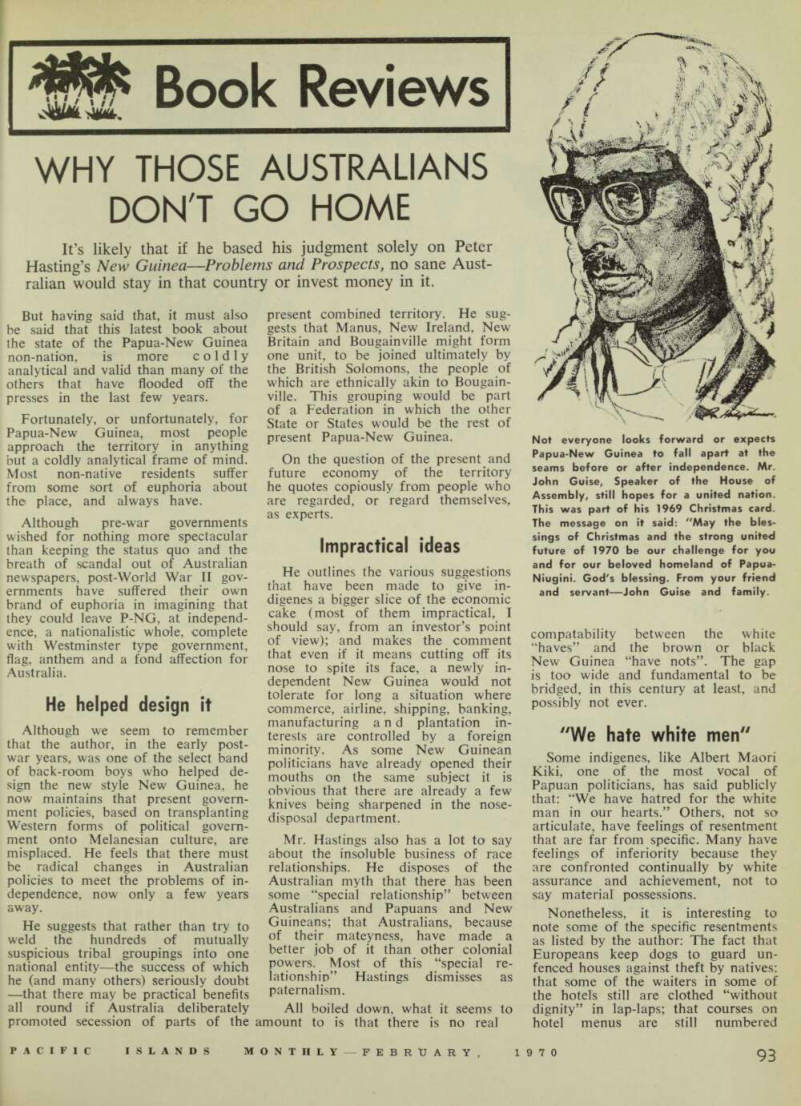
Not everyone looks forward or expects Papua-New Guinea to fall apart at the seams before or after independence. Mr.
John Guise, Speaker of the House of Assembly, still hopes for a united nation.
This was part of his 1969 Christmas card.
The message on it said: "May the bles sings of Christmas and the strong united future of 1970 be our challenge for you and for our beloved homeland of Papua- Niugini. God's blessing. From your friend and servant —John Guise and family.
(although most waiters speak English); that attractive native girls go out with Europeans; that European women in coastal towns arm themselves against night prowlers.
Why then bother with this hot, prickly, irritable land which, in spite of its racial tensions and its political posturings, needs Australia more than Australia needs it?
Most colonials in Africa, Asia and even in other parts of the Pacific, put down roots. But few Australians have ever called New Guinea home.
A place to earn money
“While many Australians have loved New Guinea and some its people,” says Peter Hastings, at the end of his book, “it has primarily re mained a place to earn a living or a pension. If, at some future date, New Guineans post ‘Australians, go home’ signs, or indulge in race riots in Port Moresby or Madang, then Australians will return home, not only because they will want to but because they can. In the absence of necessity there will be little disposi tion to remain, for in the end Aus tralia offers them personal security, economic opportunity, a future for their children and an agreeable climate. It always has.”
If the other 280 pages of this book mean anything, the race riots, the go-home posters and all the other manifestations of decolonisation are quite on the cards. So why not opt out now?
Because, according to the author, an enforced retreat would profoundly affect Australia’s emerging image as a “sympathetic regionalist.” He sees, hopefully, Australia not only as pan of the SE Asia region but bringing into its “orbit of burgeoning power, resources and influence” the whole Melanesian chain, including Fiji.
In other words, Australia is go ing to be stuck with carrying the torch in Papua-New Guinea and the rest of Melanesia even though a lot of the beneficiaries will hate her guts for doing it. That, presumably, is the price for being a Have country
in the 1970’5.
J.T.
(New Guinea: Problems And
PROSPECTS. Cheshire. $3.50 soft cover; $4.95 bound.) • A comprehensive 16-page index to all articles, etc., published in the January to December, 1969, issues of Pacific Islands Monthly is now avail able. It was issued free to regular subscribers with the January, 1970, issue of PIM. Copies are still avail able to all other readers for 30 cents Aust., surface posted all over the world.