An Epic Defence!
pp. 93-94 · Read in the full issue
• The history of a trading firm might be the last place, one would suppose, to find references to gun battles and treasure hoards. But Canberra's Pacific Manuscripts Bureau recently received a history, written by the late Mr. L Hallett of Auckland, of the old-established firm of Henderson and Macfarlane . . . and when that company extended its interests into the Pacific, aided by one Handley Bathurst Sterndale, life became anything but easy.
The founders of Henderson and Macfarlane Ltd. were two Scottish immigrants, Thomas Henderson and his brother-in-law John Macfarlane, who arrived in Wellington (then called Port Nicholson) in 1840. They acquired land in the area when the first lots were put up for sale in April, 1841, and in 1842 Henderson built the most pretentious building in town, the Commercial Hotel.
In the same year, Henderson and Macfarlane went into partnership as merchants and shipowners. For the next 20 years, they were the largest employers of labour in the colony, both of European settlers and Maoris. The kauri timber and gum industries kept 300 Maoris busy.
To export the timber, Henderson and Macfarlane acquired their own ships, and designed a house flag for these featuring a circular saw. It
was thus that the Circular Saw Shipping Line was established.
In 1849, when the gold rush to California began, Henderson and Macfarlane started a passenger and cargo service to California from NZ. This was the beginning of a shipping service that was to last for 110 years. A few years later, the company also opened up trade with Australia, China, South America and Mauritius. Henderson, who was the
Marooned a year
more active of the two partners, was also closely associated with the founding of the New Zealand Insurance Company in 1859, the Bank of New Zealand in 1861, and the Mercantile Agency Company and Auckland Gas Company.
In 1870, the firm began to look into the possibilities of trade with the Pacific Islands. All Circular Saw Line ships not engaged in the timber trade were sent to investigate the potential of sandalwood, pearl shell, vanilla, copra, etc. In 1874, the company became associated with a well-known Pacific personality, Handley Bathurst Sterndale.
“This man Sterndale,” Hallett says in his history, “had been marooned on the island of Suwarrow for 12 months and had been rescued by the notorious ‘Bully’ Hayes (perhaps the only time anyone had been pleased to see him) and when he came to Auckland he wrote a report for the government on the trade possibilities of the Pacific.
“It was not hard to interest Mr.
Henderson, for Sterndale had a wealth of knowledge of trading in the Pacific, an extensive experience of most types of Islanders, an under standing of the misisonaries and their methods, and a first-hand acquaintance of the successful trading procedure used by Godeffroy, the dominant trading concern at that time in the Islands.
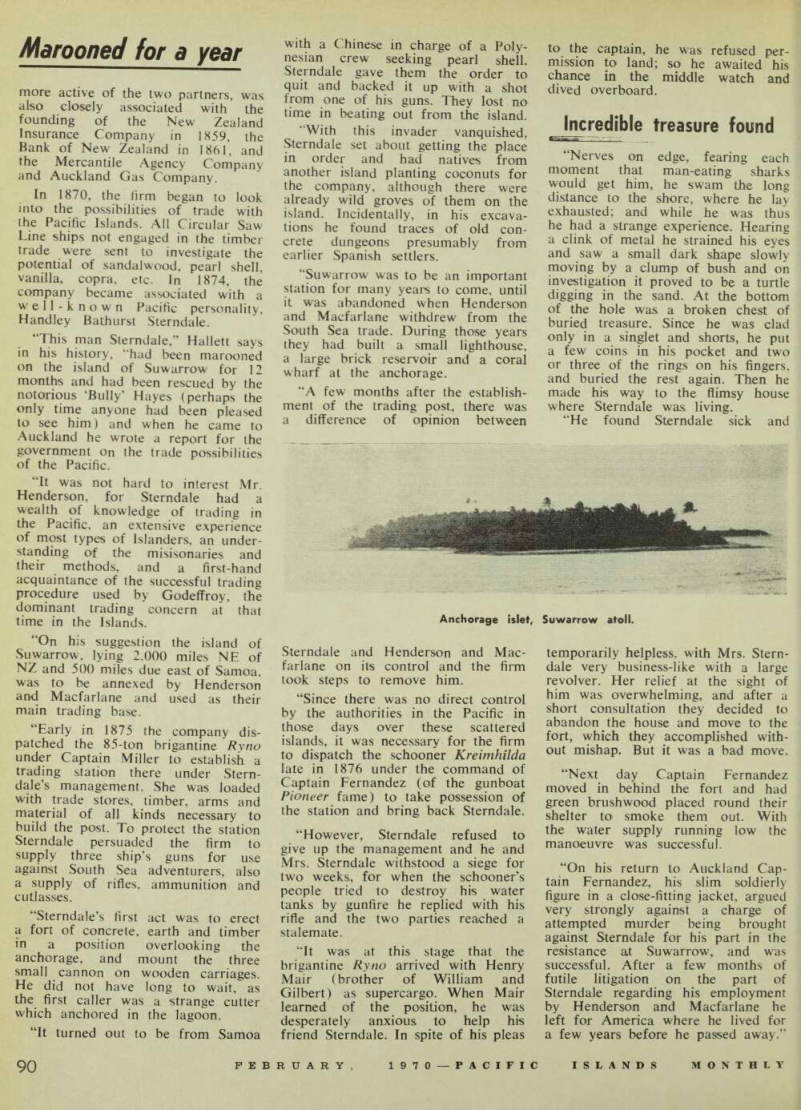
“On his suggestion the island of Suwarrow, lying 2.000 miles NE of NZ and 500 miles due east of Samoa, was to be annexed by Henderson and Macfarlane and used as their main trading base.
“Early in 1875 the company dis patched the 85-ton brigantine Ryno under Captain Miller to establish a trading station there under Stern dale’s management. She was loaded with trade stores, timber, arms and material of all kinds necessary to build the post. To protect the station Sterndale persuaded the firm to supply three ship’s guns for use against South Sea adventurers, also a supply of rifles, ammunition and cutlasses.
“Sterndale’s first act was to erect a fort of concrete, earth and timber in a position overlooking the anchorage, and mount the three small cannon on wooden carriages.
He did not have long to wait, as the first caller was a strange cutter which anchored in the lagoon.
“It turned out to be from Samoa
with a Chinese in charge of a Poly nesian crew seeking pearl shell.
Sterndale gave them the order to quit and backed it up with a shot from one of his guns. They lost no time in beating out from the island.
“With this invader vanquished, Sterndale set about getting the place in order and had natives from another island planting coconuts for the company, although there were already wild groves of them on the island. Incidentally, in his excava tions he found traces of old con crete dungeons presumably from earlier Spanish settlers.
“Suwarrow was to be an important station for many years to come, until it was abandoned when Henderson and Macfarlane withdrew from the South Sea trade. During those years they had built a small lighthouse, a large brick reservoir and a coral wharf at the anchorage.
“A few months after the establish ment of the trading post, there was a difference of opinion between
to the captain, he was refused per mission to land; so he awaited his chance in the middle watch and dived overboard.
Incredible treasure found
“Nerves on edge, fearing each moment that man-eating sharks would get him, he swam the long distance to the shore, where he lay exhausted; and while he was thus he had a strange experience. Hearing a clink of metal he strained his eyes and saw a small dark shape slowly moving by a clump of bush and on investigation it proved to be a turtle digging in the sand. At the bottom of the hole was a broken chest of buried treasure. Since he was clad only in a singlet and shorts, he put a few coins in his pocket and two or three of the rings on his fingers, and buried the rest again. Then he made his way to the flimsy house where Sterndale was living, “He found Sterndale sick and
Sterndale and Henderson and Mac farlane on its control and the firm took steps to remove him.
“Since there was no direct control by the authorities in the Pacific in those days over these scattered islands, it was necessary for the firm to dispatch the schooner Kreimhilda late in 1876 under the command of Captain Fernandez (of the gunboat Pioneer fame) to take possession of the station and bring back Sterndale.
“However, Sterndale refused to give up the management and he and Mrs. Sterndale withstood a siege for two weeks, for when the schooner’s people tried to destroy his water tanks by gunfire he replied with his rifle and the two parties reached a stalemate.
“It was at this stage that the brigantine Ryno arrived with Henry Mair (brother of William and Gilbert) as supercargo. When Mair learned of the position, he was desperately anxious to help his friend Sterndale. In spite of his pleas
temporarily helpless, with Mrs. Stern dale very business-like with a large revolver. Her relief at the sight of him was overwhelming, and after a short consultation they decided to abandon the house and move to the fort, which they accomplished with out mishap. But it was a bad move.
“Next day Captain Fernandez moved in behind the fort and had green brushwood placed round their shelter to smoke them out. With the water supply running low the manoeuvre was successful.
“On his return to Auckland Cap tain Fernandez, his slim soldierly figure in a close-fitting jacket, argued very strongly against a charge of attempted murder being brought against Sterndale for his part in the resistance at Suwarrow, and was successful. After a few months of futile litigation on the part of Sterndale regarding his employment by Henderson and Macfarlane he left for America where he lived for a few years before he passed away.”
Anchorage islet, Suwarrow atoll.