Manau people to Christ
pp. 91-93 · Read in the full issue

A "vision" of sin brought Manau people to Christ
By Robert Langdon
“The other day, going down the river on the flood, one of the boys suddenly shouted and pointed to a sand flat that we were just about to pass. On it lay a large crocodile fast asleep. I instantly did what was necessary to the engine; we brought the launch into position, and I let drive at the brute with my shot gun . , .”
The foregoing may sound like one of the choicer paragraphs from the now-defunct Wide World Magazine.
But it is, in fact, a passage in a letter from a gentle Anglican missionary, Archdeacon Stephen Romney Gill, who laboured in Papua for 44 years, from 1908 until his retirement in 1952.
The letter was written on Sep tember 6, 1922, from Gill’s head quarters in north-east Papua, which he described as “a queer place, 45 miles up a large, swift and flowing, muddy, crocodiley, not to mention mosquito-y, river called the Mamba”.
It is one of a large number that Gill wrote from the Mamba to members of his family in England between the years 1922 and 1928.
Typewritten copies of these letters have recently been copied on micro film for the member libraries of the Pacific Manuscripts Bureau.
Family tradition
Archdeacon Gill came from a family of Pacific missionaries. His grandfather, the Rev. George Gill, and his great-uncle, the Rev, William Gill, both worked in the Cook Islands in the middle of the last century, and it was there that his father, the Rev. Arthur Tidman Gill, was born.
Archdeacon Gill was still in his early teens when he decided to be a missionary himself. In a letter to his father from Hammersmith in January. 1903, he told how some times he had wanted to be an engineer, sometimes a sailor and now and then a cowboy, but all the time “something pointed to the Divine life, and at last, about H years ago, I listened to it”.
“And now,” he added, “my great longing is to follow the ‘Carpenter’ in the rough ways of life, in which it is one’s greatest joy to give up everything, because the gain is so great.”
After studying theology at St.
Paul’s Missionary College, Burgh, Lincolnshire, Gill took a course in tropical medicine at Livingstone Col lege, Leyton, in October, 1907, and exactly a year later he arrived in Papua to take up mission work. He was ordained a priest in the cathedral at Dogura in August, 1910.
His first parish was at Boianai, a few miles from Dogura, where he remained until 1922. He then moved to the Mamba District, where he established a temporary station at Manau on the mouth of the Mamba (or Mambare) River. Two years later, he began work on what was to be his head station for the next 18 years. This was at Duvira.
After the Duvira station was destroyed in 1942 following the Japanese landing in that part of Papua, Archdeacon Gill was evacuated to Australia. But he was back in Papua the following year, and he began building a new mission station at the neighbouring village of Dewade. He returned to his native England after his retirement in 1952, and died there in 1954.
One gathers from the general tenor of the archdeacon’s letters that, despite his long career in Papua, he always remained very much an Englishman, strongly at tached to his family and homeland.
“I can picture you in the Strand, and the occasion, and the little meal you had together, quite vividly,” he said in a letter to his parents in 1927. “How I look forward to having a meal—yes, a good big dinner— with you Both at the Dolphin, and other places.” On another occasion, he wrote: “You and Max will be going in to Hove to a County Match now and again. Ae! Music and County Matches (!) are I think the only two things that I miss.”
His letters are full of comments
of that kind. But there are also rich pickings for Pacific historians. Here, for example, is part of his descrip tion of his arrival at Mamba River, written on August 30, 1922: “1 write, sitting on an up-tumed case, with the type-writer on a couple of kerosene cases in front of me. . . . We have been here in this district just a month, but I have already been over the greater part of it, and have now a fairly clear idea as to what my plan of cam paign should be. The conditions of life are very much as I had expected, a good deal worse than my Boianai helpers anticipated, 1 imagine, though I had done my best to prepare them for what they would find. . . .
"One huge swamp"
‘On July 31, at daybreak we anchored [in the Whitkirk ] off the mouth of the Mamba River, and the greater part of that day was spent in getting off the stores and baggage, and drying them, and sorting things out generally.
“As a matter of fact, the Mamba has several mouths and, in between and for miles around, the country is one huge swamp infested with crocodiles. On the Mamba the mosquitoes are bad; at the beach sandfllies are numerous; and on the swamp tracks mosquitoes and leeches share the honours. There are two other rivers in my new district, the Gira and the Eia, but on neither of
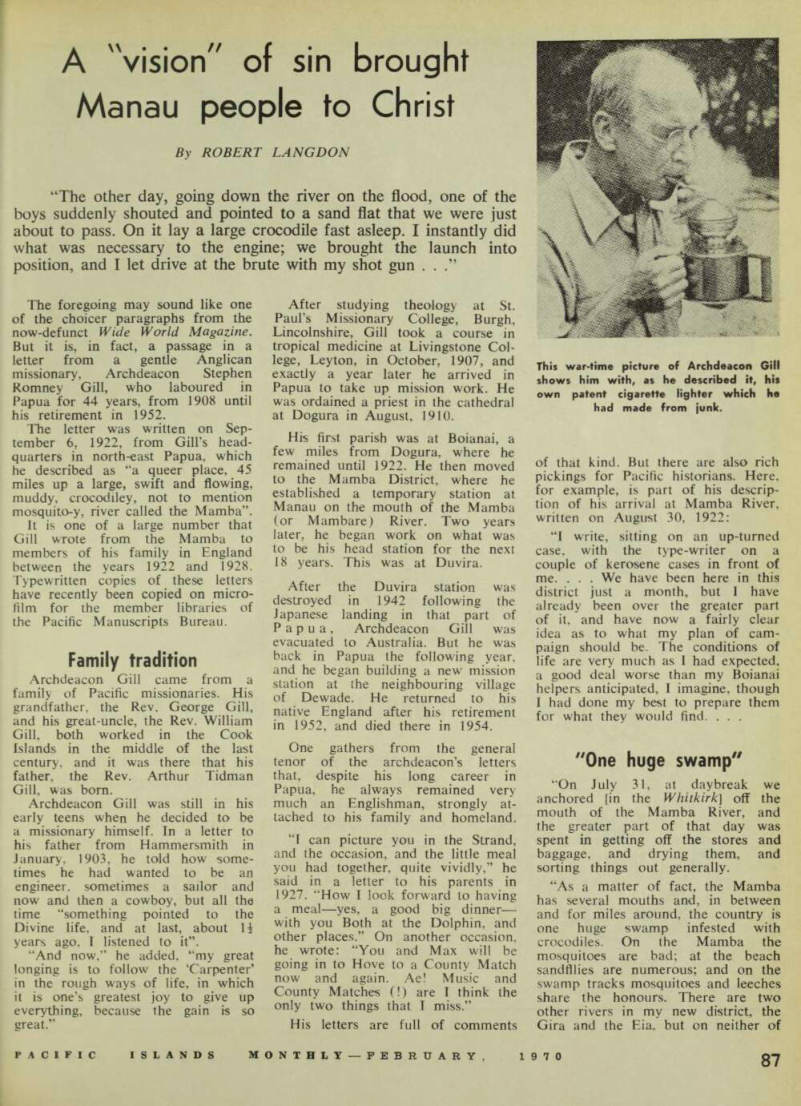
This war-time picture of Archdeacon Gill shows him with, as he described it, his own patent cigarette lighter which he had made from junk.
them do the mosquitoes seem to cause much trouble.
“On a piece of mareg land near one of the mouths of the Mamba, the Government have had a Rest House erected. It is approached by means of logs, and is quite a large building with a fairly sound roof (just new), and anyone may stay there any length of time. It is used chiefly for storing cargo, before it— the cargo—commences its journey up the river to loma, the Government Station about 50 miles away. The name of this spot is Totoadari. . . .
“A number of people from surrounding villages came round on the day of our arrival at Totoadari, including the leaders of a curious cult which has lately been started at Manau. The latter stood in a line and serenaded me with an incantation of great length, at the termination of which I thanked them suitably and took the opportunity to hold a public meeting! I explained to them, through an interpreter, what we had come for and what I expected of them.
Prepared by a vision
“I told them that it was chiefly because the people of Manau had expressed their desire for Christianity —(a man there, the leader of the cult already mentioned, claimed to have had a vision, in which Our Lord appeared to him and told him that he and his people were living in great sin, and that they must ‘Hear the words of the missionaries’) — that we had left a place called Boianai, and come to them. They were all most friendly, and the leaders said they knew we would be coming, and had been expecting us, on account of the vision.
“I paid a visit to Manau on the next afternoon, and inspected a small hill-ridge behind the village as a possible site for a station. The Manau people are really charming; the children are natural and not at all self-conscious (chiefly, I suppose, because only the older ones wear anything but ornaments).
“The people were very anxious that 1 should come and live with them. 1 told them that I should almost certainly want to place a Base Station somewhere about there on the coast, but that where I should make my Headquarters was a matter that I could not decide until I had been over the district.
“After a couple of days I was ready to make the first journey up the Mamba with some of the stores, and all the teachers. It took us a day and a half to do these 45 miles to
Ave, where we have a small Mission Station (St. Andrew’s). The river is about as broad as the Thames at Richmond, with a current varying between 3 and 5 knots. The journey up is an anxious business, especially when the water is low.
“One has to stand by the engine during the whole time and be ready for instant decisions. Snags and sandbanks are innumerable, and the dangers to both hull and propeller are incessant. One passes a number of villages on either bank, and, as a rule, somewhat dreary in ap pearance. Everywhere is mud and swamp.
“For mile on mile, one passes through wild sago belts without a sign of human habitation, and then the sago gives place to dense forest country. If you go up forward, away from the whirr of the machinery, you can hear that it is alive with the screams of multitudes of birds.
And from the trees lining the river bank great bats hang in EVIL SILENCE waiting for darkness ‘Great birds that fight and tear’!”
On reaching the mission station at Ave, Gill wrote: “I found that almost the entire male population of the near district was in gaol!
ostensibly, because the ‘roads’ were out of repair; probably, because the Magistrate needed workers on the Gov. Station and plantation. Certainly the roads are in a very bad condition, in fact they can scarcely be said to exist in many places, but owing to the very great scarcity of food, due to the destruction of large areas of garden land by floods, the people are spending most of their time dig ging for edible roots, and making sago, away in the bush.
In prison again
“Then, when the land dries a little and there is opportunity to get on to garden work again, they find them selves in prison because of the ‘roads’! However. . . .
“After a few days I returned to the Mamba Mouth with Charles and Robert for a second load of stores.
The journey down the river is com paratively simple, and can be done in about six hours. Two days were spent at Totoadari, and I had another nice meeting with the Manau people.
I asked them to clear the ridge behind their village, as I had decided to put my Base Station there.”