Magazine Section
pp. 85-89 · Read in the full issue

The real Sadie - a whore who fell in love
By WILMON MENARD, an old friend of Somerset Maugham
Sadie Thompson was a blonde, noisy and buxom prostitute who caused quite a rumpus in Pago Pago in 1916 before she was deported unceremoniously to Honolulu. She would have stayed a blowsy, undistinguished whore if she had not been separated in her amours by only a thin hotel wall from the great English writer, Somerset Maugham.
Maugham never forgave her for the noise she made with her numerous boyfriends and the now famous screeching of her wind-up gramophone. He wrote Rain * and gave his version of her sad story to the world.
Sadie became as famous on the stage as in literature, and while the real Sadie probably languished in some Honolulu brothel, she was immortalised by such stars as Jeanne Eagels, Gloria Swanson, Joan Crawford, Rita Hayworth, Kim Novak and Juliet Prowse.
A sweltering dive
Miss Thompson, during her carnal career in literature, the theatre and the cinema, earned a fortune for Somerset Maugham and for a few of the major studios in California and helped substantially to put on the map an orphan-island possession of the US in the South Seas.
Pago Pago was a sweltering dive port in those days in late 1916 when Maugham, awaiting the delayed de parture of the small inter-island boat to nearby Apia, Western Samoa, found himself occupying a mouldy room adjacent to that of an unin hibited, brazen strumpet from Honolulu, who raised bawdy bedlam night and day, while . . . “outside the pitiless rain fell, fell steadily, with a fierce malignity that was all too human”
William Somerset Maugham in variably utilised real-life characters and their emotional crises in his
short stories, novels and plays, and is still today, even though he died some years ago persona non grata in many parts of the far Southern Pacific. He was, indeed, a skeleton rattler par excellence and in his crusades invaded callously many family closets.
Why he was never roughly hauled into court and stupendously sued for slander-and-libel, defamation of character and invasion of privacy, can be attributed to the fact that the offended persons, guilty as sin— Maugham made certain of that down to the finest detail—just couldn’t chance a show-down in an open court.
His Miss Thompson is a notorious example. Sadie very definitely was a real woman who, for a brief time, caroused around Pago Pago, and Maugham used the nom-de-putain of
* The story line concerns the machinations of a missionary, the Rev. Davidson, to have cast out of Tutuila, of American Samoa, a white prostitute who has escaped to the steamy port of Pago Pago from the old Iwi Lei red-light district of Honolulu, and whom the suspicious missionary eventually discovers is wanted by the police on a murder charge.
While awaiting the northbound steamer, which will take Sadie Thompson back to an inevitable prison sentence, Davidson, who with the connivance of the island Governor has effected her deportation, attempts to make her accept willingly her punishment. But he destroys her acceptance of atonement and God when he rapes her.
The only magazine that had the courage to publish this short-story in America was "Smart Set Magazizne" (April, 1921), edited by the controversial Henry L. Mencken; later it ap peared in a Maugham anthology, "The Trembling of a Leaf", published by Doubleday- Ooran.
the rebellious trollop. The immigra tion records and hotel register for 1916-1917 are lost forever, but Maugham most certainly did use her real name, taking refuge in the fact that she could never sue him for using it.
He actually occupied an adjacent room to Sadie’s in Bella Bartley’s boarding-house in Fagatoga, on the outskirts of Pago Pago, and, be cause of the construction of the partitions between the chambers, which did not come flush with the ceiling, thus permitting a free circu lation of moist air and uncommon sounds, was able to listen, scribble and tell all about Sadie’s ribald arguments with her Samoan boy friends.
The late Benjamin Franklin Kneu buhl, long-established American merchant in Pago, corroborated the fact that she used the name Sadie Thompson in Pago.
“She arrived here from Honolulu in the early part of December 1916,” he said. “It was on the old Sonoma of the Oceanic Steamship Company.
The passenger manifests were de-
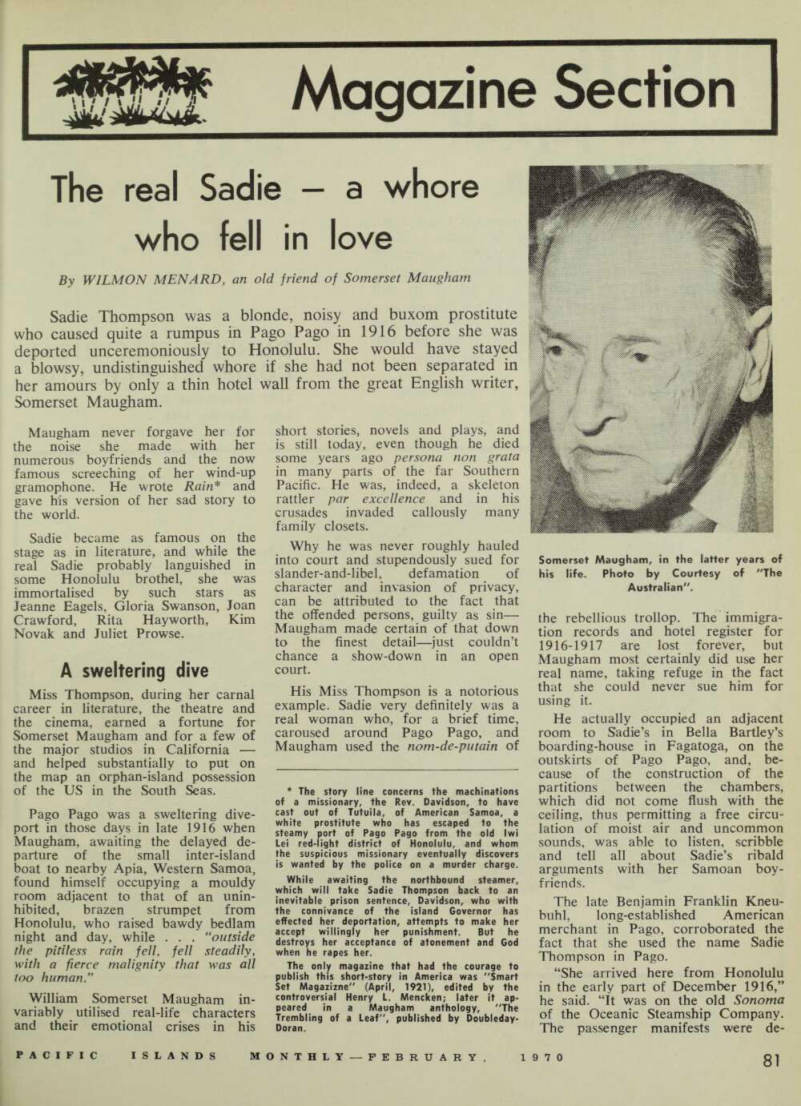
Somerset Maugham, in the latter years of his life. Photo by Courtesy of "The Australian".
AH in the same boat
stroyed years ago, and even if I could remember her real name I wouldn’t tell you. Sadie, you must remember, might still be living.”
He made a wry expression. “It’s hard, though, to think of Sadie as perhaps being a whitehaired grand mother. As for Maugham, he came on the same boat with her, together with a couple of London Missionary Society pastors and their wives, just like he told it in the story.”
“They were Mormon missionaries,” interrupted gently his pretty, part- Samoan wife Lena.
“Mormons, LMS, Catholic . . . what difference does it make who they were” said Ben, a bit ruffled.
“Whoever they were, they sure gave Sadie Hail Columbia by complaining all the time to Governor Jack Poyer about all the sinful things she was supposed to be doing here, in sisting that she be deported from American Samoa.
“Actually, it was a storm that threw Sadie, Maugham and the mis sionaries together in Bella Bartley’s hotel in Fagatoga. Maugham and the missionaries were supposed to leave right away on the inter-island boat for Apia, but the squall was so bad and the seas so rough that the boat couldn’t leave for several days. But the delay was sufficient for the mis sionaries to get in their licks against Sadie.”
“I don’t think that Sadie was deported because she was drinking and disturbing the peace. She was sent away because she was associat ing with the Samoan boys and wanted to marry one of them—Joe.”
“Joe and Sadie went over to the courthouse here to try and get a marriage licence from Judge Alexan der Stronach, a staunch southerner, but he turned them down flat, tell ing them that they’d have to get the application approved by the Gov ernor.”
Horrible spectacle
The missionaries of American Samoa, particularly the ones con fined with her in the boarding-house, must have thrown up their hands in horror at the spectacle of a young white woman in her twenties con sorting with sculptured bronzed gods of the Fita-fita guard of the Naval Station, fearful that such a shocking and demoralising fraternisation would spell love’s labours lost in the Lord’s vineyards.
Joe, Sadie’s former favourite boy friend, is today a High Chief living
in the Western District of Tutuila Island He is still handsome, alert, witty and friendly; he could pass for 50 instead of 77 “When Sadie go back Honolulu on up-boat Ventura, she write me: ‘Joe, honey, you quit Fita-fita Navy an’ I send you money come Honolulu, and we get married right ’way.’ ”
He cinches up his scarlet lava lava more securely about his loins and squats down against the High Chief’s post of his conical, thatch roofed fale, staring thoughtfully across the palm-shaded roadway to the blue South Pacific washing languidly on the white beach.
It is difficult to conject just how Joe would have fared if he had sailed off northward to Honolulu and become the legal spouse of Sadie Thompson. One thing is quite certain: he would not now hold his chiefly title or receive his Navy pension or have his SIO,OOO dollar life insurance with the US Govern ment—all these rewards accruing through joining the Fita-fita Samoan Navy guard on August 1, 1912, ad vancing to the rating of Coxswain,
orderly of the Fita-fita guard, run ning errands for the Governor, carrying messages from the radio station on the hill to the executive naval officers and making himself useful in many ways to the young Navy lieutenants stationed in Pago Pago. He was athletically built, straight and handsome in his white singlet, white lava-lava edged in blue, and red fautu fez-like cap, the official uniform of the Fita-fita Joe was quite overwhelmed by his first sight of Sadie Thompson.
“Oka-oka! Gee whiz! she was hot lookin’ baby! She look at me long time up an’ down, smile vairee pretty an’ say ‘Ullo, Joe-boy!’ ”
Busty newcomer
The meeting had been arranged by a young lieutenant of the station, who had seen Sadie come down the gangway of the Sonoma and had been hanging around Bella Bartley’s himself trying to make time with the busty newcomer. He instructed Joe to show her the sights of Pago.
F4D, USNR, and completing his 30 years in service.
Nor would he today have a handsome 27-year-old Samoan wife and three healthy sons, or own a wide vanu, or valley, full of breadfruit, taro, banana, cocoa, guava and coconuts, which will feed him, his family and the people of his village for centuries to come.
Joe is today, on Samoan standards, a man of considerable means.
But when he first met Sadie Thompson in 1916 he was just an
Sadie was about 5 ft 7 ins. tall, weighed close to 130 pounds and, while in Pago Pago, celebrated her 24th birthday. She entwined scarlet hibiscus blossoms in her shoulder length light-brown hair; in fact, it became her trademark with the Samoans. They called her “The Hibiscus Girl.” Her mouth was generous and heavily lip-sticked, her blue eyes sensually thyroid, Huge uplifted breasts pressed for midably against the cloth of her
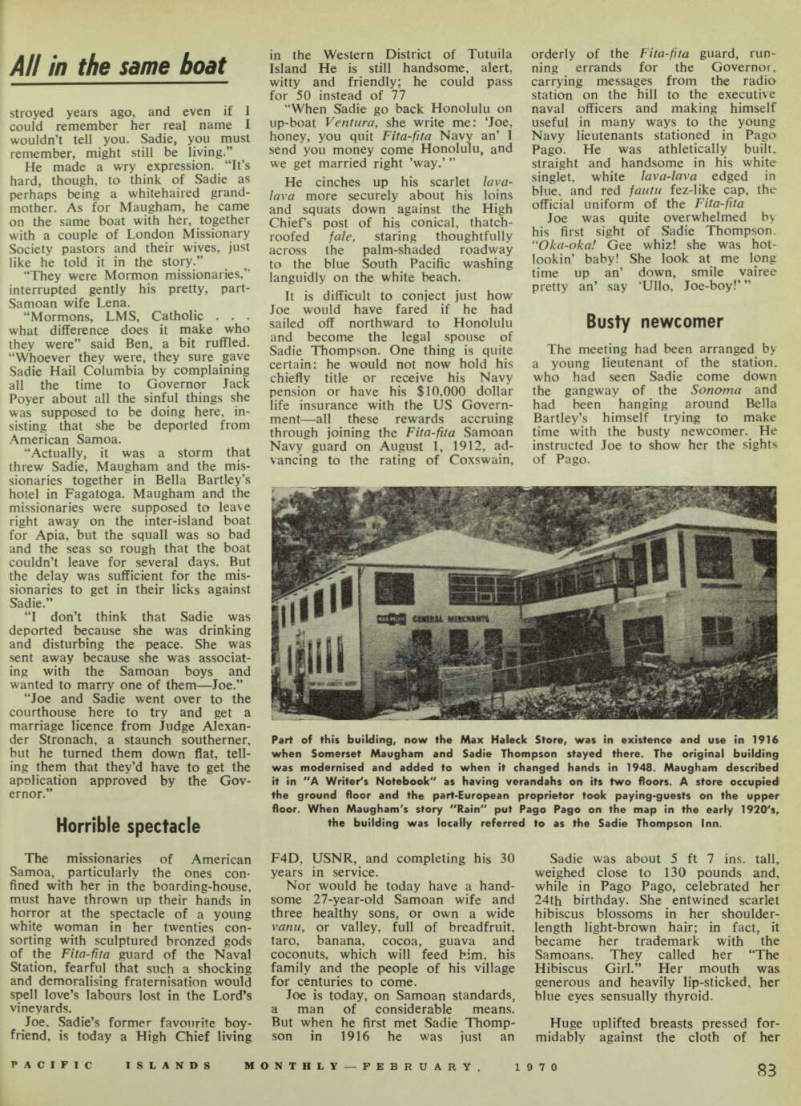
Part of this building, now the Max Haleck Store, was in existence and use in 1916 when Somerset Maugham and Sadie Thompson stayed there. The original building was modernised and added to when it changed hands in 1948. Maugham described it in "A Writer's Notebook" as having verandahs on its two floors. A store occupied the ground floor and the part-European proprietor took paying-guests on the upper floor. When Maugham's story "Rain" put Pago Pago on the map in the early 1920's, the building was locally referred to as the Sadie Thompson Inn.
Enjoyed Joe most of all
summer-print dress; she balanced herself precariously on high-heeled patent-leather pumps, and around her right ankle there was a thin, gold slave-chain. There was a slight alco holic bloat to her features, and the beginning of hard lines creasing the sides of her nose to the corners of her cynical mouth.
Sadie did enjoy her walk about the port and to the radio station on the hill. But she enjoyed Joe most of all. He took her down shaded lanes on the young lieutenant’s specified itinerary; they found a waterfall and a pool below it where they waded like children in the clear, cool water. Sadie tucked her dress up about her shapely thighs and explored farther depths of the pool; Joe, with a chaplet of ferns around his head, strummed his ukulele and sang Samoan songs.
Blaring out jazz
So Joe and Sadie met frequently, but secretly, usually after dark, be cause of the censure among the white naval staff of such a relation ship. They walked hand-in-hand along the less frequented pathways behind the Naval Station, or went farther down the harbour in an outrigger-canoe, where Joe could strum his ukulele and they could sing.
In her room at Bella Bartley’s, Sadie kept her gramophone con stantly wound up and blaring out jazz tunes. In a nearby room.
Maugham grimaced, muttered and planned his revenge. And he didn’t forget her gramophone that was wrecking his rest: “They heard Davidson’s voice, and then the noise of something heavy falling. The music stopped. He had hurled the gramophone on the floor.” No doubt, wishful thinking on Maugham’s part!
Sadie was forever sneaking Joe into her room. Bella broiled wonder ful steaks, and there were always desserts of pies and cakes, which Joe particularly relished.
One early morning there was a determined pounding on the door.
It turned out to be the Chief of Police and he wanted Joe. Sadie put up quite a fight but Joe realised the game was up and went quietly.
So Joe was brought before the Trial Division of the High Court of American Samoa. The judge asked him sternly: “Don’t you know it is wrong to go with this palagi (white) woman, losefo, to be with her almost every night in her room, like man and wife?”
Sadie leapt to her feet, eyes flash
ing and hands flaying the air, and shouted: “It’s none of your business what Joe and I do! I’ll have you know that I’m taking Joe to Hono lulu with me —and we’re going to be married!”
From that time on, when Joe was not on duty, he was confined to the Fita-fita barracks. Three days before the arrival of the Ventura from Australia, Joe received a damp, crumpled note, slipped to him by a Fita-fita buddy, and he read: “Joe, honey, I’m really leaving on the Ventura. When you’re ready to come to Honolulu, I’ll pay your fare. This is where you can reach me.” It was an address on Kalakaua Avenue in Waikiki, Honolulu.
Joe wrote her three letters, the first two promising an early reunion.
But, following a serious conference with the Captain of the Yard and the Marine Corps sergeant, who both pointed out to him the advantages of remaining in the Fita-fita guard, now that he had eight years’ service behind him in striking for the 30year pensioned retirement, the third letter must have been shattering to Sadie. Joe had the sergeant write her: “I must remain loyal to the Fita-fita Navy of Samoa. So I guess, Sadie-baby, that this is Tofa (Fare well).”
Joe never received another letter from Sadie. But on September 30, 1931, Joe was transferred, as a Seaman Ist Class, aboard the deep sea Navy tug-boat, USS Ontario, to be stationed temporarily for over haul at Pearl Harbour, Oahu, in the Hawaiian Islands, j oe had Sadie’s address on Kalakaua Avenue in Waikiki, and on b is fi rs t leave he took a taxi to t h e number. He rang the bell of the small hotel, waited an intermin able t ime, an d then an unpleasant looking woman was framed in the screen door. She suspiciously stared j oe up and down . when Joe in quired for Sadie Thompson, she snapped peevishly: “She moved away from here years ago! No, she d i dn ’t i eave an address!” j “So that was uma-lava / fi .. s c « „ for Sa , dle a " m J e ; j eF if 18 t , ong ,^ ro l °r mg Sl * en . c e, an P ers ’ against the High Chief s post, hunch U P . a pd then settle down, accom panied by a loud belly-deep grunt, “Au'e! I really like know what happen to that Sadie Thompson!”
It was a coincidence that, not long before his death in December of 1965, Willie Maugham also expressed that haunting question to me.