Kaputin
pp. 37-38 · Read in the full issue
John Kaputin was born in Matu pit, Rabaul, one of a respected Tolai family of four boys and five girls. He attended the village school at Matupit to grade six, the local Vunamami Boarding School to grade seven and the Keravat Secondary School.
From Keravat he was selected to go to Australia to complete his secondary education at the Rock hampton (Queensland) Boys’
Grammar School. He attended Rockhampton from 1956 to 1959. and took his Junior Certificate.
Back in New Guinea in 1960 he enrolled at the Port Moresby Teachers’ College, planning to be come a village schoolteacher (which meant a two-year course).
But he didn’t complete this course because he became involved with one of the lecturers, an attractive West Australian girl. Christine Lake, 24.
In July, 1961. Christine Lake and John Kaputin were married in Port Moresby. It was the first marriage between a New Guinean and a white woman and it at tracted much publicity. Kaputin that month turned either 19 or 20 —even today he avoids reveal ing his age.
He became a trainee broadcaster with the P-NG Department of In formation, but left that to manage a group of trade stores owned by a Port Moresby European, Ron Pirns. He remained with Pirns for two years.
The Kaputins by this time had lived down their initial notoriety and were accepted in Port Moresby, where he was a popular sports man —star of the Kone Tigers, a leading League team. He was the first native to play with a white football team in Moresby. As an athlete he was selected as a mem ber of the Papua-New Guinea team which took part in the Com monwealth Games in Perth in 1962.
Manager
He remained in Perth after the Games for several months, receiv ing a crash training in the baking trade so that he could take over an established business in Port Moresby. He had applied for a £3,000 loan from the Native Loans Board to enable him to buy that business, but he had to give up the prospect after two months working the bakery (in which his wife
helped) because his loan did not I come through.
“I’m still waiting for them to tell me whether I got that loan or not—l just never heard a word from them,” he said recently, with a touch of bitterness.
So he became an interpreter of Pidgin with the P-NG House of Assembly, then known as the Legislative Council, but taking a year’s absence in 1964 to success fully complete his matriculation course at the P-NG Administrative College.
September, 1964, was the occasion when the P-NG Admin istration announced that local, or native, public servants would in future receive lower salaries than expatriate officers holding the same positions, because a future P-NG economy would not be able to afford the kind of wage scale that w'as currently provided to at tract expatriates.
Kaputin, his wife and close friends all say that this announce ment had a profound effect on Kaputin. He became angry and moody overnight.
He applied for and won a scholarship to the East West Center, University of Hawaii, in 1966, to undertake a four-year degree course for a Bachelor of Business Administration. The scholarship was the first grant made available to a New Guinean at the East West Center, but the Continued over
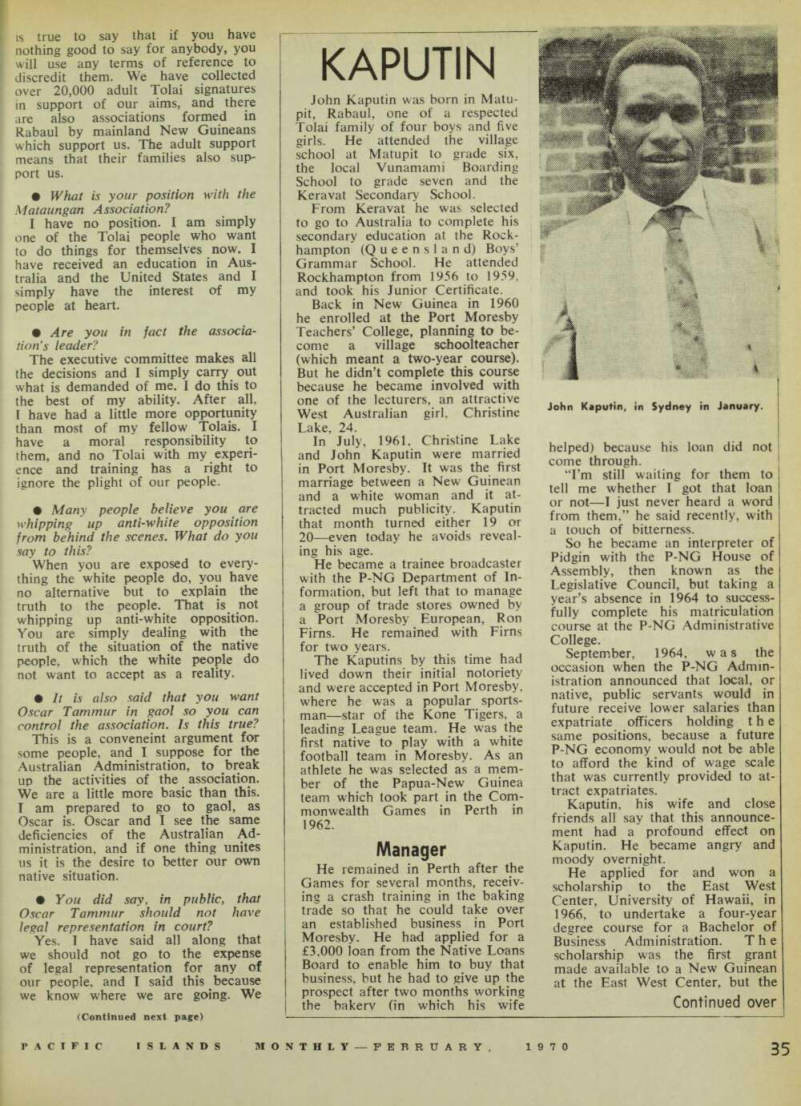
John Kaputin, in Sydney in January.
terms did not enable him to take his wife and family, who remained in Port Moresby. By this time he and Christine had three chil dren—Rellie, John and Darren.
Kaputin completed two years at the East West Center, but gave up the course at the end of 1968 to return to Port Moresby. He says this was the result of general frustration, and because what he had learned in Hawaii made him aware of politics and the many things that had to be done in New Guinea. He enjoyed Hawaii and hopes to go back about 1971 or 72 as a private student to com plete his course, for which he has two years’ credits.
Back in Port Moresby in 1968 Kaputin found that the House of Assembly had become autonom ous, its staff controlled by the Speaker, Papuan politician John Guise, and that he was regarded as an unattached officer.
After working for six or seven months as an interpreter, during which he dabbled in political com ment out loud, he was told by the Speaker that no permanent jobs were available in the House.
Kaputin believed there were jobs available, but apparently not to him, and told the Speaker so bluntly before he left.
He joined the Department of Treasury as a trainee comptroller of stores and supplies, but left after only three weeks when he saw an advertisement in the paper for the job of manager of the Gazelle League of Savings and Loan Societies, in Rabaul, applied for it and was accepted.
He has been in that position since July and says he likes it. It enables him to move around among his fellow Tolais, the pay is reasonably good, and he is in volved with economic affairs, which interest him. The league is directed by a Tolai board of directors, to whom he is re sponsible.
The Kaputins are now living apart, although they are friendly, and John Kaputin sees Christine and the children when he comes to Sydney, where they live. He has a room in Rabaul.