In New Guinea, As Elsewhere "Violence
pp. 36-135 · Read in the full issue
IS A REALITY WHICH YOU HAVE TO FACE"
• The name of a New Guinea Tolai, John Kaputin, has come to prominence in recent weeks. Kaputin is said to be the main stirrer behind the anti-council battle in Rabaul, New Britain, which has led to rioting, assaults and gaol sentences. The trouble is centred on a native organisation called the Mataungan Association, which Kaputin is said to lead from behind.
His critics say he is anti-white and that he believes in violence—and they may be right. They also say he is an uneducated no-account who learned his English in bed, which is certainly wrong. What is John Kaputin's background and what are his views? For his background, read the panel on the opposite page. For his views, read below, where Kaputin has answered, in his own words, a series of written questions put to him by RIM editor STUART INDER.
By John Kaputin
I have known Stuart Inder for eight or nine years, and he has prepared a list of questions which I am happy to answer. I am quite sure about what I am trying to do in New Guinea. I have nothing to hide, but I believe it is my task to get on with it, and I will get on with it.
• I am asked first how the Mataungan Association started and who started it.
The word “mataungan” is as old as our Tolai history. It means, as a fair translation, “to look ahead and be prepared”, and it came into modern context with the opposition to the establishment of a multiracial council in the Gazelle Peninsula. The association was started in June, 1969, under the leadership of Oscar Tammur, MHA, the member for Kokopo, and with Daimien To Kereku as chairman and Daniel To Rumet as vice-chairman. Melchoir To Mot was elected secretary. • How does it meet and who is on the committee?
Currently the members of the Mataungan Association meet weekly from village to village, while its executive committee, represented by two persons per village, meets every Saturday or during any other time at short notice, „ • Wha ‘ are its aims? was formed originally to oppose thc establishment of the multi-racial council in the Gazelle Peninsula. In h e course of doing so it has col- L e « tax . *J thl ” th , e vlcln ‘ t V. ° f *30,000 which has been put into tr . us t and controlled by a committee five ; We would use our tax money to establish if necessary our own separate council, or else put it into the one all-Tolai council. But it is
not to go to a multi-racial council.
As for any programme to be on paper, this is a foreign concept to the people. However, if our aims are to be summed up in a statement I suppose it must be said that the Mataungan Association stands for Tolai development.
We want to improve our own Tolai business, we want to improve our own social development, we want to improve our land situation and we would like to develop our own political institution without due in fluence from the Australian Govern ment representatives in the country.
I do not suggest we want to break away from the rest of New Guinea, because there must be unity in New Guinea. • Does Mataungan represent the young against the old people?
While this is a convenient argu ment for some people to use, it is groundless. Perhaps it is more to the truth to specify that the current conflict in the Gazelle Peninsula is between those in the old institution and those in the new institution.
Certainly, as it is now, the associa tion would have more Tolai elders as supporters than the Administra tion could hope to have. Those of us who have been away to receive an education have simply become either spokesmen or interpreters for these people who have refused to be under the control or the influence of the Administration. • Who are the Mantaungan members?
Most are Tolais. The Administra tion refuses to credit us with a membership, but the Administration knows that most of the Tolai people are behind the association I think it
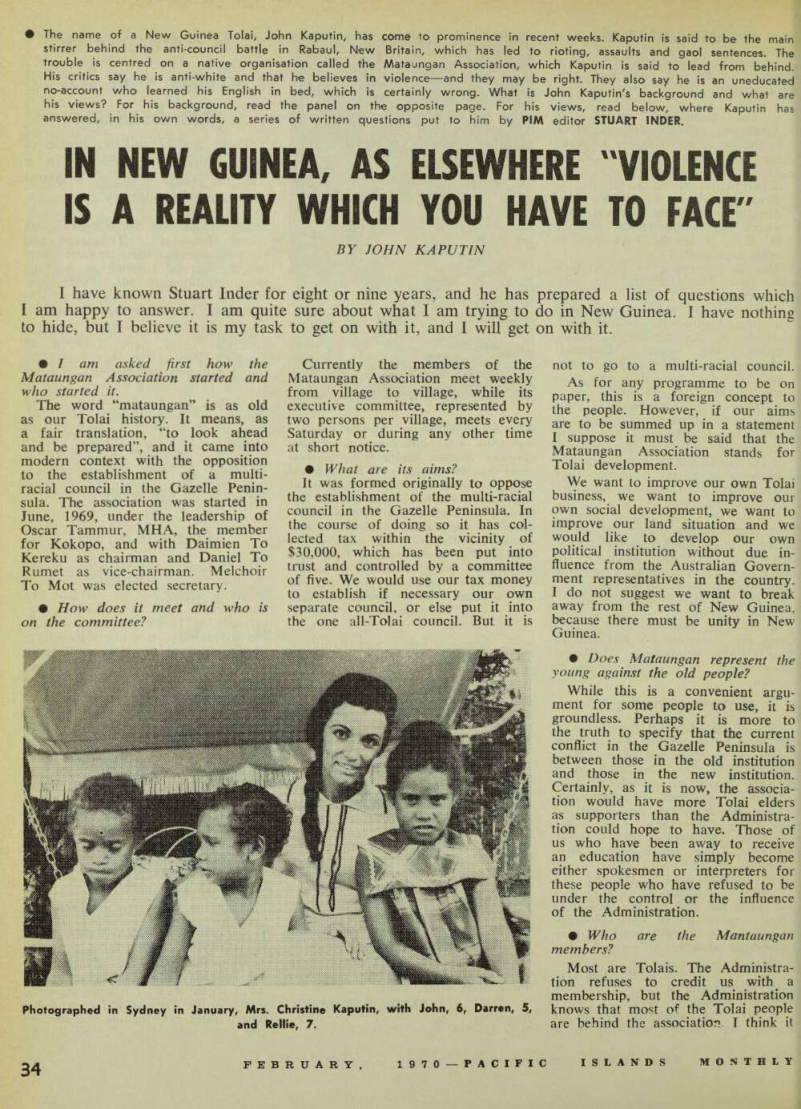
Photographed in Sydney in January, Mrs. Christine Kaputin, with John, 6, Darren, 5, and Rellie, 7.
is true to say that if you have nothing good to say for anybody, you will use any terms of reference to discredit them. We have collected over 20,000 adult Tolai signatures in support of our aims, and there are also associations formed in Rabaul by mainland New Guineans which support us. The adult support means that their families also sup port us. • What is your position with the Mataungan Association?
I have no position. I am simply one of the Tolai people who want to do things for themselves now. I have received an education in Aus tralia and the United States and I simply have the interest of my people at heart. • Are you in fact the associa tion’s leader?
The executive committee makes all the decisions and I simply carry out what is demanded of me. I do this to the best of my ability. After all, I have had a little more opportunity than most of my fellow Tolais. I have a moral responsibility to them, and no Tolai with my experi ence and training has a right to ignore the plight of our people. • Many people believe you are whipping up anti-white opposition from behind the scenes. What do you say to this?
When you are exposed to every thing the white people do, you have no alternative but to explain the truth to the people. That is not whipping up anti-white opposition.
You are simply dealing with the truth of the situation of the native people, which the white people do not want to accept as a reality. • It is also said that you want Oscar Tammur in gaol so you can control the association. Is this true?
This is a conveneint argument for some people, and I suppose for the Australian Administration, to break up the activities of the association.
We are a little more basic than this.
I am prepared to go to gaol, as Oscar is. Oscar and I see the same deficiencies of the Australian Ad ministration, and if one thing unites us it is the desire to better our own native situation. • You did say, in public, that Oscar Tammur should not have legal representation in court?
Yes. I have said all along that we should not go to the expense of legal representation for any of our people, and I said this because we know where we are going. We
(Continued next page)
should conserve our funds; my views are well known. Some people saw this as meaning that I am personally against Oscar, which isn’t true. • Are you anti-white?
Am I anti-white? There is nothing that the white people have that I, as a black man, should need or want. The only thing which they have now is political power but this will not continue to be in the hands of the white people in the country.
I have been branded as anti-white simply because I am speaking a new type of language which is detri mental to the foreigners’ supremacy in the country and because they have no intention of improving our native situation but to continue as they are now. This type of thing by the white people in New Guinea is a sure guarantee of their failure to cope with our problems.
Am I anti-white?
• But you appear to be anti-white from some of your published state ments. Why is this?
I have the plight of the people to consider, and I believe that all my statements have been directed to the policies of the Australian Govern ment. In any event, I am not a newspaper reporter—which is to say that if I appear to be anti-white it is because the newspapers are trying to create that image of me. ® You have the reputation of being anti-newspaper. Why is this?
I learned earlier in my life what the newspapers want. They want to sell their papers and they publish the things they want to publish and not the things that I am interested in. In any event, I know what I want for my people and I can operate much more efficiently without the assistance of the Press—not in New Guinea. My people in the Gazelle Peninsula, at least those who can read or speak English, have little or no respect for the mass media in the country. • How long were you in Hawaii and what did you do there?
I studied for over two years at the University of Hawaii. I have yet to complete my Business degree, which includes courses in political science. • Did you learn anything?
I suppose I did, or I wouldn’t be
as concerned about anything as I am now. • Did you find any connection between US-Negro attitudes and Papua-New Guinea?
Many Australians have condemned the Americans but there is a lot we can learn from the white-Negro situation in America about the racial relationships in P-NG. The white Americans are no more superior in their attitude to Ameri can Negroes than the white Aus tralians are to the Papuans and New Guineans. If the Australians can divest themselves of the notion that they are in possession of some in trinsic value which a black man should want to have, I think our situation in P-NG would be more agreeable than it is now. • Are you making use of the Gazelle League of Savings and Loan Societies in publicising your views?
I accepted the position as manager of the Gazelle League because I wanted to use my education and experience to help my people. It is not a place for me to publicise any views except to organise what re sources are already there. We have to start somewhere, and the Gazelle League is a resource for the use of the Tolai people.
Wanted to sack me
• What is the league's attitude to your political views?
Last September the board of direc tors were influenced to hold a meet ing to sack me because of my political views, and the board of directors turned around and sup ported me to maintain my position.
True, there, are those who are pro-Administration who have been influenced to break away from the league. This is rather a superficial division at this stage and in the long run will be overshadowed by the realisation of the misguided nature of the policies of the Adminis tration. 9 Do you support the recent physical assaults in Rabaul which have led to gaol sentences in some cases?
I regret that we have turned to physical violence against our own people, but I do not condemn the Tolais who have resorted to violence to seek justice. I believe that the people have been forced into this
(Continued on p. 129)
situation by some of the misguided policies of the Australian Govern ment. • Do you openly encourage violence?
Violence is a reality which we have to face. Even the Australians are fighting a war in Vietnam. I no more like violence than you do, but it is something which is there. It happens. • Can you sum up briefly, your own objectives in New Guinea— your own attitude to what is happen ing and what you want to happen there?
It’s taken me over 16 years to realise that I have a responsibility towards a people who are primarily living in a subsistence economy. The plight of our people in the villages, and the violence that now has ex ploded as its product, has given me the determination to speak out.
If we are to live with less racial tension it seems important to me that we have constructive programmes. We may be unconventional in achieving our ends, but we’ve got to do things our own way. For 16 years I have been told what I should think about New Guinea, This is to the benefit of some people, but not necessarily to the benefit of my people.
I find that a great number of other New Guineans think like I do, which is the reason why such organisations as the Mataungan are strong. Most Europeans in New Guinea don’t realise that the time
has come when we must do things for ourselves. Too often Europeans take control, even when we have a majority, as we have in the Gazelle Peninsula Multi-racial Council. If we are not allowed to run things our own way with the Europeans, then we must do it without them. If Aus tralians in their own country legis late to control people entering the country, or foreign companies, I see no reason why New Guineans should not do the same in their own country.
What I am saying is, New Guinea must eventually be for the New Guineans.