"Ban The Triton Shell Collectors"
pp. 39-41 · Read in the full issue
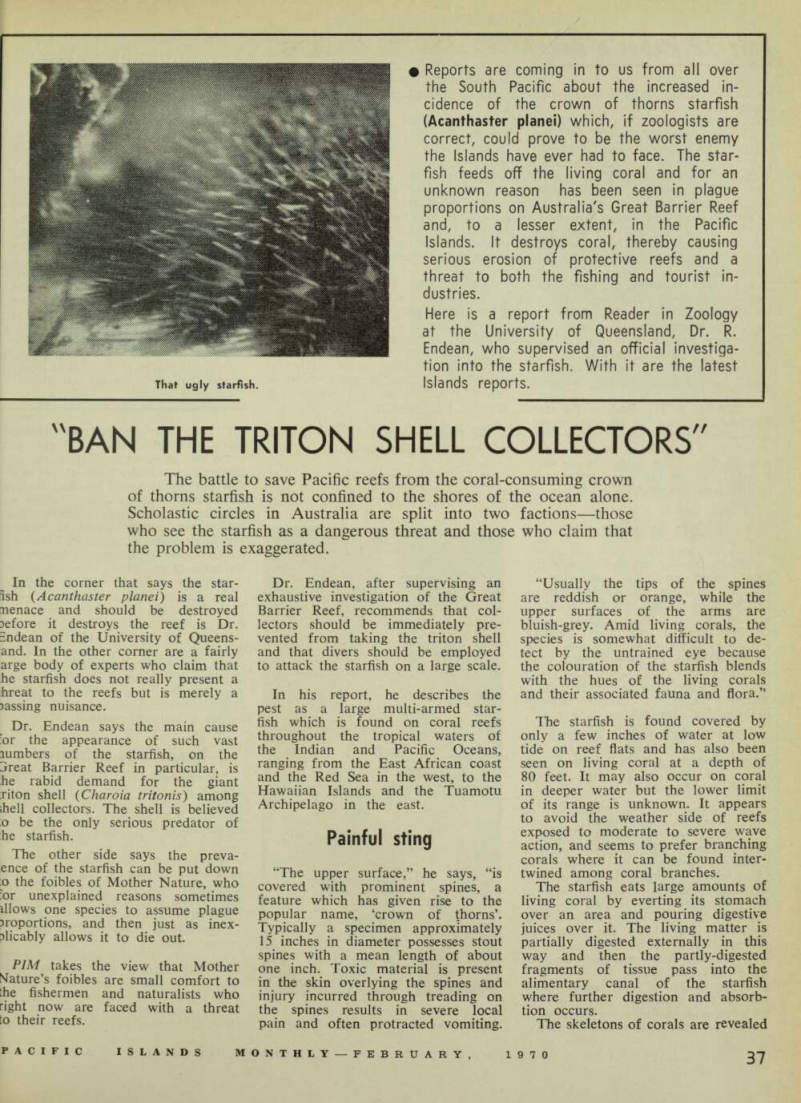
• Reports are coming in to us from all over the South Pacific about the increased in cidence of the crown of thorns starfish (Acanthaster planei) which, if zoologists are correct, could prove to be the worst enemy the Islands have ever had to face. The star fish feeds off the living coral and for an unknown reason has been seen in plague proportions on Australia's Great Barrier Reef and, to a lesser extent, in the Pacific Islands. It destroys coral, thereby causing serious erosion of protective reefs and a threat to both the fishing and tourist in dustries.
Here is a report from Reader in Zoology at the University of Queensland, Dr. R.
Endean, who supervised an official investiga tion into the starfish. With it are the latest Islands reports.
The battle to save Pacific reefs from the coral-consuming crown of thorns starfish is not confined to the shores of the ocean alone.
Scholastic circles in Australia are split into two factions—those who see the starfish as a dangerous threat and those who claim that the problem is exaggerated.
In the corner that says the star ish (Acanthaster planei ) is a real menace and should be destroyed lefore it destroys the reef is Dr.
Etndean of the University of Queens and. In the other corner are a fairly arge body of experts who claim that he starfish does not really present a hreat to the reefs but is merely a jassing nuisance.
Dr. Endean says the main cause : or the appearance of such vast lumbers of the starfish, on the Treat Barrier Reef in particular, is he rabid demand for the giant xiton shell (Charoia tritonis ) among ;hell collectors. The shell is believed o be the only serious predator of he starfish.
The other side says the preva ence of the starfish can be put down •O the foibles of Mother Nature, who :or unexplained reasons sometimes illows one species to assume plague iroportions, and then just as inex plicably allows it to die out.
PIM takes the view that Mother Mature’s foibles are small comfort to the fishermen and naturalists who right now are faced with a threat to their reefs.
Dr. Endean, after supervising an exhaustive investigation of the Great Barrier Reef, recommends that col lectors should be immediately pre vented from taking the triton shell and that divers should be employed to attack the starfish on a large scale.
In his report, he describes the pest as a large multi-armed star fish which is found on coral reefs throughout the tropical waters of the Indian and Pacific Oceans, ranging from the East African coast and the Red Sea in the west, to the Hawaiian Islands and the Tuamotu Archipelago in the east.
Painful sting
“The upper surface,” he says, “is covered with prominent spines, a feature which has given rise to the popular name, ‘crown of thorns’.
Typically a specimen approximately 15 inches in diameter possesses stout spines with a mean length of about one inch. Toxic material is present in the skin overlying the spines and injury incurred through treading on the spines results in severe local pain and often protracted vomiting.
“Usually the tips of the spines are reddish or orange, while the upper surfaces of the arms are bluish-grey. Amid living corals, the species is somewhat difficult to de tect by the untrained eye because the colouration of the starfish blends with the hues of the living corals and their associated fauna and flora.”
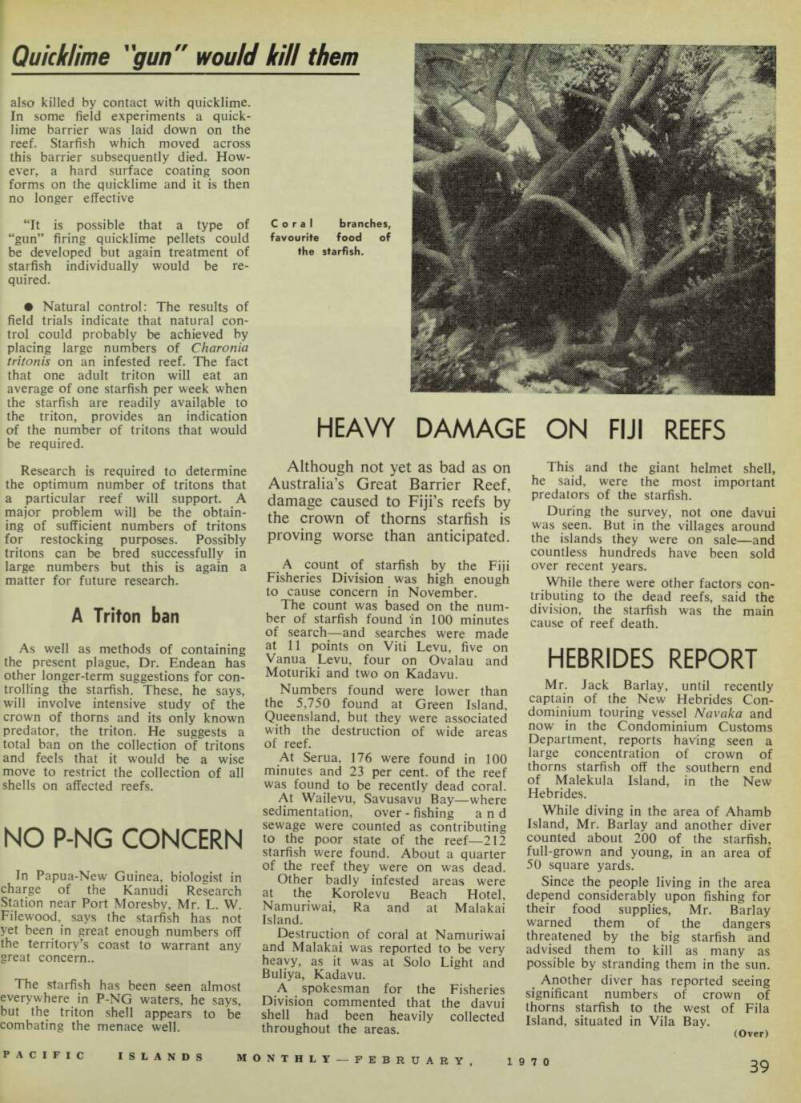
The starfish is found covered by only a few inches of water at low tide on reef flats and has also been seen on living coral at a depth of 80 feet. It may also occur on coral in deeper water but the lower limit of its range is unknown. It appears to avoid the weather side of reefs exposed to moderate to severe wave action, and seems to prefer branching corals where it can be found inter twined among coral branches.
The starfish eats large amounts of living coral by everting its stomach over an area and pouring digestive juices over it. The living matter is partially digested externally in this way and then the partly-digested fragments of tissue pass into the alimentary canal of the starfish where further digestion and absorb tion occurs.
The skeletons of corals are revealed
That ugly starfish.
Eats 32 inches a day
once the living polyps and coen chyme have been removed. Conse quently, feeding starfish leave a trail of white coral skeletons in their wake. An average-sized starfish can eat between 17 and 32 square inches of coral a day. In one week six specimens killed seven square feet of coral.
Studies have revealed that a caged starfish could live for at least four months without food, but when free on coral reefs it appeared to feed continuously.
The starfish moved at about one foot per minute and one of the most interesting points of Dr.
Endean’s report was that the star fish when present in plague propor tions appeared to congregate and migrate around the reefs together.
They had definite feeding patterns.
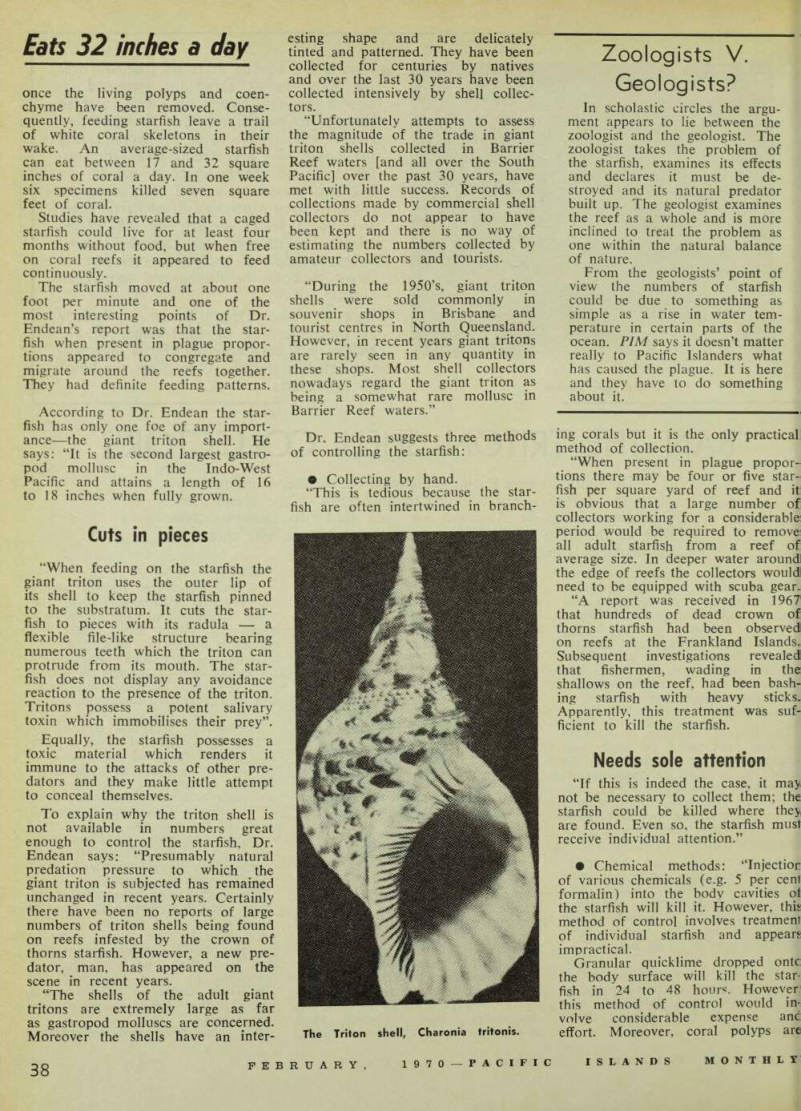
According to Dr. Endean the star fish has only one foe of any import ance—the giant triton shell. He says: “It is the second largest gastro pod mollusc in the Indo-West Pacific and attains a length of 16 to 18 inches when fully grown.
Cuts in pieces
“When feeding on the starfish the giant triton uses the outer lip of its shell to keep the starfish pinned to the substratum. It cuts the star fish to pieces with its radula a flexible file-like structure bearing numerous teeth which the triton can protrude from its mouth. The star fish does not display any avoidance reaction to the presence of the triton.
Tritons possess a potent salivary toxin which immobilises their prey”.
Equally, the starfish possesses a toxic material which renders it immune to the attacks of other pre dators and they make little attempt to conceal themselves.
To explain why the triton shell is not available in numbers great enough to control the starfish, Dr.
Endean says: “Presumably natural predation pressure to which the giant triton is subjected has remained unchanged in recent years. Certainly there have been no reports of large numbers of triton shells being found on reefs infested by the crown of thorns starfish. However, a new pre dator, man, has appeared on the scene in recent years.
“The shells of the adult giant tritons are extremely large as far as gastropod molluscs are concerned.
Moreover the shells have an inter
esting shape and are delicately tinted and patterned. They have been collected for centuries by natives and over the last 30 years have been collected intensively by shell collec tors.
“Unfortunately attempts to assess the magnitude of the trade in giant triton shells collected in Barrier Reef waters [and all over the South Pacific] over the past 30 years, have met with little success. Records of collections made by commercial shell collectors do not appear to have been kept and there is no way of estimating the numbers collected by amateur collectors and tourists.
“During the 1950’5, giant triton shells were sold commonly in souvenir shops in Brisbane and tourist centres in North Queensland.
However, in recent years giant tritons are rarely seen in any quantity in these shops. Most shell collectors nowadays regard the giant triton as being a somewhat rare mollusc in Barrier Reef waters.”
Dr. Endean suggests three methods of controlling the starfish: • Collecting by hand.
“This is tedious because the star fish are often intertwined in branch-
ing corals but it is the only practical method of collection.
“When present in plague propor tions there may be four or five star fish per square yard of reef and it is obvious that a large number of collectors working for a considerable period would be required to remove all adult starfish from a reef of average size. In deeper water aroundl the edge of reefs the collectors wouldl need to be equipped with scuba gear., “A report was received in 196 T that hundreds of dead crown of thorns starfish had been observed! on reefs at the Frankland Islands..
Subsequent investigations revealed! that fishermen, wading in the shallows on the reef, had been bash ing starfish with heavy sticks.
Apparently, this treatment was suf ficient to kill the starfish.
Needs sole attention
“If this is indeed the case, it may not be necessary to collect them; the starfish could be killed where they are found. Even so, the starfish must receive individual attention.” • Chemical methods: “Injection of various chemicals (e.g. 5 per cent formalin) into the body cavities of the starfish will kill it. However, this method of control involves treatmenl of individual starfish and appears impractical.
Granular quicklime dropped ontc the body surface will kill the star fish in 24 to 48 hours. However this method of control would in volve considerable expense and effort. Moreover, coral polyps are
The Triton shell, Charonia tritonis.
Quicklime "gun" would kill them
also killed by contact with quicklime.
In some field experiments a quick lime barrier was laid down on the reef. Starfish which moved across this barrier subsequently died. How ever, a hard surface coating soon forms on the quicklime and it is then no longer effective “It is possible that a type of “gun” firing quicklime pellets could be developed but again treatment of starfish individually would be re quired. • Natural control: The results of field trials indicate that natural con trol could probably be achieved by placing large numbers of Charonia tritonis on an infested reef. The fact that one adult triton will eat an average of one starfish per week when the starfish are readily available to the triton, provides an indication of the number of tritons that would be required.
Research is required to determine the optimum number of tritons that a particular reef will support. A major problem will be the obtain ing of sufficient numbers of tritons for restocking purposes. Possibly tritons can be bred successfully in large numbers but this is again a matter for future research.
A Triton ban
As well as methods of containing the present plague, Dr. Endean has other longer-term suggestions for con trolling the starfish. These, he says, will involve intensive study of the crown of thorns and its only known predator, the triton. He suggests a total ban on the collection of tritons and feels that it would be a wise move to restrict the collection of all shells on affected reefs.