Yesterday
p. 93 · Read in the full issue
The Pacific was relatively pacific in December, ’49, but big events were on just outside the ocean’s rim. In China, the Com munists were taking over and the losing Nationalists were retreating to Formosa, Hong Kong and New Guinea; in Indonesia, the Dutch were pulling out and the new national republic was taking shape.
In Papua the oil search was slackening, in Fiji more gold was being won and the government was taking more taxes and in Western Samoa pressure was on to scrap the British Preferential Tariff. Cocoa prices were yielding big profits in Samoa and New Guinea and a fall was forecast for world copra prices, which would affect nearly everyone.
The news for PIM, December, 1949, 20 years ago this month, in cluded these items: Trout were introduced to Nondugl in the New Guinea Highlands. Sydney philanthropist, Mr. E. J. Hallstrom, chartered a specially-equipped DC3 aircraft from New South Wales, to take the fish to his experimental station at Nondugl. They were liberated in mountain streams shortly after their Nondugl arrival.
“No Japs are wanted here. Im pertinent plan for mass migration to South Pacific lands”. Such was PlM’s comment on a Japanese scheme for moving five million Japanese to the “empty Pacific lands”, including New Guinea and Indonesia. The PIM solution: move the Japanese to the northern Japanese island of Hokkaido and introduce birth control in Japan.
The 1,500 Chinese labourers employed by the British Phosphate Commissioners on Nauru were “well housed, well-fed and well-paid”, but they were a “pain in the neck” to the Australian Administration of Nauru, a PIM contributor said. They ap peared to have been affected by Communist agitators and were generally “anti-European”.
He had little better to say for the Nauruans themselves, They were “discontented, querulous and full of grievances”. PlM’s answer for the two unhappy groups: firm discipline and strong police action.
The Western Pacific High Com mission Gazette, under the Native Status Ordinance, 1941, declared three men of the Gilbert and Ellice Islands Colony “non-native”. They were Robert Leonard Sutherland, George John Brechtefeld and John Armstrong Murdoch. Murdoch and Brechtefeld were descendants of early European traders in the Gilberts.
Seven years after the first Marines landed, the American forces left Guadalcanal, Solomons. Several ships and barges took the Americans to Hawaii. The Marines had landed on Japanese-occupied Guadalcanal, two miles east of the Lungga River, on August 7, 1942.
Mr. Horace Evander Nicolson, Tonga’s Minister of Finance, died at the Colonial War Memorial Hospital, Suva, aged 51. New Zealand-born, he had entered the Tongan civil service in 1925.
Wagers were being laid in Fiji on whether or not the colony’s 1949 rainfall total would go over six yards.
A record year total of 216 inches was close in early December.
William J. Hettig, respected trader and resident of Tonga, died in Nukualofa aged 75. He arrived in Tonga with his parents at a very early age and later became a carpenter, housebuilder, boatbuilder and trader.
He twice married into Tongan families and was survived by six children.
New Guineans were described in many ways in PIM of ’49. PlM’s Kavieng correspondent had this to say: “I’ve always said that New Guinea’s destiny is tied up with ‘black ivory’ from Aitape or the Sepik, or the immigration of a few thousand coolies from the East”.
Islanders of the Solomons were “practically in open rebellion” against the British Government, said Mr, W.
T. Wade, a member of the South Sea Evangelical Mission. He said the Islanders wouldn’t co-operate with planters and missionaries as before World War 11. “Many Christian natives are involved in the Marching Rule Movement and are getting religion and politics hopelessly con fused”.
The auxiliary cutter. Island Queen. owned by Burns Philp (South Sea), sank 15 minutes after hitting Horse shoe Reef, Nairai, 80 miles from Suva, Fiji. The 13 people aboard were saved but cargo of 400 tons of copra, timber and oil-drums was lost.
From Norfolk Island came the whisper: “If anybody with enterprise, plus a bit of capital, of course, likes to ship a few small boats to Vila (New Hebrides), he will find a ready sale for them at almost any price he cares to ask!”
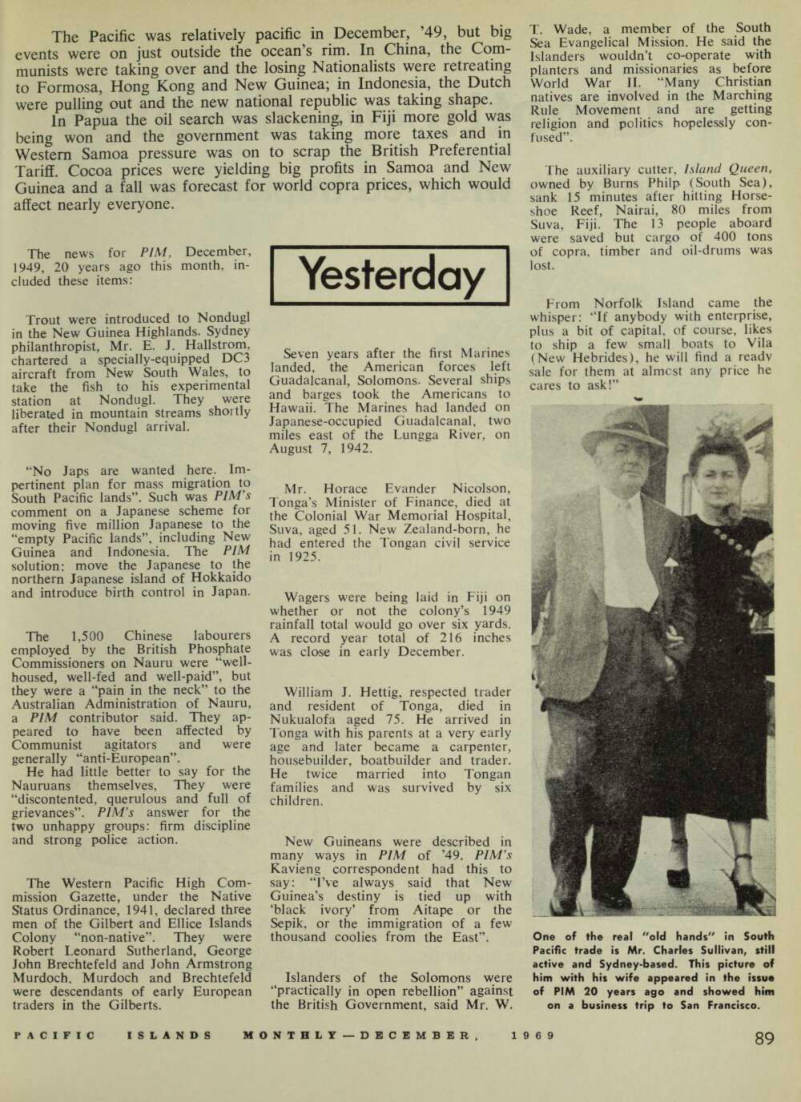
One of the real "old hands" in South Pacific trade is Mr. Charles Sullivan, still active and Sydney-based. This picture of him with his wife appeared in the issue of PIM 20 years ago and showed him on a business trip to San Francisco.