"Expensive,
pp. 90-91 · Read in the full issue
Inadequate And
Charming"
• An English spinster made a 10,000 mile “romantic” journey to Fiji in 1875 and found it . . .
By Jane Gregor
Thai ? k goodness that, whatever else they may not have had riji s earliest white women at least had the time and energy to leave us detailed accounts of all that they found there, almost 100 years ago. J
One of the most prolific writers, and the most readable, was Miss Constance Gordon Gumming. She arrived in the newly created colony in June, 1875, as companion to Lady Gordon, wife of Fiji’s first Governor, Sir Arthur Gordon, son of the fourth Earl of Aberdeen.
Miss Gumming, a lively spinster, was enchanted by the very prospect of living in Fiji. Earlier travels in the tropics had left her with a yearning for “tropical heat and sun light”. She clearly suffered from an itchy foot and Fiji at that time seemed to her the quintessence of romance, a place of “mingled joys . . . idyllic beauty and spine-chilling cannibalism”.
Indeed, only eight years earlier, the famous Rev. Mr. Baker had been killed and consumed there so that there was literal truth in Constance’s comment that “the idea of going actually to live on isles where there are still a number of ferocious cannibals has a savour of romance which you can imagine does not lack charm”.
That’s not, perhaps, quite the way to look at such a prospect but Miss Gumming came from a Scottish family and no doubt prided herself on having a cool head and a certain amount of courage.
Warm welcome
This, as it turned out, she was not going to need. After the vicious wars which marked King Cakobau’s reign Fiji, it seems, was more than ready to welcome a period of peace under Queen Victoria’s beneficent rule; and it gave its new governor a warm welcome.
The governor’s party was, by present day standards a large one
consisting of some 20 people, in cluding a major-domo and his wife, a doctor, a Welsh nurse and a Portuguese under-nurse to care for the two children of the new governor and his lady; also a “very important member of the family . . . namely Snip, a tiny black and tan terrier”.
Reading Miss Cumming’s book today, it all sounds as cosy as a family picnic. But although their first view, at Levuka, of life in these remote and scarcely known islands, was a rapturous life, life was scarcely a picnic.
No chief town
It was not even known where the seat of government and chief town of the new colony was to be. Levuka was the old port and the busiest town to date, Nadi, with its drier climate, was at one point considered. But, finally Suva, with its deep harbour and where the thermometer 'occasionally descends as low as 72” was chosen.
But before the party ever reached Fiji it stayed for a while in Sydney and here Miss Gumming began to get close to the cannibals whose strange ways so intrigued and thrilled her. She was given a first-hand account of how old King Cakobau, once such a doughty cannibal and now a positively sanctimonious Christian, had behaved during his recent stay in New South Wales. It seemed that he had taken the Gov ernor’s daughter, a golden-haired moppet, on his knee. This precocious pet had whispered, “You won’t eat me, will you?” The old king merely smiled but one wonders what his thoughts were at this frank question!
Constance says: “Our voyage was not altogether pleasant; the Pacific
proved false to its name. Thick mist alternated with downpours of rain and Levuka itself was shrouded in dense mist for some hours”. When the sun did shine the party declared themselves “duly charmed” by the scene. But not so charmed when they discovered that their arrival was totally unexpected and that Lady Gordon’s new house was still “a mere skeleton”.
Still, they were found homes and, once installed as a guest in the home of an established resident’s bungalow, Miss Gumming gives a frank account of what she finds.
“As to the houses, they are all alike hideous. We have not come to a land flowing in milk and honey.
Daily food is both difficult to obtain and expensive. Fish is scarcely to be had at any price. Milk is 1/- a quart; eggs, 3/- a dozen. Washing varies from 4/- to 6/- a dozen, not including dresses or petticoats. As to house-rent in Levuka ... it is simply exorbitant; four-guineas-a-week being the moderate price paid for this tiny little one-storeyed bungalow.”
Small salaries
Now comes a cry which one can still hear echoing through the islands, even today. “And this is the country to which the Colonial Office sends men at ridiculously small salaries because, as they were told ’ere leav ing England, living would cost them nothing and they could save all their pay.
“Why a man without private fortune could hardly live here at all.”
So much for the “good old days” all too often bemoaned.
Our inveterate letter writer con-
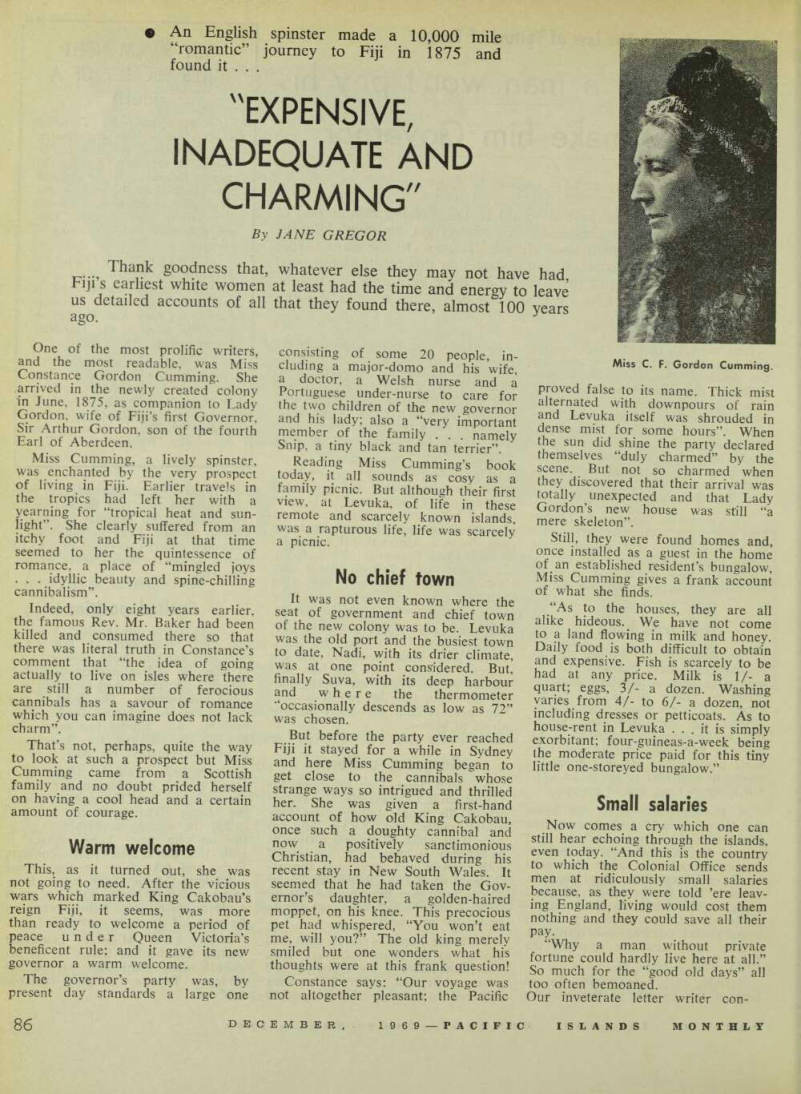
Miss C. F. Gordon Gumming.
Housekeeping miseries
tinues: “But oh, above all the miseries every housekeeper must daily endure; you probably begin by having one or two Fijians who look very in telligent but prove hopelessly stupid, or rather utterly careless about learn ing our strange new ways”. More hopefully she goes on, “They are very honest, though sometimes they cannot resist borrowing large English bath-towels which make most tempt ing sulus; and nice cambric handker chiefs are a tempting covering for carefully dressed hair.
“The very unsatisfactory person known as an English plain cook would here be a household treasure, compared with the English or Chinese wretches who by turns experiment on your unfortunate digestion at not less than £1 per week.”
No iced water
Miss Gumming is appalled by the lack of adequate provision for living in tropical Fiji. Unlike India or Ceylon, where she was used to iced water, wide verandahs and frequent baths, she finds 19th century Fiji sadly lacking, largely due, she believes to the ignorance of those at home in England.
And so, with a mixture of good and bad encountered, the early weeks of the first governor’s tour in Fiji pass and by early December Sir Arthur Gordon has rented a big house in Suva. It was formerly an hotel but must have been an ex ceedingly small one as Constance tells us that “the house would all go into one average room at home but by means of partitions it is divided into a sitting-room and six stalls for sleeping in”.
From Suva, as December lengthened towards Christmas, the party set out on a journey along the Rewa River. And there, at Niru kuruku on the Upper Rewa, Miss Gordon Gumming and her employers and friends settled down for their Christmas. • The National Bank of New Zealand has designed what are believed to be New Zealand’s first pictorial cheques intended for general use. They show a drawing of an inter island schooner against the backdrop of Rarotonga’s peaked outline. The bank says it did this to give Cook Islanders the feeling that the National Bank branch belongs to them. It is the first trading bank to operate in the Cooks, and was due to open in mid-November.