Book Reviews
pp. 96-99 · Read in the full issue
Inside story of the unhappy Wilkes expedition
When Commodore Charles Wilkes of the United States Exploring Expedition stepped ashore in New York in June, 1842, at the end of the expedition’s four-year cruise to the Pacific, there was no ovation for him from the “fashion of the city who had assembled to see his flag ship tie up.
Commodore Wilkes was not the sort of person to excite the populace, or even his own men, to cheer.
Indeed, no exploring expedition of the 18th or 19th centuries ever returned from the Pacific with such an unhappy crew or a more un popular commander.
Within a few days of the com modore’s return, the New York Morning Herald reported: “We understand that there is to be a nice mess dished up in a short time in the shape of court martials, courts of inquiry, arranging of specimens, rock, etc. in the eating of which nearly all of the officers of the Exploring Expedition are to parti cipate. ... It is said that there are at least a bushel and and a half of charges already preferred against Lieut. Wilkes, the commander-in chief, and that several officers of the squadron have come home under arrest”.
"Bitter" hostility
In the courts-martial that did fol low, four of the expedition’s officers were tried on a total of more than a dozen charges brought against them by their commander, and Wilkes was counter-charged with a total of 11.
In evidence, most of the officers called to testifv showed “bitter and heartburning hostility” towards Wilkes, and no less than eight of them claimed that he was harsh, overbearing, insulting, easily excited and offended, and, when excited, that his manner was violent and his tone
of voice frequently disrespectful.
However. Wilkes was acquitted of all but one of the accusations against him. The exception was that he had illegally punished some seamen, and for this he was publicly reprimanded by the Secretary of the Navy.
It was in this atmosphere, and in the face of official coolness and public apathy, that Wilkes sat down to write the official narrative of the expedition’s voyage, which had taken in the Tuamotus, Tahiti, Samoa, Fiji, Australia, New Zealand, the Antarctic.
Hawaii, the Gilbert, Ellice and Marshall Islands, the western coast of North America and much else.
The narrative was first published in an edition of five volumes in 1844.
Despite the unhappy background to it, it proved so popular that bv 1858 14 other editions (some of them condensations of the original) had been published.
Wilkes explained in an introduction that he had made “no allusions to any of the subjects of a personal character that came before the tribunals.” Nor did he “embrace any personal matters or difficulties that may have taken place with the officers” because he
did not regard such details as “relevant or interesting to the general reader”.
Thus, although Wilkes’ narrative runs to some 2,500 printed pages, it is not possible to glean from it more than a few vague clues to the various squabbles that led up to the bitter courts-martial at the end.
Now, however, an American his torian, Professor David B. Tyler, has pieced together the expedition’s un happy story from a vast array of unpublished and published material, and has turned it into a most readable book.
Protracted start
It appears from the Tyler story that the expedition got off on the wrong leg right at the start, and that the start itself was so protracted that it was almost a miracle that it got off at all.
The expedition had its genesis in the late 18th and early 19th centuries when American whalers, sealers and fur traders began to criss-cross the Pacific.
Captain Edmund Fanning, one of
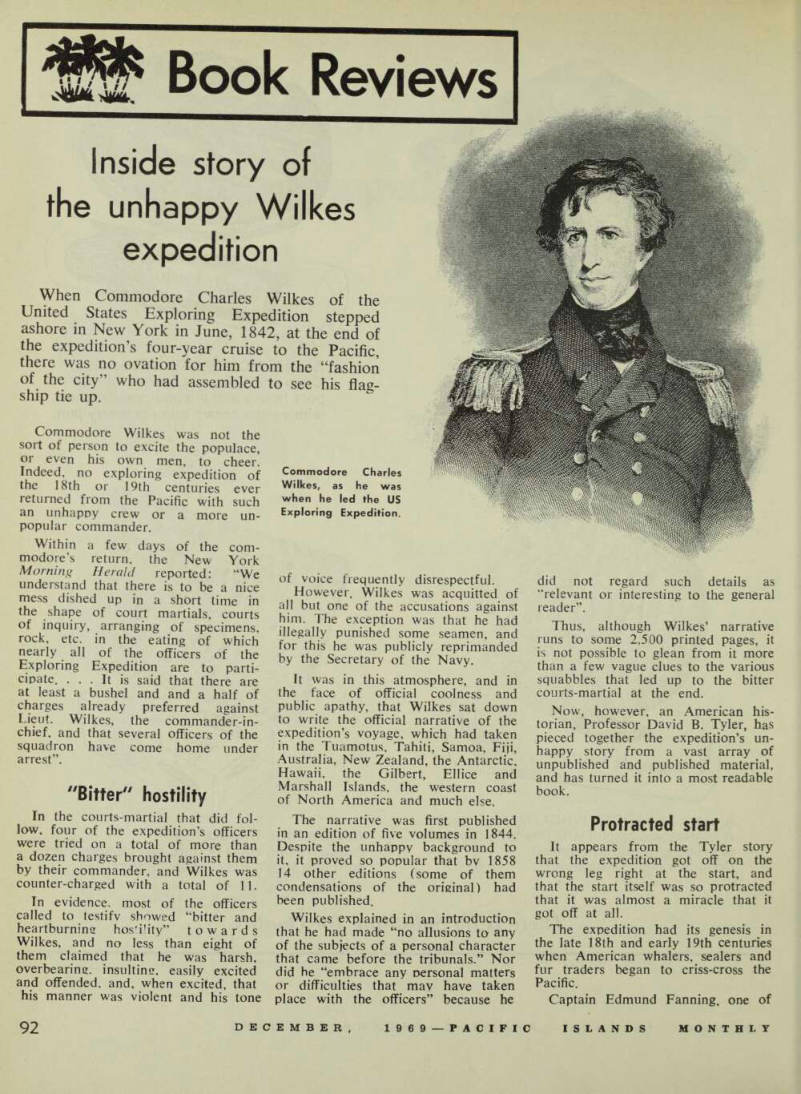
Commodore Charles Wilkes, as he was when he led the US Exploring Expedition.
Voyage of discovery
the most notable of those early sea dogs, persuaded President Madison to sponsor a voyage of discovery to the Pacific in the first decade or so of the 19th century, but this was thwarted by the war of 1812.
In 1825, President John Quincey Adams told Congress that the United States should assume her station among the civilised nations by con tributing her share to Pacific explora tion; and three years later the House of Representatives responded by re questing the President to send “one of our small vessels” to the Pacific.
However, the House failed to vote any money for the project, and it was not until 1836 —after the voyage of the Beagle, the explorations of Dumont d’Urville and British dis coveries in the Antarctic had showed the Americans how badly they were lagging—that Congress authorised the President to find $300,000 for exploring purposes.
Three more years passed before an expedition actually sailed for the Pacific.
The first commander appointed, Captain Thomas Catesby Jones, visualised the proposed expedition as such a large-scale operation that funds ran out before the expedition was fully equipped.
It was then found that the various brigs and schooners that were ordered to be built on his recommen dation were unsuitable for the work they would have to do. The bick erings and delays that this caused made it difficult to retain the officers and men who had already signed on; and in the midst of everything, Jones got sick and asked to be relieved from his command.
"Infinite confusion"
The Secretary of the Navy duly relieved him, but confided to his diary that Jones’ failure to go on the expedition would cause “infinite con fusion” as no one would wish to take command of “such vessels as he has had constructed” nor to be burdened with “such arrangements as he has made”.
Six officers did in fact decline to take command of the expedition before it was offered to Wilkes. He accepted so long as his views were carried out and the organisation of the expedition was left entirely in his hands.
Although only a fairly junior lieutenant. Wilkes had the reputation of being the best surveyor in the
Navy, and was then Superintendent of the Depot of Charts and Instruments in Washington.
Wilkes was not disturbed by the fact that the public had lost its enthusiasm for the expedition; that 24 of its officers had requested other assignments; and that one newspaper referred to it as the “Deplorable Fxnedition”
He took' the view that the less public interest, the freer he would be from interference. But all sorts of annoyances still arose. Officers who were senior to Wilkes in the service suddenly wanted to take command; the Navy Commissioners were obstructive in various ways; and Congress talked of eliminating the funds for the expedition s support.
Finally, however, the expedition’s five ships—the Vincennes, Peacock, Porpoise, Sea Gull and Flying Fish —were ready for sea. President Van Buren and the US Secretary of the Navy journeyed to Norfolk to attend a luncheon and drink to the expedition’s success.
This was the moment when Wilkes and his second-in-command, Lieutenant William L. Hudson, expected to
hear that they had been promoted to the rank of acting captain. The two men considered that these appoint ments were essential for the duties they were to undertake But no such appointments were made; and when the expedition weighed anchor on August 18 1839, neither Wilkes nor Hudson had any authority to wear the ca P tams uniforms that they had confidently bought for themselves, WJlLoc fiirmnc vvmveb luriuub Wilkes was furious. In a letter to the of W ar, who had had c h ar g e Q f the expedition’s organisa ti he said . hope you will never f ee i mortification that I do at this moment at being left now to grapple with things that the govern ment might have put under my entire control by the one act of giving Mr. Hudson and myself tem porary acting appointments for this service and which I consider was f u u y pledged to us.
“if my feelings for my country’s credit had not outweighed the morti fication at being denied, I never would have weighed anchor on this
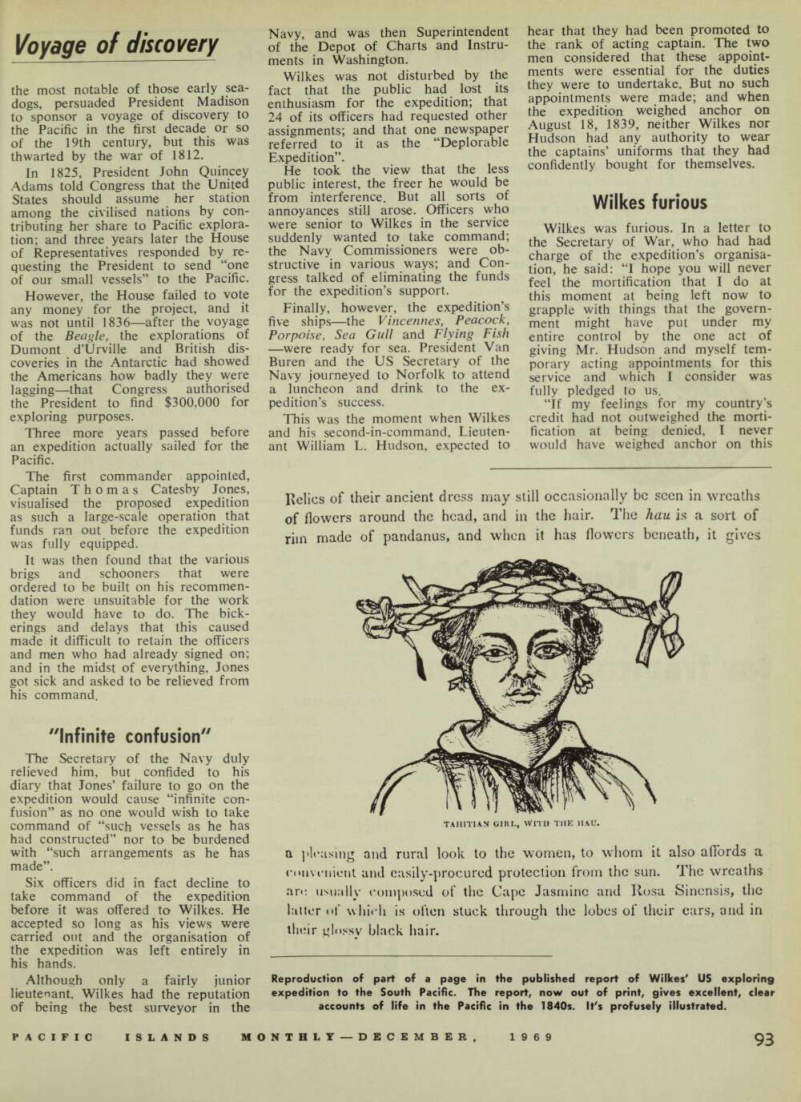
Relics of their ancient dress may still occasionally be seen in wreaths of flowers around the head, and in the hair. The hau is a sort of rim made of pandanus, and when it has flowers beneath, it gives
a pleasing and rural look to the women, to whom it also affords a convenient and easily-procured protection from the sun. The wreaths are usually composed of the Cape Jasmine and Rosa Sinensis, the latter of which is often stuck through the lobes of their cars, and in their glossy black hair.
Reproduction of part of a page in the published report of Wilkes' US exploring expedition to the South Pacific. The report, now out of print, gives excellent, clear accounts of life in the Pacific in the 1840 s. It's profusely illustrated.
Tahitian Girl, With The Hau.
One consolation left
ship—another time I shall know better. I have one consolation left that everything that we do earn by our exertions will be due entirely to ourselves.
“I hope and trust that the govern ment and country will have no cause to regret the hands in which it has been placed. Nothing will be wanting on my part to serve this expedition of the nation however much I have myself been disappointed . ..”
It was scarcely a propitious note on which to begin an arduous cruise to an ocean where months and months were to be spent in making meticulous coastal surveys in dangerous, reef-strewn waters.
Had things been otherwise, perhaps Wilkes would not have become as crotchety and overbearing as he did, and the expedition would have carried out its work in a far happier frame of mind.
As it was, although relations between Wilkes and his men con stantly deteriorated after the first few months, the expedition managed to perform an astonishing amount of useful work, thanks largely to Wilkes’ drive and utter devotion to his task despite official neglect.
Pacific landfalls
The story of where the exploring expedition went in the Pacific and what it did there is well known to Pacific scholars through Wilkes’ own writings and those of his scientists.
Professor Tyler’s book adds a new dimension by bringing out the dis sensions among the officers and crew and by dealing at some length with the various other difficulties they laboured under.
There is one substantial cause for regret about the book. Professor Tyler has made no attempt to identify, by their modern names, the expedition’s numerous Pacific landfalls. As a result, many a reader will be left floundering when names such as Strong’s, Ascension and Pescadores Islands crop up.
This brings up a serious deficiency in Pacific literature—that no readily accessible gazetteer exists containing the names of all the Pacific Islands as they once were and now are. TTie
world could do with one.-
RL.
(The Wilkes Expedition. The Ame
rican Philosophical Society, 104 South Fifth Street, Philadelphia, Pennsylvania,