To the Point
pp. 39-41 · Read in the full issue
It's Time We Had A Political
Blue-Print For Niugini
In a few weeks time we shall be in the 1970’5. A few weeks ago a ceremony took place on the south coast of Papua which recalled one of the events of the 1870’s.
The 1870’s, now a century away from us, saw the first meaningful contacts between the outside world and Niugini, for one could scarcely call Lieutenant Yule’s flamboyant action at Cape Possession in 1846 meaningful.
In 1871 Nicolai Mikluho Maclay paid his first visit to north-east New Guinea, exploring Astrolabe Bay and its immediate hinterland. In the same year LMS missionaries were making their first contacts with the southern coastline of what is now Papua.
In November 1872 a missionary party arrived in Redscar Bay, 40 miles north-west of Port Moresby, and a group of 12 Rarotongans, six pastors and their wives, was settled at the Motu village of Manumanu, at the mouth of Galley Reach. It was this event which was commemorated a few weeks ago by the dedication of a memorial erected in their village by the people of Manumanu.
Unfriendly mosquitoes
This first missionary foray into Papua had only a temporary success.
The Manumanu people were friendly, but the Manumanu mosquitoes were not, and the Cook Islanders had no natural resistance to malaria. Within a few weeks three of the party were dead, and over the next few months the survivors, first the sick and then the marginally well, for by that time none was completely well, were with drawn to the mission’s base at Somer set, on the northern tip of Cape York, Simultaneously, however, Captain John Moresby had discovered the harbour of Port Moresby and the large Motu village of Hanuabada on its shores, and in mid-1873 the survivors of the Manumanu pioneers were re-settled there. A year later, in November, 1874, Rev. W. G.
Lawes and Mrs. Lawes joined them.
Incidentally it was Dr. Lawes who first used the spelling “Niugini” though he wrote it as two words, not one.
During the latter years of the decade missionaries, explorers and traders familiarised themselves with much of the Papuan coast. They
To the Point with Percy Chatterton
included two very colourful characters Luigi Maria D’Albertis, who col lected insects, ogled the local maidens, terrorised all and sundry by letting off land-mines and rockets and igniting petrol and Bengal fire, but survived to return to his native Italy, and the Scottish explorer-missionary James Chalmers, who, after several narrow escapes, was clubbed to death on Goaribari Island.
Meanwhile, overseas, the colon ialists were becoming increasingly interested in the place, an interest which led up to the colonial grab by Britain and Germany in the 1880’s.
Out of thin air
So much for the 1870’s. Now, on the verge of the 1970’5, many in Niugini are asking “Where do we go from here?” The answers range all the way from Pangu Party’s call for home rule now, to the Honourable C. E. Barnes’ claim that 95 per cent, of Niuginians don’t want the boat rocked.
Presumably Mr. Barnes was not really quoting statistics but just pull ing a number out of the air, and choosing a number that gave him comfort. Neither he nor I nor any one else knows what the actual per centage is. We can assume that it is still fairly high; I think we can as sume that it is steadily diminishing.
One wonders whether one reason why the percentage is still so high is that many Niuginians are being con
ditioned to fear change. As an ex teacher I hate to think that even the schools may be involved in this exercise, but I am staggered by the fact that quite a considerable pro portion of the letters published in our territory newspaper on the theme “We’re not ready for self-govern ment” come from high school students.
When one takes note of the way in which high school students in other countries are behaving, this conservatism seems quite unnatural.
Far be it from me to want to see our high school students imitating the antics of some of their opposite numbers overseas, but a measure of radicalism among the young is normal and natural.
When teenagers become die-hard conservatives there is something fishy about it. Moreover the letters to which I refer show such a striking similarity in content and even in wording that one almost wonders whether there is in circulation a “Guide to Letter Writing” containing a pro-forma letter headed “We mustn’t rock the boat”.
Better, better, better
The once celebrated M. Coue used to teach his patients to say “Every day and in every way I feel better and better”, and to keep on saying it till they really believed it. Can it be that somewhere along the line Niuginians are being taught to say
Don't rock the boat' men are in majority
“We’re not ready for self-government”, and to keep on saying it till believe it?
The “Don’t rock the boat” brigade are still in a majority, but some of them are getting restive, particularly on the issue of “localisation”. An assistant ministerial member back from an overseas tour has compared our progress in this field unfavourably with that in Fiji. This is an issue on which many quite conservatively minded Niuginians feel strongly.
The late Tom Mboya, commenting on the Niugini situation as he saw it a few years ago, said “It might change overnight”. This was perhaps a picturesque exaggeration. But it might certainly change spectacularly between now and the 1972 House of Assembly elections. A wise govern-
ment, whether colonial or national, tries to keep a jump ahead of, rather than lag a step behind, public opinion. u , , . . .. . , However I have no intention of tr^, n € to ma^ e prcd'ctions as to what happen in Niugim in the 19705. !"? tead 1 * dl set down so “ e °l the j ln^s (1^ as one w ho hopes af,el : - 1972 t 0 e "J°y “ Placid retire ™ent ln a P® aceful Niugim, I would lke to see happen, MinktPrc fnr momhorc ,VumsTers Tor memDGrS First I would like to see the ministerial members designated “ministers”, as the Guise Committee originally proposed. It was Canberra which, presumably to draw the teeth of the proposal, denigrated the title.
At the same time the directors of departments might be re-designated “secretaries”. (A minority of them are already so designated). This at the start might be merely a matter of nomenclature, but it would be one which would clear the way for a progressive re-orientation of the re lationship between ministers and heads of departments.
Next, I would like to see brought to an end the historic colonial situa tion in which the Public Service both determines and implements policy.
Our present parliamentary set-up combines the disadvantages of both the British and American systems.
On the one hand choice of ministers is, as in Britain, limited to members of parliament. On the other hand the Senior Official Member and his official and ministerial colleagues, are obliged to woo parliament to secure approval for their policies.
Party should abdicate
Either the “Konedobu Party” should abdicate in favour of a majority party of elected members, or we should change over without delay to a “presidential” system, with ministers appointed from out side the House.
The former alternative could be implemented immediately with little if any change to the parliamentary structure. No doubt the group or party of elected members which took over would make mistakes, but “Konedobu” seems to have been making quite a few itself during the last couple of years.
The latter alternative has much to commend it but would involve a complete re-casting of the Papua and New Guinea Act and a very great change in the function, and probably the title, of the Administrator.
I would like to see a very early start made in the establishment of what the Speaker. Mr. John Guise, has called “provincial assemblies”.
Readers of this column know that I have had a good deal to say on this subject from time to time.
Keep councils
I like Mr. Guise’s suggestion that the areas to which government would be de-centralised should be called “provinces” rather than “regions” or “states”. However I do not see these bodies, as he does, as replacing local government councils. I would like to see the latter remain and I would like to see them kept fairly small.
I think that their value is in their being truly local, and I feel that the
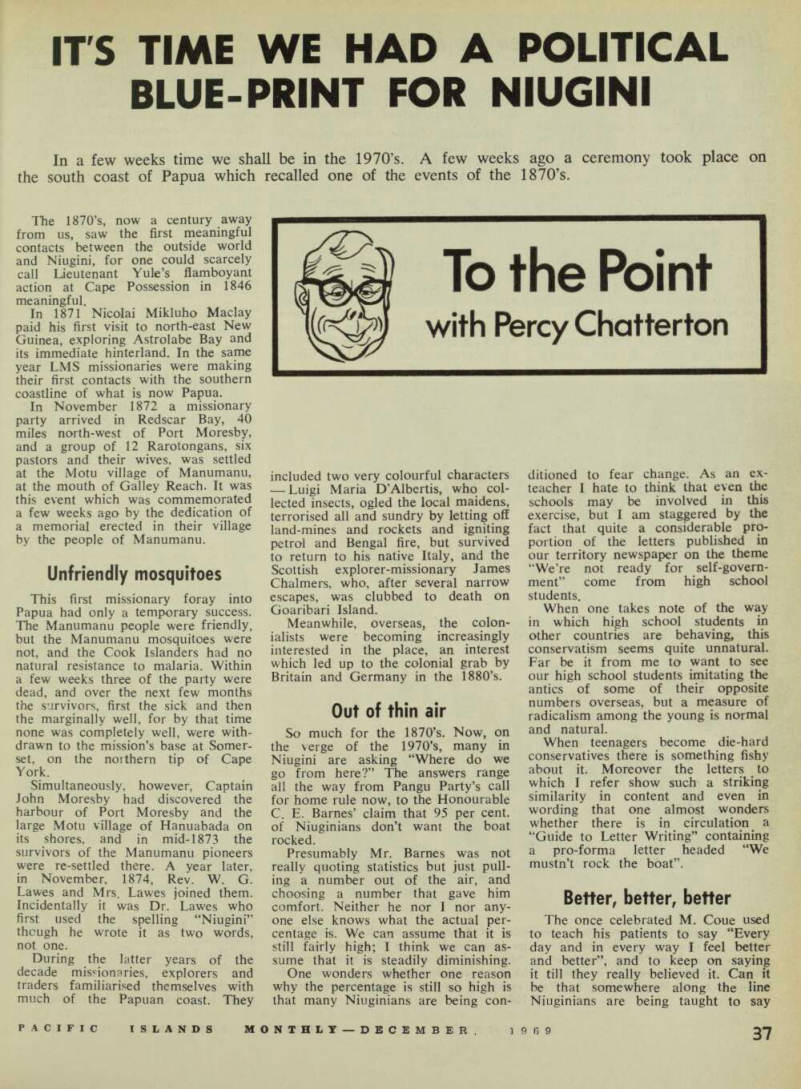
Eighty-five years after Britain took possession of Papua, the people of Papua-New Guinea are now asking, "Where do we go from here?" Percy Chatterton says the answers range from "home rule now" to "don't rock the boat". This historic picture shows the handing over of a walking stick on board the "Nelson" by Commodore Erskine to a Port Moresby chief, Boa Vagi, as part of the British annexation ceremonies of 1884.
trend to amalgamation of councils is a bad one, which should be checked or even reversed.
As I envisage them, the provincial assemblies would bridge the gulf between central and local government and establish lines of communication between them. They might well con sist of the province’s MHA’s sitting with an equal number of local gov ernment council representatives under an independent president.
Bridge the gap
Their function would be in part advisory, to the central government on the one hand and to the local government councils on the other; but I would hope that they would have some legislative functions within their provinces too.
I would like to see the problems of urbanisation tackled boldly and imaginatively through a structure
of urban local government which recognizes the Niuginian’s liking for dealing face to face with people he knows personally, rather than by correspondence with unknown officials incapable of writing a letter other than in public service jargon. This means a “ward” structure with a “ward office”, and a “ward clerk” able to deal with people personally and by word of mouth.
I would like to see acceptance of the principle that maximum indi genous participation in industry is more important than maximum development of industry. I don’t sug gest that the two things are neces sarily incompatible, but sometimes they may be.
I have been abused by some of my fellow MHAs when I have tried to develop this theme in the House, so I am somewhat comforted to find that several quite distinguished anthropologists and development economists think I am right.
Reserve industry
Acceptance of this principle in volves, among other things, reserving some areas of industry for Niuginians, and, in areas which must still remain for the time being in expatriate hands, insistence (where insistence is neces sary) on adequate training schemes for indigenous personnel.
Finally, I want Niugini to be a place where people are treated as human beings, not as units of man power or signees of forms. I am far more afraid that this apparently modest objective will not be attained than that we shall be plunged into a blood bath.
I sense a certain insensitivity to basic human rights among some Niuginians who have risen to positions of authority, and am some times horrified by the suggestions
they came up with for pushing their fellow-countrymen around. “The people must not be asked to make up their minds”, said one recently, “We must tell them what is the best way to govern them”.
Egging them on
And some of the experts seem to be egging them on. I do not under estimate the need for economic development and progress towards national prosperity, but I shudder when 1 hear people in high places suggesting that because Niuginian students depend on scholarships for their tertiary education they should submit to “direction” as to what courses they must take and what professions they must enter, and should not expect to be allowed to choose for themselves how they would like to spend their lives.
I have always taken with a grain of salt that bit in the Prayer Book about “that state of life unto which it shall please God to call me”. But I would rather think that God was doing the job than that it was being undertaken by a Scholarship Board.
If this sort of thing burgeons, you’ll probably hear me shouting out with English comedian Anthony Newley “Stop the world; I want to get off”.
Come to that, I may reach journey’s end and be told to get off. Or I may be bumped off. Tahiti's part in taking Christ to New Guinea, p. 81.
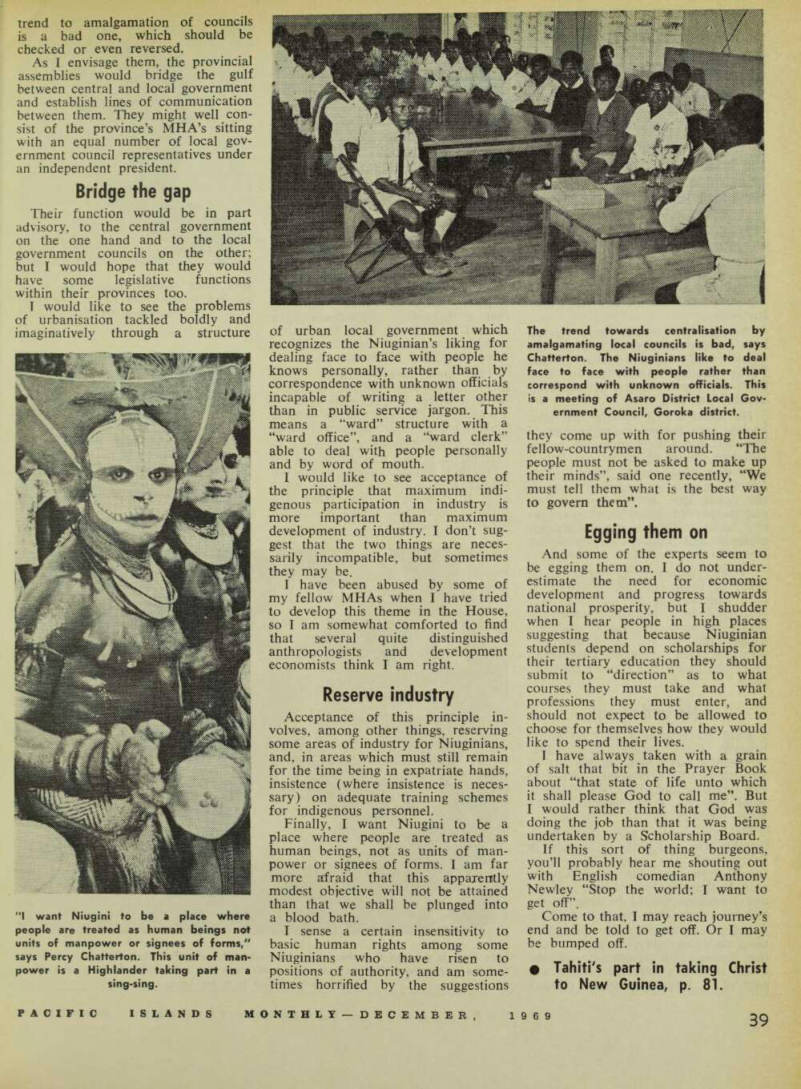
"I want Niugini to be a place where people are treated as human beings not units of manpower or signees of forms," says Percy Chatterton. This unit of man power is a Highlander taking part in a sing-sing.
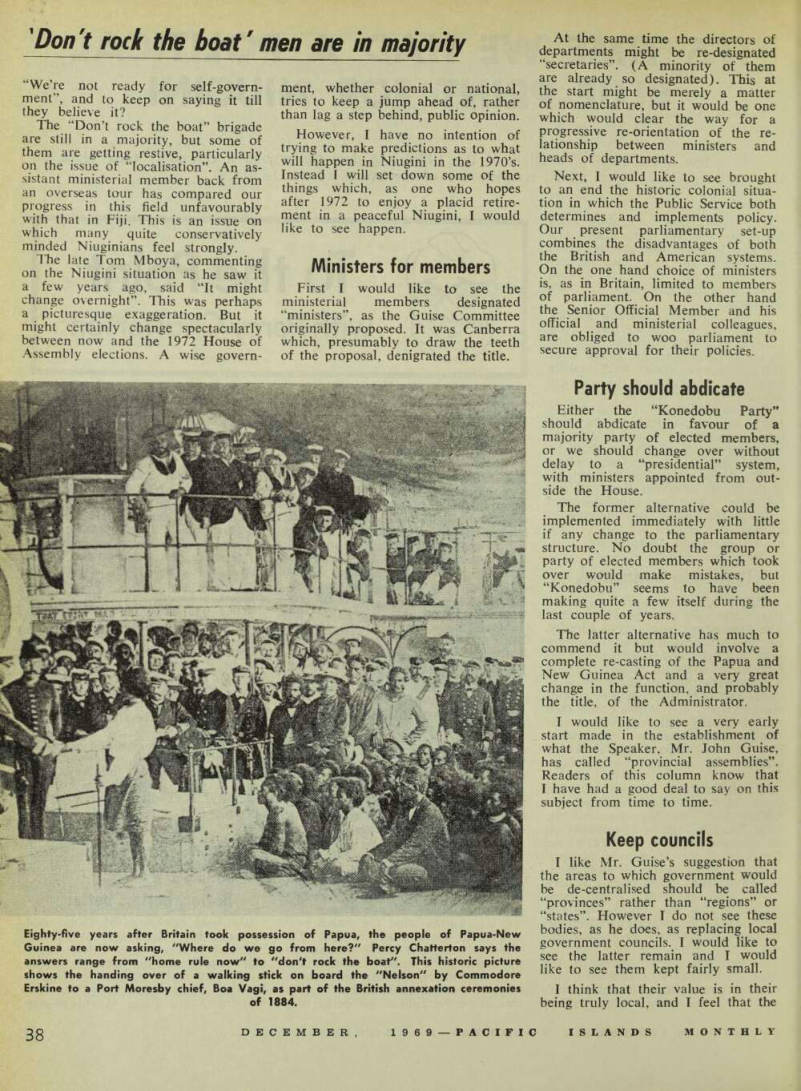
The trend towards centralisation by amalgamating local councils is bad, says Chatterton. The Niuginians like to deal face to face with people rather than correspond with unknown officials. This is a meeting of Asaro District Local Gov ernment Council, Goroka district.