Tropicalities
pp. 36-38 · Read in the full issue
New Guinea’s Pidgin English is in the news again—this time, with a group of missionaries and linguists trying to standardise the spelling.
From now on, they want Pidgin spelling based on the Pidgin New Testament (1969) and Roman Catholic missionary, Father Francis Mihalic’s Pidgin Dictionary, pub lished in 1957.
Many experts still disagree strongly over the real origin of New Guinea Pidgin and the real value of Pidgin now as a lingua franca . . . but, regardless, somewhere between 500,000 and 700,000 villagers are now speaking it, and many are beginning to read it.
From Port Moresby, Pauline Bona reports: Recently, the Administrator, Mr. Hay, issued instructions to government officers to get rid of “undesirable” Pidgin expressions like “meri”, “manki”, etc. (see, Playing meri hell with Pidgin, PIM, Sept., p. 1), and there was quick reaction —for and against.
The younger New Guineans, especially university students, ap plauded the Administrator . . . but many in the older generation, parti cularly some Europeans, just couldn’t understand the government trying to “legislate” the language.
One European MHA pencilled the following: The academics say it's so the academics say it’s so.
Those frightful words in Pidgin they simply have to go.
Masta will be Mister, And ‘ars’ will now be ‘hot’, and soon we’ll make decisions on other parts we’ve got.
The academics say it’s so the academics say it’s so.
The latest list of orders really make us sick.
Instead of manki mastas, they’ve all become domestics.
The academics say it’s so the academics say it’s so.
They’re playing a little word [game, finding words to fit.
Now we’re saying ‘rubbish, [nonsense’ instead of plain ’bullshit’.
Anon
They Want To
Standardise
Pidgin
Whatever the Administrator’s feel ings about Pidgin (and he uses the language often enough) and the reaction among some Europeans and village men too old to change the language, the missionaries and linguists are pressing ahead to standardise the spelling.
Father Mihalic, soon to publish his Pidgin Wantok newspaper from Wewak, will bear the brunt of the standardising—and it will be a con tinuing job, because Pidgin is grow ing almost daily. The vocabulary is now around 3,000 words—79 per cent, of them English or of English derivation, according to Father Mihalic.
Really a language?
Is Pidgin really a language? Father Mihalic points, as a prime example, to Manus Island whose 20,000 villagers now are using Pidgin almost exclusively, having dispensed with their numerous original place-talk (tribal or clan) languages and dialects. He adds: “This sort of thing has happened on Manus, and I see signs elsewhere.
Whatever Pidgin was originally— it contains English, German, Portu guese, Malay and some derivations from French—it’s with us, and the people are using it more every day.
“It’s a language, and who are we to tell the people to give it up?”
Some examples of the 300 or so words standardised are as follows: “adres” for address; “Brata” for brother; “husat” for who’s that”; “planti” for plenty; the phrase “Ol i” was sometimes hyphenated and sometimes used as one word but now “Ol” an “i” appear as separate words.
New Governor
takes a look
Mr, Louis Verger, new French Governor in Noumea, has been making extensive visits throughout the territory since his arrival from Paris on October 20.
After only three days in Noumea, Mr. Verger received local personal ities at an “open house” reception in his residence. The next morning he met with a specially convoked meeting of the 35-member Territorial Assembly.
Then within a week, the 48-year old Governor was accompanied by administration chiefs and an attrac tive and youthful-lookine Mrs.
Verger on a visit to the new administrative centre at Poindimie, on the East Coast.
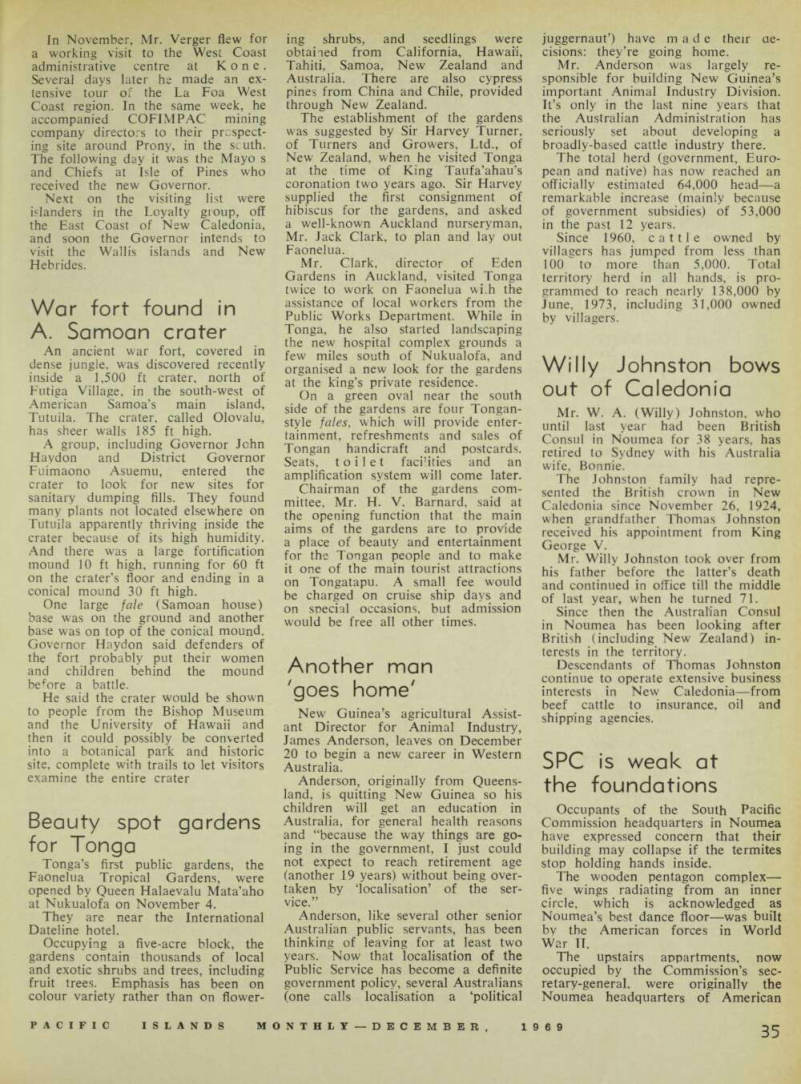
The first woman to represent a Fiji trade union overseas is attrac tive Mrs. Vasemaca Pickering, a Suva stenographer and mother of a three-year-old son.
Mrs. Pickering, 24, who is an executive member of the Tele communications Employees' Asso ciation in Fiji, represented the association at a three-week con ference of the Postal Telegraph Telephone International which began in Singapore on November 24.
The conference was held to dis cuss matters relating to women's activities as trade unionists, and ways and means of meeting their problems.
In November, Mr. Verger flew for a working visit to the West Coast administrative centre at Kon e .
Several days later he made an ex tensive tour of the La Foa West Coast region. In the same week, he accompanied COFIMPAC mining company directors to their prospect ing site around Prony, in the south.
The following day it was the Mayo s and Chiefs at Isle of Pines who received the new Governor.
Next on the visiting list were islanders in the Loyalty group, off the East Coast of New Caledonia, and soon the Governor intends to visit the Wallis islands and New Hebrides.
War fort found in
A. Samoan crater
An ancient war fort, covered in dense jungle, was discovered recently inside a 1,500 ft crater, north of Futiga Village, in the south-west of American Samoa’s main island, Tutuila. The crater, called Olovalu, has sheer walls 185 ft high.
A group, including Governor John Haydon and District Governor Fuimaono Asuemu, entered the crater to look for new sites for sanitary dumping fills. They found many plants not located elsewhere on Tutuila apparently thriving inside the crater because of its high humidity.
And there was a large fortification mound 10 ft high, running for 60 ft on the crater’s floor and ending in a conical mound 30 ft high.
One large fale (Samoan house) base was on the ground and another base was on top of the conical mound.
Governor Haydon said defenders of the fort probably put their women and children behind the mound be f ore a battle.
He said the crater would be shown to people from the Bishop Museum and the University of Hawaii and then it could possibly be converted into a botanical park and historic site, complete with trails to let visitors examine the entire crater
Beauty spot gardens
for Tonga
Tonga’s first public gardens, the Faonelua Tropical Gardens, were opened by Queen Halaevalu Mata’aho at Nukualofa on November 4.
They are near the International Dateline hotel.
Occupying a five-acre block, the gardens contain thousands of local and exotic shrubs and trees, including fruit trees. Emphasis has been on colour variety rather than on flower
ing shrubs, and seedlings were obtained from California, Hawaii, Tahiti, Samoa, New Zealand and Australia. There are also cypress pines from China and Chile, provided through New Zealand.
The establishment of the gardens was suggested by Sir Harvey Turner, of Turners and Growers, Ltd., of New Zealand, when he visited Tonga at the time of King Taufa’ahau’s coronation two years ago. Sir Harvey supplied the first consignment of hibiscus for the gardens, and asked a well-known Auckland nurseryman, Mr. Jack Clark, to plan and lay out Faonelua.
Mr. Clark, director of Eden Gardens in Auckland, visited Tonga twice to work on Faonelua wi.h the assistance of local workers from the Public Works Department. While in Tonga, he also started landscaping the new hospital complex grounds a few miles south of Nukualofa, and organised a new look for the gardens at the king’s private residence.
On a green oval near the south side of the gardens are four Tongan style fales, which will provide enter tainment, refreshments and sales of Tongan handicraft and postcards.
Seats, toilet facifities and an amplification system will come later.
Chairman of the gardens com mittee, Mr. H. V, Barnard, said at the opening function that the main aims of the gardens are to provide a place of beauty and entertainment for the Tongan people and to make it one of the main tourist attractions on Tongatapu. A small fee would be charged on cruise ship days and on special occasions, but admission would be free all other times.
Another man
'goes home'
New Guinea’s agricultural Assist ant Director for Animal Industry, James Anderson, leaves on December 20 to begin a new career in Western Australia.
Anderson, originally from Queens land, is quitting New Guinea so his children will get an education in Australia, for general health reasons and “because the way things are go ing in the government, I just could not expect to reach retirement age (another 19 years) without being over taken by ‘localisation’ of the ser vice.”
Anderson, like several other senior Australian public servants, has been thinking of leaving for at least two years. Now that localisation of the Public Service has become a definite government policy, several Australians (one calls localisation a ‘political
juggernaut’) have made their de cisions: they’re going home.
Mr. Anderson was largely re sponsible for building New Guinea’s important Animal Industry Division.
It’s only in the last nine years that the Australian Administration has seriously set about developing a broadly-based cattle industry there.
The total herd (government, Euro pean and native) has now reached an officially estimated 64,000 head—a remarkable increase (mainly because of government subsidies) of 53,000 in the past 12 years.
Since 1960, cattle owned by villagers has jumped from less than 100 to more than 5,000. Total territory herd in all hands, is pro grammed to reach nearly 138,000 by June, 1973, including 31,000 owned by villagers.
Willy Johnston bows
out of Caledonia
Mr. W. A. (Willy) Johnston, who until last year had been British Consul in Noumea for 38 years, has retired to Sydney with his Australia wife, Bonnie.
The Johnston family had repre sented the British crown in New Caledonia since November 26, 1924, when grandfather Thomas Johnston received his appointment from King George V.
Mr. Willy Johnston took over from his father before the latter’s death and continued in office till the middle of last year, when he turned 71.
Since then the Australian Consul in Noumea has been looking after British (including New Zealand) in terests in the territory.
Descendants of Thomas Johnston continue to operate extensive business interests in New Caledonia—from beef cattle to insurance, oil and shipping agencies.
SPC is weak at
the foundations
Occupants of the South Pacific Commission headquarters in Noumea have expressed concern that their building may collapse if the termites stop holding hands inside.
The wooden pentagon complex— five wings radiating from an inner circle, which is acknowledged as Noumea’s best dance floor—was built by the American forces in World War 11.
The upstairs appartments, now occupied by the Commission’s sec retary-general, were originally the Noumea headquarters of American
admirals and generals commanding the South Pacific area. It was never intended that the wooden building should last so long. It has served the South Pacific Commission for 22 years since the war.
The commission has now decided to ask the French administration to investigate the state of termite invasion of the pentagon Meanwhile, developers eye the site.
It is a much-envied one, being right on the Anse Vata beachfront. But it does have a noise problem common to tourist-nightclub areas, and the wall enclosing the attractive commis sion gardens does undergo frequent repair, being a favourite hurdle for motorists speeding around the corner.
What lies ahead
in P-NG tourism?
Speaking recently in Port Moresby, Mr. Marvin Plake, executive direc tor of the Pacific Area Tourist As sociation, said the territory had “one of the best tourist potentials” any where in the Pacific. “I would assume the future is so unlimited that I would not even care to make a pro jection on it because there is no base for a projection,” he said. He said that standards of hotels shouldn’t drop just because they might be located in small population areas.
Moresby hotels and restaurants should be as good as those in Sydney.
“When you go to the Sepik River, for example, the tourists psycho logically are tuned to the fact that they are going to rough it and they will be glad to rough it,” he added.
“There doesn’t have to be any hot water. There doesn’t have to be a good comfortable air-conditioned hotel room with shower—bath, etc.”
Before too long Qantas would introduce a third service a week on its Sydney-Hong Kong run, via Moresby, with 707’s. There was no reason why territory travel people couldn’t go “to a coffee planter’s home that has maybe two or three rooms, or persuade him to build a couple of rooms and the people would be glad to pay”.
Mr. Plake declared: “You’ve got these tremendous people, you have got tremendous scenery in places.
Artifacts that are becoming museum pieces, wartime history, a new country that some day will be really important.”
He understood the territory’s new executive director of its tourist board, Mr, B. T. Hill, would produce a handbook on New Guinea “in the near future”. Mr. Plake said Mr. Hill would probablv come up with “10. 15, 25 places” that should be of interest to the tourist.
No profit, but the
service is the thing
Rarotonga’s first bus service, on a 21-mile run round the coastal road, is doing well, although it has yet to make a profit. The service began in July with an elderly bus imported from New Zealand and now has grown to three, one of which is kept in reserve for charter work.
Sunday bus services to Rarotonga Hospital are well patronised by people visiting sick relations, as are the week day early morning and late afternoon runs. Two of the buses have travelled over 1,600 miles round Rarotonga and have carried over 6,000 passengers.
Competition still exists in the form of passenger-carrying trucks, some with canopies, some without; on those, passengers sit on hard wooden forms.
An application to establish a private bus company in Rarotonga was turned down some years ago before the advent of self-government.
School buses have been running in Rarotonga for many years, and there is also one in Mangaia, but these are for schoolchildren and are not used by the public.
A human
sacrifice, he says
P-NG planter, and president of Papua-New Guinea’s Local Govern ment Association, Mr. Gayne Cooke, believes villagers on Bougainville may be planning a human sacrifice for January.
He told PlM’s man in Port Moresby, John Ryan, that accord ing to his information from villagers, the sacrifice is being planned for Siar Village on the north-eastern coast of Bougainville, in the Selau
Census Division of the Buka Passage Sub-district.
“It’s a new outbreak of cargo cult,” Mr. Cooke said.
“In 1960 at Manob Village in the Selau Census Division, village people were strongly suspected of burying alive an old man and expecting him to rise three days later like Jesus— bringing cargo.
“I was a patrol officer then, and investigated the whole thing. There’s no doubt in my mind that they buried the old chap. They just misinterpreted the Bible. Anyway, we couldn’t pin anything on any body, and it was quietly forgotten.
“Now, the Buka Island type of cults are coming down the north eastern coast towards my place at Teop-Tinputz. Villagers have told me about several variations of the cult—and one is, that some people at Siar Village are going to bury a sacrifice in the hope of cargo.”
Human sacrifices, fantastic though they are, are by no means unusual in Papua-New Guinea. There have been several attempts over the years (attempted crucifixion, hangings) and in 1961 at Madang, a villager was killed as a sacrifice in front of the unsuspecting Archibishop Noser.
Mr. Cooke says he has alerted District Administration staff in the area.
John Ryan also reports that the Hahalis Welfare Society on Buka Island (600 policemen were flown in early in 1962 to bring an end to the “anti-government” Hahalis) is be coming more active again.
There’s also a report that a Hahalis-type “Baby Garden” has been established near Kieta, prim arily to meet the needs of some of the 5,000 men now working at Kobien, Arawa and Panguna for Conzinc Rio Tinto.
Golf course coming
for Noumea
It will evidently still be a couple of years before Noumea can boast a golf course, but slowly preparations are being made—provided no-one discovers nickel on the site in the meantime.
During October, Mr. Robert Trent Jones, of California—an interna tionally-famed designer of golf courses—inspected the selected site near the Dumbea river, 15 miles out of Noumea. Mr. Trent Jones was ac companied by an irrigation specialist.
They plan to submit to the Cale donian authorities a project for the building of an 18-hole course at Dumbea.