or nothing, says Fiji
pp. 42-43 · Read in the full issue
We want real kav ceremonies or nothing, says Fiji
From SUE WENDT, in Suva Fiji s tourist industry has had one or two shocks recently, not the least of which was Chief Minister, Ratu Sir Kamisese Mara’s criticism of the yaqona ceremony conducted during the opening of the ninth tourism convention, in Suva.
Apparently because the ceremony was attended by the Governor, Sir Robert Foster, Ratu Sir Kamisese made no secret of his disgust at what he called the shrivelling, the shrink ing and the attenuation of Fijian customs.
“Bowls of yaqona were served without any attempt to present the dignity and impressiveness of the Fijian yaqona ceremony. In fact, there was no semblance of ceremony at all,” he said.
He added that it was the first time he had seen the ceremony performed like that for a Governor, the repre sentative of the Queen.
“Either there should have been a full Fijian yaqona ceremony with all the ritual that is required, or no yaqona should have been served at all,” he said. “We must not have our customs and culture sacrificed for any gain by the tourist industry.
“Which comes first, our national pride or expatriate profit? There is only one answer to that. Let our customs be treated sensitively, delicately, or don’t touch them at all. Don’t encroach on them; don’t commercialise them; don’t cheapen them; don’t intrude on them.”
No yodelling
Ratu Sir Kamisese said he didn’t believe that mekes and other ceremonies were high on the list of attractions which brought tourists to Fiji. Tourists looked for good service, good scenery, good swimming and other facilities.
“I have never seen any Swiss dancing or yodelling in hotels in Switzerland. The people flock there for other reasons,” the Chief Minister said. In the same way, Fijian customs and traditions should be seen in the villages, where they meant something.
Delegates attending the convention were understandably stunned by both the timing and significance of the Chief Minister’s statement, which was part of a longer statement relating
to the South Pacific Conference in Noumea ( PIM , Nov., p. 30).
Overseas delegates in particular, having come from as far afield as Australia, New Zealand, the US and Canada, found it rather confusing that a ceremony which must have seemed long enough to be impressive, should have caused such an outburst from the Chief Minister.
They must have wondered; “Does this country want tourism or not?” —for it would be extremely rare for a country to embrace tourism without making some compromises of its own.
The Chief Minister’s reference to “expatriate profit” was disturbing for it seemed that he equated tourism wholly with outsiders, without being able to foresee a time when the Fijians themselves would be caught up in the industry.
Although he was not at the con vention, the executive director of the Pacific Area Travel Association, Mr.
Marvin Plake, commented on the matter when he visited Fiji a week or two later.
“There is no way that Fiji will remain unchanged if tourism comes,” he warned. “You can’t have the American dollar without Americans.
You can’t have tourism without tourists.
“An influx of visitors always brings
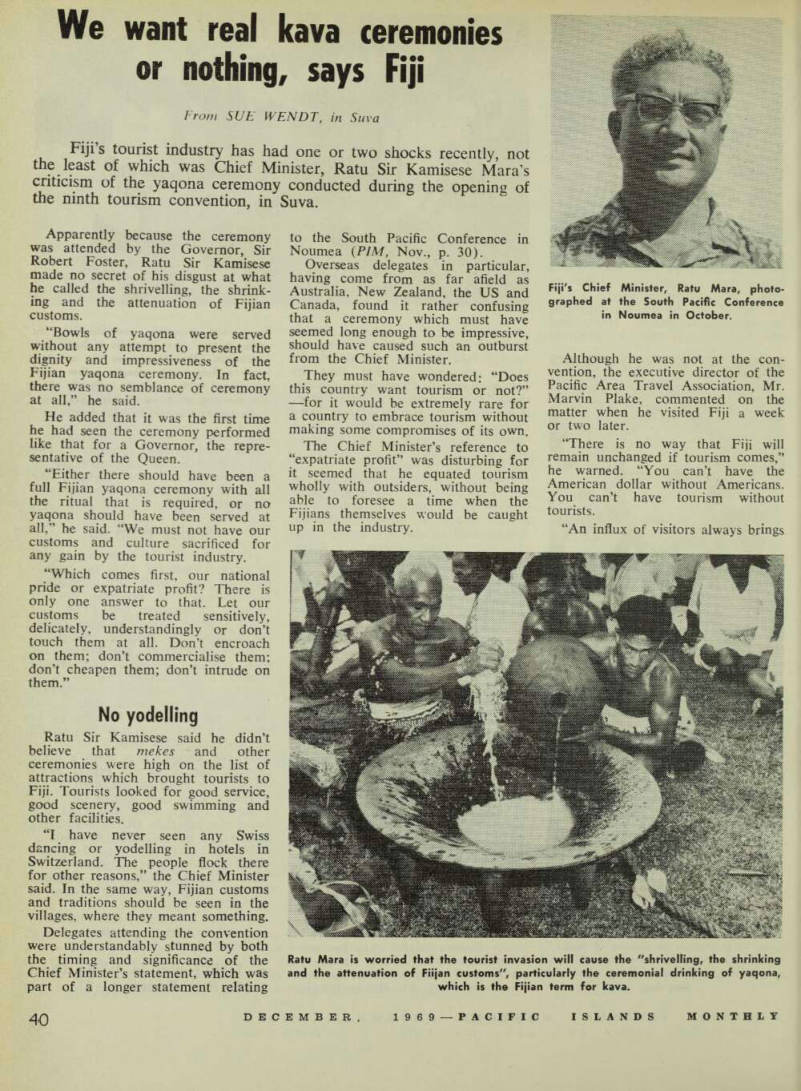
Fiji's Chief Minister, Ratu Mara, photo graphed at the South Pacific Conference in Noumea in October.
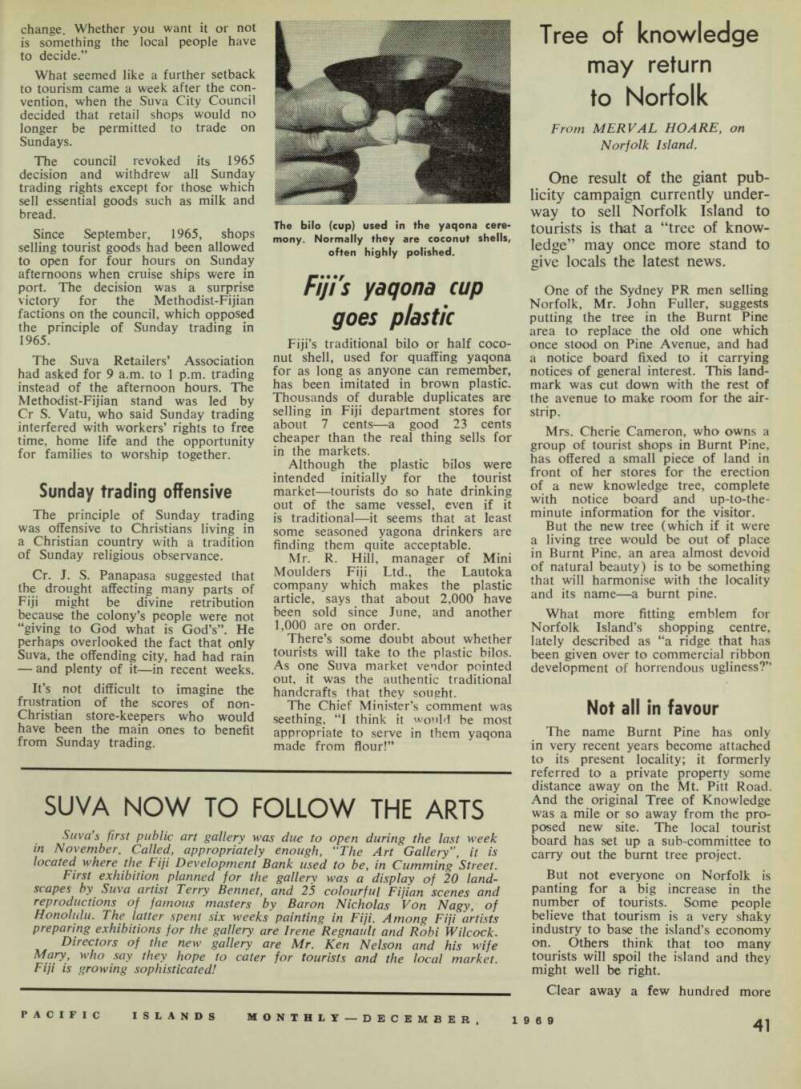
Ratu Mara is worried that the tourist invasion will cause the "shrivelling, the shrinking and the attenuation of Fiijan customs", particularly the ceremonial drinking of yaqona, which is the Fijian term for kava.
change. Whether you want it or not is something the local people have to decide.”
What seemed like a further setback to tourism came a week after the con vention, when the Suva City Council decided that retail shops would no longer be permitted to trade on Sundays.
The council revoked its 1965 decision and withdrew all Sunday trading rights except for those which sell essential goods such as milk and bread.
Since September, 1965, shops selling tourist goods had been allowed to open for four hours on Sunday afternoons when cruise ships were in port. The decision was a surprise victory for the Methodist-Fijian factions on the council, which opposed the principle of Sunday trading in 1965.
The Suva Retailers’ Association had asked for 9 a.m. to 1 p.m. trading instead of the afternoon hours. The Methodist-Fijian stand was led by Cr S. Vatu, who said Sunday trading interfered with workers’ rights to free time, home life and the opportunity for families to worship together.
Sunday trading offensive
The principle of Sunday trading was offensive to Christians living in a Christian country with a tradition of Sunday religious observance.
Cr. J. S. Panapasa suggested that the drought affecting many parts of Fiji might be divine retribution because the colony’s people were not “giving to God what is God’s”. He perhaps overlooked the fact that only Suva, the offending city, had had rain and plenty of it—in recent weeks.
It’s not difficult to imagine the frustration of the scores of non- Christian store-keepers who would have been the main ones to benefit from Sunday trading.