A matter of pride
p. 95 · Read in the full issue
on Samoa
By Robert Langdon
A century ago, when neither the Samoans nor the motley group of European residents in Samoa had fixed on any settled form of government, it was not uncommon for international in cidents to develop out of the most trivial occurrences.
One such incident, possibly the earliest of its kind, had its beginnings in 1867 when Godeffroy’s manager, Theodor Weber, who was also consul for Hamburg hauled down a French flag that was flying over the pro perty of a Frenchman called Reban.
The reason for Weber’s action seems to have been that Reban’s property had been mortgaged to him, and in taking possession of it, he did not wish to become the owner of the French flag, too.
However, Weber’s action greatly offended Monsieur Reban, who com plained of it to both J. C. Williams, the British consul, and to the French Government. On February 24, 1868, the French warship, Coetlezon, under Captain Dedit, arrived in Apia to seek an indemnification for Reban and also “satisfaction” for the insult to the French flag.
The day after his arrival, Dedit discussed the Reban-Weber affair with Williams on board his ship.
Williams told him all that he knew of the affair, and recommended that Dedit write to Weber so that they could arrive at an “amicable settle ment”.
When Williams received an invita-
tion from Dedit to go on board to discuss the question of Weber’s insult to the French flag, he found that the two men had already settled their differences.
They had agreed, Williams wrote in his diary, that on Saturday, the 29th, at 10 o’clock, the French flag should take the place of the Hamburg flag on Reban’s former property and be saluted from the ship, and that afterwards it should be hauled down again and replaced by the Hamburg flag.
Promptly next morning, the French blue jackets landed and were duly drawn up in military style in front of the Reban property. Williams and Coe, at the captain’s invitation, were on hand to witness the “yo-yo” act with the two flags. However, an un foreseen contretemps then occurred.
When Captain Dedit gave orders to lower the Hamburg flag, Weber objected that it was he should give the order for the flag to come down.
In the end, Weber submitted to the French captain’s demand; the Hamburg flag came down; the French tricolour took its place; a salute was fired from the ship; and Dedit and Weber shook hands. Then the French flag was lowered; the Hamburg flag was raised; and “after a little time” that, too, was taken down again. Finally, honour having been satisfied on all sides, everyone went off to Weber’s place for break fast.
These farcical details about the Reban-Weber flag incident are recorded in a diary spanning four years which J. C. Williams kept in Apia from February 24, 1868, to March 20, 1872. The diary is written in a large leather-bound ledger, now owned by a descendant of the consul in South Africa, Mr. R. Williams, of Johannesburg.
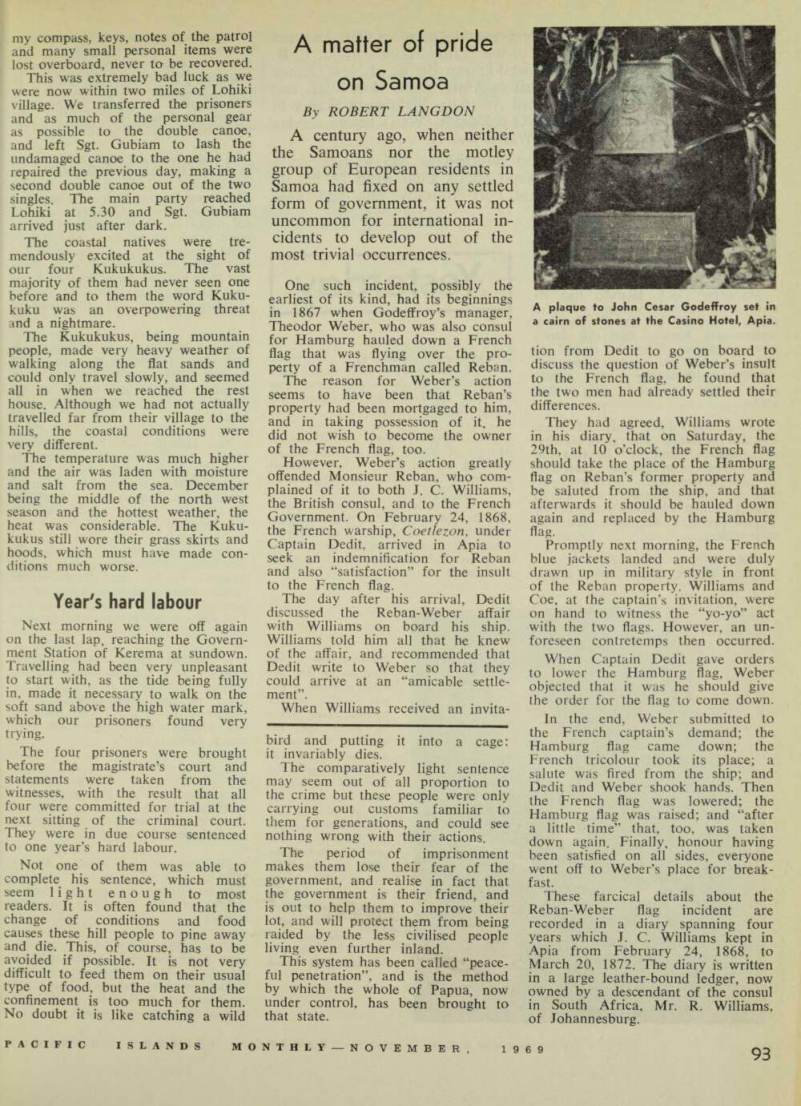
A plaque to John Cesar Godeffroy set in a cairn of stones at the Casino Hotel, Apia.