Yesterday
p. 96 · Read in the full issue
Many oldtime characters were passing away in ’49, and sad news in November was the death of the “Little Major”, Major E. B.
Ayris, veteran of three wars and well-known Before of New Guinea in the ’3o’s. He served in the British Army in the Boer War, and then went pearl fishing off northern Australia. Fighting in France in World War I, he drifted to the NG goldfields (Wau) before serving m smallships around NG during World War 11.
The “Little Major” had just returned to NG to take up a position of secretary of the Kokopo Sports Club when he fell ill he was transferred to hospital at Port Moresby, but died, aged about 72.
Other news from PIM, 1949, November, included: Mangaia, Cook Islands, lost its only plate glass windows when a truck owned by M. and P. Kereroa, shopowners, backed into this firm’s new windows. Villagers rushed to the shop when the accident happened, “expecting something in the nature of a major calamity”, PlM’s man said.
In a note dated July 22 from Pitcairn Island it was reported that the isolated island had its first on shore appendix operation. A surgeon from a passing ship. Port Pirie, per formed the operation on Pervis Young, son of Pitcairn’s radio opera tor, in the tiny dispensary near the post office.
The Gilbert and Ellice Islands Colony christened a new ship—
Nimanoa —by pouring a bilo of coconut toddy over her stern. Her predecessor of the same name was sunk by the Japanese off Tarawa on December 10, 1941.
Mr. Alport Barker was re-elected Mayor of Suva, Fiji, at the annual meeting of the Suva Town Council on November 2. He was unopposed.
A. B. Donald Ltd., long-time Cook Islands and French Polynesia shippers and traders, introduced a new ship— Charlotte Donald —on its inter-island runs in the Cooks, based out of Rarotonga.
After two and a half years cruise across the Pacific, American, Bill Murnan, reached Port Moresby, Papua, on November 2, in his 30 ft yacht, Seven Seas 11. Bill’s wife had accompanied him to American Samoa, but there she had left the yacht because of ill-health.
A joint company was to be set up in New Guinea’s Morobe Valley to exploit and mill the district’s timber.
The company was to have a nominal capital of about £750,000, and to be owned by the Australian Govern ment (majority holding) and Bulolo Gold Dredging Ltd. It was estimated that within the Morobe District, there was 200 million super feet of hoop and klinkii pine, with a smaller quantity of cedar and other timbers.
At the international sugar con ference to begin in London in November, Fiji was to be represented by Mr. C. Harvey, Director of Agri culture. The talks were deemed “vital” to the colony’s economic future.
New Hebrides and Fiji missionary, Pastor A. G. Stewart, returned to Australia after a seven-month lecture tour of Britain and the US. With his wife, Pastor Stewart began work for the mission board of Seventh-day Adventists in Fiji in 1907.
Almost the whole township of Vatukoula, Fiji, turned out to say farewell to Mr. and Mrs. N. E.
Nilsen, chief general manager of the associated gold mining companies.
The Nilsens were returning to Aus tralia.
A severe earth tremor shook Kokopo and Rabaul, New Britain, causing a landslide on the road be tween the two New Guinea towns.
Nearly 60 water tanks were damaged and many more tumbled off their stands behind homes.
A select committee of the Legisla tive Assembly of Western Samoa recommended that the preferential tariff for British goods be abolished.
The preference worked mainly against goods imported from the US.
Fiji’s new Chief Justice, Mr. J.
H. Vaughan, MC, arrived in Suva in late October to preside over a sitting of the colony’s Supreme Court.
Over 3,000 tons of American war time earth-moving equipment from six of the Marshall Islands reached Sydney by chartered ship. The equip ment was ear-marked for use in Aus tralian open-cut coal mines.
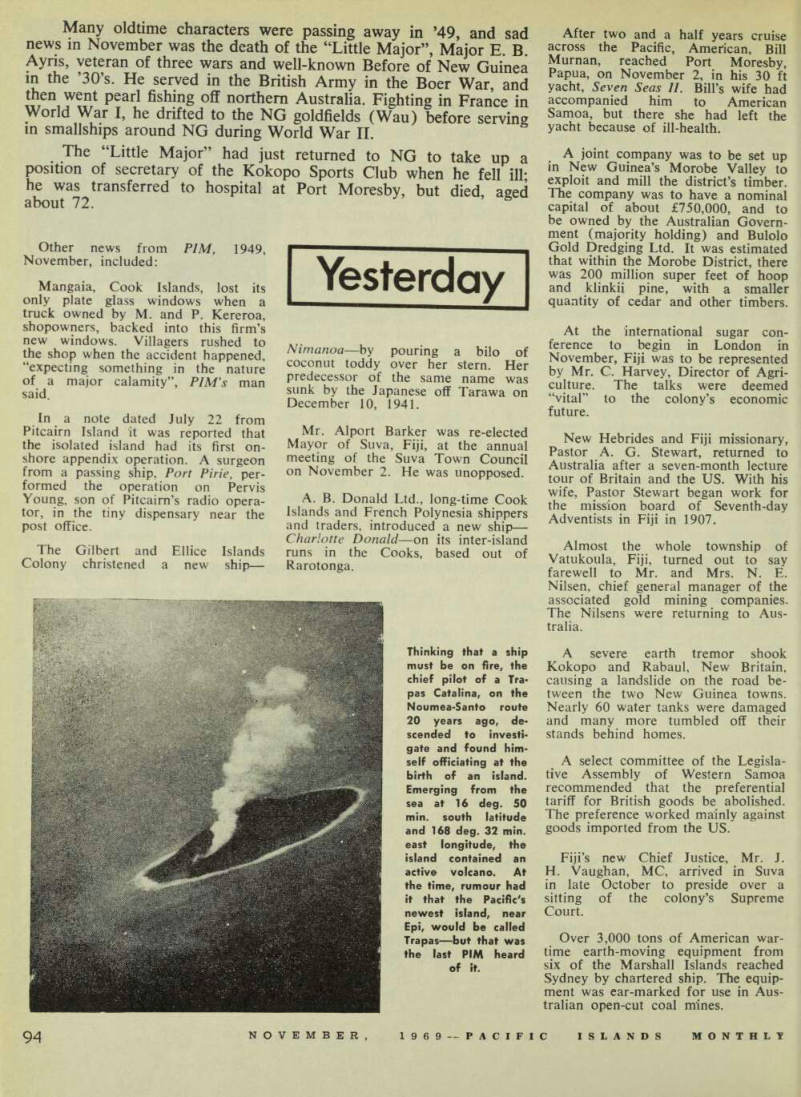
Thinking that a ship must be on fire, the chief pilot of a Tra pas Catalina, on the Noumea-Santo route 20 years ago, de scended to investi gate and found him self officiating at the birth of an island.
Emerging from the sea at 16 deg. 50 min. south latitude and 168 deg. 32 min. east longitude, the island contained an active volcano. At the time, rumour had it that the Pacific's newest island, near Epi, would be called Trapas—but that was the last PIM heard of it.