Magazine Section
pp. 87-95 · Read in the full issue

When the Kukukukus came from the hills, it was to kill
Towards the end of November, 1925, an excited native from the village of Akauda reported at the Resident Magistrate’s office at Kerema in the Gulf Division. He told us through the medium of two court interpreters that he and about a dozen other natives, men, women and children, were away from their village fishing on a small creek called the Evora, which runs into the Vailala River.
This was one of their usual fishing haunts, and for that reason, there they had built a number of rough shacks, so that they could spend one or more nights at the creek if necessary.
On this occasion everything was as usual, until one morning a party of Kukukukus, four men and a woman, visited them, all appearing to be quite friendly.
The Kukukukus are a nomadic hill tribe living in the hinterland of Papua, and as the result of genera tions of raids on the coastal natives, were very much feared. Their real name was the Maihiri tribe, but they were always referred to by the coastal people as the Kukukukus, which is a scornful term meaning bush natives.
The very mention that the Kuku kukus were anywhere near a coastal village would cause utter terror and confusion, and be a signal for the women and children to run away and hide in the bush.
Cruel cannibals
There is no doubt that the Maihiris were a cruel and ruthless lot of cannibals, and their reputation was well earned. Being nomads with no fixed villages, they roamed about their almost inaccessible mountains, and it was never known where they might strike next.
Apparently these five Kukukukus walked about among the Akauda’s huts admiring their fishing nets and traps, and the other articles used by the more civilised natives, such as their few articles of clothing and blankets. The Akauda people are not really coastal, as their village is two or three day’s travel up the Vailala River, but they are in close touch
with the coastal natives. They go to work on the European plantations, and thus accumulate articles con sidered necessary for their simple ways of living.
In due course, the Kukukukus came across a 12 inch knife and an axe, which every party of civilised
natives would take into the bush.
These articles the Kukukukus tried to buy. offering bows and arrows, and the hindquarter of a bush wallaby in exchange.
After a refusal the Kukukukus became very sullen, and sat together in a corner of the clearing talking in low tones. The Akauda natives were cooking their midday meal at about this time and offered their visitors some sago and fish, but this was refused. Becoming thoroughly frightened, they offered them all sorts of different articles, such as an old flannel shirt and cooking pots, but these were again refused.
Fired Arrows
The Kukukukus remained in this fishing village for the rest of the day. watching every movement but finally, just as it was getting dark, they left. One wonders if this long vigil were not to make sure that the Akauda people did not slip away to their main village down the Vailala River.
The next part of the story had to be pieced together with the help of information gained later. It would seem that, some time during the night, while all the Akauda natives were asleep, the visitors returned, possibly bringing others with them.
They surrounded the largest of the sha 'ks and fired arrows as fast as they could into the sleeping forms.
The result was that four were killed outright, six were wounded, l vl one of these died later. The few unwounded, and those slightly wound ed were able get away in the general confusion. Thus the Kukukukus used their own methods of getting the knife and axe, as well as blankets and other articles of clothing.
In fact they took everything they could carry. It appeared that this
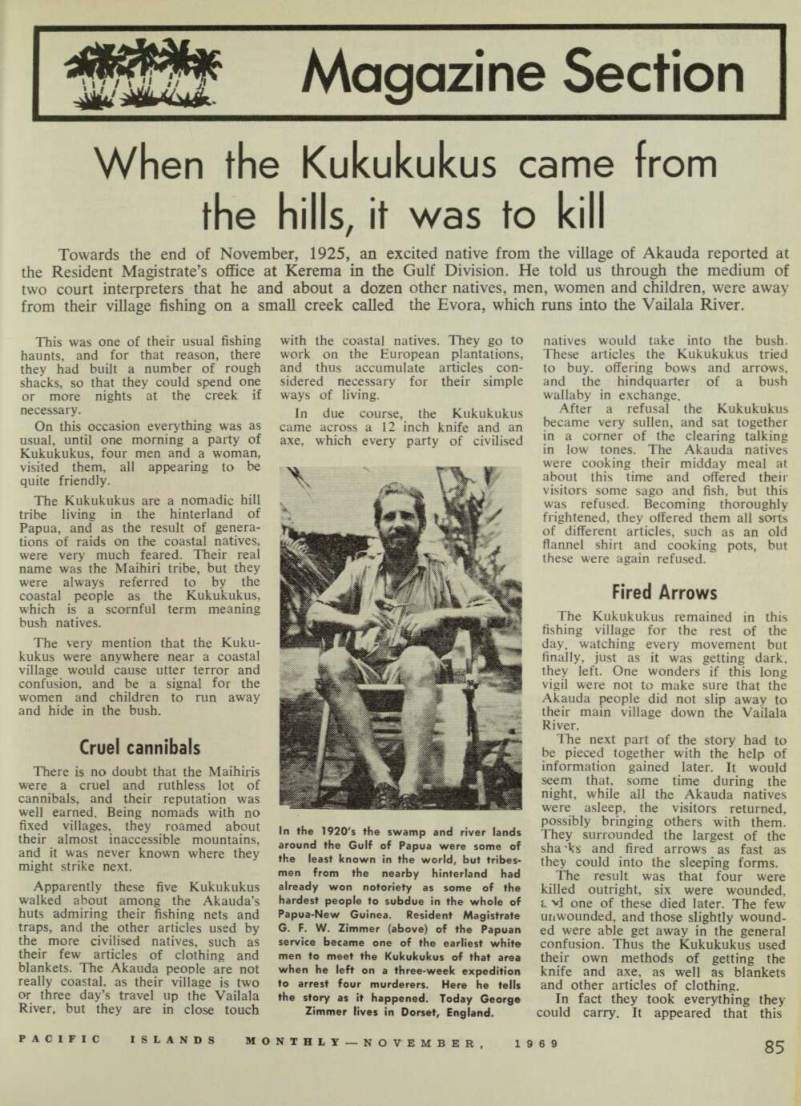
In the 1920's the swamp and river lands around the Gulf of Papua were some of the least known in the world, but tribes men from the nearby hinterland had already won notoriety as some of the hardest people to subdue in the whole of Papua-New Guinea. Resident Magistrate G. F. W. Zimmer (above) of the Papuan service became one of the earliest white men to meet the Kukukukus of that area when he left on a three-week expedition to arrest four murderers. Here he tells the story as it happened. Today George Zimmer lives in Dorset, England.
Hacked off leg
raiding party had not been a big one, and their complete success was due to surprise. This is borne out by the fact that they were unable to carry away a whole body of one of their victims, and had to satisfy them selves with hacking off one leg.
That was the story we received.
The Akauda natives were, of course, unable to give us the names of the raiders, or any information where they came from beyond the fact that they came out of the bush. The only fortunate circumstances were that several men who were in the Akauda party were unwounded, and the visitors had remained so long at the fishing village, that these unwounded men would be able to recognise the raiders if we could round them up.
Into mountains
Arrangements were made for a government party to leave at once.
It was then the first week in Dec ember, and it was hoped that we might be able to get back by Christ mas. It was decided that two Euro pean officers should go with a strong police party. It was also realised that it was going to be a stiff patrol if we had to penetrate far into the mountains. My friend, Capt. W. H.
Halford Thompson, was also at Kerema at this time as Assistant Resident Magistrate, so it was decided that he and I should go together.
It is hard to express how much I appreciated having a second Euro pean officer with me, I have always felt that the government was wrong to send officers single-handed on these
long patrols into unknown country. It is often necessary to post guards at night, when in hostile or at least unsettled country, and at least one European should be awake.
It is even more important that when travelling in new country, a responsible man should be placed at the rear as well as at the head of the column. An attack is more likely to develop from the rear in the hope of picking off a straggler, and a carrier might have to fall out when a quick decision would have to be made. But the greatest boon is having someone with whom to discuss plans.
The patrol left the Government Station of Kerema on December 8; besides the two European officers we had Sgt. Gubiam, Cpl. Kisau and 10 armed constables. In addition there were 60 carriers to handle the tents, flies, food, etc., as it was known that there would be no native food avail able once we had left the coast. When leaving Kerema for the west it is necessary to cross a strip of water more than a mile wide. This was done in the station whaleboat, and a large double cargo canoe.
On the far side of the stretch of water village constables from the nearby villages had the carriers waiting, and loads were soon made up. Carriers, whenever possible, prefer to carry in pairs, two boys carrying about 80 pounds, with the load lashed to a pole.
When we reached the Vailala we had to get a number of large canoes to transport the party up the river; I instructed the two village constables from two large Vailala villages, one on each bank at the mouth of the river, to supply four large double canoes together with 50 paddlers who would later become carriers, all to
be ready by first light. In the mean time, an armed constable and an interpreter were sent up the rtver in advance to the mouth of the Lohiki Creek, to obtain more information about the Akauda raid, and also to secure guides to take us into the Maihiri country.
On the morning of the 10th, the party left as arranged in the canoes, but the river was in heavy flood and progress very slow in spite of having 12 paddlers to each canoe. I can well remember how Thompson and I whiled away the long hours of this stage of our travels by playing piquet. We had had a light roof built over our canoe, and were thus sheltered from either rain or sun, but this occasion it was mostly rain that we had to contend with. We reached the village of Akauda on the second day.
Village constable Wa r a was married to a Kukukuku woman, and knew a little of their language. He was able to give me the names of four raiders, and also the village from which they came. This so called village, as we found later, only consisted of four or five sketchy gardens each with a round beehive form of house in the centre.
Our party left Akauda soon after sunrise, and as the flood in the river had dropped a good deal, progress was better. We arrived at Lohiki Creek, and made camp in the village rest house, and reorganised our loads for the trip up the Lohiki, and the final stretch overland. A certain amount of rice and other food for the police and carriers was left here for the return trip.
Heavy rains
We left Lohiki village in three double canoes and continued up the creek all day. Progress was very slow and it was evident that there had been heavy rains in the foothills during the night causing a strong current. In addition, we struck the first rapids within two miles of the mouth of the creek. Camp was made early to get all stores under cover before the evening rains came down.
We made an early start next morning only to find that the rapids were becoming more difficult to negotiate. It now took the combined crews of two canoes to pull one canoe through, using long lengths of lawyer vine, which is very plentiful in the jungle, where there is a heavy rainfall.
The surrounding hills were now becoming very steep, with the creek running through perpendicular walls of limestone. It took some time at the end of the day to find a piece of
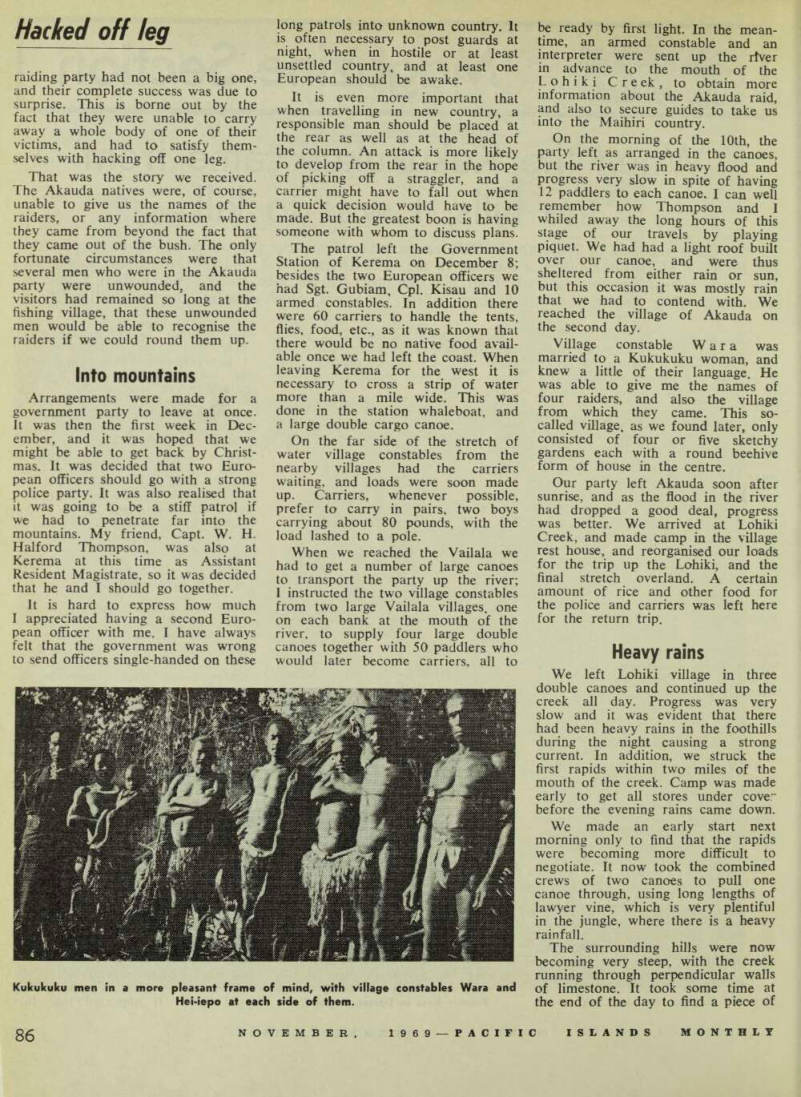
Kukukuku men in a more pleasant frame of mind, with village constables Wara and Hei-iepo at each side of them.
ground flat enough to build the camp.
Next morning after two hours hard struggling we reached 1-0 Creek, only a small mountain torrent, but the point where we were to leave our canoes and turn inland over the mountains. The canoes were un loaded and pulled up on a convenient sand spit made by the junction of the two creeks. Loads were made up for carrying, but the country was now so rough that each boy had to carry individually and not in pairs as on the coast.
We followed this new track east, and after climbing up and down several spurs, we finally camped at 5 o’clock at the highest point reached so far. We were now on a much used track. This spur was only just wide enough to allow the tents and flies to be pitched in a line on its summit.
Exhausted
Fortunately good water was near at hand as the carriers were ex hausted. How they managed to carry 40 lbs and the few odds and ends they need for themselves in this country beats me, as it took me all my time to get myself along using both hands and feet.
While camp was being made, a Kukukuku was heard shouting. Our guides, after listening for a time, said he was only calling his dog. Ap parently he was not aware that we had entered his country. Sentries were posted as soon as it was dark.
At daylight next morning, Village Constable Wara, and two Lohiki boys were sent out with a 16 inch knife as a present to Hobo, the head man of the Papekawa Kukukukus, and with instructions to try to get in touch with a party who appeared to be in the next creek.
The rest of our party left camp at 7.30. After travelling for about an hour, we reached the top of another spur where we heard much shouting and yelling which we took to be the Kukukukus greeting our guides.
The track now descended very steeply into Savcia Creek, and as we descended the shouting sounded nearer. When we got to the creek bed the shouting seemed to be very near, but they were still out of sight.
I called to Wara to bring the Kukukukus to where we were in the creek bed, to which he called back that the Kukukukus were too frightened to come down, and wanted me to come up to where they were.
I climbed up to a small shelter about 50 feet above the creek, on the far bank from the one we had
descended, and was very much surprised to find only two Kukukukus and my three boys. The excitement grew intense as we approached, and the noise ever greater, if that were possible. How these two had been able to make so much noise between them I do not know.
The first thing I noticed was the tremendous amount of betel nut that had been chewed. At the spot where they had spat the red juice, it really looked as though someone had been seriously injured and had bled profusely. Wara and his two boys must have worked very hard to keep these Kukukukus from running away.
As each member of my party came near, Wara seemed to be going through some form of introduction.
At Wara’s suggestion, I only brought up about a dozen of my party to let the two Kukukukus get used to us first. When the rest of the main party came up, I noticed that the two bush men recognised quite a few of the Lohiki carriers, and went through some form of greeting, embracing them by putting their arms round their shoulders When Capt. Thompson, the last member of our party approached, one of the two Kukukukus fainted, and had to be held up by Wara and the other Kukukuku.
It is hard to say what was the reason for this faint. It might have been Thompson’s height. He is a
good six feet, and was wearing a double-decker felt hat, which made him look even taller, whereas the Kukukukus are very short, few even reaching five feet.
Perhaps it was the size of our party, which must have numbered over 70, but most likely it was the excitement and the excessive chewing of betel nut. I had noticed that this wild betel nut was very potent judging from the effect it had on my police boys, who usually became excessively stupid after chewing it.
However, the faint did not last long. I soon learned that there were two women and two children in the party when first met by Wara, and that they had been on their way to Lohiki Creek. The women and child ren had been sent back to the garden village of Karauwe, and, from what these two Kukukukus told us, all the other members of the tribe from this area were also there. These two offered to conduct us to their village.
Kukukuku guides
After a short rest to allow our visitors to get used to us, we started off with them acting as guides, and crossed some of the worst country I’ve ever seen. Frequently there ap peared to be no track at all: the guides seemed to be taking short cuts and striking the track at inter vals. It was very noticeable the
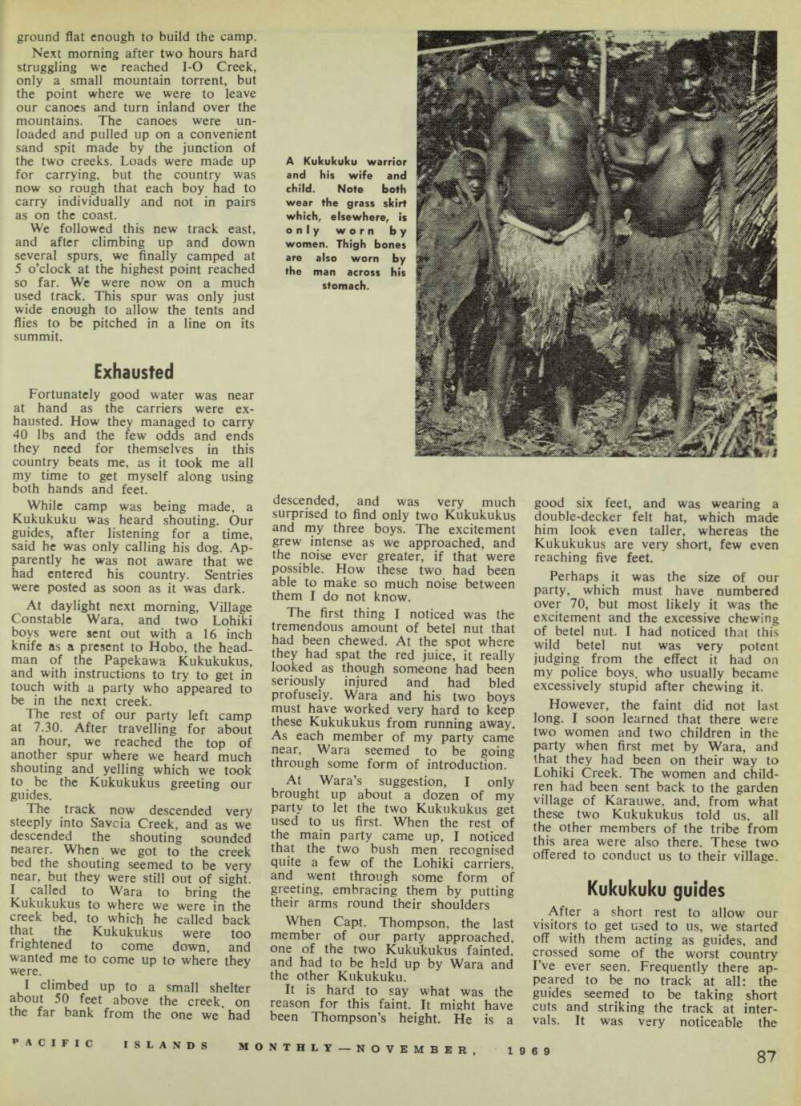
A Kukukuku warrior and his wife and child. Note both wear the grass skirt which, elsewhere, is
only worn by
women. Thigh bones are also worn by the man across his stomach.
Terrific chests
interest two Kukukukus took in the size of our party, never failing to stop and watch them wind their way up a slope.
By means of signs, our two guides asked if they could use two of the 16 inch knives to help to cut the track, handing over bows and arrows as security. They helped us all the way to Karauwe and seemed to enjoy themselves thoroughly, behaving more like children with a new toy and cutting much more than was neces sary. These big knives are extremely rare among these wild hill people, and these were probably the biggest knives they had ever seen.
After crossing an upper reach of the Lohiki, which was now very wide and shallow, and appeared to be nothing but a series of rapids, the guides led us up a spur on the right bank. After climbing up another 600 feet and crossing this spur we descended into the inevitable creek, where we met a third Kukukuku, a middle-aged man who was unarmed and undoubtedly unaware of our approach.
Beehive house
He joined our guides reluctantly and was obviously very nervous.
After climbing again we reached the first garden, in the middle of which was a house, a round, beehive with the roof extending to within two feet of the ground, making it neces sary for anyone to go on his hands and knees to enter.
From this ridge the village of Karauwe appeared to be about a mile away across more creeks and spurs. We reached a second garden at noon and as this seemed to be about the centre of these gardens, I decided to camp there.
While our camp was being erected, Village Constable Wara and our later guides went off to bring in the local natives, and to tell them that we were in need of food. This is always a useful way of getting into touch with natives, whether one actually needs food or not, and it is the only sound excuse for giving them small presents. We had with us beads, salt, mirrors, lengths of scarlet cloth and other trade articles for this purpose.
As mentioned before, this people are short but hardly down to the pigmy class; few reach five feet in height, but are strongly built with broad deep chests and tremendous thighs. These terrific hills would develop anyone’s legs and chest. Their most noticeable characteristic is that
both the men and the women wear grass skirts, the men’s skirts being thicker and heavier than those worn by the women.
The wearing of the grass skirt by women is the general rule in Papua, but I know of no other part of the territory where men also wear them.
The only reason I can give is that they are worn for warmth, for it gets very cold in these hills during the night and early morning, and as the jungle is very dense one seldom sees the sun.
Another characteristic of these people is the wearing of the “tappa cloth” hood. Worn by men, women and children, they are seldom seen without it. I think it is also worn for warmth and is a great protec tion from the rain. I never thought to inquire if they slept in them, but 1 should think they most certainly do.
As soap and washing are quite unknown, most of these hoods smell very foul. I was able to buy a new hood and was surprised to find how thick and strong it was and I would imagine that it would wear for years. This tappa cloth is the inner bark of a tree quite common in most parts of Papua, and when first taken off the tree is quite soft and pliable.
Another point of interest is the two thigh bones worn round the waist by some of the men. If I could say that these were human bones, as one might expect, it would be more dramatic, but I must admit that the pair of bones I was able to purchase, and which I later had examined by one of the medical profession, were identified as the bones of the cassowary. Personally, I should not be surprised to hear that human bones are also used.
Nervous visitors
During the afternoon, a number of men, women and children came into camp bringing bananas (which were actually cooked plantains), sugar cane, and a few sweet-potatoes, for which they were given coloured beads and salt, both items being very popular.
These visitors were nervous but obviously wanted to be friends.
Their approach was heralded by much shouting on both sides, our few words of the local language being very much overworked. My boys would call out “Borki”, “Borki”, (come, come), to be answered by “Pelu Kau”, “Pelu Kau”, (don’t shoot). Pelu being the word for an arrow, and Kau meaning No or Not.
Nearly all the men who came into the camp were unarmed. Those who had bows and arrows were diplo matically relieved of their arms, and
we tried to infer that it was not good form to bring bows and arrows into a government camp. The bows were unstrung and heaped together round a bush, where it would have taken some time to sort them out and get them into action. The men were greeted by the police and the Lohiki boys, many of whom knew them.
Several of the Akauda boys, who were present on the Evora Creek before and during the raid, had been brought along. They mixed with the carriers for the purpose of identifica tion, and during the afternoon they recognised three of the four wanted murderers. I decided to wait until the following day before making any arrests on the off chance that the fourth raider would come into camp.
A number of men, women and children slept in the garden house within five yards of our tents. They were given a feed of rice, which my boys had cooked for them. This was tackled very cautiously but finally they cleaned it up.
By 5 o’clock next day another new party came into camp, and my Akauda boys became very excited when they recognised the fourth raider. By this time we had 14 men,
Peculiar to the Kukukukus is the wearing of the "tappa" cloth hood made from the inner bark of a tree: it provides both warmth and protection from the rain in the high mountains.
Panic in village
19 women and a considerable number of children in camp, in cluding the four men we wanted.
One of the men, named Bebe, who, in fact, was the leader of the raiders, had been getting very restless and suspicious during the last hour. He had made three attempts to slip away, and the police had tactfully tried to make him sit down, so it seemed advisable to make the arrests without further delay before there was a general stampede into the bush.
To do this we had all the men brought to the tent occupied by Thompson and myself. I told them that I wanted to talk to them. Before hand, two police had been assigned to stand near each wanted man.
Village Constable Wara, as has been stated before, was married to a Kukukuku woman; so he had a working knowledge of the language, and he was used as an interpreter.
Arrests made
Through him it was explained that the government did not allow any natives to raid and kill other natives, and that the four men who had killed the Akauda people would have to go to Kerema with the police.
The police were then given the signal to arrest the four men.
This was not accomplished without a struggle. The sergeant and the corporal as well as the other police all had to help before the handcuffs were securely fastened. It was clear that they knew why they were being arrested, as they called out Bebe’s name, and kept on saying “Kau, Kau” (no, no).
The native Bebe struggled very violently. The Akauda boys however, were very sure of their identifica tion, and had had plently of time to watch the Kukukukus walking about the camp.
As can be imagined, there was general pandemonium in the camp following the arrests, but after a time the others were pacified, and we again explained why these men were being taken away, and we reiterated that if there were any more killings the same thing would happen again.
One of the Kukukukus, who had not taken part in the raid, explained through Wara that he had been to the oil fields at Upoia on the Vailala River in the early days, and no doubt considered himself a travelled man.
Upoia was first opened up about 1912, but had not been in operation for a number of years. Anyway, this man informed us that part of Pupu’s body (one of the murdered Akauda
boys) had been eaten by the raiders on their way back to the village.
He also explained which parts of the human body were usually eaten, and which parts thrown away. He was very emphatic that only the arms and legs were considered good eating, and insisted that the head was thrown away, This is probably true as I have never seen or heard of a smoked human head being found among these people, but it is quite possible that, under certain circumstances, the skulls might be kept. Our informant then went on to tell us how strips of flesh were cut from the limbs, placed in sections of bamboo and roasted over the fire.
He also told us that the axe and knife taken from the Akauda natives were in one of the bush shelters, They were collected and handed back
to the Akauda natives, as we could hardly allow these bush people to retain articles obtained in this way.
He also said that Bebe had done all the killing, but it was too much to expect us to believe that one native had killed four and wounded six others. However there is no doubt he was the instigator and ringleader.
Thompson and I took it in turns to share the guard with the police, and, to make sure the prisoners did not escape, we put on legirons as well as handcuffs. I don’t think many of us slept much during that night, and all were up before the first streak of dawn.
It was just after 6 a.m. when the party left for the return trip. The prisoners were handcuffed in pairs, and walked just in front of me with three good police boys to guard them. There was much wailing and calling from the surrounding gardens and bushes as we left, although we could not see a soul. This was quite eerie in the cold mist of the early morning. Calls seemed to come from all points of the compass, some of them even in front of us.
The track followed was the one
on which we came into the area. At one point just after we left the gardens, the track was barred with broken boughs, and lawyer vines were tied between the trees and across the path, which according to Hei-iepo indicated that the Kuku kukus were going to fight. Naturally a close look out was kept as the country was ideal for an ambush, especially when we were crossing some of the creek beds, However, all went well, and if there had been any serious thought of trying to rescue the prisoners it seems that they had not had time enough to organise an attempt, It was soon evident that the return journey was going to be more difficult than the trip up stream owing to the tremendous pull of the current, over heavy canoes and the rapids.
At 3.45 the boys looking after the
canoe in which Thompson and I were travelling lost control. In spite of two stern lines to which they were hanging on, the canoe swung broadside to the stream and crashed against two huge boulders.
One canoe of the pair broke as though it were an egg shell. This canoe sank and the deck tilted over at an acute angle. Nothing was actually lost but several bags of rice got very wet. Bebe and his com panion in handcuffs took this op portunity to try to escape, but they did not get more than a few yards before two of the police were after them.
Second disaster
At about 4 o’clock when passing the last of the rapids we had our second disaster. Again it was the canoe in which Thompson and I were travelling, and again the boys were not able to hang on to the stern lines, and much the same thing happened.
One canoe of the pair was com pletely smashed and filled up im mediately. Six bags of rice were soaked, and my haversack containing
These happy families don't look dangerous, but when they are in the mood for war they are confirmed cannibals. Note the round, beehive-shaped house which has an entrance so low that anyone wishing to enter it has to go in on his hands and knees.
my compass, keys, notes of the patrol and many small personal items were lost overboard, never to be recovered.
This was extremely bad luck as we were now within two miles of Lohiki village. We transferred the prisoners and as much of the personal gear as possible to the double canoe, and left Sgt. Gubiam to lash the undamaged canoe to the one he had repaired the previous day, making a second double canoe out of the two singles. The main party reached Lohiki at 5.30 and Sgt. Gubiam arrived just after dark.
The coastal natives were tre mendously excited at the sight of our four Kukukukus. The vast majority of them had never seen one before and to them the word Kuku kuku was an overpowering threat and a nightmare.
The Kukukukus, being mountain people, made very heavy weather of walking along the flat sands and could only travel slowly, and seemed all in when we reached the rest house. Although we had not actually travelled far from their village to the hills, the coastal conditions were very different.
The temperature was much higher and the air was laden with moisture and salt from the sea. December being the middle of the north west season and the hottest weather, the heat was considerable. The Kuku kukus still wore their grass skirts and hoods, which must have made con ditions much worse.
Year's hard labour
Next morning we were off again on the last lap. reaching the Govern ment Station of Kerema at sundown.
Travelling had been very unpleasant to start with, as the tide being fully in, made it necessary to walk on the soft sand above the high water mark, which our prisoners found very trying.
The four prisoners were brought before the magistrate’s court and statements were taken from the witnesses, with the result that all four were committed for trial at the next sitting of the criminal court.
They were in due course sentenced to one year’s hard labour.
Not one of them was able to complete his sentence, which must seem light enough to most readers. It is often found that the change of conditions and food causes these hill people to pine away and die. This, of course, has to be avoided if possible. It is not very difficult to feed them on their usual type of food, but the heat and the confinement is too much for them.
No doubt it is like catching a wild
bird and putting it into a cage: it invariably dies.
The comparatively light sentence may seem out of all proportion to the crime but these people were only carrying out customs familiar to them for generations, and could see nothing wrong with their actions.
The period of imprisonment makes them lose their fear of the government, and realise in fact that the government is their friend, and is out to help them to improve their lot, and will protect them from being raided by the less civilised people living even further inland.
This system has been called “peace ful penetration”, and is the method by which the whole of Papua, now under control, has been brought to that state.