Shell Money And Cannibal
pp. 97-99 · Read in the full issue
Bowls In This Museum
From a Honiara correspondent
When the new Solomon Islands Museum was opened in June, a dream of many Honiara residents became a reality at last thanks to a generous gift of $12,500 from the Calouste Gulbenkian Foundation.
For years a section of the com munity in the Solomons has been anxious that old customs and crafts should not die unrecorded, and al though many objects had been col lected, no permanent home could be found for them.
Before 1952, objects collected by touring officers were housed in the Germond library. This was a small building which originally contained a collection of books.
The building stood in the grounds of Government House, and Mr. Geoff Dennis, honorary curator of the small collection, did much to keep the ex hibit in repair.
Later the building fell to pieces, and the collection was moved from one government department to an other, until it ended up at the British Solomons Training College in 1959.
There were additions to the collec tion over the years, but lack of proper storage space precluded any real efforts to build up and catalogue the exhibits, and if some of the arti facts in the collection were not to fall into disrepair, or even to disintegrate altogether, more suitable premises were needed.
Solomons-style house
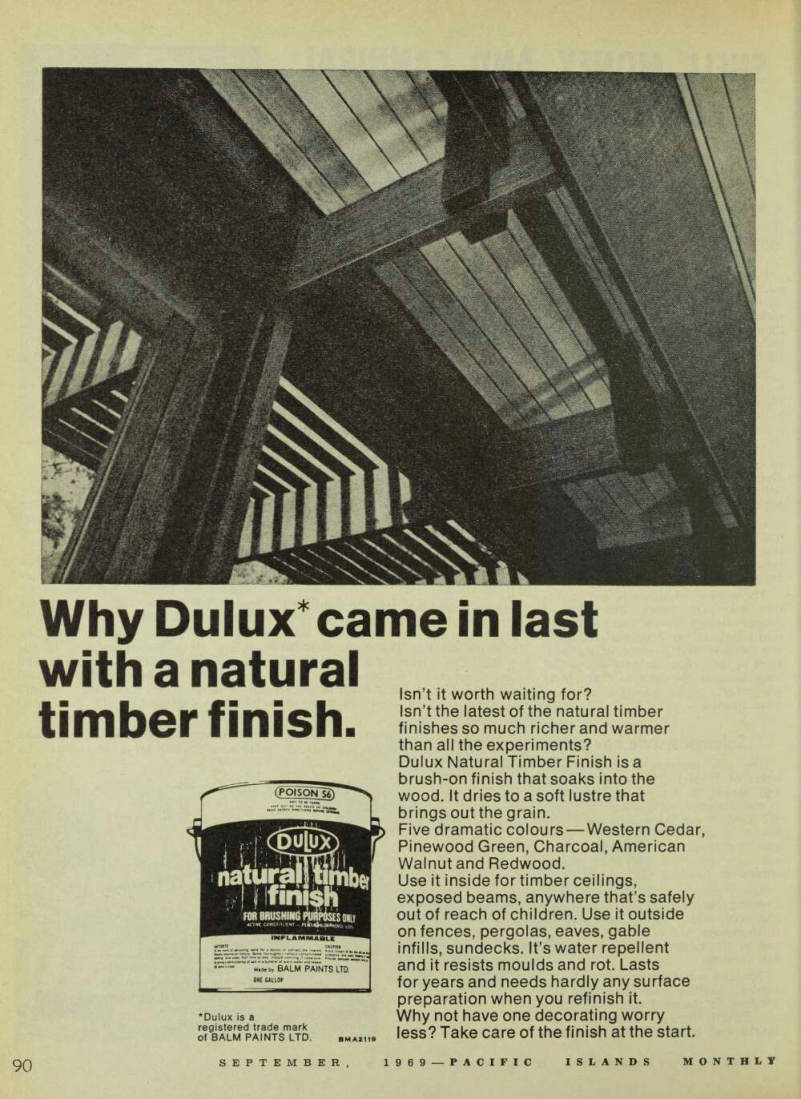
The new museum is in the main street of Honiara, Mendana Avenue, and stands in Coronation Gardens.
It was designed by architect Mr. Don Woolard to suggest a Solomon Island house in permanent materials, and this it manages to do, despite large pillarbox red doors with their shining chromium handles.
The museum, built by John Lee Constructions Ltd., has a traditional leaf roof, which blends well with its surroundings, and is decorated at each end of the ridge with stylish wooden fish carvings.
The end walls incorporated locally woven bamboo screens, and the window on the road side has a frieze of carved figures, featuring both sharks and humans. This was given
to the museum by Mr. Geoff Dennis, who believes it came from an old custom house on South Malaita.
In the museum garden stands a Japanese field gun, discovered by a geological field party, near the Lungga River, and strategically placed there to fire on Henderson Field.
Nearby is a totem pole illustrating a more personal fight. Two brothers from Santa Ana, in the Eastern Solomons, decided they would turn themselves into sharks—according to a traditional story.
One did so, but the other changed his mind. The shark brother swore angrily that he would eat his human brother should he ever venture into the sea. One day the human brother went for a swim—the pole, about six feet tall, shows him being swallowed by the shark.
Once inside the museum, the first thing to strike the eye is a large relief map of the Solomons hung from the ceiling. The map, prepared by Mr. Les Tickel and the boys of King George VI School, Honiara, is invaluable for helping the visitor to trace the place of origin of many of the exhibits.
A rare collection is of shell money from different parts of the Islands,
accompanied by notes on the lengthy process of making it. Making money could scarcely be more laborious, and it is not surprising that the practice has fallen into disuse.
There are some fine, ancient speci mens of red and black shell money threaded on strings, and also a col lection of bracelet-like shell money made from chunks of fossilised shell.
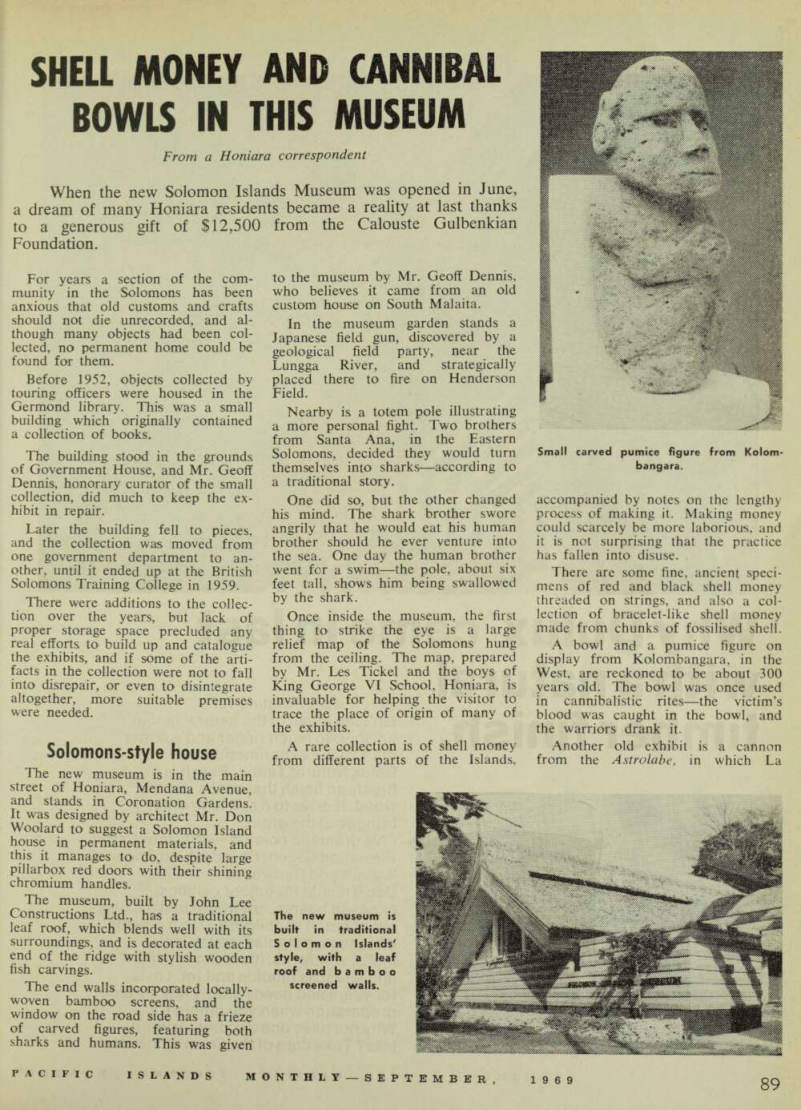
A bowl and a pumice figure on display from Kolombangara, in the West, are reckoned to be about 300 years old. The bowl was once used in cannibalistic rites—the victim’s blood was caught in the bowl, and the warriors drank it.
Another old exhibit is a cannon from the Astrolabe, in which La
The new museum is built in traditional Solomon Islands' style, with a leaf roof and bamboo screened walls.
Small carved pumice figure from Kolom bangara.
Perouse was wrecked off Vanikoro in 1788. But the oldest exhibit of all is a basalt rock sample from Santa Ysabel, which radio-activity tests have found to be 66 million years old.
Fishing and war weapons are on show and on one wall is a collection of water colours by Mr. Les Tickel, illustrating the various kinds of tattoing done in Bellona.
Not only does this fascinating display include water colours of the Bellona Islanders (Polynesians) covered in traditional tattoing, but there are also details of the different designs used, and their origins.
Honiara Town Council is responsible for administering the museum, through a committee employing a part-time curator, Mr. Ray Wraight, and a caretaker. The committee is anxious that the museum shall not become merely a warehouse of in animate objects, though initially, of course, the emphasis is on collecting as many examples of ancient Solo mons culture as possible.
Relics will return
It was galling in the old days for enthusiasts to see collectors from abroad carrying off ancient relics for their own museums. It is now hoped that some of these will be returned, or at least lent to the museum in Honiara.
A collection of wooden bowls, col lected in the Solomons by the Phila delphia Museum in America, is back in its original home, and negotiations are in hand with Melbourne Museum for the gift or loan of some fine Solomons exhibits on display there.
Recently interest was shown by Moro of Makaruka (Guadalcanal), a well-known “custom man”, who visited the museum. Explaining that it was “custom” to present gifts be fore entering a new “custom house”, Moro gave a length of shell money, a pig and a quantity of vegetables to the curator before he would go inside.
When he entered he took a great interest in the exhibits, and it is hoped that his visit will encourage other Solomon Islanders to take an interest in their museum, and in building up its collection.
A way will have to be found to raise money for improvements and extensions. There is no entrance charge and at the moment a collecting box on the wall, seldom noticed by the visitor, is the only source of in come from the public.
The committee is hoping to raise money by bringing out an illustrated brochure about the museum, to be sold locally and abroad.