Trust Fund Gives A Full
pp. 99-101 · Read in the full issue
Century Of Trouble
By MERVAL HO ARE, in Norfolk Island
A trust fund, originally set up in 1852 for the benefit of Pit cairn Islanders, has been the subject of friction between Norfolk Islanders and the authorities for over a century. The fund was trans ferred to Norfolk in 1869 —and has just marked its centenary.
The original Norfolk Island Trust fund comprised of money for the Pitcairn Islanders, then still living on Pitcairn, money derived from the sale of cattle and sheep, furniture and other public property on Norfolk Island, and from the sale of land to the Melanesian Mission.
In 1852 the fund amounted to £5,500 and was placed under the control of three trustees appointed by the British Secretary of State for the Colonies.
Since those days the Norfolk Islanders have taken a keen interest in the fund and, from time to time, complained about its management.
When the trust deed was signed in 1869, the money was invested in New South Wales Government stock.
"No claim"
When the island became Common wealth Territory in 1914 the invest ments were transferred to the Com monwealth Government. It was clearly stated in the trust fund that the islanders would have no claim on the fund —to which they had not contributed—and the “whole of the said moneys shall continue to be the property of Her Majesty to be dis posed of as Her Majesty thinks fit”.
By 1926 the fund had become a cause of friction between the people and the authorities. At a public meet ing in that year, a resolution was passed that “there is reason to sup pose that the Norfolk Island Trust fund proper has not been, for some years, dealt with in the terms of the trust deed”.
Commissioner Francis Whysall visited the island in the same year and reported that while it was doubt ful whether the trust deed was bind ing on the Commonwealth, it was un questionable that the original funds had been applied for the general benefit of the Pitcairn Islanders and their descendants, and that the terms of the trust deed, in this respect, had been adhered to.
A trust fund report was usually in cluded in the annual report of the ad ministrators but in the early 1950’s
disappeared. When the people petitioned the Queen in 1955, the accompanying letter contained a strong complaint about the adminis tration of the fund and plea for its restoration.
“The trusteeship was allowed to lapse, the fund itself palpably mis accounted and drawn upon ever since, and ourselves taxed by ordi nance to provide for expenditure over which we have no control. We pray Your Majesty to restore to us our trust fund,” said the plea.
At a 1965 council meeting it was asked what had happened to the fund and at a following meeting the Ad ministrator, the Hon. Roger Nott, quoted extracts from the trust deed and Commissioner Whysall’s findings.
Mr. Nott said the fund was now known as the Norfolk Island Ad ministration Account and over the years the original fund had been gradually absorbed in island expenses, from which all the people had bene fited.
Interest then lapsed for some time but in recent years people have again begun to wonder what has happened to their historic, century old trust fund.
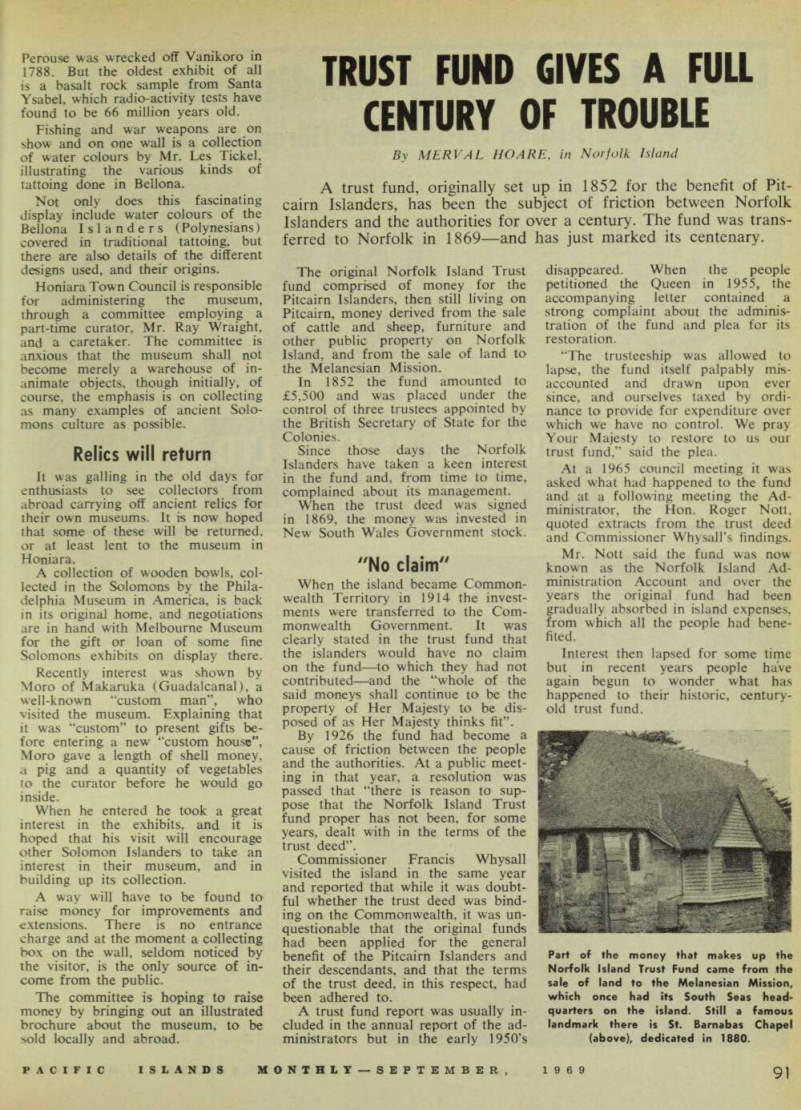
Part of the money that makes up the Norfolk Island Trust Fund came from the sale of land to the Melanesian Mission, which once had its South Seas head quarters on the island. Still a famous landmark there is St. Barnabas Chapel (above), dedicated in 1880.
PIM reported in September, 1949, that under pressure from the “mischief-making” United Nations, the Dutch apparently had “surrendered” to the Indonesians. We commented: “They are now going to allow these people to have an equal, if not a dominant voice, in the future Government of the large archipelagos between Australia and Asia.”
We said: “Dutch interests —which naturally do not like what they see developing in the East Indies —are making a strong effort to keep Dutch New Guinea (the western half of the great island of New Guinea) out of the new set-up, so that the Indonesians can have no voice in the control of Dutch New Guinea —in the future of which Australia and Oceania generally are vitally concerned.
“United States interests, proccupied with the problem of the future of Japan (where the population is increasing by nearly two million a year) are inclined to support the proposition that Dutch New Guinea should be thrown open to colonisation by surplus
Japanese.”
Among other items of that issue 20 years ago: During a 10 week’s cruise, NZ navy frigate Pukaki investigated a new volcanic cone that had more than doubled in size tiny Matthew Island, 200 miles east of New Cale donia in September, 1949. It had been reported by the British Phos phate Commission’s ship, Triona.
Previously a volcanic cone, about 30 acres in extent, Matthew Island was now accompanied by a second cone, thrown up alongside the first, making the whole island the shape of an hour-glass and about 1,200 yards by 800 yards wide.
Sterling had been de-valued about 30 per cent, in relation to the United States dollar. Australian, NZ and Fiji currencies remained in the same relation to Sterling, and there fore automatically were reduced in terms of Dollars.
Two Japanese walked into the government post at Saidor, northern New Guinea, after having lived among the natives of that area for five years without being discovered.
The natives sheltered them and never once mentioned their presence to government officers who patrolled the area regularly.
It was officially announced by Queen Salote, of Tonga, that the Kingdom’s Premier since 1941, the Hon. Ata, QBE, was to retire.
New Caledonia was finding it a costly matter to repatriate its South Asiatic labour in September, 1949.
Contracts expired in the war and post-war periods. But not only had births in the colony increased the number of those needing repatriation, but the cost of passage since 1939 had gone up from 750 francs to 5.000 francs.
When a Fiji-born Indian wrote to the Press objecting to a widespread adoption of Indian “titles” by various local Indians, “although the Indian leaders in India have discarded their British titles,” he said, “Indians in Fiji must be on their guard against fancy foreign titles and slogans.”
Besides being the first time an Indian had called anything Indian “foreign”, this started a discussion in which it was pointed out that Indians in Fiji universally demand the English courtesy title of “Mr.” although this was “absolutely” foreign to them.
In September, 1949. although it was four years since the war ended.
Yesterday
persons desiring to travel to the Ter ritory of Papua-New Guinea still needed a “Permit to Enter”, and had to submit to one of the cumber some, time-wasting controls which bureaucrats loved to devise during the war period, and which they “surrendered with manifest reluc tance”. Today, 20 years later, you still need a “Permit to Enter”.
It was a hectic day in the Pitcairn Island’s little Post Office on August 1, 1949. On that day was released a special issue of postage stamps, commemorating the silver wedding of the King and Queen.
About 1,000 letters posted in Fiji went into the sea during August when a Dakota of the RNZAF, on a flight from Nausori Airport to Auckland, developed engine trouble, jettisoned the mail, and limped home back to Nausori on one engine.
Newcastle (NSW) Methodists observed August 12, 1949, as “Fuzzy Wuzzy Day”. Buttons were sold in the streets and donations sought to the fund for rehabilitating Methodist work in Papua-New Guinea.
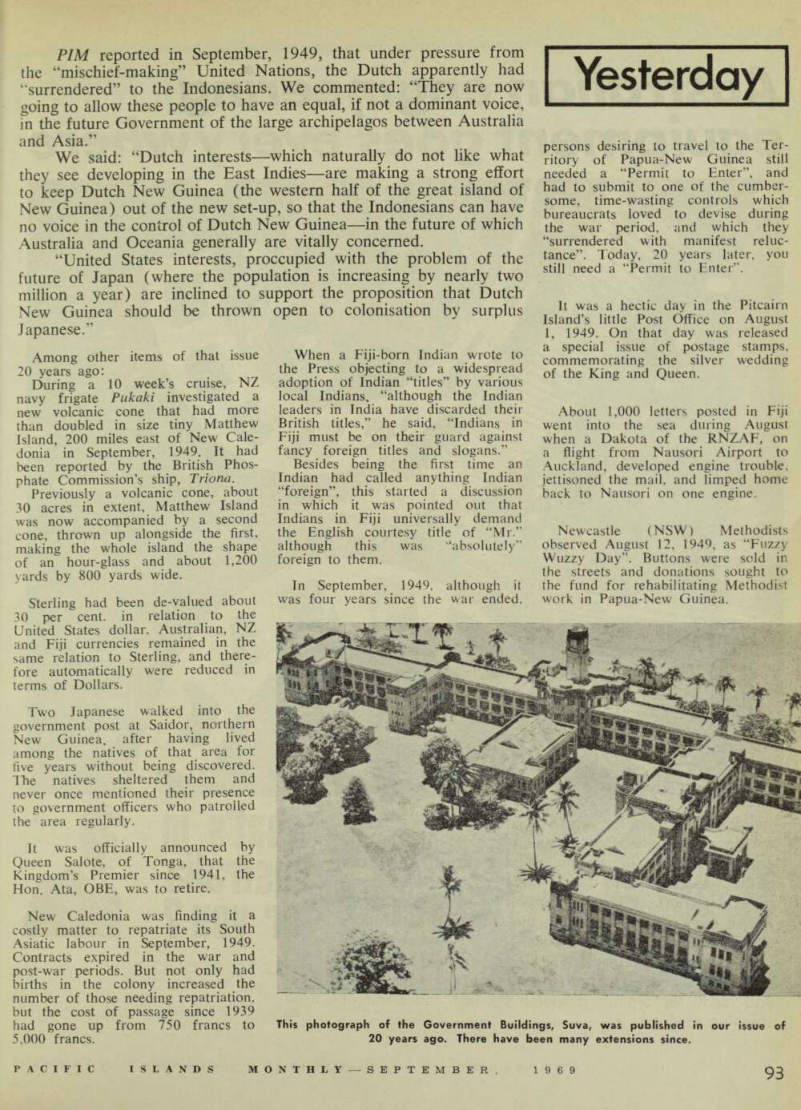
This photograph of the Government Buildings, Suva, was published in our issue of 20 years ago. There have been many extensions since.