End in sight for Vila's "Musical Chairs"
p. 95 · Read in the full issue
By Robert Langdon
General Franco’s announcement in late July that Prince Juan Carlos, of Bourbon, is to be the next King of Spain will have important repercussions in—of all places!—the Anglo-French Condominium of the New Hebrides.
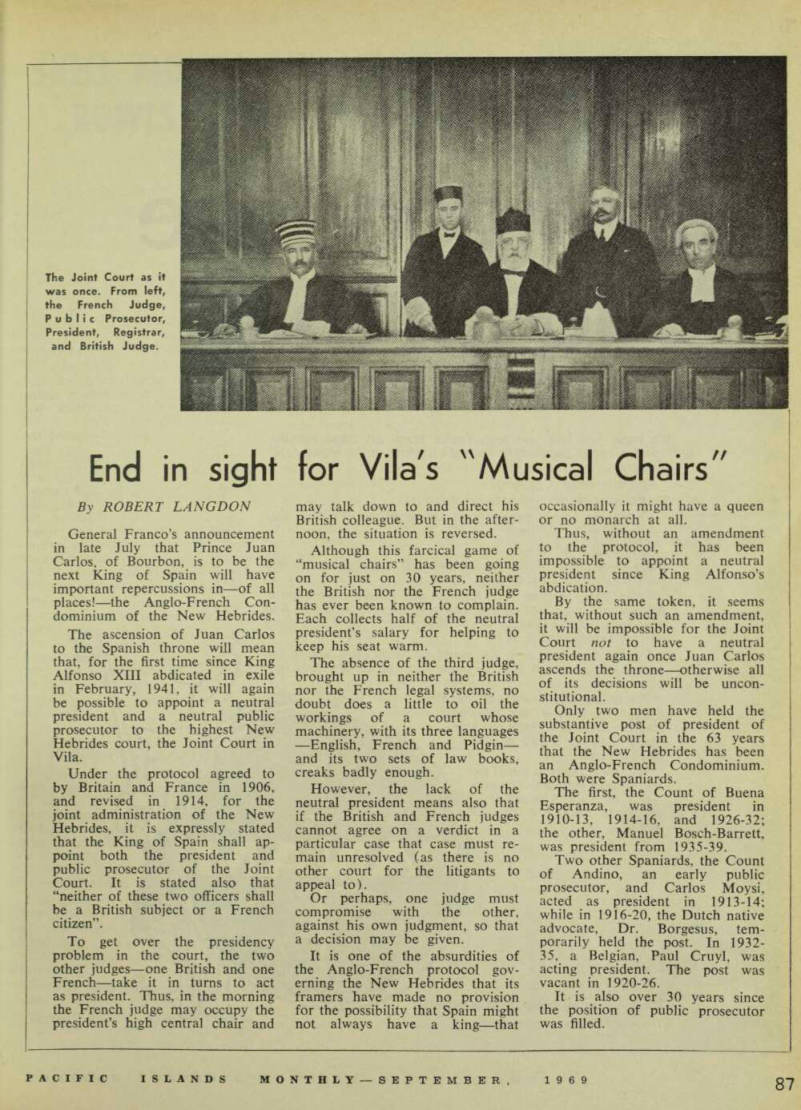
The ascension of Juan Carlos to the Spanish throne will mean that, for the first time since King Alfonso XIII abdicated in exile in February, 1941, it will again be possible to appoint a neutral president and a neutral public prosecutor to the highest New Hebrides court, the Joint Court in Under the protocol agreed to by Britain and France m 1906, and revised in 1914, for the joint administration of the New Hebrides, it is expressly stated that the King of Spam snail appoint both the president and public prosecutor of the Joint Court. It is stated also that neither of these two officers shall be a British subject or a French Cltizen • To get over the presidency problem in the court, the two other judges—one British and one French—take it in turns to act as president. Thus, in the morning the French judge may occupy the president’s high central chair and
may talk down to and direct his British colleague. But in the afternoon, the situation is reversed.
Although this farcical game of “musical chairs” has been going on f or j us t on 30 years, neither t h e British nor the French judge has ever been known to complain.
Each collects half of the neutral president’s salary for helping to keep his seat warm.
The absence of the third judge, brought up in neither the British nor The French legal systems, no doubt does a little to oil the workings of a court whose machinery, with its three languages -English French and PidgincMksVdTy enough' b °° kS ’
However, the lack of the neutral president means also that if the British and French judges cannot agree on a verdict in a particular case that case must remain unresolved (as there is no other court for the litigants to appeal to).
Or perhaps, one judge must compromise with the other, against his own judgment, so that a decision may be given.
It is one of the absurdities of the Anglo-French protocol governing the New Hebrides that its framers have made no provision for the possibility that Spain might not always have a king—that
occasionally it might have a queen or no monarch at all.
Thus, without an amendment to the protocol, it has been impossible to appoint a neutral president since King Alfonso’s abdication.
By the same token, it seems that, without such an amendment, j* Wlll be impossible for the Joint Court not to have a neutral “ f ce ?f
n"i„ u^a
‘I
& has S
The first, the Count of Buena Esperanza * was president in 1910-13 1914-16 and 1926-32the other, Manuel Bosch-Barrett!
W as president from 1935-39 Two other Spaniards, the Count G f Andino, an early public prosecutor, and Carlos Moysi, acted as president in 1913-14; while in 1916-20, the Dutch native advocate, Dr. Borgesus, tem porarily held the post. In 1932- 35, a Belgian, Paul Cruyl, was acting president. The post was vacant in 1920-26.
It is also over 30 years since the position of public prosecutor was filled.
The Joint Court as it was once. From left, the French Judge, Public Prosecutor, President, Registrar, and British Judge.