Magazine Section
pp. 93-94 · Read in the full issue
The ghost of Yamamoto still lingers in the Bougainville jungle
Pictures and story by BRUCE ADAMS.
Our guide stopped and pointed
to a small clump of bushes. We hurried over and where he had pointed was part of a wing of an
aircraft, still recognisable, but
covered with green moss. We carefully scraped the moss away and underneath we saw the faded red paint of the Japanese em blem.
We left this “find” and pushed on further, knowing that we were only a few hundred yards from the main wreckage.
I was searching for Yamamoto’s aircraft, shot down in this vicinity 26 years ago.
The morning of April 18, 1943, two J apanese Mitsubishi Betty bombers were flying low over the jungle-clad island of Bougainville, They were making for the big Japanese airfield at Kahili when they were suddenly pounced on by American Lockheed Lightnings.
In less than five minutes, three escorting Zeroes and two Betty bombers had been shot down for the loss of one American plane.
To observers on the ground it would have looked like just another aerial battle between opposing air forces.
But one Betty held more than just the crew. The Commander-in-Chief of the Japanese Combined Fleet, Admiral Isoroku Yamamoto and his staff were on board.
Man behind Pearl Harbour
Isoroku Yamamoto, the man who planned the Pearl Harbour attack and the Midway Battle one of the greatest naval strategists of his time and founder of the Japanese carrier forces—met his death 200 ft above the jungle of Bougainville because American intelligence managed to break the Japanese naval code.
They intercepted a message that Admiral Yamamoto and his staff
would be making a front line tour of inspection of the Bougainville area and they would be flying from Rabaul to Kahili on a specified date.
The Americans had special long range fuel tanks flown to them, and 16 American Lockheed Lightnings took off from Henderson Field, Guadalcanal, and flew 400 miles over water to be in exact position 30 miles east from Kahili Airfield shortly after 9.15 a.m., April 18, 1943.
Yamamoto was 10 minutes flying time from Kahili when the Americans struck. The other Betty carried Yamamoto’s Chief-of-Staff, Admiral Matomi Ugaki, and his staff.
Although shot down at the same time, Admiral Ugaki and his staff, badly injured, were rescued by Japanese patrol boats shortly after they had crashed into the ocean.
Yamamoto’s plane, after the hit, caught fire, blowing one wing off and then plummeted into the jungle, to explode on impact.
There were no survivors from his aircraft. When rescuers reached the aircraft only two people could be identified. One was Yamamoto and the other Admiral Takata. The rest were charred bodies beyond recog nition. Later it was established Yamamoto was dead before the plane crashed into the jungle—he had been shot through the head and shoulder.
Ashes in Japan
His body was cremated on Bougain ville and his ashes taken back to Japan. But his crashed aircraft still remained in the jungle. That all happened 26 years ago.
Last month I set out to try and locate the crashed aircraft which had become part of the Yamamoto Legend.
My first call was at Port Moresby where I talked to Bill Chapman of the war museum. Bill told me of the wreck and where it was roughly
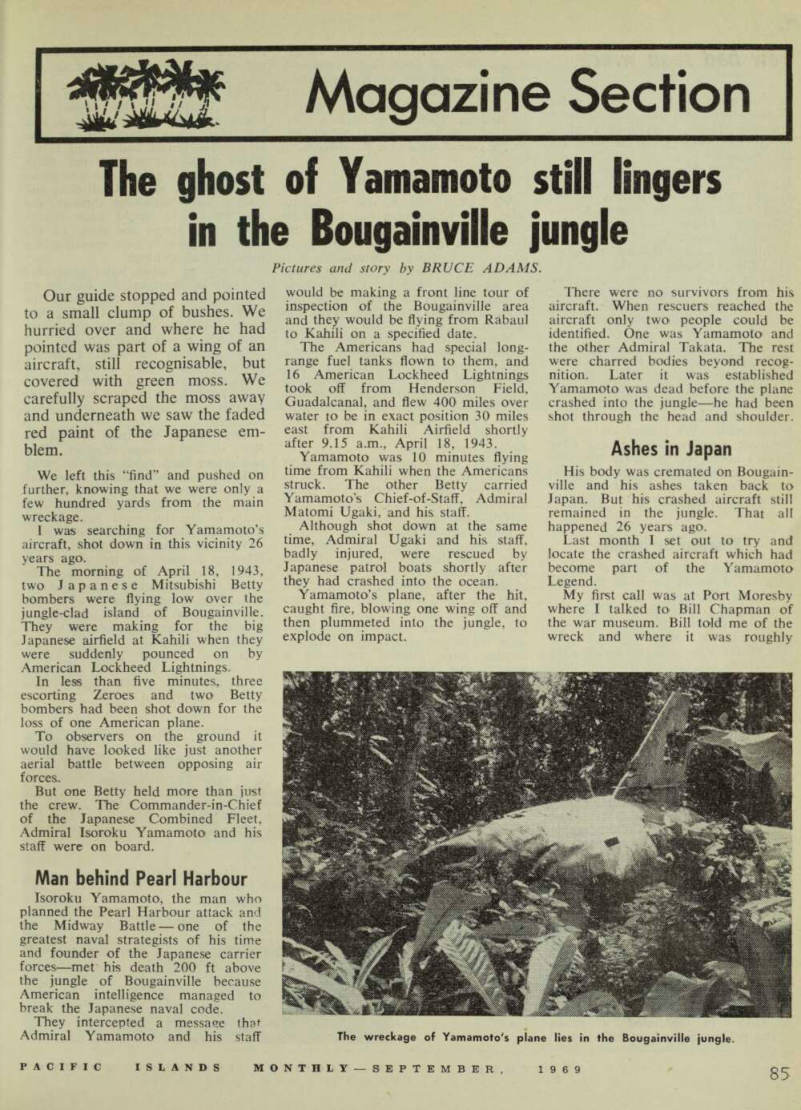
The wreckage of Yamamoto's plane lies in the Bougainville jungle.
Few had seen wreck
situated outside Buin on Bougainville.
He then produced one of the control columns from Yamamoto’s plane which had been given to him for the museum.
From Port Moresby I flew to Lae where 1 was told that the other control column was owned by the “183 Independent Helicopter Recon naissance Flight” of the Pacific Islands Regiment.
I then flew on to Rabaul and spoke to Father Church of the Catholic Mission at Kokopo, a few miles from Rabaul. Father Church had walked in to the aircraft a few months pre viously and had souvenired the identification plate. As far as I could tell, Yamamoto’s aircraft was spread throughout the Pacific, a piece here, a piece there. But very few people had seen the actual wreck in the jungle.
Two days later I flew to Buin on Bougainville. We landed on an old Japanese wartime airstrip and from there I could see the small township a few miles away. Several miles from there is Kahili airstrip—the one Yamamoto was flying to when he was shot down.
Scarred by bombs
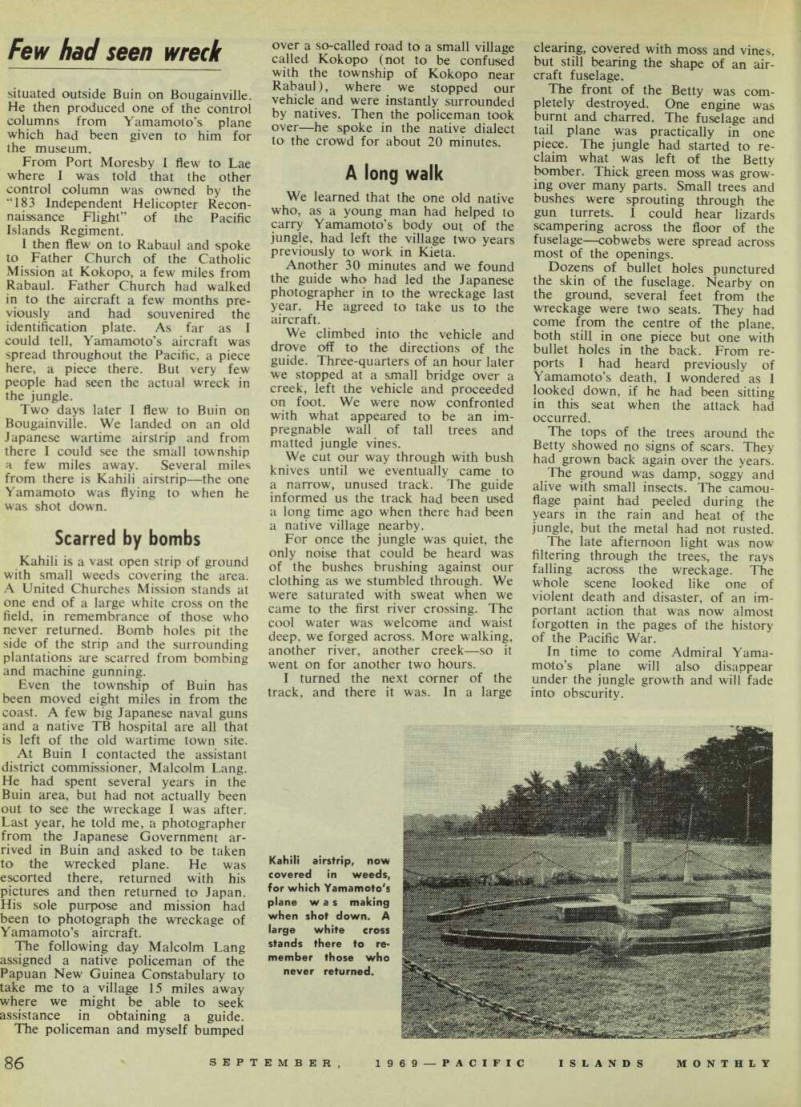
Kahili is a vast open strip of ground with small weeds covering the area.
A United Churches Mission stands at one end of a large white cross on the field, in remembrance of those who never returned. Bomb holes pit the side of the strip and the surrounding plantations are scarred from bombing and machine gunning.
Even the township of Buin has been moved eight miles in from the coast. A few big Japanese naval guns and a native TB hospital are all that is left of the old wartime town site.
At Buin I contacted the assistant district commissioner, Malcolm Lang.
He had spent several years in the Buin area, but had not actually been out to see the wreckage I was after.
Last year, he told me, a photographer from the Japanese Government ar rived in Buin and asked to be taken to the wrecked plane. He was escorted there, returned with his pictures and then returned to Japan.
His sole purpose and mission had been to photograph the wreckage of Yamamoto’s aircraft. pie following day Malcolm Lang assigned a native policeman of the Papuan New Guinea Constabulary to take me to a village 15 miles away where we might be able to seek assistance in obtaining a guide.
The policeman and myself bumped
over a so-called road to a small village called Kokopo (not to be confused with the township of Kokopo near Rabaul), where we stopped our vehicle and were instantly surrounded by natives. Then the policeman took over—he spoke in the native dialect to the crowd for about 20 minutes.
A long walk
We learned that the one old native who, as a young man had helped to carry Yamamoto’s body out of the jungle, had left the village two years previously to work in Kieta.
Another 30 minutes and we found the guide who had led the Japanese photographer in to the wreckage last year. He agreed to take us to the aircraft.
We climbed into the vehicle and drove off to the directions of the guide. Three-quarters of an hour later we stopped at a small bridge over a creek, left the vehicle and proceeded on foot. We were now confronted with what appeared to be an im pregnable wall of tall trees and matted jungle vines.
We cut our way through with bush knives until we eventually came to a narrow, unused track. The guide informed us the track had been used a long time ago when there had been a native village nearby.
For once the jungle was quiet, the only noise that could be heard was of the bushes brushing against our clothing as we stumbled through. We were saturated with sweat when we came to the first river crossing. The cool water was welcome and waist deep, we forged across. More walking, another river, another creek—so it went on for another two hours.
I turned the next corner of the track, and there it was. In a large
clearing, covered with moss and vines, but still bearing the shape of an air
craft fuselage.
The front of the Betty was com pletely destroyed. One engine was burnt and charred. The fuselage and tail plane was practically in one piece. The jungle had started to re claim what was left of the Betty bomber. Thick green moss was grow ing over many parts. Small trees and bushes were sprouting through the gun turrets. 1 could hear lizards scampering across the floor of the fuselage—cobwebs were spread across most of the openings.
Dozens of bullet holes punctured the skin of the fuselage. Nearby on the ground, several feet from the wreckage were two seats. They had come from the centre of the plane, both still in one piece but one with bullet holes in the back. From re ports 1 had heard previously of Yamamoto’s death, I wondered as 1 looked down, if he had been sitting in this seat when the attack had occurred.
The tops of the trees around the Betty showed no signs of scars. They had grown back again over the years.
The ground was damp, soggy and alive with small insects. The camou flage paint had peeled during the years in the rain and heat of the jungle, but the metal had not rusted.
The late afternoon light was now filtering through the trees, the rays falling across the wreckage. The whole scene looked like one of violent death and disaster, of an im portant action that was now almost forgotten in the pages of the history of the Pacific War.
In time to come Admiral Yama moto’s plane will also disappear under the jungle growth and will fade into obscurity.
Kahili airstrip, now covered in weeds, for which Yamamoto's
plane was making
when shot down. A large white cross stands there to re member those who never returned.