To the Point
pp. 73-77 · Read in the full issue

Process Doesn't Mean Replacement
Of White Kiaps With Brown Kiaps
Those readers of PIM who think more highly of me as a missionary than as a politician can cheer up. My brief foray into politics will end in 1972, and I can’t do too much harm between now and then. As for my career as a columnist, perhaps that had better be wound up straight away if I can’t make myself clearer than I seem to have done to one Goroka reader. (See Editor’s Mailbag, July
Pim).
When I let off a light-hearted crack about the possibility of the coastal areas developing an export trade in kiaps to the Highlands, I was, of course, thinking of white kiaps. God forbid that I should encourage any young Papuan to become a kiap, either for local consumption or for export.
This does not mean that I am anti-kiap. The kiap way was, and in diminishing areas still is, the only way in which the situation which had to be handled could be handled.
And with the odd exception here and there the kiaps have done a good job, many of them a superlatively good job.
The high standard of devotion to duty and the personal qualities of the kiaps have been acclaimed in more re cent books on Niugini, including the most recent one of all, John Ryan’s The Hot Land.
However, the time is surely ap proaching, if it has not already arrived, when a start should be made in phasing out the system of adminis tration represented by the word “kiap”.
The old-style kiap—and one of them who retired recently has re vealed that he was attracted to the career by seeing a film version of “Sanders of the River”—had to com bine physical stamina with mental agility. He had to be, as the occasion demanded, administrator, welfare officer, adviser, police officer and magistrate. His frequent changes of hat were confusing to those over whom he exercised authority, and sometimes perhaps to himself.
Brown kiaps
The worst thing that could happen to this country would be that progress towards self-government, and in par ticular progress in the “localisation” of the Public Service, should consist of the replacement of white kiaps by brown kiaps.
As I have said, the job had to be done the kiap way to get it done
To the Point with Percy Chatterton
at all. But we don’t have to go on doing it that way. We can, at least, spare Niuginians from having to engage in sleight-of-hand with hats; and they can be spared the temptation to arrogance which the kiap type of authority engenders. Dare I say that not all European kiaps have resisted the temptation to arrogance? Perhaps even fewer Niuginian ones would do so. u , .
Kiap IS government
tt , • • . .. , h 0f
nHefn f° °i, J. AT™’
It hai hppn thn onvnii ? *« at tlme
!lmi„ h" SoC i m ;
the rnnlrtrltu rtf vt‘ n - ■ CCaSe that the majority of Niuginians continue to talk about “the government” when they mean “the administration”. To them the kiap is the government.
The pattern is changing slowly at the national level, and still more slowly at the local level. One can but hope that one of the developments of the 1970 s will be the progressiye assumption of control of administration by government at all levels, so that the officers of the Public Service will be the servants, not the masters, of the new nation.
Most of us, I think, will hope this, though not perhaps the top business executive who was recently reported
as having said that “democracy had reared its ugly head in Bougainville”, Perhaps even more important and urgent than this is the separation of the magistracy from the administra tion.
For this reason I repeat: God forbid that I should persuade any young Papuan to become a kiap. I will gladly persuade them to train as local court magistrates, as police officers, as welfare officers, as local government advisers, clerks or en gineers (working either under the newly-formed Department of Social Development and Home Affairs, or better still as members of a separate local government service); and as administrative officers too, so long as the t h administrative nffirers ‘A " e ticks of afhffade “ and not ,acks of alHrade ' t*. . n i •. mUST aitord It If anyone says we can’t afford this separation of functions I think the answer is that we can’t afford not to afford it.
And now to get a few records straight. I have not lived in Port Moresby for 50 years, or for 40, or even for 30. As a matter of fact, 50 yeas ago I was sitting in a barn in Northern France waiting to be sent home from a war which I had been told was “the war to end war” to a
Suburbia overtook Hanuabada
country which I had been told was going to become “a land fit for heroes to live in”.
For 18 of my 45 years in Papua I lived in the Yule Island area, and some of my former pupils are prob ably to be found among those locals who, with the help of my old friend and former neighbour, Ron Slaughter, are trying to establish a crayfish in dustry there.
As for Hanuabada, that much vilified village, I left it in 1939, and have been only an occasional visitor to it since. My ex-pupils there are all in their 40’s and 50’s. Indeed, some of them who left my school in the 1920 s are now retiring on ex-gratia pensions from the jobs I sent them to 40 years ago.
The hard way
Although I have lived in only three locations, all in the Central District, I have travelled fairly extensively in all the Papuan districts except the Southern Highlands and the Northern District, and have done it the hard way —by launch, canoe and on foot.
My visits to New Guinea have been more superficial, but 1 have at least seen the main centres in seven of its districts. I have not been as town bound as some people seem to think.
And now let’s get the record straight on Hanuabada.
The people of Hanuabada were virile enough in their day. They were virile enough to wring a subsistence, and a surplus for feasts, from their barren, stony hillsides, from the bush, and from the sea.
They were virile enough to build some of the best dwelling houses to be found in pre-contact Papua, in spite of the fact that they had to go a considerable distance for some of their building material.
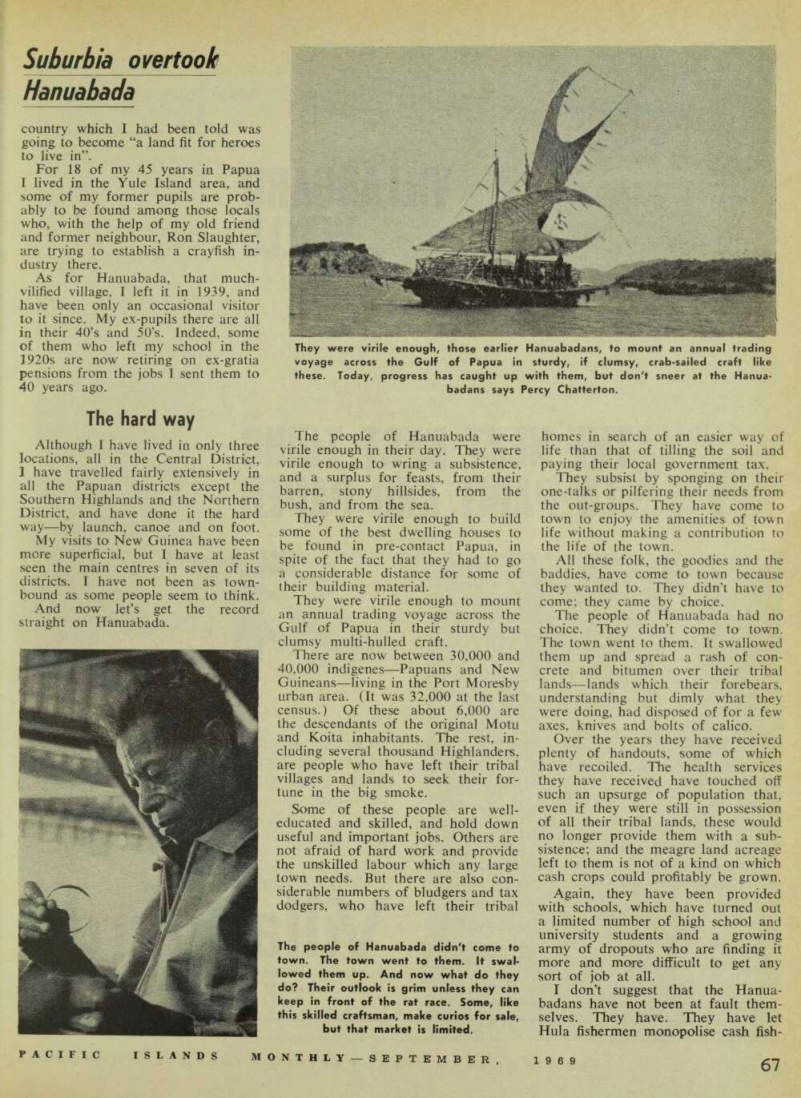
They were virile enough to mount an annual trading voyage across the Gulf of Papua in their sturdy but clumsy multi-hulled craft.
There are now between 30,000 and 40,000 indigenes—Papuans and New Guineans—living in the Port Moresby urban area. (It was 32,000 at the last census.) Of these about 6,000 are the descendants of the original Motu and Koita inhabitants. The rest, in cluding several thousand Highlanders, are people who have left their tribal villages and lands to seek their for tune in the big smoke.
Some of these people are well educated and skilled, and hold down useful and important jobs. Others are not afraid of hard work and provide the unskilled labour which any large town needs. But there are also con siderable numbers of bludgers and tax dodgers, who have left their tribal
homes in search of an easier way of life than that of tilling the soil and paying their local government tax.
They subsist by sponging on their one-talks or pilfering their needs from the out-groups. They have come to town to enjoy the amenities of town life without making a contribution to the life of the town.
All these folk, the goodies and the baddies, have come to town because they wanted to. They didn’t have to come; they came by choice.
The people of Hanuabada had no choice. They didn’t come to town.
The town went to them. It swallowed them up and spread a rash of con crete and bitumen over their tribal lands—lands which their forebears, understanding but dimly what they were doing, had disposed of for a few axes, knives and bolts of calico.
Over the years they have received plenty of handouts, some of which have recoiled. The health services they have received have touched off such an upsurge of population that, even if they were still in possession of all their tribal lands, these would no longer provide them with a sub sistence; and the meagre land acreage left to them is not of a kind on which cash crops could profitably be grown.
Again, they have been provided with schools, which have turned out a limited number of high school and university students and a growing army of dropouts who are finding it more and more difficult to get any sort of job at all.
I don’t suggest that the Hanua badans have not been at fault them selves. They have. They have let Hula fishermen monopolise cash fish-
The people of Hanuabada didn't come to town. The town went to them. It swal lowed them up. And now what do they do? Their outlook is grim unless they can keep in front of the rat race. Some, like this skilled craftsman, make curios for sale, but that market is limited.
They were virile enough, those earlier Hanuabadans, to mount an annual trading voyage across the Gulf of Papua in sturdy, if clumsy, crab-sailed craft like these. Today, progress has caught up with them, but don't sneer at the Hanua badans says Percy Chatterton.
How to solve Hanuabada's problem?
ing, and Highlanders, Goilalas and others supply the unskilled labour market. Even before the war they were letting Goaribaris provide the port’s wharf labour, while most of the town’s cooks were from Suau.
But let those whose own noses are clean sneer at the Hanuabadans, not those who are advocating the im portation of Indian labour to do the jobs that their own locals are un willing to take on.
When I contemplate the Hanua bada of today and compare it with the Hanuabada I once knew I am reminded of a poem by Queensland’s aboriginal poet, Kath Walker.
Gumtree in the city street, Hard bitumen around your feet Rather you should be In the cool world of leafy forest halls And wild bird calls.
Here you seem to me Like that poor cart-horse Castrated, broken, a thing wronged, Srapped and buckled, its hell pro longed,
Whose hung head and listless mien express Its hopelessness.
Municipal gum, it is dolorous To see you thus Set in your black grass of bitumen — O fellow citizen, What have they done to us?
A new generation of Hanuabadans may well say, “What have they done to us?” Unless they can keep to the front in the educational rat race, their outlook is fairly grim.
The manufacture and sale of arti facts and curios is providing an income for some, and the quality as well as the quantity of the goods offered for sale is rising. But this market is limited.
Fishing for the local market might provide an outlet for some, and re settlement for cash cropping for others. But both these channels would involve extensive re-education to correct the slant given to their
thinking by an academic type primary
schooling.
Here the former vocational schools, now given a new look as “vocational centres” and improving all the time, can make an important contribution.
We need more of them, and perhaps longer courses. And if they are to
make a substantial contribution to solving the problem of Hanuabada and the urban problem generally some of them must be boarding centres out in the country.
These are the kind of problems which are now to be tossed to the newly - established Department of Social Development and Home Affairs. Circumstances surrounding its establishment have given the cynics a field day, and it does seem unfortunate that the House of Assembly is never taken into the ad ministration’s confidence beforehand when major changes of this kind are contemplated. They always seem to come out of the blue when the House is in recess.
However, let’s be optimistic, and give even Mr. Barnes the benefit of the doubt. But one thing’s for sure: if the new department is to achieve any worth-while results it will need to be provided with pretty substantial funds.
Will it get them, or will it be given the task of making bricks without straw? By the time the September PIM appears the P-NG budget will have been brought down, and we shall know the answer to this question—for the current financial year at any rate.