Fiji food supply
p. 71 · Read in the full issue
Starfish is threat to Fiji food supply
From SUE WENDT in Fiji
Fiji hasn’t yet come up with any organisation to rival Queens land’s “Save the Barrier Reef” movement, but an increasing number of people are concerned about the future of Fiji’s fish-rich reefs.
Businessmen, government officials and Peace Corps workers met in Suva on August 5 to discuss the value of the coral reefs and the dangers of their over-exploitation.
The Crown of Thorns starfish reared its ugly head in discussion— but local authorities are still look ing to places like Australia, where the Barrier Reef is threatened, to show the way in tackling the problem.
Like Queensland’s Barrier Reef, the colourful platforms of living coral polyp in Fiji are an enormous attraction, as well as being prolific breeding and feeding grounds for an astonishing variety of fish. Without them, at least half a dozen cruise vessels in Suva would find them selves with nowheie to go and noth ing to do.
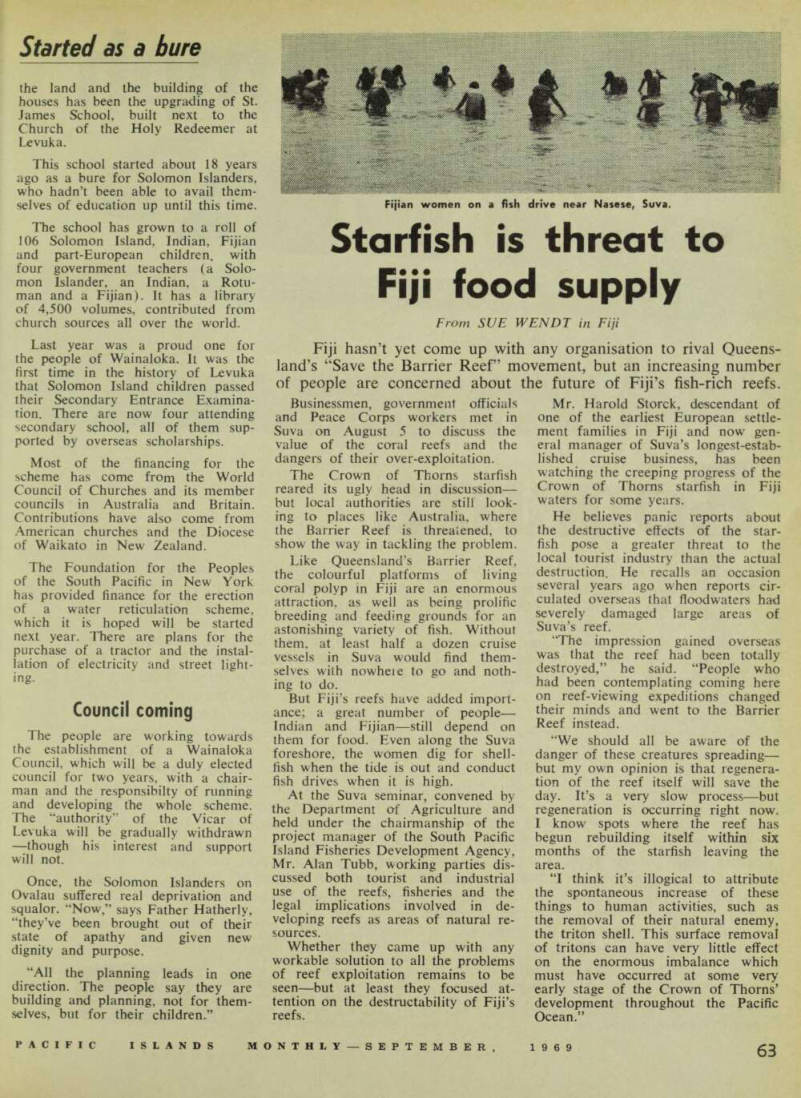
But Fiji’s reefs have added import ance; a great number of people— Indian and Fijian—still depend on them for food. Even along the Suva foreshore, the women dig for shell fish when the tide is out and conduct fish drives when it is high.
At the Suva seminar, convened by the Department of Agriculture and held under the chairmanship of the project manager of the South Pacific Island Fisheries Development Agency, Mr. Alan Tubb, working parties dis cussed both tourist and industrial use of the reefs, fisheries and the legal implications involved in de veloping reefs as areas of natural re sources.
Whether they came up with any workable solution to all the problems of reef exploitation remains to be seen—but at least they focused at tention on the destructability of Fiji’s reefs.
Mr. Harold Storck, descendant of one of the earliest European settle ment families in Fiji and now gen eral manager of Suva’s longest-estab lished cruise business, has been watching the creeping progress of the Crown of Thorns starfish in Fiji waters for some years.
He believes panic reports about the destructive effects of the star fish pose a greater threat to the local tourist industry than the actual destruction. He recalls an occasion several years ago when reports cir culated overseas that floodwaters had severely damaged large areas of Suva’s reef.
“The impression gained overseas was that the reef had been totally destroyed,” he said. “People who had been contemplating coming here on reef-viewing expeditions changed their minds and went to the Barrier Reef instead.
“We should all be aware of the danger of these creatures spreading— but my own opinion is that regenera tion of the reef itself will save the day. It’s a very slow process—but regeneration is occurring right now.
I know spots where the reef has begun rebuilding itself within six months of the starfish leaving the area.
“I think it’s illogical to attribute the spontaneous increase of these things to human activities, such as the removal of their natural enemy, the triton shell. This surface removal of tritons can have very little effect on the enormous imbalance which must have occurred at some very early stage of the Crown of Thorns’ development throughout the Pacific Ocean.”
Fijian women on a fish drive near Nasese, Suva.