Place Called
pp. 69-71 · Read in the full issue

Paradise Is A
Wainaloka
From SUE WENDT, in Suva
When the Reverend Brian Hatherly, Vicar of Levuka, goes about his business on the island of Ovalau, he drives a Land Rover with the words ‘Tui Lomalagi” adhered to its dashboard. Roughly translated, the words mean “King of Paradise”.
The explanation is found at Waina loka, a neat cottage settlement on the coast road between Bureta Air strip and Levuka.
Its occupants are Solomon Island ers, descendants of those who were “blackbirded” to Fiji last century to work on the cotton and early sugar plantations. They call their settle ment “Lomalagi”—for it represents new land, new houses and a new life.
Resettlment of Ovalau’s Solomon Islanders on the 465-acre freehold site called Wainaloka became Father Hatherly’s “baby” when he moved to Ovalau five and a half years ago.
Thick with bush
“When we started clearing the land three years ago, it was thick with bush. We had to hack our way through 15 ft high guavas with cane knives,” recalls the Australian-born minister, who is now deputy chair man of the Levuka Township Board and probation officer for the island.
“To date, 26 houses have been completed and the 27th is under construction. Eventually, 35 families —totalling some 260 people—will have a home and 13 acres of land each.”
The plight of the Solomon Island ers in Fiji, most of whom are still illiterate, has concerned the Anglican
Church ever since 1870, when the Reverend (later Archdeacon) William Floyd arrived in Levuka to minister to the European population.
“With the introduction of inden tured labour from India, the ‘black birded’ Islanders were thrown to the wilds,” explained Father Hatherly.
“When the Rev. Floyd arrived, he gathered them together around the second church built at Levuka. When this was blown down in a hurricane, land was secured for them 500 feet up the hill, behind the destroyed church. They eked out a precarious living there for the next 60 odd years “The situation became very grave in 1965, when the original lease was due to expire. With no prospect of further land, an offer was made to the church of two pieces of free hold land, one at Lovoni and the other at Wainaloka.”
Wainaloka was the eventual choice and in 1966 the Inter Church Aid of the World Council of Churches pro mised support for the resettlement of these evictees, both in purchasing the land and building new houses.
With this encouragement and financial assistance, the Islanders— “all hard workers,” says Father Hatherly—have been the first to help themselves.
Having cleared the tropical scrub, they’ve planted subsistence crops,
dug drains and built their weather board houses, each with its fresh coat of paint and clean, neat interior.
Each house is 24 ft by 16 ft with an attached 10 ft by 8 ft kitchen, containing a concrete smokeless stove.
Each has a water-sealed pedestal privy.
“It’s intended that 103 acres will be planted under Caribbean Pine— in 20 years, this should give a security to each family of $2,000 per acre,” said Father Hatherly.
“We’ve a thriving trial plot of pine already and 60 acres have been planted with subsistence crops.
“One of the men has begun making takias (outriggers) and has just launched his first. He hopes to be able to sell these commercially, probably for the tourist trade.”
Others have begun cattle trading* and there are over 25 head at pre sent —as well as innumerable goats, pigs and fowls.
Building roads
Ahead lies the task of reconstruct ing driveways, digging more drains, building bridges across creeks, con structing feeder roads and culverts (one mile of access road was built in 13 hours) and replanting the co conut plantation portion.
“And, of course, there’s the in evitable church building,” smiles Father Hatherly. “This building will be the task of the people. For the time being we make do with the old homestead, which is in a sad state of decay,”
Together with the development of
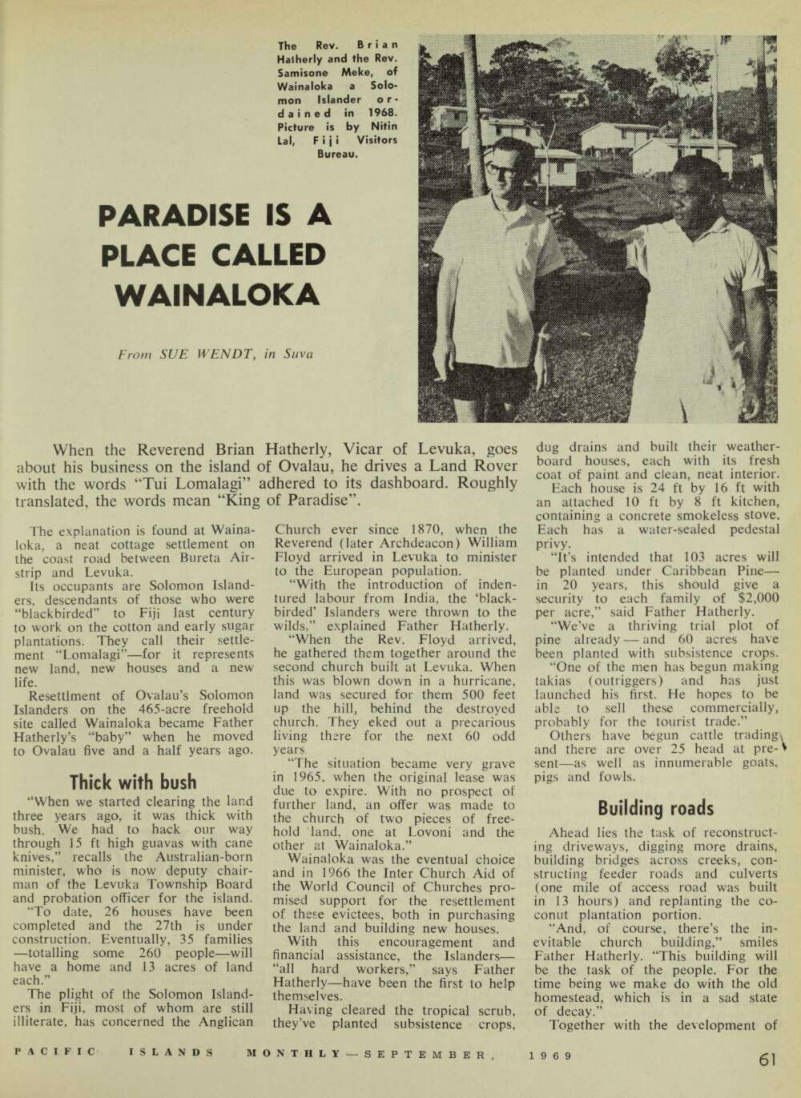
The Rev. Brian Halherly and the Rev.
Samisone Meke, of Wainaloka a Solo mon Islander or dained in 1968.
Picture is by Nitin Lai, Fiji Visitors Bureau.
Started as a bure
the land and the building of the houses has been the upgrading of St.
James School, built next to the Church of the Holy Redeemer at Levuka.
This school started about 18 years ago as a bure for Solomon Islanders, who hadn’t been able to avail them selves of education up until this time.
The school has grown to a roll of 106 Solomon Island, Indian, Fijian and part-European children, with four government teachers (a Solo mon Islander, an Indian, a Rotu man and a Fijian). It has a library of 4,500 volumes, contributed from church sources all over the world.
Last year was a proud one for the people of Wainaloka. It was the first time in the history of Levuka that Solomon Island children passed their Secondary Entrance Examina tion. There are now four attending secondary school, all of them sup ported by overseas scholarships.
Most of the financing for the scheme has come from the World Council of Churches and its member councils in Australia and Britain.
Contributions have also come from American churches and the Diocese of Waikato in New Zealand.
The Foundation for the Peoples of the South Pacific in New York has provided finance for the erection of a water reticulation scheme, which it is hoped will be started next year. There are plans for the purchase of a tractor and the instal lation of electricity and street light ing.
Council coming
The people are working towards the establishment of a Wainaloka Council, which will be a duly elected council for two years, with a chair man and the responsibilty of running and developing the whole scheme.
The “authority” of the Vicar of Levuka will be gradually withdrawn —though his interest and support will not.
Once, the Solomon Islanders on Ovalau suffered real deprivation and squalor. “Now,” says Father Hatherly, “they’ve been brought out of their state of apathy and given new dignity and purpose.
“All the planning leads in one direction. The people say they are building and planning, not for them selves, but for their children.”