Melanesia Has A Quarter Of The
pp. 79-84 · Read in the full issue


World's Languages
By DON LAYCOCK, Fellow in Linguistics, Australian National University
It is no secret that Papua-New Guinea is one of the most backward places on the earth. To admit this is not necessarily to imply criticism of the Australian Administration of the area, though there has certainly been, in the interbellum period at least, room for considerable improvement.
However, the root of the territory’s problem lies in its fantastic linguistic diversity, which presents a tangled web that linguists are only now beginning to unravel.
It is now known that there are over 700 distinct languages in P-NG; about 600 of these have been actually listed, and the remaining 100 can be taken as an informed estimate.
This is already more than a sixth of the languages spoken in the world today; but if we extend the area of our consideration to take in West Irian, the British Solomons, the New Hebrides, Fiji, and New Caledonia, we can reach a figure of over 1,000 separate languages —or one-quarter of the known languages of the world.
Small population
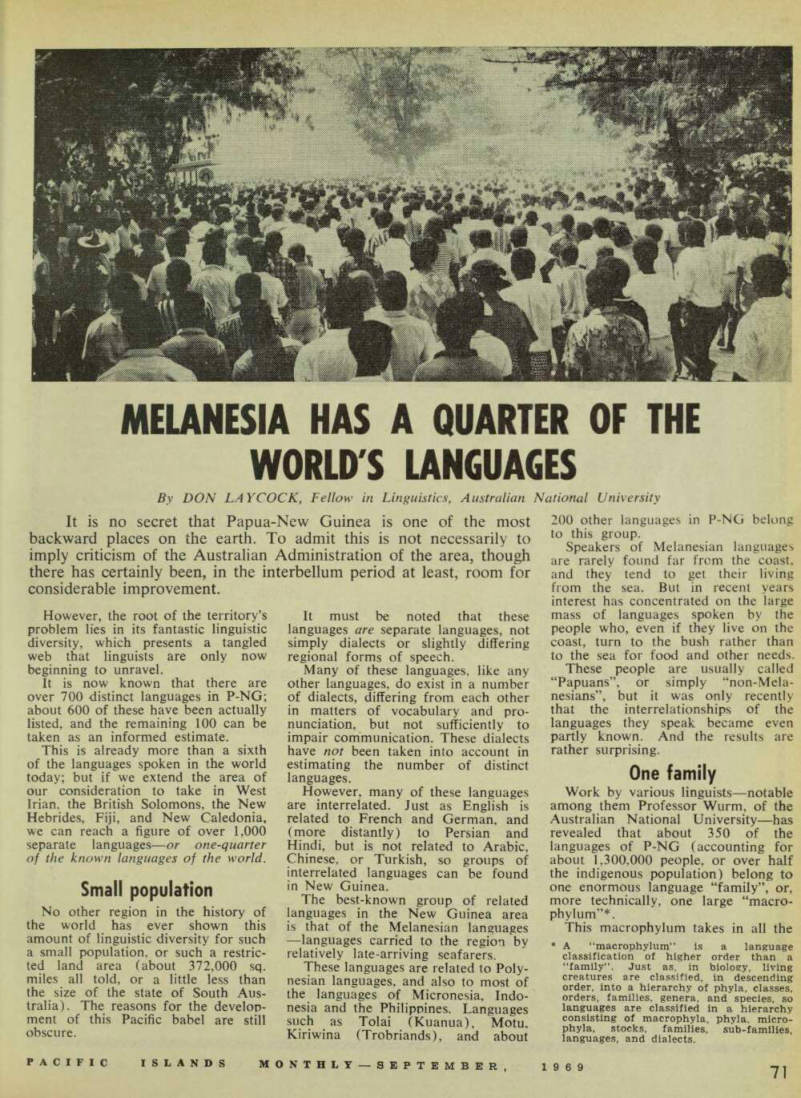
No other region in the history of the world has ever shown this amount of linguistic diversity for such a small population, or such a restric ted land area (about 372,000 sq. miles all told, or a little less than the size of the state of South Aus tralia). The reasons for the develop ment of this Pacific babel are still obscure.
It must be noted that these languages are separate languages, not simply dialects or slightly differing regional forms of speech.
Many of these languages, like any other languages, do exist in a number of dialects, differing from each other in matters of vocabulary and pro nunciation, but not sufficiently to impair communication. These dialects have not been taken into account in estimating the number of distinct languages.
However, many of these languages are interrelated. Just as English is related to French and German, and (more distantly) to Persian and Hindi, but is not related to Arabic, Chinese, or Turkish, so groups of interrelated languages can be found in New Guinea.
The best-known group of related languages in the New Guinea area is that of the Melanesian languages —languages carried to the region by relatively late-arriving seafarers.
These languages are related to Poly nesian languages, and also to most of the languages of Micronesia, Indo nesia and the Philippines. Languages such as Tolai (Kuanua), Motu, Kiriwina (Trobriands), and about
200 other languages in P-NG belong to this group.
Speakers of Melanesian languages are rarely found far from the coast, and they tend to get their living from the sea. But in recent years interest has concentrated on the large mass of languages spoken by the people who, even if they live on the coast, turn to the bush rather than to the sea for food and other needs.
These people are usually called “Papuans”, or simply “non-Mela nesians”, but it was only recently that the interrelationships of the languages they speak became even partly known. And the results are
rather surprising.
One family
Work by various linguists—notable among them Professor Wurm, of the Australian National University—has revealed that about 350 of the languages of P-NG (accounting for about 1,300,000 people, or over half the indigenous population) belong to one enormous language “family”, or, more technically, one large “macro phylum”*.
This macrophylum takes in all the * A “macrophylum” Is a language classification of higher order than a “family”. Just as. in biology, living creatures are classified, in descending order, into a hierarchy of phyla, classes, orders, families, genera, and species, so languages are classified in a hierarchy consisting of macrophyla, phyla, micro phyla, stocks, families, sub-families, languages, and dialects.
languages of the Central Highlands of New Guinea, and all non- Melanesian languages to the south of the Central Highlands, as well as all the mainland non-Melanesian languages to the east of Lae, on both sides of the central range.
This group extends into West Irian, and takes in all the languages in and south of the central mountain chain there. Some languages on the north coast of West Irian, notably Sentani, probably also belong to this group.
Of even more interest are the re maining non-Melanesian languages of New Guinea, located mainly in the Madang and Sepik Districts, with a few additional languages scattered throughout New Britain, New Ireland, and Bougainville.
Non-related
These 300 or so languages, far from forming a single interrelated group, are divided into at least 12 non-relatable groups, with a few score—perhaps 100—languages which are “isolates”—that is, languages which are not relatable at all to each other or to any of the others.
Some of the groups, such as the Torricelli phylum in the West Sepik, or the Ramu phylum in the Madang district (accounting for over 60,000 and 30,000 people respectively, although many of the individual languages in each group are spoken by less than 100 people) are quite large, which makes the problem of the origin of the smaller groups even more puzzling.
It may in fact be the case that the present non-relatable groups cannot be related to each other simply because of lack of evidence, and it is likely that the future will see a reduction in the number of separate groups and isolates.
But in my opinion it is unlikely that, at least with present linguistic knowledge and techniques, we will ever reach the stage where there is only a single group of “Papuan” languages.
Arrived when?
This fact poses problems as far as the prehistory of New Guinea is con cerned because a distinct origin and a distinct time of arrival on the island must be established for each separate group.
The problems of contact and mutual influence of the various groups present questions so complex that it will be many years, if ever, before scientists mainly archaeo logists and culture-historians—can even begin to work out the settle ment pattern in New Guinea.
But at least it is clear that the
old and simple opposition between “Papuan” and “Melanesian” will have to be revised.
Even at present, however, we can establish certain cultural patterns that correlate well with the boundaries of certain linguistic groups.
All of the well-known Sepik art, for example, comes from the speakers of a single language group, the Middle Sepik phylum—which may well be part of the large macro phylum, although this is not yet established.
And in the Torricelli mountains, in the West Sepik district, are found a large group of languages, all be longing to the Torricelli phylum, whose speakers are all sago-gatherers rather than cultivators, in spite of the fact that they live on good agri cultural land, along the ridges of the mountains, many miles from the swamps where the sago grows plenti fully.
Old cultural traits
Such a habit must persist from the distant past, when the ancestors of the present population inhabited a different environment.
The persistence of such old cultural traits is well illustrated by the perplexity of an agricultural officer in the West Sepik district who re ported that the inhabitants of one village were happy to plant coffee and other cash crops, while those of
another village, not five miles away, could not be persuaded into any form of agricultural endeavour.
Investigating, I found that a major language boundary, between two non related groups, ran right between the two villages!
This is not to suggest that speak ing a language belonging to a certain group predisposes one to certain cultural patterns, but rather that speakers of related languages share a common origin, and that they retain old patterns of life for perhaps many thousands of years.
There are other puzzles in the linguistic situation in the northern half of the territory. On New Britain, for example, there are only six re maining non-Melanesian languages, in what is predominantly a Mela nesian area, yet these six languages show no demonstrable relationship to each other, or to any other known languages of New Guinea!
Similarly, the non-Melanesian languages of South Bougainville show no apparent relationship to the hand ful of non-Melanesian languages still surviving in the British Solomon Islands, although the geographical distribution, in both these cases, would seem to make such a relation ship almost inevitable.
The complexity of the P-NG linguistic situation made the growth of a “lingua franca” like Pidgin English inevitable, and it will be many years, if ever, before this useful language is replaced by English.
What of the future?
The use of Pidgin in interracial contacts is continually decreasing in proportion to the amount of Pidgin spoken by natives of different linguistic backgrounds, as a result of the increasing mobility of native workers throughout the territory.
What of the future of the tribal languages themselves? Can they hold out against the pressures of English and Pidgin, and growing feelings of national unity? It is certain that few, if any, will ever extend beyond their present boundaries, or ever be learnt by more than a handful of dedicated linguists and missionaries.
But old languages die hard, and people’s emotional attachment to their mother tongue will mean that all of the large language groups in New Guinea will persist for many hundreds of years yet, perhaps even as long as an isolated language like Basque has persisted in Europe, against the competition of French and Spanish.
Meanwhile, the linguists are hard at work, recording, describing, and relating, and the work will not be completed in our lifetimes.