Book Reviews
pp. 97-98 · Read in the full issue
Shrewd Reportage On
Today's New Guinea
After reading the first two or three chapters of John Ryan’s book on New Guinea, The Hot Land, I found myself murmuring “By New Guinea Villager out of The Last Unknown However, as I read on, I found that there was more to it than that.
There is much shrewd comment which reminds one of Rowley, and a mass of meticulous background information reminiscent of Souter, though mercifully free from foot notes. But to these ingredients Ryan is able to add his personal contacts, as a journalist, with the situations he describes.
And he seems to have had a knack of being at the right place at the right time to collect an eyeful and an earful.
Mostly the books about New Guinea which are worth reading at all fall into one of two categories— those which survey the whole scene from a chair in a well stocked library, and those which give an eye witness’ close-up view.
The latter are in most cases written by people tied down to, and with a viewpoint orientated by, one parti cular job—government officer, mis sionary, anthropologist or what have you—and often one particular local ity. Both these classes of books have their limitations, and supplement each other.
Sparing of words
The Hot Land (which translates the Biak word “Irian”) reminds one of a film which shows a broad land scape and then suddenly zooms in to a close-up of a particular point in the landscape just at the moment when something exciting is happening there.
The passages which sketch in the broad landscape tend to be staccato and sparing of words, due perhaps to the fact that the author’s journalism has been exercised in the field of radio, with its stern discipline of fitting a certain amount of material into an inflexible ration of minutes.
For example:—“On 17 September, 1914, after his temporary capital in Toma Ridge twenty miles from
Rabaul had been shelled, German New Guinea’s Acting Governor, Dr.
E. Haber surrendered. The Austra lians raised the Union Jack and the German slice of New Guinea was now an imperial prize of war, its dozens of plantations and seven big com panies marked for expropriation in 1920 and sale by 1926; and several hundred German soldiers, govern ment officers and planters and their families were technically prisoners,”
If the whole book of almost 400 pages went at that pace, it would be a bit hard to take. But fortunately when the camera zooms in for a close-up the pace slackens.
For example:— “Eastman wanted to know from the warriors themselves what they thought about self-govern ment. A native hospital orderly, Kambo, stepped forward to tell him that ‘New Guinea is not ready yet.
things and we are learning’. Eastman was not convinced. ‘Who is this gentleman who wants this everlasting colonialism? Why?’ he asked. Kambo said: ‘I am saying what I think. We are not ready yet . . . we are still learning and I want this to go on’.
Eastman shook his head in disbelief.”
Again, on the West Irian border:— “ ‘Three more came across only a couple of days ago—a man, wife and baby’. Tony Try said he was worried about the baby. “I had to send them back across the border and they’re living now in a bush camp. . . . The husband told me he’d had to get out of Sukarnapura in a hurry. He speaks Dutch, Ger man and English—such good English that it was almost embarrassing talk ing to him’.”
Most fascinating and revealing, perhaps, are the close-ups we get when the camera prods into a news
Australia has given us many goodconference. Brigadier General Sarwo
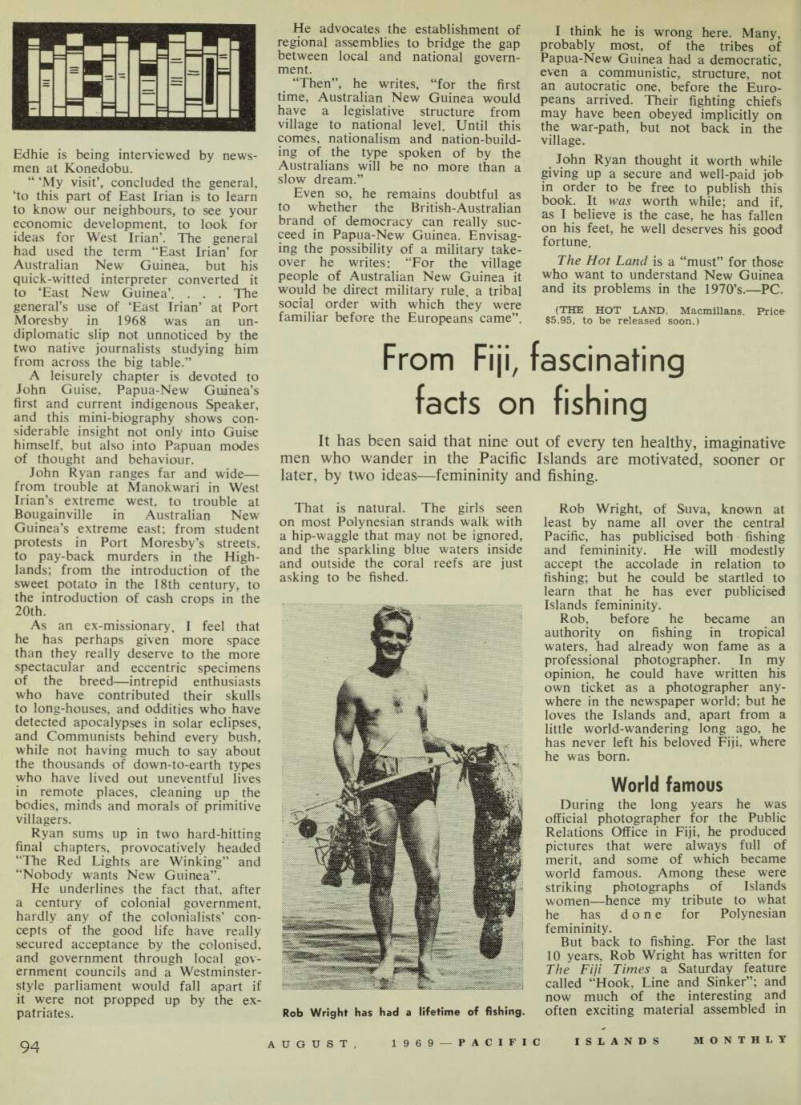
Since he left the ABC, John Ryan has established the New Guinea News Service, which supplies features, news re ports and radio material to local and overseas media. Here he discusses a point with one of his staff - journalist Luke Sela, who is from Manus.
Edhie is being interviewed by news men at Konedobu.
“ ‘My visit’, concluded the general, ‘to this part of East Irian is to learn to know our neighbours, to see your economic development, to look for ideas for West Irian’. The general had used the term “East Irian’ for Australian New Guinea, but his quick-witted interpreter converted it to ‘East New Guinea’, . . . The general’s use of ‘East Irian’ at Port Moresby in 1968 was an un diplomatic slip not unnoticed by the two native journalists studying him from across the big table.”
A leisurely chapter is devoted to John Guise, Papua-New Guinea’s first and current indigenous Speaker, and this mini-biography shows con siderable insight not only into Guise himself, but also into Papuan modes of thought and behaviour.
John Ryan ranges far and wide— from trouble at Manokwari in West Irian’s extreme west, to trouble at Bougainville in Australian New Guinea’s extreme east; from student protests in Port Moresby’s streets, to pay-back murders in the High lands; from the introduction of the sweet potato in the 18th century, to the introduction of cash crops in the 20th.
As an ex-missionary, I feel that he has perhaps given more space than they really deserve to the more spectacular and eccentric specimens of the breed—intrepid enthusiasts who have contributed their skulls to long-houses, and oddities who have detected apocalypses in solar eclipses, and Communists behind every bush, while not having much to say about the thousands of down-to-earth types who have lived out uneventful lives in remote places, cleaning up the bodies, minds and morals of primitive villagers.
Ryan sums up in two hard-hitting final chapters, provocatively headed “The Red Lights are Winking” and “Nobody wants New Guinea”.
He underlines the fact that, after a century of colonial government, hardly any of the colonialists’ con cepts of the good life have really secured acceptance by the colonised, and government through local gov ernment councils and a Westminster style parliament would fall apart if it were not propped up by the ex patriates.
He advocates the establishment of regional assemblies to bridge the gap between local and national governm » „ , Then , he writes, “for the first time, Australian New Guinea would have a legislative structure from village to national level. Until this comes, nationalism and nation-building of the type spoken of by the Australians will be no more than a slow dream ”
Even so,'he remains doubtful as to whether the British-Australian brand of democracy can really sueceed in Papua-New Guinea. Envisaging the possibility of a military take over he writes: “For the village people of Australian New Guinea it would be direct military rule, a tribal social order with which they were ■ i ■ , r t- „ familiar before the Europeans came’.
I think he is wrong here. Many probably most, of the tribes of Papua-New Guinea had a democratic, even a communistic, structure, not an autocratic one, before the Euro peans arrived. Their fighting chiefs may have been obeyed implicitly on the war-path, but not back in the village. u-i . J°hn Ryan thought it worth while giving up a secure and well-paid job to . P“ bUsh , n r. ® T e l‘ e e s *®,. c . se ’ he h ? 5 fallen ?" h ' s . feet ’ he well deserves h,s B ood The Hot Land is a “must” for those w ho want to understand New Guinea and its problems in the 1970’s.—PC. wrvr T AXrri . (iilii hoi land. Macmillans. Price $5.95, to be released soon.)