From Fiji, fascinating
pp. 98-99 · Read in the full issue
facts on fishing
It has been said that nine out of every ten healthy, imaginative men who wander in the Pacific Islands are motivated, sooner or later, by two ideas—femininity and fishing.
That is natural. The girls seen on most Polynesian strands walk with a hip-waggle that may not be ignored, and the sparkling blue waters inside and outside the coral reefs are just asking to be fished.
Rob Wright, of Suva, known at least by name all over the central Pacific, has publicised both fishing and femininity. He will modestly accept the accolade in relation to fishing; but he could be startled to learn that he has ever publicised Islands femininity.
Rob, before he became an authority on fishing in tropical waters, had already won fame as a professional photographer. In my opinion, he could have written his own ticket as a photographer any where in the newspaper world; but he loves the Islands and, apart from a little world-wandering long ago, he has never left his beloved Fiji, where he was born.
World famous
During the long years he was official photographer for the Public Relations Office in Fiji, he produced pictures that were always full of merit, and some of which became world famous. Among these were striking photographs of Islands women—hence my tribute to what he has done for Polynesian femininity.
But back to fishing. For the last 10 years, Rob Wright has written for The Fiji Times a Saturday feature called “Hook, Line and Sinker”; and now much of the interesting and often exciting material assembled in
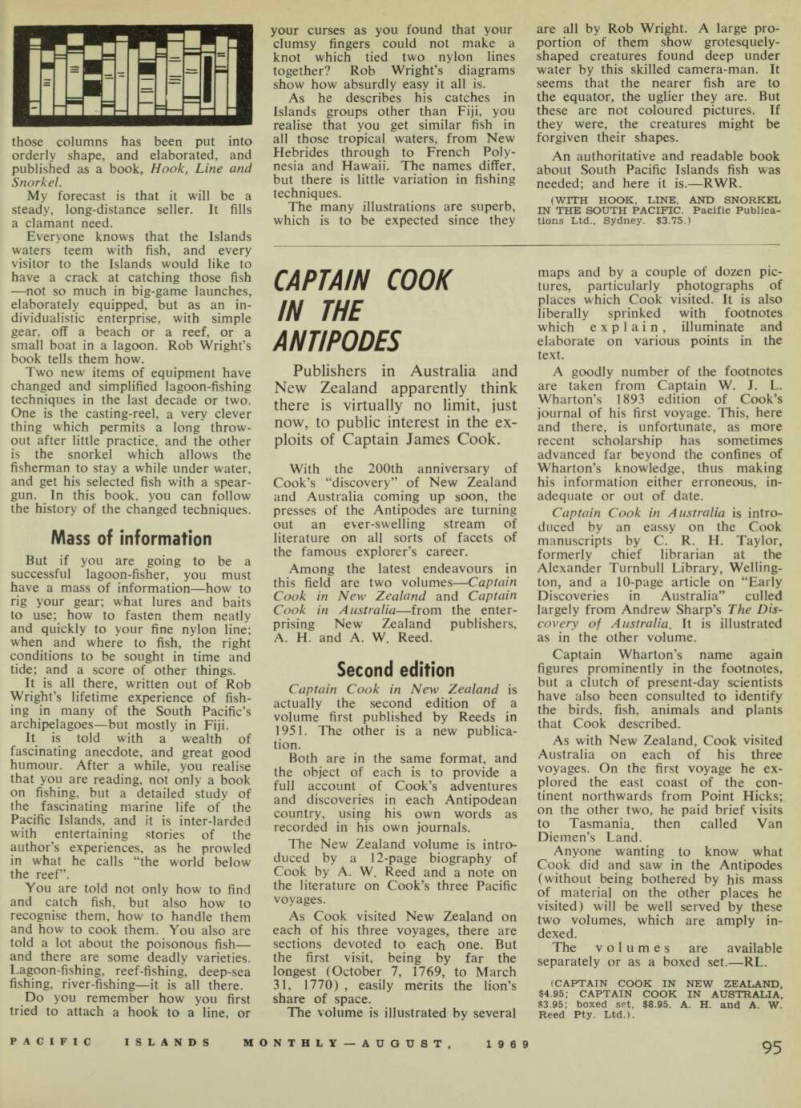
Rob Wright has had a lifetime of fishing.
those columns has been put into orderly shape, and elaborated, and published as a book, Hook, Line and Snorkel.
My forecast is that it will be a steady, long-distance seller. It fills a clamant need.
Everyone knows that the Islands waters teem with fish, and every visitor to the Islands would like to have a crack at catching those fish —not so much in big-game launches, elaborately equipped, but as an in dividualistic enterprise, with simple gear, off a beach or a reef, or a small boat in a lagoon. Rob Wright’s book tells them how.
Two new items of equipment have changed and simplified lagoon-fishing techniques in the last decade or two.
One is the casting-reel, a very clever thing which permits a long throw out after little practice, and the other is the snorkel which allows the fisherman to stay a while under water, and get his selected fish with a spear gun. In this book, you can follow the history of the changed techniques.
Mass of information
But if you are going to be a successful lagoon-fisher, you must have a mass of information—how to rig your gear; what lures and baits to use; how to fasten them neatly and quickly to your fine nylon line; when and where to fish, the right conditions to be sought in time and tide; and a score of other things.
It is all there, written out of Rob Wright’s lifetime experience of fish ing in many of the South Pacific’s archipelagoes—but mostly in Fiji.
It is told with a wealth of fascinating anecdote, and great good humour. After a while, you realise that you are reading, not only a book on fishing, but a detailed study of the fascinating marine life of the Pacific Islands, and it is inter-larded with entertaining stories of the author’s experiences, as he prowled in what he calls “the world below the reef”.
You are told not only how to find and catch fish, but also how to recognise them, how to handle them and how to cook them. You also are told a lot about the poisonous fish— and there are some deadly varieties.
Lagoon-fishing, reef-fishing, deep-sea fishing, river-fishing—it is all there.
Do you remember how you first tried to attach a hook to a line, or
your curses as you found that your clumsy fingers could not make a knot which tied two nylon lines together? Rob Wright’s diagrams show how absurdly easy it all is.
As he describes his catches in Islands groups other than Fiji, you realise that you get similar fish in all those tropical waters, from New Hebrides through to French Polynesia and Hawaii. The names differ, but there is little variation m fishing techmques.
The many illustrations are superb, which is to be expected since they
are all by Rob Wright. A large pro portion of them show grotesquely shaped creatures found deep under water by this skilled camera-man. It seems that the nearer fish are to the equator, the uglier they are. But these are not coloured pictures. If they were, the creatures might be forgiven their shapes.
An authoritative and readable book about South Pacific Islands fish was nee ded; and here it is.—RWR. (with hook, line, and snorkel m south pacific. Pacific Pubiica tions Ltd., Sydney. $3.75.)