Monthly
Pacific Islands Monthly
Registered at G.P.0., Sydney, for transmission by post as a newspaper.
August, 1969
News Magazine Of The South Pacific
• AUSTRALIA, 40c. • NEW ZEALAND, 45c. *U.S. PACIFIC TERRITORIES, 70c • FRENCH PACIFIC ISLANDS, 55 FRCS. CFP. • P..N.G., FIJI AND All OTHER
Pacific Territories, 35C. Local Currency.
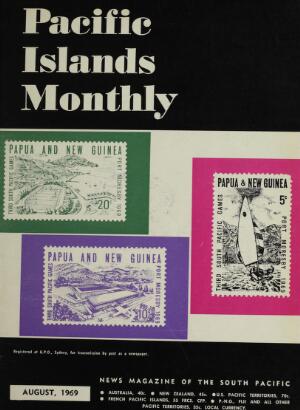
Our Cover
The three Papua-New Guinea stamps in colour on our coyer are among many stamps issued by Pacific territories to mark the Third South Pacific Games in Port Moresby, August 13-23.
For pictures of other Games’ stamps, turn to p. 99.
Advertisements & other items, pp. 2-16 (5 items)
m IQfi q pacific islands monthl
AUGUST 1969 PAC ir »
the friendly friendly way
2HS fV-W"* M *»o. 1
sfi- .WEWAK. 1 S
MANUS IS. - V
y’
Main routes only »- w . \ \ • /
PORT MORESBY
V"v \
HONIARA^
This is where we go!
k
This is how we go!
In air-conditioned comfort with smooth running twin proo-jet reliability. From Port Moresby to Lae, Midang, Rabaul. Goroka, Mt. Hagen, plus around 40 other centres. With interlocking flights planned to give you the best connections throughout Papua and New Guinea, and to Australia, on TAA’s “Bird of Paradise” T-Jet Services.
Added up, that means more comfort and more flights to more places than any other airline in the Territory.
Is it any wonder more people fly TAA?
Contact your Travel Agent or TAA: Port Moresby 2101. Lae 2311. Madang 2478.
Rabaul 2567. Goroka 8. Mt. Hagen 4 or 301. Wewak 103.
the friendly friendly way
JUST OUT!
The 1969 supplement to the
PACIFIC ISLANDS YEAR BOOK
Price of the 718 page, 10th edition, Pacific Islands Year Book and Who's Who, PLUS the 32-page 1969 supplement is as follows: within Australia and P-NG, $B.OO Aust., plus 75c posted; Pacific Islands and overseas countries, $B.OO Aust., plus 90c posted; USA, $lO.OO U.S. posted.
Supplement only—so cents, including surface postage. brings the 10th edition right up to date. now
'•jCimitccl
’3 a If postage of the supplement by 2nd class airmail is required, add 20c for Pacific Islands and New Zealand; 45c for UK, Europe and Africa; and 50c US for USA and Canada. (All Papua-New Guinea mail goes by air; additional postage is not necessary).
ORDER FORM
To: PACIFIC PUBLICATIONS (AUST.) PTY. LTD.,
Box 3408, G.P.0., Sydney, N.S.W., 2001, Australia.
NAME
Please send copies of
ADDRESS
ment"; □ "1969 Supplement only"; 1o the following: For which payment of is enclosed.
EH Pacific Islands Year Book plus Supplemon*". is enclosed. (Block Letters, Please)
"Then iJan ideal Pacific hook
fir etfertf taMe!
Fictional, Reference and true life stories torn from the Pacific's turbulent past.
Art
GRASS ROOTS ART OF
NEW GUINEA
E. F. Hannemann
"Grass Roots" is a collection of designs which have been taken from spears, masks, shields, bows, bowls, canoes, headbands, necklaces, lime containers, drums and all the other decorated objects used in everyday native village life. 56 pages, fully illustrated.
PRICE: Australia and P-NG, $1.35 Aust., plus 5c posted; Pacific Islands and overseas countries, $1.35 Aust., plus 13c posted; USA, $1.70 U S. posted.
General
DISTRICT OFFICER
G. W. L. Townsend
This is New Guinea of between-the-wars, as different from modern New Guinea as Dickens' England was from that of the Beatles. It was a period when the Territory was expected to pay its own way without Australian help and when young Patrol Officers, on £3OO a year and no leave privileges, tried, almost single-handed, to bring peace and civilisation to vast areas of primitive country, inhabited by warring Stone-Age head-hunters. 272 pages, cloth bound; illustrated.
PRICE: Australia and P-NG, $4.50 Aust., plus 20c posted; Pacific Islands and overseas countries, $4.50 Aust, plus 55c posted; USA, $5.75 U.S. posted.
WITH HOOK, LINE & SNORKEL
IN THE SOUTH PACIFIC
Rob Wright
Hook, Line and Snorkel is a Pacific Islands nature book where stories of the ones that were caught, or got away, go alongside fascinating descriptions of such oddities as the rising of the balolo; where adventures with ever-present sharks are described as a counterpoint to a word picture of the tranquil island-studded lagoon and the Islander's way of life upon it. 200 pages, cloth bound; illustrated.
PRICE; Australia and P-NG, $3.75 Aust., plus 21c posted; Pacific Islands and overseas countries, $3.75 Aust., plus 28c posted; USA, $4.50 U.S. posted.
PIM'S PACIFIC
A collection of stories that have appeared in the "Pacific Islands Monthly", written by people intimately connected with the area. Their subjects range through history, adventure, personal experiences, travel and, because the authors are as interesting as their subjects, a feature has been made of short biographical and background introductions to each story. For people who want an authentic viewpoint, this is the Pacific from the Inside looking out. Edited by Judy Tudor. 224 pages, cloth bound; illustrated.
PRICE: Australia and P-NG, $2.75 Aust., plus 15c posted; Pacific Islands and overseas countries, $2.75 Aust., plus 40c posted; USA, $4.00 U.S. posted.
TAHITI: ISLAND OF LOVE
Robert Longdon
Tahiti is the most famous of ail Pacific Islands. It has magnificent scenery, beautiful girls and a mystique that has grown with the years since European discovery in 1767.
Thanks to the efforts of playwrights, magazine writers and novelists, it has become Everyman's idea of paradise.
However, there is much more to Tahiti than that and this entertaining, background history, from Wallis to de Gaulle supplies it. 276 pages, illustrated; in hard cover, cloth bound and soft cover versions.
PRICE; SOFT COVER; Australia and P-NG, $1.95 Aust., plus 25c posted; Pacific Islands and overseas countries, $1.95 Aust., plus 33c posted; USA, $2.75 U.S. posted.
HARD COVER; Australia and P-NG, $3.30 Aust., plus 25c posted; Pacific Islands and overseas countries, $3.30 Aust., plus 35c posted; USA, $4.15 U.S. posted.
MANY A GREEN ISLE
Judy Tudor
The islands of the Pacific Ocean have been the author's journalistic stamping-ground for over 20 years. She edited the "Pacific Islands Monthly" for some years and still contributes but most of her time is now taken up editing reference books like "Pacific Islands Year Book and Who's Who".
"Many a Green Isle" represents a holiday from regular journalistic work. In it she writes informally about her many island journeys and the four years she spent in a mining-camp in New Guinea. 256 pages, cloth bound; illustrated.
PRICE; Australia and P-NG, $3.50 Aust., plus 20c posted; Pacific Islands and overseas countries, $3.50 Aust., plus 49e posted; USA, $4.75 U.S. posted.
ORDER FORM
Please send copies of the books indicated for which payment of is enclosed.
NAME
ADDRESS
(Block letters please)
PACIFIC PUBLICATIONS (AUST.) PTY. LTD.
29 Alberta Street, Sydney, N.S.W. 2000.
Postal Address: G.P.O. Box 3408, Sydney, N.S.W. 2001.
I 11
THROUGHOUT THE PACIFIC
FUI, SAMOA,TONGA, NIUE Is, NORFOLK Is.
BURNS PHILP
[SOUTH SEA] CO. LTD.
REGISTERED OFFICE: SUVA, FIJI
TELEPHONE NO: 22661
TELEX NO: FJ1127
Code Address: "BURNSOUTH' ~-;v<v —’ " v v "*"' viU V>»v i' : l v
SHIPPING AGENCIES
The New Zealand Shipping Co. Ltd.
Shaw Savill & Albion Co. Ltd.
Port Line Ltd.
Bank Line Ltd.
General Steamship Corporation Ltd.
Blue Star Line Compagnie des Messageries Maritimes Royal Interocean Lines Daiwa Navigation Company Ltd Sitmar Line Flotta Lauro (Lauro Lines) Australasia Pty. Ltd, Tonga Shipping Agency.
EXCLUSIVE
DISTRIBUTORSHIPS
INCLUDE
Akai Taperecorders Dunlop Products Hitachi Electronics Holden Motor Vehicles Rolex Watches Revlon Cosmetics Pentax Cameras Ferguson Tractors Olympic Tyres Penfold Wines
AGENTS FOR:
Queensland Insurance Co. Ltd.
Burns Philp Trustee Co. Ltd.
Shell Company (P. 1.) Ltd.
Bureau Veritas
ASSOCIATED COMPANIES
Burns Philp (New Hebrides) Ltd.
Automotive Supplies Co. Ltd.
Corrie & Co. Ltd.
Wrought Iron and Steel Construction Co. Ltd.
Bish Ltd.
SPECIALISED SERVICES
Expert advice on Shipping; Forwarding; Customs formalities; Insurance.
COMPLETE TRAVEL
SERVICE
accredited agents for the
INTERNATIONAL AIR
TRANSPORT ASSOCIATION
OVERSEAS AGENTS: SYDNEY • LONDON • SAN FRANCISCO
: m -> m <: m m 0 i mm u m m □ ■ i - V E Of CO I ' V m K ■ i f : m ■ .. . V • ■ ■ m I 5 ' ’I m
Greenlites are the only matches
in the world that light when wet... they’re made for your part of the world Greenlites are tropical matches, waterproof. Ask for them.
Made in Australia by Bryant & May.
V s 3& K (5 s o So buttery rich, that’s Edinburgh Shortbread. A traditional recipe faithfully baked by Brockhoff to give you golden melt-in-your-mouth-shortbread. Taste that blend of eggs and sugar taste that butter — there’s more than one quarter by weight of dairy butter in Edinburgh Shortbread.
There’s value, variety and quality in
BROCKHOFF BISCUITS
2391/8 X 6
f
Wunderlich
set modern
The trend today is for modern design —low-cost maintenance-free building materials. The answer lies with asbestos-cement manufactured and supplied by Wunderlich Limited.
The vast range of asbestos-cement products includes flat sheets for walls and ceilings—profile sheets for
<= 7Piindet/ec/t-
-material—
sdesign trends
carports, gable ends, feature walls and garages—and corrugated sheets for roofing, walling and fencing.
Construction of economical flats, home units and residences demands modern design trends —in asbestoscement —by Wunderlich Limited.
Write for free, informative literature on asbestos-cement building products.
Wunderlich Limited Head Office: 393 Cleveland Street, Redfern, 2016. Australia.
Telephone 69 0366.
ASBESTOS-CEMENT
AVAILABLE FROM AUTHORISED
PRODUCTS
DISTRIBUTORS
EXP 83
wiih a or
UNSHINEBegaf
dairy fresh milk
lime I want it
any quantity
I need!
NESTLE’S
SUNSHINE
FULL CREAM
POWDERED
MILK
Full of goodness— perfect for all milk recipes. Children love it, too, particularly in flavoured milk drinks.
No souring—no waste —fresh to the last rewarding spoonful!
NLS79O4
ii
SOME OF THE FIRMS
WE REPRESENT ARE;
A. W. Allens (Confectionery) Sunshine Biscuits Sunrise (Confectionery) Flamenco (Instant Coffee) Cremota (Quaker Oats, Jets Pet Foods) Marchants (Canned Soft Drinks) Lunchtime (Honey) South Pacific Canneries (Scallops, Aba lone) Safcol (Canned Tuna, Salmon) Hancock's (Spaghetti, Cereals) Melbourne Canning (Jams, Bleach) Water Wheel (Flour, Sharps, Wheat) General Food Corporation (Twisties, Twirlies) Edward Zorn (Margarine, Cooking Fats) Robert Timms (New Guinea Gold Coffees, Teas) Rodd (Cutlery) Palm (Mattresses) Esteel (Cookware) Vendolux (Cafe Bars) Mitchell's (Abrasives) Regent (Swiss Watches) Gainsborough (Furniture) Tamco (Melanie Crockery, Nylon Hardware) Elm a c o (Plastic Household Goods, Electrical Fittings) Brownbuilt (Pre-Fabricated Houses) Ryline (Fluorescent Lights) Jex (Steel Wool) Austramax (Pressure Lamps) Preservene (Soap Products) Charles Tims (School Requisites) Ascow and Philadelphian (Shirts) Lawn Chair and Tubco (Garden Furniture) Sunrise Lustretone (S.S. Sinks, Plumbers' Supplies) Electronic Industries (Electrical Household Appliances)
S. E. TATHAM
& Co. Pty. Ltd.
MELBOURNE, AUSTRALIA
G.P.O. Box 8, Cables '•SET"
Telephone 60-1125
EXPORT AGENTS
PACIFIC ISLANDS
AGENTS
Australian buying and shipping agents for the Gilbert and Ellice islands Colony Wholesale Society
DIRECT ENQUIRIES WELCOMED
Associate Company
S. E. TATHAM (FIJI)
Suva, G.P.O. Box 671.
Lautoka, P.O. Biu 366.
SINCE 1924
1 1
LTD
Cheezpop & Chickpop
mm i § § m
The happiest fun-foods
Cheezpop and Chickpop are great fun. Crisp . . . crackling . . . salty and flavoursome . . . pals to drinks ... waken your palate .. . sharpen your taste for every frosty sip. Next party, snacktime or barbecue, nibble on Cheezpop or Chickpop. Or both.
They’re pop-pop-popping good fun.
For trade enquiries: Reckitt & Colman Ply. Ltd., Wharf Road, West Ryde, N.S.W., Australia. Cables: Reckitts, Sydney.
A RECKITT & COLMAN PRODUCT
HBU
Just about the only thing
we don’t make for offices
f But Brownbuilt do manufacture Australia’s largest range of steel office equipment.
Brownbuilt make the most fashionable, efficient and colourful range of executive, typist, clerical desks, tables and credenzas, cupboards, wardrobes, card cabinets, vertical files, plan files, Compactus office file and storage units . . . phew!
Even waste paper bins.
And every piece of Browbuilt office equipment is tropic proofed to resist rust.
Call your Brownbuilt distributor now.
He can save you space, time and money.
Brownbuilt
lliiillllilllilllllllillllllllllillllllilllllllllllllllilllllllllllllillillilllllll LIMITED iiiiiiiiiiiiiiiiihiiiiU
STEEL EQUIPMENT DIVISION
Resident Representative for TPNG: John Dwyer, Saraga Street, Six Mile, Port Moresby. Phone: 53144.
Distributed by:
TERRITORY OF PAPUA & NEW GUINEA
Steamships Trading Company Limited, Port Moresby. Phone: 2221; and at Goroka, Lae, Madang.
Mt Hagen, Popondetta, Rabaul and Samarai.
Rabaul Metal Industries Pty. Ltd., Rabaul. Phone; 2062,
FIJI
Armstrong & Springhall (Pacific Islands) Limited, Suva, Phone: 24071-3, and at Lautoka, Apia and Pago Pago Reddy Construction Company Ltd., G.P.O. Box Suva 80.
Phone: 25643, and at Samabula and Lautoka.
NEW CALEDONIA
Ideal Meuble Metallique, Noumea. Phone; 37-82. eWiSTTt
FAST, BARGE
i -OUT OF DARWIN
\ - : ; M| W m- I LLi w m^rnm
diesel powered
by CUMMINS*
the new 500-ton Fourcroy,
biggest modern barge built in Australia
er ? F ° u [, c roy operates, her engine's have got to be better than good Fully loaded with supplies, she makes more than 10 knots out of Darwin to Gove Groote Eylandt, Weipa and other project areas to Australia's north-barging in strongly through shoals and shallows to land her cargo right on the beach.
Fourcroys owners specified Cummins to ensure a tough, dependable engine for a tough, critical job—and because the full weight of Cummins' service is right there to back it.
Cummins parts and maintenance service reaches right round Australia's coastline and beyond, keeping every Cummins-powered workboat permanently and profitably on the job *** ‘*nes ar oun d
wmoasmtni sure ass. ssawasaa
Distributor
CUMMINS DIESEL SALES
& SERVICE (AUST.) PTY. LTD.
Head Office: 164-170 Hume Highway, Lansvale, N.S.W.. 72-6211. Telegrams "CUMTORO"
Factory
CUMMINS DIESEL
AUSTRALIA
Adelaide: 62-1 U 936 G^ ft prrt 2 h 5 565 m^^oba^ 6 R * Br,sbane; 68 ' 2146 * Townsville: 93287 rerm - bt> ’ ll44 • Hobart: Bridgewater 381 . Darwin: 2744 . Lae: 2692 (Cummins Diesel Sales Corporation, incorporated in U S A. with Limited Liability) Ringwood, Victoria cuooa
When the best beer is called for, New Zealand’s favourite lager..
STEINLAGER
> S A *
il'Mothing
can tempt you away...
MK once you
experience
the unique
flavour and distinctive aroma of
ERINMORE
MURRAY S
ERINMORE
. MIXTURE
FINE
TOBACCOS
SINCE 1810
MURRAYS OF BELFAST
NORTHERN IRELAND
Ovaltine
for health strength and energy W 1/ %
Pvaltin^
OVALTINE. The
International Food Drink.
For extra nourishment and quick energy, there’s nothing like OVALTINE. 0 V 'Ng V N : g OVALTINE Teething Rusks help bring the teeth through faster, with less hurt.
Double toasted nutritious OVALTINE Teething Rusks. energy Üblets OVALTINE Energy Tablets.
Every one a powerhouse of instant energy. For that extra boost in a minute it’s OVALTINE Energy Tablets.
Trade Enquiries to the Manufacturers:
A. Wander (Australia) Pty. Ltd.,
Box 533888 G.P.0., Melbourne, Australia 3031.
Or Enquire direct to:
Hagemeyer (Australasia) N.V.,
Port Moresby, Lae and Rabaul.
A. S. Farebrother & Co. Ltd., Fiji. (Suppliers also of bulk malt extract in liquid or dry form) W 0598
Heinz Baked Beans has the sauce that clings to keep the flavour in That's what makes Heinz Baked Beans so good. First, Heinz select the best beans. Cook them 'til they're tender all the way through.
And, that's when the sauce comes in... rich and tasty. It clings to every bean to keep the flavour in. Try some, hot or cold, they’re delicious. You’ll find them at your local food store . . .
Heinz Baked Beans
Pacific Islands Monthly— A U G U S T , 1969
August. 1969 Pacific Islands Monthli
9
'“‘ F,C ISLANDS MONTHLY-AUGUST, 1 96 9
Letters
Memories Of The Gilberts
Sir, —In an article in PIM (May, p. 81) on Anton Meyer you refer to a Lucien Tom. The name should be Russian Tom. Tom told me he was born near Odessa and fought in the Crimean War. At the battle of Bala clava he fought against the English and was shot in the side of the abdomen with a copper bullet. The wound never healed, and when he became drunk, his stench was worse than a skunk’s.
Tom’s trading station was at the northern end of Tarawa, near Buariki.
The name Peter Grand you men tion should be Peter Grant. If my memory has not failed me, Peter with his wife (white woman) and two daughters, lived between Nuatibu and Taratai.
While writing about traders in Tarawa Lagoon, I might as well men tion all the others trading there at the beginning of this century. Francis J.
Lodge, a New Zealander, traded be tween Grant and Russian Tom. In 1906 he wrote to Mr. Deakin, the Prime Minister of Australia, saying that I refused to take his copra. He got a reply, of which I received a copy, telling him that if he brought his copra to the ship I could not re fuse to take it, provided the vessel had room. Lodge lived at a part of the island where the ship’s copra boats could only go at spring tide and as Lodge had no boat of his own he was in an awkward spot. How ever we settled our difficulties amic ably without having to resort to the old method of “pistols for two and coffee for one”. Then there was Anton Kawarra, a native of Trieste, an Austrian who could neither read nor write but had a marvellous memory. His station was near Aber kora.
Then came that fine old American skipper, Captain Kustell, whose right hand had been blown off by dynamite while fishing. I liked Kustell, for his word was always accepted. It was off Kustell’s station that Captain Handley, who was executed by the Japanese during the war, careened that beautiful schooner, the Louise J.
Kenny, but she did not rise again.
The next station south of Kustell’s was owned by On Chong and Co., of Sydney. It was near Buata but I forget the Chinaman’s name who traded there. Still travelling south, the next trader was that very nice
German Jew, Edward Meyer. His station was, as your article states, near Eita.
The next trading station was one owned by On Chong near Teaorereki.
The trader’s name was Ah Chew.
Poor Ah Chew died in the hospital at Betio. The hospital orderlies had been told not to let his wife near him while he was ill, without authority from the doctor. Mrs. Ah Chew managed to get into her husband’s sleeping quarters and it was said that Ah Chew died while performing matrimonial duties.
On Chong and Co.’s head office was in George Street. They owned shops in many parts of the country.
In the Gilbert Islands their head quarters were at Butaritari, where they had a very large store, and they had a wharf and stations at every island in the group except Abemama and its satellites, Aranuka and Kuria, Tamana and Arorae.
It used to be said that any of their New South Wales traders who could not pay his debts, was shipped to the Gilberts to work the debt off.
It is interesting to note that each vessel On Chong owned left its bones at Butaritari. The Fernmount, which they bought from the North Coast Company, sank at her moorings in the inner lagoon during the night of Christmas Eve, 1904, while under the command of Captain Menmuir.
The barque Loongana, which was built on the Derwent River in Tas mania and traded for years between Sydney and Butaritari, was lost at Butaritari. The SS Brunner, and the barquentine Alexa were wrecked there. (Captain Wynn, who is now a marine surveyor in Sydney, was master of the Alexa for four years and made some remarkably fast runs m her. He did one trip in 23 days.
He was not master of her when she was lost.) Mention was made in your article of Mr. J. Mitchell’s trip to the Gil berts. The passenger list that trip read as follows: January 5, 1899 Titus, 760 tons, Captain James Kuncie, sailed for Santa Cruz and u * „ and Ellice Elands with the following passengers Sisters Genevieve, Julienne, St. Pierre,
Valentine, Francaise, Apolline,
Clementine; Bishop Leray; Fathers
Raymond, Cochet, Troublanne, Quar-
2 er : ,X an T Hoogstraaten; Brothers Fusholler Eouis, Basil; Mr. and Mrs. . Mitchell; Mr. W. Johnstone; and :ight in the steerage.
The Titus returned to Sydney on £? rC u h i? 2 vJ 899 ’ with Mr - and Mrs.
Mitchell. The cargo consisted of 200 ons of copra and 2,000 lb of shark
fins. The Titus only made one more trip to the Gilberts. Mr. Mitchell only made the one trip. He shortly afterwards became manager at Thurs day Island, where he did wonderful business for Bums Philp, especially in pearl shell.
“Supercargo”
(Neville Chatfield) Killara, NSW.
Glen Wright's Samoa
Sir,—Mr. Glen Wright’s article about the Western Samoan universal suffrage vote (P/M, May) is un sympathetic and unperceptive. The former might be allowable, but your readers deserve more expertise and knowledge of local attitudes, customs and laws than Mr. Wright evidently possesses.
People in Western Samoa are worried about matters Mr. Wright should have mentioned. Will matais be able to maintain law and order at the village level with universal suffrage? Probably not. Would the present police force be able to take over their role? Certainly not. Would funds be available to enlarge the police force in the event of universal suffrage? Certainly not.
As Americans, both Mr. Wrighl and myself have doubtless beer brainwashed into thinking that oui system of democracy must surely hi best for all people, in all places, ai all times. I hope Mr. Wright ma) some day understand how absurd thi: notion is.
At least he should learn the fact! about the matai system. He claim: that matais have their pick of th« women both in and out of marriage Anyone who knows Samoa will spo the false ring of that statement. Du< to their position and authority, matai: must maintain the respect of thei people. In a Samoan village, when privacy and secrets do not exist hanky-panky quickly destroys tha respect.
Since the special sexual privileg of the matais is a myth, the com plaints of the taule’ale’a (untitlei men) must be a myth, too. And s< they are. My taule’ale’a friends wer vastly amused by Mr. Wright’s lad of knowledge. They pointed out tha the taule’ale’a are the ones who hav the fun in the moonlight under th bananas, and that when a man be comes a chief his days of playm around are over.
I am puzzled as to why Mr. Wrigt brought titillating matters into tha article, and also into the one m you
(Continued on p. 21)
June issue. For the latter, he was writing about Western Samoa, suddenly switched to American Samoa to inject a little sex into his journalism, and just as suddenly switched back to Western Samoa.
Does he have some sort of ecclesia stical bee in his bonnet?
What I find most troubling about both these articles is the lack of respect towards Samoa inherent in them. There seems to me to be a mockery there which, super-imposed upon an almost negligible attempt to understand Samoan attitudes, can only help make it difficult for Samoans and papalangis to under stand and trust each other.
I have just ended a year of journalism and anthropological studies in Western Samoa. During that time I lived about as closely with Samoans as a foreigner can.
When all is said and done, one cannot claim—explicitly or implicitly —that Samoans are dumb and dirty natives. They are a kind and good people. Their attempts to rule them selves in independence deserve a coverage more gentle and perceptive than Mr. Wright seems capable of producing.
Richard A. Goodman
Hotel Tahaka’a, Papeete.
Chatterton's "With-It-Ness"
Sir, —I would like to answer the letter of Mr. John Huon, firstly by voicing my great admiration and re spect for Mr. Percy Chatterton. In my six years in the territory (firstly as a volunteer worker and then as a member of the private enterprise sector) I have been increasingly im pressed by Mr. Chatterton’s humanity, understanding and vision towards this country and its people.
Far from “reflecting the psychology of the former LMS coastal pastor”
Mr. Chatterton’s column “To The Point” and his published statements in the Press show him to be a man of exceptional “with-it-ness” on to day’s “Niugini”, Naturally his electorate of Port Moresby and his great knowledge of the native people in the area are the subjects upon which he is most fre quently heard. However, he has proved himself upon numerous oc casions to be very aware of the problems of New Guinea and has very constructive and sensible ideas to alleviate many of them.
Mr. Huon’s letter, on the other hand, reflects an unfortunate and destructive regionalism combined with a thinly disguised contempt for the coastal population of Papua and possibly of New Guinea as well.
It is all very well to uphold the Highland population “who in 20 years have responded spectacularly to Euro pean influence”. These people have been singularly blessed in their short colonial experience with a very much more enlightened and beneficial system of administration than was the lot of the coastal population. The coastal people put up with a genera tion of bumbling paternalists who made little attempt to initiate economic development, however well meant their intentions.
They also have been fortunate, the Highlanders, in the productive poten tial of their land and the efficient example of the European planters.
The Niuginian kiaps will inevitably be recruited at first from coastal areas where educational facilities have been available longer, and it’s surely better for the sake of future understanding and unity that trained Papuan and New Guinean officers of all branches of the Administration work where they are needed without reference to the region of their origin.
Mr. Huon’s contention that “sophisticated native administrators are often more authoritarian and arrogant to their primitive brothers than former white officers” is doubtful to a degree in the light of modern training and ideals. Furthermore his example of the inequities of Liberia, a country that has been independent for over a century and has a rather unique history, is hardly a valid one.
What about Zambia and Tanzania where their respective presidents Kaunda and Nyrere are notable for their modest standards of living and their devotion to improving the living standards of their people—in Nyrere’s case, against almost insurmountable odds?
Mr. Huon mentions the hypo thetical example of the “indolent Sicilians running Italy”. As a student of the history of Sicily, I would say that the Sicilians are less indolent than oppressed and poverty stricken due to the indifference and neglect of their more fortunately situated northern fellow countrymen. Is Mr.
Huon recommending that this un fortunate and unfair system should be perpetrated in this country? As for Corsica, it produced Napoleon!
He cites an article in The New Guinea Quarterly of October, 1968, by a local writer as being anti- European. I read this article and considered the point of view of the writer to be that too much power is
wielded in primitive areas by young, inexperienced men of very often con temptuous and self-important outlook.
His criticism did not seem to me to be anti-European as such, and I believe that in many respects it was very accurate. I don’t think he was criticising the system of District Ad ministration in the territory as much as the amount of power wielded by its younger officers.
Agriculture is all very well and very important, too, Mr. Huon, but the urban scene of Papua-New Guinea is just as real. Home rule is probably not very far off for Papua- New Guinea, whether the people like it or not, and “racial polemics” and politics will be an ever increas ing reality. We can’t turn back the clock but we can hope and work for unity and racial harmony.
No one can fail to admire the pro gress and industry of the Highlanders or to sympathise with the problems they face in being superficially “less sophisticated” than their coastal brothers.
But let us not sneer at the coastal people and make unfavourable com parisons. They, like the Highlanders, are producing many fine young men and women who are worthy of our respect and faith that they can achieve success in the “white collar world”. This country needs them every bit as much as it needs the pro ductive planters and farmers and graziers. Let us wish them all success and let us hope for more leaders as fine and far-seeing as Mr. Chatterton.
Mrs. Penelope Bryning.
Lae, New Guinea,
Bar, Belly And Beach
Sir, —We are recent subscribers to PIM, having discovered your ex cellent magazine during our previous visits to Australia and Papua-New Guinea. We are now planning another trip for early 1970, and this time we hope to see something of areas we have missed, particularly the British Solomons and the New Hebrides.
I very much agree with US actor Victor lory’s views as stated in an article about him in July, 1968, PIM.
Mr. Jory pointed out that air fares in the South Seas are high. This is due to the large distances and, some times, to small passenger loads.
We always travel independently, using local services and facilities. We never use pre-paid US travel agents’ suggestions and tours and in that way we avoid the bar, belly and beach crowd who patronise only Hiltonised places.
Edwin L. Gustus
Chicago,
Usa
Advertisements & other items, pp. 17-25 (5 items)
Beauty
Advertisement
Salon Hints
By a Leading Skin-Care Consultant A youthfully radiant skin is the desire of every woman, particularly those whose first youth has passed. In fact, many leading beauticians say that their most vibrantly attractive clients will never see forty again. The way to keep your attractive good looks is to make a “must” of simple daily care. This will help Nature to make you feel and look more youthfully beautiful. Here are some suggestions to help you on your way to radiant loveliness.
An occasional facial steaming will do wonders for your complexion. Commence by cleansing the face and neck thoroughly with a mild cleanser, then lubricate the skin with a little tropical oil of Ulan. Pay particular attention to the sensitive areas surrounding the eyes (crow’s-feet lines) where a little extra oil should be gently tapped in. With a towel over your head, steam over a basin of hot water for a few minutes to soften the skin and clear the pores. When the warmth has stimulated the circulation, dry off with a soft towel and then massage in a further film of Ulan oil to give the surface skin silky softness and milk-like loveliness.
We all envy the lovely, English countryside complexion enjoyed by women who live in moist cool climates. A hint to give the complexion cool climate moisture is to dampen a cloth with cold water from your refrigerator and press it over your face for a few minutes once or twice a day. Then to give the skin soft loveliness and help in softening away lines, smooth on a film of moist tropical oil of Ulan. Besides protecting and softening your complexion this oil will ensure your final make-up has a perfect matt finish.
Eyes that Sparkle
rpo revive tired eyes in just a few seconds, moisten two pads of cotton-wool in lemon Delph freshener and place them over your eyes while you relax with your feet up. Then, to ease away the fine lines that develop around and beneath the eyes, pat in tropical moist oil of Ulan. This moist oil is excellent for smoothing dry skin and easing away wrinkle-dryness.
A Beauty Facial
The Peaches-and-Cream Look
THE
MAGNIFICENT
WORLD
"sr: m Model X-V It's truly a magnificent world —the world of AKAI. The soothing, relaxing remoteness of the seashore with easytide tempo. AKAI's exclusive
CROSS-FIELD HEAD is a
prime reason for this magnificent listening experience.
There are many, many more reasons, but S-H-H-H! Listen to AKAI magnificence. It’s the best explanation we can
give.
PORTABLE STEREO TAPE RECORDER
—XV *Exclusive CROSS-FIELD HEAD for remarkable recording capacity *Newly designed brushless servomotor with minimum wow & flutter *Adaptors for use with 7 reels *New automatic recording level control *New 4 watt solid state amplifier *4 speeds (!%, IA, 3K and 7 x A ips) *4 track stereo/monaural recording and playback with 2 internal speakers *Perfect AC or DC (re-chargeable) operation *For increased stereo enjoyment, use the matching double cone speaker SW-65.
Prove it by the sound! prove it with
AKAI
CROSS-FIELD HEAD
USTRALIA; AKAI Australia Ply. Ltd.. 276 Castlereagti St„ Sydney NS W NEW s'eaf'c? C L°td P pago°Pago°' /Burns' Phi™ Sti^Se, id /B pO S Ki' P ir “oni.« r ;i ! S.I.P.- NAURU- US!™cSSISJSS/cOOK ISLAND:' NXNapa (Avarual Ltd TAHIII: Els. Conumpe... P.O. 80. 200, Pape.!
APUA & NEW GUINEA: S.O. Svensson (N.G.) Ltd., P.O. Box 508, Port Moresby TONGA: Burns Philp (South Sea) Co., Lt
When you buy chocolate
always say ‘I want Cadbury’s’
Nothing else has got that Cadbury’s taste because there is a glass-and-a-half of pure, fresh, full-cream milk in every half-pound of Cadbury’s Dairy Milk Chocolate.
Look for the famous purple and gold wrapper
CADBURY’S
DAIRY MILK CHOCOLATE
the biggest selling block chocolate in Australia MDa/16/7
ACOCK
f«tA£>S MASK
L.K I
P UIL
CREAM
SWHE
A
(arnation
PRODUCT
Now you can enjoy Peacock Full Cream Sweetened Condensed Milk... a top quality condensed milk made by the producers of Carnation Evaporated Milk. It’s on sale at your local store at a value-for-money price.
I
GIBARETTES
All over the world, on six continents, in 160 countries, on 100 airlines and 150 shipping lines, the swing is to Rothmans, the world’s largest-selling King Size Virginia. Rothmans choice mild tobaccos and finer filter are known throughout the world for the cooler, smoother, more satisfying taste they give. Try them now and you’ll agree, Rothmans King Size really satisfies.
WORLDS URGES! SOUKS KINS SIZE VIRGINIA
' -T 3 .1 a r
king SIZE
•itr.tt Upf,
A '■A X f ■ Robert Hutchinson has a name for making the very best flours, sharps and meals Robert Hutchinson has many years of know-how in producing quality flours, sharps and meals.
These products are brought to you in jute, calico and hessian sacks, flour and meal also being Write Robert Hutchinson for full details: ■ Baker's Flour a Wheaten Sharps ■ Wheaten Meal ■ Biscuit Flour a Cake Flour a Hutmill Stock & Poultry Food. available in drums. An important feature of Hutchinson flours and sharps is that they are entoleted, a process ensuring outstanding keeping qualities even under the most adverse conditions.
Robert Hutchinson Limited
Hartington Street, Glenroy, Victoria, Australia. Telephone 306-7261. Telegraph “Hutmill”
Here’s total excitement the new Toyota Corona Mark II Hardtop! Here’s the styling, the performance, the luxury that's setting the pace in the 1 600 cc class.
And the comfort! There's space inside for five six-footers to really unwind. Front reclining buckets. A roomy rear seat. And a plushly finished interior replete with deluxe touches: wall-to-wall carpet, padded arm rests, courtesy lights, and lots more.
For performance there's an O.H.C. 92HP engine that's tuned to quiet perfection. It delivers remarkable fuel economy while cruising at 80 mph and still has power to spare. Sports car acceleration is matched by front disc brakes for safe, sure stopping.
Luckily there's a Toyota Corona Mark II to suit every taste: Sedan, Station Wagon, Pickup and 1 900 cc Sedan and Hardtop. And you can take your pick of 4-on-the-foor synchromesh or the new Toyoglide automatic transmission.
Good looks, comfort, performance extraordinary value. It's all there. Except a big price tag. See your dealer for Toyota excitement!
The Corona Mark 11:
It’s all there
4 4
TOYOTA MOTOR
DISTRIBUTORS: TERRITORY OF PAPUA & NEW GUINEA: ELA MOTORS LIMITED: Burns Philp House, Musgrave Street, Port Moresby, Papua / US. TRUST TERRITORY: MICROL CORPORATION: P.O. Box 234, Saipan, Mariana Islands, Trust Territory of the Pacific Islands / FIJI ISLAND: AUTO- MOTIVE SUPPLIES CO., LTD., P.O. Box 143, Lautoka / AMERICAN SAMOA: BURNS PHILP (SOUTH SEA) CO., LTD., Pago Pago / WESTERN SAMOA: BURNS PHILP (SOUTH SEA) CO., LTD., Apia / GUAM: RICKY'S AUTO CO., P.O. Box 1458, Agana
big swing to Hedges
fibreglass FREEZERS
mother
Road Conta for Central Guinea deliverer Lae per S.S. D
ledges fibreglass insulated
mit arrives to beat trophal
DLYURETHANE/FIBREGLASS SANDWICH
ONSTRUCTION —greater efficiency and economy. 7e sandwich construction of high grade polyurethane itween internal and external skins of Fibreglass resists iat. The continuous " lifetime " seamless skin elimines moisture and vapour entry. No rust or corrosion, iis means low cost refrigeration without spoilage of : )ods—savings alone will quickly pay for the unit.
UNITS TO SUIT ALL TYPES OF REFRIGERATION Units designed for any temperature (65° to -30 F.) m forced draught, convectional, barecoil or clip-on refri ration units. Also designed for refrigeration by liq Nitrogen or CO-2 gas refrigeration systems.
COLD ROOMS
—need no protective covering saving in building co
JT MAINTENANCE COSTS —
ipairs are simple, any handyman can do them. Because TRUCK BODIES perfect vapour barrier, and high quality insulation —units to suit any truck chassis, ere is less strain on refrigeration equipment (low aintenance and running costs). Often smaller and less pensive units will suffice.
iGhoi m
ledpesc
CONSUL T US
REGARDING
CONTAINERS -
CHASSIS AND
REFRIGERATION
EQUIPMENT
\3 MELTON RD., NORTHGATE 4013 PHONE 67 4151 For further information on Hedges' Refrigerated & Insulated Transport send this coupon today.
Name Address Postcode HAULAGt /£§ POULTRY f~k FISH PRAWNS GOODS
MEAT
HANGERS
14
AUGUST. 19 6 9 -PACIFIC ISLANDS MONTHLI
15
'ACIFIC ISLANDS MONTHLY- ADOUST, 1969
16
AUGUST, 1969-PACIFIC ISLANDS MONTHLI
Letters
(Continued from p. 16)
Up Front
with the Editor
This issue of PIM, and the next, are spilling over with sporting news, and of course the reason for it is the Third South Pacific Games, just about to erupt in Port Moresby. For every reader who thinks we have overdone it, there’ll be another three who would want us to do still more.
Sport is big news in the South Pacific every month of every year.
Sport, not politics, has done most to unify the Islands. The territories talk the same sports language—if one allows for the French passion for bicycle racing and the British fanaticism for hitting golf balls.
It is the South Pacific Games series, begun only six years ago, that has made this common interest obvious and thus given the South Pacific a new dimension of unity.
I reported that first South Pacific Games for PIM. Suva, that week in August, 1963, was all things to all of the South Seas, as nearly 700 sportsmen from 13 territories came together. Not even the regular South Pacific Conferences had brought so many Pacific peoples to the one spot at the one time.
Sophisticated
The impact was much greater on the visitors than on the people of Suva. Suva’s reaction to this, the biggest single gathering of repre sentative South Pacific people yet assembled, was one of those un expected ones that are part of Suva’s special charm. There was a carnival atmosphere, yet no Games “fever”.
All of us had predicted that Suva would collapse in chaos under the impact, but Suva coped without panic —treating it as a sort of sustained week of paydays, a whole week of cruise ships in port.
From Popondetta to Malaita and the backblocks of Tahiti, none of the visitors had suspected there could be such a sophisticated South Seas city as Suva, and their activities in the sports arena turned out to be of less importance to them than the whole new social world that was opened up.
This was really living.
Socially, Noumea wasn’t quite the same success, but this I think was
due to the subtle changes in the South Pacific sporting atmosphere which followed Suva.
Nobody knew before Suva what the sporting yardstick was. After Suva, they knew. More importantly, they could see how the new yardstick could be met.
Fiji showed the South Pacific that sporting organisation was required; that there had to be playing fields to train on, pools to practise in, and serious, specialised coaching. It was not good enough to play competitive sport with nothing but enthusiasm and natural aptitude.
Fiji in 1963 had been better or ganised than any other territory— it played more sport, more kinds of sport and had more grounds to play on than anybody else. It was Fiji which had originally suggested that the Games be launched. It was no surprise that Fiji dominated the first Games.
The pages of PIM in the three years after Suva disclosed, month by month, how the slapdash sporting approach was being abandoned by the territories. Nobody learned the lessons of Suva better than the French, who were determined to make a good showing on their home ground in 1966. They built grounds, a splendid pool, brought out coaches and sent their leading athletes and swimmers abroad to gain experience.
They deserved their walkaway win at Noumea, because other territories had not been idle either, and now knew the score.
Standards and determination have improved still further in the three years since Noumea. I have no doubt they will continue to improve, but in the meantime there has been another development.
This is the problem of distance and finance, which are related. It has now become apparent that all
the territories—most with economic problems—can’t raise money enough to get their people to the Games.
Niue, the Gilbert & Ellice Islands, and at the last-minute the Cook Islands, have all withdrawn because of the cash shortage. Some are talk ing of staying out and spending the money on improving sports facilities locally. Other territories have severely reduced team sizes, which will have the effect of depriving younger athletes of experience. Worse than that, if this trend continues, the social aspects of the Games—the impact of one South Pacific group on another—will be destroyed. The day could come when we send only small, highly trained athletes to the South Pacific Games for no purpose but to win at all costs.
That was not the intention of those who at a meeting of the South Pacific Conference in 1959 proposed that an inter-territory tournament be established “to overcome in sularity in the South Pacific”.
How do you fix it?
What to do about it?
My old friend Fred Dunn, who was at that time PlM’s correspondent in New Caledonia, suggested in PIM just after the Noumea Games that territories think about the advantages of holding every Games in Noumea.
This, he said, would avoid athletes making the long and expensive drag from, say, Tahiti to Port Moresby; and save less-favoured territories from having to pay out huge sums on sporting facilities to host the Games in their turn.
“It might even be possible,” wrote Fred Dunn, “to work out a system whereby other countries host the Games using New Caledonia’s facilities.”
Certainly the idea of a more central Games arena—possibly Suva —has a lot going for it. It is worth discussing seriously in the next few weeks, when the organisers must decide whether to accept France’s offer to stage the 1972 Games in
Papeete.
Stuart Inder
In This Issue
General
Third South Pacific Games preview 24-33 Burns Philp has a facelift 51 Pacific libraries at Paris auction ... 51
Islands' battlegrounds photographed 69
The soft sell on faster cargoes ... 105 Another airline for Pacific 125
American Samoa
New Governor faces big challenges . 39
Cook Islands
Out of Games 27 Visit by US Economics Professor ... 103 New tax system 123 Resumption of citrus exports to NZ 124
Fiji
Last voyage of "Jessie W" 29 Coral's deadly enemy 35 Roman Catholic episcopal conference 44 Extension for museum 52 "Gaffer", an all-Fijian yacht 53 Criticism of "colonialism" 54 Attracting American tourists 72 Ninth tourist convention in October 73 Rob Wright's book on fishing 94 Rory Scott in Australia 103 Melbourne manager for Tourist Bureau 103 Biggest ship ever slipped in Suva ... 107 Enthusiasm over industrial potential 122
French Polynesia
Amnesty for Pouvanaa a Oopa 41 Forget the myths—enjoy Tahiti 59
Tahiti's upside-down pub 63 How welcome is the tourist? 65 Internal air service competition 65 Hopes for new Tahiti pearl industry 67 Artist's book on Tahiti 97 Captain John Holm in Tahiti 103
Gilbert And Ellice Islands
The old rivalries between missions ... 87 "Ninikoria" on slips in Fiji 107
Nauru
Abrupt end to pools 127
New Caledonia
Amnesty for Maurice Lenormand 41 Preparing to celebrate colonisation .. 52 Fourth shipping service 107 Noumea's "Australia Week" 122
New Hebrides
Australia looks at land problem 44 Timber projects 47
Norfolk Island
Chandris Lines to call in 1970 109
Papua-New Guinea
Pleas for UN to condemn Indonesia 34 Gil Platten returns to New Ireland 42 Anglicans' diocesan conference 43 Chatterton on "act of free choice" .. 48 Hastings on "act of free choice" ... 49 Joe Pachernegg's tourist brigantine 52 Tribute to Tom Mboya 53
John Ryan's book on P-NG 93 Tim Ward may open bowling alley . 103 Missionaries trying to raise money 103 Five new wharves 107 Joint boat-building venture 11l Transport survey ended 11l Nautical school to take 61 natives 111 More work for coastal ships 11l Drive to export timber to S-E Asia . 116 Oil competition 116 New minerals exploration company .. 116 New Moresby brewery? 118 Duty-free concession for Patair 124 New office block for Moresby? 124 Ansett wants Guam run 125 Tobacco picks up 125 Aquatane's oil search 125 Death of Frank Henderson 134 Death of Bishop Wade 135
Solomon Islands
Museum opened 87 "Pop" Johnson recalls the old times 89
Tulagi as small-ships dockyard . 109
New inter-island shipping service 109 Tourist Association 124 World Bank projects 125
Tonga
Consul for London 43 Dr. Lewis and the Ha'amonga 44
United States Trust Territory
Micronesia wants a plebiscite 34 New District Administrator for Yap 103 District Administrator for Marianas 103 "Maritime Academy" for Carolines? .. 107 "No commercial phosphate" on Palau 118 Ansett wants Guam run 125
Western Samoa
Travelodge gets OK 121 Red share of trade 121
DEPARTMENTS: Letters, 13; Up Front with the Editor, 22; To the Point with Percy Chatterton, 48; Tropicalities, 51; From the Islands Press, 74; Magazine Section, 83; Yesterday, 91; Book Reviews, 93; People, 103; Shipping, 105; Cruising Yachts, 112; Business and Development, 116; Produce Prices, 126; Shipping, Airways Schedules, 129; Deaths of Islands People, 134; Practical Planter, 141.
Fewer Athletes At Games-But Best
Yet Times Expected
Port Moresby began to fill up with keyed-up athletes and officials, as well as many hundreds of spectators, with only days to go before the third South Pacific Games, starting August 13.
Although fewer athletes are taking part in the Games, the standard of events is expected to be much higher than in previous years. Officials and competitors have learnt much from previous Games and have been train ing intensively over the past months.
Interest in the Papua-New Guinea capital was tempered only slightly by the news that yet another territory— the Cook Islands—had withdrawn at the last minute, and the Western Samoan team would be reduced be cause of costs.
Eleven Islands’ territories, how ever, with over 1,000 athletes and officials, will be competing for the 760 gold, silver and bronze medals.
Competing territories are the host team, New Guinea, and the Solomons, French Polynesia, Guam, Tonga, Nauru, New Caledonia (including Wallis and Futuna), New Hebrides, Western Samoa, Fiji and American Samoa.
Not competing, besides the colour ful Cook Islanders, are the Gilbert and Ellice Islands, Niue and the US Trust Territory of Micronesia.
July Microlympics
In July, Micronesia held its own Microlympics at Saipan to examine its athletic potential for the next South Pacific Games in 1972, in which it hopes to take part.
The territory has also been en couraged to develop its own native skills and among the events were canoe sailing and paddling, coconut tree climbing, spear throwing, coco nut husking and underwater swim ming and diving.
Sports at Port Moresby will be athletics, Rugby Union, soccer, basketball, swimming, netball, yacht ing, golf (at Lae), tennis, judo, table tennis, boxing, volleyball, weight lifting, and softball.
FinisJiing touches to Games arenas in Moresby are being made, timing equipment is being installed and last minute accommodation arrangements are being made sufficient for Games people and the expected hundreds of
overseas and territory visitors who will fill the town’s pubs, private homes and temporary housing.
Mr. D. O. Hay, P-NG s Admimstrator, has declared the afternoon of August 13 a half-day holiday in Port Moresby, so that public servants and others can see the opening ceremony.
The official opening will be performed by the Duke of Kent.
Competitors’ and managers’ accom- !5,,“ rl~ u l ”"” d These are the last-minute reports on Games chances, specially compiled bv PI M’s Islands correspondents;
Shiomon Islands
suiumun IjLMinl/J The soccer team has improved considerably and is expected to acquit itself well. Sixteen players will be sent under coach manager Jock Basketball is a game that has picked up considerable popularity in
players' wm be sent Tnder Fathir
L T%^rfit in and CO keen m Rugb e y team with lots of fight in it is doing well, The training squad is bringing the team up to the peak of condition.
Fiji dominates this sport, but the
Solomons feel they have a good chance among the others.
Twenty-one players, including David Campbell, at the University of Papua-New Guinea, have been selected, under coach-manager Tom Donovan.
The golf team is represented by John Hall, Deputy-Director of Agri culture, who is a big man, a big hitter, and possessed of a good match temperament.
Whether there are medals to be won or not in netball, the Solomons girls are determined to have a go at the P-NG team. Ten girls are in the team under coach-manager Winnie Duituturaga.
The Chinese lead in table tennis; two of the team of three having previously played in competition table tennis in Hong Kong, winning high reputations.
In athletics, hopes lie for a few individual medals. The team of 11 men includes George Lepping, who won a silver medal for the triple jump in Noumea, and George Fafale, currently doing a course at Rabaul and the present NG record holder.
Both are jumping close to 48 ft for the triple jump, and will also repre sent in the long jump.
Andrew Dakatia, another Solomons student in NG, will take part in the 10,000 metres and marathon, for which he is tipped by Moresby coaches to be a likely medal winner.
The remainder of the team, who are relatively untried, will take part in the sprints, 1,500 metres, 5,000 metres and 10,000 metres. One of the distance men, Lonsdale Bako, competed in Noumea as a 15-year-old schoolboy and now has a lot more strength and stamina.
Team manager is Mike Lee and assistant manager. John Tura. The total team strength is 82, most of whom will travel to Moresby by the RCS Be lama, leaving Honiara on August 6.
The Solomons have participated in both the previous Games but their only success so far has been in the Noumea triple jump, where they took bronze and silver medals.
Fiji
Prior to the announcement of Fiji’s South Pacific Games team, a smattering of onlookers and a deter mined group of athletes braved cold, wet weather to gather at Buck hurst Park for the final trials.
Highlight of the two-day meeting was undoubtedly the magnificent performance from slightly built Usaia Sotutu, who became the fastest 10,000 metres runner in the South Pacific when he ran the distance in 31m. 55.75. His time was 4m. 16.35. out side the world record.
The second and third runners — middle and long distance coach, Mike Joyce and Nowame Vuto of the RKS Old Boys Club—also broke the South Pacific Games record of 33m. 4.65. established at Noumea in 1966 by Morgan-Morris of Nauru.
There were some excellent per formances from a number of other athletes —including girl runner Torika Varo, who starred in the Noumea Games. She was trying out her leg for the first time in serious com petition since undergoing a cartilage operation. The results were good enough to win her a place in the team.
Record breaking
Attractive Mereone Bose, 18, earned her place when she broke Fiji’s discus record twice within five minutes at Buckhurst Park.
Eleanor Phillips took the women’s pentathlon, amassing 3.540 points to Ana Ramacake’s 3,384 points for the five events.
Highlight of the second day’s events was the 5,000 metres tussle between Sotutu and Englishman Mike Joyce, who has been the only pace maker formidable enough to push Sotutu on the track.
Joyce and Sotutu see-sawed in first and second places during the 12 laps of the 5,000 metres but it was only in the final straight that the result could be seen.
Joyce flashed past Sotutu 40 metres from the tape—and the little Fijian grinned as he saw his coach breast the tape first.
Although it seemed in June that girl swim-star Olive Pickering, who represented Fiji in Noumea, wouldn’t compete at Port Moresby, news came in July that she would be in Moresby after all.
She returns to Fiji temporarily from Australia in late July to join the Games team.
Olive’s recent times have been well under the qualifying times set by the Amateur Swimming Association of Fiji.
She has been swimming regularly in Australia, where she has been living since 1967, and has now acquired top coach Vic Arneil who coached Australia’s Michael Wenden to gold medal success at the Mexico Olympics.
Her presence on the team, with Lorraine Emberson (who dominated tle women’s events in the recent Fiji championships), Lyndal Probert and Julie Murphy gives Fiji its best-ever women’s swimming team.
A Games team of nine boxers. five of them 1969 Fiji champions, was chosen during the Fiji Amateur Boxing Association trials held in Suva on July 12.
As no middleweight of sufficient standard was available, Fiji will not be represented in this division, nor will there be anyone in the lightflyweight, as no boxer in Fiji is small enough.
The team is: Flyweight, Subhas Chandra, of Labasa, who won a gold medal at the last Games without having to box for it, because there was no contender; Bantamweight, Chandra Sen, an aggressive young boxer from Lautoka, who won the Fiji title this year; Featherweight, former champion Sakaraia Qoro, of Suva; Lightweight, champion Esala Vula, ah K UVa ’ Wh ° haS been undefeated in t-u l * 8 ’ • Light-welterweight, Isimeli Nuinui, who became the 1969 champion in June;
Welterweight, champion Basedeo, from the Western Division; Light-middleweight, champion Alipate Korovou, of Suva, a silver medallist from Noumea and reigning Fiji champion for the past three years; Light-heavyweight, Salusalu, of Suva and heavyweight, police sub inspector Veramu Dikidikilati, who had been disqualified on a technicality during the June championships when he was clearly ahead on points, Manager Stan Brown says Fiji’s strength lay in the lightweight, light welterweight, welterweight and light middleweight divisions.
“But it’s the same with the other territories,” he added wryly. “Boxing should be much keener at the Games, because P-NG is putting great effort into training and Western Samoa has been working with a NZ trainer for months.
“Tonga and French Polynesia have been meeting regularly in competition bouts—so competition from them will be keen too.
“The New Hebrides team is an unknown quantity of course since it will be its first appearance, “But I’m pleased with our team— they’ve been training hard since the June championships and will continue to do so right up until the Games begin.”
Fiji’s coach is Hector Hatch, trainer of the very successful team which won seven medals at Noumea, If funds can be raised, Moses Evans, ex-Fiji and ex-Games
Fiji gold medallist Vilitate Qumivutia lifts nearly 300 lb above his head in a preliminary lift at weightlifting trials in Suva. Fiji's team won four gold medals at the Noumea Games.
champion, will be accompanying the team to Moresby as assistant trainer.
During the Noumea Games, Fiji’s heavyweight gold medallist, hefty Vilitate Qumivutia, scored a total of 765 lb with his three lifts. But he put that score well and truly in the shade when he lifted a total of 815 lb during the Amateur Weightlifting Association trials in Suva a few weeks ago.
Vilitate raised 310 lb in the clean and jerk, breaking his own record of 281 lb, set at Noumea.
In the press, he raised 275 lb above his head, breaking the South Pacific Games record of 253 i lb set by Western Samoa’s F. Sueili at Noumea.
In the middle-heavyweight division, Filimoni Romanu, of Suva, smashed the press record of 2421 lb, held by P. Patel, of New Caledonia, by 27i lb.
The Fiji team, with five veterans of the Noumea Games, looks a formidable one. Team members are: Bantamweight—J. K. Nair; light weight—V. P. Sharma and M.
Hassan; middleweight—S. Vonovono; light-heavyeight M. Sivoi; middle heavyweight—F. Ramanu; heavy weight—Vilitate Qumivutia.
Papua-New Guinea
The host country for the Games by far has the biggest contingent . . . 234 in all.
In Noumea, P-NG’s record for the field events was a great collection of silver medals. This year P-NG enters into the Games with a warning from athletics team coach John Cheffers that “gold medals for New Guinea will be as scarce as hen’s teeth”.
Cheffers, speaking at Rabaul, said New Guinea couldn’t be sure of win ning even one gold medal.
The factors, he said, were the rapidly rising standards in the other Pacific territories and the slowing down of New Guinea athletes in training during the past few days.
“What some of them need is a swift kick in the right place,” Cheffers told a radio interviewer. “Some of our athletes are working (at their training), some are not working too hard, and a few are just not doing anything.”
Cheffers says that now that most of the New Guinea championships are over, the Games team is finding itself hard-put to get enough last minute, serious competition in readi ness for August 13.
“New Guinea athletes just don’t appreciate the strength of the op position—the Games are not going to be a ‘picnic’ for us,” he said.
Cheffers claimed that some of the territory’s section managers had been
boosting the morale of their athletes and players by telling them they would win plenty of medals. “They are in danger of getting carried away with themselves,” said Cheffers.
“We don’t want our athletes to go into these Games too confidently, and then be disillusioned. I’m a pessimist at heart, and despite what I’ve said, I hope that we can—l think we will —win a few medals.”
The best bets?
Kito Kaida (Dam), Salitia Pipit, Geno Pou, Brother Gough, Darius Uvah (Rabaul), Loko Kolore (Port Moresby), Goa Koite (Lae). Cheffers believes that if a medal is almost “certain”, it will be the 4 x 100 metres relay, won by New Guinea at Fiji (1963) and Noumea (1966).
In the 100 metres, four countries, in cluding P-NG, are strong contenders.
The territory’s best time for this event was recorded by Meli Muga at the territory championships, running into a strong wind, at 10.95. Fiji and Naum have recorded times of 10.35. and 10.45.
P-NG has entered in all divisions of the boxing except heavyweight. Its hopes rest with four boxers.
Both men and women’s basketball teams are well in the running for medals.
The P-NG soccer team has every chance of making the top four, who will play off for the three medals.
This time the matches have been arranged in such a way that all teams will play each other. Tahiti is still favourite.
The big threat in Rugby Union is the Fijian team now touring Australia on its way to the territory. Fiji did not participate in Rugby Union at Noumea, and P-NG took out the gold. . .
The territory tennis team received a silver medal . . . going down to French Polynesia. The tennis team is more confident this time, although it sees French Polynesia as a danger still.
Of the table tennis team, the
strength seems to lie with the women, but officials admit they don’t know performances in other territories.
The swimming team has youth and at the moment is undergoing two training sessions daily: it will be in creased to three as the Games draw nearer.
In the weightlifting, the territory has entered in all divisions, but Fiji appears to have the strength.
Guam
Not represented in Suva, and in only three sports in Noumea (athletics, basketball, volleyball), Guam is sending its biggest team to Moresby—loB competitors and officials. They’ll compete in athletics, softball, netball, volleyball, basket ball, swimming, tennis, table tennis, judo, sailing, golf, boxing and weightlifting. It’s a young team, designed to gain experience, but there is strength in the ball games, particu larly in basketball. Guam won a basketball bronze in Noumea.
French Polynesia
French Polynesia has excellent prospects of carrying off several gold medals in the athletics events.
Jean Bourne, the territory’s champion sprinter, seems almost certain to win the men’s 100 and 200 metres. He has spent much of his time in France since the last Games and has done the 100 metres recently in 10.45. and 10.35.
He won a gold medal in Noumea for the 200 metres with a time of 22.45.
Stanley Drollet, the silver medallist in Noumea in the pole vault, could easily go one better this time, as his best recent performance is 4.30 metres (14 ft li in.) compared with the Games record of 13 ft 7i in.
Other good performances recently by French Polynesian male athletes were: Charles Huck, 52.55. in 400 metres; Alexandre Teahu, 1.90 metres (6 ft 3 in.) in the high jump; Pierre Teahu, 1.87 metres (6 ft 2 in.) in the high jump and James Deane, 39.40 metres (129 ft 3 in.) in the hammer throw.
Dominique Chaze, with recent per formances of 13s. for 100 metres and 12.55. for the 80 metres hurdles, looks like being well in the running for a medal or two.
Yvonne Harry (3,350 points in the pentathlon) is also considered a good prospect among the women, as is Yolande Temeharo (3,400 points).
New Caledonia
With the second largest team after the host team at the Games, New Caledonia is expected to really turn on the pace, particularly in swimming
and athletics. Six coaches from France will accompany the team.
In recent weeks Caledonian sports men in various events have been able to match themselves against several overseas teams for worthwhile ex perience. This could well pay off in Moresby.
The best recent performances were: Men 100 metres, Wajieme, 10.95.; 110 metres hurdles, Blameble, 16.45.; 200 metres, Wajieme, 22.35.; 400 metres, Wajieme, 50.95.; 800 metres, Guepy, 2m. 5.35.; 1,500 metres, Guepy, 4m. 12.55.; 3,000 metres steeple. Julien, 10m. 46.85.; 5,000 metres, Feracci, 17m. 9.45. and 10,000 metres, Guepy, 34m. 50s.
Shot put, Bone, 14.59 metres; discus, Bone, 47.5 metres; javelin, Wayo, 58.64 metres; triple jump, Kaddour, 14.73 metres; long jump, Paouta, 6.72 metres; hammer throw, Bone, 38.40 metres; high jump, Belmeda, 1.75 metres and pole vault, Bonnet de Larbogne, 4.20 metres.
Women 100 metres, Kapoui, 13.35.; 400 metres, Guenant, Im. 2.65.; 800 metres, Guenant, 2m. 33.25.; shot put, Lesson, 11.73 metres; discus, Sakoumory, 34.34 metres; javelin, Paniewa, 42.08 metres; long jump, Pine, 5.17 metres and high jump, Maindu, 1.50 metres.
Nauru
The team will include basket bailers, tennis players, softballers, and track and field athletes.
The tennis squad of four men and four women includes four players of Games experience (Graham and Gay Roberts, Kun Menke and Langi Grundler).
Training both on the courts and in organised physical activities takes up at least five sessions per week, so the team should not lack stamina.
In softball, Nauru is fielding an attractive young side. Out of the 12 girls, three are still attending secondary school, so speed and enthusiasm will be more than evident.
Softball is in its third year on the island, and registered players number over 100.
As Nauru ground conditions don’t favour softball, the girls should find the grassy fields of Moresby a wonderful change.
The basketball team is made up of eight Nauruans and four Ellice Islanders. Under the vigilant eye of Queenslander Bob Love, the team is in intensive training.
Lack of height may hinder the team, but speed and ball-handling are features of the Nauruan game, and these latter qualities may more than compensate for the lack of “tall timber” in the side.
If statistics are any guide, Nauru looks certain to collect one gold medal and a string of silver medals.
Mrs. Lois Lax is currently throw ing the discus 20 ft further than the best recorded elsewhere in the South Pacific, and her 145 ft 10i in. may be improved upon at Moresby.
She should make the final of the 80 metres hurdles as she has recorded 12.85. already this year and all her runs have been solo!
Tony Bowditch ran a 9m. 57.45. steeplechase in his first attempt since Noumea and should improve enough to give the Fijian Sotutu another great race.
Tony has twice run 4m. 10.65. for the 1,500 metres on his own, and should break his Games record at Moresby.
He will also run in the 5,000 metres and the marathon.
Robbie Morgan-Morris has started to show some form again with 32m. 59.65. and 32m. 47.25. for 10,000 metres on two consecutive weekends, but is still six seconds behind Sotutu’s best.
The three distance events should be worth watching when these two athletes meet.
Promising junior Karl Tabwia will lead the younger brigade of distance runners from Nauru, and Karl is to run in the 1,500 metres, 5,000 metres, and the steeplechase.
Karl Hartmann lines up for 10,000 metres and marathon, while William Tabwia tackles the 800 metres, 1,500 metres and the steeplechase. Nauru expects these young athletes to bring home a great deal of experience from these Games, and put it to good use by collecting medals in 1972.
Nauru holds five South Pacific Games records in track and field athletics and hopes to improve the tally in Port Moresby.
American Samoa
Boxing and basketball are the two big hopes of the 70-man Samoan team. The territory will also be repre sented in volleyball, weightlifting, softball and tennis.
Boxing, which regularly attracts big crowds to the Lee Auditorium and other arenas near Pago Pago, is extremely popular, particularly bouts between burly athletes from neigh bouring Apia, Western Samoa, and Pago Pago youths.
American Samoans have acquitted themselves well in boxing events in both Games, without taking away full honours, and locals expect their punching boys to return to Tutuila in late August with a few medals.
Favourites for Games include Ve’a, a heavyweight, To’o, a light heavyweight, and Pii Nomaea, a middleweight.
In a recent fight at the Lee Audi torium, Pii scored an easy knockout in the first round against Lauifi Laumoli in an elimination tourna ment for Games selection. The crowd, who had cheered Pii even before the action started, wildly acclaimed Pii a Games “must” when he put Pauifi on the canvas seconds later.
Western Samoa
Western Samoa will send a team of 14 contestants and four officials.
They will fly from Apia to Port Moresby via Noumea, Sydney and Brisbane on August 9.
That independent Samoa would participate was very much in doubt until the middle of July because of the lack of funds. Money-raising projects fell flat.
At last the government came to the rescue, the cabinet granting SWS3,OOO on July 16—half the amount needed.
The rest was by public subscription.
Western Samoa’s team will consist of three weightlifters, two marathon runners, two yachtsmen, six boxers and four officials.
They are, in the same order: Paul Wallwork, middleweight (gold medallist in the Noumea Games); Peko Seuili, heavy (silver medal, Noumea), and Filo Fuata, bantam; Amani Tapusoa and Saialala Gaopoa, who will run in the 5,000 and 10,000 metres and steeplechase in addition to the marathon, and lafeta Suamene, decathlon; Allan Grey and S.
Tefaga; Moli Afatasi, light-welter, who won a gold medal in Noumea.
He was the only boxer selected when this issue went to press. A bantam, welter, feather and middleweight were to have been chosen the last two weeks of July. The officials: Tufuga
S. Atoa, president of the Amateur Sports Federation, general team manager and representative to the Games Council; Floyd Strain, athletics; Alfred Betham, boxing; William Barrett, weight lifting.
Western Samoans won four golds and four silvers with a team of 43 in Noumea, 1966, and a silver and a bronze with a team of 80 at Fiji in 1963. The financial restrictions have curtailed severely the number of contestants for Port Moresby, yet at the same time ensured high quality, so this Games may bring in more medals than the others.
Samoan sports officials believe that their 14 competitors will bring home as many as six gold, two silver and two bronze medals.
Gold medallist middleweight weight lifter Paul Wallwork, now studying in Australia, is considered certain to re tain his title, as is gold medallist light-welterweight boxer Moli Afatasi, who has been showing great form in New Zealand. Officials expect silver medallist heavyweight weightlifter Peko to take the gold medal this time.
Samoa’s third weightlifter, bantam weight Filo, has been lifting in the Commonwealth Games category and is also expected to take a gold medal.
Samoa’s yachting entrants, A. Grey and crewman Tevaga, have been performing consistently well with Apia’s flourishing Yacht Club and should be among the placegetters at Port Moresby. The three-man athletics team comprises two mara thon and distance runners Saialala and Amani who have been clocking around 2h. 40min. for the marathon plus a dccathalon entrant lafeta who has been doing well in New Zealand.
There are any number of out standing boys from whom to pick the other five boxers not already named.
Boxing officials are confident that every boxer who makes the team will be a gold medal prospect.
New Hebrides
High medal hopes are centred on a 14-strong squad of athletes, seven men and seven women which, in spite of its youth (average age is a little under 18), contains some ex perienced members.
Eight of the team have competed overseas before —three men and one woman took part in the Noumea Games —and it is hoped that the territory will be well represented in the finals.
Experience gained by sprinter Charles Godden during a visit to Australia last year was of great benefit and his times during this year
are well up to expectation. He has three times done 10.45. for the 100 metres even though he was beaten into second place during the principal meet of the season by Yves Rollands, both men clocking 10.65. (sprint strength is shown by third and fourth runners in the race, Jean Bai and Seru Korikalo, both being timed at 10.75.).
In the 200 metres, the season’s best time has been 21.85. (Korikalo twice, Godden once) though Rollands recorded 21.45. from five metres in a handicap event.
Best time for the four x 100 metres relay has been 41,95. but this was on a track where the first 200 metres were in very poor condition.
For the same reason it is difficult to assess chances in the 400 and 800 metres events where the best times for the season have been 51s. and 2m. 3.25.
Only one man has been entered for field events and this for the long, high and triple jumps—he has a good chance of reaching the top six in at least one of these events.
The big steps this season have been made by the women athletes, previously not strong. Saria Kaluat, who at 14 reached the final of the 100 metres in Noumea, has had a very good season. She took the 100 metres in 12.65., 200 metres in 26.35., 400 metres in 61.95. as well as a long jump of 16 ft 5 in. and several javelin throws over 112 ft.
Another girl, Merilyn Rose Leo, has a season’s best time of 64.15. for the 400 metres but part of the track was in poor condition.
In field events, Didin Kaltakae is throwing a discus regularly around the 120 ft mark; Leisale Mangawai is reaching 125 ft with the javelin.
Two other girls aren’t far behind with their throws in both events.
Athletics trainer Alan Bell is sure that some medals will be won since such large advances have been made since 1966. However, he’s reluctant to say in which events because it’s been hard to obtain up-to-date information from other competing territories.
For the first time the football team will come from Santo and Vila.
Previously the Hebrides has been represented by either a complete Santo or a Vila team.
Final selection of the 15-man squad was made on July 21 by team manager Mr. Gabrillargues, a pro fessional coach and former inter national player from France, called in for the last two months to weld together players who have hardly met before.
His professional assistance was requested by coach Remy Delaveuve who is not hopeful of Hebrides’ football chances. “With progress made recently by Fiji and Papua- New Guinea, we’ll be lucky to get a bronze medal”, he said, Mr. Delaveuve also hopes to
A dramatic scene at the 1966 Noumea Games as Robbie Morgan-Morris of Nauru, and an official support Fiji's Usaia Sotutu at the end of the 10,000 metres.
Sotutu collapsed after finishing second to Morgan-Morris. Both Sotutu, a hot favourite, and
Morgan-Morris will
run at Moresby.
arrange exchange visits between Hebrides and Australian football teams. This could improve standards enormously.
Boxers have been entered at five weights: middle, light-middle, welter, light-welter and light. The most promising and most experienced is middleweight George Coulon. Boxing is new in the condominium and prospects are hard to assess. Never theless, hopes are high and the ex perience will be of great future value.
In tennis only one event, the mixed doubles, will be played—by Rene- Guy de Gaillande and Evelyne Vallette. Rene-Guy has played at both previous Games, but this will be Evelyne’s first overseas com petition—she’s only 15 but an extremely talented and potentially top-class player.
There is an upsurge of golf interest in Vila, thanks to the superb new course at Erakor (part of the new Lagon Hotel and Country Club).
Previously unknown hazards are steadily raising standards among Vila players who have nearly all managed to eliminate any tendency to hook (three holes have boundary fences on the left which are backed with impenetrable undergrowths).
The three-man golf team for Lae is Mr. Justice Trainor, Rick Coppage, of Vila, and Ken Carpenter, of Santo.
Enthusiasm and interest are mount ing all the time and it was especially regrettable that, thanks to an extra ordinary fit of parochial pique on the part of the Santo Judo Club, it was necessary to cancel the judo entry at the last minute.
Tonga
Tonga will send 13 contestant to the Games, six in boxing and seven in athletics.
The boxers are: heavyweight; Fonomanu Sekona; light-heavyweight, ’Aisea Funaki; middleweight, Sione Ngalu; light-middleweight, Hiva Sekona; welterweight, Setefano Santos and lightweight, Solomoni Nanoa.
The Amateur Boxing Association has put in a long season of hard training and extensive preparation with competitive bouts at home and overseas.
President of the association, Adolph Johansson, who was to manage the boxers, has been called on an over seas course and will be replaced by Hahano Vaha’i, who will also repre sent the Tongan Chiefs.
Usually reticent, Mr. Johansson, speaking on the chances of the boxers, said, “We are expecting medals, since all six boxers are champions in their divisions. Fono manu, Sekona and Hiva Sekona should take the laurels while Setefano Santos should also be in the gold.
“Sione Ngalu could also win his division but this is anticipated to be the toughest and most gruelling section of the boxing. ’Aisea Funaki should stand a good chance of a bronze medal also the late selection, Solomoni Nanoa.”
Athletic team to travel consists of Peni Tu’ipulotu and Sione Havili, hurdlers; Saia Maka, sprinter; ’Alipeti Latu, decathlon: Keta ’longi, girl sprinter; Sanitesi Latu, high jump; and Semi Pulu, runner.
Athletics manager, Alan Nixon, hopes his older, more experienced, contestants will win medals.
Peni Tu’ipulotu is the present holder of the Games records for 110 and 400 metres hurdles and has bettered his time on several occasions since the last Games.
Semi Pulu, at present in New Zealand, has run places in the NZ national championships and has bettered the Games records for 100, 200 and 400 metres. Decathlon ’Alipeti stands a good chance for honours also.
Among the younger group, girl sprinter Keta ’longi has equalled the present Games record while Sanitesi Latu has cleared 6 ft 4 in. in the high jump. Saia Maka and Sione Havili are also promising. • For a review of form over the last two Games, see pp. 30-31.
And for Noumea and Suva records, see pp. 32-33.
Cook Islanders
To Miss Games
The Cook Islands will not be sending a team to the South Pacific Games because of lack of funds, and because of trans port problems.
Instead the islands’ sports asso ciation has raised $2,000 towards the development of Rarotonga’s Constituion Park as a central sports ground.
The Cooks were represented at Suva, but arrived three days after the start of the Noumea Games because of transport diffi culties, The Cooks have no regular commercial air service.
Last Voyage Of The 'Jessie W'
An 82-year-old Anglican clergyman was warned not to attempt sailing his trimaran single-handed from Suva to Australia. But three months after the departure of the Rev. Frederick Watts from Suva, an American freighter found his trimaran, Jessie W, aground on the Great Barrier Reef, 185 miles off Brisbane. Mr. Watts had been dead for some time, probably through illness and exhaustion.
“He was not a navigator,” said one of his friends in Suva. Mr. Watts had left in his 35 ft craft despite pleas from his friends to take a safer route home.
He said he had been sailing all his life. This photo was taken in Suva aboard the Jessie W.
Mr. Watts had given up partial retirement in Western Australia, to take up work in Fiji two years ago. He decided to return home to Australia after having been pursuaded by his diocese not to sail on missionary work to the Cook Islands.
Confrontation
New Guinea Land
Drastic legislation has been passed by Papua-New Guinea’s House of Assembly to safeguard territory assets, such as build ings, roads and bridges, against villagers who claim ownership of the land on which they are built.
Now, villagers may win their land claims in court but instead of getting the lands or the con structions on it, they will be given cash compensation on a scale yet to be finalised.
Meanwhile, the Administrator is studying a confidential report on the reasons behind Rabaul land disputes, prepared at his request by former MHA, Mr. lan Downs.
And on Bougainville in late July a confrontation was build ing between native landholders and police over land resumptions for the Panguna copper project.
Your form guide to the Games
A guide to performance at the South Pacific Games in Port Moresby is to be found in the per formances in the first two Games. On these two pages PIM writers who were on hand at both Noumea and Suva sum up form there. Their summaries should be read in conjunction with the de tailed results of those two Games, on pages 32-33.
Overall point scores
Traditionally, there is no official point-scoring at the South Pacific Games, but as in the Olympic Games the tally of medal winners by each territory is followed with great in terest. In Noumea and Suva four territories have dominated the results —all of them with large populations.
They are Fiji, P-NG, New Caledonia and French Polynesia.
In Noumea, New Caledonia topped the unofficial point-score after taking more gold, silver and bronze medals than any of the other 13 competing countries. In Suva, Fiji had exactly the same success among 12 other competing territories.
These results indicate that a host territory begins with an advantage over its opponents, probably because it can field bigger teams with less expense and with less disruption to their training.
In Noumea, order of points was: New Caledonia, Fiji, French Poly nesia, P-NG, Western Samoa, Nauru, Wallis and Futuna, American Samoa, Tonga, the Cooks, Solomon Islands, New Hebrides and Guam. No points were scored by the GEIC.
In Suva, the order was: Fiji, P-NG, New Caledonia, French Polynesia, Tonga, Cooks, American Samoa, Western Samoa, GEIC, New Hebrides. No points were scored by Nauru, Niue and the British Solomons.
Athletics
Fiji (thanks mainly to its women) and New Caledonia (thanks mainly to its men) carried off the bulk of the athletics medals in Noumea and Suva, with the main threat coming from P-NG. But on the basis of results compared with team size, some of the smaller territories did better —notably Nauru.
Both Games showed that the smaller territories could, between them, considerably reduce the medal hopes of the larger territories if
they concentrated on their athletics prowess. The Noumea Games also showed the advantages that were drawn from proper coaching in the three years since Suva. Contestants were fitter and better trained than they were in Suva, and the times were generally better, although not always. Variable weather undoubtedly reduced chances of South Pacific records in Noumea. And Sunday competition, which was against the religious convictions of some terri tories, undoubtedly deprived some contestants of medals.
The Fijians at both Games showed they had great natural ability as athletes.
In Port Moresby: Keep your eye on the smaller territories, and on Fiji’s women. P-NG’s men could shine.
Swimming
The French beat the heck out of everybody in Noumea, Fiji beat all comers in Suva. The French display was the superior one; Suva standards were not high because there was not so much competition at that time.
In Noumea, New Caledonia took all 19 gold medals and missed only three of the 15 silver medals. Star of the swimming, and star of that Games, was a 12-year-old, Marie-Jose
Kersaudy, who took seven gold medals, five in individual events.
Young stars similar to Marie-Jose had done the same thing for Fiji in Suva, and both Games showed that, in swimming, one or two brilliant exponents can scoop the pool.
Noumea showed what everybody suspected after Suva—that South Pacific swim standards would improve with expert coaching and more pools to train in; that native swimmers had especially lacked these facilities. Be tween Games the French installed both coaches and pools.
In Port Moresby: Watch New Caledonia, Fiji and New Guinea battle for places. For real thi ills keep your eye on their youngsters.
Soccer
It’s been a preserve of the French.
New Caledonia and French Polynesia were favourites in both Noumea and Suva, and certainly gave the best displays. They played each other for the gold medal in Noumea (with French Polynesia taking the honour, to the surprise of the crowd).
In Suva, by the luck of the draw the two French teams found them selves playing it out in the semi finals, and New Caledonia emerged winners—to go on and beat Fiji, The French Polynesians had deserved better.
At both Games the Solomon Islanders were great fun.
In Port Moresby: For spectacular soccer, buy a seat when the French are playing. Or the Solomon Islanders.
Rugby
The Rugby standard in Noumea was low. Results there weren’t re garded as an indication of true South Pacific form. New Guinea took out the gold medal in Noumea, and in skill they were streets ahead of the three other contestants —New Cale donia, New Hebrides and Wallis and
Futuna. Fiji and Tonga were missing from Noumea because the timing of the Games December put their players too far out of season. Fiji and Tonga are traditional Rugby rivals—they have been competing against each other in Tests since 1924.
In Suva, they were the main opponents and the Fijians trounced Tonga for a gold medal—although the Fijians had played better Rugby on their Australian tours.
In Port Moresby: The Fijians are the team to watch.
Boxing
Performances varied widely in Noumea and Suva, but generally it was a battle between science and stamina, with stamina taking most of the medals. The central Poly nesians—the Samoans, the Tongans and the Cook Islanders—had most success. They punched harder. Box ing is a popular sport in these terri tories.
Fiji had a commendable record in both Games; P-NG was a disappoint ment in Noumea, after having done reasonably well in Suva.
New Caledonia showed signs of future development in Noumea, not having been represented at Suva be cause of affiliation difficulties.
In Port Moresby: Prowess will vary widely in the different divisions. But watch the West Samoans, keep half an eye on the New Caledonians—and regret the absence of the crowd pleasing Cook Islanders.
Basketball
The French Polynesians the Tahitians—were superior in men’s basketball in both Games, and also in women’s basketball in Noumea.
The French Polynesian men’s team was first-class in all departments, and results of the first two Games seemed to indicate that the French would continue to dominate this sport in the South Pacific. In women’s basketball, the P-NG team was prominent, but not superior, at both Games.
In Port Moresby: French Polynesia for favourite, with an eye on P-NG’s women.
Volleyball
It’s been an all-French affair in both Noumea and Suva. In Noumea, French Polynesia, New Caledonia
and Wallis divided up the medals for men’s and women’s games, but American Samoa was also prominent in Suva.
Volleyball is a popular Polynesian sport, played in the villages often with a fishing net strung between two palms.
In Port Moresby: The French should continue to be the exponents.
Netball
The old-style version of women’s basketball was played only in Noumea, and the Cook Islanders slaughtered all opposition.
In Port Moresby: As the Cook Islanders won’t be competing, look for new exponents.
Weightlifting
It wasn’t contested in Suva, and in Noumea some Fiji representatives were upset by food poisoning, so what happened there might not be a true guide to South Pacific form. But the Fiji team, New Guineans and the West Samoans dominated.
In Port Moresby: Watch Fiji.
Your form guide to the Games
Tennis
The French played the more brilliant tennis in both Noumea and Suva. In Noumea, New Caledonia took all the gold medals, and deserved them, but they were pushed by Fiji and New Guinea.
Tennis standards appear to be higher in territories with the biggest transient European populations; players from other territories have lacked experience. Teamwork has been the secret of success at both Games, despite individual brilliance.
In Noumea the “lawn tennis” was on concrete.
In Port Moresby: For fine play, watch the French, but have a saver on New Guinea for victories.
Table tennis
The French and Fiji dominated all table tennis in Noumea and Suva.
Both were well served by Chinese players, whose Oriental qualities of patience and persistence gave them a flying start.
French Polynesia was easily superior in Noumea, and New Cale donia was defeated by the slightly more skilful Fiji team in Suva. The P-NG men’s team did take a bronze medal m Noumea, as a slight revenge for their cry of “we wuz robbed!” in Suva under the knock-out system then operating. They thought they would have had a better showing under a points system. Best South Seas table tennis exponents appear to be found among the more sophisticated populations, who have more time to devote to the art.
In Port Moresby: Keep your eye firmly on the French, with half the other one on New Guinea.
Yachting, Softball, Judo and
Golf
All being staged for the first time.
Pick your own favourites!
Moresby's Games will present yachting for the first time. A triangular 12-mile course off Paga Point, in Fairfax Harbour, has been selected for Fireball Class yachts like this one.
Suva Games
Results
OF 1963
Men's Athletics
100 Metres: I—J. Pothin (NC), 10.65. 2 K. N. Kaiyala (Fiji), 10.95. 3—C. Kaddour (N 200 1 Metres: I—C. Kaddour (NC)- 22.3 s 2- A. Nabou (Fiji), 22.45. 3—B. Richter (P-NG), 22 400 Metres: I—C. Harrison (P-NG), 49.75. 2 —W. Maina (P-NG), 49.95. 3—A. D. Racule 1 MO Metres; I—M. Joyce (P-NG), 2m. 2. 45. 2—S. Naivalurua (Fiji), 2m. 2./s. o o
-SB? &: 2m i-s; Tuifangaloka (Tonga),
4m. 23.45. 2—M. Joyce (P-NG), 4m, 255. 3 S. Rokovesa (Fiji), 4m. 25.45. 5.000 Metres; I—M. Joyce (P-NG), 17m. 16.65. 2—K. Pupa (Cooks), 17m. 28.65. 3 K. S. Gould (Fiji), 17m. 28.85. 10.000 Metres: I—V. Saulekaleka (Fiji), 36m. 39.85. 2 —T. Mango (GEIC), 36m. 46.25. 3 K.S. Gould (Fiji), 37m. 7.85. p . 110 Metres Hurdles: I—C. Tetana (FrP), 15.65. 2—K. Pale (Tonga), 16.25. J—k.
V 400 el Metres Hurdles: 1—0; Malamala (Fiji), 59.55. 2 —G. Southwick (Fiji), 59.75. 3 r.
Martin (FrP), 60.95. . , p , alfa 3.000 Metres Steeplechase: I—J. P. La ta (NC), 10m. 23.85. 2—V. Saulekaleka (Fin), 10m. 475. 3 —S. Ratuyawa (Fiji), "m. Us. 4 x 100 Metres Relay: I—P-NG (B. Richter, J Vuia, Sale, M. Muga), 42.85. ?— NC (A.
N- 4°i 400 Mrtrcs Relayi l—' p -NG (C. Hafison, B Rac ß nla L. Wagt J Navosolo, 0.
Malamala), 3m. 26.1. 3—NC (A. Humuni, A.
Pie o P i e sios; W TakrT4)>/^lJn. 2 K Vatanimotu (Fiji), 130 ft 6 in. 3 A.
Hulot (NC), 126 ft 1 in a ft 3 in High Jump: I—E. Laboran (P-NG), 6ft 3 in. 2 T. Kabakoro (Fiji), 5 ft 11 in. 3 N. Passa (N Hop? Step, l Jump: I—C. Kaddour (NC), 46 ft 8 i jp 2 —T. Kabakoro (Fin), 46 ft 1 in, 3—S. Latu (Tonga), 43 ft 10 2 ,n - . f . 8 .
Javelin ; I—o.1 —0. Ivahana (P-NG), 203 tt a in. 2 —M. Penissio (NO, 196 ft 5£ in. 3 V. Liga (F Ung^ump: 10 ! 2 —C. Kaddour (NC), 22 ft 11 ; n 2—J. Pothin (NC), 21 ft 61 in. 3 C.
T *Ki; £& 2 1-Vi.J5- (Tonga), Uft6 In 2—J Waewo (NH), 11 ft 6 in. 3—Malatana (P 'shot Put!* I—M. Rakuro (Fiji), 47 ft b\ in. 2 A Tokawa (NC), 45 ft 7 in. 3 —P. Wakalma (NC), 44 ft 21 in.
Boxing
Bantamweight: I—M.1 —M. Julius (P-NG). 2 K.
Nair (Fiji). 3—S. Qoro (Fi|i).
Featherweight: I—T. George (Cooks). 2 P.
Gurumuthi (Fiji). 3—S. T.nae (AmS) and M. ° S L?ghtweight‘: I—J. Bfown (Fiji). 2—K. Katoa (Tonga). 3—T. P. Hopkins (P-NG . 1 Light-welterweight; I—J. Scanlan (AmS). 2 p. Aniti (Fiji). 3—A. Tomaira (P-NG) and M. l—P. Marsters (Cooks), 2—P.
Nehon (P NG 9 ) 3-S. Cawa (Fiji) and M. Kautau (T °Light-middlewcight: I—M. Eva . ns ( Ei 'AL T. Tuineau (Tonga). 3 —K. Hopkins (P-NG) and T. Ponapa (AmS). p Middleweight: I—R. Roko (F'lO- 2 P.
Puruto (Cooks). ,3— L. Hu. (P-NG) and E.
Fonoti (AmS). Roko by forfeit.
Light-heavyweight; I—J,1 —J, Tukana (Fiji). 2 G. Robati (Cooks). 3 —A. Loloasa (AmS) and M. Delai (Fiji).
Men's Team Sports
Basketball; I—FrP. 2—AmS. 3—P-NG.
Decided on points.
Rugby: I—Fiji.1—Fiji. 2 —Tonga. 3—WS.
Soccer: I—NC.1 —NC. 2 —Fiji. 3 —FrP.
Volleyball: I—FrP. 2—AmS. 3—Fiji.
Decided on points.
Men's Swimming
110 Yds. Backstroke: I—C. M. Raddock (Fiji), Im. 15.85. 2—P. Postal (NC), Im. 18.8 s. 3—M. Sau (Fiji), Im. 20.35. 110 Yds. Butterfly: I—T. Jovel (P-NG), Im. 16.45. 2—K. Jarope (P-NG), Im. 26.95. 3 P. Postal (NC), Im. 295. 110 Yds. Freestyle: I—C.1 —C. F. Bay (Fiji), Im. 2.25. 2—J. D. Griffiths (Fiji), Im. 3.85. 3 P. Kerrigan (Fiji), Im. 4.25. 220 Yds. Breaststroke; I—S. Koroi (Fiji), 3m. 13.45. 2 —P. Kangon (P-NG), 3m. 18.8 s. 3 J. Dauapere (NC), 3m. 27.55. 440 Yds. Freestyle: I—C.1 —C. F. Bay (Fiji), sm. 23.45. 2 —J. F. Griffiths (Fiji), sm. 25.35. 3 J. Y. Mamelin (NC), sm. 375. 440 Yds. Medley Relay: I—Fiji1—Fiji (C. M.
Raddock, C. F. Bay, S. Koroi, J. D. Griffiths), sm. 16.25. 2 —P-NG (J. Hardy, B. Selan, P.
Kangon, K. Jarope), sm. 19.75. 3—NC (J.
Bouye, J. Duffayet, P. Postal, J. C. Legras), sm. 28.75. .. 4 x 110 Yds. Freestyle Relay; I—Fin (P.
Kerrigan, C. J. Muller, J. D. Griffiths, C. F.
Bay), 4m. 21.65. 2—NC (J. C. Legras, F.
Cai I lard, P. Postal, J. Y. Mamelin), 4m. 31.4 s. 3—P-NG (J. Hardy, T. Jovel, B. Selan, K.
Jarope), 4m. 34.45. 1,650 Yds. Freestyle: I—C. F. Bay (Fin), 21m. 36.45. 2 —J. Mamelin (NC), 22m. 38.65. 3—F. Caiilard (NC), 22m. 57.45.
Women's Team Sports
Basketball: I—Fiji. 2—WS. 3—P-NG.
Decided on points.
Women's Athletics
100 Metres: I—A. Ramacake (Fiji), 12.25. 2—M. Vakalala (Fiji), 12.35. 3—E. A. Phillips (Fl iob 1 Metres: I—M.1 —M. Vakalala (Fiji), 26.35. 2 —A. Ramacake (Fiji), 26.45. 3 —E. A. Phillips (F M 0 I—G. Bigourd (NC), 2m. 28s. 2—L. L. Lotu (Fiji), 2m. 335. 3—A. Serukalou (Fiji) (no time recorded). , 80 Metres Hurdles: I—H. Sarciaux (FrP), 12.85. 2—E. A. Phillips (Fiji), 13.15. 3—A.
Ramacake (Fiji), 13.75. w . , . 4 x 100 Metres Relay: I—Fi|i1 —Fi|i (M. Vakalala, A. Ramacake, E. A. Phillips, K. L. Kuruvoli), 50s Western Samoa and American Samoa, who followed in that order, were disqualified for baton change outside the area.
Discus: I—M.1 —M. Turukawa (Fiji), 117 ft 1 \ in. 2—S. David (FrP), 109 ft \ in. 3—D. Tanc (N High B J f ump 4 : I—M. Woodhouse (Fiji), 4ft 10 in. 2—E. A. Phillips (Fiji), 4 ft 9 in. 3 H. Sarciaux (FrP), 4 ft 7 in. .
Javelin: 1— M. Turukawa (Fi|i), 120 ft \ in. 2—l. Haro (P-NG), 105 ft 2 in. 3—L. Nadumu (Fl [ong l0 J 4 ump; 2 l— K. L. Kuruvoli (Fiji), 18 ft s j n- 2—A. Ramacake (Fiji), 17 ft 9£ in. 3 M. Vakalala (Fiji), 15 ft 81 in.
Shot Put: l—M. Turukawa (Fiji), 37 ft 7 in. 2 M. Tetuaira (FrP), 33 ft 2 in. 3—V. Pua (WS), 32 ft 8| in.
Women's Swimming
no Yds. Breaststroke: I—M. L. Smith (Fiji), 1m 39.65. 2—W. Raivuni (Fiji), Im. 40.75. 3 J. E. Herrington (Fiji), Im. 41.2 s 110 Yds. Backstroke: I—W.1 —W. Adi (Fin), Im. 27.65. 2—J. Finn (P-NG), Im. 31.55. 3—J.
M. Blyth (Fiji), Im. 31.9 s no Yds. Freestyle; I—A. Ranadi (Fi|i), Im. 13 9 S . 2 —S. Matthews (P-NG), Im. 16s. 3 C. S. Anfinson (Fiji), Im. 16.85.
220 Yds. Breaststroke: I—J. Herrington (Fiji), 3m. 33.85. 2—M. L. Smith (Fiji), 3m. 37.35. 3—P. Mae (P-NG), 3m. 45.05. 440 Yds. Freestyle: I—J,1 —J, E. Herrington (Fiji), 6m. Is. 2 —S. Matthews (P-NG), 6m. 5.35. 3 —C. S. Anfinson (Fiji), 6m. 16.65. 3 x 100 Yds, Medley Relay: I—Fiji (W.
Adi, M. L. Smith, A. Ranadi), 4m. 20.75, 2 P-NG (J. Finn, S. Matthews, P. Rae), 4m. 345.
Only two teams competed. 4 x 110 Yds. Freestyle Relay: I—Fiji1—Fiji (W.
Adi, C. S. Anfinson, J. E. Herrington, A.
Ranadi), sm. 17.45. 2—P-NG (J. Finn, S.
Matthews, P. Rae, A. Cronan), sm. 20.35.
Only two teams competed.
Mixed Team Sports
Table Tennis; I—Fiji. 2 —NC. 3—GEIC. On a knockout basis.
Tennis: I—Fiji. 2—NC. 3—P-NG. On knock out.
How They Performed
In Suva And Noumea
On these two pages are the results of the First South Pacific Games in Suva in 1963, and the Second Games in Noumea in 1966.
Several of the Noumea figures— the jumping and throwing events —have been converted from metric measure to the nearest half inch.
In the weightlifting events the metric measure has been retained.
To convert to pounds, the formula is: 10 pounds equals 4.535 kilo grams. The cycling results have been omitted from the Noumea figures, as cycling has not before or since been part of the Games.
Results
OF 1966
Noumea Games
Men's Athletics
100 Metres: I—J. Pothin (NC), 11.25. 2 A. Kaumata (P-NG), 11.35. 3—K. Cavuilate (Fiji), 11.55.
Record: J. Pothin (NC), 10.65., Suva, 1963. 200 Metres: I—J. Bourne (FP), 22.45. 2 B. Richter (P-NG), 22.65. 3—S. Moceidreke (Fiji), 22.85.
Record: B. Richter (P-NG), 22.05., Ist semi final, Suva, 1963. 400 Metres: I—D.1 —D. Lacahanne (NC), 50.25. 2—D. Midi (P-NG), 50.95. 3—L. Waqa (Fiji), 51.35.
Record: C. Harrison (P-NG), 49.75., Suva, 1963. 800 Metres: I—E.1 —E. Humuni (NC), 2m. 0.55. 2—W. Wellbourne (P-NG), 2m. o.Bs. 3—o.
Malamala (Fiji), 2m. 2.45.
Record; 0. Malamala (Fiji), 2m., in first qualifying heat. 1,500 Metres: I—A.1 —A. Bowditch (Nauru), 4m. 7.95. (record). 2 —P. Tuinakauvadra (Fiji), 4m. 8.75. 3 —K. Raciri (Fiji), 4m. 8.95. 5.000 Metres; I—R.1 —R. Morgan-Morris (Nauru), 15m. 44.85. (record). 2—D. Schuster (WS), 16m. 19.15. 3—L. Tabua (P-NG), 16m. 23.75. 10.000 Metres: l —R. Morgan-Morris (Nauru), 33m. 4.65. (record). 2—U. Sotutu (Fiji), 33m. 24.75. 3—J. Goe (NC), 34m. 19.25. 110 Metres Hurdles; I—P.1 —P. Tuipolotu (Tonga), 15.35. (record). 2 —C. Tetaria (FP), 15.65. 3 M. Blameble (NC), 16.15.
400 Metres Hurdles: I—M.1 —M. Blameble (NC), 54.75. 2—W. Wellbourne (P-NG), 565. 3—H.
Iwa (NC), 56.95.
Record: P. Tuipolotu (Tonga), 53.65., in first qualifying heat. He did not run in final because it was staged on a Sunday. 3,000 Metres Steeplechase: I—U.1 —U. Sotutu (Fiji), 9m. 59.25. (record). 2—A. Bowditch (Nauru), 10m. Is. 3—M. Guepy (NC), 10m. 8 8s 4 x 100 Metres Relay: I—P-NG1 —P-NG (P.
Waleawate, A. Kaumata, S. Tita, B. Richter), 435. 2 —Fiji (K. Caviulate, R. Thomas, J.
Lesu, R. Ravonu), 43.15. 3—FP (M. Thunot, C. Tetaria, A. Teai, J. Bourne), 43.75.
Record: P-NG, 42.85„ Suva, 1963. 4 x 400 Metres Relay: I—Fiji (A. Racule, 0. Malamala, L. Waqa, S. Tamani), 3m. 245. (record). 2—NC and P-NG tied, 3m. 27.25.
Discus: I—M.1 —M. Rakuro (Fiji), 148 ft. 2 —A.
Beer (NC), 146 ft 7 in. 3—H. Wetta (NC), 131 ft 5 in. „ Record: M. Rakuro (Fiji), 161 ft 11 in., Suva, 1963.
Hammer; I—H.1 —H. Wetta (NC), 126 ft 7 in. (record). 2—J. Deane (FP), 124 ft 2\ in. 3—M. Bone (NC), 117 ft U in.
No event in Suva, 1963.
High Jump: I—J.1 —J. Salmon (FP), 6 ft 3 in. (equal record). 2 —A. Tautehau (FP), 6 ft 3 in. 3 —L. Mamuafiua (Wallis), 6 ft 1 in.
Equal record: E. Laboran (P-NG), Suva, 1963.
Javelin: I—P. Wakalina (NC), 226 ft 10 in. (record). 2 —V. Liga (Fiji), 217 ft 6 in. 3—U. Watha (NC), 194 ft 8 in.
Long Jump: I—C.1 —C. Tetaria (FP), 24 ft (record). 2 J. Pothin (NC), 23 ft 5 in. 3—J. Lesu (Fiji), 23 ft 3 in.
Pole Vault: I—B. Ballastre (FP), 13 ft 1\ in. (record). 2 —S. Drollet (FP), 13 ft in. 3 Y. Bonnet (NC), 13 ft 5i in.
Shot Put; I—A.1 —A. Beer (NC), 51 ft 11 in. (record). 2 —M. Bone (NC), 48 ft 3a in. 3 A. Tokawa (NC), 46 ft.
Triple Jump: I—C.1 —C. Kaddour (NC), 48 ft 3 in. (record). 2 —G. Lepping (BSIP), 46 ft in. 3—V. Biri (BSIP), 45 ft 10 in.
Boxing
Flyweight: I—S.1 —S. Chandra (Fiji), only entrant.
Bantamweight: I—M.1 —M. Julius (P-NG), only entrant.
Featherweight: I—B.1 —B. Ainsley (P-NG). 2 S. Tinae (AmS). 3—N. Zeoula (NC).
Lightweight: I—D. Le Vangon (NC). 2 —J.
R. Sivia (AmS). 3 —E. Warren (FP).
Light-welterweight: I—M.1 —M. Fatasi (WS). 2 L. Vantu (NC). 3—M. Moli (Fiji) and A.
Tomara (P-NG), Welterweight: I—S. Ulaula (WS). 2 —A.
Korovou (Fiji). 3 —N, Kaoutche (NC) and B.
Gobrait (FP).
Light-middleweight; I—Basdeo1 —Basdeo (Fiji). 2—T.
Latulipe (WS). 3—P. Fai (AmS) and A.
Taofifenua (Wallis).
Middleweight: I—P.1 —P. Biu (Fiji). 2—E. Fonoti (AmS). 3 —L. Lealofi (Wallis) and U. Dawa
(P-Ng).
Light-heavyweight: I—J.1 —J. Ramasima (Fiji). 2 F. Panape (AmS). 3—A. Kulimoetoke (Wallis) and A. Haereapo (FP) .
Heavyweight: I—D.1 —D. Pouia (NC). 2 —Verumu Dikidikilati (Fiji). Only two contestants.
Men's swimming
100 Metres Backstroke; I—J.1 —J. Y. Mamelin (NC), Im. 10.45. (record). 2—P. Henry (NC), Im. 13.35. 3—D. Lane (Fiji), Im. 15.25. 110 yds in Suva, 1963. 110 Metres Butterfly: I—T.1 —T. Ruyer (NQ, Im. 10.35. (record). 2 —S. Baleisolomone (Fiji), Im. 11.1 s. 3—F. Caillard (NC), Im. 11.35. 110 yds in Suva, 1963. 100 Metres Freestyle; I—J.1 —J. P. Morault (NC), 58.45. (record). 2—J. Y. Mamelin (NC), 58.95. 3 P. Wilkins (Fiji), 59.25. 110 yds in Suva, 1963. 200 Metres Breaststroke: I—P.1 —P. Lesturgie (NC), 2m. 55.85. (record). 2 —G. Villaume (NC), 3m. o.Bs. 3—S. Koroi (Fiji), 3m. 3.75. 220 yds in Suva, 1963. 200 Metres Freestyle: I—D.1 —D. Douceur (NC), 2m. 11.45. (record). 2—J. Y. Mamelin (NC), 2m. 12.15. 3—P. Wilkins (Fiji), 2m. 12.25.
No event in Suva, 1963.
200 Metres Individual Medley; I—Cf.1 —Cf. Douceur (NC), 2m. 36.85. (record). 2 —J. P. Mamelin (NC), 2m. 39.55. 3—T. Ruyer (NC), 2m. 41.75.
No event in Suva, 1963. 400 Metres Freestyle: I—D.1 —D. Douceur (NC), 4m. 42.65. (record). 2—J. Y. Mamelin (NC), 4m. 50.55. 3—P. Wilkins (Fiji), 4m. 52.45. 440 yds in Suva, 1963. 1,500 Metres Freestyle: I—o.1 —0. Colin (NC), 19m. 35.15. (record). 2—D. Douceur (NC), 19m. 56.95. 3—J. R. Colin (NC), 20m. 37.75. 1,650 yds in Suva, 1963. 4 x 100 Metres Freestyle Relay: I—NC1 —NC (J.
Morault, J. Y. Mamelin, F. Caillard, D. Douceur), 3m. 56.45. (record). 2 —Fiji (C. Bay, R.
Newbiggin, S. Baleisolomone, P. Wikins), 4m.
O. 3 —FP (M. Davio, L. Bellais, C. Davio, C. Freedland), 4m. 21.55. 4 x 110 yds in Suva, 1963. 4 x 110 Metres Medley Relay: I—NC (J.
P. Mamelin, P. Lesturgie, T. Ruyer, J.
Morault), 4m. 41.45. (record). 2 —Fiji (D.
Lane, S. Koroi, S. Baleisolomone, P. Wilkins). 4m. 48.25. 3—P-NG (D. Cluer, N. Cluer, Tovitolon, P. Maloney), sm. 10.55.
No event in Suva, 1963.
Weightlifting
Bantamweight: I—S.1 —S. Nair (Fiji), 217.5 kg. 2—S. Niautou (NC), 210 kg. 3—G. Seeto (P-NG), 207.5 kg.
Featherweight: I—J.1 —J. Seeto (P-NG), 250 kg. 2—D. Seeto (P-NG), 247.5 kg. 3—S. Gutuhau (NC), 245 kg.
Lightweight: I—A. K. Nair (Fiji), 282.5 kg. 2 —M. Hassan (Fiji), 242.5 kg. 3 —S. Hellouin (NC), 240 kg.
Middleweight: I—P. Wallwork (WS), 317.5 kg. 2—C. Seeto (P-NG), 315 kg. 3—R. Bowen (NC), 275 kg.
Light-heavyweight: I—C.1 —C. Wallwork (WS), 345 kg. 2—P. Patel (NC), 312.5 kg. 3—A.
Fulilaci (Wallis), 252.5 kg.
Middle-heavyweight; I—F.1 —F. Ramanu (Fiji), 335 kg. 2—B. Bernard (WS), 327.5 kg. 3 B. Naceri (NC), 280 kg.
Heavyweight: I—S. Q. Vilitati (Fiji), 347.5 kg. 2—P. Seiuli (WS), 340 kg. 3—K. Sako (Wallis), 330 kg.
NOTE: The winner's performance in each of the weightlifting events is a Games record.
Weightlifting was not on the programme in Suva, 1963.
Men's team sports
Basketball: I—FP. 2—NC. 3—Guam.
Rugby: I—P-NG. 2—NC. 3—NH.
Soccer: I—FP. 2—NC. 3—NH.
Table Tennis: I—FP.1 —FP. 2—Fiji. 3 —P-NG.
Tennis: I—NC. 2—P-NG. 3—FP.
Volleyball: I—FP. 2—NC. 3—Wallis.
Mixed team sports
Table Tennis: I—FP. 2—NC. 3—Fiji.
Tennis: I—NC. 2—Fiji. 3—P-NG.
Women's athletics
100 Metres: I—T. Varo (Fiji), 12.85. 2 A. Ramacake (Fiji), 13s. 3—N. Taraingal
(P-Ng), 13.25.
Record: A. Ramacake (Fiji). 12.25., Suva, 1963. 200 Metres: I—T. Varo (Fiji), 25.35. (record). 2—A. Ramacake (Fiji), 26.55. 3—M. Lacombe (NC), 26.85. 400 Metres: I—l. Mitchell (Fiji), Im. 2.85. 2 G. Bigourd (NC), Im. 3s. 3—M. Frebault
(Fp), Im. 3.65.
Record: I. Mitchell (Fiji), Im. 1.35. in 2nd qualifying heat.
No event in Suva, 1963. 800 Metres: I—S. Makuku (Fiji), 2m. 25.25. (record), 2—B. Namal (P-NG), 2m. 25.55. 3 G. Bigourd (NC), 2m. 26.75. 80 Metres Hurdles: I—S. Hefferman (Fiji), (NC) S 'l2 9s L LaX (Nauru) ' 12-8 - 3—Y - ukeiwe Record: L. Lax (Nauru), 12.65. in second qualifying heat. 4 x 100 Metres Relay: I—Fiji (U. Totoki, T. Varo, I. Mitchell, A. Ramacake), 49.65. record). 2—NC (M. Lacombe, A. Kopoui, E.
Deuwi Arii, A. M. Benjamin), 50.55. 3—P-NG Wika, N. Taraingal, D. Exon, N. Anisa), Discus: I—L. Lax (Nauru), 138 ft 10 in. (record). 2—M. Turukawa (Fiji), 116 ft 1 in. 3 C. Mattere (FP), 112 ft 7 in.
High Jump: I—A. N. Vacoume (NC), sft (record). 2—E. Phillips (Fiji), 5 ft. 3—L.
Meindu (NC), 4 ft 10 in.
Javelin: I—E. Poa Matane (NC), 132 ft 6£ in. (record). 2—S. Milo (NC), 131 ft 7 in. 3—N. Tufele (Wallis), 126 ft 11 in.
Long Jump: I—A. Ramacake (Fiji), 18 ft 1 in. (equal record). 2—Y. Temearo (FP), 16 ft 9 in. 3—T. Varo (Fiji), 16 ft 8 1 ,. in.
Equal record: K. L. Kuruvoli, Suva, 1963.
Shot Put; I—A. Naimotu (Fiji), 39 ft 11 in. (record). 2—M. C. Wetta (NC), 38 ft 9 in. 3—L. Vakautu (Tonga), 37 ft 7 in.
Women's swimming
100 Metres Backstroke: I—M. J. Kersaudy (NC) Im. 17.45. (record). 2—o. Pickering (Fin), Im. 21.55. 3—M. J. Constans (NC), Im. 23.45. 110 yds in Suva, 1963. 100 Metres Butterfly: I—M. J. Kersaudy (NC), Im. 18.25. (record). 2—S. Manner (NC), Im. 19.75. 3—o. Pickering (Fiji), Im. 24.65.
No event in Suva, 1963. 100 Metres Freestyle: I—M.1 —M. J. Kersaudy (NC), Im. 6.55. (record). 2—S. Manner (NC), Im. 7.55. 3—C. Legras (NC), Im. 9.45. 110 yds in Suva, 1963. 200 Metres Individual Medley: I—S. Manner (NC), 2m. 49.55. (record). 2—o. Pickering (Fiji), 2m. 52.55. 3—C. Berton (NC), 2m. 58.25.
No event in Suva, 1963. 200 Metres Breaststroke: I—M. A. Nicollet (NC), 3m. 9.75. (record). 2—C. Berton (NC), 3m. 13.55. 3 —M. Smith (Fiji), 3m. 13.85. 220 yds in Suva, 1963. 400 Metres Freestyle: I—M. J. Kersaudy (NC), sm. 5.15. (record). 2—S. Manner (NC), sm. 13.65. 3—C. Legras (NC), sm. 18.75, 440 yds in Suva, 1963. 800 Metres Freestyle: I—M, J. Kersaudy (NC), 10m. 24.55. (record). 2—S. Manner (NC), 11m. 1.35. 3—C. Legras (NC), 11m. 6.15.
No event in Suva, 1963. 4 x 100 Metres Freestyle Relay: I—NC (S.
Manner, C. Berton, C. Legras, M. J. Kersaudy), 4m. 46.95. (record). 2—Fiji (0. Pickering, L. Bannantyne, M. Smith, S. Newbiggin), 4m. 53.15. 3—P-NG (T. Mae, S. Maloney, M.
Alquin, S. Matthews), 4m. 58.35. 4 x 110 yds in Suva, 1963. 4 x 100 Metres Medley Relay: I—NC1 —NC (S.
Manner, M. A. Nicollet, M. J. Kersaudy, C.
Legras), sm. 28.55. (record). 2—Fiji (0.
Pickering, P. Griffen, K. Le Conte, S.
Newbiggin), sm. 33.95. 3 —P-NG (S. Maloney.
T. Mae, P. Mae, S. Matthews), sm. 59.45.
No event in Suva, 1963.
Women's team sports
Basketball: I—FP. 2—P-NG. 3—Fiji.
Netball: I—Cook Is. 2—Fiji. 3—P-NG.
Table Tennis: I—FP. 2—Fiji. 3—NC.
Tennis: I—NC. 2—Fiji. 3—P-NG.
Volleyball; I—FP. 2—NC. 3—Wallis.
(bar the shouting)
In W. Irian it's all over (bar the shouting)
From JOHN RYAN, in Port Moresby
The so-called “act of free choice” is over. West Irian is now the sovereign 17th Province of the Republic of Indonesia.
The 800,000 Papuans of the former Dutch New Guinea (1848-1962) are now officially Indonesian citizens . . . and the Republic of Indonesia stretches (as Sukarno promised in 1962) from Sabang in Sumatra to Merauke, 40 miles from Papua, in the extreme south-east of West Irian.
And Australia (and its White Aus tralia policy) now officially shares a
455-mile, unfenced border with coloured Asia.
Dutch Foreign Minister J. A. H.
Luns insisted in August, 1962, that West Irian’s 800,000 should have their 1969 “act of free choice”, but the method of vote-taking was danger ously vague. Indonesia moved in on May 1, 1963, and even though the transfer agreement gave Djakarta only “full administrative control” of West Irian, the Indonesians immediately began treating West Irian as the 17th Province and its people as “Indo nesians”. The ethnic noun “Papuan” was banned.
And now, in July-August, 1969, Indonesia has kept faith with the 1962 transfer agreement by giving its “Indonesian” citizens of West Irian the promised “act of free choice”.
Little needs to be said about Indo nesia’s odious way of taking votes . . . barbed wire fences around the voting places “so as to prevent the Free Papua Movement staging demon strations” . . . and hours of harangues and promises to put the voters in the right frame of mind . . , scores of armed troops and policemen . . . and then the voting itself: a show of hands instead of a secret ballot.
Three centres did it
This “act of free choice” vote taking was scheduled from July 14 to August 4 in the eight regencies (districts) of Merauke, Djajawidjaja (main centre Wamena), Paniai (Ena ratoli), Fakfak (main centre, Fak fak), Sorong, Manokwari, Tjendera wasih (Nabire) and last, the capital township regency, Djayapura.
But after only three centres were polled (Merauke, Wamena and Enaratoli) the Indonesian Home Ministry in Djakarta was able to an nounce on July 20, that “the people of West Irian have already decided to remain Indonesian ... the rest of the voting does not matter now”.
The 524 selected voters at Merauke.
Wamena and Enaratoli represented just over half of West Irian’s entire native population and Djakarta’s
Home Ministry was quick to point out that on majority rule. West Irian’s future was already assured.
It was no accident that the first three rounds of vote-taking were in the most pro-Indonesian and the most unsophisticated, dependent areas— Merauke, where Indonesians have lived for nearly a century, and in the Highlands, where national political knowledge is unknown.
More control
With half the population already accounted for in the first six days of the “act of free choice”, the Indo nesian Government could relax— could even discount any possible damage from adverse polling in the traditional, trouble areas: Fakfak, Sorong, Manokwari, Tjenderawasih and Djayapura.
Indonesia’s Military Commander in West Irian, Brigadier-General Sarwo Edhie, reorganised his civil-military staff for more effective control in the
final stages of the “act of free choice”.
The General replaced his Army Chief of Staff in West Irian, and brought in several other more ex perienced soldiers.
In addition, he took a tighter rein on the civil administration of West Irian by transferring several District Administration officers. The Resident (District Commissioner) at Merauke in the extreme south-east, was trans ferred to the capital Djayapura be cause of his apparently good record against “trouble-makers”.
Border patrols—civil and military —were also strengthened to head off any “Indonesian citizens” who are members of the small Free Papua organisations which tried to prevent Indonesia getting sovereign control of West Irian.
Border liaison with the Australian administration has also been in creased. Australia’s Liaison Officer, Mr. Royce Webb, has made several trips to Djayapura and the Indo nesians are expected to reciprocate in September by visiting Vanimo, in New Guinea’s West Sepik District.
During one trip, Mr. Webb took back to the Indonesians four rifles smuggled across the border since April by some of the 400 who’ve crossed, asking Australian political asylum. Late in July, the Australians increased their watch along the entire border for West Irian villagers dis satisfied with the result of the “act of free choice”.
And in Port Moresby, after re turning from the UN Trusteeship debate on New Guinea, the Minis terial Member for Labour, Mr. Toua Kapena, said: “We should send all refugees back to West Irian . . . they should not have been allowed across here in the first place.”
His New Guinean companion at the UN, Mr. Matthias Toliman (Rabaul), was silent. He may have been think ing of the UN debate in 1965 when,
with Mr. John Guise, he had a private interview with U Thant and political adviser Dr. Ralph Bunche, seeking urgent UN action to help the West Irian refugees then entering Australian New Guinea.
Indonesia’s Minister for Home Affairs, Amir Machmud, has promised West Irian “full autonomy” (internal self-government), A broadcast from Radio Merauke on July 14 after 174 selected native leaders had voted at Merauke for West Irian to remain Indonesian, said Amir Machmud had also promised several million rupiah for urgent development work in the Southern (Merauke) Division of the country.
"Great day for Indonesia"
Radio Merauke quoted Amir Machmud: “Today’s voting shows once and for all that the West Irian people see their correct future—one language, one culture and one nation with Indonesia.
“Indonesia now stretches from Merauke to Sabang . . . this is a very great day for Indonesia.”
The West Irian serial was over.
All that remained was for the United Nations General Assembly to accept from U Thant’s personal representa tives in West Irian a carefully-worded account of the polling and the results.
And if any of the UN delegations were to challenge the system of polling or the result, what would they do about it?
West Irian has been a political football in a game of power politics and nobody—the Netherlands, the United States, Australia or any of the other 86 signatories to the transfer agreement in 1962—seems to believe that West Irian’s 800,000 deserve any
thing better , . . than Indonesia has just given them.
West Irian is now Indonesia’s 17th Province and Djakarta now has every moral and sovereign right to do there as it pleases.
Already, West Irian’s missionaries are reporting the rejuvenation of Djakarta’s 1965 “population plan” for West Irian—the shipping of several thousand (some reports say up to 13,000) landless Javanese and Ambonese to New Guinea for farmer resettlement schemes. And if the West Irianese landowners object, as they did in 1965. more Indonesian troops will be flown in. Their “police” actions will be “private” affairs, no longer in the UN spot light. • See also Percy Chatterton's comment, p. 48.
condemn Indonesia
They want the UN to condemn Indonesia
From LUKE SELA, in Port Moresby The Free Papua Movement has appealed to 36 coloured nations to condemn Indonesia’s “act of free choice” in West Irian.
Chairman of the Free Papua Move ment, self-exiled West New Guinean, Nicolaas Jouwe, has told Free Papua members in Port Moresby that he wants the 36 nations—stretching from Malawi to Jamaica—to prevent the UN general assembly ratifying the “act of free choice” at the next UN meeting in September.
Nicolaas Jouwe says in a letter that he is also appealing to President Diori of Niger to provide travel docu ments from Papua-New Guinea to New York for two former members of the West Irian Provincial Assembly, Mr. Clemens Runaweri and Mr. Wilhem Zongganoa, who crossed the border on May 1.
Both men are carrying documents “proving” Indonesian atrocities, threats and promises concerning the “act of free choice”.
Australia has declined them travel documents. But an Australian mem ber of the Papua-New Guinea House of Assembly, Mr. James Middleton (Sumkar Electorate, Madang District), has put up $4,000 for plane fares to New York, if they can get travel documents.
Mr. Middleton was in Australia in July, still attempting to get a clear ance for the men from Australian authorities.
a plebiscite
Micronesia wants a plebiscite
The establishment of a self governing Micronesian state in “free association with the US” rather than an independent Micronesia was the first recom mendation for the US Trust Territory in the final report of the Micronesian Political Status Commission, submitted to the Congress of Micronesia, Saipan, on July 21. The commission re commended independence should its first recommendation be “not feasible”.
Alliance with the US was neces sary, the commission said, be cause Micronesia needed economical support and it “wished to retain the present association with Americans and with the American way of life”.
The decisions contained in the final report were the same as those announced earlier in the year by the Commission in a statement of intent ( PIM, June, p. 25). The final report goes into detail about the problems likely to be encountered.
It said it feels Micronesia can approach the US on the new pro posals “in an attitude of confi dence”, and the commission members pledged to fully inform Micronesia of progress with preliminary negotiations over the next few months. The report proposed a constitutional con vention and a plebiscite.
Coral's Deadly Enemy
Fiji Fisheries Assistant Euka Ninokibau looks with justifiable dislike at the creature currently menacing coral reefs throughout the South Pacific.
It’s the Crown of Thoms starfish, almost indestructible and responsible for turning 100 square miles of the Australian Great Barrier Reef into an undersea desert.
Fiji’s fishermen and divers have been urged to destroy the starfish by burning—breaking them into pieces only results in each piece turning into another starfish.
The Crown of Thoms poses such a threat to the reefs of the Pacific that the US Government held a conference in Guam to discuss possible means of wiping it out.
Panguna copper
Giant loan for Panguna copper
Conzinc Riotinto, the majority shareholder in the copper de velopment on New Guinea’s Bougainville Island, announced in late July that a 5U5246.4 million European loan, headed by the world’s biggest bank.
Bank of America, had been negotiated to finance the SA3OO million proiect.
The massive loan, still subject to final approval, will be pro vided by 27 world-wide banking and financing bodies.
bang but a whimper
This is the way history ends—not with a bang but a whimper
The Department of District Administration, 60years-old this year, has become the first “casualty” of a new campaign to reorganise and streamline the Papua-New Guinea Administration.
DDA and its 800 public servants (739 field officers) have been absorbed by the Department of the Administrator.
DDA’s Director, Mr. T, W. Ellis, has become the Secretary of the Department of the Administrator, displacing Mr. D. M.
Fenbury, who’ll now head a brand-new Department of Social Development and Home Affairs.
DDA has become a division of the Department of the Administra tor. The decision took most by surprise, but latest reports indicate that the reorganisation will not bring any changes in fieldwork authority or responsibilities, DDA began life in 1909 as the Papuan Department of Native Affairs with three officers —a Commissioner, a Protector of Papuans (mainly in the Torres Strait pearling industry) and a doctor —to police labour regu lations. Later, it became the Depart ment of Native Affairs and District Services and three years ago, the
Department of District Administra tion.
There was a serious attempt in 1965 to get rid of the department by allotting patrol officer respon sibilities (policeman, magistrate, post master, bank agency officer and numerous other titles) to specialist departments.
Canberra’s decision (with strong prompting from Administrator Hay) to absorb DDA within the Depart ment of the Administrator was one of Konedobu’s best-kept secrets for years . . . senior DDA staff, with the exception of Director T. W.
Ellis, knew nothing until the Admini strator issued a news statement.
The Administrator admitted that one of the prime factors for destroy ing DDA as an independent depart ment, was the repeated lack of liaison between DDA and his own depart ment during the recent Indonesian incursions, shootings and killings on the Australian side of the border.
District Commissioners and other field staff were reporting to Mr. Ellis, and he was reporting to Canberra and to the Minister.
Protocol and diplomacy were casualties during the border troubles, and the Administrator and Secretary of the Department of External Terri tories, Mr. George Warwick Smith, moved quickly to restore them.
By absorbing DDA and promoting Mr. Ellis as Secretary of the Depart ment of the Administrator, the Administrator has made sure that from now on, vital information from Mr. Ellis’ field men will reach Mr.
Ellis where he is readily available . . . within the Administrator’s own department.
But the experienced, straight-from the-shoulder former Secretary of the Administrator’s Department. Mr.
Fenbury, is widely regarded as the real casualty of the reorganisation.
He has been moved out to head a new Department of Social Develop ment and Home Affairs, consisting of mid-rank divisions and branches from several other departments.
Mr. Fenbury happy?
They include the Social Services and Community Development division from DDA, the Archives Section, the Bureau of Statistics, the Electoral Office, the Stores and Supply Branch, the Government Printing Office and the General Services division from the Treasury Department. The Administrator says that Mr. Fenbury will help the Administration put considerably more emphasis on problems of urbanisa tion, excessive migration from villages to towns, and the employ ment of school drop-outs.
If Mr. Fenbury was happy about having a new and highly versatile department of his own, he was not prepared to go on record as saying so.
This sad pen and ink tribute to the famous Department of Natives Affairs is by J. K. McCarthy, one of the last and probably the best-known Native Affairs Directors, who began his career as a patrol officer and now lives in retirement in Port Moresby.
The date 1884 is the year Papua was proclaimed as a British Protectorate and the real work of pacification
began.
Mini-Skirts
Down With
The Teop-Tinputz Local Govern ment Council on Bougainville Island has put a ban on mini-skirts.
Teop-Tinputz councillors were told in July that young, unmarried girls wearing mini-skirts were much too revealing when bending over. In addition, mini-skirts were frowned upon by the Roman Catholic Mission.
A councillor sprang to the de fence of the mini-skirted Tinputz girls by pointing out that years ago, before the missionaries ar rived, the girls wore only a bunch of leaves front and rear.
One indignant girl wrote a letter to Radio Bougainville denying that the mini-skirts were at all indecent when girls bent over. "We wear 'liklik trauses' (pants) to cover our selves properly," she said.
Advertisements & other items, pp. 41-42 (1 item)
New Guinea Australia Une
There's more than one driving force
behind our fast cargo service
Safe, reliable freight shipping needs men as well as metal; experience as well as ships.
The New Guinea Australia Line has the men; efficient men with the right experience and fast, modern ships that you can rely on.
Regularly "CORAL CHIEF" and "ISLAND CHIEF" depart Sydney and Brisbane, providing a fast efficient service to Port Moresby, Lae, Madang, and Rabaul. Both ships are fully mechanised and side-port operated for swift, delay-free delivery and specially designed units give greater security against breakages and pilferage.
So, when there's freight to be moved, call us. If you've got the goods, we'll deliver . . . We've got the driving force.
Our film "Cargo Revolution" will show you how it's done.
NEW GUINEA AUSTRALIA UNE
OF THE CHINA NAVIGATION COMPANY LTD.
AGENTS:
SYDNEY—SWIRE & GILCHRIST BRISBANE—WILLS GILCHRIST PAPUA & NEW GUINEA— PTY - LTD & SANDERSON PTY. LTD STEAMSHIPS TRADING CO. LTD
ft* * Guam Carolines Marshalls
■West I rian Nauru ;
New. Guinea ocea n s .'-..Gilbert Is. * v • \%vSolomons ’‘.Ellice Is. . , n —* ... ... • Tokelaus Papua • Wallis, Samoa V N Am. Samoa New Hebrides % V Fiji ki "V *• *Niue New '.
Caledonia Tongas % Norfolk Is. • Lord Howe t
EQUATOR
Marquesas ■•. Tahiti ;v Cook Is, Pitcairn New Zealand
Partitions. Anywhere.
u If you’re building, renovating or expanding, you’ll need partitioning.
That’s our line. We supply the entire Pacific area with our range of DHM partitions. Quickly, efficiently. Demountable partitions. Flexible partitions. Steel partitions. Aluminium partitions. Wood partitions.
Glass partitions. Any partition, supplied anywhere —installed, too, if required. From the Marshalls to Moresby, from Tahiti to Tonga.
Anywhere.
Orders and enquiries through the general merchants in your area, or write direct for detailed information, drawings and price lists.
FRANK G. O’BRIEN ltd.
223-231 BOTANY ROAD, WATERLOO, SYDNEY,
AUSTRALIA
cm mm. The ang Port Moresby- New Guinea’s biggest building. Exterior glass and partitions supplied by O’Brien’s.
W F 0.158.84
Two big challenges face new
Governor of American Samoa
By Thomas Kaser*
The appointment of John M. Haydon as the new Governor of American Samoa continues a tradition of high turnover and political legacy in that territory’s No. 1 position.
Haydon, former president of the Seattle (Washington) Port Commis sion, is to succeed Owen S. Aspinall on August I—the second anniversary of Aspinall’s appointment. He thus becomes the 38th Governor of Ame rican Samoa since the islands were ceded to the US more than 69 years ago. Counting acting governors— some of whom succeeded other acting governors—Haydon is the 46th chief executive of the territory.
The status of being Governor of American Samoa seems to have changed over the years. There was a particularly high turnover of gov ernors during the years of admin istration by the US Navy (1900- 1951), apparently because it was neither fun nor fashionable to be king of such a remote castle. The average tenure of naval governors was about 21 months, with some unusual exceptions: two governors left after serving two months on the job, and one committed suicide in the rambling frame mansion that has been the governor’s home since about 1903.
Increased status
Since the administration of Ame rican Samoa was turned over to the US. Interior Department in 1951, the status of being governor has increased considerably, and the position has become largely a political plum.
Without passing judgment on the abilities and accomplishments of Samoa’s civilian governors, it re mains clear the job has acquired distinct political ties. For example, Democrat James Ewing was bounced in early 1953 by the incoming Eisenhower administration after serv ing just over three months on the job. He was replaced by Republican Lawrence M. Judd, who in turn stayed only five months because of failing health.
Republican Peter Coleman (now the No. 2 man in the US Trust Ter • The writer is a former Government Information Officer, American Samoa.
ritory of Micronesia), was replaced by Democrat H. Rex Lee as the Kennedy administration took over in 1961. And the territory’s two youngest civilian governors. Demo crats John C. Elliott and Owen S.
Aspinall, were sons of influential American politicians.
The indication is that American Samoa’s civilian governors are stay ing longer than the naval governors did. Whereas the average tenure for naval governors was 21 months, it has been 27 months for civilian governors.
But perhaps the wide range of tenures makes the term “average” a misnomer; three civilian governors stayed four months, three months and five months, respectively, while the two longest governorships in the territory’s history (75 months of H.
Rex Lee and 54 months of Peter Coleman) were those immediately before Aspinall.
American Samoa’s governors have become known for various accom plishments—or a lack of them. H.
Rex Lee, the man who got the money from Washington, was a capital im provements or “building governor”, although his successful transfer of more powers away from the governor and to the territorial legislature is
largely overlooked by his critics, particularly those from outside the territory who claim he brought too much too fast to American Samoa.
Aspinall, who sought an identity of his own following Lee, has em phasised the development of beauti fication, parks and recreational facilities.
American Samoa’s turnover pro blem—among governors and other stateside employees—is not unique or unknown: it is common in other American territories.
There have been suggestions that the US establish something similar to the British colonial service, which would train administrators to serve entire careers in outposts such as American Samoa.
The US has a federal civil service programme, but it remains sensitive to political winds, particularly at the top levels. There are many observers who feel that turnover brings fresh ideas and fresh energies to a ter ritorial assignment.
Somewhere between
William Norwood, a Democratic appointee as High Commissioner of the Trust Territory until he was re placed recently by Edward Johnston, a Republican appointee, suggests that the ideal system might lay some where in between the American and British systems.
Norwood acknowledges that he was both appointed and replaced by political influence; he also believes the incumbent political party in Washington is entitled to put its own men in the various governorships and ambassadorships around the world (although there are “political” ambassadors and “career” ambas sadors).
But he says that continuity ana direction in the territories could be
Challenges in Samoa
better served if there were—for each party—a pool of efficient and informed administrators who have more knowledge of the people and culture of a given territory than would a banker from Philadelphia or a lawyer from Chicago.
The apparent assumption in Washington over the years has been that any intelligent person with “executive skills” can become Gov ernor of American Samoa, And to an extent this is true; the governor re receives visiting dignitaries, watches spending, and must possess a certain maturity and insight for making im portant decisions.
But there are deeper challenges to the territory’s chief executive. And two challenges, in particular, con front John Haydon as the 38th Governor of American Samoa.
One is turnover itself. Too many stateside employees are coming and going through the territory. In some cases, projects, policies, and even laws established in recent years have been neglected. Numerous projects have been started, but follow through is an entirely different matter.
Personality conflict
Since the beginning of this decade, the Government of American Samoa has managed to keep most of its statesiders for about two years. Some statesiders expecting more favors or flexibility than the government provides break their contracts and leave before the two-year contract period; a few stay on to become old timers.
The main reasons for turnover after the regular two-year period are: little chance for advancement, person ality conflict (not uncommon in the often tight and intense stateside community of American Samoa), desire to return to more comfort able stateside living, and lack of future for a statesider in Samoa.
There is no retirement plan and it is illegal for non-Samoans to buy a home or property.
The other, more important, chal lenge facing John Haydon is to make the government of American Samoa not just of the people and for the people, but also by the people.
The most unfortunate aspect of the US administration of American Samoa over the last 69 years has been the unwillingness of policy
level administrators—in Washington and Pago Pago—to engage in even cautious experimentation with self government.
The common view, mostly un written and unspoken, is that Ame rican Samoans are not ready for self-government.
The trouble with this assumption is that no one has made even in cipient moves to test its veracity, or lack thereof.
Little thought is given to the fact that self-government need not be an overnight, off-the-deep-end occurrence.
But someone has to make the first major moves in that direction, and
there must be follow-through.
Technical advisors will be needed in American Samoa for years to come, but now is the time to display trust in the administrative skills— active or latent—of more Samoan leaders at the policy level. Mistakes will be made; setbacks will be ex perienced; programmes will miss their mark. But that is what experiments are for.
Until John Haydon, or some suc cessor, at least tries to implement the full meaning of the Samoa-for- Samoans concept. American Samoa will only be marking time in its search for a modern identity.
To Sir, With Love
Perhaps Mr. John Haydon’s toughest cross to bear in American Samoa will be the territory’s chequered and contro versial education system.
Currently going nowhere be cause it has lost its American managers, the television orientated system is hailed by its backers as the possible answer to schooling the world’s millions and decried by its detractors as a coffin for Samoan culture.
Governor Haydon takes it from there.—KMcG.
The Governors of American Samoa
American Samoa
Naval governors, 1900-1951: 29.
Civilian governors, 1951-present: 8.
Average tenure of naval governors: 21 months.
Average tenure of civilian gover nors: 27 months.
Longest tenure of a governor: H.
Rex Lee, 6 years 3 months (May 6, 1961, to August 1, 1967).
Shortest tenure of a governor: Lt.
N. W. Post, 2 months (May 14, 1913, to July 14, 1913).
Advertisements & other items, p. 44 (1 item)
Spread >t • t 0 hot w
10 aU need V\tam»n B> e the most ° s U a d it on toast and Spread >t • t 0 hot w S«r « uch better V gives san See drink lion yonny as Like tee\ >v V' V C. o D / ,1 0 £5 l i#i M4020/°
French wipe the slate clean
for two Islands leaders
Two former political leaders in France’s Pacific territories were amnestied under a law passed by the French Parliament at the end of June.
The men are Pouvanaa a Oopa, the Tahitian nationalist, and Maurice Lenormand, a former leader of the radical Union Caledonienne in New Caledonia.
Both men are widely thought by their followers to have been the victims of frame-ups designed to destroy them politically. Both were representatives of their territories in the French Chamber of Deputies when they were charged with crimes which led to the loss of their civil rights and worse.
Banished, imprisoned
Pouvanaa was convicted in October, 1959, of having attempted to burn down the town of Papeete following a referendum in which he campaigned —almost successfully—on a platform of “Tahiti for the Tahitians, and the French into the sea”. He was sentenced to eight years’ imprison ment and 15 years’ banishment from Tahiti, and automatically lost his civil rights.
Lenormand was convicted of “knowing a crime had been com mitted and not denouncing same”— the crime being the dynamiting of the office of his own news sheet, L’Avenir Caledonien, in April, 1962.
After appealing to the highest French
court, he was given a suspended sentence in January, 1964, of a year’s imprisonment with a heavy fine, and was deprived of his civil rights for five years.
Pouvanaa, who is now 73, served three years of his nine-year prison term and nine years of his period of banishment before being pardoned by President de Gaulle last November ( PIM, Dec., 1968, p. 37).
He returned to Tahiti from France three weeks later, after telling a Press interviewer in Paris that he wanted the case against him to be reopened (PIM, Jan., p. 24).
The law under which Pouvanaa and Lenormand were amnestied was one of the first to be passed in the French Parliament following the installation of President Georges Pompidou.
Anyone convicted of a political or social crime in France’s overseas territories before June 20, 1969, is amnestied so long as the crime did not involve a death or injury.
The law provides that all reference to an amnestied person’s crime be “effaced”, except from the records of the court convicting him.
Newspapers, etc., are henceforth prohibited from publishing any details of the crime, and no one is allowed to keep documents dealing with it.
Other provisions of the law are that an amnestied person may again exercise all civil rights, and may occupy any employment or dignity without prejudice.
Gil Platten
Returns On
A Mission
Gil Flatten returned to New Ireland on a special mission earlier this year, after being away for 10 years.
He was born in January, 1901, at Peterborough, South Australia, where his grandfather had settled after leaving his native Bohemia and marrying a Devonshire lass.
Gil was bom a Methodist, and christened “Gilbert James”. He finished school in Adelaide and joined the Engineering Depart ment of the SA Railways as a clerk. In 1922 he started a three year full-time course in theology, and then served as a Methodist minister in the Adelaide suburbs for two years.
In 1927, he married Isabel Rose Harcus, and they went to Rabaul, Papua-New Guinea, to serve in the Methodist Mission.
They have a son and a daughter.
Gil was then transferred to New Ireland, where he superin tended a large number of native schools in the central area, with native teachers using the Tolai language written phonetically. Gil spent over 12 years in the area, during which time he did a lot of travelling in canoes, some times in the usual outriggers, and occasionally on the planked canoe called Mon. When the Japanese were attacking P-NG in early 1942, Gil followed his wife and family to Sydney, to work in the Methodist Church there.
He returned to P-NG in 1945, and three years later joined the
Education Department of the Administration. He was seconded to the South Pacific Commission to study methods of teaching natives in the vernacular.
After 1950, Gil spent three years on Tabar Islands, off New Ireland, preparing to do a study of the drastic depopulation for the SPC, but this was finally vetoed by Canberra.
Gil became interested in the traditional ritual of shark snar ing from canoes at Tabar, and published an article with photo graphs in Walkabout during 1953.
According to Gil, shark ritual begins with a magic service ashore, to ensure success for the men of the guild in their outrigger canoes.
A large bunch of coconut shell pieces is shaken on the surface of the water to simulate shoals of fish, and the shark victim is lured alongside the canoe with a mullet. As soon as the shark is in position, a noose is slipped around his head and a plaited rope, at the end of which is a wooden propeller, is secured around his body just before his off in a hurry, but the wooden propeller tires him out after an hour or so, and he is brought alongside and dispatched with a heavy blow on the forehead.
Gil’s present mission in New Ireland, mentioned at the outset of this story, is to make sure that the ritual is still being practised and that it is exciting enough for a documentary film.
Brett Hilder profile
perhaps spirituality
Absent from the church: Money and perhaps spirituality
From SUSAN YOUNG in Port Moresby and BERYL CATES in Suva.
The second Diocesan Con ference of the New Guinea Ang lican Church, held in Lae at the end of June, was notable for strong words on just about every
thing.
Bishop David Hand himself set the ball rolling with a first-day pre sidential address, which described the official Australian pronounce ments on “the so-called act of free choice” in West Irian as “a disgrace”, and the Territory Land Titles and Affidavit Bills as “sailing very near the wind”, in the way that they ap peared to “contravene the basic principles of justice”.
Taking their lead from him, dele gates promptly tabled three West Irian motions. The first of these, drawn up and presented in its final form by native teachers, expressed the view that not enough people were going to vote in the act of free choice and urged the House of Assembly and Australian Parliament to ask the United Nations to start a new plan allowing all West Irianese adults to take part in “a true act of free choice”.
"An obligation"
Two hours and four interpreters later the resolution was through with only a handful of dissenters, who apparently felt that not enough was known about the true situation to warrant a motion of that sort.
The second motion declared that the presence in the territory of West Irianese refugees placed the churches under “a direct and immediate obligation to adopt measures neces sary for their spiritual and material welfare”. It called on the Melanesian Council of Churches to initiate action.
One of the most important con ference decisions was the cause of less fuss than almost anything else: the unanimous passing of the new diocesan constitution which if, as is expected, it is passed by the General Synod of the Australian Church in September, will make the church in New Guinea self-governing.
The chief result of administrative
autonomy for the church will be the right to choose its own bishop. It will also have the right to remain a member of a province of the Aus tralian church, or if it wishes, join in creating a new province—of the South Pacific for example.
The conference pivoted around two major themes, “Spiritual Renewal” and “Christian Stewardship”, or in other words, the right and full use of time, skills and money.
Indirectly, both themes prompted two fierce verbal blitzes which effect ively blew to bits the conference’s early air of calm deliberation and, later, its air of jaded weariness.
Just as the conference was about to start its first discussions on spiri tual renewal Father Theodore Woods was provoked by a passing question on another topic to launch into an impassioned speech of chilling beauty and power, accusing the church of failing to love and nourish its people spiritually.
"This miserable economy"
Father Dennis Browning was just as angry about something quite dif ferent. Moving a resolution for a plan to rectify the church’s parlous financial state, the ex-wartime Grenadier Guards chaplain gave delegates a ferocious bawling out for what he described as “this miserable economy of ours”.
These verbal fireworks undoubtedly stimulated delegates into deeper thought, greater effort, more search ing self-examination, and probably sent them home still thoughtful.
A more promising road chosen by conference was via the linked routes of spiritual renewal and stewardship in its fullest sense. Delegates found that the church’s educational and medical work, its evangelistic outreach, pastoral care, administrative and building programmes were all suffering severely, chiefly because stewardship was lacking—and that in turn suggested that spiritually some thing was wrong somewhere.
Not enough people, either locally or overseas, are responding to the church’s urgent need for qualified staff of all kinds. Not enough people, either locally or overseas, are giving anything like enough money to keep the church.
Remedial measures approved by conference include an all-out drive to make everyone’s Christian faith a more personal and vital force; stewardship campaigns all over the diocese to encourage people to give more of themselves and their pos sessions; administrative streamlin ing; and an Australia-wide appeal
to wipe out the P-NG church’s frightening debt.
Significantly, the conference re commendations laid emphasis on self support. Delegates seemed to sense that, with the continuing drop i*» overseas giving and manpower, the church in New Guinea can no longer rely on the overseas church to carry it.
As Bishop Hand said: “We must learn to grow up . . . this is the way we must go if we are not to be begging babies any more.”
Catholic conference
The 10 bishops and two bishop’s representatives who met in Suva in late June for the second meeting of the Roman Catholic episcopal con ference of the Pacific—known as CEPAC —made decisions which will affect the 263,000 Catholics through out the north and south Pacific.
The bishops represented all Islands territories, and were of many nation alities. Two were Pacific-born, the tall and imposing Archbishop of Papeete, the Most Rev. Michel Coppenrath, and the dynamic Apostolic Administrator of Agana, Guam, the Rt. Rev. Monsignor F.
Flores. Conference president was the American-born Archbishop of Suva, the Most Rev. G. H. Pearce, who before his enthronement in 1967 spent 18 years in Samoa.
Features of the important Suva meeting were informality and unity.
Most of the bishops have spent ardu ous years in the tropics as working priests, and have never put over emphasis on the need for their own personal dignity.
Among their decisions: Steps are to be taken to ordain deacons, either married or single.
They will work in outlying areas and may administer all the sacraments except the Eucharist and Penance.
International organisations, such as UNESCO, will be asked to help, either to provide technical schools in overpopulated islands, or to assist with the emigration of people to sparsely populated areas.
Bishop Guichet, of the Gilberts, voiced his concern for the Gilbertese now economically supported by royalties from Ocean Island phos phate, soon to be mined out. Starva tion faced the Gilbertese, for their islands are coral atolls, incapable of supporting any real form of agri culture, the bishop said.
Bishop Rodgers, of Tonga, out lined the desperate predicament of the over-populated Tongan Islands, in which 3 per cent, of the popula tion is in paid employment. The
average wage for a worker in Tonga is $1 a day, he said.
CEPAC will seek to establish as soon as possible a Pacific seminary because of the need to train Pacific born priests within their own cultural milieu. The seminary will have two phases of training; one in Noumea, the other in Suva. The dual sites were chosen for several reasons, not the least being the need for unity between Pacific territories.
Though no new policy was adopted, the present method of choosing lay missionaries was queried. Tribute was paid the good work done by many lay missionaries, but the in advisability of sending them to the Solomons without adequate training and proper screening was voiced by 42-year-old Father Fox, who repre sented Bishop D. Stuyvenberg, of the British Solomons, and also the Papua-New Guinea-British Solomons Bishops’ conference.
Tonga schools
Bishop Rodgers announced a pro posal to phase out early Catholic primary school classes in Tonga be cause of the heavy financial burden placed on parents in paying Roman Catholic school fees when govern ment tuition was free. The children could go to the government schools.
Missions had added difficulty in pay ing lay schoolteachers from meagre funds.
Father Fox said where a govern ment primary school was available in the Solomons the Roman Catholic primary school was closed.
Bishop V. Kennally, 75-year-old Vicar Apostolic of the Caroline Islands, said all primary classes in the Caroline Islands were either closed or were being closed and chil dren directed to government schools.
The conference agreed to request the Holy See to revise Canon Law 1098, which affects marriages in ex traordinary circumstances, such as those between Roman Catholic partners in outlying areas with no resident priest. Under present Canon Law the partners can marry providing they make their vows before two witnesses. CEPAC wants greater re ligious solemnity attached to such occasions for the tendency has grown for the married couple not to regard this civil service as having made a permanent bond.
Bishops also will ask for a Court of Second Instance in the Pacific.
This is a court of appeal used by couples when the validity of their marriage is questioned.
Date for the next meeting of CEPAC is August, 1970, in Noumea, New Caledonia.
Tonga's
man in London
A Tongan noble, the Hon.
Vaea, in September will become the first Tongan Commissioner and Consul in the United Kingdom. He will take with him as Consular secretary the present Acting Crown Solicitor in Tonga, Tevita Tupou. Vaea is pictured.
The appointment of Tonga’s first consular representative abroad follows revision last year of the Treaty of Friendship between Tonga and Britain. For many years Britain has had a representa tive in Tonga, who in the past has had a great deal of power, but the revised treaty removes this power and clears the way for complete independence, which is expected in the next few months.
Appointment of the Hon. Vaea to London is a recognition of this new independence. And Vaea is a first-rate choice for the new post. He’s world-wise, charming and popular, with a colourful career behind him at the age of 48. Born as Alipati Tupou in Nukualofa, second of eight children, he was educated in Tonga and at Wesley College, Auckland. In 1941 in NZ he joined the RNZAF and became a sergeant pilot with No. 6 Flying-boat Squadron, serving in the Pacific area.
Back in Tonga after the war he worked for Tongan Govern ment departments until 1953, when he was appointed aide to Queen Salote, a post he held until 1959, when he was made Gov ernor of Ha’apai.
Since then he has acted as
Minister of Lands and Minister of Police, and spent 16 months in the UK on an administrative course at Oxford University. In the UK he also qualified for a civil pilot’s licence. His wife and four of their children will go with him to London. Their eldest daughter is at school in Australia.
Tevita Tupou, consular sec retary, is also no stranger to the UK. For three years from 1966 he did post-graduate Law in London and at Oxford. He took his Law degree in Auckland in 1964 and was called to the Bar a year later. Now only 27, and married to an attractive school teacher, a former Miss Nukualofa.
Tevita represents the young, quest ing with-it Tongan.
Governor for Ha'apai
Announcement of the London appointments was followed by the appointment of another popular Tongan, the noble Ve’ehala as Governor of Ha’apai, and Acting Minister of Police.
Ve’ehala- 44, born Leilua Vi, and educated in Tonga and at Auckland Grammar School, was installed as a noble at the age of 22. Three years later he became Keeper of the Palace Records. He is still consulted widely on matters of Tongan history and protocol.
He has been Acting Governor of Ha’apai but he is best known as probably the South Pacific’s most popular radio personality— as a disc jockey over Tonga’s radio station while off duty.
history
Tonga's history re-lived
Dr, David Lewis, New Zealand medical practitioner, yachtsman and scientist, who is studying the star navigation techniques of the Pacific Islanders in the context of Pacific history, in June took a first-hand look at the secret of Tonga’s Ha’amonga-’a-Maui—and was fascinated. Dr. Lewis is here with his son Barry, 20, in his ketch Isbjorn .
As part of his navigation studies (he has a research fellow ship with the Australian National University, Canberra), Dr. Lewis has recently been sailing with the Polynesians of Tikopia, and with the Micronesians of the Carolines and the Gilberts. He altered his programme to come to Tonga at the invitation of King Taufa’ahau, so he could see for himself the sun rise over the Ha’amonga at the winter solstice, June 21.
King Taufa’ahau has shown only recently that the trilithon, whose purpose was for so long a mystery, was erected in ancient times to determine the seasons in Tonga. The king found that it is aligned exactly in the direction in which the sun rises on the longest day of the year, and there are markings on the crosspiece indicating the bearing of the sun at dawn on the shortest day.
After viewing the trilithon at dawn on June 21, Dr. Lewis said: “In the southern Gilbert Islands, which are believed to have been occupied by Tongans from Samoa in the 14th century, there are navigational stones and structures and there were platforms from which the bearing of the rising sun was observed at 15-day intervals throughout the year. In Rapa Nui, or Easter Island, the most distant land of all Polynesia, a sun observation platform has been identified.
But the most impressive monu ment to the astronomical genius of the old-time Polynesians, and the meticulous observations on which their navigation was founded, is the Ha’amonga-’a- Maui. It was left to King Taufa’ahau to discover something of the purpose of this massive structure.
“The scene before sunrise was incredibly impressive. The eastern sky was already flooded with light, against which stood out boldly the vast ancient monument. We were greeted by Chief Tamale and his people with touching ceremony, in the course of which I was presented with traditional gifts of kava root, sugar cane and tapa cloth—this last will serve as a treasured reminder of the morning’s events—and draped with a sisi.
“As the light grew stronger, Sione Tongilava, senior official from the Lands Department, who had kindly escorted me, led the way up a ladder to the top of the Ha’amonga. He indicated the markings that His Majesty had discovered and in a few moments when the sun blazed over the horizon, its rays struck a golden track right across the central marking. Those Tongan as tronomers and craftsmen of more than 1,000 years ago had wrought true.
“I was profoundly grateful to His Majesty for allowing me the privilege of re-living something of the ceremony that must have taken place so long ago at this ancient trilithon.”
Dr. Lewis later discussed with many of the old sailors their ideas of ancient navigation over the expanse of the Pacific, and will sail with some of them, northward through the group, in a proving voyage in the Isbjorn.
From
Betty Sanft
in Nukualofa.
its Hew Hebrides land problem
Australia takes a new look at its Hew Hebrides land problem
"Chief President Moses", alias Jimmy Stephens, a barely literate New Hebridean, is leading a strong New Hebrides nationalist movement aimed at restoring to native ownership all European-owned land that has never been developed. Robert Langdon reported on the movement in July PIM (p. 23). Here, another writer gives the background to the ownership of large tracts of Australian Commonwealth land in the New Hebrides, and reports that Australia may hand some of it back. . . .
By Roger Thompson *
Growing unrest among New Hebrideans over land ownership in the last few years (as de scribed by Robert Langdon) has forced the Australian Govern ment to consider doing some thing positive about the thou sands of acres of land to which it has rights in the New Hebrides.
The land is commonly referred to as Commonwealth land, but, it is, in fact, registered in the name of Burns Philp and Company, and the Australian Government has never considered it as its property. The government, however, has control over the disposition of it.
This strange situation dates back to 1889, when the Australasian New
Hebrides Company was formed by a group of prominent Australian Presbyterians, merchants and politi cians who feared that growing French economic interest in the New Hebrides would lead to French an nexation of the group.
To combat this, the new company organised an extensive trade network.
It also bought about 100,000 acres of land from the natives to give British subjects a stake in a territory where French land speculators had already bought up vast areas, as indicated in Langdon’s report.
In 1890-91, nine Australians were settled on part of 10,000 acres that the company had bought on the south coast of Santo. But the murder of one of these in late 1891 caused the settlement scheme to collapse within the next 12 months.
Flourished
With falling copra prices and mis management, the company was heavily in debt by 1893. That year it was reorganised, with Bums Philp directing it and as leading share holder. The company thereupon flourished. Admiral Cyprian Bridge reported in 1895 that it “was con ducting its operations—largely in the steamer-carrying trade—with much energy” and that it had cap tured most of the commerce of the New Hebrides from its French rivals.
Yet, in 1897, the company was dissolved, and its assets were taken over by Burns Philp, who claimed that it was then making a loss.
Between then and the formation
* Mr. Thompson is a PhD student in the Department of Pacific History at the Australian National University. He recently visited the New Hebrides to gather material for a thesis on Aus tralian interests in the New Hebrides to 1922.
of the Commonwealth of Australia in 1901, Burns Philp did nothing to develop the land it had acquired from the now defunct ANH Co. But in December of that year Sir James Burns, the BP’s, managing director, wrote to the Department of External Affairs offering to make the land available for settlement.
He said his company would carry bona fide British settlers and their families to the group free of charge in the company’s steamers, and it would make over all former ANH Co. land to the government and hold it in trust for the government in order to promote settlement.
Correspondence of the time makes it clear that Sir James Burns feared that without a substantial increase in British settlement, the trading opera tions of his company would suffer.
The French were making vigorous efforts to increase the number of French settlers, and, as a result, there was a danger that France would annex the islands.
In one of his letters he said: “We must either go further and if possible absorb this group or the chances are we may be driven away”.
The Australian Government, which was strongly opposed to French an nexation of the New Hebrides, reacted favourably to Sir James Burns’ proposals, and a scheme to put Australian settlers on the com pany’s land was initiated in 1902.
It is clear that Burns Philp wanted the government to have a vested interest in promoting settlement, since this would lead to an increase in the company’s trade.
However, an agreement drawn up
between Burns Philp and the Gov ernment on March 12, 1902, does not seem to reflect precisely the wish of Sir James Burns to hand the land over to the government.
The agreement states in part that Burns Philp “will stand possessed of all such lands and properties in trust to lease them to such persons . . . and on such terms as the Minister of External Affairs of the Commonwealth may from time to time approve” and at the expiration of the agreement, or when required by the Minister, it will transfer all its “right, title and interest in and to such lands and properties to such person or persons and in such manner as the said Minister may direct”.
Prospective settlers in 1902 were offered leases of 50 to 500 acres at one shilling per 50 acres per annum, which they could convert into 99year leases if they carried out im provements to their land.
Hundreds of people applied for leases. But all were told of the pre valence of malaria in the New Hebrides and that titles to land could not be guaranteed, and most of them thereupon had second thoughts.
Nevertheless, a small band of prospective settlers left Sydney for the New Hebrides in May, 1902. The noted poet “Banjo” Patterson ac companied them to report on their doings in The Sydney Morning Herald. In February, 1903, 31 men and 20 women and children had settled on land on the south coast of Santo, and a few others were at Hog Harbour, and at Undine Bay on Efate.
Four years later only 13 male residents remained. Difficulty in
procuring labour and an Australian tariff on the importation of maize, which the settlers were relying on until their coconut palms began pro ducing, had ruined the settlement scheme.
No attempt was made to revive it.
The establishment of the Anglo- French Condominium in the New Hebrides in 1906 considerably les sened the possibility that those islands could or would be annexed by France and therefore the development of a British community in the group become less important.
Furthermore, the Commonwealth Attorney-General gave it as his opinion in 1909 that the Australian Government did not own the land mentioned in the 1902 contract with Burns Philp, and therefore the gov ernment felt no obligation to en courage further settlement on it.
In 1920, one of the original settlers at Hog Harbour, A. S.
Thomas, who was secretary of the New Hebrides British Association, complained to the British Resident Commissioner that “during the past five years ... a number of applica tions for lease of settlement areas from would-be settlers have been refused by Messrs. Burns Philp and Co”. When this complaint was re ferred to Burns Philp, the company stated that the settlement scheme had been “suspended some time ago and is not likely to be resumed in the near future”.
Most land untouched
In more recent times, areas of the so called Commonwealth land have again become available for lease to British subjects, and settlers such as Mr. Bob Paul on Tanna and Mr. H.
Harris at Undine Bay, have taken them up. Some of the original leases are also still being worked. How ever, the bulk of the land has either remained untouched since its acquisi tion 80 years ago, or if it ever was developed it has reverted to its natural state.
This, in the face of the growing demand for land among the rapidly increasing New Hebrideans, is ob viously a situation that cannot con tinue indefinitely.
Already, so I understand, one leaseholder at South Santo, who is not now working his land, has agreed to give up his lease in favour of New Hebrideans, and the Austra lian Government is considering this.
It is also reported from Aoba that the Australian Government is look ing into the question of handing back a large area of undeveloped land on the south side of that island to the New Hebrides.
Wari Dies
—AT 112
Wari, an islander born on the northern New Hebridean Island of Pentecost, died on his North Efate village of Siviri in early June. He was reputed to be 112.
Wari moved to Efate as a young man and he helped several pioneer Presbyterian missionaries on nearby Port Havannah and Nguna Island.
Wari was a friend of the second New Zealand Presbyterian missionary to the Hebrides Reverend Peter Milne, who landed at Nguna in 1870.
He is survived by five children and numerous grandchildren and great-grandchildren.
Advertisements & other items, p. 50 (1 item)
Syd Hill
M m
BARCOO FOLEY
Built on Syd Hills patented ARRA saddle tree this saddle can be made to fit any size rider. Knee pads can be made to fit the following heights— 2", 2\", 3", 3*", 4".
A 3" knee pad on the Barcoo Poley is equal in grip to a 4£" knee pad on conventional saddles. Thigh pads can be fiat, H", 2" or 2\" dip in seat plain type, semi or full roll, 3i"/ 4", A\", 5" with super soft seat. Saddle made from special Chrome Buff Hide or Kip.
SYD HILL
SADDLES
Syd Hill & Sons are Australia's largest
manufacturers of Saddles & Saddlery.
Range includes Stock Saddles, Rodeo,
Show, Hunting, Dressage, Polo, Race
and Exercise Saddles.
WRITE FOR
FREE CATALOGUE
ROVER POLEY
Ideal for Ladies, Gents or Youths.
Light weight saddle for general riding and Polo Crosse, 2" knee pads, flat thigh pads and 3|" dip in seat. From smoothed out predressed Kip. ■
WIZARD SMITH
COX POLEY
Proved over the years to be the ideal saddle for Camp drafting and general Station work.
Features the famous broken neck style that allows the rider to have perfect grip from the knee pads. Weighs only 17 lb bare, has 3" knee pads, flat thigh pads and 4£" dip in seat. Made on best quality solid gullet tree, steel reinforced knee pads and "Staysoft" set seat. Made to fit any size rider. Advise height and weight.
SwAHiMM
* AND SONS PTY. LTD.
458 QUEEN ST. BRISBANE. QUEENSLAND
Timbered Land Looks Greener
Europeans who have made use of the land they control in the New Hebrides have concentrated on growing plantation crops, mostly copra, cocoa and coffee but moves in recent years have been to invest in cattle and timber projects. Best current example of land use for timber operations is by a French company, Societe Rougier.
Rougier has an ambitious export production programme of New Hebridean timber from Erromanga. The company came to an arrange ment with Mr. J. C. Rouleau, who has a contract with local islanders to extract timber from the southern part of Erromanga.
Operations have speeded up with the arrival of a 500-ton timber freighter, Roger Rougier, which began transporting logs in May ( PIM, Mar., p. 101). In May also, Erromanga was visited by the top European based executive of Rougier, Mr. Maurice Rougier, with another director or the company, Mr. Coude du Foresto.
A leading European manufacturer of laminated woods, Rougier has now announced plans to set up storage depots for its logs on Efate.
The future looks rosy for Erromanga’s timber. There’s estimated to be enough on the island to keep a profitable extraction industry going for 20 years. Also, as the island’s population is only about 600, prospects for jobs will be found for Hebrideans from neighbouring Tanna, where there are more than 8,000 people.
To the Point
Let's Say What We Re Thinking—Irian's
FREE CHOICE IS A FRAUD AND A SHAM
In this month of August, 1969, the thoughts of many, brown and white, in Niugini are turned towards their neighbour, West Irian, some apprehensively, some compassionately and some with vhat they imagine to be realism.
The apprehensiveness of Papuans n P-NG’s Western District, and slew Guineans in the West Sepik District, as they see the earlier rickle of refugees crossing the border becoming a steady stream, md hear of armed Indonesian patrols ■ampaging across the border, is easy o understand.
The compassion, too, is easy to inderstand when one has met some 3f the West Irianese now domiciled in Niugini and heard the stories of athers who have crossed the border in recent months.
Difficult to understand
The realists are a bit more difficult to understand because their realism is so frequently half-baked.
From the point of view of the Indonesians themselves there is. of course, nothing to argue about. West Irian has always been a part of Indonesia and that’s that. Sukarno is said to have looked back to the
To the Point with Percy Chatterton
Majapahit Empire of nearly a thousand years ago to support his territorial claims, but historians are cagey about saying whether the boundaries of that empire did or did not include any part of New Guinea.
In the more recent past, there is the fact that West Irian formed a part of the Dutch East Indies. Its inclusion therein was based on a
recognition of the Sultan of Tidore’s claim to sovereignty over “the Papuan islands in general . . . with out being specifically enumerated” — a very convenient vagueness if Indo nesia should ever want to repudiate the 141st meridian boundary as an invention of the colonialists.
Whatever the Australian Minister for External Affairs, Mr. Freeth, may say now, there is no doubt that back
in 1950 the Australian Government was far from happy about the extent of Indonesia’s territorial ambitions, and the then Minister for External Affairs, Mr. (later Sir Percy) Spender, said so in no uncertain terms.
“The Australian Government,” he said, “does not consider that Indo nesia has any valid claim to Dutch New Guinea, the future of which is of vital importance to the Australian people. ... If the claim of Indonesia were conceded in any degree at all, it would be a matter of time, no matter how genuine may be as surances to the contrary, when the claim will be pushed further so as to include the trust territory of Aus tralian New Guinea and its people.”
It is beyond dispute that there is a clear ethnological line of division between what may be called Malayan Indonesia on the one hand and what may be called Melanesian or Papuan Indonesia on the other.
The map shown opposite is from West Papua Freedom Movement sources, but, except that the divid ing line is not carried southward to include the island of Timor, it agrees closely with a map published by the English naturalist A. R. Wallace in 1868.
Wallace had spent eight years wandering all over what is now called Indonesia (he called it the Malay Archipelago), and one of the strongest impressions he formed was of the vast difference between the Malay people of western Indonesia
and the Papuan people of eastern Indonesia..
Writing of his arrival in the Ke Islands in 1857 he says: “I now had my first view of Papuans in their own country, and in less than five minutes was convinced that the opinion already arrived at by the examination of a few Timor and New Guinea slaves was substantially correct, and that the people I now had an opportunity of comparing side by side belonged to two of the most distinct and strongly marked races that the earth contains”. He reverts to the differences between the two races again and again in the course of his book.
Two points of view
Wallace lived in the archipelago during the last days of slavery, and was actually there when the Dutch declared the slaves to be free. From what he says about it, it appears to have been a fairly benign and easy going sort of slavery.
But it is clear from the records that the chief interest which the sultans of Tidore had taken in New Guinea up to that time had been as a source of bird-of-paradise plumes and slaves, and New Guinean chiefs had paid their annual tribute to the sultans in these commodities.
It has always seemed to me some what ironic that the passage of a century should have transformed an interest in New Guinea as a source
of slaves into a justification for “liberating” it.
Wallace’s Malay Archipelago was published exactly 100 years ago, in 1869. We live amidst the realities and complexities of 1969, and there are two points of view we can take about the present West Iriam pro blem—the humanitarian and the hard-boiled.
The humanitarian point of view is that the people of West Irian are human beings, with human rights which should not be sacrificed to the alleged “hard facts” of inter national power politics; that they are entitled to decide their own future freely and without fear; that, what ever the virtues of decision-making by consultation and consensus may be in other circumstances, in the circumstances now obtaining in West Irian it cannot be relied on to reveal the real wishes of the West Irianese people; and, that whatever responsibilities the United Nations may or may not have undertaken in 1962 in relation to the “act of free choice”, it now in 1969 has a clear duty, as the avowed champion of self-determination, to see that a genuine act of free choice takes place in West Irian.
This is the humanitarian point of view. It is my point of view, for which I apologise to no one, and which I would have supposed Aus tralians, those ardent apostles of the “fair go”, would have shared.
Lest any Australians should still
be under any illusions about the act of choice currently being enacted in West Irian, I will quote not the spokesmen of the West Papua Freedom Movement but Indonesia’s Foreign Minister, Mr. Malik, who is reported as having said in Singa pore: “The conditions of this act were already decided to be 100 per cent, on the Indonesian side”. These words were spoken a week before the “act of free choice” began.
Now for the hard-boiled approach.
The self-styled realists claim that a West Irianese decision for inde pendence might lead to the collapse of the Suharto regime and possibly to the break-up of the Indonesian Republic; that it is in Australia’s interest that a stable, anti-Communist regime should hold power in Indo nesia; and that we must therefore look the other way or even, like Mr.
Freeth, pretend to approve of what is going on in West Irian so as not to rock the boat.
This is not being hard-boiled; it is being parboiled.
If we are going to look at the situation from the point of view of Australian self-interest, we cannot assume that it is necessarily in her interest to have a powerful, united Indonesia as her neighbour. It might well be to Australia’s advantage to have several small states rather than one big one interposed between her self and South-East Asia.
Particularly it might be to her advantage, and to the advantage of Papua-New Guinea, to have a re public of “Papuan Indonesia”, by whatever name it might be called, as a buffer state between Australia and Papua-New Guinea on the one hand and Malayan Indonesia on the other.
From the point of view of Papua- New Guinea’s self-interests, a genuine act of free choice in West Irian, whichever way it went, might just possibly give us a peaceful border.
The current “act” certainly won’t.
The Freedom Movement will not accept it as final, and if they get no sympathy from the United Nations or from what we optimistically call the free world they may well seek it, and perhaps find it, in the Com munist world—which might not be averse to using West Irian as a springboard from which to avenge the wholesale massacre of Com munists which marked the present Indonesian regime’s access to power.
At the best we can look forward to a border situation which will tax the patience and skill of our Admin istration to the utmost. At the worst we might find ourselves with a neighbour torn by civil war and orientated towards Communism.
The trouble is that when we try to be hard-boiled there are so many things that we just don‘t know.
We don’t know whether a genuine act of free choice in West Irian would result in a decision for inde pendence or for unity with Indo nesia. And it looks as if we never shall know.
We don’t know whether the at tainment of independence by West Irian, if this occurred, would lead to further secessions and to a break-up of the present Indonesian Republic.
We don’t know whether, if this did happen, it would turn out to be to the advantage or the disadvantage of Papua-New Guinea and Australia.
Above all, we don’t know whether Indonesia’s territorial ambitions end at the 141st meridian. In 1945 Sukarno’s slogan was “Atjeh to Ambon”. In the 1950 s it became “Sabang to Merauke”. When this becomes a reality will there be a new slogan, and what will it be?
We do know that less than a decade ago Indonesian assurances that they would not prosecute ffieir claim to Dutch New Guinea by force were followed by the dropping of Indo nesian paratroopers there.
We do know that just recently a restrained Australian reaction to armed Indonesian intrusion into Papua-New Guinea was met, not by comparable restraint, but by wild accusations that we were training West Irianese guerrillas.
We do know that appeasement
never evokes respect, friendship or lasting peace, I am not advocationg bellicosity.
I am not suggesting that we should send troops to the border or gun boats up the Fly. I am not suggest ing that we should go out of our way to antagonise the Indonesians.
We can only wait on events, and try to refrain not only from inter fering but also from jumping to premature conclusions as to what effect any particular outcome may have upon us.
In the absence of effective inter vention by the United Nations, nothing we can do or say is likely to have the slightest effect on the course of events.
But we can say out loud what we are all thinking, namely that the act of free choice now being carried out in West Irian is a fraud and a sham. By saying so we shall retain our own self-respect, and will not forfeit the respect of anyone whose respect is worth having.
In the meantime we have the pro blem of refugees on our hands. Not all those who come across the border are bona-fide refugees; some are seeking relief from stark economic conditions and some no doubt are spivs. The task of sorting them out is a formidable one, and must for humanity’s sake proceed on the principle that it is better to let a few phonies through than to send one man back to an undeserved death.
I believe that by and large the Administration and its officers are doing a good job in a very difficult situation—a situation which calls for cool judgment and humanity, and sometimes for a quite substantial slice of courage.
I wish I were equally happy about the treatment of those who are allowed to stay here. Holding camps for those whose cases are under con sideration are fair enough, and the camps would appear to be well run.
But once they have been granted per missive residence these people should be treated as far as possible like all other citizens. It is reasonable that they should be kept out of the border areas. It is perhaps reasonable that they should be required to notify their movements to authority. But subject to such restrictions they should be allowed to enjoy the same freedom of movement that the rest of us enjoy. A recent disclosure that they are required to undertake not only to refrain from political activity (this we already knew) but also to live where the Administration tells them to live and to stay put there has come as a surprise to many of us— a surprise with rather a sour taste.
Johan Ariks, the first leader of the Manok wari rebels in Indonesian West Irian.
Ariks, sold as a slave to the 19th century Arab-Maiays from the Indies, returned to lead West Irian's rebel tribesmen against the incoming Indonesians. He was caught, jailed for two years and died in prison near Djayapura in February, 1967.
West Irian Look?
Where Would A Free
In an article in the Australian newspaper, Sydney, on July 2, Peter Hastings, the newspaper’s South- East Asia correspondent, who is also editor of the New Guinea Quarterly, strongly criticised Percy Chatterton for having introduced a resolution in the P-NG House of Assembly in June which condemned the West Irian act of free choice “as not being free”, and asking the UN for a proper referendum. The resolution was overwhelmingly passed.
Hastings said that the loss of West Irian, “especially if accompanied by foreign meddling”, could have explosive results in Indonesia, possibly unseating the present liberal regime.
Djakarta was neither insensitive to the conditions of West Irian’s internal dissidents nor unaware of world opinion. Last year it spent more in West Irian than in any other part of the republic.
He said he did not intend to excuse Indonesian excesses in West Irian—whether shootings, gaolings or intimidation of dissidents—although, in Indonesian eyes, they were merely rebels to be treated like rebels anywhere else in the republic.
But if West Irian were to declare itself indepen dent, where would it look?
“It would get no help from the big powers, which value their relations with Indonesia far more than aiding the world’s most non-viable state, comprising 800,000 people,” Hastings said.
“Encouraged by Mr. Chatterton’s resolution it would look to P-NG in the hope, if not in the belief, that it would be subsidised, like New Guinea, by Australia. It would look to union with East New Guinea as a one-island eventually independent state; and in the present mood of hysteria in Port Moresby one wouldn’t be surprised if New Guinea politicians responded to the notion. But not for long. In such a fantastic situation, would Mr. Chatterton, Bishop Hand, or any single New Guinea politician, advocate spending half the Australian annual subsidy and a substantial portion of internal revenue on essential West Irian development?
“Mr. Chatterton has undoubtedly done Australia and New Guinea a grave disservice with his resolu tion. Ironically, he has done the West Irianese an even greater disservice, and a cruel one, by raising unrealistic hopes that New Guinea, if not Australia, will raise the flag of freedom and come to the rescue.
“When New Guineans become independent in the not-so-distant future they will have problems enough with a dissident Indonesian province on their border without expatriate politicians, however honest and however sincere, here and now creating dangerous dilemmas for them to inherit.”
Tropica lities
Seven Bridge Street, Sydney, for nearly 70 years nerve centre of that grand old lady of Islands trading, Bums Philp and Co. Ltd., has been given a $200,000-plus facelift over the last 18 months.
And the beauty treatment continues.
Visitors to BP’s dated but elegant two-storey headquarters have seen it acquire a third floor (by elevating the roof) and a “radical” silent press button lift (replacing its ageing, rope operated “glass cage”).
And, as though these changes weren’t enough, most of BP’s tall, Dickensian desks and chairs have been shortened—in keeping, one supposes, with the company’s trend away from quill pens.
What on earth’s going on, many customers and visitors (especially the more conservative) have asked.
Well, several years ago the firm’s venerable board (with the late Joe Mitchell at the wheel) decided to modernise the building rather than demolish it or rebuild on the same site a glass and concrete skyscraper.
BP’s doesn’t need to make its pre sence felt with 20 storeys of glass and chrome —even if a lot of other companies in the Bridge Street area do.
A third floor
Modernisation began late 1966 when 7 Bridge Street was steam cleaned. In October of the next year the inside shake-up began.
Over 4,000 square feet of new office space was created by adding a third floor to the building. BP’s sub sidiary trustee company moved into this area—the only air-conditioned part of the building.
Next, several departments on the ground floor were relocated, and the inside of the building was scrubbed and polished.
Then, over a long weekend in the middle of last year, BPs traded in their manual lift on a ’6B automatic.
The “glass cage’s” affable operator cum-caretaker. Bob Greig, dis appeared from public view to con centrate on other duties with BPs, and Sydney’s meagre supply of rope operated lifts becomes even more meagre.
Last stage of the modernisation—
Aunty Burns
Philp Has
A Facelift
due to be completed by 1970—is the up-dating of the first and second floors. With air-conditioning out of the question because of the huge rooms on these floors, ventilation systems are being installed. Even the room of BP’s young chairman, Mr.
David Burns, is not air-conditioned —something extraordinary for a man nominally controlling an empire worth well over $lOO million.
Other minor changes have been made, or will be by 1970—and these include an archives-cum-library (this is staff manager Ray Sharp’s baby) and the re-arrangement of the many shell, artefact and ship displays in varying spots in the building.
For the 300-plus staff one major shift will come later this year—BP’s accountants will move to the air
conditioned third floor and the em ployees of its trustee company will move a stone’s throw away—to a six floor $1.25 million building this group “picked-up” earlier this year.
All in all, BP’s renovations are a compromise. Sir James Burns’ think house stays, though her boarders have bought new clothes.
Pacific libraries do
well in Paris auction
The four member libraries of the Pacific Manuscripts Bureau were among the most successful bidders at the auction in Paris in June of an outstanding collection of manu scripts concerning Tahiti and other islands of the French Pacific, says Robert Langdon, executive officer of the Canberra-based bureau.
The collection was previously owned by Father Patrick O’Reilly, the well-known Pacific bibliophile and author. ( PIM , July, p. 73).
A total of 201 items—mainly manuscripts, but including a number of rare printed items—were offered for sale at the auction. More than a third of them were bought by the member libraries of the Pacific Manu scripts Bureau, although a few may be claimed by the French Bibli otheque Nationale under a law which gives it a prior right to literary material of national interest—pro vided it can match the price offered for it by others.
Senior librarians of the PMB mem ber libraries exchanged numerous letters and telegrams before the auction took place in an effort to avoid the prospect of one library
Seven Bridge Street,
Sydney-BP's nerve
centre. Cleaned on the outside, re modelled on the in side.
outbidding another for the same items.
The Mitchell Library, Sydney, which has an exceptionally strong collection of material on the Eastern Pacific, bought 40 items; the National Library of Australia, nine; the Uni versity of Hawaii Library, 13; and 13 others went to the National Library of New Zealand.
Six of the Mitchell Library’s purchases may be claimed by the Bibliotheque Nationale, and there is some doubt over the disposition of a seventh. The University of Hawaii Library may lose one item to the Bibliotheque Nationale.
Twenty items that the Mitchell Library would have liked to acquire went to other, higher bidders. These included a letter from King Pomare II of Tahiti written on July 2, 1817, announcing the adoption of Christi anity in Tahiti; a letter from Queen Pomare IV from Raiatea on May 11, 1846, saying she would never live under the protectorate that the French had established in Tahiti two years earlier; and a notebook in the hand of George Pritchard, the first and most famous of the British consuls in Tahiti, containing copies of 19 letters of great historical in terest of the years 1836-37.
The Mitchell Library was par ticularly disappointed that its “quite high limit” for the Pritchard item was exceeded, and it is now trying to find out who bought it with a view to negotiating the repurchase of it or obtaining a microfilm copy.
Of the 40 items that the Mitchell Library did buy at the sale, 19 are manuscripts, 20 are books or printed items, and one is a pen sketch. One of the books, a privately-printed work by the noted American historian Henry Adams, entitled Memoirs of Marau Taaroa, last Queen of Tahiti, was described in the catalogue as “the rarest book on Tatiti.” Only three copies of the book are known to exist, and two of them are in the Henry Adams Museum in Massa chusetts.
The copy bought by the Mitchell Library has manuscript annotations on 13 of its 109 pages and is thought to be the copy that Adams sent to Queen Marau in 1893.
New Caledonia gets
ready to celebrate
Noumea’s Festival Committee is preparing for New Caledonia’s week of local celebrations to mark the 116th anniversary of the French colonisation of the island, on Sep tember 24, 1853.
Planned activities include petanque
(French bowls) contests, a gymkhana of European cars, fashion parades, women’s cricket and a gruelling round-the-island bicycle race.
During last year’s celebrations, visiting tourists were invited to join the petanque contests, which were held by Anse Vata beach. The bowls used in this sport are solid metal and they are thrown on hard ground.
The latest model European cars accompanied by Paris fashions were also well appreciated at last year’s celebrations.
Finals of the women’s cricket con test are always a boisterous, hilari ous affair, accompanied by pilou pilou war dances from the men.
This year a parade of the colourful “Mother Hubbard” dresses is also planned, with prizes for the most picturesque creations.
The event which most captures the enthusiasm of the Caledonians at this time of the year, however, is the “Tour de Caledonie” bicycle race.
The 700 mile tour is over central mountains and coastal plains where less than one-quarter of the roads are sealed.
This year’s tour will depart Noumea on September 13 and return on September 24 with one day of rest inland.
Six cyclists are expected from
France, Australia and New Zealand.
Rousing welcomes await the men in each inland stopover with bouquets and kisses on both cheeks for the winners of each lap. Prizes are offered en route for the first or last past various landmarks—a village bridge or shop.
There are prizes, too, for the un luckiest—those who suffer the most falls and punctures, while guessing competitions are sponsored for the public to predict winners on each day’s lap.
Back in Noumea there is a tumultuous welcome over the final lap, with hundreds of cars lining the route into the city and thousands awaiting at the Magenta Velodrome, where the finishing cyclists make a triumphal round of the speed track.
$60,000 extension
to Fiji Museum
The Fiji Museum—which houses a Fijian-Melanesian collection re garded as second only to that of Honolulu’s Bishop Museum—is to undergo a $60,000 extension pro gramme.
According to its director, Mr.
Bruce Palmer, the need for expansion has become urgent because of the
A "Cannibal" For The Tourists
Captain Joe Pachernegg, who with his wife Benita, has sailed through PIM's pages many times over recent years during yachting exploits, has built him self something to replace the "Okeanos", long since sold. It's this 72 ft brigantine of cement and steel, called "Cannibal", which Joe intends to introduce into the tourist charter business. In his travels he has had much experience of this, and he knows the Pacific. The 10-berth brig was more than 12 months under construction. The photograph was taken in Madang harbour, New Guinea, where masts are being erected.
growth of recent research activities, the establishment of a museum education service and the increasing problem of inadequate storage space for valuable additions to the col lection.
Plans for the new extensions to begin towards the end of this year —comprise a ground floor and gallery, containing a laboratory, dark room, research and storage facilities and considerable new display space.
The display area will be known as the “Hall of Man in the South Pacific” and the emphasis will be on the arts of the various South Pacific cultures.
“It is hoped that significant works of art will be on display to enable visitors to appreciate the diversity and richness of the cultures in this part of the world,” said Mr. Palmer.
The Fiji Museum has taken its place in recent years alongside other metropolitan museums in becoming a research centre serving a wide area.
The museum’s education service is becoming increasingly important.
Last year, nearly 20,000 children had lessons from museum staff.
P-NG remembers
Tom Mboya
“You are my brothers” . . . this was how Kenya’s then Minister for Justice, Mr. Tom Mboya, greeted Papua-New Guinea’s political leaders on a flying tour of New Guinea in 1964.
“Africa is watching you.” Mr.
Mboya told the then Member for Milne Bay in the Papua-New Guinea House of Assembly, Mr. John Guise.
In Port Moresby during that tour,
Mr. Mboya said: “This country will have much trouble . . . you need nationalism . . . your village people will have to think of themselves as part of a nation.
“Until then, there will be no strong political parties, and no hope of a strong, nationalistic nation.”
Last month, in Nairobi, a gunman killed Mr. Mboya (minister for economic planning and development) outside a chemist shop, and as the 38-year-old Mr. Mboya’s body was taken home for burial, Kenya’s suspicious tribes, the Luos and Kikuyus, were rioting and blaming one another for the killing.
In Port Moresby, Speaker of Parliament Mr. John Guise com posed a cable of condolences for Kenya’s President Jomo Kenyatta.
It read: “My colleagues and I join you in mourning the grievous loss of Tom Mboya whom we remember with affection and admiration.
“The friends he made here during his brief visit in 1964 feel a great personal loss.”
To observe the niceties of protocol (after all, Australia’s Department of External Affairs officially handles all of P-NG’s dealings with other countries) a carbon copy of the Guise cable was handed to the Administrator.
Islands like this are more often found in cartoons, complete with one male and one female. But they do exist and Vince Storck, who runs Suva's "Oolooloo Cruises", proves it with this shot of one of the islands on his cruise. He calls It his "Honeymoon Island". Vince himself planted the coconut.
An All-Fijian Yacht
Gaffer (right), Jon Bateman’s 37 ft sloop, is 100 per cent. Fiji-built and 99 per cent. Fiji-grown. Except for the mast of Canadian Oregon, all the timber used came from the Yasawas, Kadavu and Viti Levu.
No mechanical tools were used during her con struction in a mangrove swamp at Lautoka. Most of the timber was shaped with an adze wielded by a boatbuilder from the Yasawas, Apenisa Momolevu.
Just two years after construction started. Gaffer (named after the Old Gaffer Association in England whose members sail gaff-rigged yachts) was in Suva on her first excursion out of Lautoka waters.
Mr, Bateman, from England, explained that he had gone for traditional lines to give extra comfort. He said Gaffer was a heavy boat needing a lot of sail to drive her. She has an 11 ft beam and a draught of 5 ft.
Vesi was used for the keel, frames and stringers, dakua for the planks, damanu for deck beams and trimming and dilo for the knees.
With a sail area of 600 sq. ft, the sloop has a designed maximum sailing speed of seven knots. A diesel engine gives her a maximum cruising range under power of 350 miles and a cruising speed of five knots.
Photo: Bal Ram.
Dr. Cairns Sets
Some Fiji
Teeth On Edge
“As the wife of an Australian sent to help Fiji, I am disgusted to think that a fellow Australian would come to a country as a guest and make so much mischief in matters that are no concern of his.”
The writer, in a letter to The Fiji Times, was referring to Australia’s left-wing politician, Dr. Jim Cairns, whose June-July visit to Fiji left a far from sweet taste in many mouths.
He was, of course, the guest of the National Federation Party and not of the Fiji Government. He was there to show his sympathy with NFP policies, not to exercise the tact and diplomacy with which peripatetic politicians tend to strew their paths.
With his strong-faced, bespectacled wife always beside him, Dr. Cairns attended several NFP gatherings.
But it was his lengthy speech at the Party’s fifth annual convention which aroused the most ire.
Having chosen to speak on Colonialism and its consequences to Fiji, Dr. Cairns attacked the Euro pean and his position in Fiji. Euro peans, he stated, were in Fiji be cause of money—“lf it weren’t for money, they would not be here”.
He also attacked Fiji’s tax system on the grounds that it was unfair, with only 20 per cent, of the national budget coming from taxes or incomes derived from property and entre preneurship.
“Property and entrepreneurship get away with it remarkably well in Fiji,” he said.
"Disquiet"
“And, remembering as I do, that over one-third of the overseas com panies registered in Fiji are Aus tralian, I must say I feel some disquiet about the situation, which doesn’t seem to be shared by these Australian companies.”
Dr. Cairns was asked in a written question about the Australian Gov ernment’s attitude to Fiji.
“The attitude of the Australian Government to Fiji is to ignore it,” he replied.
He added that the Australian Government assumed that Fiji was
well-governed and assumed Britain would look after things if they went wrong.
Fiji was practically never mention ed in the Australian Federal Parlia ment except when questions were asked about the deportation of people from Fiji who wanted to stay in Australia.
Since Australian companies were draining so much out of Fiji, he went on, the Australian Government should provide compensating aid. (He didn’t say how much, or whether the present aid being supplied by the Australian Government could be considered even a drop in the bucket).
Dr, Cairns said Fiji needed inde pendence. . . .
“And friends, she needs not only independence from London but she needs independence from Economic Australia; she needs independence from those people in Fiji who rule at present.”
He added that to achieve inde pendence and establish a truly democratic government of the people, it was imperative that the present Constitution be revised and changed immediately.
He talked of “the struggle” and said it was not only political, but depended very much upon the trade unions. It was nonsense to say that trade union work was not political.
He urged political parties and trade unions in Fiji to work closely together—and he urged people to listen to Apasai Tora and Pat Anthony, the Fiji trade unionist who “created a great impression in Aus tralia and brought back much that will be of value”.
The NFP national secretary, Mr, K. C. Ramrakha, once told an
interviewer that there were no political “isms” in Fiji. He now realises, one supposes, that he can never make that claim again.
Back in Australia later, Dr. Cairns’ pronouncements on Fiji also got him plenty of space in Press and radio —with headlines such as, “Australian Firms Exploit Fiji”.
Also getting himself some space in Australia at the same time was 27-year-old Satyendra Pratap Sharma, former president of the Fiji Transport Workers Union, just back from a 10 months’ study tour of Russia at the invitation of the Soviet Govern ment.
He said in Sydney he was con vinced that “democratic socialism” was the solution for Fiji, and nationalisation of all Fiji industries.
This would prevent further exploita tion of Fiji workers by Australian interests.
Russian help?
He would also like to see another political party established in Fiji, “to represent the working class”. The Alliance Party was influenced by vested overseas interests and the Federation Party by Indian business interests.
Mr. Sharma said Russian labour officials were interested in the “plight” of Fiji workers, and the possibility of Russian assistance for a Fiji trade union or a political party could not be ruled out.
In a radio interview, broadcast nationally, in reply to Dr. Cairns and Mr. Sharma’s attacks, Mr. Harry Halstead, the Fiji Government Repre sentative in Australia, said it was “quite incorrect”, to say Fiji or Indians working for Australian com panies in Fiji were living in “naked poverty”, the words Mr. Sharma had used, although there certainly was poverty in Fiji. No Australian com pany was exploiting Fiji or the Fijians.
He said there was an imbalance of trade in Australia’s favour and capital invested in Fiji was heavily Australian, but Australian capital provided a large amount of the employment and economic benefit for the colony.
In the field of education, Aus tralia was not pulling its weight as much as New Zealand was, but there were “definite signs that Australia does now wish to give much greater assistance to Fiji”.
Asked whether Fijians “really liked Australians”, Mr. Halstead added: “Well, I wouldn’t say they liked them. They are rather negative to Australians, where they positively like New Zealanders”.
Dr. Cairns, in Fiji.
French
Polynesia has that certain smile
French Polynesia—people and places. The man at the top of the page is cutting palm to thatch a roof, the kids to his right are fishing on Bora Bora wharf, and the chap above is cleaning a street in Papeete. To the left of the page, the Royal Papeete Hotel and Papeete's jumping Whisky a Gogo.
At the top of the page, Moorea from the air; above, children sit on the memorial to famous Pacific yachtsman Alain Gerbault; right, the memorial on Tahiti to Captain Louis Antoine Bougainville who landed on the island in 1768; and left, a beach on Moorea.
It's been photographed before and the photographs have been reproduced in maga zines before, but we make no apologies for reproducing once again a picture of Moorea's Pao Pao Bay. After all it would be hard to find a more beautiful bay anywhere else —even in French Polynesia. It's got everything a South Seas bay should have mountain peaks and palm-fringed shores and, in this case, a backdrop of billowing white clouds and a yacht at moorings. Stories on French Polynesia by KEN McGREGOR begin opposite.
And Enjoy The Place
Forget The Myths About Tahiti
By staff writer KEN McGREGOR, just back from French Polynesia
“Tahiti has had it. Everything’s too expensive and too commercialised.” This is a popular view of Tahiti. It is also rubbish.
Of course Tahiti has changed. It will change more. No place can stand still, and it would be senti mental to suppose that Tahiti could remain an idyllic South Seas islands —if indeed any South Seas island was ever truly idyllic.
Those who expect to find naked Tahitian girls swimming out to their ship or sacrificial orgies in full swing a mile or so out of Papeete, the capital, will be disappointed. Papeete is more than Quinns Bar and sleazy shops. It’s the Islands’ busiest and most colourful old lady, and peak hour traffic along the Rue du General de Gaulle and the Quai du Com merce is more dense than in Port Moresby or Suva.
And Tahiti needn’t be too ex pensive. Some souvenirs in some shops are daylight robbery and of course some meal prices at some restaurants are abominable.
Bargain a bit
But for those prepared to look around a little, and bargain a bit, there are first-rate meals—Chinese or European—to be had for less than SAL The same meals in a plush place a couple of blocks away would cost up to $lO.
As for curios—shops can be found selling the same stuff for well under half the price that tourist haunts mark them up.
Tahitians “commercialised”? I think that’s a lot of nostalgic hog wash. Anyone who thought the Tahitians could remain unaffected after the massive influx of Europeans and their money is surely dreaming.
Today they are no more “com mercialised” than any other people subject to this sort of change, and many of them are still well capable of enjoying a joie de vie most out siders will never understand.
The first big money came with the Americans who filmed “Mutiny on the Bounty” and left upwards of $lO million.
Then came the French atomic testing setup—which is still very much around—pumping more money into an Islands economy (which had
traditionally relied on copra, vanilla beans and pearl shell).
And finally now there is the current phenomenon—tens of thousands of tourists a year, mostly American, cavorting through Tahiti and visiting the three outer islands—Bora Bora, Moorea and Raiatea.
What does it all add up to?
Exciting . . . and appetising
Recently, I put in two weeks on the islands of Tahiti, Bora Bora, Raiatea and Moorea, and I found them beautiful, exciting . . . and appetising. French Polynesia is a veritable gourmet’s paradise—l put on 13 lb during my trip!
I began my Tahitian travels in Papeete. With more colourful cloths sold per block than the rest of the world, dozens of local beer dives, a bizarre fish, vegetable and curio market-place and narrow winding streets incredibly crowded with cars and motor-cycles, Papeete is a hotspotch of China, Tahiti, France and the other Islands.
Papeete has a spooky neglected museum full of tikis from the darkest
Marquesas and nightclubs aglow with Somerset Maugham characters.
Yachts could only “happen” as they do in Tahiti, and Papeete water front remains the premier spot to be in the Islands. A dozen cruising yachts of all sizes can always be seen along the waterfront killing some time before sailing south, mostly for the Cooks, or north, mostly for Hawaii.
A swing in a lumbering DC4 got me to the northern Societies—Bora Bora and Raiatea; and that’s with some good aerial sights of two other islands, Moorea and Huahine, thrown in.
Stunningly beautiful
Bora Bora, an island dominated by one huge mountain and almost surrounded with atoll-like islets, is stunningly beautiful. There are two resorts, the Club Mediterranee’s Hotel Noa Noa, and American in vestor Huey Long’s Hotel Bora Bora, and a small Tahitian hotel.
Local personalities are the Hotel Bora Bora’s longtime manager Alec Bourgerie and businessman-cum-skin-
Traffic is quite a problem in bustling Papeete, capital of Tahiti.
Forget the myths
diver Erwin Christian. Things to do include enjoying one of several water sports in an excellent lagoon, and around-the-island trips by bus. But if you want, you can always enjoy some of the best relaxing in the South Seas. And for history, 42 maraes (ancient open-air temples) afford a great opportunity for tracking down the past.
A sister island, only 10 minutes flight away, Raiatea, is less spectacu lar but every bit as beautiful with an American Bali Hai Hotel the big resort.
Raiatea is extremely hilly with another skindiver’s dream of a lagoon and there are plenty of tiny uninhabited islets nearby. Two other hotels are planned, but nothing definite has yet been announced.
Orgy of colour
Original Polynesian houses have long been replaced by small fibro and wood two and one-room Euro pean houses on both Raiatea and Bora Bora but well-kept gardens make villages an orgy of colour.
There’s no bustle and these islands could be a 1,000, rather than a 100, miles away from Papeete. The beaches are nicer than many of the black sand Tahiti spots.
Moorea, much closer to Tahiti (12 miles away, either a seven-minute hop in light aircraft on an hour and a half ride by smallship), is a little busier. Its mountain peaks, valleys and tapering bays make it, however, the most beautiful island I’ve seen.
Few visitors would forget Captain Cook’s Paopao Bay which looks more like a painting than a bay.
There are three resorts—the American Bali Hai, and the two French setups, Hotel Aimeo and Club Mediterranee. Hotel Aimea, in Paopao Bay, boasts the best views and work is on hand to greatly expand guestroom accommodation.
It’s the Club Mediterranee, how ever, where I found the most lively crowd in French Polynesia.
No shirts
There is bure accommodation for 320 guests, 80 per cent, of whom are American, and with the help of the travel agency, American Express, which recently bought a financial stake in the club, room occupancies so far have been high (a result which has piqued new hoteliers).
It’s no wonder the club has done well, and it’s especially popular with those in the 20 to 40-year-old bracket. Under the eye of manager
Arnoux Serge, a resident for 20 years of French Pacific territories, every thing is casual from the word go.
Visitors get around in waist sulus or bikinis only; there is no money circulating except coloured beads, which are exchangeable for drinks, and no shirts or blouses are needed for meals.
More food is downed by hand than by knife or fork and at any single bench or table, the language comes in up to six different tongues. Plentiful supplies of red and white wines are on the tables for every meal, together with great heaps of French bread and numerous cheeses from Europe.
All sorts of sports from horse riding to deep-sea fishing are on for those want them (at no extra cost) and the nightlife is a story in itself.
I went to the club for an after noon and stayed two nights.
Most at the club were on inclusive price package deals out of Los Angeles, San Francisco or Sydney, which, at a cost of about $6OO, in cluded return economy air fares, a bed at the club for two weeks and all meals. This deal is offered by one airline only.
It would pay other airlines to set up similar resorts. PanAm, for in stance, crosses the Pacific 18 times a week, calling at New Caledonia, Fiji, American Samoa and Tahiti. It also has regular regional flights be tween Samoa, Tahiti and Hawaii.
A package deal offered by PanAm to its two affiliated hotels, Inter continentals at Pago Pago and Tahiti, would encourage many more younger people to visit those territories.
PanAm has an excellent record of pioneering many international air routes, particularly the Pacific. It can and ought to generate new package deals.
Quinn's, one of the best-known bars in the South Seas.
Moorea's Club Mediterranee—where they trade with beads.
Advertisements & other items, pp. 64-66 (1 item)
Jet M Nbk Ouahb
3 m i * c ■
I MM I
" M
THINGS HAVE CHANGED...
Take our aircraft, for instance now we're flying great, gleaming DC-8 jets.
From Los Angeles, right through the South Pacific as far as Singapore.
They're bigger, better, carry you more comfortably than the grand old flying boats we took from lagoon to lagoon all over the South Pacific. They serve you better now go to more places. Today our circuit reads like a Traveller's Guide to the romantic South Pacific —Honolulu, Papeete, Pago Pago, Fiji, Noumea, Norfolk Island, Auckland, Sydney, Melbourne, Brisbane ... plus the Pacific gateways Los Angeles, Hong Kong and Singapore. But some things haven't changed. Come aboard. It's the same, the all-the-way service you've known for years, informal, friendly. You like it that way, you tell us. So we'll keep it that way.
Jet m NBK OUAHB
THE JETLINE OF THE SOUTH PACIFIC with boac a qantas 0.
cpLY
the south
pacific
freeway!
cEvery Monday morning
Fiji Airways jet prop HS74S
flies on a 2500 mile run down
the “ South Pacific Fr
Port Moresby* non-stop to Honiara.
Then to Santo, Vila, Nadi and Suva.
Flight FJ 962 departs Port Moresby every Monday at 11.15 a.m., arrives Honiara at 4.15 p.m., departs Honiara every Tuesday at 7.30 a.m., arrives Nadi at 4.20 p.m.
Flight FJ 963 departs Nadi every Sunday at 8.20 a.m. arrives Honiara at 3.10 p.m. departs Honiara every Monday at 7.30 a.m. arrives Port Moresby*at 10.30 a.m.
The non - stop weekly service from Port Moresby to Honiara - apd on to the other South Pacific territories - commenced this February. Now you can fly the “South Pacific Freeway” with Fiji Airways.
Victoria Parade, Suva. Phone: 25-661 Offices also at Nadi Airport, Phone 72-488 and throughout the South West Pacific.
WINGS OF THE SOUTH PACIFIC’
An Unequalled View From
The Upside-Down Pub
Why not build a high-rise Islands resort upside down? . . .
Buy a 46-acre site with spectacular and commanding views of the coast and nearby islands? Install three restaurants, a roomy Islands-style reception area, a swimming pool, a bar and several shops on the cliff edge under one monstrous roof resembling a New Guinea house tambaran?
Place an illuminated 25 ft tiki at the entrance driveway, decorate the interior with every conceivable replica of Polynesian art, set up two mini waterfalls and grass a small golf course? Build dressing facilities for surfers on black-sand beaches hundreds of feet below?
Then build 200 luxury suites, in rows of 10, on the cliff side, and supply three lifts to whisk guests from the reception area to their cliff-hanging bedrooms?
Spectacular
Wild? Maybe, but not impossible!
The upside-down highrise idea is now a reality in the form of Tahiti’s Hotel Taharaa, a joint SUSS million American and French Government venture.
Love it or hate it, the Hotel Taharaa is by far the most specacu lar and ambitious resort in the Islands.
Situated near Capt. Cook’s famed Point Venus, about six miles north of Papeete, Taharaa is a fitting memorial to the 250-odd Tahitians,
Americans, Canadians, French and Australians who took more than two years to build her.
Like most luxury hotels in the Islands these days, the Taharaa’s rooms have air-conditioning, hot and cold water, phone services, recorded music and big comfortable beds.
However, Taharaa has a view which isn’t equalled elsewhere in the
South Pacific—and perhaps not even in the world.
All her rooms open out onto big patios lined with flowers. The patios face Tahiti’s sister island of Moorea, a mere 15 miles away, and to the guest, as he stands on his balcony, is an uninterrupted view of Tahiti’s coastline stretching as far as Papeete six miles away.
Moorea’s jagged, dark-blue peaks rise out of the Pacific disappearing into grey clouds which seem always to be hovering above. Sunsets swamp Moorea in colours whose brilliance I have only seen equalled on Bora Bora, 140 miles to the north-west of Tahiti, and on Abemama, one of the central atolls of the Gilberts.
Naturally, guests at the hotel rave about the view, but few of them con sider the tremendous construction problems people like American Ed Fearon had to overcome to build the Taharaa.
Taharaa is principally the product of American supermarket and hotel investor, Mr. Huey Long, who also has a significient shareholding in the luxury Hotel Bora Bora.
Mr. Long invested about $2 million in the Taharaa, the French Govern ment put in over $2 million on a 20-year loan at 4 per cent., Inter continental Hotels (a Pan American Airways subsidiary) contributed nearly $500,000, and several private investors have minor shareholdings.
The hotel has about 230 em ployees, including about 25 Ameri can, Dutch, French, Australian and Canadian supervisory staff. Manage ment—on a 10-year contract—is in the hands of Intercontinental Hotels, and the Taharaa, as with American Samoa’s Pago Pago Intercontinental Hotel, is part of this group’s chain of 40-odd luxury hotels scattered throughout the world.
Manager is Michel Savignol, trans ferred from the chain’s US west coast hotels, and his assistant is Charles Klemes, a naturalised Australian and
Entrance to Tahiti's Hotel Taharaa
Sunset in Tahiti—a tourist's dream.
“troubleshooter” for the chain, who is well-known as the former manager of Intercontinental in Pago Pago.
Ninety per cent, of the Taharaa’s guests in her first six months were of Anglo-Saxon origin—80 per cent, from the US, and 10 per cent, from Australasia. The remaining 10 per cent, were Continentals and Asians, particularly West Germans and Japanese.
“The Taharaa offers two things,”
Mr. Savignol says, “it has all the mod cons and it has an Islands atmosphere made up of its architec ture, its interior decorations and its Tahitian employees.
“I feel its success boils down to our lowest-paid employees. If they are good, if our waitresses are smart, if our porters are quick and if our barmen are efficient, then we have a good hotel.”
Training the Tahitians to become efficient hotel employees is by far the Taharaa’s biggest job and the fact that almost all Tahitians speak French well and English hardly at all doesn’t help.
Also, most Tahitians haven’t learned to live European-style them selves yet, let alone serve four-course meals, take complicated food orders or change rooms.
Guests, then, shouldn’t expect first class Continental hotel service. The service they’ll get will vary greatly —from good to mediocre.
The girls, in blue and red uniforms, are pretty and young, the boys big, tall and quick to be in on a joke.
Self-contained
Taharaa is fairly isolated as Tahiti goes. But unless you need to meet people in Papeete in a hurry, this doesn’t really matter because Taharaa is completely self-contained, with a massive generator keeping things functioning. There are a dozen-odd shops and a travel agency in the hotel, and the adjoining golf course is nearly completed.
Taharaa’s lifts—the first installed in French Polynesia—caused the Islanders great excitement. No one wanted to work when the lifts were first operating—everyone wanted to ride them.
All suite charges are the same— about SA23 without meals. Food at the Taharaa—French, Tahitian and American—is excellent, but relatively costly (breakfast, lunch and dinner would cost a guest about SAIS).
Most visitors therefore eat one meal a day elsewhere.
The Taharaa, however, is by no means the territory’s dearest pub— the hotel Bora Bora can cost SUSSO a night without drinks!—KMcG
Advertisements & other items, p. 68 (1 item)
seatbelts!
Loosen your
% J li a i Some First Class fare from the Qantas chef.
Let’s face it. When you’re on an overseas flight— there’s nothing much else to do —than eat. And drink. We faced it.
And since we like to do things a little better, we decided to make our food as interesting, as delicious, as varied, as a menu in any one of the world’s great restaurants.
We’ve trained our stewards. To mix any cocktail you could ask for. And mix it better.
And we’ve asked our cellar man to choose for you only the finest wines.
So loosen your seat belts. Sit back and enjoy it. You mightn’t see another meal like this...until you fly back with us.
QAiVTAS
QANTAS. with AIR INDIA. AIR NEW ZEALAND. BO AC. MSA and S.A.A.. 9QI
You're Welcome (But Only in a Sort of a Way)
The rugged Mini-Moke wouldn’t start after it had bogged down in heavy mud on a winding road behind Moorea’s spectacular Paopao Valley.
The Moke’s three American tourists and one PIM staff writer signalled two passing Polynesian motorists for help, but they didn’t stop. However, the third passerby, a Chinese shopkeeper, stopped and gave the Moke the necessary tow to get her started again.
For his trouble and time, the Chinese wouldn’t accept money.
A little thing, perhaps, but it is incidents like that which make visitors to Tahiti and Moorea ask themselves: Do the French Polynesians really welcome tourists?
They certainly don’t display the enthusiasm for tourists that can be found in Fiji and the Gilberts and many of them believe tourists are a “necessary evil” for French Polynesia’s economy.
A lot of Tahitians are dependent for their livelihood on the blossoming tourist industry but that doesn’t mean they have to like it or care a great deal if visitors get bogged in cars, get served wrong dishes of food or have to carry a big bag or two.
There are exceptions, of course, but most French Polynesians act indifferently towards the tourist.—KMcG.
over French Polynesia
There's competition in the air over French Polynesia
Internal air services within French Polynesia are improv ing with the only regular schedule operator, RAI, receiving spirited competition from two new charter groups, Air Tahiti and Air Moorea.
The territory’s sixth commercial airstrip—on Tubuai in the Australs— is due to be completed by August.
This 800-metre grass runway will take DC4’s, and it will be a welcome variation to the RATs popular tourist destinations of Moorea, Raiatea, Bora Bora and Faaa (Tahiti), and Rangiroa Atoll in the Tuamotus. (RAI also operates twice-weekly one hour hops by Bermuda flyingboat from Tahiti to Huahine, another Society Island.)
Local shareholders
Of the charterers, the 12-monthold Air Tahiti is bigger. With a paid-up capital of about $40,000, it has a Cessna 206, a Piper Aztec, two Norman-Britten Islanders and a Piper Pawnee.
The Cessna and Piper Aztec each carry five passengers, the Islanders 10 people each and the Pawnee is used for freight and agricultural purposes.
Shareholding of the company is local, with Tahiti businessmen Messrs, Jean Gillot and Jean Arbelot having a stake along with Tupai Plantation, a group of copra growers on Bora ®°^ a - . .
As with Air Moorea, Air Tahiti’s best revenue earner is seven minute
Faaa-Moorea hops (at $5 each way) taking tourists on day trips or guests bound for Moorea’s profitable Bali Hai, Hotel Aimeo or Club Medi terranee resorts, Air Tahiti has done some charter jobs to Rarotonga, Cook Islands, and recently five Papeete businessmen took up small shareholdings. Three pilots—one of them is Mr. Gillot— are employed.
Air Moorea has operated out of Papeete for about two years with local French businessmen holding EL 081 of its f lo * ooo P aid - u P capital.
The company has three six-passenger Piper Cherokees.
Both Air Tahiti and Air Moorea are operating unprofitably and each wants to get government permission to run regular services, rather than charter services.
They argue that internal traffic has built up so much in recent years that RAI has not been able to pro vide adequate services. RAI, an associate company of the French international airline, UTA, disagrees and says the charterers are “picking the eyes” out of the aviation business and would not have the resources to run regular services.
Many Papeete businessmen, how ever, welcome the air war. Compe tition is needed, they say.
Advertisements & other items, p. 70 (1 item)
Your Next Leave
SOUTHERN CROSS-NORTHERN STAR
Linking the
PACIFIC ISLANDS with . . .
England, West Indies, New Zealand,
Australia and South Africa • One Class liners, Southern Cross (20,000 tons) and Northern Star (24,000 tons) —airconditioned with the latest in amenities.
Regular sailings approximately every six weeks via Panama Canal and South Africa, calling at a selection of the following ports: Fiji, Rarotonga, Tahiti, Acapulco, Balboa, Curacao, Trinidad, Barbados, Miami (Pt. Everglades), Bermuda, Lisbon, Southampton, Las Palmas, Cape Town, Durban, Fremantle, Melbourne, Sydney, Wellington, Auckland.
For full particulars apply: — Fiji—Any branch or agency of Burns Philp (South Sea Co. Ltd.).
Cable Address: Burphil.
Tahiti. Messageries Maritimes, Papeete.
Cable Address: Messagerie Papeete.
SHAW SAVILL LINE
HOTEL TANOA
FIJI
Air-conditioned luxury only
minutes from Nadi
International Airport.
Coming to or passing through Fiji, your first stop should be the Tanoa.
Superb hilltop location, 24-hour meal and room service. Fresh water swimming pool. All the comforts of a modern international hotel . . . music nightly. Fijian entertainment every Saturday night.
HOTEL TANOA
NADI, FIJI
P.O. Box 211, Nadi Airport.
Cables: TANOA, Fiji. Telex: FJ 1160.
A holiday in Fiji is not complete without a stay at
KOROLEVU BEACH HOTEL
Korolevu, the South Pacific's most famous resort, is a must for all visitors to Fiji. Situated on the beautiful Coral Coast of Viti Levu, Korolevu is a holiday-maker's dream. The beautiful curving white sand beaches and the shimmering palm fronds make a stay at Korolevu a truly memorable occasion.
Other Northern Hotels at Suva, Sigatoka, Nadi, Lautoka, Ba and Tavua.
NORTHERN HOTELS LIMITED,
BOX 285, SUVA, FIJI.
Sales Representative: Shaul International, Hotel Representatives, 34th Floor, Australia Square, Sydney, N.S.W., 2000, Australia.
Telephone: 27-4601. Cable: "Rephotel", Sydney.
Shaul International, 6th Floor, 330 Collins Street, Melbourne, 3000, Victoria, Australia.
YOUR NEXT LEAVE
Modern up to the minute homes at Palm Beach, Avalon, Newport, Church Point, Mona Vale, etc., available to Island Residents for Holidays. Write for information
J. T. STAPLETON PTY. LTD.
ESTATE AGENTS,
133 PITT STREET, SYDNEY, 2000. 25-5305, 25-1737 or any of the Branch Offices located at Mona Vale, Newport, Avalon, Palm Beach.
Stay at —
JOHN OXLEY
MOTEL
491 WICKHAM TERRACE,
BRISBANE.
(750 yards City Hall) Every possible facility.
At very sensible rates.
SEND FOR BROCHURE
3
Hopes For New Tahiti
Pearl Industry
Pearl shell, at the beginning of this century a significant French Polynesian export, may make a comeback in the territory.
Though there is not nearly as much shell about today as there was in the 1900’s, the Government of French Polynesia is encouraging experiments into cultured pearl and is showing increasing concern about the overfishing of the valuable Tuamotu and Gambier shell grounds.
Polynesian pearl shell is fetching $l,OOO a ton on Japanese and German markets and divers, who number up to 500 or 600, are earning up to $lOO a week —more than twice the money earned by hotel staff.
Divers work six hours a day, making about 100 dives—some of them to depths of 150 ft.
In June Papeete buyers said that overseas demand for Polynesian pearl exceeded supplies by five times!
In August a quota of 60 tons of pearl shell from the southerly Gambier atolls is due to arrive in Papeete. At about the same time shelling on two Tuamotu atolls will finish and in September shelling will commence on Raroia and another atoll in the Tuamotus.
Marutea, a Gambier atoll, has seen shelling operations since last Decem ber and about 120 tons of shell are collected there.
Papeete’s two biggest buyers of shell, the French Herve Company and a Chinese group, pay three per cent, export tax on the shells.
Currently grounds are rested for four years but biologists feel if the grounds are not rested for 50 years pearl shell will disappear from the territory’s small export list in the 1970’5.
Cultured pearls
Meanwhile, government and com mercial experiments are underway on cultured pearl and hopes are that just as “pearl farms” have almost re placed natural pearls on Australia’s Torres Strait islands and in the Papuan Gulf, a similar development could come about in the Tuamotus and Gambiers.
French Polynesia’s Fisheries De partment has begun rudimentary tests on several Tuamotu atolls. Results so far have been inconclusive.
On Manihi, a northerly Tuamotu atoll, the Manihi Experimental Pearl
Culture Company, financed by Rosenthal Brothers, Paris pearl merchants, with a small Papeete shareholding, has been operating for about 18 months without a major breakthrough.
Government tests will incorporate
lessons learnt from cultured shell in dustries in the Red Sea.
In the meantime, French Polynesia is expected to export between 20 and 40 tons of trochus shell by 1970 to Japan and Europe.
Imported from New Caledonia 12 years ago, it is now growing, slowly but surely, on Tahiti, other Society Islands and parts of the Tuamotus.
Greensnail shell, introduced from the New Hebrides, hasn’t been such a happy migrant. Much of it has died or disappeared from where it was planted around sheltered parts of Tahiti. There are no plans to import more.
Advertisements & other items, pp. 71-72 (1 item)
Ica Rljuvder
MORE SERVICE/MORE
MORE OFTEN
CARGOES WITH
ICA RLJUVDER
d M.V, Slott 290 feet bale capacity 160,640 cu. ft.
P'
aLI
M.V. Slidre 258 feet bale capacity 97,900 cu. ft. r M.V. Saidor 264 feet bale capacity 114,000 cu. ft.
M.V. Sletholm 264 feet bale capacity 127,443 cu. ft. ■M *5 M.V. Slidre Timur 240 feet bale capacity 71,000 cu. ft.
M.V. Sletfjord 264 feet bale capacity 127,443 cu. ft.
Specialising in container services to and from: Melbourne • Sydney • Brisbane • Port Moresby • Rabaul • Lae • Samarai Q Madang • Alexishafen 6 Wewak • Manus Is. • Buka • Kieta • Kavieng • Honiara
KARLANDER NEW GUINEA LTD.
MANAGING AGENTS: F. H. STEPHENS PTY. LTD.
A/^ C D* ari ?.r iaCe J SS n ®y.' NS W - Australia. Tel. 27-8311. MELBOURNE—F. H. Stephens (Vic.) Pty. Ltd., off 544 Flinders St. BRISBANE—F. H. Stephens Pty. Ltd., 30 Albert St Agents: Port Moresbv—Steamships Trading Co. Ltd.
Samarai —Steamships Trading Co. Ltd.
Kieta—Breckwoldt & Co. (N.G.) Pty. Ltd Wewak—Breckwoldt & Co. (N.G.) Pty. Ltd.
Rabaul —Rabaul Trading Co. Ltd Madang—B. J. Back Pty. Ltd.
Lae — N.G.G. Trading Co. Ltd.
Honiara—E. V. Lawson Ltd.
Call it ACCO for short. Drive it long, drive it hard, anywhere!
I AT m
INTERNATIONAL ACCOD-1820
is made for men who like to make money These big International ACCOD-1820s are the toughest, most profitable trucks you'll ever lay your hands on. They'll handle any kind of load, haul up to 46,000 lb. GCW and never miss a beat. They're tough like a tank, in fact they're developed from a vehicle built to military specifications. Up front, a big 131 h.p. Perkins diesel gives you more pull on less fuel and the 5-speed synchro transmissions (with overdrive or direct in fifth) makes it a dream to drive There's no sweat, no strain on you or your ACCOD-1820. It's the big tough truck that makes big money for the men who own them Have your International dealer show you how
INTERNATIONAL TRUCKS
INTERNATIONAL HARVESTER COMPANY OF AUSTRALIA PTY. LTD.
Full details from SOLOMON ISLANDS: Solomon Motors Ltd., Honiara.
NEW HEBRIDES: Kerr Bros. Pty. Ltd., Sydney.
FIJI: Niranjan's Auto Port, Suva and Lautoka.
NEW CALEDONIA: Marine Agricole Etectrique, Noumea.
TAHITI: Ets Bredin Freres, Papeete.
NEW GUINEA: N.G.G. Trading Co., Lae.
Steamships Trading Co. Ltd., Rabaul.
New Guinea Goldfields Ltd., Wau.
Wewak Engineers, Wewak.
Govt. Council, Mt. Hagen.
PAPUA: Steamships Trading Co. Ltd., Port Moresby. 3588/E/31
Of S. Pacific
Picture Record
Battlegrounds
Back in Sydney in July was
Sydney freelance photographer
Bruce Adams, after a three months photographic tour through the old battlegrounds of the South Pacific, during which he took 4,500 pictures in colour and black and white.
He is now faced with the task of selecting 400 of the best, as the basis for a new book. Battleground South Pacific, to be published by A, H. and A, W. Reed early next year. The publication of the book will coincide with the 25th anniversary of the end of the Pacific War.
Text of the book is by Bob Howlett, formerly of Fiji, and now a Sydney travel promotions man, who fought with the Fijians in the Solo mons and is author of the official World War II history of the Fiji battalion.
But the biggest task has been the photography, because Battleground South Pacific will mainly be a pic torial book. During his three months Adams trekked through Papua-New Guinea, including outlying islands, the British Solomons (including some more out-of-the-way places) and the Gilbert and Ellice Islands.
Among his shots are one of the wreckage of the aircraft in which Admiral Yamamoto was shot down in Bougainville in 1944, the Austra lian guns which were knocked out by the Japanese prior to the invasion of Rabaul, the only Japanese Betty bomber still left standing on its wheels anywhere in the South Pacific (this was at Ballalei, BSIP), the fixed British guns of Betio, Tarawa, brought in by the Japanese, not from Singapore (which is a commonly held belief), but from Japan where they were used by the Japanese in the Russo-Japanese War.
He also uncovered a number of “furphies”, the details of which he will relate in his book.
Adams interviewed and photo graphed 13 surviving Coastwatchers native and European still living in the Islands.
“That trip was the hardest photo graphic job I’ve ever done,” says Adams, “I couldn’t have done it at all without the extraordinary co operation I got everywhere. It was local knowledge that counted.”
Advertisements & other items, pp. 73-76 (2 items)
69
PACIFIC ISLANDS M O N T H L Y A U G U S T , 1969
muEm
The only book telling the vivid history of Tahiti from its discovery to the present day
Robert Langdon’s
TAHITI: ISLAND OF LOVE
PRICE: SOFT COVER; Australia and P.-N.G., $1.95 Aust., plus 25c posted; Pacific Islands and overseas countries, $1.95 Aust., plus 33c posted; U.S.A. $2.75 U.S. posted.
HARD COVER; Australia and P.-N.G., $3.30 Aust., plus 25c posted; Pacific Islands and overseas countries, $3.30 Aust., plus 35c posted; U.S.A. $4.15 U.S. posted.
Available from:
PACIFIC PUBLICATIONS (AUST.) PTY. LTD.
29 Alberta Street, Sydney, N.S.W. 2000, Australia. (Postal address: Box 3408, G.P.0., Sydney, N.S.W., 2001, Australia.)
z\ aw J
muEm
nad#
I Not square man-all round SHELLEY & SONS CORDIAL FACTORY PTY. LTD.,
SYDNEY, AUSTRALIA.
Qrnott's/a" Biscuits
in triple wrapped, tropical packs
m v v Arnott’s SCOTCH FINGER Biscuits.
A butter-rich, chunky biscuit with the true flavour of shortbread.
'C; *5 & Arnott’s SALTINE Biscuits.
Light, tangy, crisp cracker biscuit... perfect with salads, cheese, soup or eaten plain, Biscuit Arnott's CHEESE JATZ Biscuits.
Crisp cracker biscuit with a fine cheese flavour — perfect for entertaining.
Arnott’sMlLK ARROWROOT Biscuits.
A wholesome, nourishing biscuit especially suitable for children, but a favourite with all the family.
Arnott’s SAO Biscuits.
A light, crisp cracker biscuit . . . delicious with butter and cheese, ham, jam or other spreads.
wio
Moiw
Arnott’s MONTE CARLO Biscuits.
Crisp short biscuits, flavoured with pure honey and coconut, sandwiched with vanilla cream and raspberry jam.
shredded wheatmeal
Biscuit* Arnott’s SHREDDED WHEATMEAL Biscuits.
A wholesome biscuit with the nutty flavour of crunchy whole wheatmeal.
Delicious plain or buttered.
Arnott’s NICE Biscuits.
A sweet plain short-texture biscuit sprinkled with fine sugar. Popular for morning tea.
There is no Substitute for Quality
H 699
He needs it —and so do you.
The blooming good health of
Australian Dairy Foods.
Growing children need the body-building goodness of Australian Dairy Products: concentrated energy from Australian butter, vital protein and calcium from Australian Cheese. Children need the natural health and strength that Australian Dairy Foods give and so do you.
Top quality Australian Dairy Products include: Butter, Ghee, Cheese, Full Cream, Skimmed and Malted Milk Powders, Baby and Invalid's Food.
Trade enquiries to: Your resident Australian Trade Commissioner or
AUSTRALIAN DAIRY PRODUCE BOARD,
G.P.O. Box 1657 N, Melbourne, Victoria, 3001. Australia.
Always look
for the word
AUSTRALIA
V
‘AUSTRALIA’
on the label.
Luring West
Coast Americans
To Fiji
From SUE WENDT, in Suva Fiji’s Chief Minister, Ratu Sir Kamisese Mara, last year spoke of tourism as “manna from the
sky”. The way things are shaping
up, Fiji looks like receiving so much manna that it may find it self suffering from mild indiges tion.
Although established hoteliers still complain of accommodation “lows”, travel agents are turning away busi ness during the peak periods. To complicate matters, the peak periods follow a changing pattern.
It’s somewhat bemusing to watch the soaring monthly tourism figures.
In May, there was a remarkable 53.2 per cent, increase over May, 1968.
The total for the first five months of this year was 30,793 —an increase of 26.6 per cent, compared with the same period last year.
How to cope with the increasing number of tourists? Harvey Hunt, a director of Fiji’s largest travel agency, Hunt’s Travel Service, has the answer,
"Lack of information"
“What we need,” he says, “is a 300-room beach resort on the Coral Coast.”
Doyens of the local industry, Iris and Harvey Hunt have spent the last two and a bit months promoting Fiji on the Canadian and US market.
They found, they said, an
Iris and Harvey Hunt.
“astounding lack of information” about Fiji in Toronto and Montreal but came away convinced that West Coast Canadians, at least, were ready to be lured to this part of the South Pacific.
It was impossible. Iris Hunt pointed out, to make an accurate estimate of the number of Canadian and US visitors we could expect. But the figures she gave for the booming convention business were staggering.
“Toronto’s Royal York Hotel, with two floors devoted to convention facilities, is booked up until 1985,” she said.
“We’ve been plugging the need for convention facilities in Fiji for years.
Convention business is BIG business.
“Thousands of Americans are booked to attend Australian conven tions—such as the Orchid Convention in September and the Rotary con vention in May, 1971. There’ll be 20,000 going through for that.
“We’ve been asked to find accom modation for 2,000 —1,000 each way.
"Tag along"
“All Fiji needs to do is tag along and catch people going and coming.
If we can find the accommodation, that is.”
The only hotel in Fiji with proper convention facilities is the Trade winds in Suva, although the Grand Pacific Hotel is currently building convention rooms.
The Hunts believe that West Coast Americans and Canadians can be persuaded to overlook the high air fares to Fiji, once they’re aware that Fiji’s accommodation and food costs are much, much cheaper than any where else.
“Have a look at this restaurant menu, from Honolulu. One potato costs 75 cents,” said Mrs. Hunt. • The Governor of Fiji, Sir Robert Foster, has agreed to open Fiji’s ninth tourism convention, to be held at the Suva Civic Centre from October 22-24. The theme of this year’s convention is to be “Tourism Partner in Progress”.
Guest speakers at the Convention will be Mr. John D. Bates, chairman of the Australian Tourist Commission; Mr. Melville B. Grosvenor, editor in-chief and chairman of the Board of the National Geographic Society in Washington; Mr. Robert H. Burns, general manager of the Kahala Hilton Hotel in Honolulu; and Mr.
Russ Gribble, the Fiji Visitors Bureau manager for Australia. The Convention chairman will be Mr.
Raman Nair, Commissioner for Fiji’s Western Division,
Cockroaches
End the Problem of Cockroaches
rie cockroach is undoubtedly one of the most detestable of household insect pests, and an acknowledged carrier of the germs of typhoid, cholera, gastro-enteritis and pathogens of polio. He frequently hides near sinks, boilers and hot-water pipes, inside the motor compartments of refrigerators or in radio cabinets, because he favours any nook or cranny that is warm or damp.
He runs with a swiftness that sometimes defeats the human eye, can safely submerge in water and emerge unscathed from fire.
Today, as always, the roach is disconcertingly at home in the habitations of man. He thrives on a bewilderingly varied diet—paint, soap, toothpaste, newspapers, old shoes, wood, ink, book-covers— and even the skin he casts off from time to time. He has a fetid odour that is unmistakable and he invariably taints any food that he finds in his wanderings around the home.
If there is no food at all available, roaches can still exist for months on end without visible ill-effect, a fact that is not really so surprising when you consider that they were in reality among the first of the earth’s inhabitants and have been cleverly learning the art of survival for three hundred and fifty million years.
You can’t possibly escape them —they are found from the middle stretches of the Sahara to the icy wastes of Siberia. Archaeologists, delving into the conditions pre-
valent a mere two million years back, have found the fossilised re mains of cockroaches in coal veins which establish that these amazing insects actually reached a length of twelve inches in the dim and distant ages, Although in past milleniums the world has found it impossible to be finally rid of these insect pests with their amazing ability to dodge annihilation, it is a proven fact that today cockroaches cannot withstand the death-dealing pro perties of Pea-Beu aerosol spray, They fall easy pray to the quick, powerful killing action of this deep-penetrating insecticide and cannot build up any sort of im munity to it.
In the world-wide laboratories of A.N.I. Chemical Research, safe, fine-mist Pea-Beu spray was found to be capable of ridding homes of every type of insect pest on a pattern analogous to fumigation, Its wide “umbrella-spreading” action is particularly invaluable and it has the ability to permeate into cracks and crevices to seek out and destroy even invisible and often unsuspected infestations, Economically advantageous be cause of its high concentration and fine-mist distribution, Pea-Beu aerosol spray may be easily and safely used to keep kitchen, pantry, living-room, bedroom, nursery and cellar pest-free. Pea-Beu in aerosol and powder form is safe to use in the presence of children, food and pets, and is available from chemists and leading stores.
From the Islands Press
& M T WOULD very much like M ■ A you to publish my letter H ■in the newspaper of the Guoeri islands, please because I seek a bride from there who I could marry as soon as possible. I suppose, that many ladies would write to me from these islands when they read my letter in the paper. I hope to receive very many letters from the Gilbert Islands in the very near future.
My age is 33. I am single and I work in the forging industry, here in Sheffield. I have general interests.
I like dancing, very much, and I often go to the cinema. I also like to travel. I have never been to the Gilbert Islands but I would love to see what they are really like, I can picture palm trees, indeed island paradises. Will the women who write to me from the Gilbert Islands, please send a photograph.— Letter from Rex Jacklin, of Sheffield, England, in the “Colony Information Notes”, Tarawa.
A LARGE crowd gathered at the British District Agency in Vila yesterday afternoon to inspect a most unusual crab. The crab, which measured about 30 inches across, long thin claws, was pinky brown in colour. Every part of its body, legs and claws was covered with sharp spikes.
It was caught about three miles off Pango Point in over 100 fathoms of water, by Mr. Fred Kaltoua, of Fila Island. Or, rather, it caught itself, because it had grabbed Mr.
Kaltoua’s line in one of its claws and refused to let go.
No one who saw it could remem ber having seen such a crab before, which is not so strange in view of the great depth of the water where the crab was living.— Radio Vila report, New Hebrides.
OUR present rate of road accidents is minor, compared with other countries in the world. I would say, far beyond minor—in other words, nothing to be exact.
If what I hear that tourists are coming to Rarotonga is right, I wonder just how busy our road traffic will be? Will our road accidents decrease or increase with a dead body per day?
The introducing of buses for public purposes is a great importance for us. But we must be aware that a
bus accident can be one of the most disastrous accidents in the world today—it results in the loss of a few lives.
I hope you and I will not be in cluded with these dead bodies if there happens to be a bus accident in the future.— Letter from “Ning Nong” in the “Cook Islands News”, Rarotonga.
BY issuing a booklet on memorable events going back to the turn of the century, the census com missioner’s office is taking steps to combat a major problem in getting islanders to work out their ages.
People have already been asked to try to work out their ages in readiness for census day, February 1 next year. The booklet is designed to help them to relate their births to notable and well-remembered happenings.
Tlie events range from wartime happenings to tidal waves, cyclones, religious events, changes in District Commissioner and even cases when a strange sea monster was sighted off Lord Howe Island, Santa Cruz, and in 1905, when a widespread sickness occurred at Anuta and Tikopia. Item in “BSIP News Sheet”, Honiara.
DR. J. Cairns (an Australian MP and member of the Australian Labour Party) has a nerve coming to Fiji and talking about “The evils of colonialism”. He would have been better advised to go to Czechoslovakia and denounce “The evils of Com munism”.
Here in our lovely, peaceful Fiji we enjoy a precious freedom under a Chief Minister who is no tyrant or dictator, but a patient, tolerant man whose high ideals are a fine example to all of us.
We have freedom of religion and political inclination. There is no dis crimination in any sphere of our lives. We have freedom of speech, freedom of the Press and freedom to criticise Government action if we wish.
We have all kinds of employees unions which are free to express the views of their members and do so, in no uncertain terms.
In these, and in many other ways, Fiji is a shining example to the rest of the world.— Portion M m of a letter from Mrs. L. ■ H Low, in “The Fiji Times”. J J
Advertisements & other items, pp. 78-86 (2 items)
Guinea
r
A magazine
of fact
and ideas
NEW
GUINEA
AND AUSTRALIA, THE PACIFIC
AND SOUTH-EAST ASIA
Don’t miss reading in the latest issue now on sale . . .
★ THE FUTURE
OF PIDGIN . . .
John Gunther Geoffrey Smith Stephen Wurm Don Loycock
75c A COPY
At your bookstore or from: The Sydney & Melbourne Publishing Co. Pty. Ltd. 29 Alberta St., Sydney, N.S.W. 2000. (Postal Address: Box 1813, G.P.0., Sydney, N.S.W., 2001.)
Philips
cofhe up
trumps again!
PHILIPS
% ♦ * as* L This superb Philips portable radio gives you ace-high reproduction on the Medium and three ShoritWaves, including the Trawler Band,throuflhnking-sized loudspeaker.
The deal includes many special features.
An Automatic Frequency Control holds powerful stations precisely in focus and an electronic fine-tuning device does the same for weaker SW stations. You even get sockets for a record player, tape recorder, earphone, outdoor aerial and external power supply. On performance, features, looks and sheer value for money, it wins hands down. See your Philips Dealer. .
L
m vegemite, Tomato and honest-to-goodness kraft Cheddar Cheese
The sandwich
you could live on
The bread and butter supply energy and Vitamin A. The tomato adds Vitamin C, the vegemite* yeast extract supplies the precious B group Vitamins for healthy vitality, and the kraft Cheddar Cheese is packed with strengthening protein and calcium, kraft Cheddar has the fresh taste the whole family goes forand they thrive on it!
After all, it takes 8 pints of fresh, creamy milk to make every pound of kraft Cheddar Cheese-that's why you can rely on its purity and nourishment.
You couldn’t eat better or enjoy lunch more
KRAFT
u for good food and good food ideas
*REGD. TRADE MARK
Ir r: S 33 u^'dSum m
Flour that s
MILLED
FRESH
when called for by
your shipping agent
W&orrt
MKO
n ***» * fm tr° 2,
MUNCO
SHE
* w $ s m ■/ ¥ y o s %& > ♦ > ¥ Milled fresh—when called for—then packed in clean, strong sacks or drums. That’s the reason why Mungo Scott’s have the largest output of any mill in Australia.
Mungo Scott’s skilled laboratory staff put to practice, every modern method to ensure you receive the finest quality entoleted flour.
Since 1894 . . . Mungo Scott “a good firm to do business with."
Ne nride ourselves on documentation Bakers Flour Sharps Meals Cake Flour Biscuit Flour Sponge Flour
MUNGO SCOTT - FLOUR MILLERS
A DIVISION OF ALLIED MILLS INDUSTRIES LIMTED
HUTCH
Summer Hill, N.S.W., Australia Cable & Telegraphic SUPERB Sydney
Car&
Driver*
discover
DATSUN's
Secret!
?ep dynamic DATSUN power is always there. Always purring, ways ready with 96 hefty horses in flying fettle! \TSUN is new now. And will remain new as only a masterafted car can. And you will see more of the world from this ceptional sedan than from any other comparable car! hich is one reason why people in over 100 nations relax in \TSUN's many comforts. Car and Driver * magazine (USA) the secret behind the incomparable DATSUN 1600, e secret behind its fabulous features! They had this to say: leldom do we find such graphic proof that the manufacturer ade the product better than it had to."
I't it time you discovered DATSUN?
MOTOR CO., LTD.
V rather remarkable
party family sedan...
lATSUN by Nissan
ailable at: ROKO MOTORS LTD. Port Moresby, Lae, Madang, Mt Hagen VA MOTORS LTD. Suva, Lautoka
IRRIS HEDSTROM LTD. Apia
. KNEUBUHL Pago Pago ). PENTECOST Noumea IMTECOST PACIFIC S.A. Port Vila, Santo :. SYMES PTY. LTD. Honiara
|r : -- ■ •■ --. •• • ;;■ . ' 2^- B*S :*S •/ y. % % € w a«
4
f°* Jo$I '■
THE M bRA HD
50
>T TR
RAHD
yE a* s
USTE®.
|H
*HPS-
(jilleApie
(\NC
HOR
ANCHOR
FLOUR
MAINTOP HIGH PROTEIN
BISCUIT FLOURS AND WHEATMEALS
Gillespie flours are milled from selected high quality Australian wheats and are entoleted for purity. Their consistent high quality has made them the best-known, most asked-for, brands of flour in the Islands. (Entoletion is a special purification process which reduces the risk of insect infection.)
GILLESPIE BROS. PTY. LTD
HEAD OFFICE: CABLE ADDRESS:
52 Union St., Pyrmont, Sydney, N.S.W "GILLESPIE", (G.P.O. Box 2518. Svdney, 2001). Sydney and Brisbane Phone: 660-4933
BRISBANE OFFICE:
Albion, Brisbane, Queensland. (P.O. Box 8, Albion, Brisbane, 4010).
Phone: 6-1121
When only the best will d 0... and isn't that all the time?
What will lighting be like in 1969?
This 32-page book tells you now.
And it’s free.
What's inside? Ideas. Trends. News. Advice from one of the great Australian decorators. Colour photographs of 37 pendants, 65 ceiling lights, 18 wall brackets, 13 exterior fittings. A range that will appeal to all your customers. By Leonora, the newsmakers.
Cut out and post this coupon for your free Leonora Catalogue. Or, if you prefer to keep your magazine intact, send a letter or postcard.
LEONORA DIVISION
OF PHILIPS ELECTRICAL PTY. LTD.
Douglas St., Wallsend, N.S.W. Australia. 2287.
Please send me, free and post free, the new Leonora Lighting Catalogue.
Name : , .
Address
Postcode j
_j
Magazine Section
In 1855, Dr. W. H. Harvey, botanist, found more than algae in Tonga and Fiji
By Robert Langdon
Dr. William Henry Harvey, Professor of Botany at Trinity College, Dublin, just over a century ago, had, among other things, a passion for algae. To look for specimens of his beloved algae— whether they were sea-weeds, kelps, pond scums, stoneworts or diatoms—he would walk for miles in the hot sun or wade or paddle for hours in the sea.
When Professor Harvey paid a visit of several months to Tonga and Fiji in the second half of 1855, he found plenty of algae to interest him.
Indeed, he even found a new speci men or two; and when he wrote home to his sister Hannah or his niece Mary in Dublin, he could scarcely conceal his excitement Thus, in writing of a visit to Lifuka, in the Haapai Group of Tonga, Professor Harvey told his sister: “I here collected a very curious algae which (if not a new genus) is a very distinct new species of the curious genus Dictoyospheorid. This is my first discovery at the Friendly Islands”.
Earlier, the professor had confided to his sister that the lagoon at Tonga tapu was “thickly fringed with mangroves which grow out into the water, and on their rope stems and young rope-like radicles, I collected several small algae, not previously met with in Tonga”. Elsewhere, again, Professor Harvey spoke of algae being “few and far between” and of making “many additions to my algae”.
Fleet of war canoes
However, the professor was by no means completely devoted to algae.
He was also interested in tree ferns, sea urchins, star fish (he found one in Tonga as large and as thick as a 4 lb loaf of bread with a five-inch fish inside it), water cresses, molluscs —and people.
Professor Harvey could, in fact, write about people with the same enthusiasm and in the same detail as he could about algae; and so it was that his sister Hannah and his
niece Mary received vivid descriptions from him of a number of events that he happened to witness during his tour of the South Seas, including a couple of most unusual ones.
The first unusual event was a religious revival at Vavau, the northernmost of the Tonga groups; the second was the arrival at Lakeba, Fiji, of a big fleet of war canoes, led by Tonga’s King George I, with 2,000 men, plus women and children.
Describing the first event in a letter to his sister from Sydney on December 12, 1855, Professor Harvey said: “We had hardly well landed (at Vavau) and gone up to
the mission house on the morning after our arrival when a long proces sion of the natives of a distant village was seen slowly wending through the narrow roads and heard loudly singing hymns as it came along. Men, women and children drest in their best and ornamented with leaves and flowers composed it and every one carried something in his arms or on his shoulders, being a present or offering of ‘mea ofa’ (love things) as an expression of gratitude to the missionaries for their teaching.
“One carried a pig, another again a fowl, a piece of native cloth, etc., etc., and a few brought money (a dollar or a shilling as the case might be) and the little children brought
An early Lakeba mission. Dr. Harvey's letters record the strife between the cannibals of Lakeba and the early missionaries.
long wreaths ingeniously made with sweet-scented flowers.
“No one came empty handed. All the offerings were brought to the front of the mission house, where our party stood to receive them, and as each was laid down, the missionary said, ‘faka fatai’ (‘thank you’) to which the natives often repeated ‘faka fatai lesu’ (‘thank the Lord’) and then came forward to shake hands ...
“During my stay of three weeks, there were two or three similar pro cessions from other villages, and on one of these occasions, an old lady with white hair . . . insisted on rub bing noses with us when she came forward to shake hands! This was the first and last of my experiences of that custom, which has nearly disappeared, the shaking of hands accompanied by the expression of ‘chiata ofa’ taking its place. The words ‘chiata ofa’ literally mean ‘small is my love’—it being a favorite idiom of the Tongan language and considered an elegance to say, when speaking in complimentary phrase, the contrary of what you wish your friend to believe . . .
Alarmed by storms
“These processions of ‘mea ofa’, though several have lately taken place, are not common, but are one of the fruits of what is called a ‘revival of religion’ which commenced a few months before our arrival, and was still continued while we re mained and seemed increasing. The immediate cause of the revival ap peared to be from a terrific storm of thunder and lightning which swept over the islands and brought torrents of rain with it, which caused great floods and did much damage.
“The natives were greatly alarmed and many thought that the end of the world was coming. Soon after the storm, some people of very dissolute lives previously began to pray, and confess their sins. This attracted attention to them, the ‘revival’ began to spread among the neighbours, till one village after another took it up, and now it has become general throughout the group.
“While I was at Vavau, the quarter sessions was held and no less than 30 persons (under religious con viction) came forward voluntarily to accuse themselves of misdemeanours and to submit to the penalties of the law . .
Describing the arrival of King George I and his fleet of canoes at Lakeba as “a very pretty sight”, Professor Harvey said: “The double canoe at a little distance looks like a raft, in the midst of which a house
covered with lumber is built, and it is driven along by a top-heavy sail made of matting. The crew and passengers cling on all round and at top, as in a Neapolitan caleche,
carried £ each of’the
sails very dose to the wind and very fast, ploughing the
s pu^
her nose into it ...
The professor said that King George had helped the King of Feejee’ to put down “a formidable rebellion that had nearly upset his authority”. He did not go into details, but added that a month after his departure from Fiji, King George was still at Lakeba “waiting for a favourable wind, as they never put to sea on a long voyage without a leading wind, and the prevalent winds in those parts are contrary”. r. r „ Professor Harvey then went on to talk about Lakeba’s grisly past.
“This town, up to a couple of years back,” he said, “was the chief seat of cannibalism and devilry of all kinds, and perhaps has witnessed more savage crimes than any other spot of its kind on the face of the earth.
“About two years ago, after a continual refusal for the preceding 18 years, a Christian missionary was allowed to find footing here, and the change since that time has been extraordinary. When first he came with his wife and children to live at Bau, the people were all cannibals, not occasionally but habitually.
Thousands of human victims were annually slain, cooked and eaten— as many as 200 bodies having been known to be cooked at a single feast.
There was a row of ovens all round the principal temple, a large building, and nothing was ever cooked in them but human flesh . . . , (Af(er the missionary arrived) and whenever there was a cannibal * e ‘ ow r n ’ ‘ he . “ re ‘ ch f “ sed ° brln 8 UP the cooked limbs to show the flesh before his face with insult ing gestures. Can you fancy a single unprotected man and his wife and two small children going to live in the midst of a scene like this*>” u . , , JVu < *9 es not seem , to record whether Professor Harvey s relatives ! n . P U u, ln ere , to im aguie the fleshly milieu of Lakeba, £ r * a lg ae- coated mangroves of Tongatapu or any of the other things he wrote to them about.
Urt .. Q ... , .. 4 , Ho * e ™ r > J* > s c dear , tbat th /V ued his South Seas letters, for '"1 ° ( 9]f r r s ., that I j le ,. wr ° te , to them from Gibraltar, Malta, Ceylon ?." d , Australia are now among the treasures of Trinity College,
UUDlin -
At the time Professor Harvey wro u te fro ™ th e South Seas he was in 5 1S eai p ort is s ; . He up Professorship at Trinity College soon a to re^ ln 1856, a " d he he , ld that P ost untll his death 0 years laten His South Seas letters, although only four in number, are unusually substantial and of considerable historical interest. The Pacific Manu scripts Bureau has recently had them copied on microfilm for its member libraries.
For years before Dr.
Harvey trod Tonga's shores in search of algae, Tongan women had done the same sort of thing—except that they searched for shellfish. This sketch was by one of the artists on the
Malaspina expedition
to Tonga in 1793.
Picture reproduced by permission of the Trustees of the Mitchell Library, Sydney.
Advertisements & other items, pp. 88-90 (1 item)
islander aircraft sales pty. ltd.
the
W mm w L'M The Islander. Introduced last year. Sold out last year. And no wonder.
Britten- Norman's versatile twin offers 10 seat/cargo capability, full S.T.O.L. performance, and exceptionally low costs. Caused Flight International to comment; 'The price, performance, and payloadability of the aircraft represents a milestone in aeronautical engineering ... no aircraft can approach the Islander for low seat-mile costs allied to a cost per hour more akin to that of a light twin of half the capacity." Ahem!.., but what better proof of the Islander's economics, than the large number of profit conscious operators who are happily putting down their money $60,000 less than they'd pay for an aircraft of comparable capabilities in the field of short haul commuter service operation. 1. Public Transport Islander. 2. Cargo Islander. Carries up to 3. Utility Islander. Carries pas- 4. Ambulance Islander. Carries Carries 9 fare paying pas- one ton of freight. sengers and freight. 2 stretchers and 3 attendants sengers. S.T.O.L. capability.
For full details, contact Mr. Harold Hunt Jnr. at
islander aircraft sales pty. ltd.
DISTRIBUTORS FOR BRITTEN-NORMAN IN AUSTRALIA, PAPUA/NEW GUINEA AND THE SOUTH PACIFIC. 817 Canterbury Road, Lakemba, Sydney, N.S.W. 2195.
Telephone: 759.3183. Cables; “ISLANDER” Sydney. tA.2.86
m
CHOCOLATE
WHEATEN
AWARD WINNING BISCUIT FOR ’69
Yes, chocolate wheaten is first with the public, now it’s first with the judges. First for flavour, first for freshness. A taste-tempting combination of crunchy, nourishing wheatmeal topped with a generous lashing of pure, rich chocolate.
Look for Webster’s Chocolate Wheaten at your store on your next shopping trip.
Manufactured by David Webster & Son Pty. Ltd., 468 Gympie Rd., Kedron, Brisbane 4031
The Sad Days Of Rivalry
Between The Missions
Years ago rivalry between Catholic and Protestant missionaries in the Islands was bitter—something that is not easy to imagine in these ecumenical times. Of course, both sides showed bias against the other.
This story, by staff writer KEN AAcGREGOR, just happens to be about Protestant bias . . .
Rivalry for converts between Protestant and Catholic mission aries was often pretty fierce in the Gilbert Islands 70 years ago.
Today, though records of the fights and feuds between the two denomina tions are readily available, the people personally involved have almost all died. An exception is Sister Clementine, of Tarawa’s Roman Catholic mission headquarters, who possibly holds the world’s record for the longest serving missionary—70 years.
When I visited Tarawa late last year I called on the mission head quarters and I found Sister Clemen tine, now 91, pottering about in the gardens.
Born in Brittany, France, she has only once ever returned to her homeland —for a few months in 1939. She has spent her time since 1932 on Tarawa, with a break on nearby Abaiang during World War 11.
Before 1932 she was stationed at Nukunau, Butaritari, Nonouti and Tabiteuea.
Sister Clementine, who speaks English and Gilbertese as well as French, remembers her welcome, or rather lack of welcome, at her first station—Nukunau.
With the late Sister Baptist, she arrived at Nukunau on February 16, 1899, aboard a small Burns Philp steamer, either the Tambo (which today lies wrecked off Abemama) or the Ysabel.
Not wanted
Most of the atoll’s 1,600 Gilbertese were Christianised by London Missionary Society pastors—and thus almost to a man they were Protestants.
“We were at first not allowed to land,” Sister Clementine recalls, “The Gilbertese gathered at the beach near Rungata Village and gave us a hostile reception.
“Our seamen pushed through the big crowd with our luggage and
everyone made it plain they didn’t want them. It was almost impossible to find somewhere to stay.
“Sister Baptist and I clambered ashore through the water and walked over the beach and we met Mr. Smith and Mr. Turner, who were traders.
“The Gilbertese wouldn’t let us move our cargo off the beach so two seamen stayed with it through the first night. We managed to find beds on the verandah of Mr. Smith’s home.”
Made converts
The sisters stayed with Smith for the next few weeks (they later found he was sympathetic because, years before, he had been baptised a Catholic in Fiji).
“The LMS pastor and the Samoan teachers told the Gilbertese not to give us any food or drink. One young man who was seen coming towards Mr. Smith’s house with breadfruit and coconuts was beaten up,” Sister Clementine said.
She added that it was “many
weeks” before the two sisters were able to leave Mr. Smith’s house and set up a little place for themselves.
“Slowly we made a few converts.
A little church was built and a tiny school was started.
“I stayed there until 1907. when I was transferred to Butaritari. Some times I think back that it was twice as bad being put on an LMS island for my first position. However, island food was far better than the ship’s biscuits we were being fed on ever since the ship called at Funafuti on the way up from Sydney,” she said, with a grin.
Not ready to accept “retirement”.
Sister Clementine has already de clined several chances to return to France. “I couldn’t go—now”, she said. “You can’t stay in one place for 70 years and then go ‘home’.”
She was right, of course.
With her on Tarawa is one other sister who has also put in a long period of service in the GEIC.
She is Mother Superior Oliva, 62, who arrived at Tarawa as recently as 1928!
Whatever may be said about those earlier times of rivalry between the missions in the GEIC, this can be said of the Catholics—they stay.
There are several other sisters and priests in the GEIC with long service; Nonouti’s Father J. Branstett and North Tabiteuea’s Father L. Rinn have both put in over 20 years.
Solomon Islands Museum Opened
The British Solomons Islands Protectorate now has a museum.
Financed with $12,000 from the Calouste Gulbenkian Foundation, it opened in early June opposite the Hotel Mendana, one of the three hotels in Honiara, Guadalcanal.
Housing nearly 350 items (mainly artefacts gathered from all parts of the widely scattered protectorate), it includes a piece of basalt from Santa Ysabel reputed to be 60 million years old and a small Japanese “mountain” gun.
Before 1952 all artefacts collected by the government were kept in Honiara’s Germond Library; they were then housed in various govern ment departments.
The museum, in a concrete-walled building with a steeply-pitched thatched roof, was opened by Mr. Solomon Dakei, vice-chairman of the Honiara Town Council.
Advertisements & other items, p. 92 (2 items)
88
AUGUST, 1969 PACIFIC ISLANDS, MONTHLY
Morris
HEDSTROM
LIMITED
HEAD OFFICE: SUVA, FIJI
GENERAL MERCHANTS
MEAT PROCESSING
FACTORY
PRODUCE BUYERS
IMPORTERS AND EXPORTERS
PLANTATION OWNERS
COMMISSION AND
INSURANCE AGENTS
LONDON OFFICE:
MORRIS HEDSTROM LTD.,
Park House, 22 Park Street, Croydon,
CR9 BNP
AUSTRALIAN
REPRESENTATIVE:
W. R. CARPENTER Gr CO. LTD.,
(Merchandise Division) the A. Gr N.Z. Building, 68 Pitt Street, Sydney, 2000 Registered Cable Addresses: • DEUBA-SUVA • AAORRISHED-LEVUKA • CAMOH E-SYDNEY • SUVAAAARK-LONDON • AAORRISCO-NUKU'ALOFA • DEUBA-APIA • CODES: ALL
AGENTS AND DISTRIBUTORS FOR:
• Adhesive Tapes Ltd. • Bacardi International • China Navigation Co. • John Dewar Gr Sons Ltd. • Electrolux Limited • Evinrude Outboard Motors • Ford Motor Co. • General Electric Co. Ltd. • Glaxo Laboratories • Goodyear Tyre Gr Rubber Co. • Guinness Exports Ltd. • Imperial Chemical Industries • Matson Navigation Company • Mobil Oil Australia Pty. Ltd. • Max Factor Gr Co. Inc. • Napier Bros. Ltd. • Parker Pen Company • Proctor Gr Gamble • Rootes Ltd. • Rowntree Gr Co. Ltd. • Smiths English Clocks Ltd. • Tanqueray Gordon Gr Co. Ltd. • Taubmans Ltd. • Yorkshire Imperial Metals Ltd.
Morris Hedstrom Ltd. are LLOYD'S AGENTS in FIJI and SAMOA For friendly service and complete satisfaction it's Morris Hedstrom Ltd. in
FIJI - SAMOA - TONGA
"Pop" Johnson, 91, Recalls
The Old Times
It has graced the wall of the old Sydney home for over 20 years.
Black and well-carved, the two-foot Solomons war canoe is studded extravagantly with pearl shell.
A gift to its owner, 91-year-old “Pop” Johnson, the canoe would fetch a fat price from overseas artifacts buyers.
The canoe is not for sale, though, nor are the many other souvenirs of Islands life stored meticulously away by “Pop” in his Lindfield house.
But the old man is happy to part with his memories of his days in the Islands—and these memories go back over more than 60 years.
Bom in Surrey, England, Frederick Johnson enlisted in the British Army at an early age and saw service in the Boer War.
He spent 15 years in the Hebrides (from 1904 to 1919) as a trader, supercargo, labour recruiter, planta tion overseer, labour inspector and police commandant; and nearly 30 years with the Solomons Government as Treasurer, Collector of Customs, Advisory Council member. Assistant Registrar of Marriages, Magistrate, Acting Resident Commissioner and protectorate overseas representative in Sydney during World War 11.
"Pandemonium"
For two years he wandered the 80-odd islands of the New Hebrides, meeting people like Malekula’s tooth less and crippled girls. The girls’ husbands, “Pop” recalls, had reasoned that blackbirders would kidnap their wives if they found them attractive.
The husbands had therefore bashed out their wives’ teeth and lashed hot coals behind their knees.
Then, in 1906, when France and Britain formed the New Hebrides condominium—or “pandemonium” as “Pop” now calls it—the young Johnson became one of the first to join the British Civil Service in Vila.
One of his early jobs with the Civil Service was as a police comman dant. He remembers the time when he mounted an expedition into the Malekula foothills after a British trader called Bridges and his four children had been axed to death and at least one child had been eaten.
During the expedition two of his New Guinea policemen were shot and eaten by cannibals. This additional tragedy, plus sickness and lack of supplies, forced the party
to retreat and the cannibal culprits were never caught.
“Pop” is probably best remembered for his 21 years (from 1920-41) as Treasurer and, in the late ’3o’s Acting Resident Commissioner, of the Solomons.
He gained a good reputation for making the Solomons’ pathetically small budget go a long way in those days, but today he’s loath to comment on Britain’s interest (or lack of it) in her scattered Pacific colonies before World War 11.
Since his retirement from the Colonial Office in 1947 he has lived at Lindfield. Until four years ago, when his eyes almost gave out, he read a lot.
Mrs. Johnson, incidentally, his wife of nearly 60 years, was one of 10 children of an early New Hebridean trading couple, Esta and Alec Cronstedt. Mr. Cronstedt, from Sweden, and Mrs. Cronstedt, from
Britain, had stores at Aneityum, Tongoa, Vila and Mele. It was at Mele store in 1909 she first met “Pop”.
They married in 1911 and later had three daughters Mesdames Dorothy Lotze, Betty Harvey, of Sydney, and Gladys Nixon, of Brisbane.
Twelve years younger than her husband, the lively Mrs. Johnson is another mine of information on the Islands, particularly on early char acters.
She recalls the first Spanish judge appointed to Vila to adjudicate be tween the British and French shortly after the condominium was mooted.
A huge Spaniard called Esperanzo, he was allocated a house overlooking Vila—then no more than a cluster of several tin-walled “stores”.
Esperanzo, who stayed on for about four years, Mrs. Johnson recalls, was paid £9OO a year—a “fortune” in 1907—and his house boasted seven bedrooms, two bathrooms and nearly 10 servants.
Ironically, Esperanzo. a bachelor, lived alone in this mansion.
Dr. Charles Fox, probably the longest-serving Protestant missionary in the Islands (now 90, he lives in retirement in the Solomons) is another Mrs. Johnson recalls from her early days. Dr. Fox, she says, spent months at a time living in island villages in the Solomons just as the islanders lived, trying to under stand them better and to learn their language.
Dr. Fox, Spanish judges and many others connected with the early European days in the Hebrides and Solomons are not forgotten—in Lindfield, at least.
Dr. Charles Fox.
"Pop" Johnson —in the early 40's.
Advertisements & other items, p. 94 (1 item)
Your amateur ways
are over.
Ife
a \ Take the controls of this handsome separate stereo system and your amateur ways are gone forever. it's called the AU-555 system and it consists of the 60 watt AU-555 Stereo Control Amplifier, TU-555 AM/FM Multiplex Tuner, SR-30308C 2-speed manual turntable, SP-200 3-way 5-speaker high-fidelity stereo speaker systems and SS-2 stereo headphone set.
Each component has been carefully planned for full compatibility and professional performance.
Take the controls of the Sansui AU-555 separate stereo system and leave your amateur ways behind you.
Samstiii
PRABHU BROTHERS P.O. Box 183, Nadi, Fiji Islands / SERVONNAT Rue des Poilus, Tahitiens Papeete, Tahiti. Tel. 03-29 SANSUI ELECTRIC CO., LTD. 14-1> 2-chome, tzumi, Suginami-ku, Tokyo, Japan
Yesterday
In what was described in August, 1949, PIM as “one of the most forthright statements ever made by a Fiji Governor,” Sir Brian Freeston, opening a session of the Legislative Council in Suva, warned that the increasing Indian population was leading towards a disasterous situation in which the colony would be unable to sup port the population. Sir Brian said that it was up to the leaders of the Indian community to see that Indians improved their standard of living by a voluntary reduction of their natural rate of increase.
Among other items in PIM of August, 1949; Raymond Dubois, who formerly owned a string of brothels in Paris, was apprehended in New Caledonia when he arrived as a member of a film unit and convicted, in 1949, of theft from a Paris shop eight years before. The territory’s prosecutor said he was “ridding the New Cale donian air of a gangster from the metropolis”. Dubois was sentenced to two years prison and expulsion from Caledonia for 10 years.
Thieves were active around Vila, New Hebrides. Vietnamese in Vila, indulging in their favourite gambling game, were interrupted by a man “clad in a big cloak” who swept away their banknotes into his pocket and disappeared “while the Vietnam ese sat rigid with fear”. And a trader, Mr. Max Frouin, had been loaned a bodyguard of five militiamen by the Police Commissioner because of attacks on him and his store.
A New Guinean cafe had opened at Koki, Port Moresby, with meals for 3/6d in “fairly civilised sur roundings” with a background of gramophone music—mostly cowboy songs. Prices were “distinctly Euro pean,” PIM said.
From Honiara, new capital of the Solomons, came the news that pro perty owners in the Gilbert and Ellice Islands and the Solomons were to receive no war damage compensa tion. Both territories suffered massive damage during World War II and this decision by the British Govern ment of the period forced the big firms, Burns Philp and W. R. Car penter, to take their operations else where.
From Suva came the tiny para graph: “Ratu Mara, a Fijian chief who is a student at Oxford Univer sity, has graduated as Bachelor of Arts. Ratu Mara, who is a son of Ratu Teuita Uluilakeba and a nephew of Ratu Sir Lala Sukuna, is shortly to take the Administrative Service course at Oxford”.
A New Zealand frigate, Kaniere, sailed to Flint Atoll, in the mid- Pacific, and left a painted notice on the beach of the three mile-long uninhabited atoll to afirm British sovereignty. Kaniere reported that Flint was “heavily wooded with palms predominating”.
On Mangaia, Cook Islands, the coronation of King Tangi-ariki Trego took place. “All were required to wear local morning dress to the ceremony, performed in the great LMS church on Oneroa,” PlM’s man on Mangaia said. “Morning dress was starched white drill for the males and muslin for the fair sex”.
After a brown and white rabbit was seen running across Fiji’s Queens Road there was great dismay lest the dreaded animal increase in the colony.
Officials from the Department of Agriculture were soon rabbit hunting for all they were worth in the
Serua Hills area of the road where the rabbit had been reported.
Why did Manus Islanders of New Guinea have such superior physiques?
Health experts were checking their diets and Australian External Ter ritories Minister, Mr. Ward had called for a report on the NG “He- Men”.
Included in the large stock of army equipment that Burns Philp’s Rabaul branch had bought when New Guinea’s military rule changed to civilian rule shortly after World War II was an unlabelled tin con taining two sets of human brains.
“The gruesome discovery opens up some interesting speculation,” PIM said.
The administrative officer of the Phoenix Islands had been appointed income tax collector for Canton Island, then a trans-Pacific airways station. PI M’s comment: “The few depressed lads who have had to live there and service the planes ought to be paid specially by the govern ment, instead of being mulcted in tax for the benefit of the Gilbert and Ellice Colony’s yawning coffers”.
Tahiti went wild for Bastille Day, July 14, 1949. “The frenzy of the himene singers, in the abandon of their wild chants, was only surpassed by the fiery gyrations of the hula dancers whose flashing colourful garments flared from their revolving bodies and produced an explosive effect, which at times, was even startling,” were the excited words of PlM’s Papeete man.
This picture, taken in 1903, of the first staff of the Pacific Cable Board, Suva, appeared in the August, 1949, issue of PIM. Pictured, from the left, are: Back row—Messrs.
Salisbury, Bartlett, Wager, Walker, Atherton, Price, Earl. Middle row —Messrs. Phippard, Blackley, Parish, Milward, Nichols, Massie-Taylor. Front row —Messrs. George March, Harold Thurston, Jack Gardiner.
Advertisements & other items, p. 96 (1 item)
Stop glare
H * mm
Finished pictures
in seconds
with Polaroid
instant cameras
There are 9 Polaroid instant cameras that give you black and white pictures in 15 seconds ... beautiful 3V4 x 4V4 inch colour pictures in just one minute.
Join in the fun and excitement of Polaroid instant photography.
Featured is the Polaroid COLORPACK II instant camera. ■
Stop glare
with Polaroid
sunglasses
The unique polarizing lenses in Polaroid sunglasses provide complete eye comfort and protection from harmful glare.
There’s a style and colour at a price to suit y0u... in the International Collection of Polaroid Sunglasses.
For details of supply to your area contact:
POLAROID AUSTRALIA PTY. LTD.
P.O. BOX 335, BROADWAY
NEW SOUTH WALES, AUSTRALIA
m Polaroid is a registered Trade Mark of Polaroid Corporation. Cambridge. Mass., U.S.A.
Book Reviews
Shrewd Reportage On
Today's New Guinea
After reading the first two or three chapters of John Ryan’s book on New Guinea, The Hot Land, I found myself murmuring “By New Guinea Villager out of The Last Unknown However, as I read on, I found that there was more to it than that.
There is much shrewd comment which reminds one of Rowley, and a mass of meticulous background information reminiscent of Souter, though mercifully free from foot notes. But to these ingredients Ryan is able to add his personal contacts, as a journalist, with the situations he describes.
And he seems to have had a knack of being at the right place at the right time to collect an eyeful and an earful.
Mostly the books about New Guinea which are worth reading at all fall into one of two categories— those which survey the whole scene from a chair in a well stocked library, and those which give an eye witness’ close-up view.
The latter are in most cases written by people tied down to, and with a viewpoint orientated by, one parti cular job—government officer, mis sionary, anthropologist or what have you—and often one particular local ity. Both these classes of books have their limitations, and supplement each other.
Sparing of words
The Hot Land (which translates the Biak word “Irian”) reminds one of a film which shows a broad land scape and then suddenly zooms in to a close-up of a particular point in the landscape just at the moment when something exciting is happening there.
The passages which sketch in the broad landscape tend to be staccato and sparing of words, due perhaps to the fact that the author’s journalism has been exercised in the field of radio, with its stern discipline of fitting a certain amount of material into an inflexible ration of minutes.
For example:—“On 17 September, 1914, after his temporary capital in Toma Ridge twenty miles from
Rabaul had been shelled, German New Guinea’s Acting Governor, Dr.
E. Haber surrendered. The Austra lians raised the Union Jack and the German slice of New Guinea was now an imperial prize of war, its dozens of plantations and seven big com panies marked for expropriation in 1920 and sale by 1926; and several hundred German soldiers, govern ment officers and planters and their families were technically prisoners,”
If the whole book of almost 400 pages went at that pace, it would be a bit hard to take. But fortunately when the camera zooms in for a close-up the pace slackens.
For example:— “Eastman wanted to know from the warriors themselves what they thought about self-govern ment. A native hospital orderly, Kambo, stepped forward to tell him that ‘New Guinea is not ready yet.
things and we are learning’. Eastman was not convinced. ‘Who is this gentleman who wants this everlasting colonialism? Why?’ he asked. Kambo said: ‘I am saying what I think. We are not ready yet . . . we are still learning and I want this to go on’.
Eastman shook his head in disbelief.”
Again, on the West Irian border:— “ ‘Three more came across only a couple of days ago—a man, wife and baby’. Tony Try said he was worried about the baby. “I had to send them back across the border and they’re living now in a bush camp. . . . The husband told me he’d had to get out of Sukarnapura in a hurry. He speaks Dutch, Ger man and English—such good English that it was almost embarrassing talk ing to him’.”
Most fascinating and revealing, perhaps, are the close-ups we get when the camera prods into a news
Australia has given us many goodconference. Brigadier General Sarwo
Since he left the ABC, John Ryan has established the New Guinea News Service, which supplies features, news re ports and radio material to local and overseas media. Here he discusses a point with one of his staff - journalist Luke Sela, who is from Manus.
Edhie is being interviewed by news men at Konedobu.
“ ‘My visit’, concluded the general, ‘to this part of East Irian is to learn to know our neighbours, to see your economic development, to look for ideas for West Irian’. The general had used the term “East Irian’ for Australian New Guinea, but his quick-witted interpreter converted it to ‘East New Guinea’, . . . The general’s use of ‘East Irian’ at Port Moresby in 1968 was an un diplomatic slip not unnoticed by the two native journalists studying him from across the big table.”
A leisurely chapter is devoted to John Guise, Papua-New Guinea’s first and current indigenous Speaker, and this mini-biography shows con siderable insight not only into Guise himself, but also into Papuan modes of thought and behaviour.
John Ryan ranges far and wide— from trouble at Manokwari in West Irian’s extreme west, to trouble at Bougainville in Australian New Guinea’s extreme east; from student protests in Port Moresby’s streets, to pay-back murders in the High lands; from the introduction of the sweet potato in the 18th century, to the introduction of cash crops in the 20th.
As an ex-missionary, I feel that he has perhaps given more space than they really deserve to the more spectacular and eccentric specimens of the breed—intrepid enthusiasts who have contributed their skulls to long-houses, and oddities who have detected apocalypses in solar eclipses, and Communists behind every bush, while not having much to say about the thousands of down-to-earth types who have lived out uneventful lives in remote places, cleaning up the bodies, minds and morals of primitive villagers.
Ryan sums up in two hard-hitting final chapters, provocatively headed “The Red Lights are Winking” and “Nobody wants New Guinea”.
He underlines the fact that, after a century of colonial government, hardly any of the colonialists’ con cepts of the good life have really secured acceptance by the colonised, and government through local gov ernment councils and a Westminster style parliament would fall apart if it were not propped up by the ex patriates.
He advocates the establishment of regional assemblies to bridge the gap between local and national governm » „ , Then , he writes, “for the first time, Australian New Guinea would have a legislative structure from village to national level. Until this comes, nationalism and nation-building of the type spoken of by the Australians will be no more than a slow dream ”
Even so,'he remains doubtful as to whether the British-Australian brand of democracy can really sueceed in Papua-New Guinea. Envisaging the possibility of a military take over he writes: “For the village people of Australian New Guinea it would be direct military rule, a tribal social order with which they were ■ i ■ , r t- „ familiar before the Europeans came’.
I think he is wrong here. Many probably most, of the tribes of Papua-New Guinea had a democratic, even a communistic, structure, not an autocratic one, before the Euro peans arrived. Their fighting chiefs may have been obeyed implicitly on the war-path, but not back in the village. u-i . J°hn Ryan thought it worth while giving up a secure and well-paid job to . P“ bUsh , n r. ® T e l‘ e e s *®,. c . se ’ he h ? 5 fallen ?" h ' s . feet ’ he well deserves h,s B ood The Hot Land is a “must” for those w ho want to understand New Guinea and its problems in the 1970’s.—PC. wrvr T AXrri . (iilii hoi land. Macmillans. Price $5.95, to be released soon.)
Rides Again
Young Ben Cropp Rides Again
Bougainville-born Ben Cropp, who for 20 years has been skin diving, and for the last eight shooting underwater films, has published another book of his adventures around the Australian coast, Whale of a Shark (Rigby Ltd., 53.50), He tells of wrecks he has visited and exploits he has been involved in, and illustrates his readable yarn with plenty of pictures, some in colour. For anybody wanting to go underwater adventuring from an armchair.
From Fiji, fascinating
facts on fishing
It has been said that nine out of every ten healthy, imaginative men who wander in the Pacific Islands are motivated, sooner or later, by two ideas—femininity and fishing.
That is natural. The girls seen on most Polynesian strands walk with a hip-waggle that may not be ignored, and the sparkling blue waters inside and outside the coral reefs are just asking to be fished.
Rob Wright, of Suva, known at least by name all over the central Pacific, has publicised both fishing and femininity. He will modestly accept the accolade in relation to fishing; but he could be startled to learn that he has ever publicised Islands femininity.
Rob, before he became an authority on fishing in tropical waters, had already won fame as a professional photographer. In my opinion, he could have written his own ticket as a photographer any where in the newspaper world; but he loves the Islands and, apart from a little world-wandering long ago, he has never left his beloved Fiji, where he was born.
World famous
During the long years he was official photographer for the Public Relations Office in Fiji, he produced pictures that were always full of merit, and some of which became world famous. Among these were striking photographs of Islands women—hence my tribute to what he has done for Polynesian femininity.
But back to fishing. For the last 10 years, Rob Wright has written for The Fiji Times a Saturday feature called “Hook, Line and Sinker”; and now much of the interesting and often exciting material assembled in
Rob Wright has had a lifetime of fishing.
those columns has been put into orderly shape, and elaborated, and published as a book, Hook, Line and Snorkel.
My forecast is that it will be a steady, long-distance seller. It fills a clamant need.
Everyone knows that the Islands waters teem with fish, and every visitor to the Islands would like to have a crack at catching those fish —not so much in big-game launches, elaborately equipped, but as an in dividualistic enterprise, with simple gear, off a beach or a reef, or a small boat in a lagoon. Rob Wright’s book tells them how.
Two new items of equipment have changed and simplified lagoon-fishing techniques in the last decade or two.
One is the casting-reel, a very clever thing which permits a long throw out after little practice, and the other is the snorkel which allows the fisherman to stay a while under water, and get his selected fish with a spear gun. In this book, you can follow the history of the changed techniques.
Mass of information
But if you are going to be a successful lagoon-fisher, you must have a mass of information—how to rig your gear; what lures and baits to use; how to fasten them neatly and quickly to your fine nylon line; when and where to fish, the right conditions to be sought in time and tide; and a score of other things.
It is all there, written out of Rob Wright’s lifetime experience of fish ing in many of the South Pacific’s archipelagoes—but mostly in Fiji.
It is told with a wealth of fascinating anecdote, and great good humour. After a while, you realise that you are reading, not only a book on fishing, but a detailed study of the fascinating marine life of the Pacific Islands, and it is inter-larded with entertaining stories of the author’s experiences, as he prowled in what he calls “the world below the reef”.
You are told not only how to find and catch fish, but also how to recognise them, how to handle them and how to cook them. You also are told a lot about the poisonous fish— and there are some deadly varieties.
Lagoon-fishing, reef-fishing, deep-sea fishing, river-fishing—it is all there.
Do you remember how you first tried to attach a hook to a line, or
your curses as you found that your clumsy fingers could not make a knot which tied two nylon lines together? Rob Wright’s diagrams show how absurdly easy it all is.
As he describes his catches in Islands groups other than Fiji, you realise that you get similar fish in all those tropical waters, from New Hebrides through to French Polynesia and Hawaii. The names differ, but there is little variation m fishing techmques.
The many illustrations are superb, which is to be expected since they
are all by Rob Wright. A large pro portion of them show grotesquely shaped creatures found deep under water by this skilled camera-man. It seems that the nearer fish are to the equator, the uglier they are. But these are not coloured pictures. If they were, the creatures might be forgiven their shapes.
An authoritative and readable book about South Pacific Islands fish was nee ded; and here it is.—RWR. (with hook, line, and snorkel m south pacific. Pacific Pubiica tions Ltd., Sydney. $3.75.)
Captain Cook
In The
Antipodes
Publishers in Australia and New Zealand apparently think
there is virtually no limit, just
now, to public interest in the ex ploits of Captain James Cook.
With the 200th anniversary of Cook’s “discovery” of New Zealand and Australia coming up soon, the presses of the Antipodes are turning out an ever-swelling stream of literature on all sorts of facets of the famous explorer’s career.
Among the latest endeavours in this field are two volumes— Captain Cook in New Zealand and Captain Cook in Australia —from the enter prising New Zealand publishers, A. H. and A. W. Reed.
Second edition
Captain Cook in New Zealand is actually the second edition of a volume first published by Reeds in 1951. The other is a new publica tion.
Both are in the same format, and the object of each is to provide a full account of Cook’s adventures and discoveries in each Antipodean country, using his own words as recorded in his own journals.
The New Zealand volume is intro duced by a 12-page biography of Cook by A. W. Reed and a note on the literature on Cook’s three Pacific voyages.
As Cook visited New Zealand on each of his three voyages, there are sections devoted to each one. But the first visit, being by far the longest (October 7, 1769, to March 31, 1770) , easily merits the lion’s share of space.
The volume is illustrated by several
maps and by a couple of dozen pic tures, particularly photographs of places which Cook visited. It is also liberally sprinked with footnotes which explain, illuminate and elaborate on various points in the text.
A goodly number of the footnotes are taken from Captain W. J. L.
Wharton’s 1893 edition of Cook’s journal of his first voyage. This, here and there, is unfortunate, as more recent scholarship has sometimes advanced far beyond the confines of Wharton’s knowledge, thus making his information either erroneous, in adequate or out of date.
Captain Cook in Australia is intro duced by an eassy on the Cook manuscripts by C. R. H, Taylor, formerly chief librarian at the Alexander Turnbull Library, Welling ton, and a 10-page article on “Early Discoveries in Australia” culled largely from Andrew Sharp’s The Dis covery of Australia. It is illustrated as in the other volume.
Captain Wharton’s name again figures prominently in the footnotes, but a clutch of present-day scientists have also been consulted to identify the birds, fish, animals and plants that Cook described.
As with New Zealand, Cook visited Australia on each of his three voyages. On the first voyage he ex plored the east coast of the con tinent northwards from Point Hicks; on the other two, he paid brief visits to Tasmania, then called Van Diemen’s Land.
Anyone wanting to know what Cook did and saw in the Antipodes (without being bothered by his mass of material on the other places he visited) will be well served by these two volumes, which are amply in dexed.
The volumes are available separately or as a boxed set.—RL.
(Captain Cook In New Zealand,
$4.95; Captain Cook In Australia,
53.95; boxed set, $8.95. A. H. and A. W.
Reed Pty. Ltd.).
Advertisements & other items, p. 100 (1 item)
.discover
World Book’s
Australasia
and the Pacific Islands
The only International encyclopedia that includes two complete volumes devoted to Australasia and the Pacific Islands.
For a child to fully grasp the important facts and events of our area an encyclopedia would need to devote some space exclusively to us. World Book does better than that.
Because only World Book devotes two of its 24 volumes to Australasia and the Pacific Islands. Foremost contributors have traced the area's history. Its peoples. Customs.
Animals. Industries. Politics. Pastimes. Incidentally, of all encyclopedias, only World Book gives you biographies of Island Leaders like Chief Hammer de Roburt, Ratu K.K.T.
Mara and John Guise. And many more. Everything you or your family needs to know is contained within World Book the only encyclopedia that covers Australasia and the Pacific Islands in two volumes. mm rrrrrrrf f r w r A 8 „C ;C O £ F c Hi I 1 M M ¥ I I i wm s i #.
Price $194 plus shipping terms $7 down $7 per month. No interest.
Send today to your own local World Book representative for a free reprint of an actual article from the Australasian volumes of World Book. Yours to keep without obligation. r 7 m or write to ■ Mr. John A. Nevin, Managing Director, ■ Field Educational Enterprises A/asia Pty. Ltd., P.O. Box 436, North Sydney, N.S.W. I 2060
I Name..
® Address
I I
FE2Oj
It 50 Years Ago
Tahiti As An Artist Saw
Hanging in the marble halls of some of the great museums, art galleries and institutions of the United States, Canada, Brazil, Mexico, Japan, India and Israel are examples of the work of an 82-year-old American painter, George Biddle.
Biddle began his career as an artist just before World War I, and was just beginning to make some headway in it when he enlisted in the American Army and was sent to France.
When the war ended, he went, like his literary compatriots, Charles Nordhoff and James Norman Hall, to live in Tahiti. His object was to cut himself off from the world for a year or two and master the techniques of painting.
Tahiti attracted him because of its lush vegetation, brilliant colour ing and dark skins, and also because a boyhood friend was building a bungalow at Tautira, some 80 kilo metres from Papeete.
Biddle reached Tahiti in May, 1920, and, following the suggestion of a New York publisher friend, he kept a journal from then until his departure from the island some 28 months later.
Now, after the passage of nearly half a century, and long after such American contemporaries as Nord hoff and Hall, Robert Dean Frisbie,
Frank Stimson and Frederick O’Brien have gone to their graves, Biddle has blown the dust off his Tahitian journal and handed it to the Univer sity of Minnesota Press for publica tion.
Seems far away
To read it now—now that The Bomb and tourism have come to Tahiti and the land developers have moved into beautiful, remote Tautira —is to transport oneself back to a Tahiti that seems very far away and long ago. It is a pleasant, attractive book.
Being the work of a painter, the journal, inevitably, contains numerous musings on art, some of which are no doubt rather passe to modern practitioners. But there are many interesting comments on other matters. Here, for example, is Bid dle’s view on the Tahitians’ contribu tion to civilisation: “The Polynesians have not be queathed any great legacy to man’s development and happiness. No great sculptures; no painting; not even pottery—the humblest and most primitive of the arts.
“Nature was both too generous and too stingy: it provided abundantly of food and the like so that there was no challenge to ingenuity, but it did not furnish the materials—copper, iron ore necessary for serious creative growth.
“Their poetry and mythology are chiefly of interest to anthropologists.
Their music which has almost perished —is their only achievement of high artistic excellence.
“The Tahitians have revealed to us, however, their one redeeming virtue, a way of life—perhaps now lost to them for ever—that of harmony, symmetry and form. . , .
Every activity of the daily life of the Tahitians—work, play, music and religion—is part of a whole. With them life has consistency, formal design: beauty,”—RL. (TAHITIAN JOURNAL. University of Minnesota Press, $A9,90. Our copy from Oxford University Press, Melbourne.)
The World In
Your Pocket
Three useful pocket books have been put out by Fontana in recent months. They are a French-English dictionary, a German-English dictionary and an atlas. They all sell for 90 cents.
The two dictionaries each contain 34,000 words as well as several thousand modern phrases and idioms. They have been specially revised and brought up to date by Fontana and they are aimed at the student, tourist and businessman.
The atlas is a neat little job with 126 pages of maps plus a special holiday maps supplement.
It is crammed with useful information, including political, economic and social mans of various parts of the world.
Advertisements & other items, p. 101 (1 item)
Books
We specialise in all Technical
Books.
Motor manuals used and new.
Agricultural and all books required for livestock.
Secondary and senior school and adult text books. Latest fiction and paperbacks.
We will procure any book if in print.
For all your book requirements Post coupon for catalogues.
j To PHOENIX BOOKSTORE
I 93 Creek Street, Brisbane. Please send catalogue of books.
NAME I
J ADDRESS I
LIFE AFTER DEATH
FREE BOOKLET
There is a life hereafter for all who have ever lived—all our ancestors right back to Adam. The Bible, the only source of information on the subject, says, "All that are in the graves shall come forth" (John 5: 28, 29). "There shall be a resurrection of both the just and the unjust" (Acts 24: 15). "Jesus gave himself a ransom for all" (I Tim. 2: 4-6).
"As all in Adam die, even so in Christ shall all be made alive" (I Cor. 15: 21, 22). The call of the Church is to live and reign with Christ 1,000 years, but the subjects of his kingdom will be all mankind, and the purpose of the reign will be their blessing. There is hope of eternal life for the unsaved dead.
Send today for your copy of the FREE booklet "Life After Death".
NAME (Print)
ADDRESS
Send to: DAWN BIBLE STUDENTS,
Box 1358, Auckland, New Zealand.
AIRVIEWS OF
NEW ZEALAND
Photographs of every district . . . also pictorial ground scenes. Representative views of South Pacific Islands.
Pictures supplied for use in books or feature articles—send for price list.
WHITES AVIATION LTD.
C.P.O. Box 2040, Auckland, New Zealand.
A good history, but it could
have been better
When that famous historian and indefatigable writer of Pacific Islands drama, Dr. A. Grove Day (Professor of English, University of Hawaii) planned Adventurers of the Pacific, the idea was com pletely praiseworthy.
Adventurers were in the North and South Pacific Islands in swarms during the 19th century, and count less stories have been written about them. Most of the stories were exag gerated and distorted, and are forgot ten now, anyway.
Since truth is stranger than fiction —and more acceptable by a new generation of readers—the time was ripe for the re-telling of the stories, by a writer with a real sense of drama, and a respect for the actual record. None is better qualified than Dr. Grove Day.
That is why the book is a disap pointment. The author has cast his net too widely. The title suggests colourful Pacific Islands history. But out of the eight sections which are assembled under the intriguing title, three describe the adventures of men whose exploits were confined mostly to Australia (the Kelly Gang, John Macarthur, and Mosquito, Brady and Howe), and two more (Dampier and Scheffer) are concerned with men who gained notoriety as navigator explorers rather than as Pacific Islands characters.
There are three sections (Emma Coe Kolbe, Peter Dillon, and the Brothers Rorique) which carry the full flavour of Islands adventurers.
Because they are written by a skilled author, and are based on the meticulous care of a famous his torian in assembling the facts, they are a real contribution to Islands literature.
Meticulous
I was intrigued, naturally, to find that the story of Emma Kolbe is actually a skilful summary (with conscientious acknowledgements) of my book Queen Emma of New Guinea published in 1965, and now completely sold out. Dr. Grove Day has added no new facts about Emma.
During my half-century association with the Pacific Islands, I have noted the records of many men who could be classed as adventurers with a lively or romantic history, about whom books could be written—
Father Rougier, for instance; or the Grieg family of the Line Islands; or George Murdoch of the Gilberts; or Marsters of Palmerston Island; or Steinberger of Western Samoa; or those outstanding characters who founded the Nelson firm in Samoa and the Hedstrom firm in Fiji.
Never been told
And there was Bully Hayes—a dozen cock-eyed narratives have been written about him, but the real, factual story never has been told.
The records on which the true stories could be based are either gone, now, or are rapidly fading away.
However, Dr. Day has brought into record a great deal of fascinating new material, written in a most at tractive style, and his book must join
his score or more of other books in the libraries of those who collect authenic Pacific Islands history. —
R.W.R.
(Adventurers Of The Pacific, By
A. Grove Day. Published 1 by Meredith Press, New York.) • The islands of the South Pacific aren’t the only places in the world to have real Islands scenery. Aus tralia has it too, as Horwitz Publica tions’ Australia's Great Barrier Reef shows. With colour pictures—of fishes, people, islands and balmy beaches—by Douglass Baglin and text by Barbara Mullins, this slender, soft-cover book, which sells for $1, is good value. The book takes a look at many aspects of the Great Barrier Reef, the mightiest coral structure in the world, which covers an area of 80,000 square miles and extends for more than 1,200 miles along the east coast of Queensland from just south of the Tropic of Capricorn to a point near the mouth of P-NG’s Fly River.
Mrs. Emma Kolbe ("Queen Emma") with Captain Paul Kolbe, soon after their mar riage in 1894.
4iss Mainer Lipai prepares to spin a disc on Radio WSZD, Ponape Island, IS Trust Territory. Each district in the territory has its own radio station.
Newly elected member of P-NG's House of Assembly, representing Jimi (Open), is 25-year-old Thomas Kavali of the Western Highlands District. Mr. Kavali, a gaol warder, was elected after the death of Kaura Duba.
The new Regional Representative of the United Nations Development Programme for the Western Pacific Region, Mr. William Hussey, arrived in Apia, Western Samoa, recently to take up his duties.
Cook Islands-born Air New Zealand receptionist Dorice Reid holds a trophy presented by Air New Zealand for the Cook Islands Constitution Day cele brations (July 25-August 10).
Marceline Badlwick, born in Mauritius, is taking part in the South Pacific Beauty Contest due to take place at the South Pacific Games in Port Moresby. Marceline, 20, is the wife of P-NG Electricity Com mission officer Denis Badlwick.
All set to combine music with football are these three cheerful representatives of Fiji Rugby Union at Sydney's Kingsford Smith Airport. Jope Naucabalavu, Asaeli Batibasaga and Semesa Sikivou are among the Fiji team taking part in a six week tour of Australia, ending in Port Moresby for the Games. By late July, the Fijians had won four out of five games in Australia.
Changes at Trans-Australia Airlines, New Guinea. Captain Lionel Thrift (left above) —the man who has headed P-NG operations since they began in 1960—takes up a senior post at TAA's head office, in Melbourne, on October 1. He will be replaced by Ralph Conley (right above), previously assistant manager of TAA, P-NG.
Bishops who attended the Roman Catholic episcopal conference—CEPA[?] in Suva in June (see p. 44) were (left to right); Bishop de Corq, of Cook Islands; Monsignor F. Flores, of Guam; Bishop J. H. Rodgers, of Ton Archbishop P. Martin, of New Caledonia; Father N. Fox, of the Solon[?] Islands; Archbishop G. H. Pearce, of Fiji; Father L. Ross, secretary CEPAC and representative of Samoa; Bishop V. Kennally, of the Carol[?] Islands; Archbishop M. Coppenrath, of Tahiti; Bishop P. Guichet, of Gilbert Islands; Bishop M. Darmancier, of Wallis and Futuna; and Bishop Julliard, of the New Hebride.
Heavyweight Pita Fanene Maivia will be starring against New Zealand's Steve Rickard in all-star wrestling matches in Samoa and other South Pacific islands later this year. Mr. Maivia became famous among movie-goers recently when he played James Bond's "meanest, toughest and biggest" opponent yet in "You Only Live Twice". Mr. Maivia will be accompanied by his beautiful 18-year old daughter Ata (seen with him in this picture). From Samoa the tour will go to Tonga, Fiji, New Caledonia and New Hebrides.
In a colourful and historic ceremony in Fiji, the Chief Minister, Ratu Sir Kamisese Mara, was installed as Tui Nayau (King of the Island of Nayau) on July 8. Before the ceremony Ratu Sir Kamisese declined to be carried up the half-mile of winding path leading to the site where his ancestors had been installed. He preferred to walk along the path, which .was covered with masi and mats and lined by women from the three villages of Nayau (see above). At the start of the ceremony (in progress below right), lliesa Raloulou, whose ancestors had installed previous Tui Nayaus, wrapped a turban of masi around Ratu Sir Kamisese's head. Another piece was tied round his arm as the symbol of his authority. With the traditional bodyguard, Ratu Sir Kamisese was then carried back to Nayau village (below left). Two days later the Chief Minister was the centre of another ancient ceremony, this time at the village of Tupou on Lakeba Island, where he was installed as Sau ni Vanua (Overlord of Lau). Earlier, he and Adi Lady Lala attended an installation service in Tubou Church. After the service, they were led to a dias on the green for the installation [?]ceremony which involved the tying of masi around the Chief Minister's arms. In accordance with custom, Ratu Sir Kamisese [?]stayed awake all night, accompanied by three heralds whose task it was to see that no-one removed the masi. Later in the month, on July 16, Ratu Sir Kamisese and Adi Lady Lala attended ceremonies at Somosomo to lift the mourning of the late Tui Cakau, Ratu Josefa Lalabalavu.
Advertisements & other items, pp. 103-108 (1 item)
South Pacific Games Stamps
SOUTH PACIFIC GAMES 1969
PORT MORESBY
Five triangular stamps to commemorate the Third South Pacific Games at Port Moresby, P-NG, August 13-23, have been issued by the Cook Islands. They are available in the following denominations: £ cent, 1 cent, 4 cents, 10 cents, 15 cents.
Western Samoa has issued three Games stamps—a 3 sene, a 20 sene, and a 21 sene.
HOES CONDOMINIUM
i
NEW HEBRIDES CONDOMINIUM
25 SI
THIRD
UTH PACIFIC
AMES 1969
pout uomsiv X E'R
CONDOMINIUM PCS NOUVaiES HEBRIDES
jCtfcftMtS “
INIUM DES NOUVaiES HEBRIDES
it
m j&JS
* 3c
SOLOMON ISLANDS
THIRD
SOUTH PACIFIC
GAMES
1969 A L R h r 14
SOLOMON ISLANDS
THIRD
>UTH PACIFIC
JAMES 1969
FORT MOREIfIV
& &R The New Hebrides will issue four Games stamps (two in English, two in French —see above) on August 13, the first day of the Games. Some other territories are also issuing Games stamps. For those of the host country, see this month's cover. ft OD « 8c
SOLOMON ISLANDS
I T
POUTI
GAME
i <*ORT
TH RD
OUTH PACIFIC
AMES 1969
1 E«R fS A i 45 C/j
SOLOMON ISLANDS
The British Solomon Islands Protectorate's Game stamps above are also to be issued o August 13.
r ' yy nn U
GRASS ROOTS ART
OF NEW GUINEA
Pastor E. F. Hannemann left South Dakota, USA, in 1923 to be a missionary in New Guinea. In the following 33 years, as well as being a pioneer, a teacher and a translator, he also became a collector of native art.
But he wasn't a collector in the ordinary sense. He didn't ship a load of native carvings back to the United States when he retired. He took a collection of designs which he had taken from spears, masks, shields, bows, bowls, canoes, headbands, necklaces, lime containers, drums and all the other decorated objects used in everyday native village life.
We have now published the best of these designs in a 56-page folio called GRASS ROOTS ART OF NEW GUINEA. Along with the designs, Mr.
Hannemann gives a description of each, its place of origin and, usually, some indication of what the artist had in mind when he executed it.
If you ask a contemporary painter what is the meaning of his subject, you can get some peculiar answers; if you ask a New Guinean artist the same thing, his answers can be just as surprising. For example, the design on the left side was said by its Sepik River creator to be "a fly in the second stage of development". • For those who want an authentic souvenir of New Guinea. • For those interested in primitive art. • For commercial artists in search of new designs.
USE THE FORM OVERLEAF WHEN ORDERING
"GRASS ROOTS ART OF NEW GUINEA" sells in Australia and P.-N.G. for $1.35 Aust., plus 5c posted. Pacific Islands and overseas countries, $1.35 Aust., plus 13c posted; U.S.A., $1.70 U.S., posted.
Please send copy(ies) “GRASS ROOTS ART
OF NEW GUINEA” to:
NAME ...
ADDRESS
(BLOCK LETTERS, PLEASE)
for which payment of is enclosed.
Pacific Publications (Australia) Pty. Ltd.
29 Alberta Street, Sydney, N.S.W. 2000 (Postal address: Box 3408, G.P.O., Sydney, N.S.W. 2001) When ordering ask for our Pacific book catalogue
AUGUST, 1969—PACIFIC ISLANDS MONTHLY
People
• Mike Linden, a Rugby Union football enthusiast who has spent several years in Fiji as treasurer of the Fiji Rugby Union and a selector for the colony, has recently taken up a new job in Rarotonga, Cook Islands, as senior clerk in the terri tory’s Treasury Department. Mike is expected to put his football ex perience to good use by coaching locals. • Captain John Holm, managing director of Holm and Co. Ltd., re cently spent two weeks in Papeete, Tahiti, looking into ways of increas ing New Zealand trade with French Polynesia. Holm ships maintain monthly cargo services with Tahiti and the Cook Islands, as well as operating fortnightly runs out of NZ to Noumea, New Caledonia. • Mr. George Hoover, in the US Trust Territory for the past two years, was recently appointed District Administrator, Yap. Mr. Hoover, 37, was Yap District Officer in 1967, and Assistant District Administrator from February last year. • Mr. Walter Hambuechen, editor since 1964 of the Cook Islands Gov ernment-owned newspaper the Cook Islands News recently relinquished his editorship to take charge of an other government publication, the Cook Islands Review magazine, which is published at Rarotonga about five times a year. • Two new arrivals in Rarotonga, Cook Islands, are Mr. and Mrs. Roger Blake, formerly of Dunedin, New Zealand. Mr. Blake, an experienced cook in NZ, is now chef at one of the island’s new restaurants, Rima’s Polynesian Cafe. • Eric Fordham, an old Islands hand (he put in two years in Fiji be fore World War II with a trading firm) has for several years been moving about the Islands selling Aus tralian rice. Future trips include a stay in New Guinea in August and a week in Tahiti later this year. (Eric hopes to escape for a few days from business in Papeete to a resort on nearby Moorea.) • Nicolai Michoutouchkine, French-naturalised painter and “col lector extraordinaire” of Polynesian
and Melanesian artefacts, is currently interior decorator for the French Hotel Maeva just outside Papeete.
Nicolai has lent much of his collec tion of artefacts to the hotel. At his own expense Nicolai has wandered the Islands for over 16 years collect ing artefacts. Based in Vila, New Hebrides, he hopes that the Hebrides government will one day build a central museum to house Melanesian artefacts from the whole area. • Messrs. M. L. Hegan and Kapi Kapi have been appointed to the Cook Islands’ newly-formed Public Service Commission. Mr. Hegan, for some years a top official with the Cl Government, is chair man, and Mr. Kapi, a Cl public servant for 34 years, is a member of the commission. It will be accom modated in offices on the bottom floor of Rarotonga’s new Post Office, due to be built by August. • New Zealand artist Alan Thorn ton, who has had all sorts of weird adventures with transporting his paint ings around the Islands in recent months, was recently in Vila, New Hebrides, for a month’s stay. His specialty is portrait painting and his works are known in New Caledonia and the US. • Rory Scott, Suva-based manager of the Fiji Visitors Bureau, made his umpteenth appearance in Sydney in July to spread the word about Fiji.
Rory, who has built up quite a name for himself in his three years of sell ing Fiji, says that about 60 American travel writers will be arriving in the colony at different times during the next nine months. • Recent executive appointments on Fiji’s Emperor Mines Ltd.: Mr.
N. E. Nilsen has been made executive director, Mr. A. Watson has been made director and chief general manager, and Mr. O. H. Marshall has been made general manager of Emperor Gold Mining Company Ltd. • Nadi pharmacist, Mr. Raymond Prasad, has been appointed manager of the Fiji Visitors Bureau’s new Melbourne office, due to open in October.
Mr, Prasad, 40, married with three children, was educated at Ivanhoe Grammar School, Melbourne but during the past few years he has been associated with the development of Fiji tourism, particularly in the Nadi area. For the past three years he has been organiser of the Miss Fiji Quest, the winner of which competes in the annual Queen of the Pacific Quest.
• Three new District Commis sioners have recently taken up ap pointments in Papua-New Guinea.
They are Messrs. F. M. Driver Milne Bay; R. S. Bell, the Gulf District; and I. A. Holmes, Western District. • Mr. and Mrs. Harrie Standen, longtime missionaries in Papua-New Guinea and for many years opera tors of Papua’s independent Bamu River Mission, “The Mission in the Mud”, are trying to raise $3,000 for a new mission motor vessel to re place their aged 40 ft ketch, Crusader. Mr. Standen arrived in Papua in 1933 and his wife, Eva, ° n Fly ver in early • New Guinea businessman Mr.
Tim Ward, who recently sold his Trobnands Hotel, its accompanying trade store and copra-collection opera tions for $130,000 (PIM, June, p. ’ W BI build a $250,000 bowling alley and recreation complex in Port Moresby if he can get approval from the NG Lands Department for his venture. • Father William Ross, who has worked in Papua-New Guinea as a missionary since 1926 and who in 1934 set up the Mount Hagen Catholic Mission, is currently on six months’ leave at his hometown Lawrenceville, New Jersey, USA. • Father Kevin Murphy, who has worked at various Roman Catholic missions in eastern Papua for 20 years, is trying to raise about $lO,OOO to build six primary schools at his current base, Kiriwina, in the Trobriand Islands. The Kiriwina mis sion doesn’t have the money, Father Murphy told PIM, and the schools are badly needed for 800 pupils. • Mr. Francisco C. Ada, a founder of the Mariana Islands District Legislature and a former member of the legislature, was recently appointed acting District Administrator, Mariana Islands. Mr. Ada, 34, is an islander from Saipan. He and his wife, Ines, have six children. • Dr, Earl C. Hald, a Professor of Economics and interregional adviser with the Centre for Develop ment planning of the United Nations in New York, visited Rarotonga in June to advise on economic and social development and to discuss possible assistance for the Cook Islands from the United Nations Development Programme.
Advertisements & other items, p. 110 (1 item)
Millers Limited
MARINE & GENERAL ENGINEERS
BOILERMAKERS FOUNDRYMEN
BOAT-BUILDERS SHIP-REPAIRERS
* A .AJ I m » VESSELS UP TO 500 TONS GROSS CAN BE OVERHAULED AND FITTED OUT AT OUR WHARF. SLIPPING FACILITIES FOR VESSELS UP 1,000 TONS GROSS CAN BE HANDLED AT THE GOVERNMENT SLIPWAY, WHICH IS AVAILABLE TO US.
Modern Machinery Largest Work Shops in Colony Providing Efficient Service
I I\SI I I
FIJI
296,
BOX
SUVA,
Pacific Shipping
They've Started The Soft
Sell On Faster Cargoes
The first public screening of a well-made colour film “Cargo Revolution” in the plush reception rooms of a major Sydney hotel in July wasn’t, as few of the uninitiated guessed, another blurb on a bizarre cargo cult springing up in darkest New Guinea or the Solomons.
It was an attempt, financed by New Guinea and Hong Kong interests, to show the big changes in shipping cargo methods in the past couple of years—mainly on the lucrative Aus tralia-New Guinea route.
The film, with more than a few strategically placed “plugs” for its backers (China Navigation, Steam ships Trading, Amott’s Biscuits, etc.), contrasts old cargo handling sling methods with fast unit-sideloading operations. One of the results, the film cleverly points out, is that where once the village people near Madang might have received their Arnott’s biccies in many pieces now they arrive intact! Great stuff.
"Organised confusion"
Well-p ack e d consignments of about a ton each are now being shipped on pallets and removed direct on to the wharf by up to 15 fork lifts operating together in “organised confusion”.
The 18-minute Australian-made film will be released in New Guinea and promoters hope it might also get a run in movie houses in the Solomons, New Hebrides and Fiji.
As PIM pointed out in June (p. 107) two factors—unit cargoes and sideloaders—have speeded up New Guinea cargo in recent years.
This has resulted in intensified competition and has encouraged more Australian exporters to “have a go” at territory markets, once the pre serve of a few.
Australia-NG shipping operations have not yet reached “cut throat” pro portions but certainly a mini ship ping war is in progress, especially
with backloadings to Australia re cently starting to pick up.
Desiccated coconut is begining to come out of Rabaul bound for Aus tralia, there have been recent huge consignments of coffee from Lae, Madang is producing cocoa in big quantities, rubber is picking up out of Moresby, timber is coming out of New Britain, and so on.
Bright future
The future looks even brighter...
Highlands tea via Lae by the ton, palm oil from the Cape Hoskins area of New Britain, and accumu lated quantities of cocoa out of the rich Rabaul area.
Not to mention facilities Wewak is going to get an over seas-handling wharf, as is Cape Hoskins, New Britain; a temporary overseas wharf will go up at Arawa Bay, Bougainville, to relieve some of the current chaos at nearby Kieta wharf caused by inadequate storing facilities; there’s talk of a couple of decent tugs for Lae and Moresby ports and the news of an overseas handling wharf on hand at Papua’s Cape Rodney early next year (see story p. 116).
China Navigation and Australia- West Pacific Line have spearheaded moves into these fields and these two company’s investments in the terri tory are now very large. The China Navigation group, part of the big world-wide Swire consortium, has continued confidence in NG. It in dicates the territory is still well thought of in Hong Kong and other
Port Moresby—lts wharves are among the busiest in NG, with backloadings bound for Australia as well as increasing imports from overseas.
Hong Kong investments in NG wouldn’t be a surprise.
China Nav’s success with its side loaders in NG (it scored a first here) goes back to a 1965 lecture in Lon don attended by one of the parent company’s executives, who heard about a Norwegian sideloading idea.
He followed this up, and sideloaders will now be a fact of life in South- East Asia as well.
A mark of the China Navigation Coy’s success is the fact that a staunch competitor in NG. Burns Philp, has chartered a sideloader from China Nav. for its own use in NG. This ship, renamed Marsina, is formerly the Papuan Chief, the Island’s first sideloader.
Fourth Nz-Caledonia
Shipping Service
A fourth shipping service between New Zealand and New Caledonia was to start in mid-July with the loading of the Capitaine Cook in Auckland. The 1,379-ton passenger cargo vessel was to sail for the first time from Auckland to Tauranga (NZ), Noumea (New Caledonia), Vila and Santo (New Hebrides), Suva (Fiji), Wallis Island, Apia (Western Samoa), and return.
Owned by Sofrana (Societe Francaise de Navigation) of Noumea, Capitaine Cook has refrigerated space for 350 tons and accommodation for 12 people.
Her NZ agents are Trans Pacific Marine Ltd., also the agents for the Fiji-NZ group, Reef Shipping Com pany, which operates almost an identical route with its vessel. Other shippers on NZ-New Caledonia runs are the German-owned NZ Export Line and the NZ Holm and Com pany.
Sofrana’s freight rates for NZ- New Caledonia vary from 5NZ3.25 per 100 lb gross, general refrigerated cargo, to $25 a ton for general cargo.
Timber is carried at $4.40 per 100 square ft.
"Ninikoria"—Biggest Ship Ever
To Have Been Slipped In Suva
The Gilbert and Ellice Island Government vessel Ninikoria (pic tured) was on the slips in Fiji in June-July for hull cleaning and inspection—the biggest ship ever slipped in Fiji.
Displacing 1,090 tons, and with a length of 212 ft and a beam of 31 ft, the Ninikoria is the maximum size that the Marine Department’s slipway, Fiji’s biggest, can carry.
The master of the Ninikoria, Cap-
tain E. V, Ward said that if it hadn’t been possible to slip the vessel at Suva the maintenance work would have to be done at Hong Kong.
The work is being carried out by Millers Ltd.
After leaving Suva, the ship was due to recruit labour for work in the coconut plantations of Christmas and Fanning Islands.
"Maritime Academy" For
The Caroline Islands
A “maritime academy” and small ship complex at Truk, Caroline Islands, has for several months been the dream of George Kiskaddon. president of MILI, the US Trust Territory’s shipper, and recently MILI directors, at a Saipan get together, voted a SUS 15,000 no interest loan to “explore the pos sibilities” of a training school for Micronesians.
As well, MILI put aside $lO,OOO for “boating operations” in Truk lagoon, which could later include dry dock facilities, a ferry service, a maintenance section for boats and a ferro-cement boat building business (PIM, Apr., p. 99).
Mr. Kiskaddon proposed that Micronesian seamen be completely trained by the TT Education Depart ment. MILI had openings for 60 Micronesian ship’s officers and would employ graduates of the training school.
Dublon, a former Japanese naval base on Truk, would make an ideal site for both the school and the dry docking facilities, he said.
Five New Wharves
For Papua-New Guinea
At least five new contracts will be let for wharves in New Guinea by 1970. The contracts are for
"Ninikoria", pride of the Gilbert and Ellice Islands' shipping fleet, on Suva slips in July.
overseas ships’ wharf at Wewak; a wharf at Vanimo, near the P-NG- West Irian northern border; a wharf at Bogia, near Manam Island in the Madang District; an overseas ships’ wharf in the Cape Hoskins area of New Britain (in association with the palm oil project); and a wharf at Arawa, Bougainville (in associa tion with the copper project).
The US firm designing and con structing the Bougainville mining project, Bechtel-Wke, has already called tenders for a “temporary wharf”, primarily for barge unload ing operations at Arawa. Another Arawa wharf, to handle copper load ing operations, will be 250 ft long and tenders for its construction will be called at a later date.
Chandris Lines For
Norfolk In 1970
The Greek shipping line, Chandris, will conduct four cruises to Norfolk Island next February and March with its line Queen Frederica. She will depart from and return to Syd ney, calling at Melbourne and Norfolk.
There will be three nine-day cruises with fares from $135 and one 11-day cruise with fares from $156.
Two representatives of Chandris Lines were expected on Norfolk in July for discussions on the cruises with local officials.
The success of the cruises will depend on Norfolk’s weather—the island lacks a harbour and passengers must come ashore in small lighters.
Should the seas be rough when the Queen Frederica is anchored, land ing won’t be possible.
The last cruise ship to land pas sengers at Norfolk was the Wanga nella which anchored off Cascade on October 17, 1962. Nearly 100 passengers landed to spend the day visiting the duty free shops and the annual Agricultural and Horti cultural Show. Wanganella was the first liner to call at Norfolk since the end of World War 11.
Shipping Briefs
• Tulagi, the tiny island that was the capital of the British Solomon Islands until it was nearly blown off the map during the Pacific War, is nowadays making something of a comeback as a small-ships dockyard.
In 1968, 56 vessels—lo of them privately owned and the rest govern ment—were slipped for repairs and maintenance at Tulagi and the local
engineering boys worked on over 100 outboard motors during the year, some of them with fuel injection systems.
The Solomons Government marine fleet increased by six new vessels in 1968, while three oldtimers the Myrtle, Raumati and Cape Torrens —were replaced. Meanwhile, Auki, on Malaita, has become the Solo mons’ second boat-repairing centre.
The marine training school on Auki has been disbanded. • Mr. Lyall Price, who ran an inter-island shipping service with the A. K. Wellington in the British Solo mon Islands in 1966, returned to the
Solomons in June with another ship, Waroo 11, to operate a similar service. He said in Honiara that he planned to operate a monthly service out of Honiara from July to the eastern and outer islands, including the Reef and Duff Islands.
Waroo II is a 63 ft steel cargo vessel fitted with Gardner engines.
She can carry 60 tons of cargo and 10 deck passengers. Her agents are Melan-Chine Shipping and Forward ing, Honiara. • The Waimana, a cutter-rigged yacht which has been in and out of service in the British Solomon Islands for 13 years (in recent years
she has been out of service), was recently “re-launched” at Honiara’s Point Cruz Yacht Club. She was first sailed to the Solomons by two New Zealanders in 1956 and sold for $2,400 at Tulagi. Since then she has been sunk and holed and nibbled at by hungry Toredo worms, (The Point Cruz Yacht Club, incidentally, has been completely rebuilt by its new owner, Mr. Ray Wraight.) • The 600-member Kairuku Fish ing Co-operative Society, 75 miles north of Port Moresby in the Gulf of Papua, which early last year won big local catches of crayfish ( PIM, Apr., 1968, p. Ill), is now taking part in a joint venture to build two 31 ft ferro-cement fishing boats with a local firm, Morr Company Ltd. • New Guinea’s extensive 12month transport survey, carried out by the English firm of Sir William Halcrow and Partners, ended in late June and its full report is expected to be presented late this year with a future transport plan (with a close look at coastal shipping operations) and investment recommendations, to the NG Administration, the World Bank and the Australian Government. • Papua-New Guinea Nautical School near Port Moresby expects an intake of 61 Papuans and New Guineans next January to train as marine engineers, seamen and cadet masters. Since the school’s inception in 1962, over 200 Islanders have graduated and been placed in Admin istration jobs or private enterprise. • Under a Japan-Australia Fish eries Agreement, two Japanese re search vessels Fuji Maru and Suruga Maru arrived at Rabaul, New Britain, in July to carry out several months’ survey work of the Bismarck Sea to determine the possibilities of com mercial tuna, skipjack and livebait fishing. o Coastal ships are taking a bigger hand in carrying cargoes between
Papua-New Guinea’s major ports of Port Moresby, Lae, Rabaul, Madang and Wewak—at the expense of over seas ships. In 1967-68 the coastal vessels carried about 70 per cent, of the 70,000 tons carried around these ports . j n 1968-69 coastal vessels carried a b o ut 90 per cent, of the 85,000 tons carried around the same ports.
Coastal P-NG cargoes are grow ing at annual rates of 15 per cent, while general cargoes to P-NG from overseas are increasing at 16 per cent, annually. Mr. G. N. McDonell, P-NG’s Co-ordinator of Transport, released these figures in July.
The former Japanese fishing ship "Fuji Maru No. 28", which was aground in Fiji two years be fore being salvaged by McNicholl Indus tries (Fiji) Ltd. last year, took to the water again in July with the name "Labasa Princess" on her bow. She will operate on a weekly direct service be tween Suva and Labasa, returning to Suva via Natewa Bay.
In The News This Month
A.K. Wellington Bona Dea Cape Torrens Capitaine Cook Exodus Fuji Maru Gitana lota Lababa Princess La Salle Marsina Myrtle Ninikoria Papuan Chief
Queen Frederica Rainbow Raumati Red Furnet Roselle La Douce She Shearwater II Solveig Suruga Maru Unbound Waimana Waroo II Wild Goose
Advertisements & other items, pp. 112-118 (1 item)
Islander 43’
fibreglass
cray boat or trawler
for long range or long endurance fishing m 1 ' This boat —a development of the famous “Karifane 29” —is designed for a crew of four and combines relatively comfortable living conditions with long range or long endurance. The Islander 43 has sufficient room for a 10-ton freezer and is intended to be a self-contained unit. It would also make an ideal mother ship for a number of Karitane 29 trawlers.
SPECIFICATIONS.
Constructional and fitting details are basically similar to that of the “Karitane 29” except for the dimensions, engine size and fuel capacity: Length: 42' 6". Motor: Suitable for engines up to 160 h.p.
Beam: 12'. Fuel tanks: Two 200-gallon tanks are Draught: s'. standard. There is provision for Displacement: 16 tons. larger tanks.
MANUFACTURED BY
GEORGE & ASHTON LTD.
P.O. Box 2056, Dunedin New Zealand Phone:42-779
tamatic reduction in docking for coastal shipowners for ntenance, survey and repair ; resulted from the use of this Iliant new concept in docking, compared to the conventional jchanized slipway. This docking stem (patent pending) was sloped by a Dutch Masterlariner, now retired.
SAVE BIG MONEY BY NEW DOCKING SYSTEM!
It has been thoroughly tested and proven over 5 years in East African waters, with the backing of the owners of Holland Africa Line.
Now YOU can benefit!
Contact Captain D.J.Swen for further information at 5 Darley Place. D'hurst.
Sydney, NSW 2010, Aust.
Telephone 315409
1 1 ■ ' iH •; ,*:-- Sea trials of the TRIN aluminium work boat.
Transfield at Sea
Built by Transfield and designed by Warwick Hood —the new all aluminium high-speed work boat.
Length: 50 ft.
Displacement; 18.5 tons Capacity; 8000 lb.
Speed: 24 knots Power: Twin 350 h.p. Diesels The TRIN was developed at the special boat section of Transfield's Seven Hills Plant.
It is a multi-purpose boat which sets new standards in marine design and construction.
Transfield is an Australian Company which has a key role in the development of the Nation ... On the land, in the air and on the sea.
TRANSFIELD
Transfield House,
North Sydney 2060
FOR FIRE, MARINE
ACCIDENT INSURANCE
Queensland
Insurance
Company Limited
(INCORPORATED 1886 IN AUSTRALIA)
HEAD OFFICE: 82 Pitt Street, Sydney FlJl —Branch Office, Suva, Manager for Fiji; K. Galloway LAUTOKA, BA, LEVUKA, LABASA— Burns Philp (South Sea) Co Limited. Resident Officer at Lautoka; U. Singh PAPUA & NEW GUlNEA —Branch Office, Port Moresby: Manager for Papua & New Guinea: D. J. Granter
PORT MORESBY, SAMARAI, LAE, MADANG, RABAUL,
KAVIENG —Burns Philp (New Guinea) Limited. Resident Officer at Rabaul: A. Leong. Resident Officer at Lae: J. D. Maclean.
HONIARA (8.5.1. P.) —Breckwoldt & Company (S.L) Pty. Limited NOUMEA—W. Johnston VlLA —Burns Philp (New Hebrides) Limited.
SANTO —Burns Philp (New Hebrides) Limited NORFOLK ISLAND —Burns Philp (South Sea) Co. Limited OTHER SOUTH SEA ISLANDS— Burns Philp (South Sea) Co Limited Assets exceed $A50,000,000
WHY BROOKER
• Rugged all welded construction. • Every Brooker Boat is fully welded throughout to produce one extrastrong, extra-stable unit —You won't find one rivet in a Brooker. • Lasts longer than fibreglass in the tropics. • One of Australia's leading Naval Architects was the Design Consultant in creating the range of
BROOKER BOATS.
Sole Export Agents:
GILMAN & CO
(AUSTRALIA) PTY. LTD.,
Gold Fields House, 1 Alfred Street, Sydney, 2000.
BOATS ARE BETTER
, ■- **46 H
% m
SINGLE ARM
BOWL MIXERS
5 ONLY TO CHOOSE
FROM
ALL REBUILT IN OUR
WORKSHOP
RANGING IN PRICE FROM
$650.00 Further details from:
SMALL & SHATTELL
PTY. LTD.,
41-49 Johnston Street, Fitzroy, 3065, Victoria Phone: 41-2167, 41-2168.
WISE BROS. PTY. LTD.
MILLERS OF BAKERS' AND
BISCUIT FLOUR. HIGH PROTEIN
FLOUR. WHEAT MEAL AND
SHARPS.
There is a variety of packs available, specially prepared for the export trade.
Wise Bros, have mills at Narranderra and Tocumwal and are able to ship through either Sydney or Melbourne.
The staff of Wise Bros, can supply machinery required for the bread baking industry. This Company represents and operates as sole Australian Distributors for the English manufactured "Mono" bakery equipment. 20 Bridge Street, Sydney. 2000 Australia
WISE BROS. PTY. LTD.
PARAMOUNT AGENCY, G.P.O. Box 459, Suva
Cables: "PURITY" Sydney.
FIJI AGENTS:
ISO IBS. WHEN PACKED
PYRAMID FLOUR
Phone: 25438 (Suva); 61723 (Lautoka).
CAPTAIN W. L KENNEDY PTY. LIMITED
(Established 1931)
SHIPBROKERS, BUSINESS Cr REAL ESTATE
32-34 Bridge Street, Sydney, 2000
Phone: 27 3797. Cables: “CAPKEN”, Sydney.
CARGO VESSEL, 633 tons dwt., built 1949, diesel, one hold, 2 hatches, derricks 2x3 tons, 1 x 7.5 tons, Lloyds Classification, well maintained. $95,000 or offer.
CARGO VESSEL. 107 ft x 25 ft, carry about 250 tons, twin diesel, large hatch, derrick lift 5 tons. $42,000.
CARGO VESSEL, 87 ft x 22 ft, carry about 100 tons, 6LW Gardner diesel.
$lB,OOO.
STEEL TUG, 57 ft x 14 ft, 500 h.p. diesel, new 1967, Loadline Certificate valid until 1972. $55,000. 63 FT STEEL WORK VESSEL, new 1967, 115 h.p. diesel, accom. for 6, well maintained. $22,000.
FIBREGLASS WORK BOAT. 40 ft x 13 ft 6 in., 140 h.p. diesel, 5 years old. in excellent condition. $15,000.
NEW STEEL LANDING CRAFT, without engines, designed for twin screw, bow ramp, suitable workboat, tow launch and beach landings. $15,000.
WORK LAUNCH. 30 ft x 10 ft 6 in., diesel. $5,500.
We shall be pleased to obtain independent surveys of any craft we offer and subsequently arrange delivery either on ship’s deck or sea as desired.
WOODEN BOATS
ALL CLASSES OF WOODEN BOATS DESIGNED
AND BUILT
Engineering, Electrical and Refrigeration Catered For
MILL KRAFT BOATYARD PTY. LTD.
59 Byron Street, Bulimba, Brisbane, Queensland.
(ESTABLISHED SINCE 1946)
Contractors to Commonwealth and State Governments Quotations free and without obligation.
MICK SIMMONS
“ The Home of
Sydney's Leading Sports Store
Everything for the Sportsman . . . • Surfing and Spearfishing Equipment • Guns and Accessories e Baseball • Body Building e Boxing Apparel • Football (all codes) • Golfing Requirements O Hockey • Ski Wear ® Judo • Squash 0 Tennis e Cricket Headquarters: 720 George St., Haymarket, N.S.W. (P.O. Box 18, Haymarket, Sydney, N.S.W. 2000.)
Cruising
Yachts
• RAINBOW, Rudolf and Olga Krause’s 40 ft sloop, was in Sydney recently. The Krauses plan a cruise to Europe, possibly via the South Pacific. • EXODUS, Jens and Keiko Jensen’s new 35 ft yacht, was to leave Hong Kong recently for points south, with the first planned stop in the Philippines, where the Jensens hoped to meet up with Paul Hurst in Staghound.
• Roselle La Douce, Jack
Elsdon’s 37 ft cutter, was to leave Vila, New Hebrides, in mid-July for Port Moresby, Papua-New Guinea, where Jack and his wife hoped to see the South Pacific Games before leaving for Fremantle, Western Aus tralia. The cutter was last mention ed when she was in Suva {RIM, May, 1968, p. 112). • lOTA, Simon Simpson’s 30 ft yacht, was to leave Lae, Papua-New Guinea, in late June or early July aboard a freighter. She arrived in Lae in early June after a cruise which started from Samarai, P-NG. on May 15 (RIM, Apr., p. Ill) and went to Normanby, Ferguson and Goodenough Islands and along the P-NG coast. Simpson was accom panied by crewgirl Jenny Ashford.
Next year the two of them will go on a cruise to Indonesia. • UNBOUND, 36 ft tri, from New South Wales, spent about 24 hours grounded on a reef off Tagula Island, Calvados Group, Eastern Papua, in early July. It was reported there were two men and a woman aboard. No injuries were reported and the tri. was successfully floated off the reef about midnight with the NG Administration trawler Managuna standing by. • GHANA, 36 ft yawl, arrived in Rarotonga in June with skipper owner William J. Lambie, his wife, Anita, and their year-old son, Louis, on board.
Starting from California, the Lambies went first to Mexico, where their son was born. Pacific calls have
included Nuku Hiva, Marquesas, Tahiti (where they spent seven months), Huahine, Raiatea, Bora Bora and Aitutaki. They plan to sail to Hawaii and continue their Pacific cruise next year with calls at Tonga, Fiji, and the New Hebrides. • SHE, 35 ft sloop from England, arrived in Rarotonga from Bora Bora in June with Hans Fleming, MD, and his wife, Sheila, also an MD, on board. The couple planned to sail to Tonga. • WILD GOOSE, a 32 ft yacht, left Rarotonga in June for Tonga.
On board were captain-owner Ken Matson, his wife Lu, their children, Eric and Mark, and friend Galyn Barney—all of them Americans. • WIND SONG, Fred Wood’s yacht, was reported adrift off Christ mas Island in early July. Fred, 44, had been knocked into the water by the yacht’s boom and his efforts to catch up with the yacht by swim ming failed.
He swam nearly five miles to Christmas Island and then walked 40 miles around the huge mid-Pacific atoll before reaching the settlement of London, at the mouth of Christ mas’ big lagoon.
An American, Fred was trying to reach Australia. All his possessions were in Wind Song. • FORTUNA, Ken Furley’s yacht, was in the Trobriand Islands, Eastern
Papua-New Guinea, in late June, out of Rabaul (P/M, July, p. Ill) en route for Port Moresby. Two other yachts in P-NG waters recently were Rambler and Westwind, both reported in the Manus area en route for Rabaul from Port Moresby. • AVANTI, 67-year-old Danish built topsail schooner, was auctioned in Sydney in late July. Within a few hours it had sunk at moorings.
The 76 ft schooner made news late last year when her owners, Leif and Erik Brochmann, with a crew of two girls and three men, encountered some bad weather between Norfolk Island and Sydney before she reached
Sydney. It was the last leg of her 14-month voyage from Denmark. • TRIVENTURE, with John Nicholls and Mai Beilby, left Port Moresby, Papua, on July 10 for South Africa, via Thursday Island, Timor, Indonesia, Chagos and Seychelle Islands. Triventure reached Moresby last year from Sydney with a crew of three. The 29 ft tri is well equipped, and has a radio, and an emergency raft. • NOMAD, Bruce Baker’s yacht, was expected in the South Pacific this year, out of Panama, and Bruce hoped to make calls at the Galapagos
Sailor-actor Rollo Gebhard and his blonde fiancee Birgitta Lundholm, photographed on board their 24 ft sloop "Solveig" at the Royal Suva Yacht Club, during an around the-world voyage which was to end in the Mediterranean.
Islands, French Polynesia and New Zealand. Bruce bought Nomad in England in 1965 and has done extensive cruising to France, Holland, Spain and the Caribbean. He can be contacted through 44a Waimea Rd., Nelson, NZ.
His yacht is one of three of the same name. Bryan and Pauline Williams’ Nomad was last reported in Finschhafen, New Guinea (PIM, Nov., 1968, p. Ill) and Ron Kind’s Nomad was recently in the Carib bean. • CAROPHYL, a London-register ed yacht, JAY DEE, a white-hulled New Zealand yacht, and HETTAE UCKLUN, from Norfolk Island, were at Rushcutters Bay, Sydney, in late July with no definite plans for cruising in the immediate future. • AVENGER, 44-foot New Zea land cutter, reached Noumea mid- May after damaging her propeller out of Suva. She was due to head for Brisbane, and New Guinea after the damage had been repaired, with owners Weston Griffin and David Herman and crewman lan McDonald. • SKINNIE LINNIE, Queensland built steel cutter, arrived in Noumea in May. Aboard were American Harry Neely with his wife Helen, children Ben and Linda and English man Peter O’Connell. The Neely family are planning to sail to San Francisco via Fiji, Pago Pago and Hawaii. • SCHNOUFI, the Jourdan’s 30 ft ketch, was to leave Fiji waters about July for Japan, via the New Hebrides or New Caledonia. Schnoufi left France three years ago and has since put in long stays in several areas, including Tonga and French Polynesia. • LA SALLE, 42 ft yawl from Pittsburgh, USA, arrived in Raro tonga, Cook Islands, in June. On board were Harold Autenreith, cap tain-owner, his wife, Sally, their children James, Eric, Arch, Wendy, and an English friend, Richard Harwood.
Pacific calls before Rarotonga were the Galapagos, the Marquesas, Tuamotous, Tahiti and Aitutaki, Cook Islands. From Rarotonga they plan to sail to Suva. • Mr. Bernard Moistessier, a singlehanded French yachtsman, reached Papeete, Tahiti, in late June after sailing non-stop one and a half times around the world in 10 months.
• SHEARWATER 11, with Derry and Lynne Syme, was to leave Coifs Harbour, New South Wales in late July for Noumea, New Caledonia.
After Noumea, the 34 ft ketch (bu by Derry) was to sail for NZ, via Norfolk Island. Derry s son David was to join her in NZ. Next year s plans are to sail to the Cook Islands and Tahiti before returning to Aus tralia in late 1970.
There are two other yachts called Shearwater recently wandering the Islands. One, a blue-white French yacht, was in Papeete in June (PIM, July, p. 115); the other, with the Nettletons, was at Port Moresby
about the same time (PIM, July, p. 111).
BQNA DEA with Dick Thorn . bury and Fred and Andy Price was repo rted recently in Capetown, So U th Africa. Plans were to slip her before making preparation for a trip across the Atlantic to the West [ n( ji es before heading for Britain, • red GURNET, 34 ft sloop with Dale and Gair Frankum of British Colombia, was recently in Auckland, NZ. She set out from BC for NZ in August last year and made calls en route in the Marquesas and Society Islands.
Advertisements & other items, pp. 119-121 (1 item)
baby’s exhausted, too —
I need rest —
What would you do?
I’ve tried to be an attentive mother but so many times I’ve felt at a loss to know just how to comfort my little one.
Baby, having arrived so much later than Tim and Jen, I’d really forgotten the distressing symptoms that come with teething troubles.
Then, in desperation I remembered Fisher’s Teething Powder.
You’d be amazed what an effective and soothing aid they are to baby’s sore gums, digestive disturbances and intestinal upsets which are natural teething disorders.
Another great virtue of Fisher’s Teething Powders is their safety. They do not contain Calomel, Opiates, Bromides or any harmful substances. Even if the babe by mischance should eat several, they could do no harm.
By giving your baby a Fisher’s Teething Powder as needed, you not only keep the little one happy and well, but save yourself all those upsets and nervous tensions that beset a mother when her baby suffers distress. Be sure to get a supply of Fisher’s Teething Powders from your chemist or store. Only 30 cents for 20 powders. If you have any difficulty buying Fisher’s Teething Powders, write direct to Fisher & Co., Manufacturing Chemists, 17 May St., St. Peters, N.S.W.
Postcode 2044.
mllijk-1
-LtlAl--LilJ>l--LilA<_-lhj.<-
NEDLLOYD LINES
MANAGERS • NEDERLAND LINE - ROYAL DUTCH MAIL - AMSTERDAM
ROYAL ROTTERDAM LLOYD ROTTERDAM
REGULAR SAILINGS BY FAST, MODERN, CARGO VESSELS
from CONTINENTAL PORTS via PANAMA to
PAPEETE, APIA, SUVA, LAUTOKA, NOUMEA and NEW
ZEALAND.
other ports called at subject to sufficient inducement
heavy-lift facilities—refrigerated space—cargo deeptanks
For further particulars apply to agents Ets. Donald Tahiti, Papeete.
Carpenter's Fiji Ltd., Suva.
O. F. Nelson & Co. Ltd., Apia.
Russell & Somers (Wellington) Ltd., Wellington, N.Z. lll_ Burns Philp (South Sea) Co. Ltd.
Nuku'alofa.
Agence Maritime Pentecost Noumea.
Wherever you g 0... keep in CONSTANT TOUCH m m m
CR AMMON D
CTR 66 TRANSCEIVER
POWERFUL
RELIABLE
MODERN
* SIZE: 13" x 17" x 8". WEIGHT: 30 lbs. 12 or 24 VOLT DC. * For all Marine and Land Based services where reliable long distance communication is essential.
MODELS;
CTR 66: 5 Transmitter and 5 Receiver locked frequencies.
CTR66A: 10 Transmitter and 10 Receiver locked frequencies.
CTR66L: Power output restricted to 25 watts for land based services.
Transmitter input power 70 watts. Silicon transistors. Tuning meter, plus tuning light for ease of transmitter tuning. Five transmitter channels —Receiver tunable 2-10 Megacycles and Broadcast Band with Crystal locking provision on five channels. Automatic noise Limiter. Full reverse polarity protection. Low battery drain.
Two-tone baked enamel finish. Gimbal Mounting Bracket. Fibreglass Whip Aerials and bases.
ALL ENQUIRIES DIRECT OR SEE YOUR LOCAL CRAMMOND DEALER For Sales and Service in the New Guinea area contact; AMALGAMATED ELECTRONICS LIMITED, P.O. Box 193, Port Moresby.
Make
it
Easier!
BRAYBON
Portable
a
Power Units
240 Volt 50 Cycle A.C.
★ POWER TOOLS
★ WELDING
★ APPLIANCES,etc.
★ MOBILE OR STATIONARY
1 K.V.A. to 5 K.V.A.
from $260 ex stock
Bbaybon Bros. Pty. Ltd,
ELECTRICAL ENGINEERS
27-33 WASHINGTON ST.,SYDNEY 2000
Business and Development
Drive To Export P-Ng
Timber To S-E Asia
Papua-New Guinea, is to spend $105,000 on two barges and a timber harbour complex at McFarlane Harbour, Marshall Lagoon, Papua-New Guinea, is to spend $115,000 on two barges and a sea-going tug. The three vessels are being built by the Port Moresby and Brisbane divisions of the shipping and wharf contractor, Homi brooks.
The bigger barge, with a carrying capacity of 300 tons, will cost $40,400 and be called Roger D. It will be delivered by November for lighterage operations between Marshall Lagoon and Moresby, 100 miles away up the Gulf of Papua.
The tug, to be called Kapar'i (after the firm’s sawmill), will cost $53,800 and be used to manoeuvre Roger D and its smaller sister barge (which will cost $10,900 and have a carrying capacity of 120 tons).
Pacific Islands Corporation is a subsidiary of ANG Holdings Ltd., which has rubber, coffee and tea interests in P-NG as well as being the owner of Moresby’s celebrated local “skyscraper”, ANG House.
ANG’s timber investments, how ever, far exceed its other interests and the company has a 51 per cent, stake in the Marshall Lagoon project.
Expenditure so far this year has been over $1 million.
S-East Asia
Success of the venture depends largely on winning export orders from South-East Asia, as well as Australia. Sales so far of sawn timber have gone to Australia but later this year pilot shipments of logs from the project will be exhibited through the Toyko offices of Jardine Matheson, which has a 25 per cent, share in the project.
ANG says inquiries have been received from Nationalist China and South Korea but that it will try to place its first Asian sales in Japan.
Along with several P-NG timber firms, Pacific Islands Corporation has been selling timber to operators of the Bougainville copper project and the firm has advantages, particularly
over loggers on Bougainville, in that it can supply sawn timber and not only logs.
ANG would rather sell processed timber than logs. The export of logs to South-East Asia from NG is barely a profitable business because of poor prices offered, particularly by the biggest buyer, but higher profit margins could be had in shipments of sawn timber or wood chips.
Auxiliary facilities
To this end, PIC is rapidly up grading its milling facilities and hastening work on auxiliary facilities, such as roads and harbour facilities.
Its deepships wharf is due to be ready in March next year, about seven months behind schedule.
Since being floated on Australian Stock Exchanges in 1966, ANG’s per formance hasn’t been startlingly good
—a point that hasn’t been helped by premature announcements of divi dends by its much travelled chairman, Mr. Stephen Rich.
On a capital of $914,000 in $1 shares, ANG chalked up profits of $26,030 in 1966, and $49,443 in 1967, both less than a six per cent, earning rate. Then in 1968 came a loss of $89,865 which wiped both these profits out.
In the first half of the 1968-69 financial year, another loss was incurred, though Mr. Rich said that it was not as heavy as the loss dur ing previous corresponding period.
When the full result for this year is announced by Mr. Rich on Sep tember 18, he expects a “consider ably improved performance”.
Talk of dividends has been discreetly dropped for the time being.
Mini-plantations
for maxi-dollars
And now it’s mini-plantations!
Real Estate of Fiji Ltd., which was incorporated only four months ago, is the latest of Fiji’s mushrooming real estate businesses. And its managing director, James Mair (he built Fiji’s first hard-chined ferro concrete boat, Miss Tiffany, last year) says he has 50 plantations on the books.
They’re being advertised as mini plantations—areas ranging from 10 acres to 50 acres and located any where from the Lau Group to
Mr. S. Rich.
Taveuni, Viti Levu and Vanua Levu. was being floated as a public com-
The prices range from $15,000 for the mini variety to $600,000 for one 4,000 acre plantation (a maxi plantation?).
It’s a little surprising to see so many plantations on the market. But perhaps people are getting tired of the “planter’s image” and succumb ing to the lure of the American dollar. For there’s no doubt that investment-minded Americans are impressed with the romance of owning a South Seas copra planta tion.
Jim Mair is working towards the plushly-carpeted first floor office in the centre of Suva, is new to the real estate game—but says so are most of the others in Fiji.
“Every law office, architect’s office or engineering firm is dabbling in it now. Most of them are purely speculators, interested in buying and selling land for the most they can get,” he said.
“Ninety per cent, of my interest is in development. With the Suva firm, MacManus and Bradley, as my consultants. I do project develop ment studies for clients interested in resorts and commercial developments.
After the preliminary planning we negotiate for the land on behalf of our overseas clients.
“We have big plans—ranging from multi-million dollar reclamation schemes to the design, development and construction of housing settle ments and island resorts.”
Jim Mair is working towards the establishment of a Real Estate Institute of Fiji—one with rules to which every land dealer, including himself, will have to conform.
“An Institute cannot possibly dic tate to an owner the price at which he sells, but it could regulate who can deal in land. It would prevent large-scale profiteering by property speculators.
“We are preparing a case for an Institute in Fiji, to be presented to the government for both approval and advice.”
New gold-exploration
company for P-NG
Drilling will start in mid-August by a newly-formed minerals explora tions company to assess and develop the Mount Victor and Kathnel gold deposits in the Eastern Highlands of Papua-New Guinea.
The company. Highland Gold Development NL, based at Kainantu, is interested in winning payable lode gold rather than quantities of alluvial gold from the area. Highland in July
pany to residents of P-NG and Aus tralia and listing permission had been granted for Brisbane, Sydney and Melbourne Stock Exchanges.
Chairman was Mr. C. W. Siller, MBE, a Brisbane-based geologist and also chairman of two Australian mineral exploration groups. Exoil and Trainsoil, and the two directors were Messrs. L. W. Doggett, a Bris bane accountant, and E. T. Forster, P-NG operations manager.
Paid-up capital would be about $600,000. of which Exoil and Tran soil would control, with options, over 50 per cent.
Tongan bananas
hit by disease
An increasing number of Tongan farmers are extremely worried about the effect that black leaf disease is having on their bananas.
First experienced in Vavau and Ha’apai, black leaf has taken a heavy toll on the industry in Tongatapu and it may take up to 18 months to combat the disease and restore the industry to normal.
The period of rehabilitation could be shortened, provided growers will co-operate vigorously with depart
mental officers in spraying their plants and keeping their plots clean.
This has been the worst year for black leaf and other leaf-spot com plexes throughout Tonga, and could cost the country dearly in reduced exports.
During the last two years the total export of bananas reached over half a million cases per annum.
This year it could tumble to half that amount.
There is more encouraging news from other sectors of the agricultural front, however.
A machine for the pre-packing of desiccated coconut into 8 oz retail packs is soon to be installed in the Tonga Copra Board’s factory at Havelu, and according to the market ing adviser to Government, Mr. K.
Masters, an initial order has already been received from a well-known New Zealand chain store for 6,000 dozen packs.
A Fiji importer has placed a trial order for 15 cases of Tongan tomatoes which will go by Tofua to the Fiji market.
Share floatation for
new Moresby brewery
A share floatation will be made later this year to residents of Papua- New Guinea and Australia to finance a proposed second brewery in Port Moresby, United Brewery Ltd.
In July work was underway, by businessmen in Moresby and hoteliers in Sydney, to finalise plans for the float. Executives of United, Messrs.
Norman White, Raymond Lord and Geoffrey Martyn, were hopeful their company would gain listing on Aus tralian Stock Exchanges, particularly Sydney.
They had two other jobs— to con tract Japan’s Asahi Brewery to supply technical aid and equipment for the Moresby-based brewery plant and to take over a NG hotel group and obtain outlets for their beer.
Agreement with the Japanese would provide for an annual production capacity of 9,000 kilolitres, and Asahi-patented outdoor beer storage tanks. Asahi would be paid royalties on beer produced.
Meanwhile, through Pacific Ac ceptance Corporation Pty. Ltd., United was arranging to take a major interest in Sangara (Holdings) Ltd., owners of Rabaul’s Cosmopolitan Hotel, the Goroka and Wau Hotels, and the Hotel Cecil, Lae. ( PIM , June, p. 119).
The beer taverns around Moresby, in which Mr. Lord has interests, are possible outlets for new P-NG beer (Mr. Lord, incidentally, is also on the board of Nauru’s controversial Pacific Sporting Pools Ltd., football pools operators).
NG already has two brewing plants, at Moresby and Lae, both controlled by South-East Asian interests.
'No commercial
phosphate' on Palau
Continental Minerals Inc. of the US has ended its exploration of the Palau Islands of the US Trust Territory for phosphate rock. Tests by Continental showed that the lagoon areas didn’t contain phosphate or associated minerals in “com mercial quantities”. The company’s exploration permits had aroused op position from overseas scientists and the Congress of Micronesia. It was feared that the “Rock Islands”, a potential tourist attraction, might be destroyed by exploration. a More commerce on p. 121
Reds share in
W. Samoan trade
Of the 231,800 rounds of small arm ammunition imported last year into Western Samoa, 75,000 came from the Soviet Union and her satellite, Czechoslovakia. And of the 1,432,367 yards of cotton piece goods of which Western Samoans used almost 11 yards each, 420,070 came from Russia. Japan was a close second with 392,320 yards.
This is just a sample of the intriguing information contained in the booklet “Trade, Commerce and Shipping of Western Samoa 1968,” recently issued by the Collector of Customs. Its 70 pages are replete with such items as: Fish is slightly more popular than red meat, as 1,690 tons of the former were imported compared with 1,380 tons of the latter.
Bacon and ham are becoming more popular. Some 10 tons were landed to go with 17,940 dozen eggs from New Zealand.
More than 2,500 tons of cocoa beans were exported but only about 17 tons came back in the form of cocoa in tins, while only four tons of coffee arrived in exchange for 20 tons of coffee beans exported to NZ.
The most important food item im ported is flour and 3,837 tons came in during the year: 2,928 tons from Australia, 781 tons from France, 103 tons from Canada, 22 tons from America and a couple of tons from New Zealand.
Not too much guzzling goes on.
Beer imports were 137,781 gallons, spirits 1,693 gallons and wine 990 gallons. That works out to be slightly more than a gallon per head of population a year.
Fuel for lanterns and cooking
stoves was a big- item—433,336 gal lons.
Making fire by rubbing sticks together is too slow for modern Samoa. Imports of matches amounted to 1,343,328 individual boxes or about 10 for each man, woman and child.
Speaking of heat, the Samoan housewife dotes on her charcoal clothes-pressing iron. She bought 2,520 from England last year.
Despite all the stories about lung cancer, 25,194,000 cigarettes and 734,688 two-ounce tins of tobacco helped to increase the volume of imports.
But Japan supplied most of Samoa’s footwear; 127,719 pairs out of a total of 148,475 pairs of shoes, boots, sandals and the like, Japan also supplied most of the motor vehicles, almost 70 per cent, of the 243 cars,
trucks, buses and motorcycles brought in. USA, Singapore, Indonesia, and Saudi Arabia supplied the 1,197,333 gallons of petroleum products to run them. To keep them on the move, 9,415 tyres were needed. Bicycles needed 3,896 tyres, as well.
Western Samoans are not clock watchers. Only 839 watches and 581 clocks were imported in 1968.
Finally, animals and birds were an item on the list, and 447 tons of animal and bird food. Nine hundred and sixty eight dogs, cats, cattle, sheep, horses, canaries and parrots were imported.
Interesting as this information may be, it is a sad story for Samoans because of the imbalance of trade it represents. Imports for 1968 amounted to 5W55,497,525 while ex ports were valued at only $3,837,828.
The deficit of $1,659,697 is rough on the economy.
Here is the list of the exports for the year 1968;
Copra, 12,623 tons ! 51,880.138 Cocoa beans, 2,587 tons .. 1.276,18£ Bananas. 94,327 cases 268,974 Other Produce 214,139 Coffee beans 8,715 Timber 6,530 Kava to Fiji 4,009 Annatto 3,460 Hides 3,700 Copra Meal 1,080 Western Samoa’s growing ary industries contributed secondsubstantially to export income: Handicrafts $43,214 Ice Cream 31,375 Beverages 24,525 Canned Fruit 21,146 Apparel 4,289 Soap 4.086 Biscuits 1,404 Taro Chips 63 Furniture 50
Enthusiasm over Fiji's
industrial potential
After conducting a survey into the potential of secondary industry in Fiji, a team of industrial advisers from India has come up with some enthusiastic suggestions.
Leader of the team, economist Mr. O. P. Jain, said that compared with “other developing countries with a similar set of conditions”, Fiji had considerable potential— particularly relating to sugar, coco nuts and timber.
Among schemes suggested by the
team was the establishment of small factories in the cane areas for the manufacture of refined sugar. This, it was felt, could lead to a con fectionery industry.
The manufacture of pure alcohol, rum, animal feed and vinegar from molasses was another suggestion; also the manufacture of cardboard and particle board from bagasse, the residue left after sugar cane is crushed. (At present, it is used as boiler fuel).
The team also suggested that a copra oil processing plant and several more coconut fibre factories be established on the island of Taveuni,
which now has one factory produc ing a ton of fibre a day. This is not enough to meet orders.
Other possibilities included using coconut shell to make activated charcoal for filtering processes in chemical industries, the rehydration of fruits and vegetables, manufacture of soap powder and ginger oil and use of local wood to make veneer, plywood, chipboard, flooring, turned parts and pegs.
As Mr. Jain pointed out, technical expertise and know-how for such massive industrial development would have to come initially from over seas. In addition, it would have to be made easier for the man-in-the street to obtain finance to start and operate a small industry.
Upon returning to India in July, the team was to submit a report to the Government of India, which would pass it on to the Fiji Govern ment.
The visit, during which more than 50 factories were inspected, was sponsored by both governments.
Copra report
for July
Mr. lan McDonald, chairman of the Papua-New Guinea Copra Marketing Board, gave the following report on July 21: The June average price for Philip pine copra was $A170.03, almost SA3 per ton better than the May average.
Contrary to expectations, the market commenced to firm about mid-June rising to $182.83 on July 1, but since has fallen to $177 and it seems likely that this level will be maintained for the rest of the month.
Laurie oil supplies have been tight under near conditions over the last month or so, and this, of course, is the reason for the recent firming in the market for copra and palm kernels. However, with heavier supplies of other oils, particularly fish oil and sunflower, becoming available, it is likely that copra will tend to remain fairly steady for the next month or so at around present levels.
They'll lift the
ice-cream ban
Noumea is to be the scene of an “Australia Week” at the beginning of September. This follows the May visit to the territory by Mrs. Beryl Wilson, an Australian Trade Com missioner for the Pacific Islands (the other is Mr. W. R. Carney).
Mrs. Wilson said Australian goods
would be promoted by three lead ing retail stores in Noumea —the Etablissements Ballande, Maison Barrau and Prisunic.
It is expected that special dis pensation will be made to allow the tasting of imported ice cream during “Australia Week”. During these winter months—from June 1 to Sep tember 30—the Administration has prohibited the importation and sale of foreign ice cream, in an effort to protect the locally-manufactured product.
Australian and New Zealand ice cream is normally extremely popular in New Caledonia. More recently the Caledonians have been importing the Italian Motta brand—manufac tured in France. Being a French product, Motta is not affected by the present ice cream ban.
New tax systems
for Cook Islands
Cook Islanders will have to pay two years’ income tax in 1970—for 1969 and 1970. This is a result of the decision by the Cook Islands Government to introduce a pay-as you-earn income tax system on April 1, 1970.
At the same time as the PAYE system is introduced, a welfare tax, payable by all members of the com munity at a rate of 3 cents in the dollar to a maximum of 30 cents, will also be introduced.
The Premier of the Cook Islands, Mr. A. R. Henry, announcing the tax changes in July, said that of the 4,000-odd salary and wage earners in the Cooks only 600 paid income tax.
As a result, the health, education and community development services, now given free, are paid for by New Zealand tax payers.
This situation had to be remedied, Mr. Henry said. Cook Islanders had to contribute more themselves to wards the rising costs of government, and the welfare tax would be a step in this direction.
BP's in tea—but
in Queensland!
Conspicuous by its absence from the several companies developing a multi-million dollar tea industry in New Guinea’s Highlands, Burns Philp and Co. Ltd. has now taken a hand in a joint tea-growing project—in north Queensland, Australia.
On July 1 Nerada Tea Estates Pty. Ltd. was registered in Towns ville with a paid-up capital of $250,000 divided into shares of $l.
The four directors of Nerada are
Messrs. C. R. Taylor and R. W.
Stone (both BP’s Queensland branch managers), Dr. A. P. Maruff, who has pioneered tea planting and mechanical harvesting at Innisfail, and Mr. A. T. Covacevich, a local businessman.
Dr. Maruffs tea gardens will be included in the venture, which will comprise 320 acres in a rain forest area with an elevation of over 100 ft, 20 miles from Innisfail.
First plantings were made in this Nerada area in 1960 and about 92 acres are now planted with other areas cleared and being prepared for tea. Mechanical harvesters will be used (there is one already on the property) and the emphasis will be
on high-grade rather than low-grade tea.
A tea processing factory will be built and be operational by January next year when the first tea will be available.
Tea operations by BP will greatly interest NG growers, particularly Carpenters, who seriously considered using mechanical harvesters for their plucking before rejecting them for several reasons—one of which was NG’s labour costs.
Ironically, this would be one of the reasons BP’s have plumped for mechanical harvesters in Australia— with pluckers downunder due for Australian rates of pay, tea growing would be surely prohibitive.
Trade briefs
• Although many territory busi nessmen would have preferred to see no duty-free set up at all in Papua- New Guinea, at least their worst fears weren’t realised with the July news that NG’s third major airline, Papuan Airlines Pty. Ltd., had won the five year concession to set up a duty-free shop at Port Moresby Airport.
Businessmen, particularly the Chinese, had feared the concession might have gone to a Sydney-based operator— now a NG firm has won what will prove to be a profitable monopoly for cheap cameras, etc.
The hard fact remains, however, that at least $500,000 worth of cameras and similar imports that have been stockpiled by importers in the territory will be doubly difficult to sell, as their prices will be greatly undercut by the Patair operations. • The Cook Islands Government decided in mid-July to resume exports of citrus fruits to New Zealand. A shipment of fruit was due to leave Rarotonga for New Zealand on the Moana Roa some time in the month.
The Cook Islands had cancelled a shipment of citrus fruit to New Zealand in June in protest against the way in which a New Zealand com pany, Fruit Distributors Ltd., mar keted Cook Islands produce. Since then the New Zealand Government has agreed to a Cook Islands request to look into Fruit Distributors mar keting methods. Hence the decision to resume exports. • The Local Government Asso ciation in Papua-New Guinea is con sidering spending up to $lOO,OOO on a block of offices in Port Moresby.
The honorary secretary, Mr. J. K.
McCarthy, says most of the offices will be rented, with the money going back into the local government movement of 142 councils covering nearly two million people.
The association will also shortly publish its first magazine. • Impatient with the government’s lack of action in setting up a tourist organisation for the Solomon Islands, the Honiara-based Solomons Cham ber of Commerce has set up one of its own. IPs known as the Tourist Association.
Mr. J. Curtin, the chamber’s chairman, said Rory Scott, managing director of the Fiji Visitors Bureau, had made a comprehensive investiga tion of tourism prospects in the Solomons and had made recom mendations to set up a tourist organisation. To date, government
had not acted on Mr. Scott’s report, he said.
The first meeting of the Tourist Association was held on June 18 and a list of available hotels and things to do for visitors was drawn up. The accommodation list included: Hotel Mendana, Honiara, 15 bed rooms; Blums Hometel, Honiara, 14 double rooms; Chan Wing Motel, Honiara, 13 bedrooms; Chan Pong Hotel, Gizo, six bedrooms; Wheatley’s Paradise Island, Munda, one bun galow; Tavanipupu Island, Marau, one bungalow; and Tambia Village Tourist Resort, 30 miles from Honiara on Guadalcanal, 24 Islands style cabins. • The World Bank will not con tribute to financing a proposed $6 million hydro-electric project on the Lungga River, near Honiara, on Guadalcanal, Solomon Islands. How ever, it could well contribute to an alternative $BOO,OOO diesel project to meet Honiara’s future power require ments. • Tobacco-growing is picking up in the Chimbu District of New Guinea. Over 50 acres are planted, over 200 lb a month is going to the Madang H. O. Wills factory and plans are to increase the acreage of tobacco.
• Islanders on Kar Kar Island, off Madang, on New Guinea’s north mainland coast, are trying to raise $30,000 for a co-operative cocoa fermentary to process an estimated 1,032,000 lb of wet cocoa beans to be produced by them this and next year. By June, $B,OOO had been collected.
• Aquatane, a French company, is carrying out test drilling opera tions to search for oil in the Maprik sub-district of New Guinea, and Continental Oil, an American com pany, is having a “reflexion” seismic survey done of certain areas around Josephstaal and along the Sepik and Keram Rivers of the Madang District.
The Good Oil
For P-Ng
New Guinea’s two petroleum suppliers, Mobil and Shell, are in for a bit of competition from two other oil giants- British Petroleum and Esso.
BP will spend well over $200,000 to build a terminal, a 6,000 ft pipeline and a service station, all in the Port Moresby area, and Esso, which recently appointed a territory agent, is sizing up the growing market which has followed record vehicle sales, particularly of Japanese makes, in recent years.
Advertisements & other items, pp. 123-131 (1 item)
Charts * Hydrographic Publications
We can arrange SALE * PURCHASE ■ DELIVERY • CHARTERING of Most Types of Vessels We have a consultancy department and we invite shipowners and operators to approach us when considering any items appertaining to the purchase of new or second hand tonnage. We can investigate, develop and operate all forms of shipping projects on an international basis and work is already being undertaken by us in this field.
We Specialise in the Delivery of Ships.
We are principal agents for the sale of British Admiralty, New Zealand and R.A.N. charts and Hydrographic Publications. We carry large stocks and will airmail your orders.
NAVIGATION FOR
YACHTSMEN
This correspondence course by Captain G.
W. Dunsford, AA.I.N. (Master Mariner — Square Rigged) has been completely revised. It teaches Ocean and Coastal navigation. Quick, accurate and simple methods, an interesting course beautifully bound and complete with chart instruments, etc. Special Australian Supplement on local coastal navigation.
TRANS PACIFIC MARINE LTD.
P.O. Box 3269, Auckland, 1. N.Z.
Cables: "PACMARINE", Auckland.
your family first—
Let Burns Philp Trustee
Take care of vital problems
Burns Philp Trustee is ready to save you time, worry and money.
Executor Administrator, Trustee, Attorney, Agent—whatever the task, you and your family can depend on B.P. Trustee to act promptly and wisely on your behalf. Professional Trustee Executives—men with specialised knowledge and warm understanding—are waiting to shoulder your problems.
A free brochure, available at any B.P. Branch, will give you full information about every B.P. Trustee service. If you live in Fiji, the Resident Manager, Mr. A. W. Cooper, can advise you on the spot.
Senior Trustee Executives visit Papua-New Guinea regularly. The sooner you read the brochure, the quicker you can act to protect your family's interests, now and in the future.
BURNS PHILP TRUSTEE COMPANY LIMITED
Head Office: 51 Pitt Street, SYDNEY, Australia, 2000.
Telephone: 2-0547. Telegrams: "BURNSTRUST", Sydney.
THAT
Directors: J. D. 0. Burns, P. T. W. Black, E. P. Lee, L. N. Stanford, A. H .E. Furze.
Manager; A. H. E. Furze. Secretary: J. M. MacCallum.
Fiji Board of Directors: Sir Maurice Scott, C.8.E., D.F.C. (chairman); D, M, N. McFarlane, C.8.E.; J. A. Baker.
Fiji Manager: A. W. Cooper, C/- Burns Philp (South Sea) Company Limited, Rodwell Road, SUVA.
Telephone: 24-661.
Also Registered Offices at MELBOURNE, BRISBANE, PORT MORESBY (Papua) and VILA (New Hebrides).
Canberra Agent: BURNS PHILP TRUSTEE COMPANY (CANBERRA) LIMITED, C.M.L. Building, University Avenue, CANBERRA CITY, A.C.T., 2601. 9.627
a to
PLUG IN YOUR NEW ELECTROLUX
- AND ENJOY A BETTER LIFE!
Think of it —cold drinks and fresh food whenever you want it.
Plenty of ice cubes from the large freezing compartment, and lots of meat and vegetables in the slim, modern cabinet. You open the door to a new way of enjoying life when you open your new Electrolux electric refrigerator.
The new all-electric refrigerators from Electrolux are built for tropical climate, and will work day and night with all the trouble-free performance that you have come to expect from an Electrolux product.
There is a size just right for your home. Call on us and see the complete range.
H3I
Electrolux
DISTRIBUTED BY
Modern, slim-line design at a price you afford.
Quality built into every detail.
Large capacity for ice-making.
All-electric operation—very low running c<
W. R. CARPENTER & CO. LTD
and their agents NEW GUINEA CO. LTD., Rabaul, Madang, Lae, Mt. Hagen.
ISLANDS PRODUCTS LTD., Port Moresby.
MORRIS HEDSTROM LTD., Fiji, Western Samoa, Tonga.
COMPTOIR FRANCAIS DES NOUVELLES HEBRIDES, Santo, Vila
BURNS PHILP LTD.,
E. V. LAWSON PTY.
Vila,
LTD.
Santo, Norfolk Is.
Honiara.
Bacardi rum:
■™r e i k -\k K
DRY
V § m m %
At,-AI 4 * ,
W*** Z> Name a mixer. Any mixer.
Cola, Dry Ginger, Soda, Tonic, Bitter Lemon.
Light smooth Bacardi rum mixes perfectly with any of them. And for an encore, makes the base for the immortal Daiquiri and many another soul-stimulating cocktail and long drink experience.
IOACARDI =MEWOffIiDfS (MEAT HUM
CE ARE REGISTERED TRADEMARKS
OF BACARDI A COMPANY LIMITED
bac a;o4 69
S^IWA
LIHS
©AIWA LINE
JAPAN/HONGKONG/PHILIPPINES/WEST NEW GUINEA SERVICE
JAPAN/SOUTH PACIFIC SERVICE
DIRECT MONTHLY SERVICE
JAPAN GUAM & SOUTH PACIFIC
M.V. "SAMOA MARU" V-15
Guam Sept. 30 Pago Pago Oct. 10-11 Apia Oct. 11-12 Suva Oct. 15-16 Lautoka Oct. 18-19 Noumea Oct. 21-23 Vila Nov. 3 Santo Nov. 4-5 Heavy lift available. Reefer cargo space available.
Subject to alteration with or without notice.
Next sailing—M.V. Ellice Maru Voy. 10, End October
lillllllllllllllllllllllllllill
THE DAIWA NAVIGATION CO., LTD.
OSAKA 'DAILINE" AGENTS • TOKY ° ' FUNEDAILINE,/ V GUAM: Atkins, Kroll (Guam) Ltd.
APIA; Burns Philp (South Sea) Company, Ltd.
PAGO PAGO: B. F. Kneubuhl., Inc.
NUKUALOFA; Tonga Shipping Agency.
SUVA: Burns Philp (South Sea) Co., Ltd.
LAUTOKA; Burns Philp (South Sea) Co., Ltd.
NOUMEA; Agence Maritime pentecost.
SANTO; South Pacific Fishing Co. (N.H.) Pty. Ltd.
VILA; Burns Philp (New Hebrides) Ltd.
HONIARA; British Solomons Trading Company Ltd.
PAPEETE: Etablissements Baldwin.
J
PRODUCE MARKETS LTD.
Wholesale Fruit & Produce Merchants, Island Traders P.O. Box 1513,
AUCKLAND, NEW ZEALAND
Also our Subsidiary Company
Produce Markets Supplies (Auckland) Ltd
Specialise in exporting first class fruit and vegetables to the Pacific Islands and other countries at competitive prices.
Also large suppliers of Potatoes and Onions.
Telephone: 378820. Cable address: "PROMARKS", AUCKLAND
PARENT COMPANY
A. B. DONALD LTD.
Auckland, New Zealand
Associate Companies:
ETABLISSEMENTS DONALD TAHITI.
A. B. DONALD (C. 1.) LTD., Rarotonga, Cook Islands.
A. B. DONALD (Hamilton) LTD., New Zealand.
C. H. SLATER LTD., Hastings, New Zealand.
REO MOTORS LTD., Byron Ave., Takapuna, New Zealand.
SOUTHERN PACIFIC INSURANCE
COMPANY LIMITED
Head Office; The Wales House, 66 Pitt Street, Sydney.
Specialising in Pacific Island Insurance requirements for over 30 years. • FIRE • FIRE AND VOLCANIC ERUPTION • HOUSEFIOLD COMPREHENSIVE • MOTOR VEHICLE • COMPULSORY THIRD PARTY • COMPULSORY WORKERS' COMPENSATION
• PUBLIC LIABILITY • MARINE
Enquiries invited for all classes of insurance from special representatives at: RABAUL: Jack T. Ray—Manager for Papua & New Guinea, Mango Avenue. P.O. Box 123.
LAE: Alex B. Barker —Manager at Lae, Kam Hong's Building, Coronation Drive. P.O.
Box 758 PORT MORESBY: John L. Pardey—Manager at Port Moresby, Maloneys Building, Cuthbertson Street. P.O. Box 136. SUVA-FIJI: L. M. Rolls—Manager for Fiji, McGowans Building, Margaret Street. P.O. Box 521. $5
RID-X
A revolutionary NEW product epecially de-
signed to provide TROUBLE FREE operation of your septic sytem.
An American product now cleared by Public Health Authorities for sale in Australia and available for Pacific Island residents for the first time.
NO MORE of the irritating troubles associated with septic systems such as BACKING UP with attendant offensive odors. RID-X reactivates and sustains beneficial bacterial action in disposal units and promotes operating strength.
RID-X supplies billions of additional bacteria.
Waste matter is thus broken down and liquefied so that liquid may flow freely and gases may be dissipated through efficient working of the sewerage disposal unit.
RID-X is available in 16 oz. packets at your local store.
Trade enquiries are welcomed by: C. Sullivan (Export) Pty. Limited, Box 3373, G.P.0., Sydney.
Travelodge gets OK in West Samoa
After months of delay, the Western Samoan cabinet in July decided to start negotiations with the Australian moteliers Travelodge in their proposals to take over the government-owned, decrepit Casino Hotel. Last year Travelodge proposed to the government a joint venture on which Travelodge would raise a SUSI million loan to develop the Casino as one of their chain of hotels. The proposal was widely welcomed by the public and strongly backed by the Minister of Finance, Mr. G.
F. D. Betham, but a split developed in Cabinet when some Ministers, notably chairman of the Western Hotel Development, Tuaopepe Tame, maintained the hotel should be developed by Samoan capital. Tuaopepe secured a six months’ postponement on the decision, during which local capital was sought. The prospectus drew only $1,500 of the $15,000 wanted.
It is not expected that remaining negotiations between the govern ment and Travelodge will take long and some Samoan officials predict that work on the 15-acre site will start within six months.
Advertisements & other items, p. 128 (1 item)
Pacific Islands Transport Line
Owners: Thor Dahls Hvalfangerselskap A/S —Sandefjord, Norway.
Motor Vessels "THORSGAARD" and 'THOR I"
Regular Freight and Passenger Services between Pacific
Coast Ports of U.S.A. and Canada
and
TAHITI - SAMOA - TONGA - FIJI - NEW CALEDONIA
NEW HEBRIDES
GENERAL STEAMSHIP CORPORATION LTD.
General Agents
400 California Street, San Francisco, California, U.S.A.
APlA—Burns Philp (South Sea) Company, SYDNEY—Trans-Austral Shipping Pty. Ltd.
Ltd.
PAPEETE Agence Maritime Inter- SUVA—Burns Philp (South Sea) Company, Ltd.
LIU.
LAE/RABAUL —Burns Philp (New Guinea) Ltd. nationale Tahiti.
PAGO PAGO—G. H. C. Reid & Co.
NOUMEA—Etablissements Ballande.
PORT VILA Comptoirs Francois da Nouvelles Hebrides.
Another airline for the South Pacific
In a reversal of its earlier decision to nominate Eastern and Con tinental Airlines to fly the South Pacific, the US Government in July nominated the US’s second-biggest carrier, American Airlines, to fly the South Pacific.
President Nixon’s American Airlines decision surprised most, and it will provoke controversy because there are already too many operators on the Pacific run.
American is expected to operate out of major eastern US cities, via Hawaii and American Samoa, and possibly Fiji, to Sydney and Auckland, but as yet no date has been set for its first Pacific flight.
The American Airlines announcement was followed by news that Ansett Airlines is applying for a licence to operate a fortnightly passenger service through Port Moresby, Madang or Lae and Manus Island to Guam.
Ansett’s move, strongly opposed by Australia’s government-owned international airline, Qantas, would make it an international airline overnight. Nobody believes Ansett has much chance of going to Guam.
The others news in July was a broad hint by the Islands biggest regional operator, Fiji Airways, that it would shortly rename itself to better reflect its other interests besides Fiji. (This was predicted in PIM in December, 1968, p. 49). Suggestions for a new name include Pacific Islands Airways and South Pacific Airways.
Advertisements & other items, p. 132 (1 item)
Relax With Radio Australia
Dick Williams, compare of Sound Survey, Monday to Thursday at 9.15 p.m. (New Zealand and Fiji Time).
Frequencies: 7.205 megacycles, 41.64 metres; and 11.81 megacycles, 25.40 metres.
ON AIR 18 HOURS A DAY
Daily broadcasts from 6 a.m. to midnight
(New Zealand and Fiji Time)
★ Music that swings and soothes ★ Talks of special interest ★ News you can believe Here are the frequencies and wavelengths: 6.00 a.m.-12.30 p.m. 11.84 mc/s - 25.34 m. 6.00 a.m. - 10.00 a.m. 9.55 „ -31.40 6.00 a.m.-10.00 a.m. 9.54 „ -31.45 8.00 a.m.- 8.30 p.m. 15.16 „ -19.79 2.00 p.m.- 8.00 p.m. 15.24 „ -19.69 6.45 p.m.- 9.15 a.m. 9.56 „ -31.38 6.45 p.m.- 9.15 a.m. 11.71 „ -25.62 8.30 p.m. - Midnight 7.205 „ -41.64 WRITE FOR OUR FREE PROGRAMME GUIDE TO: RADIO AUSTRALIA
MELBOUNE, 3000, AUSTRALIA
as
Produce Prices
(Unless otherwise stated, quotations are in Australian currency. Australian dollar equals $l.OO New Zealand; 98-99 cents Fiji; 98 French Pacific francs; 80 cents Western Samoa; $l.OO Tonga; 9/3 sterling and $1.12 USA).
Copra
PAPUA-NEW GUINEA:—AII production is delivered to Copra Marketing Board, controlled by six members, including three planter's repre sentatives. The board directs distribution and sales, and makes payments to the producers.
Production goes mainly to (a) Unilever, in UK, (b) Australia for local consumption, (c) crushing-mill in Rabaul, and (d) Japan (surplus as available).
P-NG prices for copra delivered main ports in July were hot-air dried, $126 per ton; FMS $123 per ton; smoke-dried, $l2l per ton.
FIJI: —Fiji's Coconut Industry Board fixes prices to be paid for copra on a formula based on Philippines copra, taking into account freight, taxes, selling costs, shrinkage, etc.
Copra must be graded at centres in Suva, Levuka, Lautoka, Savusavu and Taveuni. Prices until Aug. 18 were: Ist grade, $F124.75; 2nd grade, $F114.75; CAS $F95.25. A scale of deductions has been established for copra delivered to grading centres other than Suva.
WESTERN SAMOA:—AII production is sold to the Copra Board of Western Samoa at fixed prices. The board makes payments to pro ducers through its agents—local firms—and sells the copra on the open market with a portion of Abels Ltd., NZ. Recent prices were SWSIO4 for Ist grade, SWSIO4 for Ist grade sun dried, and SWS9I for 2nd grade.
TONGA: —All copra is sold to the Tongan Copra Board which sends it to Europe and the open market. Recent prices to growers were $T86.75 Ist grade and $T74.75 2nd grade.
SOLOMON IS.: —All production marketed through official Copra Board at prices based on Philippines rates. Output goes to Unilever, UK; to Australian crushers; and the rest to the open market. Prices from Aug. 1 were: Ist grade, $120; 2nd grade, $116; 3rd grade, $lO6 per ton, BSIP ports (Honiara, Yandina and Gizo).
GILBERT AND ELLICE:—LocaI copra board pays growers $78.40 per ton and receives $143.05 per ton from overseas buyers.
Exchange Rates
FlJl.—Through Bank of NSW, ANZ Bank, Bank of NZ, Bank of Baroda. Sterling dollar on Fiji dollar, buying £Stg.l = $F2.085; selling $2.11.
WESTERN SAMOA—Through Bank of Western Samoa, controlled from NZ, seller SAI to SWS Tala 1.2470.
Norfolk Is., Papua-New Guinea. Aus
tralian currency used: no exchange payable in transactions with Australia.
FRENCH PACIFIC COLONIES.—Pacific francs (CFP) are used in New Caledonia, New Hebrides (jointly with Australian dollars), Wallis and Futuna Islands and Fr. Polynesia. French Bank, Sydney, on July 22, quoted: Selling, Noumea and Papeete, 98 Pac. francs to $ Aust.; approx. 90 Pac. francs to US $; Noumea 18 Pac. francs to 1 French franc (conversion rate: 1 Pac. franc equals 0.055 French franc). Paris- London: Buying 11.88 francs to £Stg. Also, £Stg. equals 215.50 Pac. francs.
NEW HEBRIDES:—Copra sold direct by planters to France and Japan. Official market price in July was $BO (8,000 Pac. francs).
French price was 945 francs per metric ton, c.i.f, Marseilles.
COOK IS.:—Copra goes to Abels, Ltd., of Auckland, who operates NZ's copra crushing mill. Price paid is average London price for previous three months, less handling charges.
Prices for July, Aug. and Sept, were fixed, subject to freight adjustment, at $NZ154.81 Ist grade, hot air dried; $NZ152.71 Ist grade, sun dried, and $NZ151.16 standard grade.
US TRUST TERRITORY:—Copra Stabilisation Board pays $U5112.50 per ton, grade 1; $lOO per ton, deliveries outer islands.
Other Produce
BECHE-DE-MER: Chang Sing Loong Co., Suva, quoted F2oc (4 in. to 7 in.) to F3oc (9 in. to 11 in.) lb for "Sucuwalu" and "Loaloa" varieties.
Honiara.—Live slugs, over six inches, black six for 10c, other colours—l2 for 10c.
CHILLIES.—SoIomons, Honiara, Tabasco, grade one, dried 22c per lb, wet, 6c per lb; long red, grade one, dried, 12c per lb, long red, wet, 5c per lb.
COCOA: —Islands rates are based on Ghana prices. Ghana price on July 21 was £Stg.432/10/- per ton, c.i.f., UK Spot.
On July 21, Quote No. 1: In store Rabaul, export quality $790 per ton, delivered in store Sydney, $B4O. Quote No. 2: Best quality, ex wharf Sydney, $B3O, in store NG ports $786 (for UK, Continent and USA shipments).
W. Samoa. —Latest price quoted in Sydney on July 22, was Ist grade, £Stg.3Bs; 2nd grade, £Stg.37o, f.o.b.
New Hebrides.—beach, Vila, Santo, $3OO per ton.
Solomons. —5 cents a lb delivered to a fermentary, 4 cents a lb at buying points.
COFFEE.—P-NG: July 21, Quote No. 1, good quality A grade 35c per lb; B grade 32c; C grade 29c; X grade 32c and native X grade 30c (ex-store Sydney). (Best prices available).
CROCODILE SKINS. On July 22, Sydney buyers quoted for 12 in. and over, Ist grade quality as follows: P-NG —$3.05 per in., f.o.b. main ports, small scale (salt water); large scale (fresh water) $2.10 per in. 8.5.1., Honiara: $l.BO to $2.20 per in.; Gizo: $2.10 per in.
GREEN SNAIL SHELL. On July 22 Aus tralian buyers report very little demand from Japan, Europe and the US. Price not quoted: Honiara: 16c lb.
PAPUAN GUM: Graded gum $lB5 per ton, f.0.b., NG ports.
PASSIONFRUIT. —Cook Islands, Islands Foods Ltd. pays growers NZ2.5c per lb for good fruit.
PEANUTS.—P-NG; Sydney agents reported July 22, f.0.b., Lae; Kernels —white Spanish 17.25 c lb.
PEARL SHELL.—Torres Strait Pearlshellers' Assn, recently quoted these prices for MOP: AA grade, $A1,250 per ton; A $1,450; B, $1,800; C, $1,900; D, $1,220; E, $B4O and EE, $6OO f.o.b. Thurs. Is.
Solomons. —Honiara, mother of pearl black lip 15c lb, goldlip 20c lb. Cook Islands.— Penrhyn Island, SNZ7OO a ton (approx.), f.0.b., Rarotonga. French Polynesia,—Tuamotu, Gambier shells, up to $l,OOO per ton, Papeete.
PYRETHRUM.—NG growers 17c lb, flowers.
RICE (Aust.): Prices, until Oct. 31, 1969, are—P-NG: Dried brown rice, 112 lb bags, $137.50 per ton, f.o.w. Sydney. Vitamin enriched white rice, 56 lb bags, $152.50 per ton. Other Pacific Islands: Polished white (56 lb bags) or dried brown rice (112 lb bags), $l6l per ton, f.o.w.
Solomons.—sls6 per ton (orders under 2 tons), $l4B per ton (over 2 tons), f.o.b.
Honiara.
RUBBER.—P-NG price is based on Singapore rates, which on July 21 were: Prompt nominal shipment 76 Malayan cents per lb; Aug., M7s£ cents per lb and Sept,, M7si cents per lb (all about 24 Aust. cents per lb).
SANDALWOOD.—New Hebrides, landed on the beach, Vila and Santo, $250 a ton.
SHARK FINS: Chang Sing Loong Co., Suva, offers F4sc per lb for well-dried fins of commercial quality. ICEP Pty. Ltd., 22 Taylor St., North Curl Curl, Sydney, quote 65c to 85c lb., ex-store Sydney, according to quality.
TROCHUS.—A Sydney buyer indicated the following prices: July 23 —Papua—$140-$l5O per ton—Honiara—sl4o-$145 per ton, f.o.b.
Islands ports—direct shipment overseas—NG— sl2s-$ 130 per ton.
TURTLE SHELL.—BSI: First grade unmarked 60c to $1.50 a lb at Gizo.
VANILLA BEANS.—Victor Karp Tulk & Co., Sydney, buy mainly from Tahiti for Sydney and Melbourne essence makers. Prices on July 23 were: White and yellow label processed, standard packs, $5.50; green label $5.30, c.i.f., Sydney. Tonga.—sT4.2o, f.0.b., Nukua lofa; $14.50, Melbourne.
Uk, Us Quotes
COPRA: LONDON, July 18, Philippines, in bulk, SUS2O4 per long ton, c.i.f. UK/Nth.
European ports; US Pacific coast SUSI 74 per short ton.
COCONUT OIL: LONDON, July 18, Ceylon, 1% in bulk, £Stg. 128 per ton, c.i.f., UK/Nth.
European ports.
RUBBER: LONDON, July 21, Spot 27-5/16d Stg. lb; Aug. 26£d Stg. lb; Oct. 27-5/16d Stg. lb.
Stock Market
Last Sales Sydney
Sydney stock exchange share price index for ordinaries on July 22 was 570.07. On June 24 it was 546.18.
June 24
July 22
A. Lemon .50 . . . .90 1.00 ANG Hold. 1.00 . . .77 .77 Bali Plantations .50 .90 .88 Burns Philp 1.00 . . 4.70 4.65 Burns Philp (SS) 2.05 4.35 4.35 Camelec .50 ... . .58 .56 Carpenter .50 . . . 2.28 2,43 Choiseul PIntn. 1.00 4.30 4.20
C.S.R. 1.00 . . . .
7.04 7.60 Dylup PIntn. .50 . . .96 .95 Fiji Industries 1.02 . 2.85 2.85 Kerema Rubber .50 . .25 .27 Koitaki Rubber .50 . .78 .75 Lolorua Rubber .50 . .40 .40 Makurapau PIntn. .50 .65 .59 Mariboi Rubber .50 . .40 .40 P-NG Motors .50 . . .60 .69 Plantation Hldgs. .50 .63 .68 Queensland Ins. 1.00 6.00 5.89 Rubberlands .50 . . .34 .34 Sogeri Rubber .50 . .65 .65 Sth. Pac. Ins. .50 . 2.05 2.10 Steamships Tdg. .50 .81 .90 Watkins Cons. .50 . .92 1.15
Oil And Mining Shares
C.R.A. .50 ... .
16.50 17.20 Cultus Pacific .25 . .36 .45 Emperor .10 ... . 2.00 2.35 NG Gold Ltd. .35 . .60 .62 Oil Search .50 . . . .39 .43 Pacific 1. Mines .25 .40 .45 Papuan Apin. .50 . . .33 .38 Placer Dev.* . . . 37.75 35.50 Southland .25 . . * No par value 2.25 2.80
To Nauruan
Abrupt End
Football Pools
Nauru’s football pools ended abruptly in July, after less than two months’ active operation. Australian workers on Nauru, including depen dants were repatriated by air to Australia, and arrived with some bitter comments for the Press.
The Nauruan Government had ar ranged for their air charter, and paid for it, after Pacific Sporting Pools Ltd., made a formal request for this assistance. The government intends to recover the costs.
The failure of the pools left Nauru with a partly-finished hotel, built by PSP to house workers on the pools.
In a Press statement the republic said it had “no immediate plans” either to offer to purchase the hotel or to arrange to finance its completion.
But later in the month, two of PSP’s directors, Bill Mayberry and Alan Newbury, flew to negotiate with Nauru on the hotel, and to clean up after the failure. The whereabouts of another prominent director of the group, and its spokesman, Mr.
George Pearce, was a mystery. He had in fact resigned. Mr. Newbury told PIM he had no comment, and Mr. Mayberry, like his former partner, also could not be reached for a comment.
How much capital?
By the end of July it was difficult to discover just what state the affairs of PSP were in, and what was left of its $500,000-plus capital.
The Republic of Nauru had no financial investment in the pools scheme—merely having granted the promoters a licence.
PI M’s Nauru correspondent said construction of the hotel had long provided locals with a talking point.
During the second week of July, however, work stopped and people could “only hazard guesses” as to why the project had ceased.
Since the arrival in October, 1968, of a pioneering team of nine men, work had been hampered by various factors. Firstly, the Anibare Bay site had to be cleared of massive coral pinnacles by blasting—a slow job. Then the wet season came. Also, Nauru’s isolation meant delays in materials from Australia and huge transport costs.
Total PSP staff eventually num bered 70, of which 17 were Nauruans.
When the pools operations started in early June, because of unexpectedlypoor numbers of entries from Australia, the 25 European women residents who had been trained for coupons work were “laid-off”.
“It was hoped that the Naoero Hotel and the PSP would succeed, as the Nauruan people had much to gain by their success and little to lose,” the correspondent said.
The planeload of retrenched Australian workers from Nauru’s pools arrived in Australia bitter over the whole affair. They petitioned the Nauruan Government to help them
get satisfactory settlements from the company.
Why did the pools fold? There were many contributing factors, but lack of promotion was the big thing, Experienced pools investors agree the promotion of Nauru’s pools was scanty. Background detail on football teams wasn’t there and results would have been hard to predict, top prizes weren’t announced and even Nauru’s position on the map, or its status, were not publicised enough for the 300,000-odd Australians who found Nauruan football coupons in their letter-boxes.
Advertisements & other items, pp. 134-135 (1 item)
Blue Waters Estate
REAL ESTATE VALUE AT ITS BEST
Right in the heart of Queensland's Salad Bowl area. • UNRESTRICTED BAY VIEWS, mown and ready to build on. • FISHING, SWIMMING & CRABBING in the most beautiful section of Redland Bay.
• FAST REGULAR TRANSPORT TO BRISBANE.
TERMS TO SUIT YOUR POCKET from SA2O deposit
BARRY JONES REAL ESTATE
107 A Albert- Street, Brisbane. Phone: 2-8596.
New Guinea Representative: DIGGER BUTLER, P.O. Box 15, Lae.
MARKETING OPPORTUNITY
And now the Famous WF Polar Domestic Freezers and Prefabricated Aluminium Coolrooms will shortly be available in the islands.
Enquiries are invited from wholesale and retail refrigeration resellers to market Australia's and New Zealand's fastest selling and lowest priced chest type deep freezers for domestic and commercial use. • Also available, a line of prefabricated aluminium "do-ityourself" coolrooms of small to medium size, most useful for domestic purposes but also applicable to commercial use, at extremely low prices.
Suitable territories will be allotted to successful applicants.
Tell us about yourself and we will contact you immediately.
Please mark your replies— Attention Refrigeration and Air Conditioning Division Manager,
WARBURTON FRANKI INDUSTRIES (SYDNEY) PTY. LTD.
G.P.O. Box 1523, Sydney, N.S.W. 2001, Australia.
Our language is shipping.
Key words
PALLET
UNIFLAT
m
CONTAINER
V.
Straight talking!
Continuous terminal receiving and delivery of cargo.
Regular sailings link Australia, Papua & New Guinea, Hong Kong,
Taiwan, Sabah, the Philippines and Japan.
GENERAL AGENTS
Wilh Wilhelmsen Agency P/L Sydney 20517 Melbourne 613031 Brisbane 22991 AGENTS Dalgety & New Zealand Loan Ltd Adelaide 41191 Australia - West Pacific Line CN.G.) P/L Lae 2269 New Guinea Company Ltd Port Moresby 2117 Madang 2752 Rabaul 2640 Collins & Leahy P/L Goroka 67 Breckwoldt &Co (N.G.) PA. Ml Hagen 392
Keep your cargo happy.
Ship
AWP
THE UNIT LOAD
line
Shipping
& Airways Information
AUSTRALIA - FIJI - USA - CANADA Pacific-Australia Direct Line, owned by the Transatlantic Steamship Co. Ltd., of Sweden, operates a fast cargo service, departing Adelaide, Melbourne, Sydney and Brisbane every three to four weeks for Lautoka and Suva en route to West Coast, USA, and Canada.
Details from Trans-Austral Shipping Pty.
Ltd., 275 George Street, Sydney (29-2551).
Orient Overseas Line, with four cargo vessels, operates a monthly service from Adelaide, Melbourne, Sydney and Brisbane to Suva, Lautoka, San Francisco, Puget Sound and Vancouver.
Details from H. C. Sleigh Ltd., 115 York Street, Sydney (2-0253).
BRISBANE - SYDNEY • WEST IRIAN -
Indonesia
The P.N. Djakarta Lloyd Shipping Company operates a monthly cargo service from Indo nesia to Brisbane, Sydney and Melbourne.
Calls are also made occasionally at Djayapura.
Details from John Manners and Co. (Aust.) Pty. Ltd., 4 Bridge Street, Sydney (27-9164).
Sydney - Fiji
CSR operates a passenger/cargo run with the MV Rona, departing Sydney every three to four weeks for Suva and Lautoka and return.
Details from Colonial Sugar Refining Co.
Ltd., 1 O'Connell Street, Sydney (2-0515).
SYDNEY - FIJI - TONGA - SAMOA Union Steam Ship Co. maintains a six-weekly cargo service with the Waimate from Sydney to Lautoka, Suva (including transhipments for Vavau and Niue), Nukualofa and Apia with return to Sydney via Auckland. The return trip occasionally takes in Malua (Fiji) and Tauranga (NZ) for timber.
Details from Union Steam Ship Co. of NZ, 247 George Street, Sydney (2-0528).
SYDNEY - NZ - FIJI/TAHITI - UK Chandris liners Australis and Ellinis maintain a two-monthly passenger service from Sydney via NZ, Suva (Australis only), Papeete (Ellinis only) to Southampton, returning via South Africa.
Details from Chandris Line, 135 King Street, Sydney (28-2451).
Sitmar Line, with four liners, operates a monthly passenger service from Sydney, Mel bourne or Brisbane to Southampton, UK via Balboa, Panama, via NZ, Fiji or Papeete.
Details from Sitmar Line, 22 Bridge Street, Sydney (27-4521).
Sydney - Geic - Honolulu
Columbus Lines of New York, operate approximately monthly passenger-cargo sailings from West Coast, USA (with occasional calls at Papeete or Pago Pago) to Australia and New Zealand, returning via Tarawa, GEIC (with transhipments to Majuro in the Marshall Islands) and Honolulu to Los Angeles or Vancouver.
Details from Shiptraco Sea Transport Services Pty. Ltd., 19 Bridge Street, Sydney (27-4149).
SYDNEY - LORD HOWE - NORFOLK IS. •
New Caledonia
Jacques del Mar II (owned by Societe Maritime Caledonienne, Noumea), makes a regular three weekly passenger-cargo voyage from Sydney or Melbourne to Lord Howe, Norfolk and Noumea.
Details from F. H. Stephens Pty. Ltd., 5 Macquarie Place, Sydney (27-8311).
Sydney - New Caledonia - New
Hebrides - Fr. Polynesia
Messageries Maritimes Line passenger-cargo vessels, Tahitien and Caledonien from Marseilles, via West Indies and Panama, call regularly at Papeete, Taiohae (Marquesas Group), Vila, Noumea and Sydney, and return by same route.
Polynesie maintains three-weekly passenger sailings between Sydney, Noumea, Vila and Santo.
Details from Messageries Maritimes, 2 Young Street, Sydney (27-2654).
SYDNEY - NZ - FIJI - HAWAII -
Canada - Usa
P. and 0. Lines passenger vessels call approximately monthly at Auckland, Suva and Honolulu on eastbound and westbound voyages between Sydney and Vancouver, San Francisco, Los Angeles, with occasional calls at Pago Pago and Tonga.
Details from P. and 0. Lines of Aust. Pty.
Ltd., 55 Hunter Street, Sydney (2-0317).
SYDNEY - NZ ■ FIJI/COOKS - TAHITI -
Panama - Uk
Southern Cross, Northern Star and Akaroa passenger vessels each make four round-the world voyages per year, from Southampton, UK, alternatively via South Africa and Panama, calling at Sydney, Wellington, Auckland, Raro tonga, Suva, and Papeete.
Details from Shaw Savill Line, 8a Castlereagh Street, Sydney (28-1828).
SYDNEY - NZ - TAHITI - PANAMA • USA Holland-America Line passenger vessel Maasdam leaves Sydney twice a year for Panama and USA, calling at Wellington and Papeete.
Details from Holland-America Line, cnr.
Bridge and Pitt Streets, Sydney (27-6432).
SYDNEY - NORFOLK IS. - NEW HEBRIDES -
Bsi
MV Tulagi (passenger-cargo) leaves Sydney about every six weeks for Norfolk Is., Vila, Santo, Honiara and BSI ports.
Details from Burns, Philp and Co. Ltd., 7 Bridge Street, Sydney (2-0547).
Australia - P-Ng
Australia-West Pacific Line operates a regu lar cargo/passenger service from Melbourne, Sydney and Brisbane to Port Moresby, Lae, Madang and Rabaul.
Details from Wilh. Wilhelmsen Agency Pty.
Ltd., 13 Bridge Street, Sydney (27-6301).
Burns Phi Ip passenger/cargo vessels main tain regular services from the Australian East Coast to New Guinea ports.
Braeside sails every seven weeks from Mel bourne and Sydney to Pt. Moresby, Samarai, Rabaul, Madang, Lae, Pt. Moresby, Sydney, Melbourne.
Moresby maintains a service from Sydney and Brisbane to Lae, Madang, Rabaul and return to Brisbane and Sydney.
Montoro sails every four weeks from Sydney to Brisbane, Pt. Moresby, Samarai and return.
Marsina sails every two weeks from Sydney to Rabaul and Kavieng, and return. On alternate trips she calls at Honiara instead of Kavieng. Sira sails monthly from Sydney to Brisbane, Wewak, Lombrum, Lorengau and return to Sydney.
Details from Burns, Philp and Co. Ltd., 7 Bridge Street, Sydney (2-0547).
NG Aust. vessel Coral Chief runs a service every 17/18 days from Sydney to Brisbane and Pt. Moresby. NG Aust.'s Island Chief runs a service every 21 days from Sydney to Brisbane, Lae, Madang and Rabaul. .
Details from Swire and Gilchrist, 8 Spring Street, Sydney (27-4701).
Karlander New Guinea Line's six cargo vessels leave Sydney approx, weekly for P-NG ports, calling at Brisbane, Pt. Moresby, Samarai, Rabaul, Lae, Madang, Wewak, Kieta, Fulleborn, Gizo, Honiara, Buka and Vammo.
Four of these ships carry passengers.
Details from F. H. Stephens Pty. Ltd., 5 Macquarie Place, Sydney (27-8311).
Amplex NG Lines, with the freighter Jette Bue, operates a three-weekly service from Sydney to Rabaul, Lae and Fullebom, and re turn.
Details from Botany Bay Shipping, 19 Bridge Street, Sydney (27-3837).
Messrs. Keith Holland Shipping Company uses a small motor vessel Jardine to operate fortnightly services from Cairns, Queensland, to Pt. Moresby and Daru, and return.
Details from Herbert S. Craig, Box 12, Port Moresby (2728).
Sydney - P-Ng - Far East
Austasia Line's passenger/cargo vessels Australasia and Malaysia run monthly between Australian ports (turn round at Melbourne) and Singapore, via Pt. Moresby and Djakarta.
Details from Joint Cargo Services, 56 Pitt Street, Sydney (27-1271), Amtraco, Sydney (28-2203).
NG-Pacific Line (China Nav. and Mitsui) vessels provide a monthly passenger-cargo service calling at Pt. Moresby when north bound between Australia, Manila, Keelung and Hong Kong.
Details from Swire and Gilchrist, 8 Spring Street, Sydney (27-4701).
EUROPE - TAHITI - W. SAMOA •
Tonga - Fiji - N. Caledonia
Nederland Line Royal Dutch Mail and Royal Rotterdam Lloyd operate a regular passenger/ cargo service from the Continent and UK every three weeks via Panama to Tahiti, Western Samoa, Fiji and New Caledonia, and
every alternate month from Panama to Tahiti, New Caledonia and New Zealand. Transhipments for Tonga, Am. Samoa, Niue and Fiji ports are off-loaded at Suva (Fiji) and Apia (Western Samoa).
Details from Royal Interocean Lines, 261 George Street, Sydney (2-0573).
Far East - Fiji
China Navigation Co, Ltd. four "K" vessels operate a monthly cargo service from Japan and Hong Kong southwards to Fiji direct, returning to Japan via NZ and the Far East.
Details from Swire and Gilchrist, 8 Spring Street, Sydney (27-4701).
Sydney - New Caledonia - New
Hebrides - Fr. Polynesia
Messageries Maritimes operates a six-weekly service from Sydney to Melbourne, Noumea, Vila or Santo, Papeete, and return.
Details from Messageries Maritimes, 2 Young Street, Sydney (27-2654).
EUROPE - TAHITI - NEW CALEDONIA -
Australia
Messageries Maritimes vessels Marquisien, Malais, Mauricien and Maori, run monthly between France and New Zealand or Australia via Panama Canal, calling at Papeete and Noumea.
Messageries Maritimes passenger-cargo vessels Vivarais, Vanoise, Velay, Ventoux and Vosges run monthly between France and Noumea via South Africa and Australia. From Sydney, vessels go to Noumea,- return to France via Brisbane and southern Australian coastal ports.
Details from Messageries Maritimes, 2 Young Street, Sydney (27-2654).
Far East - Fiji - Nz
Royal Interocean Lines operate a monthly return service with the Straaf Torres, Straat Madura and Houtman from Hong Kong, Bangkok (opt.), Pt. Swettenham and Singapore to Fiji and NZ, calling at Suva and Lautoka, and returning via the Philippines.
Details from Royal Interocean Lines, 261 George Street, Sydney (2-0573).
FAR EAST - P-NG - BSI - NEW HEBRIDES -
New Caledonia - Tahiti - Am.
Samoa - Fiji
China Navigation vessels Chengtu and Chekiang maintain a monthly cargo service from Japan and Hong Kong to Rabaul, Kavieng, Madang, Lae, Samarai, Pt. Moresby, with regu lar calls at Wewak, Honiara, Santo, Papeete, Pago Pago, Apia, Suva, Lautoka and Noumea returning to Japan direct.
Details from Swire and Gilchrist, 8 Spring Street, Sydney (27-4701).
Geic - Sydney
The GEIC Wholesale Society operates a 12-weekly cargo service between Tarawa and Sydney, using Moanaraoi. Passengers taken.
Details from Kerr Bros., 65 York Street, Sydney (29-5703).
JAPAN - SAMOA - FIJI - N. CALEDONIA •
Geic - N. Hebrides • Bsi
Daiwa Line runs a monthly passenger/cargo service from Japan via Guam to Apia, Pago Pago, Suva, Labasa, Lautoka, Noumea, Vila, Santo and Honiara. Alternate voyages include Tarawa.
Details from Burns Philp (SS), Suva.
Japan - New Guinea
Mitsui and China Nav. vessels provide fortnightly services from major Japanese cities to major NG ports, and return.
Details from Mcllwraith McEacharn Ltd., 247 George Street, Sydney (27-1481).
New Zealand - Cook Is.
NZGS Moana Roa (40 passengers) makes monthly trips from Auckland to Rarotonga, with calls at Niue and other Cook Islands when cargo warrants.
Details from NZ Department of Island Territories, Wellington (71-846) or any office of Union SS Co. of NZ, Ltd.
NZ - FIJI - TONGA - SAMOAS Union Steam Ship passenger-cargo vessels Tofua and Taveuni (cargo only) leave Auckland alternately every two weeks. Tofua calls at Suva, Niue, Pago Pago, Apia, Vavau, Nukua lofa, Suva and Auckland. Taveuni calls at Lautoka, Suva, Pago Pago, Apia, Haapai, Nukua lofa, Suva and Auckland.
Details from USS, Quay and Commerce Streets, Auckland (379450).
Nz - Cook Islands - Tahiti
Holm and Co. Ltd. vessels Luhesand and Fahrmannsand maintain a 28-day service from Auckland, NZ, to Rarotonga and Papeete, with other Island calls when cargoes warrant.
Details from Holm and Co. Ltd., Customs Street East, Auckland (49930).
Nz - Tahiti - Uk
New Zealand Shipping Co. Ltd.'s vessel Rangitoto, operating between NZ and UK, via Panama, makes an occasional call at Tahiti, Northbound and southbound.
Details from NZ Shipping Co. Ltd., Custom house Quay, Wellington, NZ, or P and 0, Sydney (2-0317).
NZ - N. CALEDONIA • NG • NORFOLK
Island
NZ Export Line operates a 14-day service from Auckland to Noumea, Pt. Moresby, Lae, Rabaul, Norfolk Island, and return.
Details from Maritimes Services Ltd., 22 Kitchener Street, Auckland, or Shiptraco, Sydney (27-4149).
Holm and Co.'s vessel Holmburn maintains a fortnightly service between Auckland and Noumea.
Details from Holm and Co. Ltd., Customs Street East, Auckland (49930).
NZ - NORFOLK IS. - NEW CALEDONIA - NEW HEBRIDES • WALLIS IS. - FIJI Reef Shipping Company, Suva, operates a three-weekly service from NZ ports to Norfolk Is., Noumea, Vila, Santo, Lautoka and Suva, and return to Auckland, Norfolk and Santo subject to cargo inducement.
Details from Trans Pacific Marine, 29-31 Fort Street, Auckland (41-873).
Sofrana, with Capitaine Cook, operates a monthly passenger-cargo run out of Auckland to Tauranga (NZ), Noumea, Vila, Santo, Suva, Wallis and Apia (W. Samoa) and return.
Details from Trans Pacific Marine Ltd., 29 Fort St., Auckland. 31-459.
NTH AMERICA - TAHITI - AM. SAMOA Polynesia Line vessel Graziella Zeta main tains a regular seven-week cargo route (with limited passenger space) from Los Angeles, San Francisco, Coos Bay (British Columbia) to Papeete and Pago Pago and return the same way.
Details from Marine Chartering (Aust.) Pty.
Ltd., Box 1631, GPO, Sydney (27-5483).
Tonga - Fiji - Australia
Tonga Copra Board vessel Niuvakai operates a six-week passenger-cargo service from Nukua lofa, Apia, Suva, Lautoka, Melbourne and Sydney.
Details from Burns Philp and Co. Ltd., 7 Bridge Street, Sydney (2-0547).
• PlM's shipping and airways timetables are correct to time of publication.
Tonga - Fiji - Samoa
Tonga Shipping Agency operates a cargo passenger run from Nukualofa and Fiji (Suva, Lautoka, Ellington, Rotuma) with MV Aoniu.
Calls are also made as required at Apia and Pago Pago.
Details from Burns Philp (SS), Suva.
UK - PANAMA - SAMOA - FIJI The Fiji Direct Service is maintained by Conference vessels, sailing at regular monthly intervals out of London, via Panama, for Apia, Suva and Lautoka. Bethell, Gwyn and Co. Ltd., act as Loading Brokers in London.
Details from Burns Philp (SS), Suva.
UK - PAPUA - NG - BSI Bank Line operates a monthly direct service from Europe via South Africa to Pt. Moresby, Samarai, Lae, Madang, Wewak, Kavieng, Rabaul and Honiara, occasionally extending to Tarawa, GEIC, or Vila and Santo, New Hebrides.
Details from Bank Line (A/asia.) Pty. Ltd., 269 George Street, Sydney (27-2041).
UK - TAHITI - NZ - AUSTRALIA Cogedar Line vessel Flavia, operates a passenger service four times a year from Southampton, via Panama, Papeete and Auck land, to Sydney.
Details from agents: H. C. Sleigh, 115 York Street, Sydney (2-0253).
Us/Japan - Micronesia
MILI, with several inter-island passenger/ cargo ships, operates regular services out of the US west coast and Japan, via Honolulu and Guam, to all major Micronesian ports, including Saipan, Yap, Koror, Ponape, Truk, Kusaie, Kwajelein, and Majuro.
Details from Marine Chartering Aust. Pty.
Ltd., Box 1631, GPO, Sydney (27-5483) or Box 471, Saipan, Mariana Islands.
USA - AM. SAMOA - HAWAII -
Australia
Matson-Oceanic Line operates a monthly passenger-cargo service from Los Angeles with the Sonoma, Sierra and Ventura. Regular calls Include Sydney, Brisbane, Melbourne, Adelaide, Burnie, Pago Pago and Honolulu.
Details from Matson Lines, 50 Young Street, Sydney (27-4272).
USA - PACIFIC PORTS - NZ - AUSTRALIA -
Usa
Bank Line Ltd., operates regular services from US Gulf ports to Australia and NZ.
Frequency of sailings offering fortnightly availability for calls at Suva and Lautoka on demand.
Details from Bank Line (A/asia.) Pty. Ltd., 269 George Street, Sydney (27-2041).
Matson Line liners Mariposa and Monterey maintain a regular passenger/cargo service every three weeks from San Francisco and Los Angeles to Bora Bora, Papeete, Rarotonga, Auckland, Sydney, and return via Vila, Suva, Niuafoou, Pago Pago and Honolulu to San Francisco.
Details from Matson Lines, 50 Young Street, Sydney (27-4272).
Usa - Tahiti - Australia
Farrell Lines passenger-cargo ships on US Atlantic Coast-Panama-Sydney service makes three-weekly calls at Tahiti on southbound voyages.
Details from Wilh. Wilhelmsen Agency, 13 Bridge Street, Sydney (27-6301).
USA - TAHITI - SAMOA - FIJI - NEW
Caledonia
Pacific Islands Transport Line's vessels Thorsgaard and Thor I maintain approximately monthly services from West Coast Nth. Ameri can ports to Papeete, Pago Pago, Apia, Suva, Noumea, and occasionally Lautoka, Vila, and return.
Details from Trans-Austral Shipping Pty.
Ltd., 275 George Street, Sydney (29-2551).
Airways
Trans Pacific Services
SYDNEY - BRISBANE - HAWAII - US Qantas, with 707's, operates weekly services from Sydney and San Francisco, departing on Thurs.
SYDNEY - FIJI - TAHITI - MEXICO Qantas, with 707's, operates weekly services out of Sydney on Wed. and return out of Mexico City on Sat. Stops are made en route at Acapulco.
SYDNEY - FIJI ■ HAWAII - CANADA CP Air, with DCB's, operates weekly services out of Sydney and Vancouver on Sat.
SYDNEY - NZ - HAWAII or TAHITI ■ USA Air-NZ, with DCB's, operates services out of Sydney and Los Angeles on Wed., Fri. and Sun.
SYDNEY - FIJI - HAWAII - USA Qantas, with 707's, operates daily services, except on Thurs., from Sydney to San Francisco, and from San Francisco daily, except Thurs.
Sat. flights by-pass Fiji.
BOAC, with 707's, operates services on Tues., Thurs. and Sun. out of Sydney and Tues., Thurs. and Sat. out of San Francisco. (There will be five return flights weekly by November).
SYDNEY or NOUMEA - USA (via FIJI,
Nz Or Tahiti)
UTA, with DCB's, operates out of Sydney on Fri., and Noumea on Mon. and Thurs.
Mon., Thurs. and Fri. services operate from Los Angeles.
SYDNEY - USA (VIA N. CAL., NZ, FIJI,
Am. Samoa Or Hawaii)
PanAm, with 707's, operates nine return trans-Pacific services a week out of Sydney and Los Angeles. Planes connect with through services to the Far East, London and New York. Two services operate out of Sydney on Mon. and Wed., and two services operate out of Los Angeles on Sat. and Mon.; other services daily.
Jets fly Sydney-Hawaii non-stop both ways Mon., Tues., Thurs. and Sat.
NZ - AM. SAMOA - TAHITI OR HAWAII •
Usa
PanAm, with 707's, operates services out of Auckland on Mon., Wed., Thurs., Fri., and out of San Francisco on Tues., Wed. and Sat.
Mon. flights departs Honolulu for Auckland, via Pago Pago.
Indonesia Or Malaya - Usa (Via
Darwin, Noumea, Nz Or Tahiti)
UTA, with DCB's, operates a weekly service out of Djakarta to Los Angeles on Wed. and return on Mon. A non-stop Noumea-Singapore flight operates on Thurs.
Australia-Far East
Sydney - P-Ng - Far East
Qantas, with 707's, operates services out of Sydney on Thurs. and Sun. to Pt, Moresby, Manila and Hong Kong, and return from Hong Kong on Fri. and Sun.
Australia-New Zealand
Qantas, Air-NZ, BOAC and PanAm operate regular trans-Tasman services. The Qantas and Air-NZ services link major NZ cities with Australian east coast cities.
Australia-Pacific Islands
(For other schedules touching these islands see also trans-Pacific services.)
Sydney - Fiji
Air-lndia, with 707's, operates weekly services to Nadi on lues., returning to Sydney on Wed. Qantas, with 707's, operates weekly on Sat. to Nadi, returning to Sydney the same day.
Sydney - Lord Howe Is.
Airlines of NSW, with flying-boats, operates twice weekly, return services from Rose Bay, Sydney, to Lord Howe. More frequently as traffic demands.
Sydney - New Caledonia
Qantas/UTA, with 707's and DCB's, operates return services on Mon., Tues., Thurs. and Sun.
Qantas operates Mon. and Thurs., UTA on Tues. and Sun.
Sydney - New Zealand - Fiji
BOAC, with 707's, operates services out of Sydney on Mon. and Sat., and out of Nadi on Tues. and Sun. NZ call is at Auckland
Sydney - Norfolk Is
Qantas, with DC4's, operates at least two return services a week. More in holiday periods.
Australia - P Ng
TAA and Ansett, with 727'5, each operate five times a week from Sydney or Melbourne to Pt. Moresby. Ansett doesn't operate on Tues. or Thurs., TAA doesn't operate on Mon. and Wed. Both airlines operate a weekly DC4 with cargo to NG.
Queensland - Papua
TAA and Ansett, with Fokkers, operate weekly services. TAA leaves Townsville, via Cairns, for Pt. Moresby on Tues. and returns on Thurs, Ansett leaves Cairns on Thurs. for Moresby and returns on Fri.
New Zealand-Pacific Is.
(For other schedules touching these islands see also trans-Pacific services.)
Nz - Am. Samoa
PanAm, with 707's, operates from Auckland to Pago Pago on Wed. and Thurs., and returns on Mon. and Wed.
Nz - Cooks
No commercial services but RNZAF planes make regular calls, Auckland-Rarotonga return.
Passengers are carried.
Nz - Fiji
Air-NZ, with DCB's, operates daily return services from Auckland to Nadi; there are extra Auckland-Nadi services Thurs. and Sat.
Nz ■ Fiji - Am. Samoa
Air-NZ, with DCB's, operates services out of Auckland on Thurs. and Sat. and from Pago Pago on Wed. and Fri.
Nz - Tahiti
UTA, with DCB's, operates from Auckland on Thurs. and from Papeete on Tues.
Air-NZ, with DCB's, operates from Auckland on Sun. and from Papeete on Sat.
Nz - New Caledonia
Air-NZ/UTA, with DCB's, operate twice weekly services from Auckland on Wed. and Sun.
Nz - Norfolk Is.
Air-NZ, with chartered Qantas DC4's, operates a weekly service, leaving Nl on Sat. and Auckland on Sun.
Inter - Territory Services
Chile - Easter Is. ■ Tahiti
Lan-Chile, with DC6-B's, operates fortnightly services, leaving Santiago on alternate Tues. and Papeete on alternate Fri. Trips include a 36-hour stopover at Easter Island. Details from Mr. J. Federer, Box 196, Kings Cross, NSW, 2011 (Phone 31-4366), or Tahiti Tours, Papeete.
Fiji • Geic - Nauru
Fiji Airways, with 748's, operates weekly return services to Nauru, leaving Nadi on Fri. and making stops en route at Funafuti and Tarawa. Planes return from Nauru on Sat.
FIJI - NEW HEBRIDES - BSIP - NG Fiji Airways, with 748's, operates from Nadi on Wed. and Sun., via Vila and Santo, to Honiara. Planes leave Honiara on Tues. and
Thurs. On Mon. 748's fly direct to Ft. Moresby from Honiara and return to Honiara same day; staying overnight before flying to Fiji, Tues.
Fiji - Western Samoa
Fiji Airways, with 748's, operates from Suva on Thurs., returning the same day from Apia (Wed.).
Fiji - Tonga
Fiji Airways, with 748's, operates from Suva to Apia three times a week and return.
Hawaii - Am. Samoa
PanAm, with 707's, operates from Honolulu on Mon., Wed., Thurs., Sat., and Sun. and operates from Pago Pago on Mon., Thurs.
Fri. and Sat.
Hawaii - Am. Samoa ■ Tahiti
PanAm, with 707's, operates from Honolulu on Thurs. and Sat. and from Papeete on Thurs A Sun. flight from Papeete overflies Pago.
Hawaii - Micronesia - Saipan
Air Micronesia, with 727'5, operates from Honolulu on Wed. and Sun., via Johnston Is., Majuro, Kwajalein, Truk, Guam and Saipan, and returns on Thurs. and Sat.
New Caledonia ■ New Hebrides
UTA, with DC4's, operates two return services a week, out of Noumea on Tues. and Fri., making calls at Santo and Vila.
NEW CAL. - WALLIS IS. - NEW CAL.
UTA, with DC4's, operates a fortnightly service, leaving Noumea on the second Wed. of the month.
New Guinea - West Irian
TAA, with CfC3's, leaves Madang on alternate Wed. for Djayapura and returns the same day (Aug. 13, 27).
P-Ng - Solomons
TAA, with Fokkers and DC3's, operates twice weekly. Fri. planes leave Moresby via Munda to Honiara, returning Sat. same route.
Tues. leave Rabaul via Buka, Kieta, Munda, Yandina to Honiara, returning Wed. same route.
Tahiti ■ Usa
UTA, with DCS's, operates on Mon. and Thurs. from Papeete to Los Angeles, and return, the same day. The same flight on Sat. out of Papeete makes an extra call, at Honolulu.
PanAm, with 707's, operates to Los Angeles from Papeete on Mon., Thurs., Fri. and Sun.
The Thurs. flight takes in Pago Pago and Honolulu; the Sun. flight is via Honolulu.
Planes return from San Francisco on Wed., Thurs., Sat. and Sun.; Thurs. flight takes in Honolulu and the Sat. flight includes Honolulu and Pago Pago.
Air-NZ, with DCS's, flies to Los Angeles from Papeete on Sun., leaves Los Angeles on Fri.
W. Samoa ■ Am. Samoa
Polynesian Airlines, with DC4's, operates between Apia and Pago Pago more than daily frequencies (all flights, 45 min.).
W. Samoa - Tonga
Polynesian Airlines, with DCS's, operates a weekly service from Apia, leaving on Sun. and returning to Apia from Nukualofa on Mon.
W. Samoa - Fiji
Polynesian Airlines, with DCS's, operates from Apia on Sat., and on Sun. planes return from Nadi.
Internal Services
Fiji
Fiji Airways, with Herons, DC3's and HHS74B's operates regular services to Labasa, Mate!, Nadi, Nausori and Savusayu.
Details from Fiji Airways, Victoria Parade, Suva.
Air Pacific, with light aircraft, operates regular services to Ba, Bureta, Korolevu, Nadi, Nausori and Vatukoula.
Details from Air Pacific Ltd., Suva (Phone 25137).
French Polynesia
RAI, with DC4's, Twin Otters and a Bermuda flying-boat, operates regular services to Bora Bora, Huahine, Moorea, Papeete, Raiatea and Rangiroa.
Details from RAI, Quai Bir Hakeim, Papeete, or any UTA office.
Air Tahiti and Air Moorea, with light air craft, operates charter services from Papeete to Moorea, Raiatea and Bora Bora.
Gilbert And Ellice Islands
Fiji Airways, with Herons, operates regular services between Tarawa, North Tabiteuea and Abemama.
Guam - Us Trust Territory
Air Micronesia, with 727'5, DC6's and Grumman SA-16 flying-boats, operates regular services to Guam, Koror, Kwajalein, Majuro, Ponape, Rota, Saipan and Yap.
Details from Continental Airlines, Inter national Airport, Los Angeles, California.
Papua - New Guinea
TAA, operates regular services to Baimuru, Baiyer R., Balimo, Banz, Buin, Bulolo, Buka, Cape Gloucester, Cape Hoskins, Chimbu, Daru,
Finschhafen, Garaina, Goroka, Gurney (Samarai), Jacquinot Bay, Kainantu, Kandrian, Kavieng, Kerema, Kieta, Kikori, Lae, Madang, Malalau, Manus, Minj, Misima, Mt. Hagen, Munda, Nanatanai, Nissan Is., Popondetta, Pt. Moresby, Rabaul, Talasea, Valimo, Wabag, Wakunai, Wau, Wapenamanda and Wewak.
Ansett-MAL, with Fokker Friendships, DC3's and Piaggios, operates regular services to Aitape, Ambunti, Angoram, Banz, Bulolo, Erave, Goroka, Mayfield, lalibu, Kainantu, Kagua, Kavieng, Kundiawa, Lae, Lumi, Madang, Mendi, Minj, Mt. Hagen, Momote, Nuku, Pt. Moresby, Rabaul, Tari, Telefomin, Vanimo, Wabag, Wapenamanda, Wau, Wewak and Yangoru.
Papuan Airlines Pty. Ltd., with a variety of aircraft, operates regular services to Aroa, Balimo, Bereina, Cape Rodney, Daru, Gurney, Kairuku, Kokoda, Losuia, Mendi, Mt. Hagen, Paili, Popondetta, Pt. Moresby, Rorona, Tapini, Vivigani, Wanigela and Woitape.
New Caledonia
Air Caledonie, with Twin Otters, Herons and Aztecs operates regular services to Hienghene, Houailou, Isle of Pines, Isle Ouen, Kone, Kouaoua, Koumac, Lifou, Mare, Noumea, Ouvea, Poindimie, Touho, Voh.
Details from Air Caledonie, Noumea
New Hebrides
Air Melanesia, with Drovers, operates regu lar services to Aneityum, Epi, Erromanga, Lamap, Longana, Norsup, Santo, Tanna, Tonqoa and Vila.
Details from Air Melanesia, Vila.
Solomon Islands
Solair, with Beech Barons, operates regu lar services to Auki, Avu Avu, Barakoma, Honiara, Kira Kira, Marau, Mono, Munda, Sege and Yandina.
Details from Solomon Islands Airways Ltd..
Box C 25, Honiara. BSIP
Advertisements & other items, pp. 138-140 (1 item)
The Bank Line
MONTHLY SERVICES
UNITED KINGDOM AND CONTINENT
TO AND FROM
PAPUA, NEW GUINEA AND THE SOLOMON ISLANDS
ALSO :
FIJI, TONGA, SAMOA AND TARAWA TO UNITED KINGDOM AND CONTINENT ☆
U.S. GULF/AUSTRALASIA SERVICE VESSELS CALLING AT
FIJI, ETC., WHEN SUFFICIENT INDUCEMENT OFFERS FROM U.S GULF PORTS & X It
FOR PARTICULARS APPLY:
THE BANK LINE (AUSTRALASIA) PTY. LTD., SYDNEY, N.S.W.
- MICRONESIA INTEROCEAN LINE INC
Direct freight and passenger services to
THE TRUST TERRITORY OF THE PACIFIC ISLANDS from U.S. PACIFIC PORTS-HAWAII and also from JAPAN General Agents; Interocean Steamship Corp., 680 Beach Street, San Francisco, California 94109, 'phone 415-771-6400
TWX 910-372-7388 RCA 27-337
Cables; 'lnterco' Marine Chartering Australia Pty. Hawaii Agents: Ltd., Box 1631, G.P.O. Sydney, Hawaii Freight Lines, Inc., N.S.W. 2001, Australia. 711 Nimitz Highway, 'phone 27 5483, Cables: 'Explorer' Honolulu 6, Hawaii 9 6806 Sydney. 'phone 567-031 Telex: 723-407 Japan—Okinawa—Taiwan: Interocean Shipping Corporation, Tokyo, Japan.
Telex: 781-2335 Cables: 'Oceaninter'
POLYNESIA LINE LTD.
Regular freight and passenger service between
U.S. PACIFIC PORTS-CANADA-TAHITI-SAMOA
(OTHER PORTS ON INDUCEMENT)
General Agents: Interocean Steamship Corp., 680 Beach Street, San Francisco, California 94109, 'phone 415-771-6400 TWX 910-372-7388 RCA 27-337 Cables: 'lnterco' Marine Chartering Australia Pty. Ltd., Box 1631 G.P.O. Sydney, N.S.W. 2001, Australia, 'phone 27 5483, Cables: 'Explorer' Sydney.
Port Agents: Papeete, Maison Morgan-Vernex, Cables: 'Morex' Pago Pago, B. F. Kneubuhl, Cables: 'Kneubuhlinc'
FIJI
DIRECT
SERVICE
The cargo link with the UK
Sailings every four weeks
LONDON
To APIA (W. SAMOA) SUVA & LAUTOKA Also cargo at through rates with transhipment in Suva for Levuka, labasa, Nukualofa, Vavau, Niue and Pago Pago.
BETHELL, GWYN & CO. LTD.,
P. & 0. Building, Leadenhall St., London, E.C.3., England.
BURNS PHILP
(SOUTH SEA) CO. LTD.,
Suva, Fiji.
Deaths Of Islands People
Tributes To
New Guinea's
Frank Henderson
Tributes from all over the territory have been paid to the Assistant Administrator (Econo mic Affairs) of Papua and New Guinea, Mr. Frank Cotter Hen derson, who died in Port Moresby on July 21 after a long illness. He was 58.
Minister for External Territories, Mr. C. E, Barnes, said Mr. Hender son made an outstanding contribution to the development of agriculture in P-NG and deserved much of the credit for the rapid expansion of cocoa and coffee over the past 15 years.
Mr. Henderson had won a world wide reputation as a tropical agri culturist and had given outstanding leadership in the territory both as Director of the Agriculture, Stock and Fisheries Department and as Assistant Administrator, in which position he had major responsibility for economic development, he added.
A graduate in agricultural science at Sydney University, Mr. Henderson went to New Guinea as an Agri cultural Officer in 1936. He was posted initally to the Lowlands Agri cultural Experiment Station at Keravat where he developed an in terest in cocoa, which was to in fluence him considerably in future years.
After a tour of duty at Keravat he was transferred to Talasea on the north coast of New Britain to carry out agricultural extension duties and remained there until the outbreak of war.
The north coast of New Britain was sparsely populated and almost totally undeveloped but Mr. Hender son soon gained an appreciation of the potential of its fertile volcanic soils.
Since then he’s worked towards the opening up of that area and in recent years his vision has borne fruit in the initiation there of the territory’s largest development project to date. His Talasea experience also gave him an insight into the problems of native economic development.
Following the Japanese invasion
of New Britain, as one of a small group of civilians, Mr. Henderson played an important part in the evacuation of the area and partici pated in a Homeric voyage in an open boat from Talasea to Cairns.
He then enlisted and saw service as an RAAF officer.
Immediately after the war he re turned to Keravat as officer-in charge and began, almost single handed, the rehabilitation of the station.
Mr. Henderson re-established cocoa, coffee and other collections from the remains of the material at Keravat and brought in additional material from plantations known to have been planted with good stock.
He then began a systematic pro gramme of selection and agronomic trials, especially with cocoa, and his work has formed the basis of much of what has been done since. His influence was of considerable impor tance in lifting cocoa from a position of minor importance to its present place as the territory’s third ranking crop.
Tolai Cocoa Project
He played an important part in the early development of the Tolai Cocoa Project along sound lines and was largely responsible for the develop ment of central fermentaries to im prove the quality of smallholders’ cocoa and the introduction of the concept of minimum areas to reduce the danger of very small areas being abandoned and becoming foci for pests and diseases. He also tried to lift the economic sights of the small holders.
In 1951, Mr. Henderson became the first chief of the newly-created Division of Plant Industry and the next year moved to Port Moresby and began to organise a sound scientific agricultural service for the territory.
Although some excellent work had previously been carried out in a somewhat uncoordinated way by several entomologists, one or two chemists and a few scattered agrono mists, and a small soil survey section had begun to operate, there was no well-organised and balanced scientific and research service before that time.
He became Director of the Depart ment of Agriculture, Stock and Fisheries in 1958, and built the de partment up in all divisions before his promotion to the position of Assistant Administrator (Economic Affairs) in 1966.
Valuable though Mr. Henderson’s work was in scientific research, plan ning and organisation, it is probably true to say that his greatest contribu tion has been in the broader sphere of economic development. His sound economic perspective was the major factor in preventing the subdivision of plantation land in the early 1950’s into areas that would have proved to be totally uneconomic at commodity prices prevailing only a few years later.
It took all his doggedness to main tain his viewpoint against the short sighted pressures of many who did not look beyond the early post-war situation with its abnormally favour able commodity prices. His views on the difficult question of land tenure in a developing country have also markedly influenced government policy.
Mr. Henderson was largely instru mental in the setting up of the Land Development Board to examine all development proposals.
It is a tribute to his sound judg ment and wide understanding of the problems of indigenous development that thorough economic analysis has generally confirmed his ad hoc judg ments and major development schemes for smallholders are proceeding very much along the lines he envisaged years before the financial resources and planning personnel were avail able to bring them to fruition.
Mr. Henderson was awarded the OBE for public service in 1967. As the senior Assistant Administrator and Leader of the Government Mem bers in the House of Assembly, Mr.
Henderson continued to exert a major influence on territory development until recent months, when his tragic illness removed him from the daily scene in Port Moresby.
He leaves a widow, Joyce, a son and daughter.
The late Mr. Henderson.
Bishop's Death
A Legacy Of The
Pacific War
The Rt. Rev. Thomas Wade, who as Bishop of Bougainville
successfully evaded Japanese
capture during World War 11,
died in Boston on June 12, aged 75. This warm tribute to him comes from Honiara: Before deciding to become a priest, Rhode Island-born Thomas Wade was a league baseball player and appren tice jeweller, and he was 23 when he commenced his studies for the priest hood. The Solomons, where his life’s work was done, has cause to thank him for that decision on his vocation.
In 1925, after being ordained, he was appointed to the North Solomons Mission, which at that time comprised Bougainville, Buka, Shortlands and Choiseul. His achievements were impressive, and in 1930 when the North Solomons mission was raised to the status of a Mission Vicariate (diocese) he was named as its first bishop. He was consecrated at St.
Patrick’s Sydney, on October, 1930.
He returned to the mission in February, 1931, and established his seat at Kieta, Bougainville.
Interior work
His main concern in the years up to the war was the extension of mission work among the tribes of the interior of Bougainville, few of whom had had any previous Euro pean contact. He concentrated on training schools for village teachers and on efficient medical work in which he received devoted service from volunteer doctors and nurses from Australia.
In February and March, 1942, his vicariate was occupied by the Japanese. All the missionaries were instructed to remain at their posts if at all possible, but by August, 1942, the events of Guadalcanal aroused in the invaders a temper of savage reprisal.
Those of the missionaries who were sufficiently alerted to their danger took to the villages of their people in the mountains, but others were arrested, some were sent to concen tration camps in Rabaul, some were executed, others died of wounds or sickness.
The bishop himself received an eight-hour warning of his impending arrest from an old acquaintance, now
in the Japanese Navy, and escaped to the hills. The groups in the hills kept in contact with the coast watchers and in early 1943 a hazardous night rendezvous was arranged with a US submarine and all the sisters and some elderly priests and brothers were suecessfully taken off the island to the safety of Guadalcanal.
The bishop and eight others remamed for another five months on Bougainville, but lack of food, sickness and the mounting intensity of the Japanese search for them persuaded departure P by°submarin^ B was succet r 1 j l’.l •_1 p 1 1 ful and the bishop arrived on Ciuadal* ranal in limp 1041 ’ '
With US forces
From there he went to Noumea and after two months in hospital he was appointed Military Vicar (bishop) for all the US forces operating in the South Pacific sector.
This was an active post of responsibility which served to distract his mind from the constant anxiety of his people and missionaries still in the hands of the Japanese.
He returned to Bougainville at the end of 1945. His mission had to be completely rebuilt and almost completely re-staffed. An appeal for aid was well heard and a larger group of young priests and sisters and lay helpers worked enthusiastically to rebuild the old places and found new ones. The new spirit of development in the islands was very much in their line of thinking and the bishop gave them full reign.
His own aims for his people had always been a free-ranging search
for opportunities of social develop ment, and of involving the islanders in the responsibility for that develop ment.
But his health had never recovered f u n y f rom the sufferings in the Bougainville bush in 1942 and 1943. j n 1945 he had sent all the other old missionaries for an extended furlough to restore their health, but he felt t h a t he should always be at hand to fc eep an eye on the reconstruction anc i new development In 1955 he finally had to give in
fo w£
cover. In 1956, in consultation with n;t a • r t * n o i Bishop Aubm of the South Solomons, he arranged for the creation of a mission district which should com prise the islands of the Western District and the British Solomons which each of them had held up to that time. This district is now the Diocese of Gizo.
Resigns, 1959
He continued his work m Bougam ville, but the strain of travel and the increase of responsibilities with the rapid expansion of work in the vicariate was becoming too much for him and in 1959 his resignation was accepted by the Holy See.
His departure from Bougainville evoked an open expression of loss from all sections of the community, especially among older planters and traders who were losing their friend and adviser of many years. He re turned to a house of the Marist Fathers in Boston, where his health improved and for the last nine years he led a moderately active life.
Advertisements & other items, pp. 142-147 (1 item)
Union Steam Ship Co. Of N.Z.
LIMITED
Serving the Pacific for nearly 100 years.
Regular Sailings by Modern Vessels
From Sydney to Lautoka, Suva (including transhipments for Vavau and Niue), Nukualofa and Apia.
Also from Auckland to Lautoka, Suva, Pago Pago, Apia, Niue, Vavau, Nukualofa.
Ship your cargo by a Union Company Vessel.
BRANCHES AT ALL MAIN AUSTRALIAN, NEW ZEALAND AND ISLAND PORTS.
OBITUARY
DEV ANY, John Francis. On July 23, at his home, 33 Denman Ave., East St. Kilda.
Dearly loved husband of the late Kathleen, loved twin brother of Dan (Dec.), brotherin-law of Dora and Uncle of Suzanne, loved cousin of Mrs. M. Copley (nee Griffiths).
ACCOMMODATION
KINGSCLIFFE, N.S.W. “Koolmurra” Flats, 144 Marine Parade. Modern brick 2 B/R.
S.C. Maximum accom. 5. All carpeted.
Septic, 2 mins, beach. Opposite bowling club. Brochure available. Harry and Margaret Prosser. Telephone: 74-1114, Kingsclifife.
KINGSCLIFFE, N.S.W. 15 minutes Gold Coast, “Carellen” Flats. On beach, comfortable, family accom., modern amenities, fitted for TV, carports, fishing, bowls, tennis. Special off-season tariff: Enquiries: Bill and Anne Diamond, 78 Marine Parade, Kingscliffe, N.S.W., 2413.
MELBOURNE VISITORS. Well furnished twin bedsitter, serviced, use of cons., phone and car space, in new flat with owner, on public transport, handy to city, 5 mins, beach and all sporting facilities.
Write: 8/61 Ormond Road, Elwood, Victoria, 3184.
SUN, SURF. HOLIDAY. New 8 storey luxury home units. Ocean front, one block from shops, large pool, full service optional, covered car park, elevator, realistic tariffs. Sahara Court, Surfers Paradise, Q’ld., 4217.
“TINGIRANA”, Burleigh Heads. Luxury, mod. brick s.c, 2 b.r. units. T.V. inc., excellent view. Handy bowls, golf, shops.
From $24.00 p.w. (off season). Brochure available: Apply: Box 6, P. 0., Burleigh Heads. QTd., 4220.
PANORAMA MOTEL. Luxury suites and holiday flats, T.V., radio, private telephone, piped music, guest laundry, swimming pool, fishing, roof garden and restaurant. 21 Dudley Street, Highgate Hill, Brisbane, Qld. Phone: 44801.
FOR FIRST CLASS ACCOMMODATION,
Mooloolaba, Alexandra Headland on Queensland’s sunshine coast. Contact: W.
N. Perraton, Esplanade, Mooloolaba, Qld., 4557.
VISITING BRISBANE?
Stay at TOWER MILL MOTEL. First class air-conditioned accommodation, T.V., private bathroom and verandah with a delightful view. Two restaurants.
From $lO.OO per day.
Book through your Travel Agent or Airline office or direct to 239, Wickham Terrace, Brisbane. Telephone 31-1421.
BOOKS, MAGAZINES, ETC.
ALL BOOKS AND JOURNALS ON AUS-
TRALASIA AND THE PACIFIC BOUGHT
AND SOLD. Catalogues issued and sent free on application. Correspondence invited. Berkelouw, 114 King St., Sydney. 2000. Telephone: 28-7874.
Classified Advertisements
Per line, 75c Aust.; Minimum rate. 4 lines.
FOR SALE
BODEN’S BOAT DESIGNS PTY. LTD.,
695 George Street, Sydney, 2000. Get your New Boden’s Boat Building Books from Newagents and Booksellers everywhere. Posted direct $3.40, $3.95 airmail.
CONCRETE BLOCK MACHINE. Makes
blocks, flags, edgings, screen-blocks, garden stools —up to 8 at once and 96 an hour.
SAB3 c.i.f. main ports. Send for leaflets.
Forest Farm Research, Londonderry,
N.S.W.. 2753.
BOAT KITS. 6 ft 6 in. rowing dinghy $A35.50. 8 ft rowing dinghy $A39.95. 8 ft Moppet sailer $A97.65. 9 ft 6 in. fishing dinghy $A57.70. 9 ft 6 in. Moppet major sailer SAI42. 10 ft 10 in. Mirror sailing dinghy $A292.88. “125” 12 ft 6 in. fast racing sailer $A381.63. 16 ft Mirror camping sailer $A545.82. All kits absolutely complete except paint. Prices free of Aust. Sales Tax. Allow approx. SAIO to freight anywhere in the Pacific. Puller, illustrated details on request. Blockey The Boatbuilder, 448 Chapel St., S. Yarra, Vic.. 3141, Aust.
FLEETS. 36 ft carvel passenger boat, in survey 20 persons, 4 cyl. Ford marine diesel $6,000. 42 ft sharpie passenger boat, in survey $12,600. Fleets, Rowe’s Building. Edward Street, Brisbane. Cable: “Fleets”, Brisbane.
A HOME AND BUSINESS IN PARADISE!
Tourist Lodge on a tropic isle. Luxuriously appointed, all amenities and facilities, completely and recently equipped, man and wife gross to $6OO weekly. Present limited accommodation can be greatly increased. Terrific potential, air and sea connections. Moderately priced for quick sale. Terms available. Reply to; "2898”, C/- Box 3408, G.P.0., Sydney, 2001.
CRUISING YACHT “STRIDER”, for sale
in New Guinea. Just completed 4 years cruising. Top condition, fully equipped and ready for cruising. $lO,OOO. For photos and complete details write; Bob Heacock, Box 491, Madang, T.N.G.
"SAMOAN SONGS OF LOVE AND
DANCING”. 33-1/3 LP record containing 14 of the most melodic Samoan songs— recorded in Apia. £2/10 / - Samoar currency, post paid. Samoa Records, P.O Box 139. Apia, Western Samoa
PROFESSIONAL
HEALTH MANAGEMENT SERVICES
offering specialised consultation to those with environmental management problems.
Lloyd Smith, Palm Cove P. 0., via Cairns.
Queensland, 4870, Australia.
STAMPS Cr COINS
TOP PRICES PAID FOR ISLAND
STAMPS. Current issues, old accumulations (used or unused), covers, collections.
Seven Seas Stamps Pty. Ltd., Sterling Street, Dubbo, N.S.W., 2830, Aust.
TRADE ENQUIRIES
MAIL ORDER. Whatever you might want from Hong King (Photographic and Cine Equipment, Transistor Radios, Household Appliances, Chinese Brocades. Plastic Flowers, Cultured Pearls, etc.) we can supply you. Right prices and personal care assured. Please write us for quotations. Filmo Depot Ltd,. 313 Marina House, Hong Kong. Established in Hong Kong since 1936.
EXPORT AGENTS for Island produce.
Suppliers of imported goods by post.
Worldwide Goods Exchange Co., Box 1414 M, G.P.0., Melbourne, 3001, Aust.
EXPORT garments, footwear, cloth, radios, rainwear, watches, wood/cane furniture, brilliantine. Import fungus, birdnest, sharkfin, shell. Johnson Young Co., Box 423, Hong Kong.
REAL ESTATE
PACIFIC PARADISE, Fiji. If you want to buy Islands, Land, Houses, or Guest Houses. Write to Pacific Real Estate Co., P.O. Box 933, Suva, Fiji, or call on us in Suva.
WANTED
SEA SHELLS. Buy, sell or exchange.
We are the largest traders of sea shells in the world. Collections bought or sold.
Send your sea shells in natural condition or write to: Panchos Shellorama, Box 598, Dania, Florida, 33004, U.S.A.
WANTED TO BUY
OPERATING COPRA PLANTATION,
with permanent management. Freehold title desired.
Please write: '"DBH", C/- Box 3408.
G.P.0., Sydney, 2001, Australia.
LAND WANTED
LARGE TRACT OF FREEHOLD LAND
in Melanesia, Polynesia or Micronesia. Can pay cash.
Please write: "FVC", c/- Box 3408, G.P.0., Sydney, 2001, Australia.
WANTED
BUTTERFLIES AND
LARGE MOTHS,
LARGE INSECTS
AND BEETLES.
From all Islands in New Guinea, Indonesia, Philippines, etc., common or rare.
Good prices paid for perfect specimens.
Collectors who can supply us, please write for free instructions to:
BUTTERFLY COMPANY, 2903 Long Beach
Road, Oceanside, N.Y. 11572, U.S.A.
The Winner!
Imperial
Braised Steak
and Tomato
$ l?Mi
**AISED STEAK 3
. A ND TOMATO*,(,
Flavour comes first every time with Imperial. Choice cuts of beef steak and rich juicy tomatoes make a big hearty meal, for big hearty appetites.
Try it and you’ll see why we call it . . . the winner!
MANY OF THE WORLD S NEWEST
AND MOST
EFFICIENT BOATS
4 . * «- II Illustrated are: Top: 'EASTERN AAAHIGIR', built in England for prawn fishing in the Bay of Bengal; powered by Kelvin Diesel TB, 240 s.h.p. with reduction gear.
Below: 'KIARA', research boat at Lagos owned by The Nigerian Federal Fisheries Service; powered by two Kelvin Diesel 120 s.h.p. engines.
ARE POWERED BY
m
POWER
RANGE
10 s.h.p. to 320 s.h.p.
DCiILWDKI diesei
Kelvin Diesel are the leading power units within their power range in new British fishing boats up to 80 ft. long—this confirmed over the last two years by the statistical account compiled by 'World Fishing'.
Despite the home demand 75% of Kelvin engines are exported to the world's markets and the pictures show two of the fine modern vessels in which they are installed.
Our close association with fishing interests ensures that every Kelvin engine is designed to meet fishing requirements and, in the larger engines of the T range, to provide many extra advantages such as multiple ancillary drives, hydraulic reverse/reduction gear, a special highly developed cooling system, all of this combined with extremely robust construction, ease of access, and compact size.
KELVIN
Marine
fill flCinn 254 Dobbie's Loan, LSI VIOIISI I Glasgow. C. 4.
ENGLISH ELECTRIC
DIESELS LIMITED
% r.r* £ :
ftil
m » m *. *r»» •r 3 til Ballina, Richmond River, N.S.W.
WOOD and STEEL SHIP BUILDING,
SHIP REPAIRS
and all forms of MARINE and
GENERAL ENGINEERING
Cargo, copra, island vessels, fishing boats and yachts, cargo winches and windlasses, etc.
QUOTATIONS INVITED * SHIPS SLIPPED UP TO 400 TONS
AND DOCKED UP TO 1,000 TONS
Owned by:
S. G. WHITE PTY. LIMITED
Diesel and General Engineers.
WORKS AND HEAD OFFICE:
Fitzroy Ave., Balmain, N.S.W.
Phone: 82-0733 (4 lines)
SLIPWAY:
Baltina, N.S.W.
Phone: 86-2577
The
lantern
that floats
» ■ The “Eveready” Dolphin lantern is not just waterproof. It’s weatherproof and shockproof.
And it floats. It can lie around in water all night. It will work submerged to 12 feet. The tough plastic case resists oils, greases, most chemicals, even temperature extremes.
The efficient new non-tarnish reflector results in excellent light output. The bulb is fully protected and the lens unbreakable.
The convenient push-button switch is water-proofed by a Neoprene cover. This powerful, light-weight lantern is available in three attractive colour combinations—beige/ white, blue/white and red.
Enquiries for prices, delivery, etc., welcome from any country. s. m Ali Other products available from Union Carbide Australia Limited are: “Eveready” Batteries and Flashlights • “Glad” Plastic Household Wrap and Bags • “Zendel” Polyethylene Film for Construction and Agriculture • Creosote and coal tars • Chemicals for Mining, Agriculture and Industry.
Union Carbide Australia Limited
167 Kent Street, Sydney, Australia (Cables: “UNICARBIDE,” Sydney) ‘Union Carbide," "Glad," "Zendel" and “ Eveready" are registered trade marks. 5012-8
The Practical Planter
Cereals, Grasses And Legumes
Used As Fodder Crops
Last month PIM published the findings of Mr. C. S. Edwards, a senior agronomist with the Papua- New Guinea Department of Agriculture, on grain crops, seeds and fruits used as fodder in the Islands. This month we publish his findings on the use of leafy crops (cereals, grasses and legumes) as fodder. The article was first published by the South Pacific Commission.
Maize, Corn: The entire maize plant may be used for feeding to livestock (as well as crushed maize — PIM, July, p. 137) and as such it is one of the highest yielders of dry matter and total digestible nutrients per acre. If grown as green fodder or for hay or silage, larger yields will be obtained by close planting, but the yield of grain will be much less.
Green maize fodder is widely used for feeding to dairy cattle when the supply of green feed from pastures is short. When cut for silage, maize is almost invariably of good quality.
The crop should be cut when the kernels have started to harden but most of the leaves are still green.
When properly ensiled there should not be excessive loss of nutrients from the crop. Compared with dried forage, maize silage is more palatable and more of the stalks are consumed, so that the feeding value of an acre of maize cut for silage is likely to be greater than if cut for dried forage.
Sorghum: Sorghum is more suited to areas of low rainfall than is maize.
Many sweet sorghum types have been developed for use as fodder, and give a heavier fodder yield than grain sorghum {PIM, July, p. 137).
For maximum feeding value the sorghum should be cut when the grain is in the dough stage. At certain stages sorghum may contain cyano genetic glycosides which can cause poisoning through the formation of prussic acid. The danger of poisoning is lowest when the grain is nearly mature.
Sudan Grass: Sudan grass is an annual species grown mainly for hay or for short-term pasture. As with grain sorghum, feeding value and
yield for hay is highest when the crop is cut fairly late. This also avoids the risk of cyanide poisoning, although sudan grass is reputed to be less prone to this than some other sorghums.
Seed is generally broadcast or drilled in close rows at 10-30 lb per acre. Due to the heavy tillering characteristic of sudan grass, low seed rates will yield as highly as high rates, but high seeding rates will result in a quicker canopy forming, resulting in better weed control.
Rice stubble
Rice: Rice hay and rice stubble may be grazed after the crop is harvested. The nutritive value is low, about the same as for other cereal straw and stubble. Rice stubble is grazed in Fiji after harvest of the grain.
Sugar Cane, Cow Cane: Sugar cane tops and leaves may be fed to cattle during harvesting of the cane where the practice of setting fire to the crop is not carried out. Cane may also be grown specifically as a fodder crop, and special varieties are available for this purpose. In sub tropical and tropical regions sugar cane often yields more green forage per acre than other fodder crops.
For best utilisation the cut fodder should be chopped. Sugar cane silage can make a very satisfactory roughage for cattle if supplemented with a protein concentrate.
Bulrush Millet, Pearl Millet: This tall, stout annual is grown as a drought resistant cereal fodder in the drier parts of tropical Africa, India, and Pakistan. Studies in the Northern Territory of Australia have shown its ability to extract nutrients leached
into the lower horizons of the soil.
It is also cultivated as a summer fodder in southern United States, where considerable breeding work has resulted in the development of promising hybrids. Sowing rate is 4-5 lb per acre, in rows 48 in. apart.
Elephant Grass, Napier Grass: This tall, deep-rooted perennial grass is widely grown in tropical countries as a forage crop and pasture plant. Its habit and ecological requirements are similar to sugar cane. It is more suited to cutting for fodder than for grazing, but under a rotational system of grazing a satisfactory stand can be maintained for many years.
Whether cut for forage or grazed, it is preferable to reduce the plant to a height of 6-9 inches with a frequency of cutting of four to six weeks. Closer cutting is possible, but a longer period (8-12 weeks) should elapse before the next cut, to allow the plants to recover.
Advantage
Yields will drop sharply over suc cessive cuts if a low cutting height is combined with a high cutting fre quency. If the plants are not cut back to a height of less than 1 ft much of the re-growth comes from the upper nodes on the old stalks, rather than in the form of vigorous new shoots from the base of the plant.
Elephant grass is normally estab lished from stem cuttings planted similarly to sugar cane, in rows 2-3 ft apart. Where the crop is not allowed to become overgrown creeping tropical legumes can be established between the rows to good advantage.
The yield of green forage depends upon soil fertility, and on how much
fertiliser is applied. Yields of up to 120 tons per acre have been re corded. Young leafy elephant grass has a low dry matter content (10-15 per cent.).
Para Grass: While commonly used as a pasture grass in rotational graz ing, para grass can also be cut for green fodder or hay. Under heavy fertilisation, yields of up to 100 tons of green fodder have been recorded.
It may be cut at intervals of four-six weeks, comparing well in quality with other tropical fodder crops. It is well suited to very wet, even water logged soils, yet it maintains a higher dry matter content than elephant grass at the same age.
On heavy clay soils para grass can be severely damaged by trampling from grazing stock, and mechanical or hand harvesting may be necessary if the stand is to be maintained for several years. Para grass is also quite well adapted to silty soils in drier regions, provided the dry season is not prolonged. It combines well with creeping tropical legumes such as siratro.
Establishment of para grass is usually by means of runners or cut tings. These may be planted by hand or, when soil moisture is adequate, excellent establishment may be ob tained from cuttings broadcast over the soil and buried by one more culti vation with disc harrows.
Less nutritious
Guatemala Grass: A tall, leafy perennial with leaves similar in ap pearance to maize, guatemala grass is adapted to well-drained soils in high rainfall regions of the tropics. It is not suitable for grazing, and is gener ally regarded as being less productive and nutritious than elephant grass.
Establishment is by rooted culms or stem cuttings.
Pangola Grass: Pangola grass is a creeping perennial. The leaves are soft and succulent. Some seed heads are produced, but no viable seed, so that establishment must be from stem cuttings.
Pangola grass is especially adapted to acid sandy soils or other well drained soils of the sub-tropics and tropics. It has been found not to thrive on alluvial soils of neutral to alkaline reaction, especially where there is a tendency towards poor drainage.
This grass responds very strongly to high levels of nitrogen fertiliser,
when yields can be as high as from elephant grass. It makes good quality cut fodder, hay, or silage, but should be cut frequently (four- to sixweekly), since the nutritive value and intake by livestock decline rapidly as the grass matures. .
Setana: Setana is a stout-tufted, free-seeding perennial. It is adapted to a wide range of soils in tropical and sub-tropical areas with a rainfall greater than 30 inches per year. It is tolerant of waterlogging and withstands heavy grazing. Two varieties commercially available are Nandi and Kazungula.
The Nandi variety has short rhizomes and erect culms up to 5 ft high at flowering. It flowers earlier than Kazungula, approximately one or two months after the commencement of the rainy season. It can flower continuously if not grazed, and becomes very stemmy . This tendency is much less pronounced in the lowland tropics, and is probably de pendent on day-length and temperature. Establishment from seed is rather slow relative to other grasses, but this may be an advantage when combining with a legume.
Kazungula variety is more robust and coarse than Nandi. Plants may reach a height of 7 ft at flowering, with panicles up to 15 in. long. The general appearance of Kazungula is of a pale blue-green, whereas Nandi is a reddish blue. Both hairy and glabrous plants occur in the Kazungula variety.
Under rotational grazing Kazungula has proved to be very productive
in the New Guinea lowlands, on a par with elephant grass. The Nandi variety has a higher dry matter con tent than Kazungula under these con ditions. Seed of Kazungula is fully viable immediately after harvest, whereas seed of Nandi may show considerable delay in germination.
This is thought to be due to some inhibiting factor in the seed coat or glumes, r •
JUpenOr
Setaria is now widely grown through the New Guinea Highlands, where it is superior to native grasses, even without fertiliser. Vegetative propagation is possible by breaking up the plants into individual tillers However, if seed production is de sired, care should be taken to propa gate from a wide range of plants, otherwise the quantity of seed pro duced will be small because of £ lf . incompatibility within clones, Cowpea: This annual is widely cultivated in the tropics and sub tropics as a fodder plant. There are numerous varieties which have been selected for particular purposes. The forage types bear less seed, and the pods tend to ripen unevenly. New varieties resistant to stem rot and other diseases have been developed for humid environments, Cowpeas are frequently grown in rotation with cereal crops and sugar cane, or in combination with sorghum or maize for fodder. The plant thrives on most soil types. The growth habit is indeterminate so that new growth
Cattle grazing in para grass in the New Guinea Highlands.
is put out while bearing seed over a long period. Consequently, the time of harvesting or utilising the crop is not critical, and little feeding value is lost if the crop is allowed to stand after bearing its first crop of seed.
The crop is difficult to cure for hay, but it is reputed to be equal in quality to lucerne hay.
The sowing rate for seed is 30-50 lb per acre when broadcast, or 10 lb per acre in drills 2-3 ft apart.
Velvet Bean: The velvet bean is a vine-like annual which grows well on poor, acid, sandy soils. In New Guinea, growth of the velvet bean on neutral to alkaline calcareous soils is inferior to that of cowpeas or dolichos. The seeds are difficult to harvest, as the pods are borne close to the ground under the foliage. This habit also increases the tendency for seeds to rot in areas of high rainfall.
The seeds are large, slightly flattened, about i in. in diameter. In Queens land, the recommended sowing rate is 30 lb per acre broadcast, or 10 lb per acre in drills 4-5 ft apart.
Dolichos, Hyacinth Bean: This widely cultivated perennial has re cently come into prominence in Queensland and the South Pacific as a foliage plant, with the release of the virogous leafy strain, Rongai.
Another strain is grown in Brazil as a forage plant in combination with maize.
Dolichos is a short-lived perennial or annual legume. It forms a vigorous, erect seedling, later putting out long trailing stems, which give a complete ground cover in a few weeks. The plant has very large tri foliate leaves and white, pink, or purplish flowers from which develop broad, flat pods containing two-four seeds. Seeds of the Rongai strain are reddish brown, but the colour of seed of other strains range from almost black, through reddish brown to white. All seed types have a white area around the hilum.
The Rongai strain is resistant to a number of diseases which attack cow pea and velvet bean. Crown rot has been observed in stands grown under high rainfall conditions in New Guinea, but the disease is usually confined to a few plants, and gaps in the stand are quickly filled by run ners from neighbouring plants.
If carefully managed, dolichos provides an excellent short-term fodder crop. The stand generally deteriorates in the second year under rotational grazing. The Rongai strain combines well with sorghum or maize as a companion crop, but the cereal must not be sown too thickly, or it will shade out the legume.
Good seed production is only possible in regions where the mean monthly minimum temperature falls below 64 deg. Fahr. for flower in duction. Recommended sowing rates are 20-30 lb per acre when broadcast, or 10-15 lb per acre drilled in rows 30-36 in. apart.
Soyabeans: Soyabeans are mostly cultivated as a seed crop, but the plant may be used for grazed forage, hay, or silage. Soyabean hay is equivalent to lucerne hay in feeding value, but there can be a wastage of up to 20 per cent, due to the coarse ness of the stems. The greatest yield of nutrients is obtained when the beans are almost fully developed. As a grazing crop soyabeans provide forage for only a short period. If plants are only lightly grazed, satis factory re-growth may be obtained.
Peanuts: This short-lived annual is grown mainly as a cultivated crop for seed production. It can also be grown for hay, silage, or green fodder. The forage remaining after harvesting a seed crop of peanuts can be cured for hay, which is of quite high quality despite its appearance.
As the hay nearly always contains some roots and soil, it should be fed on racks so that livestock can reject coarse stems and roots, and the soil will fall out.
Peanuts are widely used in the US for direct feeding of pigs in the field.
Pigs fed in this way should receive a mineral supplement, especially calcium and salt. This method of rearing pigs, is not recommended for brood sows and very young pigs.
Varies widely
In Florida, pigs have been grazed on Spanish peanuts as the sole diet, on a crop yielding about 1,100 lb of nuts per acre. Half an acre is re quired per pig, and an average live weight gain of 1.6 lb per head per day is obtained.
The sowing rate for peanuts varies widely in different countries. In New Guinea, the White Spanish variety is sown at 30-50 lb per acre of shelled nuts, in rows 28-36 in. apart.
Leucaena: This leguminous tree is naturalised in most Pacific islands, as well as in Malaysia, Indonesia, Central and South America. Selected strains from Peru, Guatemala, and El Salvador have proved to be con siderably more robust and productive for fodder than the strain which is common to New Guinea. This in creased vigour is more marked in lower rainfall areas.
While normally growing as a small tree, leucaena can be maintained in definitely as a hedge by careful graz ing in rotational management. For fodder cropping, the leucaena can be cut at a height of about 12 in,, but a longer interval between harvests is required than when grazed.
For grazing in New Guinea, leucaena is recommended to be grown
A mixture of elephant grass and silverleaf desmodium in the New Guinea Highlands.
in dense hedges 5-10 ft apart, with a sown grass between the rows. The hedges are initially cut back to a height of 3 ft. Where mechanical cultivation is possible, the wider row spacing is recommended.
Under humid tropical conditions leucaena will withstand cutting to 6 in. from ground level every 12 weeks. At the Bubia Plant Industry Centre near Lae, New Guinea, an annual yield as high as 80,000 lb per acre of dry matter has been recorded for the Peru strain of leucaena.
Average protein content (leaves and stems up to pencil thickness) was 18 per cent, of the dry matter.
Leucaena contains the alkaloid mimosine, which is toxic to non ruminants such as horses, pigs and poultry. Mimosine inhibits the function of active hair follicles, and the most obvious external sign of toxicity is loss of hair from the tail and back. Cattle, sheep and goats can adapt quickly to being fed leucaena, and the mimosine is de stroyed by bacteria in the rumen.
Temporary toxicity symptoms may appear in cattle, especially if they have access to many seed pods. The seed has a higher mimosine content than the leaves, and seeds which pass undigested through the rumen may release mimosine in the rest of the digestive tract. Unless leucaena is the sole diet for cattle, toxic symptoms are quite rare and of little concern.
Valuable
For poultry, leucaena leaf meal may be fed at levels up to five per cent, in starter and layer rations, and 10 per cent, in developer or grower rations. While not supplying all the protein requirement, it is a valuable source of vitamins A and K and probably other vitamins as well.
Lucerne, Alfalfa: Lucerne is one of the most widely grown of the leguminous fodder crops; it may be grown for fodder in sub-tropical en vironments, and in highland areas of the tropics. In the humid tropical low lands most varieties of lucerne are susceptible to fungous diseases, and the crop is less productive than the better-known tropical legumes. Even in the tropical highlands it is doubt ful whether lucerne would compare in productivity with tropical legumes such as Desmodium intortum and Glycine jacanica, given identical cul tural treatment.
The sowing rate for lucerne is 10-
30 lb per acre depending upon rain fall, with the heavier rates for higher rainfall areas. Inoculation of seed with the appropriate strain of root nodule organism is important.
Pigeon Pea: The pods and leaves of pigeon pea have good feed value for livestock and may be used for green fodder, hay, or as a browse plant. The plants will not survive under continuous grazing.
Siratro: Siratro is a twining, pros trate perennial legume. The leaves are trifoliate, with a velvety texture.
The deep purple flowers are borne on a long raceme, usually appearing one at a time. Seeds are vari coloured, brown to black, in smooth, narrow, light-brown, cylindrical pods, 3-5 in. long.
This variety, which was bred as a perennial forage legume for sub tropical Queensland, has proved to be widely adapted to the Pacific Islands.
Year-round growth is favoured where temperatures do not fall below about 60 deg. Fahr. At altitudes above 4,000 ft in the tropics, growth rate of siratro is markedly reduced, due to low night temperatures. Siratro has a marked seedling vigour, a feature lacking in many better-known peren nial tropical forage legumes. It is therefore very competitive, and can be established by surface seeding into native grassland, especially if the grass growth is checked by burning or roll ing beforehand.
Most commercial seed is already scarified to improve germination. For rapid establishment of a dense stand, locally harvested seed should be scarified, either mechanically or with sulphuric acid. As a general rule, seed should be inoculated with a suitable culture of root nodule bacteria, although siratro will nodu late freely with most naturally oc curring rhizobia of the cowpea type.
The sowing rate is 2-5 lb per acre of scarified seed. If sown as a pure stand, the higher sowing rate should be used.
Tropical Kudzu, Pueraria, Puero: This creeping perennial is widely used as a cover crop and green manure. It provides excellent grazing for cattle, and is commonly grown under coconuts for this purpose.
Establishment from seed is rather slow. Germination percentage can be improved by seed scarification. When sowing, the seed should only be lightly covered; if rain is plentiful the seed may be left on the surface of the soil. A sowing rate of 4 lb per acre is usual. Pueraria may also
be propagated by cuttings. It is best suited to fairly fertile soils and a high rainfall, although it will withstand drought once established.
Glycine: This legume has come into prominence in recent years as an outstanding legume for the sub tropics and tropics. It has similar soil and climatic requirements to pueraria. Several strains are now available, varying in earliness of flowering and seedling vigour. In the humid tropics some strains produce virtually no flowers, and a cool dry season is necessary for good seed production. The sowing rate is 2-4 lb per acre.
Greenleaf Desmodium and Silver leaf Desmodium: Both of these species are vigorous prostrate forage legumes suited to the tropics and sub tropics. In the New Guinea High lands they are superior to siratro, centrosema, and glycine. They appear to be reasonably tolerant of low phosphate levels in the soil. Silverleaf desmodium has larger seeds and establishes more quickly, while green leaf desmodium, once established, is more productive and persistent under grazing.
A mixture of both species can therefore be recommended for estab lishment of a good stand of forage.
If sown as a pure stand, a dense cover is formed which could be cut regularly for green fodder for cattle or pigs.
Where suitable root nodule bac teria occur naturally in the soil, the desmodium can be established from cuttings during the rainy season.
Both species flower profusely, but seed set and quality may be seriously affected by infestations of sucking insects and weevils. The sowing rate for seed is the same for both species: 1-2 lb per acre.
Dwarf Koa: This forage plant is naturalised in the US Trust Territory and in several other Pacific island groups. It is an upright bush, used for fodder and grazing in Hawaii and Mauritius, but it is not normally grazed unless other more palatable foods are in short supply. Yield and protein content of the fodder is in ferior to that from leuceana.
Crotalaria: Numerous species of crotalaria occur in the South Pacific, many having become naturalised after accidental or deliberate intro duction. Several species have been used as leguminous green manure crops.
Advertisements & other items, pp. 149-166 (3 items)
Massey-Ferguson
If? m * W .
M m m ii
Slash away
profit erosion with a
Massey-Ferguson
slasher
When Kunai grass, tropical undergrowth and crop residue are a problem, cut them down to size.
There’s a range of Massey-Ferguson slashers so pick the model to suit your own operation. All match with the MF 135 tractor to give superior performance.
Here are six reasons why you should prefer a Massey-Ferguson slasher to any other: 1. They feature a rugged one piece hull of % 6 " formed steel plate rigidly braced. 2. Precision engineered gear boxes have accurately lapped bevel gears that operate in an oil-bath for quiet operation, extra long life and trouble-free service. Gearboxes are sized to match the width of cut of each model. 3. Replaceable skid plates guide the slasher over undulations. They are reversible so you can even-up wear. 4. Steel gauge rollers for rear cutting height adjustment are standard. 5. Shielded PTO shafts ensure safe operation. 6. The swing back blades, can cut through heavy regrowth without stalling. When they meet a solid obstacle they swing back, thus lessening shock loading.
The MF 145 is a medium duty slasher with a 4 ft. width of cut; For a 5 ft. cut the MF 150 is ideal in most plantations, or wherever clearing operations are needed. There’s a trailed as well as a mounted model.
Both models match with the MF 135 tractor.
The trailed model incorporates an adjustable drawbar and screw crank levelling device for positive control of cutting height.
We boast we can turn wild country into productive land with a slasher.
Ask your nearest MF distributor for more information.
Distributors: South Pacific Area Burns Philp (New Guinea) Ltd.
P.O. Box 75, Port Moresby, Papua Branches throughout Papua/ New Guinea Burns Philp (South Sea) Co. Ltd.
P.O. Box 61, Lautoka, Fiji. Branches throughout Fiji, Tonga, Western Samoa, and other South Pacific Territories Pacific Motors S.A. 9 Rue Jean Jaures, Noumea, New Caledonia Pentecost Pacific S.A.
Port Vila & Santo, New Hebrides R. C. Symes Pty. Ltd.
P.O. Box 83, Honiara, Guadalcanal British Solomon Islands Protectorate Etab Donald Tahiti P.O. Box 131, Papeete, Tahiti
MFB44A
HERE'S YOUR INBUILT BONUS...
we offer it
with every electric power plant
Extra value from years of development and experience, extensive specialised plant, advanced designs . . . that's your integral guarantee of value. Then there are many extras which are automatically included as STANDARD equipment with every Dunlite plant. Extras such as — Engine hour meter to indicate maintenance oil change; oil pressure safety shut down; automotive type starter, eliminating decompressor solenoids, linkages, etc.; simplified control panel; static voltage control to maintain voltage within close limits; 0.8 power factor eliminates costly power factor correction condensers.
Dunlite power plants are available in capacities from 1 to 150 KVA—single and 3-phase. The "single-unit" design offers you economical trouble free power supply.
Ask your nearest distributor for a free copy of the brochure "10 Essentials" which explains step by step how to choose the right plant to suit your power needs.
Manufactured by:
DUNLITE ELECTRICAL CO. PTY. LTD.
21-27 FROME ST., ADELAIDE, SOUTH AUST. 5000 Cables/Telegrams: "DUNLITECO", Adelaide.
Distributors: • Rural Services Pty. Ltd., 65 Ipswich Road, Woolloongabba, Brisbane. • N.G.G. Trading Company Ltd., Lae. • New Britain Electrical Co., Rabaul. • Colyer Watson (N.G.) Ltd., Goroka.
W. H. GROVE & SONS LTD.
Established 1896
Island Merchants
16-18 FANSHAWE STREET, AUCKLAND
Telegraphic and Cable Address: “Grove”, Auckland. P.O. Box 490, Auckland, New Zealand Entrust your requirements to the firm with more than 70 years' practical experience in the Island trade.
REPRESENTING MANUFACTURERS
THROUGHOUT FIJI, SAMOA, TONGA, NEW HEBRIDES, NEW CALEDONIA, SOLOMON ISLANDS, SOCIETY ISLANDS, COOK ISLANDS, NIUE, PAPUA,
NEW GUINEA, ETC.
SHIPPERS OF ALL CLASSES OF NEW ZEALAND MANUFACTURES AND PRODUCE SPECIALLY PREPARED FOR THE ISLAND TRADE IN FIJI as; W. H. GROVE & SONS (FIJI) LIMITED
> To Islands Cordial-makers . . . Pastrycooks . .
FOLLOW THE EXAMPLE OF
AUSTRALIA'S LEADING FOOD PROCESSORS
WHO FOR 30 YEARS HAVE CONSISTENTLY USED
GOLD BADGE
FINE QUALITY
ESSENCES and EDIBLE COLOURS
Confectioners . . .Canners . . .
BRAND
■w mr
AND
CO.LTO.
Samples are available for manufacturers We ore Flavouring Specialists producing highly concentrated soluble essences for the food industries and invite your enquiries, either direct or through your usual buying channels.
KEITH HARRIS & CO. LTD.
Sefton Road, Thornleigh, N.S.W.
Cables: Kehar, Sydney 1015 Ann Street, Valley N.l, Qld.
Cables: Keharbris, Brisbane
c*
tVtcfat
5 time; 7
TIME TO TURN
GRASS
INTO LAWN!
IiiCTA
A model available to suit all conditions and every purpose Obtainable from:
SUVA MOTORS LTD.
Suva, Lautoka.
ISLAND PRODUCTS LTD.
Port Moresby.
NEW GUINEA CO. LTD.
Rabaul, Madang, Lae, Hagen, Minj, Goroka.
THE
YORKSHIRE INSURANCE
CO. LTD.
(Incorporated in England)
A MEMBER OF THE GENERAL ACCIDENT GROUP OF COMPANIES
ALL CLASSES OF INSURANCE
AUSTRALIAN HEAD OFFICE: 10-12 Spring Street, Sydney.
Group Manager for Australia: R. M. Trotter.
PAPUA AND NEW GUINEA BRANCH: James Arcade, Cuthbertson Street, Port Moresby.
Manager, J. L. Walters.
CHIEF ISLAND REPRESENTATIVES
Port Moresby, James Services Pty. Ltd.; Rabaul, A.S.P. (N.G.) Ltd.; Lae, New Guinea Industries Pty. Ltd.; Madang, C. Sidaway; Manus, Edgell & Whiteley Ltd.; Honiara, 8.5.1. P., E. V. Lawson Ltd.; Suva, Williams & Gosling Ltd.; Noumea, R. Laubreaux; Norfolk Island, Martin's Agencies* Apia, E. A. Coxon & Co.
Chev. and Ford Blitz, Jeeps,
Studebaker 6x6, G.M.C.
6x6, Landrovers & Toyota
Specialists for 20 years in all
multi wheeldrive vehicles.
COMPLETE STOCKS
Replacement Parts for Ex-Army Jeep, Blitz, Studebaker, G.M.C., Land-Rovers Series 1 and 2. Includes Reconditioned Motors, Transmissions, Differential Centres. Dual Wheel equipment and Garwood D Winches. Power Take-offs, Pumps, Telescopic Hoists and Bodies. * Also comprehensive range of lower priced vehicles.
Authorised Old. Distributors
and Agents for:
Perfection Gear Co., Darlington, U.S.A.
Alco Universal Joints, Chicago, U.S.A.
U.S.A. Gear Co., Chicago, U.S.A.
C.G.T. Transmission Gears, Italy.
SINGLE SOURCE OF SUPPLY—
Spare Parts, Crown Wheel and Pinions.
FULL RANGE—Single and 2 speed. Eaton Rear Axle Parts. Timken Diff. Parts.
Transmission Gears "Fuller", "E.N.V.", "Warner", "Clark", "Turner", "Spicer", "I.H.C."—New Process: "Bedford", G.M.- Bedford 2 Speed Diff Parts. Ball and Roller Bearings, Clutch Plates, Pressure Plates and Seals.
COMPLETE STOCKS—ALL ORDERS FOR
SAME DAY DESPATCH.
Never Fails ”
COUNTRY ORDERS!
“Service that
PROMPT DESPATCH
F. & D. MOTORS Inc. F. & D. MOTORS TRADING PTY. LTD.
227 GREY STREET, SOUTH BRISBANE.
Telegraphic: GEARDOR. Phones: 4-5325, 4-6049
TURNERS & GROWERS LTD.
AUCTIONEERS FRUIT & PRODUCE MERCHANTS
AUCKLAND, NEW ZEALAND
WE SPECIALISE IN THE EXPORT TO THE TROPICS
OF NEW ZEALAND PRODUCE, POTATOES, ONIONS,
APPLES AND FRUITS IN SEASON
All Inquiries to our Export Organisation:
Turners Supply Company Limited
Box, 1370 Cables Auckland, N.Z. “Tusco”, Auckland
The ideal book for the Pacific Planter 1968/69
Power Farming Technical Annual
The most comprehensive farm and plantation machinery guide ever published.
PRICE: $2.75 Aust. plus 45e posted.
Available from: Pacific Publications (Aust.) Pty. Ltd., 29 Alberta Street, Sydney, N.S.W. 2000, Australia. (Postal address: Box 1813, G.P.0., Sydney, N.S.W., 2001, Australia.)
df
Established Cable Address:
1870 “WEYSEAS, SYDNEY "
Place yourselves in the hands of Specialists for your requirements in
FRESH FRUIT & VEGETABLES
POTATOES & ONIONS
★ We invite your enquiries WEYMARK & SON (Overseas) Pty. Ltd.
14-18 STEAMMILL STREET, SYDNEY, N.S.W. 2000
Rambler's Guide to Norfolk Island
A visitor's guide to historic Norfolk Island by an island resident, Mrs. Merval Hoare, who takes the reader with maps and charts on a stimulating tour of every point of interest on this second-oldest British settlement in the South Seas. Price $l.OO Aust., plus 15c postage, or $1.40 U.S. posted.
Available from:
PACIFIC PUBLICATIONS (AUST.) PTY. LTD.
29 Alberta Street (G.P.O. Box 3408), Sydney.
Rid Kidneys of
Poisons&Adds
If you suffer from Rheumatism, Sleepless Nights, Leg Pains, Backache, Lumbago. Nervousness, Headaches and Colds, Dizziness, Circles Under Eyes, Swollen Ankles, Loss of Appetite or Energy, you should know that vour system is being poisoned because germs are impairing the vital process of your kidneys.
Ordinary medicines can’t help much, because you must kill the germs which cause these troubles, and blood can’t be pure till kidneys function normally.
Stop troubles by attacking cause with Cystex—the new scientific discovery which starts benefit in 2 hours. Cystex must prove entirely satisfactory and be exactly the medicine you need or money back is guaranteed. Get Cystex from your chemist or store today
D apua new guinea
printing co. ply. ltd.
Supplying the Territory with:
• COMMERCIAL JOB PRINTING
• PAPER RULING
• STATIONERY REQUIREMENTS
• RUBBER STAMPS
Mail Orders Invited P.O. Box 633, Port Moresby Cables & Telegrams: P.O. Box 759, Lae Printer Port Moresby P.O. Box 30, Mount Hagen and Lae
Snrisnu
Wiitffl
If you cough, wheeze, can’t breathe or sleep well due to Asthma. Catarrh or Bronchitis attacks, get MEND AGO from your chemist or store today.
MENDACO works through the blood and bronchial tubes to dissolve and remove offending phlegm congestion. Then your cough Is curbed, you can breathe freely. sleep like a baby, and regain natural energy.
Satisfaction or money back Is guaranteed. Save this notice.
The most comprehensive book ever
published on the Pacific Islands.
10th EDITION
PACIFIC ISLANDS YEAR BOOK
PRICE: Australia and P.-N.G., $7.80 Aust., plus 50c posted; Pacific Islands and overseas countries, $7.80 Aust., plus 90c posted; U.S.A., $lO U.S. posted.
PACIFIC PUBLICATIONS (AUST.) PTY. LTD.
29 Alberta Street, Sydney, N.S.W. 2000, Australia. (Postal address: Box 3408, G.P.0., Sydney, N.S.W., 2001, Australia.)
if it*s better Mtum you re
wanting
say it’s blended Overproof, underproof, in quarts, pints & 5 or. flasks BLENDED AND BOTTLED BY JOHN WALKER AND SONS LTD. a*,**-*
Fiery Eczema
Quickly Curbed
Don’t let ugly, disfiguring Pimples, Eczema, Acne, Ringworm, Psoriasis, Blackheads or Itching, Cracking, Peeling, Burning SKln Troubles make llzo miserable and spoil your fun.
Don’t be embarrassed and feel Inferior because of a bad skin.
Now every chemist has a new American Hospital Discovery Called Nixoderm that stops the Itch In 7 minutes, kills germ* and fungus and in 24 hours bogins to heal the skin clear, soft and smooth No matter how long lou have suffered or what yo® ave tried, get Nixoderm fro* your chemist to-day under poollive guarantee to return yottf money If not entirely satisfied.
€ m
Ji/we7S7J>
HELLABY’S
CANNED MEATS
ff
CROWN
PACIFIC
ARROW
m 9M 0 ll m m m HtLUfiP
CORHtD#**
SET SCREWS
BOLTS & NUTS
Made in high tensile steel, stainless steel. Galvanised, bright or black mild steel, brass, copper or aluminium. Also rivets, woodscrews, self tapping screws,
IN FACT ANY TYPE OF FASTENER
FOR ANY APPLICATION
Trade Enquiries Welcome.
CAROHN Cr CO.,
44 Flora St., Kirrawee, N.S.W., Australia,
AUSTRALIAN SADDLERY AND
RIDING EQUIPMENT
Send for FREE illustrated catalogue.
JOHN CHARLTON
& CO. PTY. LTD.
168/170 Pacific Highway, St. Leonards, N.S.W. 2065, Australia.
QlandsMadeYound
Vigour Renewed
WITHOUT OPERATION
If you feel old before your time or suffer from nerves, brain and physical weakness, you will find new happiness and health in an American medical discovery which restores youthful vim and vigour quicker than gland operation. It is a simple home treatment in tablet form, discovered by an American doctor. Absolutely harmless and easy to take, but the newest and most powerful Invigorator known to science. It acts directly on your glands, nerves and vital organs, builds new, pure blood, and works so fast that you can see and feel new body power and vigour in 24 to 48 hours. Because of its natural action on glands and nerves, your power and memory often
improve amazingly.
And this amazing new gland and vigour restorer, called Vi- Stlm, has been tested and proved by thousands in America, and is now available at all chemists here. Get Vi-Stim from your chemist to-day. Put it to the test. See the big Improvement in 24 hours. Take the full bottle under the guarantee that it must make you full of vim, vigour and energy, and feel 10 to 20 years younger, or money back.
One of the best books published on Pacific shells
Walter O. Cernohorsky's
MARINE SHELLS OF THE PACIFIC
Fine plates of all shells described; numerous diagrams; over 240 pages.
PRICE: Australia and P-N6, 56.50 Aust., plus 17c posted, Pacific Islands and overseas countries, $6.50, plus 49c posted; USA. $B.OO U S posted
Pacific Publications (Aust.) Pty. Ltd.
29 Alberta Street, Sydney, N.S.W. 2000, Australia. (Postal address: Box 3408, G.P.0., Sydney, N.S.W., 2001, Australia.)
WE ARE BUYING AGENTS
W. S. TAIT & Co. Pty. Ltd.
Since 1890
31 Macquarie Place, Sydney, N.S.W., 2000
POSTAL ADDRESS: Box S 3 IS, G.P.0., Sydney 3001 TELEGRAPHIC ADDRESS; "Success", Sydney.
FOR PROMPT, CAREFUL AND
EXPERT ATTENTION TO
REQUIREMENTS OF
MERCHANTS IN
THE PACIFIC
n &
Sole
Distributors
in the
REGARDLESS OF THE
PRODUCT, OR THE
ORIGIN, WE
CAN SUPPLY
YOUR
NEEDS. A
7 "FULDA" Tyres r '"AAYNOR" Cordials "ROWCO" Scrubcutters "SEBEL" Steel Furniture "RIVIERA" Casual Shoes
MISS MUFFET" Jams
"NOBEL" Intercom Phones "HOADLEYS" Confectionery "FAIRWAY" Fibreglass, Lifebuoys, Rafts, etc.
PLASTEVIC" Vinyl Antifouling Paint
AND
SPE
CANNED FISH
BISCUITS
GROCERIES
DRIED PRAWNS
STOVES
TORCHES
TOOLS
EDIBLE OILS
STAINLESS STEEL SINKS
KEROSENE IRONS
KEROSENE REFRIGERATORS
OREGON TIMBER
TOYS
TEXTILES
BLANKETS
SACKS
PAPER PRODUCTS CIGARETTES
WE SELL ON WORLD MARKETS
Coffee • Cocoa • Shell • Copra, etc.
SPECIALISTS IN ALL FAR EAST GOODS
W. £>. T. (£ales) £tc).
31 Macquarie Place, Sydney, N.S.W. 2000 POSTAL ADDRESS: Box 5315, G.P.0., Sydney 2001.
TELEGRAPHIC ADDRESS; "Taitco", Sydney.
WE ARE SELLING AGENTS
is. m m- %
STEWARTS AND LLOYDS
IN THE PACIFIC ISLANDS
PIPES FOR TROPICAL CONDITIONS
• Steel Pipe—Galvanised, Ungalvanised, Screwed and Socketed or Plain End for pressure and structural applications • Steel and Malleable Screwed Pipe Fittings • Linepipe and Buttwelding Fittings for welded pipeline installations • Steel Piling Tubes • Cast Iron Pipes • Electric Conduit —Steel and P.V.C. • Light-Gauge Precision Steel Tube • Plastic Pipes—P.V.C. and Low and High-Density Polythene.
For enquiries and supplies contact the following merchants: — Burns Philp (New Guinea) Company Ltd.
Sums Philp (South Sea) Company Ltd Morris Hedstrom Ltd.
W. R. Carpenter (Suva) Ltd Millers Ltd.
I. H. Carruthers Ltd. 0. F. Nelson & Co. Ltd.
Steamship Trading Co.
Island Products Ltd.
The New Guinea Company Ltd.
Rabaul Me'al Industries Ltd
STEWARTS AND LLOYDS (AUSTRALIA) PTY.
DISTRIBUTORS DIVISION
LTD.
Herbert Street, St. Leonards, N.S.W. 2065.
S&LS6IOA
SARI
Sandals and Thongs
The international look
FOR MEN, WOMEN
AND CHILDREN
Sole Distributors: F. L. CHARTERS & CO. PTY. LTD 135 Merivale Street, South Brisbane, Queensland. 4101. Australia P.O. Box 175 South Brisbane, Qld. 4101 0 Q
OCKA
Reg. Design No. 53411
* SULLIVAN EXPORT SERVICE *
C. SULLIVAN (EXPORT) PTY. LTD.
4th Floor, Kemblo Building,
60 MARGARET STREET, SYDNEY, 2000, N.S.W.
Cables: CHASULL, Sydney.
NEW ZEALAND
C. SULLIVAN (N.Z.)
LTD.
Windsor House, Queen Street, Auckland Telephone: 43-307.
Cables and Telegrams: CHASULL, Auckland.
Also at; PORT MORESBY • LAE • RABAUL • SUVA • LAUTOKA • LONDON • SAN FRANCISCO
OFFERING A COMPREHENSIVE BUYING SERVICE
TO ISLANDS CLIENTS
Telephone: 29-8144 (6 lines).
MELBOURNE
C. SULLIVAN (EXPORT)
PTY. LTD.
59 William Street, Mlbourne, 3000, Vic.
Telephone: 62-6600.
Cables and Telegrams: CHASULL, Melbourne.
Telegrams and
BRISBANE
C. SULLIVAN (Q'LAND)
PTY. LTD.
Empire House, cnr. Queen & Wharf Sts., Brisbane. 4000 (G.P.O. Box 1697 V, Brisbane, 4001.) Telephone: 24958.
Cables and Telegrams: CHASULL, Brisbane.
FOR CONSISTENT HIGH QUALITY
USE
■-»-jr-ii ■ g m I TfN Terry Road, Dulwich Hill, N.S.W. 2203 BRUNTON &L CO. PIT. LTD. Cables: "Beacon and Brunton". Phone: 56-1448 Established 1868 Australia’s oldest export flourmillers.
o Olympia International Lx w m
A program unmatched
Office machines from Olympia
Typewriters and calculators in a variety which is rarely available.
That’s the Olympia line. From flat portable typewriter to electric office typewriter. From adding machine and automatic calculator to electronic desk calculators. Olympia supplies the right model for every purpose and job custom-tailored. Call for the free demonstration of Olympia machines. You will then realize the big advantages which the Olympia program can offer you.
Breckwoldt & Co. (NG) Pty. Ltd.
Rabaul (NG) P.0.80x 222 Port Moresby (NG) P.0.80x 1549/Boroko Madang (NG) P.0.80x 185 Lae (NG) P.0.80x 557 Kieta (NG) P.0.80x Wewak (NG) P.0.80x 178 Mount Hagen (NG) P.0.80x 237 Breckwoldt & Co. (5.1.) Ltd.
Honiara (8.5.1.) P.0.80x C 5 Wm. Breckwoldt & Co.
Apia (Western Samoa) P.0.80x 47
He'd do better with a
HANOI
KERO-PET
Stormproof
LANTERN >
Twice as bright as electric light!
Don't put up with dim, eye-straining light get a HANOI Pressure Lantern for brilliant 300 candle-power lighting in your home, caravan for fishing, boating ANYWHERE! gives you approximately 12 hours of brilliant lighting.
The HAND! is completely stormproof, easy, safe to use and one filling Beautifully finished, rustproofed. You can pay a lot more for a lantern, but you can't buy better.
Other HANOI quality products include: The HANOI Portable Twin- Burner Stovette and the HANOI Pumpless Petrol Iron. Ask for HANOI!
AVAILABLE IN KEROSENE AND PETROL MODELS
& X / 111 \ I v. \ / \ / UAHDI IifCIB IfC p. ~J Compo Rd < Salisbury North, Ph. 47 2121 W " "■mBWP rty.Ud. BRISBANE, QUEENSLAND, AUSTRALIA
ED. PENTECOST
24 RUE DE L'ALMA
PHONE; 2114. B.P. BOX 41.
... ■ . • • . - I II * wm
ELECTRIC RADIO: 37 Rue
de I'Alma.
Everything dealing with Radio, Electrical Supplies, Fittings, Installations and Repairs. Distributors for Norge, R.C.A., Sanyo.
MINING OPERATOR:
24 Rue Jean Jaures.
Nickel, Chrome, Manganese. Agents for Mitsubishi Shoji Kaisha Ltd., Tokyo; Sumitomo Shoji Kaisha Ltd., Tokyo.
PACIFIC MOTORS S.A.:
7 Rue Jean Jaures.
Johnson—" Lawn Boy"
H y s t e r. Rustoleum.
Kohler Massey- Ferguson.
Tel.: 34-60.
PENTECOST AVIATION:
Magenta Airport.
Cessna Distributor.
Tel.; 41-19.
ESTATE DEPT.: 16 Rue de
I'Alma.
Builders and Contractors.
LIBRAIRIE PENTECOST: 24 Rue de
I'Alma.
Books, Magazines, Stationery, School and Office Requisites, Hermes Typewriters, Sports Goods.
AGENCE ALMA: 4 Rue de I'Alma.
Distributors for: Citroen, Nash, Packard, Willys Overland, White Evinrude, Goodyear, Autolite, Baroclem, Velosolex, John Deere, Tools.
CINE OPTIC BUREAU SERVICE; 16 Rue
de I'Alma. Tel.: 38-14—8. P. 41.
New Caledonia Agents for: "Hermes"
Typewriters and Supplies, "Bolex"
Cameras, "Gestetner" Duplicating Machines. Agents Kodak Photographic Equipment and Films. Gillette Razor Blades.
CALTRAC: Rue Jean Jaures.
Distributors for Caterpillar.
CLAUDE FRANCE: 24 Rue de I'Alma.
Everything from Paris. French Perfumes, Fashionwear —Ladies, Children and Babies Garments. Lux Lingerie, Christofle Glassware, Novelties.
METO: 3 Rue de I'Alma. Tel.: 3483.
Repair Workshops Motor Cars, Tractors, Boat Engines, Diesel Motors, Sheet Iron, General Mechanical Work, Rental Cars. Distributors for Mercedes, Man, Autolumion, DAF, Autobianchi, Dunlop.
L'UTILE & L'AGREABLE; 39 Rue de
I'Alma.
Modern Showroom. Complete Kitchenware, Crockery, Cutlery, Plated Ware, Pottery, Ornamental Brass Ware, Garden Furniture, Kelvinator Refrigerators, etc. Agents for: ELNA Sewing Machines.
AGENCE MARITIME PENTECOST
SHIPPING AGENTS: 24 Rue de I'Alma.
Agents for Royal Rotterdam Lloyd, Nederland Line, Mitsubishi Shipping Co., Shinwa Kaiun Kaisha Ltd., Daiwa Navigation Co. Ltd., Lloyd Triestino, Flotta Lauro, Royal Inter-ocean Line.
SERVICE CALEDONIEN d'ACCONAGE
et de TRANSPORTS (SCAT): 4 Rue de
la Republique.
Stevedors Transport.
VOYAGENCE PENTECOST TRAVEL
SERVICE: Rue Georges Clemenceau.
Travel Agents: U.T.A. Air France, Qantas, Pan American and Air India Passenger Sales Agents.
AGENCE G.F.A.: INSURANCE; 16 Rue
de I'Alma.
Insurance Agents. Fire, Accident, Burglary, Motor, Transport, Marine and Life Insurances Arranged.
CALEDONIA
B.P. BOX 41.
24 RUE DE L'ALMA, NOUMEA, NEW
PHONE; 2114. CABLES: "PENTECOST", NOUMEA.
Head Office:POßT MORESBY/PAPUA Cable:BU RPHIL
agents for Burns Philp Trustee Co. Ltd.
Queensland Insurance Co. Ltd.
Lloyds of London Stewarts & Lloyds Distributors Pty. Ltd.
Shell Company (Pacific Islands) Ltd. overseas agents Burns Philp & Co., all Australian States Burns Philp & Co. Ltd., London Burns Philp Co. of San Francisco Inc.
TRADE INQUIRIES INVITED
shipping agents for Austasia Line Bank Line Ltd.
Burns Philp & Co. Ltd.
Cogedar Line Campagnie Des Messageries Maritimes Chandris Line Cunard Steamships Co. Ltd.
Nederland Line Royal Dutch Mail P.&O. Orient Line Royal Rotterdam Lloyd The Indo-China Steam Navigation Co. Ltd Union Steamship Co. of N.Z. Ltd. air line agents for Ansett-A.N.A.
Trans-Australia Airlines Qantas Empire Airways International Air Transport Representatives travel department Consult our experienced personnel for planning world wide travel distributorships include Beresford Pumps Briggs & Stratton Engines British Paints Buckingham and Carnatic Textiles Citizen Watches 'Cecoco” Machinery Conditionaire Air Curtain Doors Hardie’s Building Products International Majora Paints ■ John” Valves Joseph Lucas Electrical & C.A.V. Equipment Massey-Ferguson Tractors and Equipment Mikimoto Pearls National Radios & Appliances Noritake Chinaware Rover Power Mowers Sunbeam Appliances Tempair Air Conditioners Vauxhall Cars & Bedford Trucks exporters of Coffee & Cocoa Beans, Peanuts, Rubber & Trochus Shell branches and shopping centres PAPUA: Port Moresby, Boroko, Samarai, Popondetta and Daru NEW GUINEA: Rabaul, Kokopo, Kavieng, Lae, Wewak, Madang, Goroka, Wau, Bulolo, Kainantu and Mt. Hagen
BURNSPHILP (New Guinea) LTD.
Head Office Port Moresby Telex PM 116 Telegrams all centres Burphil
thrill to the melodic Mmd<i
otf the
Pacific jljlandj
Hibiscus Records present, as part of a new series. Adventures in Sound, featuring the finest singers and dancers of the Pacific in authentic melodies and sounds of the South Seas. All records, unless otherwise indicated, are 12" L.P.'s, compatible mono/stereo.
Em mi
HOTEL BAU HA! ENTERTAINERS
m %
SAMOA
FIJI
□ FROM THE HEART OF POLYNESIA: Featuring some of the finest singing in Samoa from the choir of Canel College, Apia, this record represents a comprehensive cross-section of Samoan custom and tradition through the medium of music. HLS-14. $4.75 Aust., plus 25c posted.
Q BLUE LAGOON: From a completely unspoiled group of islands on the fringe of the Fiji group comes the sound of the Yasawas—the intricate interplay of male and female voices with lali and bamboo percussion conducted with remarkable spirit and precision by Ratu Epeli. HLS-16. $4.75 Aust., plus 25c posted. □ SAMOA SINGS: The Girls of AAatautu, favourite performers at Aggie Grey's hotel in Apia, have their own special brand of island melody. This is a marvellous example. HLS-6. $4.75 Aust., plus 25c posted. □ FIJI RED HIBISCUS: The Bula Boys, widely known throughout the Pacific, set the atmosphere at the Skylodge Hotel, Nadi Airport. All the South Seas favourites are here. HLS-7. $4.75 Aust., plus 25c postage.
TAHITI
GENERAL
Q BALI HAI: The Hotel Bali Hai Entertainers here evoke a sense of spontaneous fun in their presentation of genuine Tahitian folk music. Includes two drumming sequences of "Tamure" dancing. HLS-10. $4.75 Aust., plus 25c posted.
Q ECHOES OF THE ISLANDS: Haunting song and "meke" (dance) melodies of Fiji, Tonga, Rotuma and the New Zealand Maori. Presented by the Cawaci- Loreto Combined Choirs of Ovalau, Fiji. HLS-1. $4.75 Aust., plus 25c posted.
ORDER FORM
Please send copies of the records indicated for which payment of $ ... is enclosed
NAME
(Block letters please) *
ADDRESS
PACIFIC PUBLICATIONS (AUST.) PTY. LTD.
29 Alberta Street, Sydney, N.S.W. 2000
Postal Address: G.P.O. Box 3408, Sydney, N.S.W. 2001.
W. R. CARPENTER B CO.LTD.
\ A*
GENER
For more than 50 years the brought progress and service to
18 AUG 1969
Carpenter z / R. has wholeiflc Islan
HANTS
salers and retailers; as buyers of island produce such as copra, coffee and cocoa beans; and by creating industries and facilities which have contributed to the economic development of the area.
The Group is a buyer of merchandise from world markets, and holds many valuable agencies. These include • ELECTROLUX • NISSAN/DATSUN • DEWARS WHISKY • FORD • GORDON'S GIN • VICTA MOWERS
• EVINRUDE OUTBOARD MOTORS • CHRYSLER
Associated Group in include: companies of the the Pacific Islands
PAPUA/NEW GUINEA
Island Products Limited New Guinea Company Limited Coconut Products Limited Boroko Motors Limited
FIJI
Carpenters Fiji Ltd.
Morris Hedstrom Limited Island Industries Limited Suva Motors Limited
W. R. CARPENTER & CO. LTD
HEAD OFFICE: 68 PITT STREET, SYDNEY, N.S.W., AUSTRALIA
CABLE ADDRESS:
"CAMOHE"
TELEPHONE:
25-5421.
U.K. OFFICE:
22 PARK ST., CROYDON, CR9 3NP.
145
PACIFIC ISLANDS MONTHLY AUGUST, 1969
TU 0 Prnrtirnl Plnntpr int? riULULUI r iumici
Published by PACIFIC PUBLICATIONS (AUST.) PTY. LTD., 29 Alberta Street, Sydney, 2000. SBt UP
and printed in Australia by The Sydney and Melbourne Publishing Co. Pty. Ltd., 29 Alberta Street, Sydney, 2000.
Page scans (166)
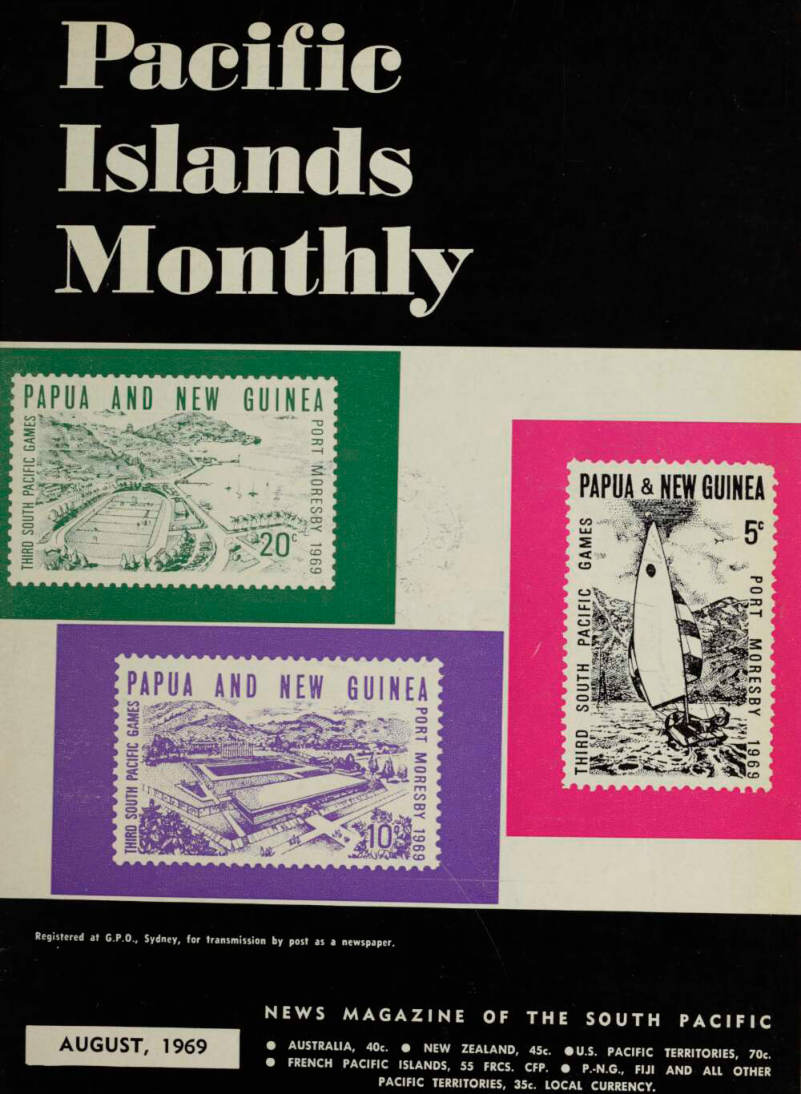 1
1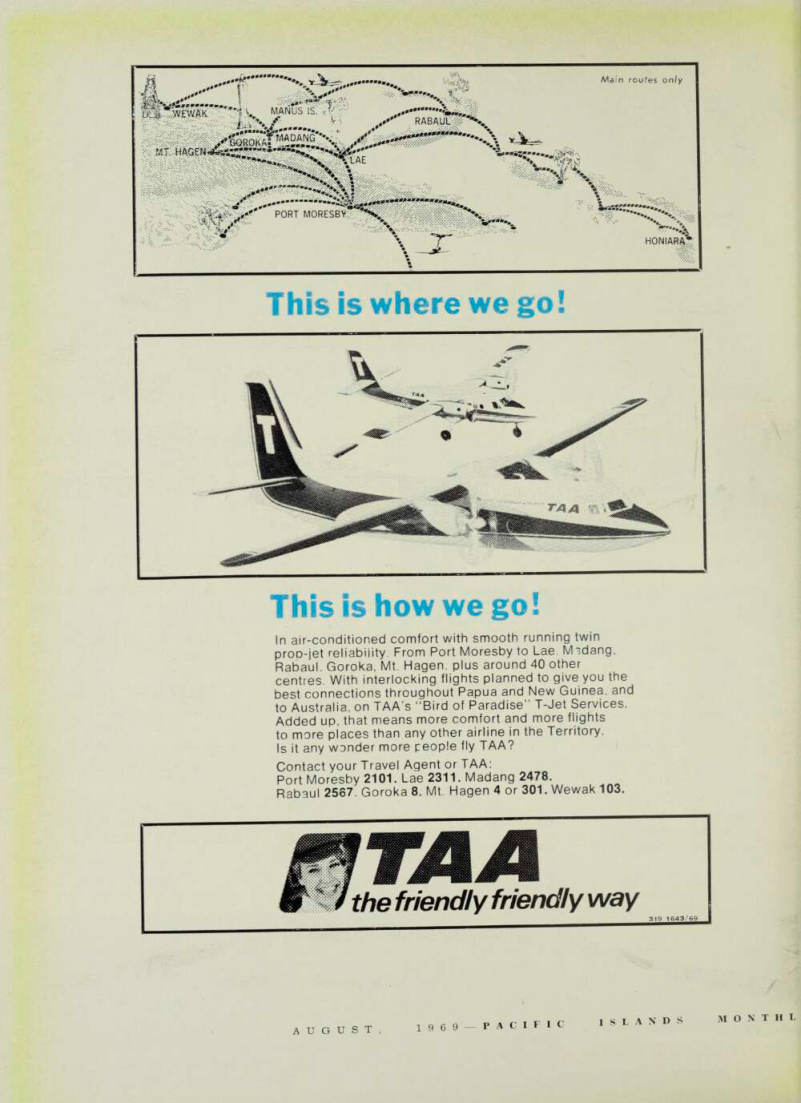 2
2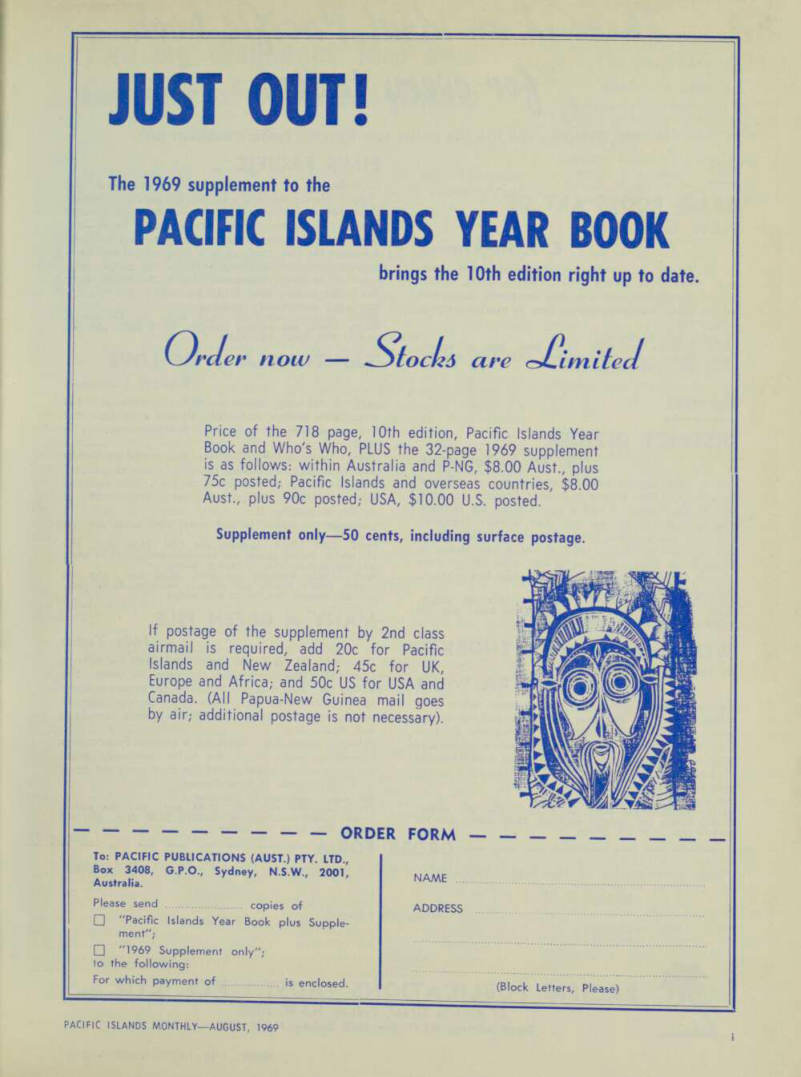 3
3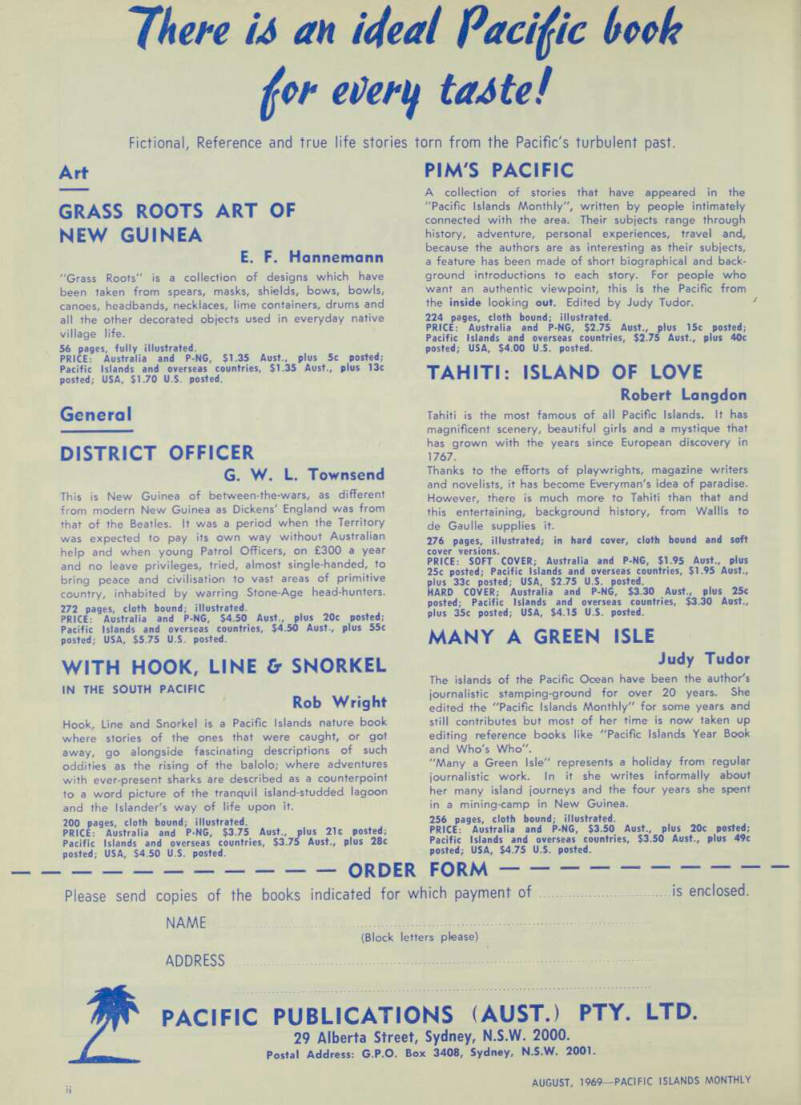 4
4 5
5 6
6 7
7 8
8 9
9 10
10 11
11 12
12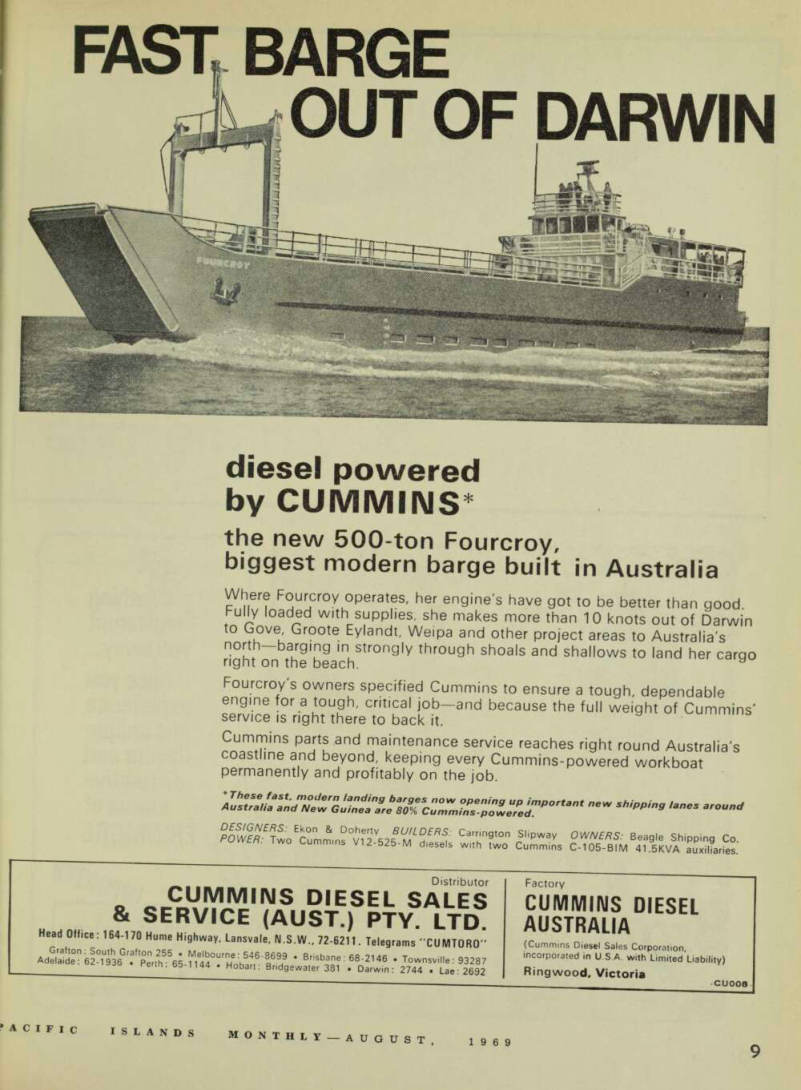 13
13 14
14 15
15 16
16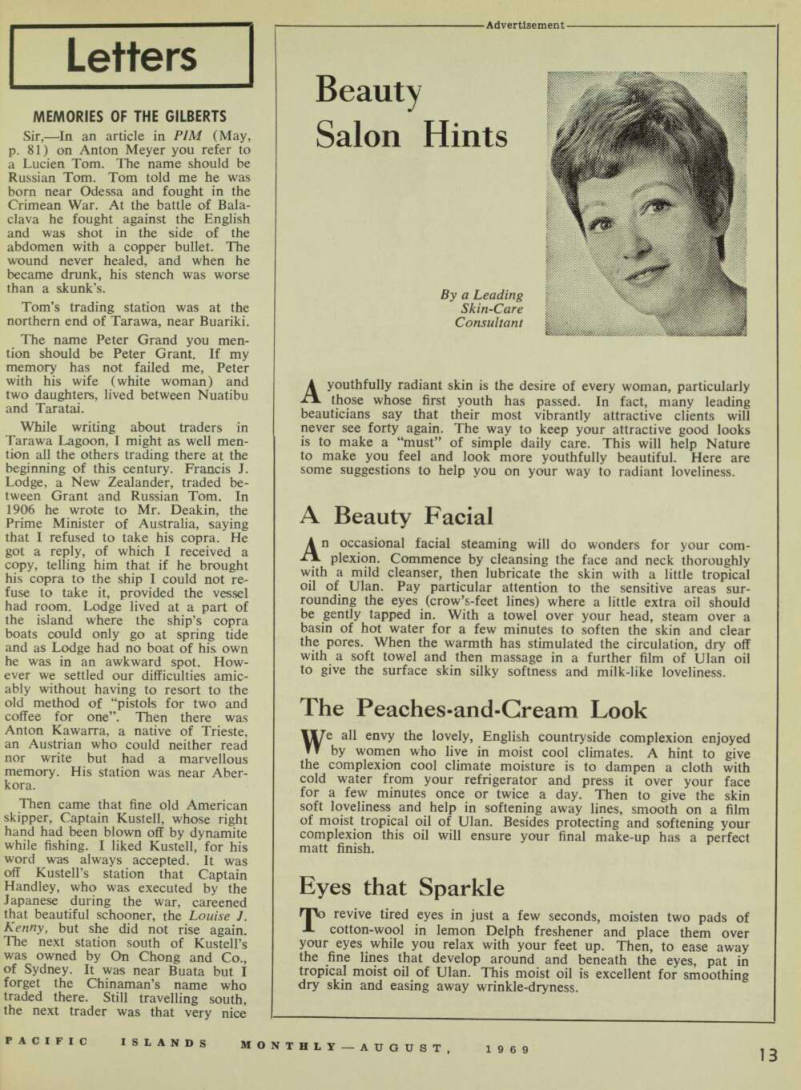 17
17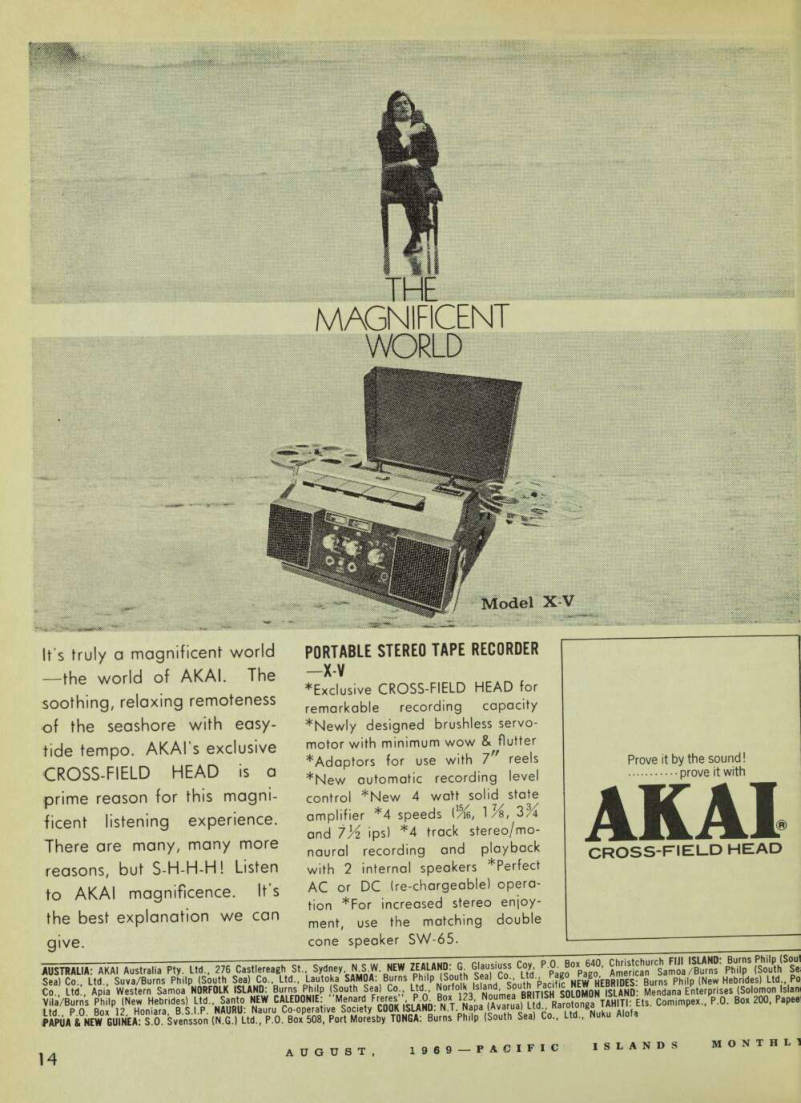 18
18 19
19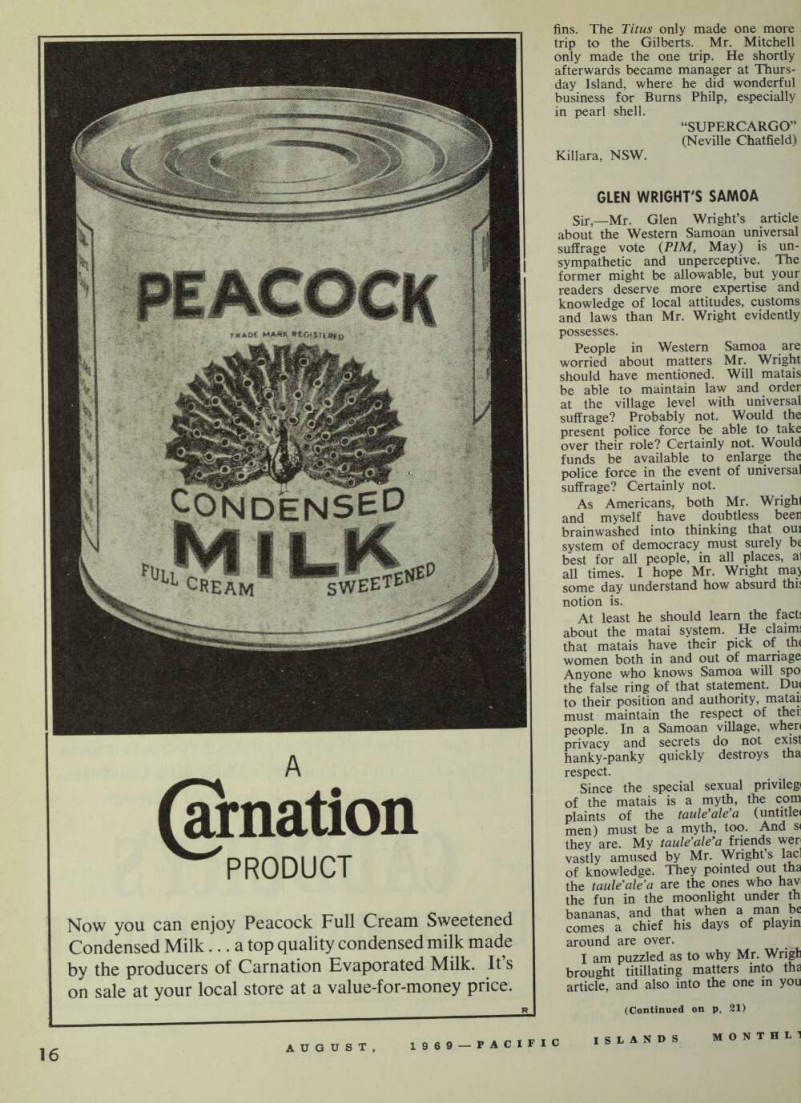 20
20 21
21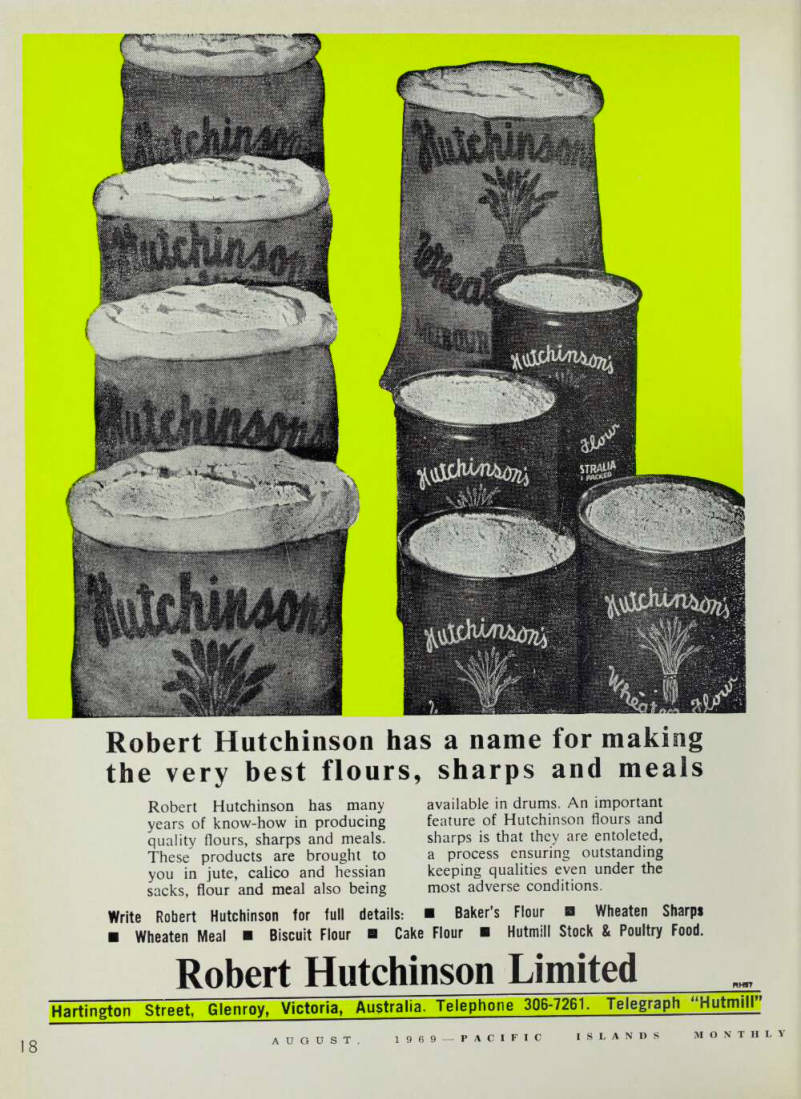 22
22 23
23 24
24 25
25 26
26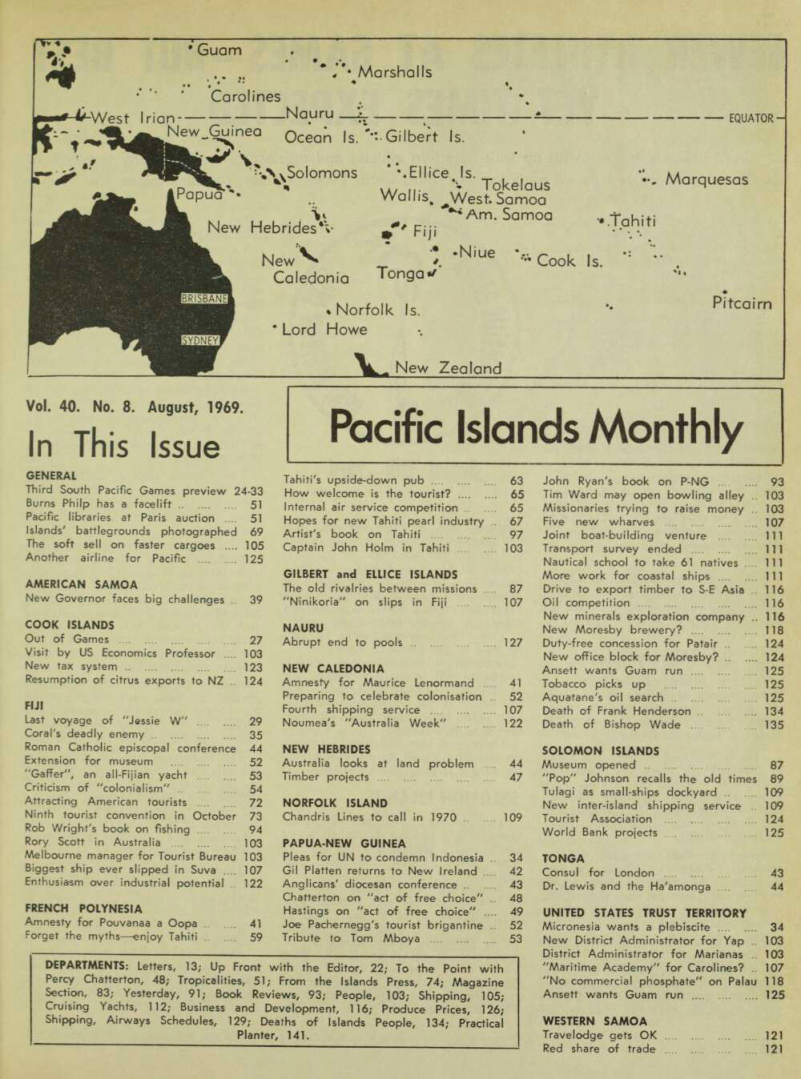 27
27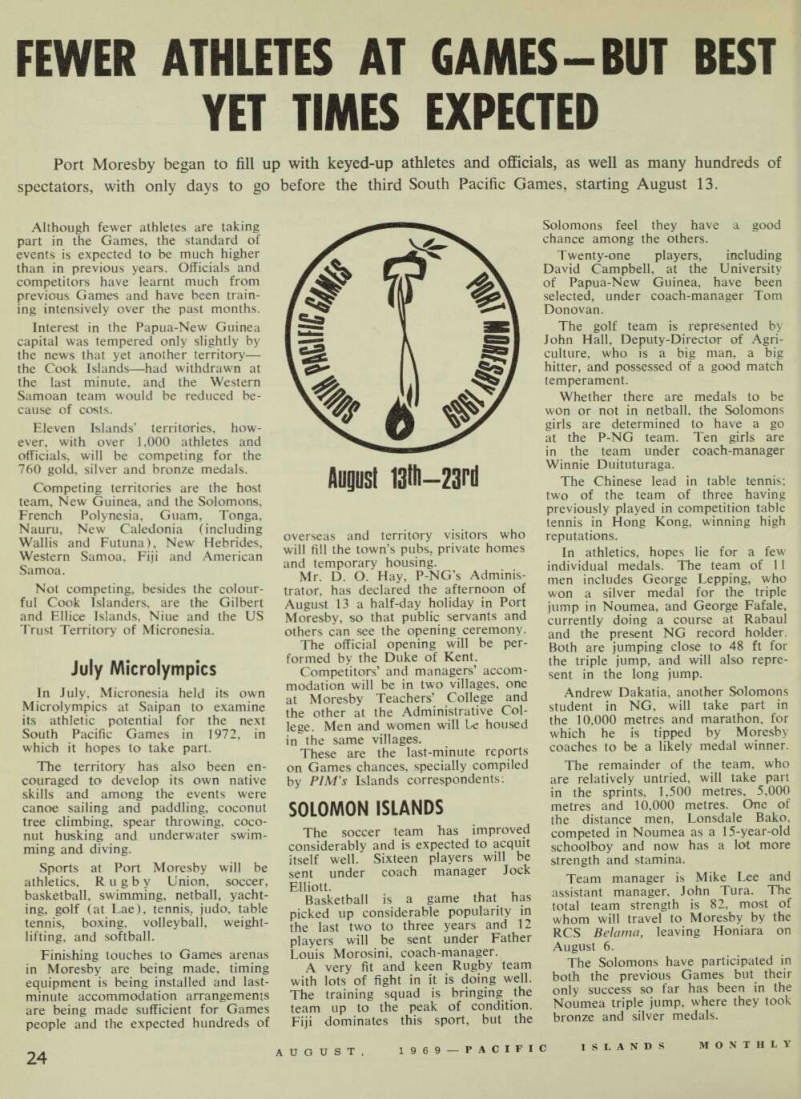 28
28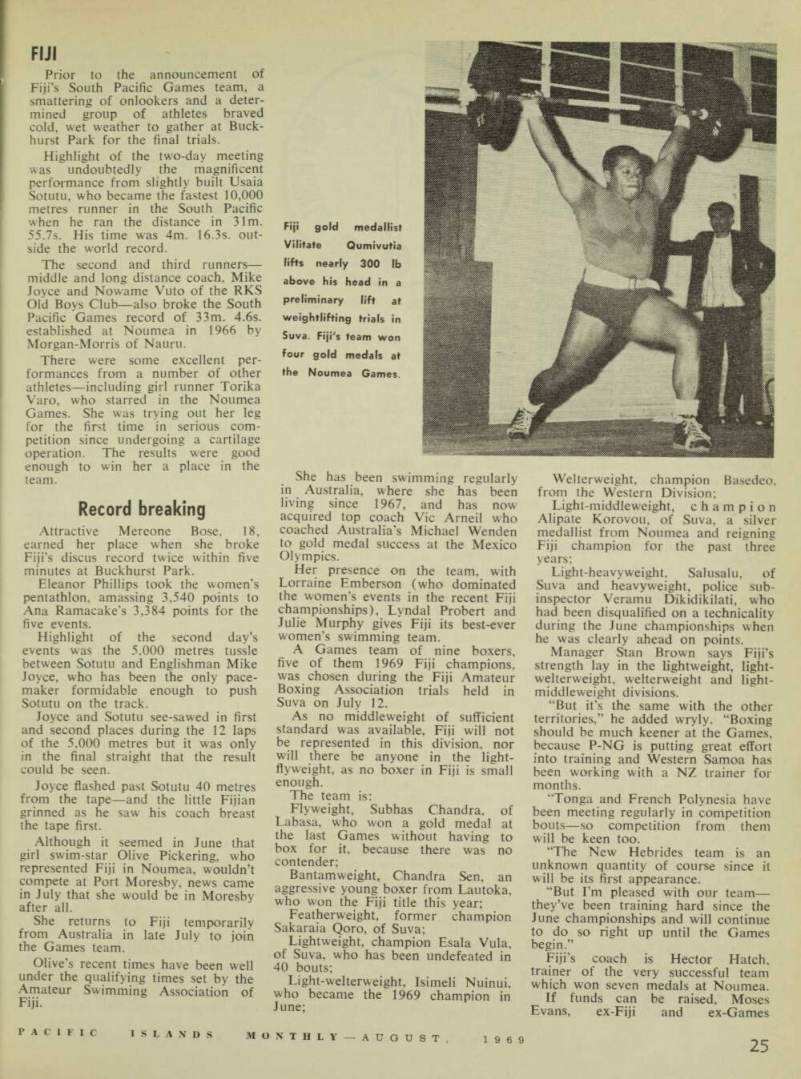 29
29 30
30 31
31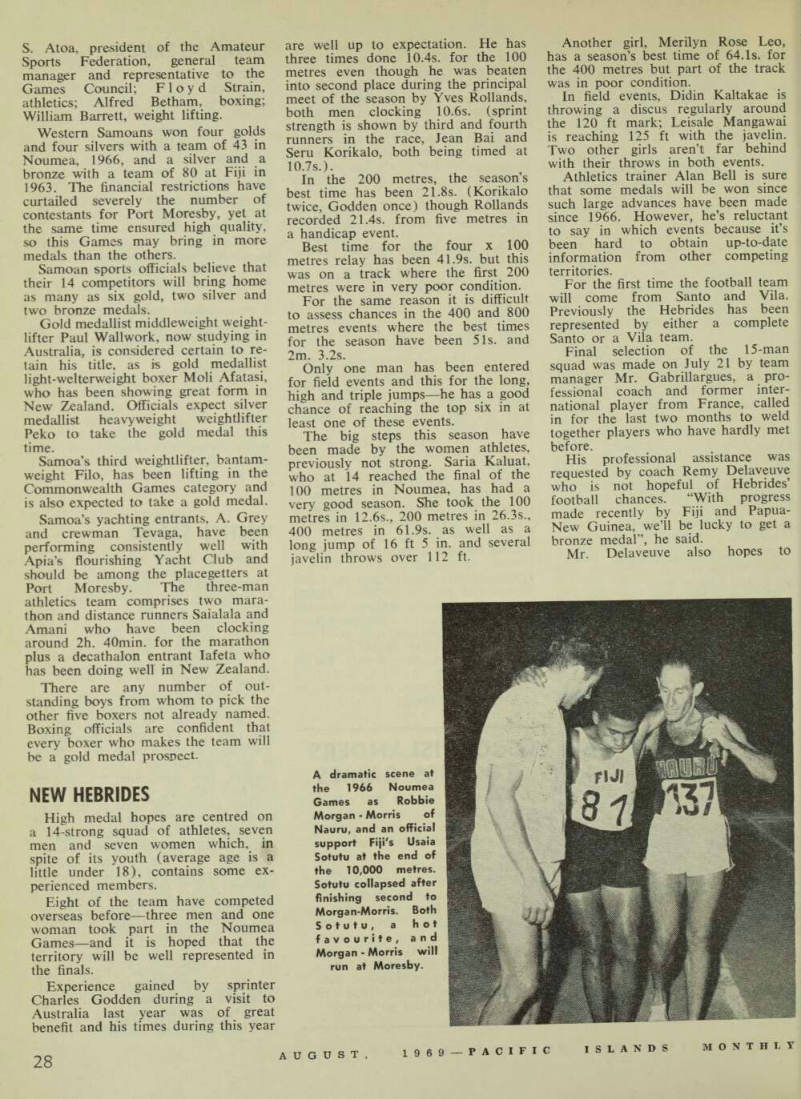 32
32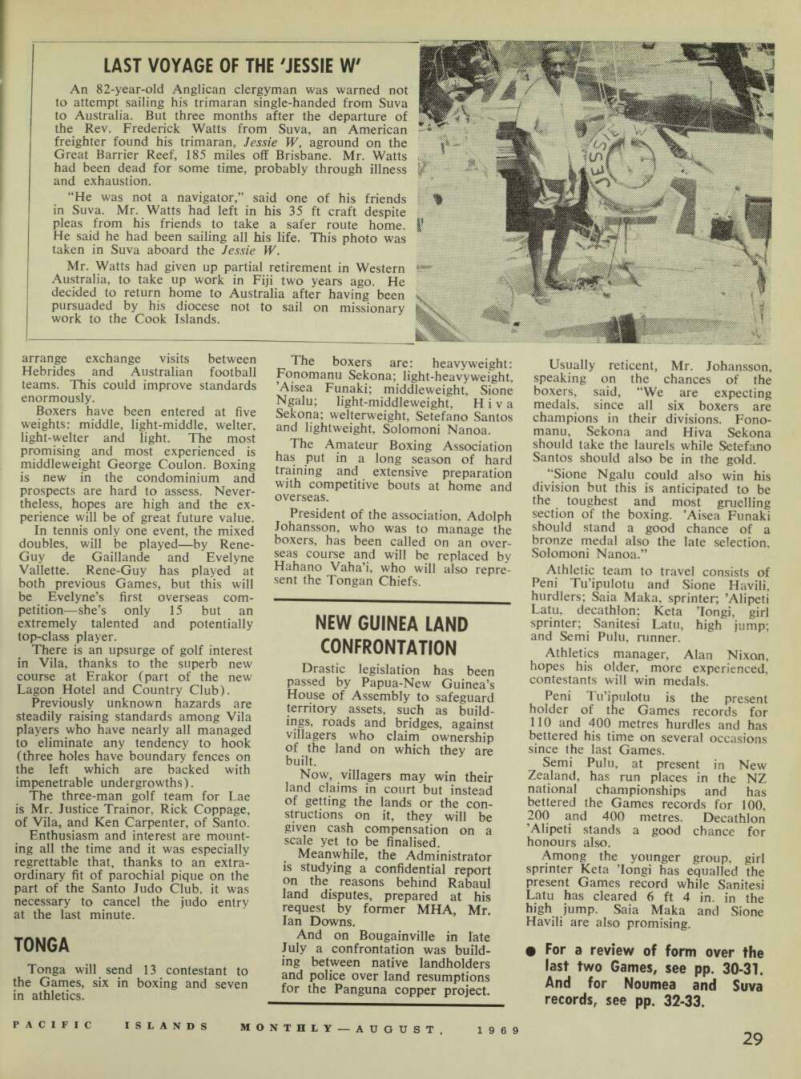 33
33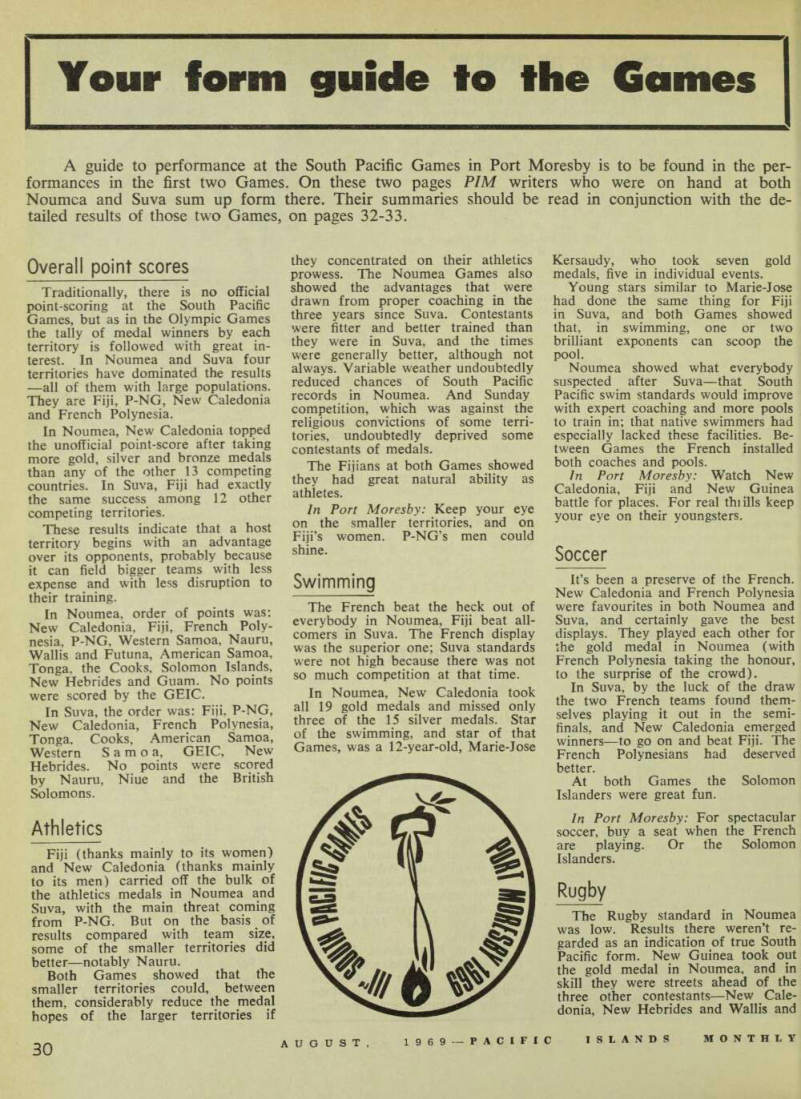 34
34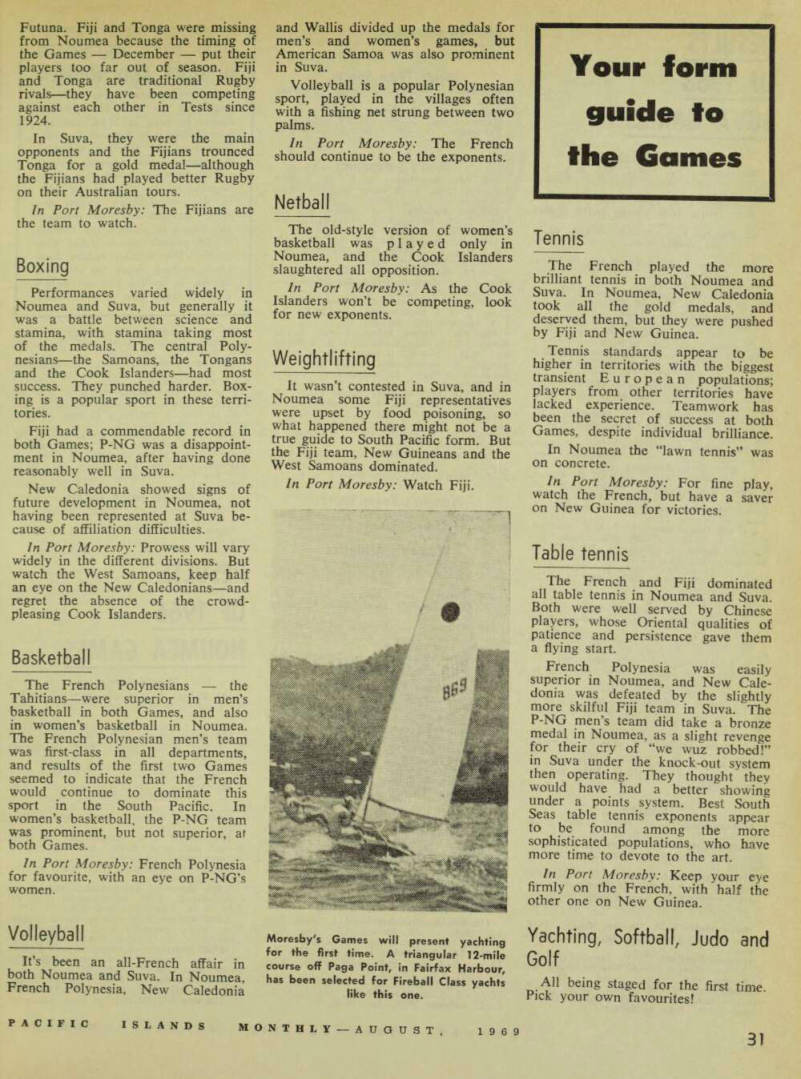 35
35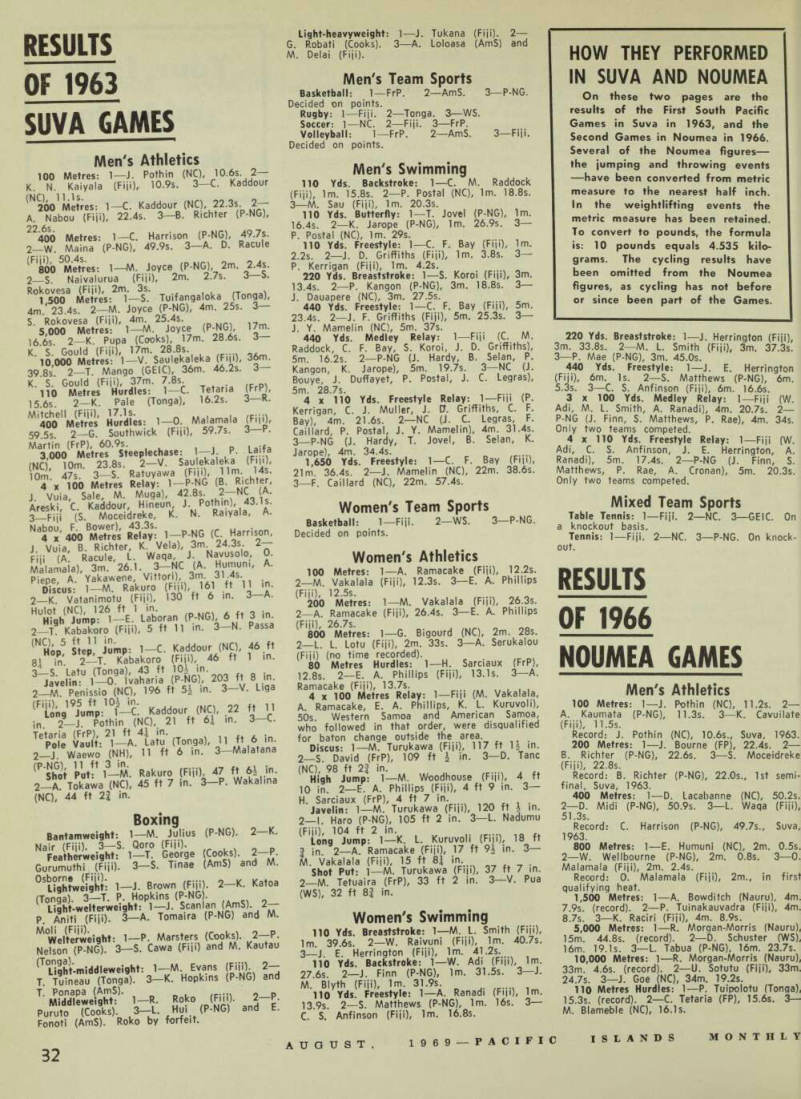 36
36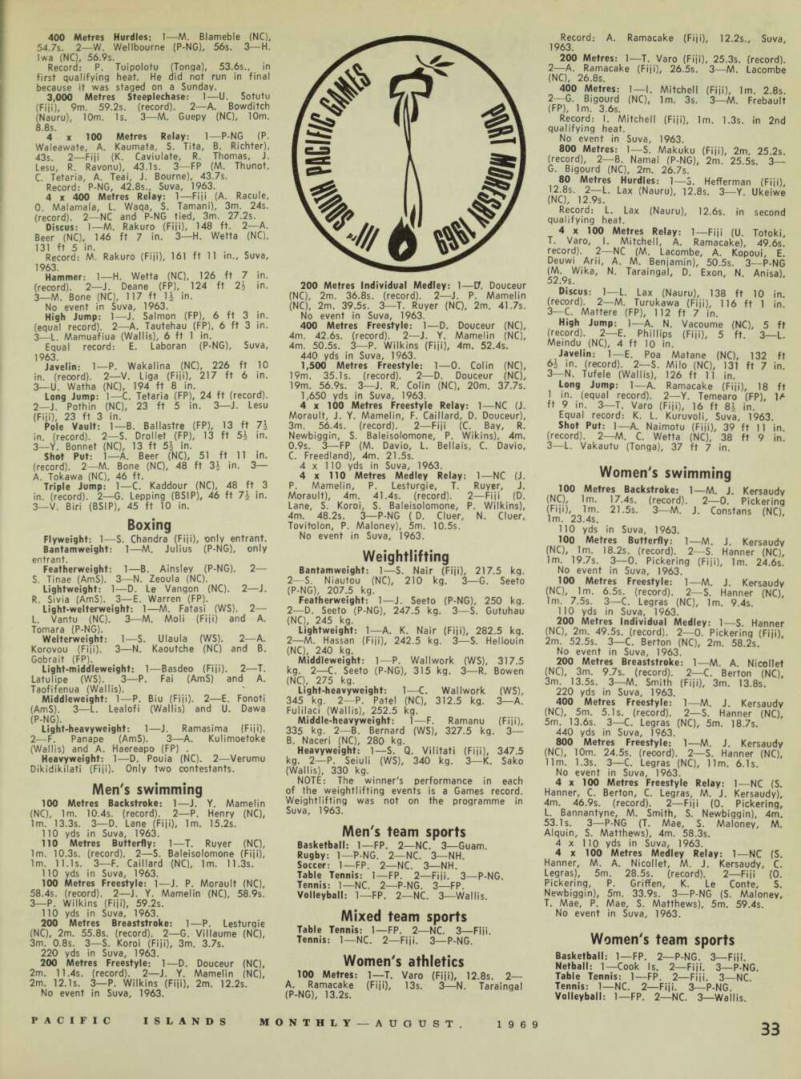 37
37 38
38 39
39 40
40 41
41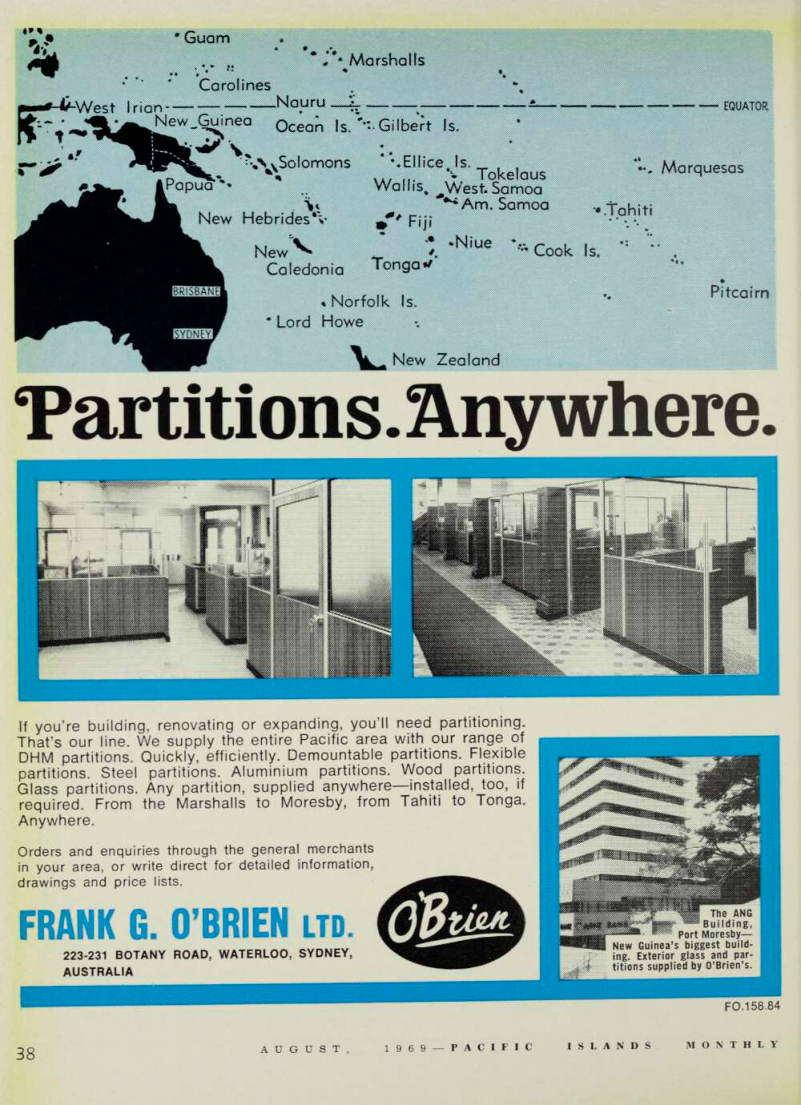 42
42 43
43 44
44 45
45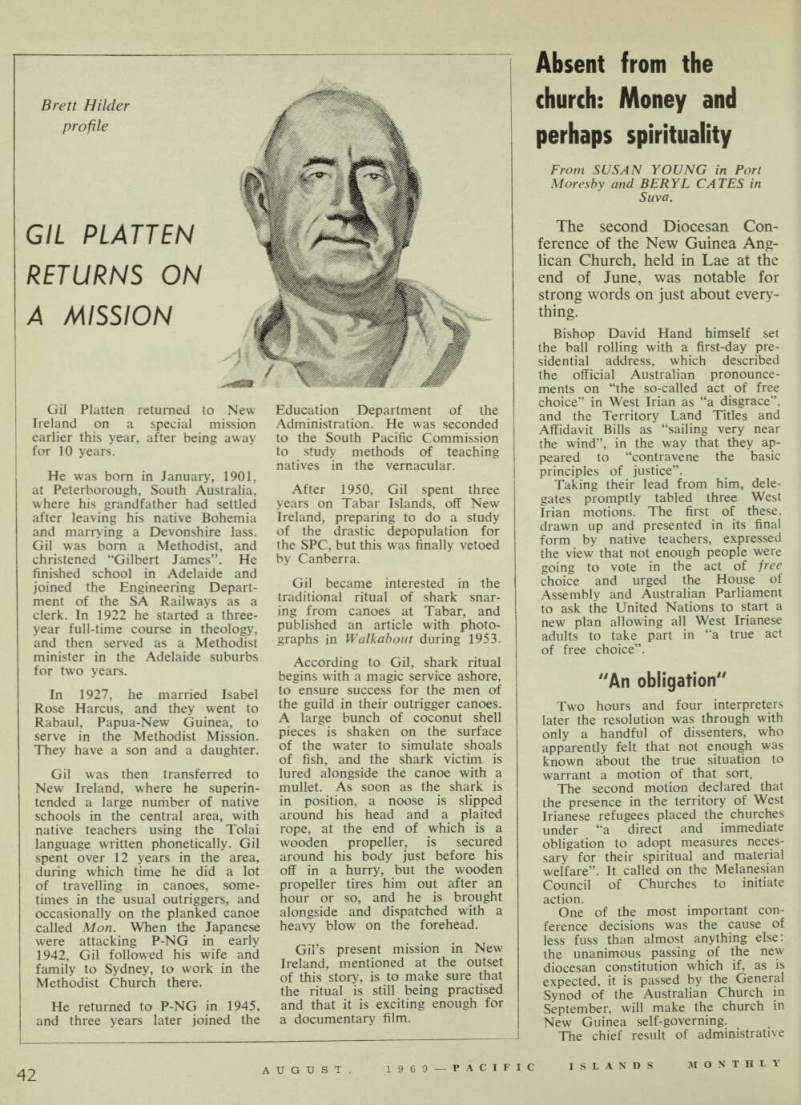 46
46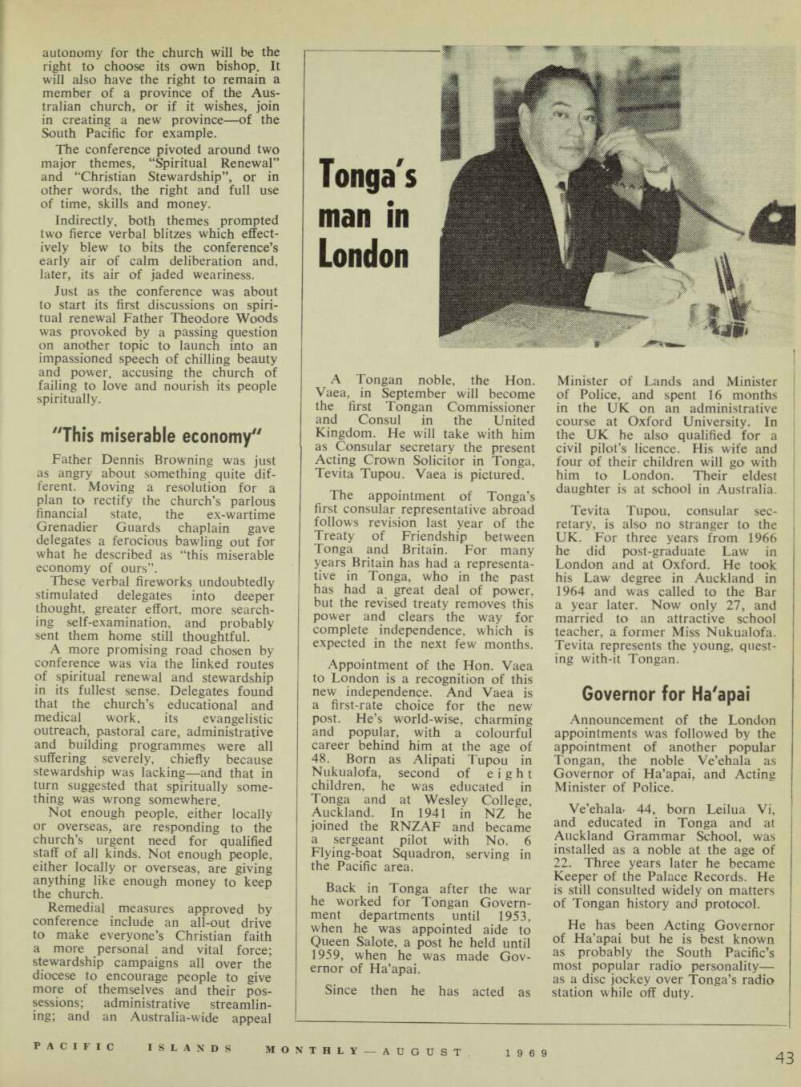 47
47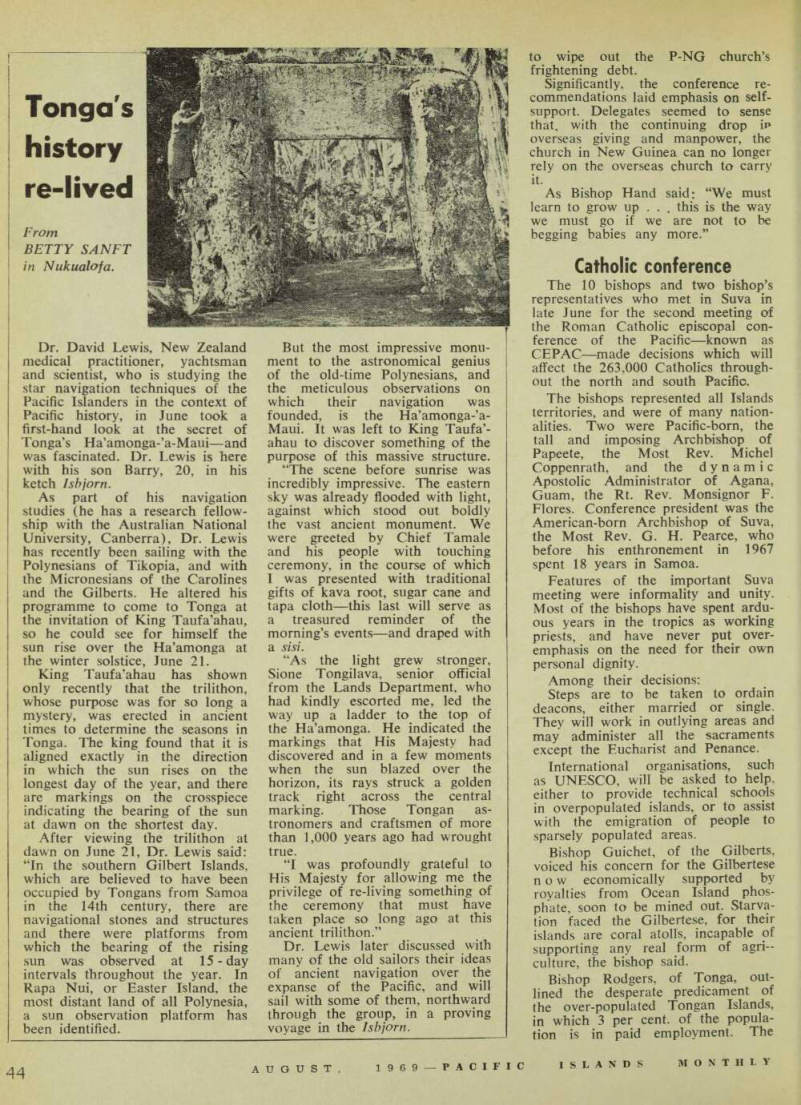 48
48 49
49 50
50 51
51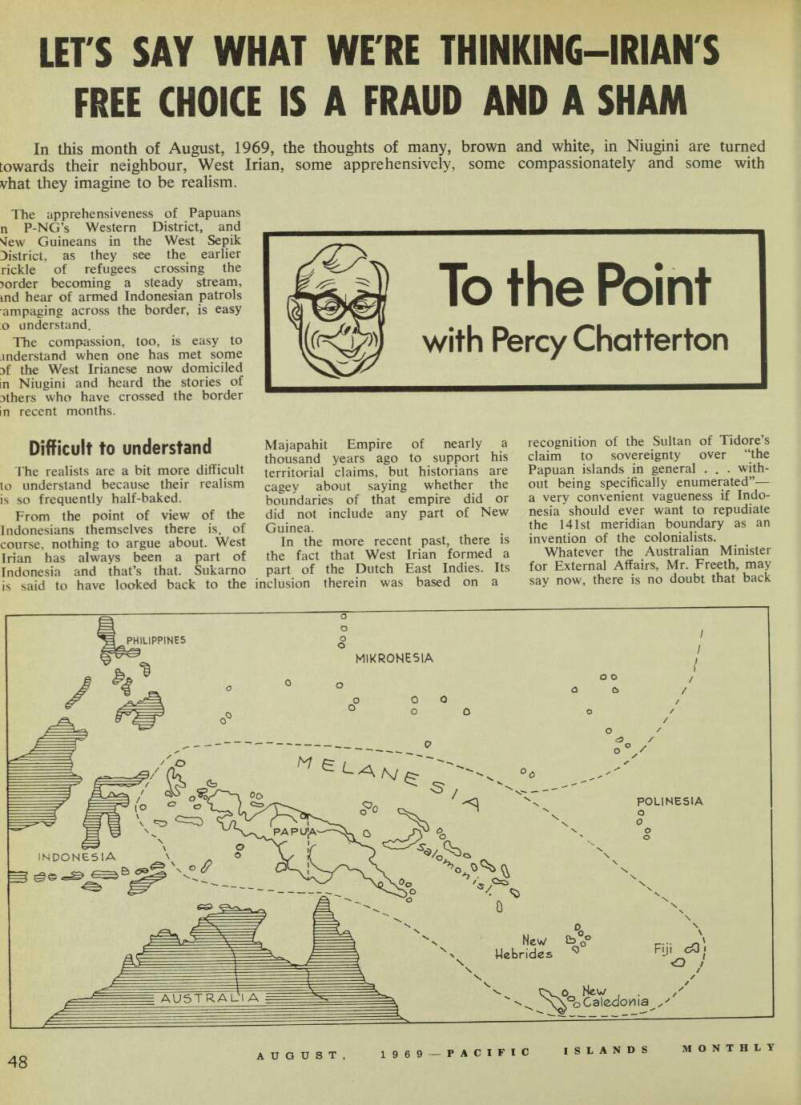 52
52 53
53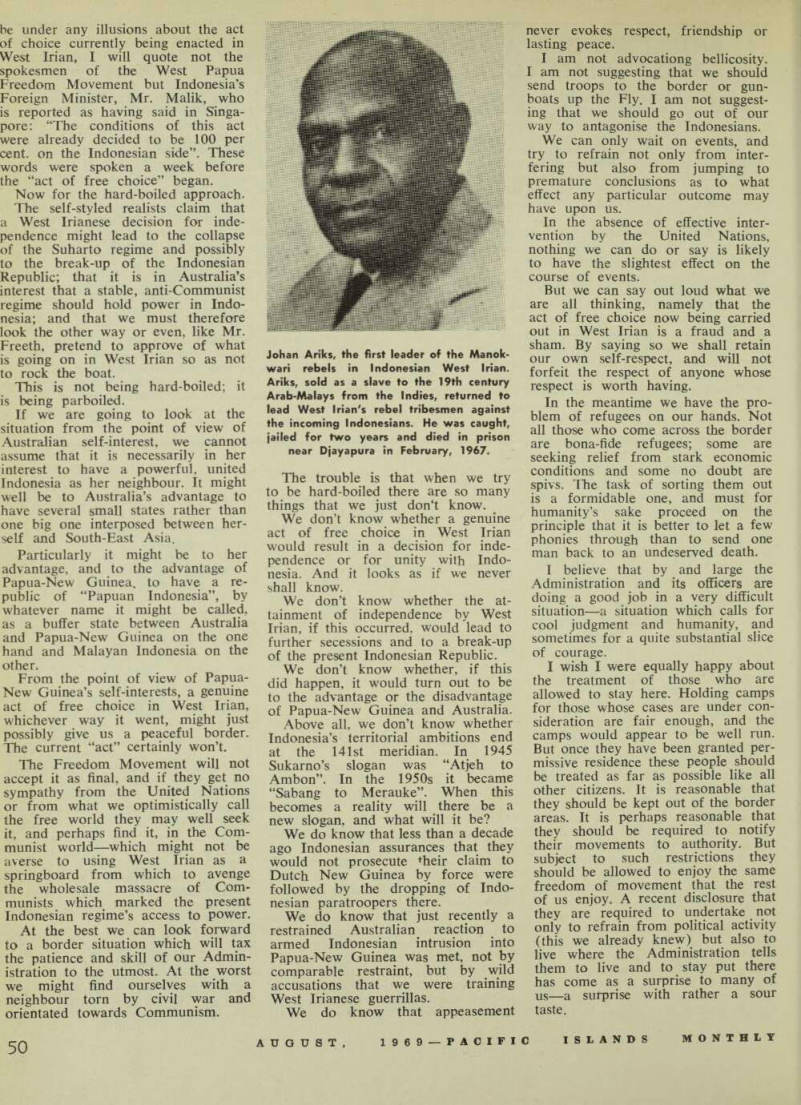 54
54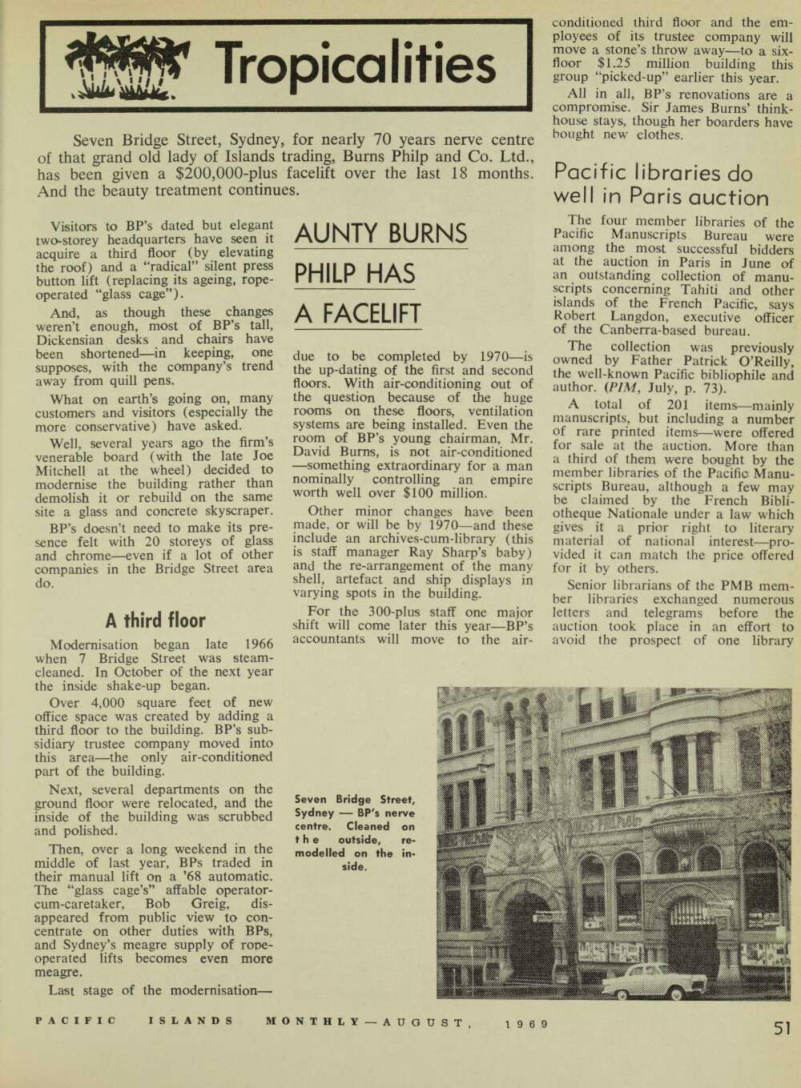 55
55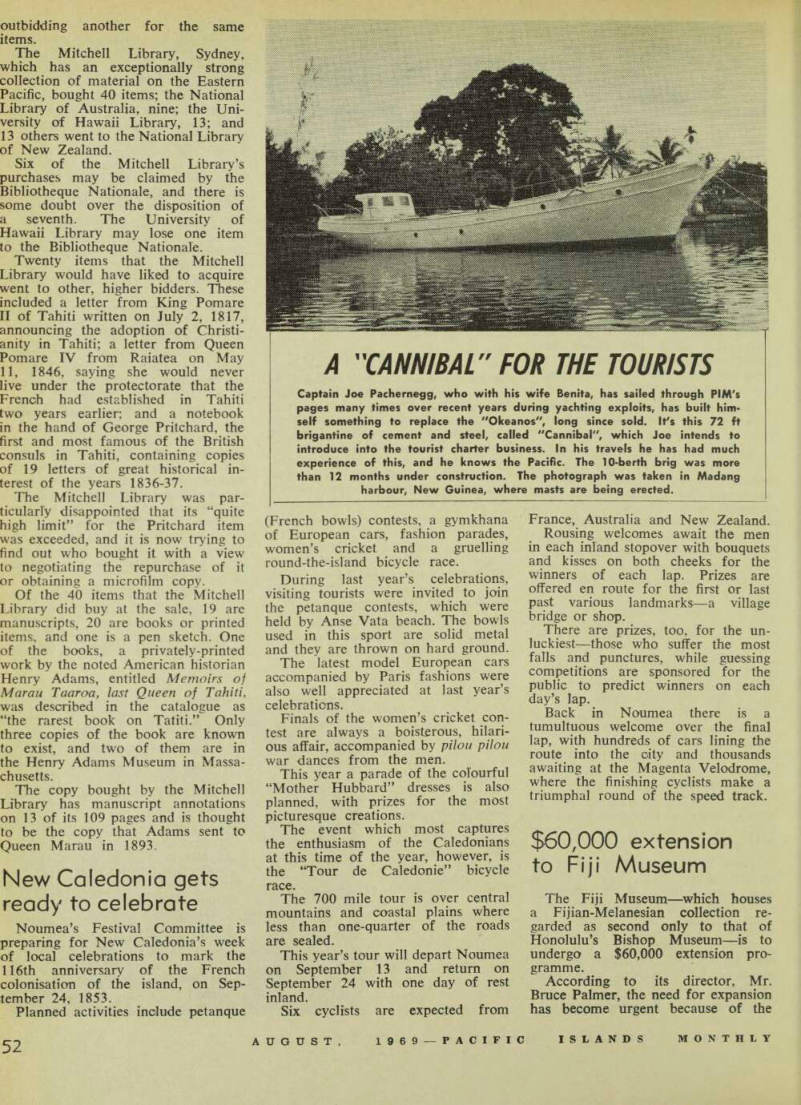 56
56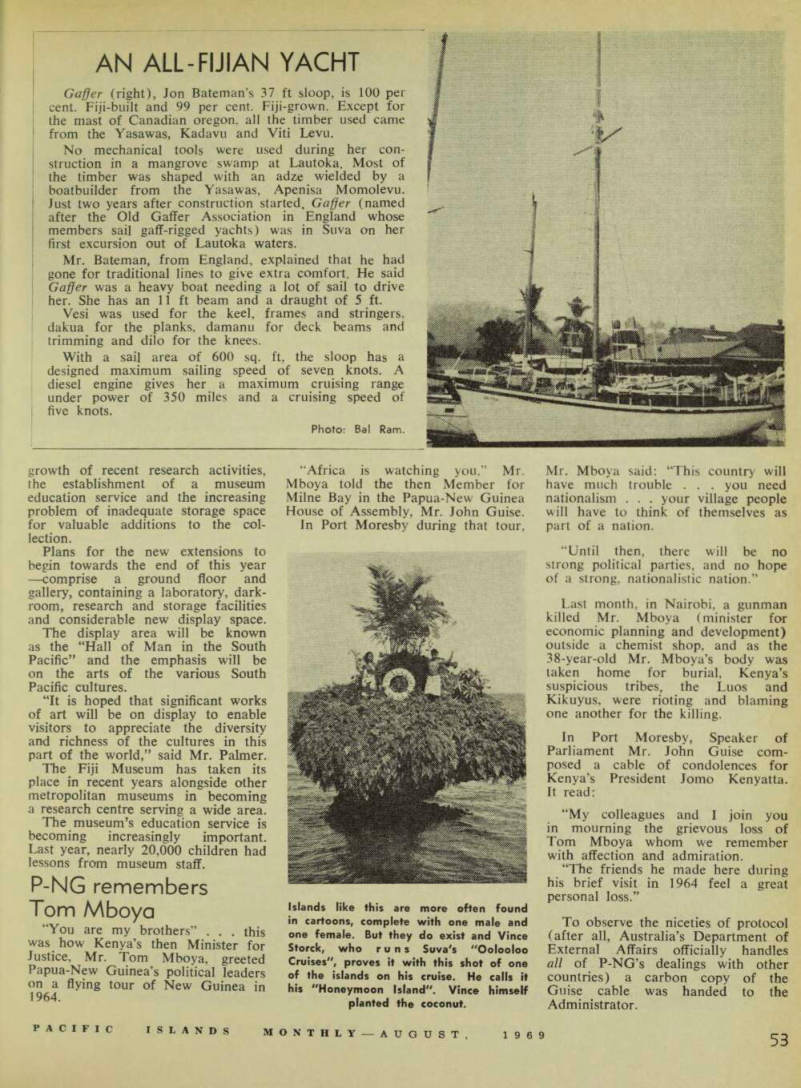 57
57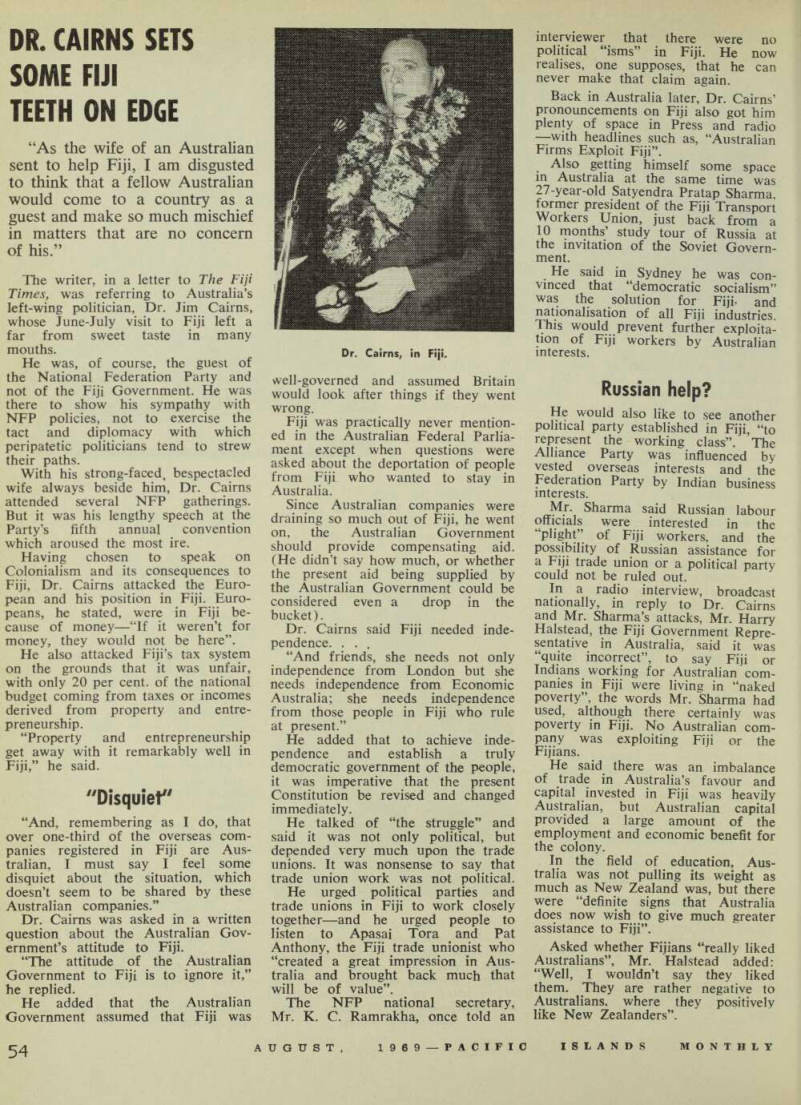 58
58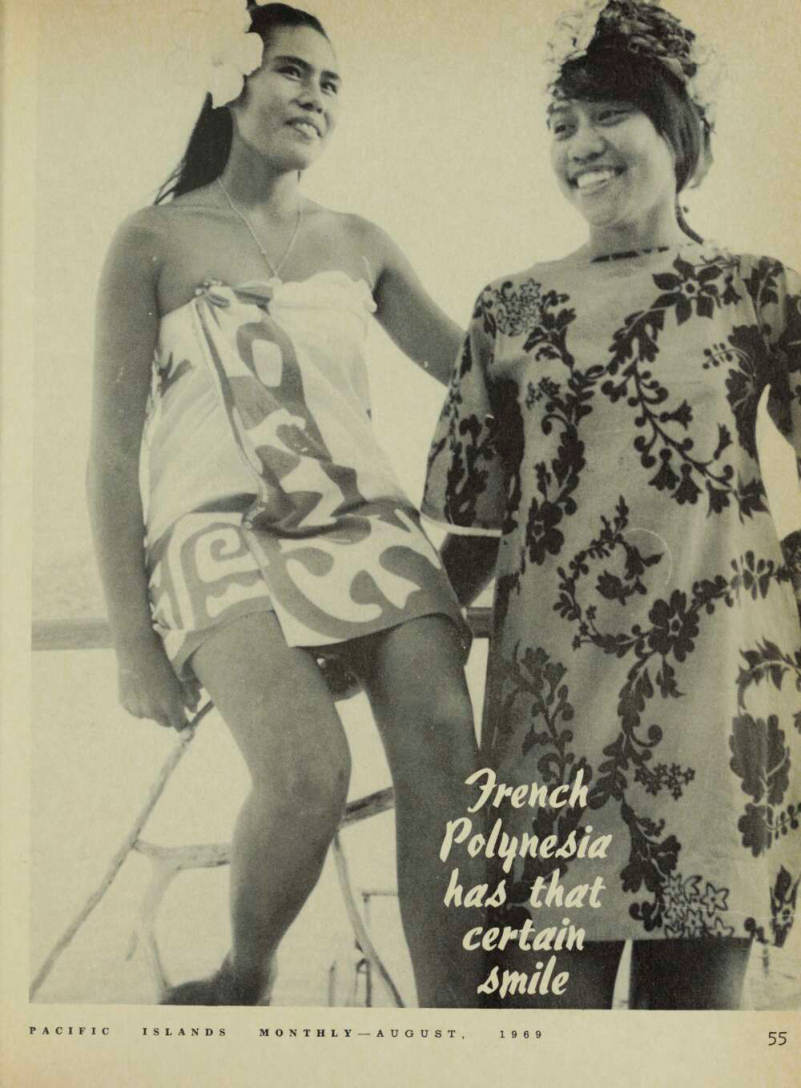 59
59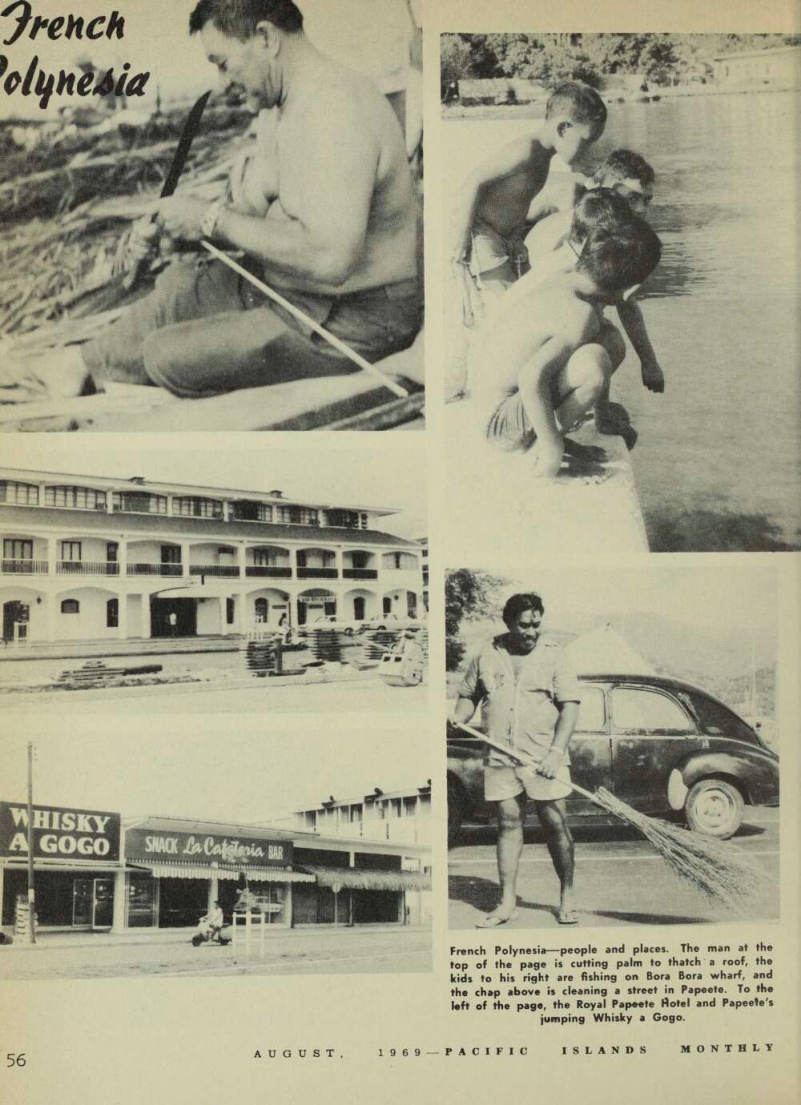 60
60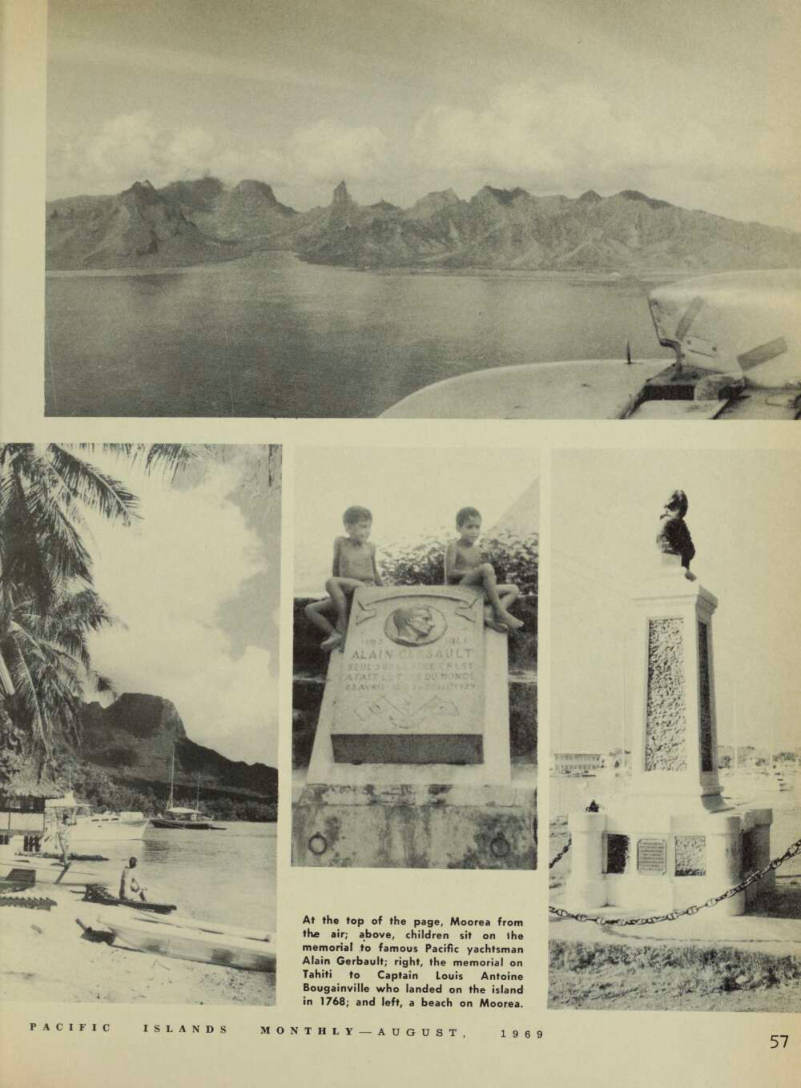 61
61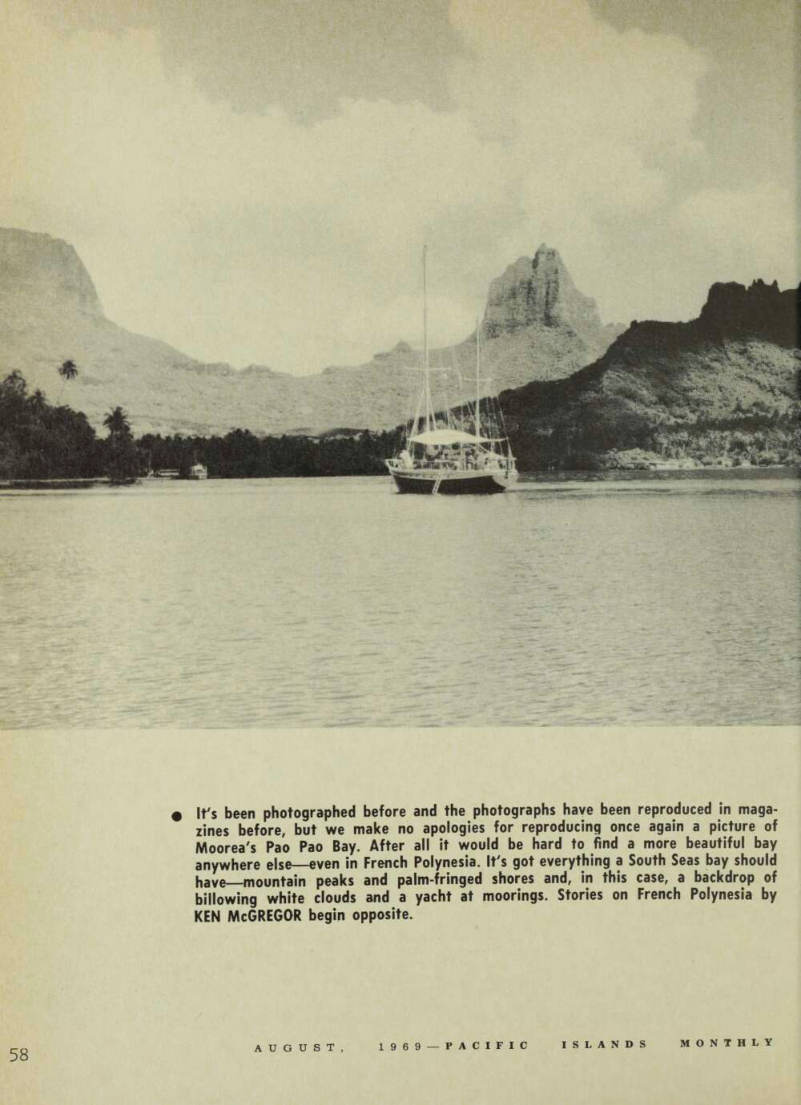 62
62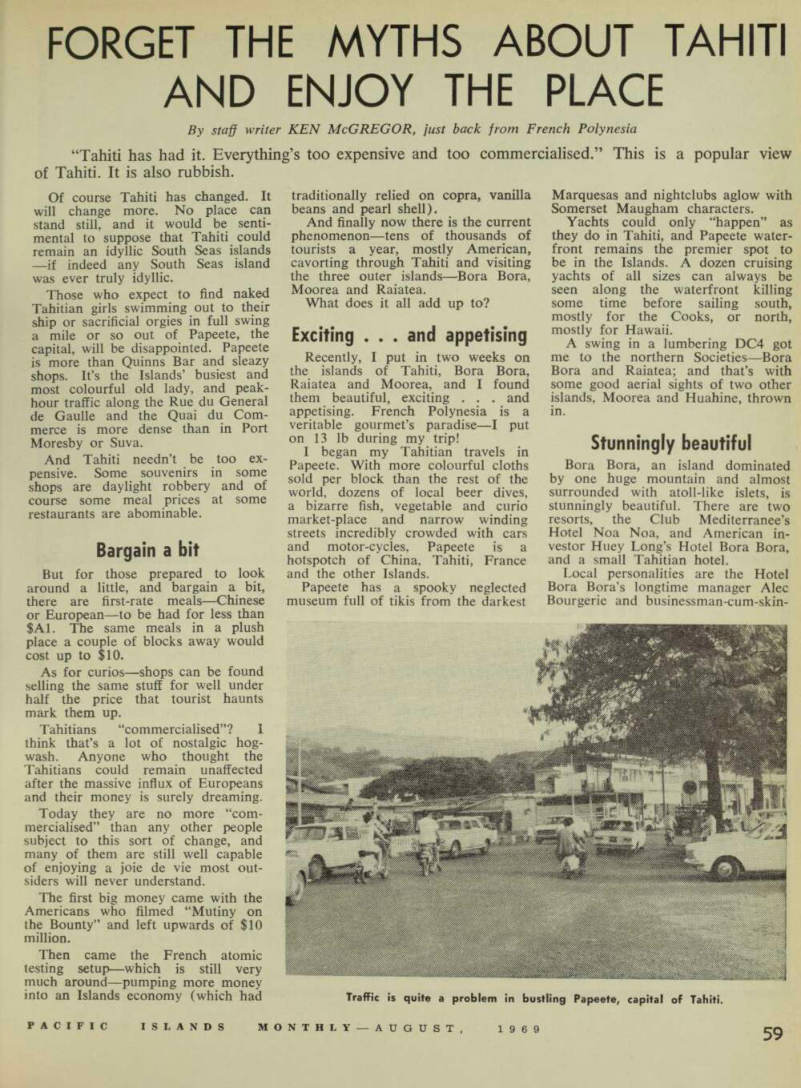 63
63 64
64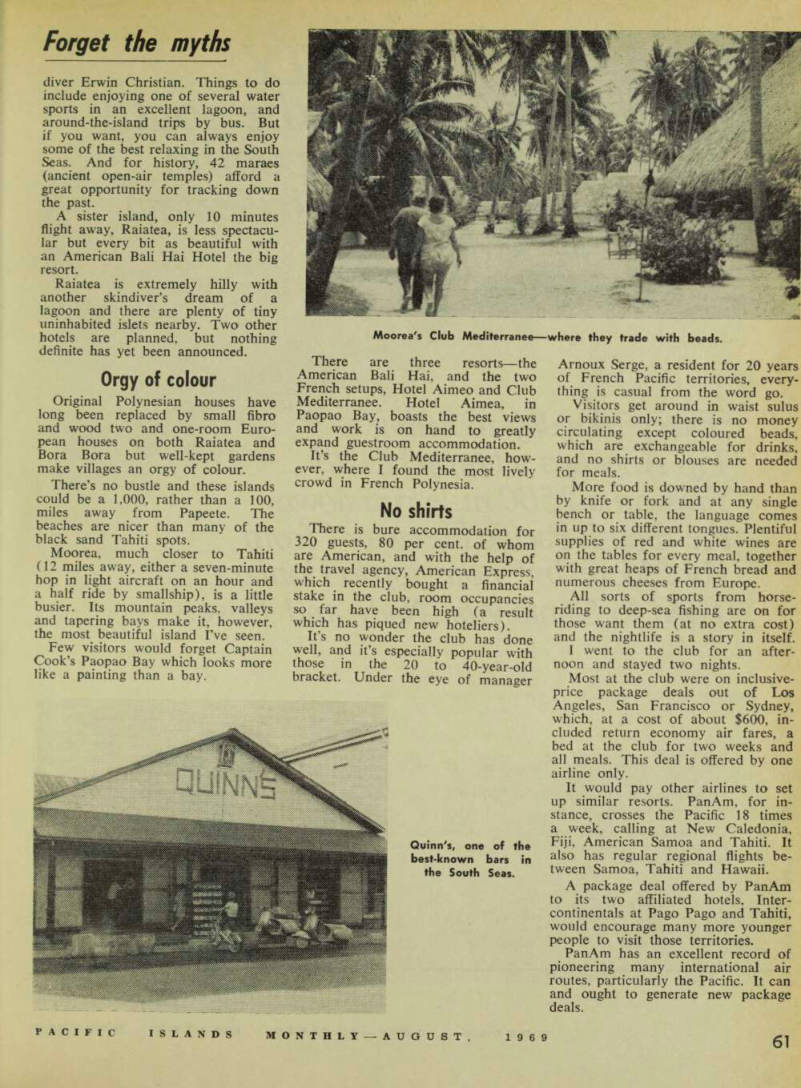 65
65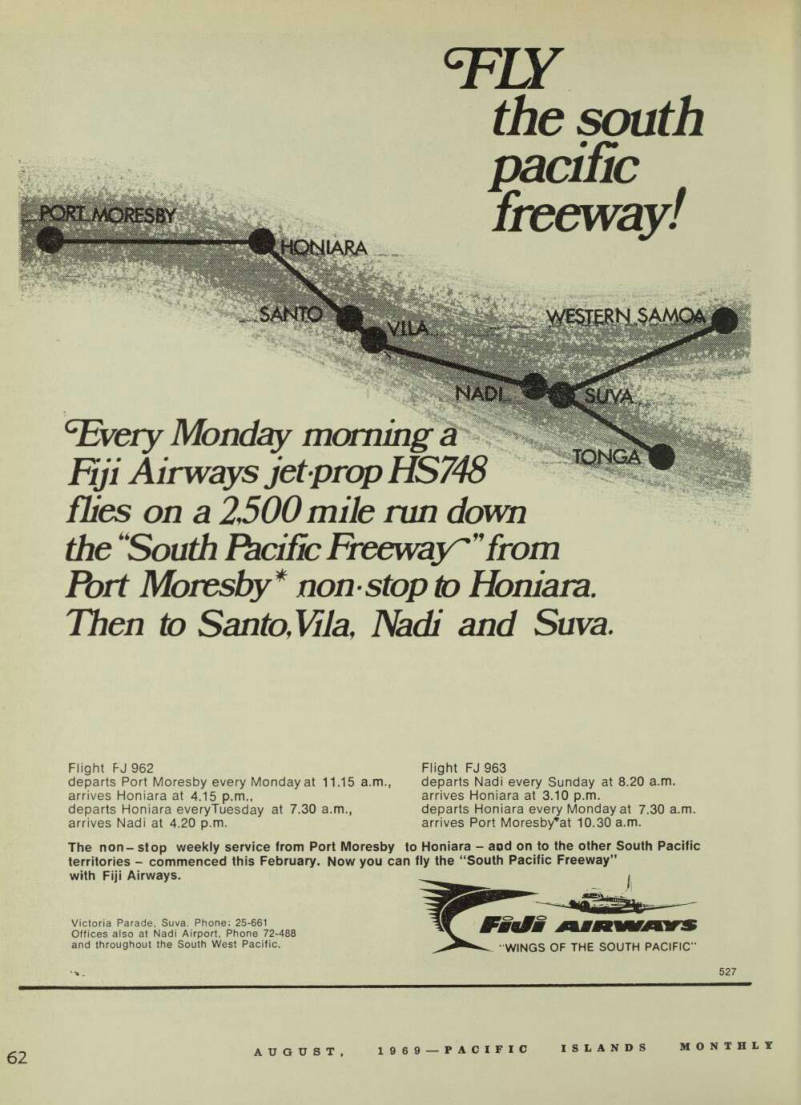 66
66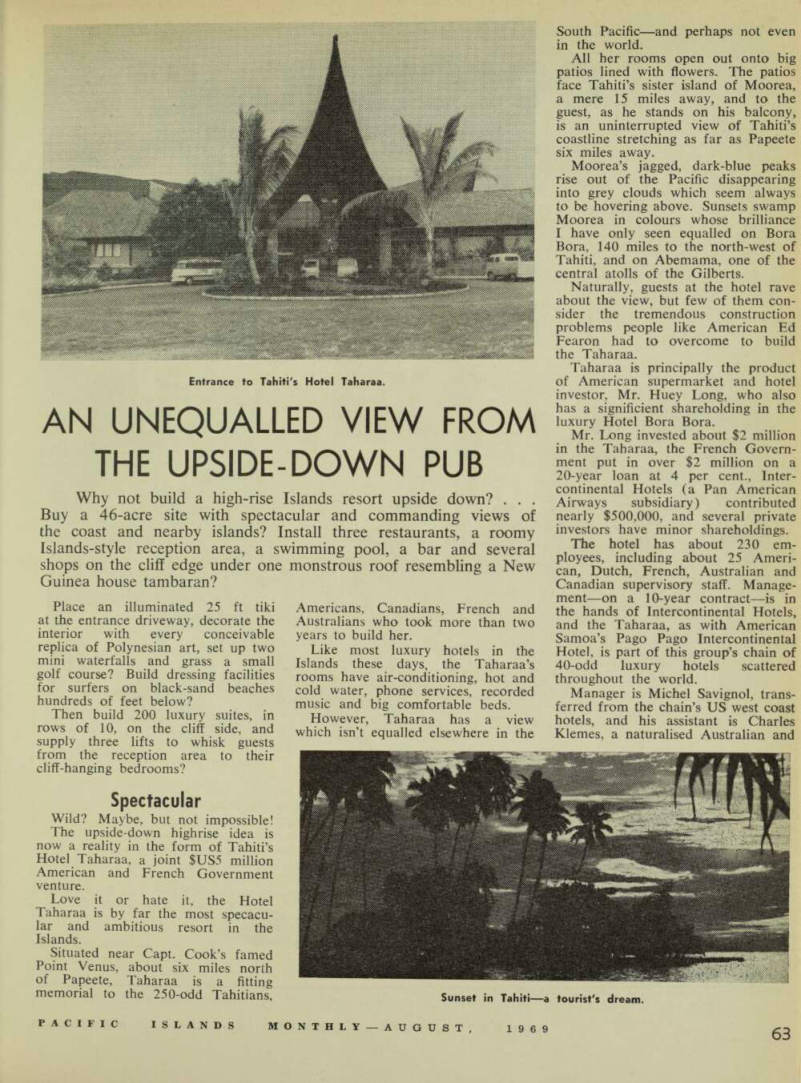 67
67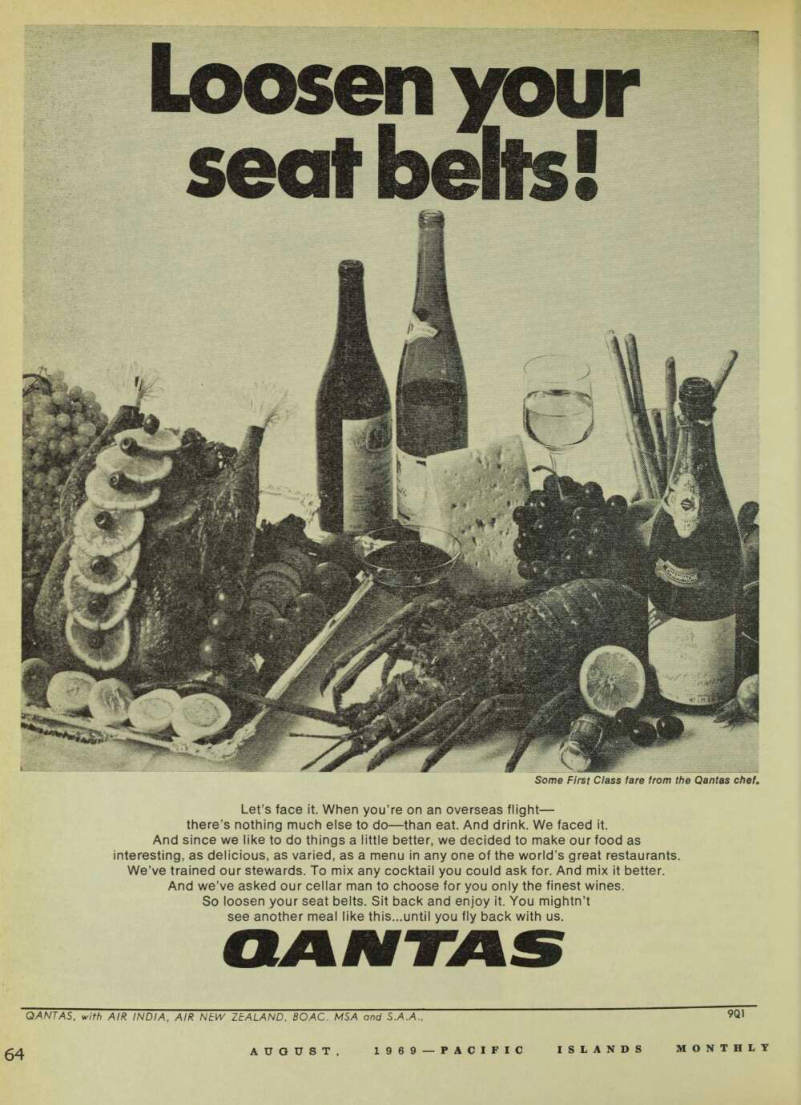 68
68 69
69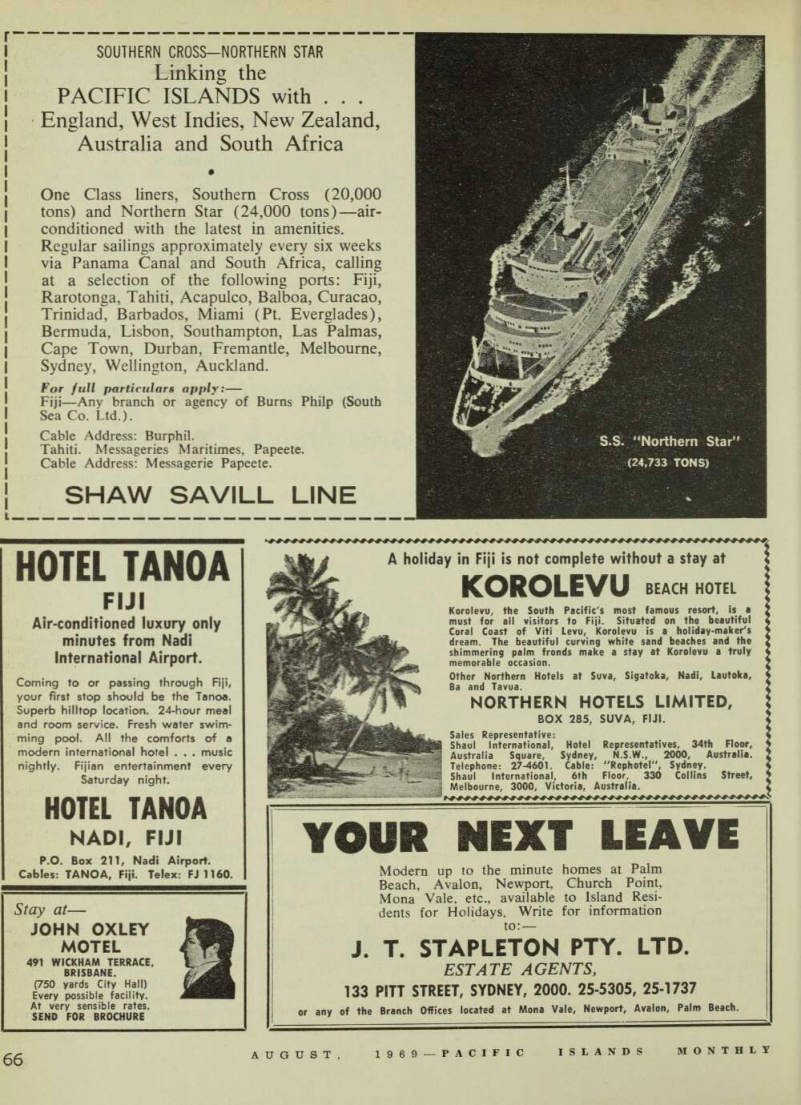 70
70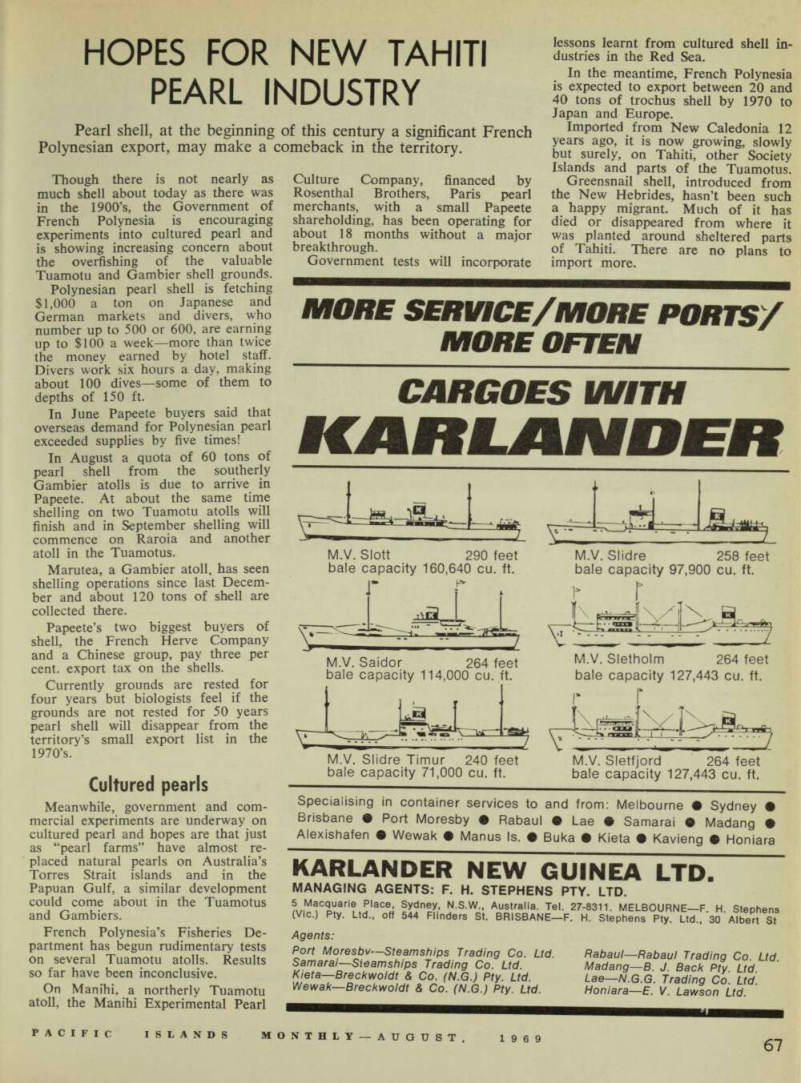 71
71 72
72 73
73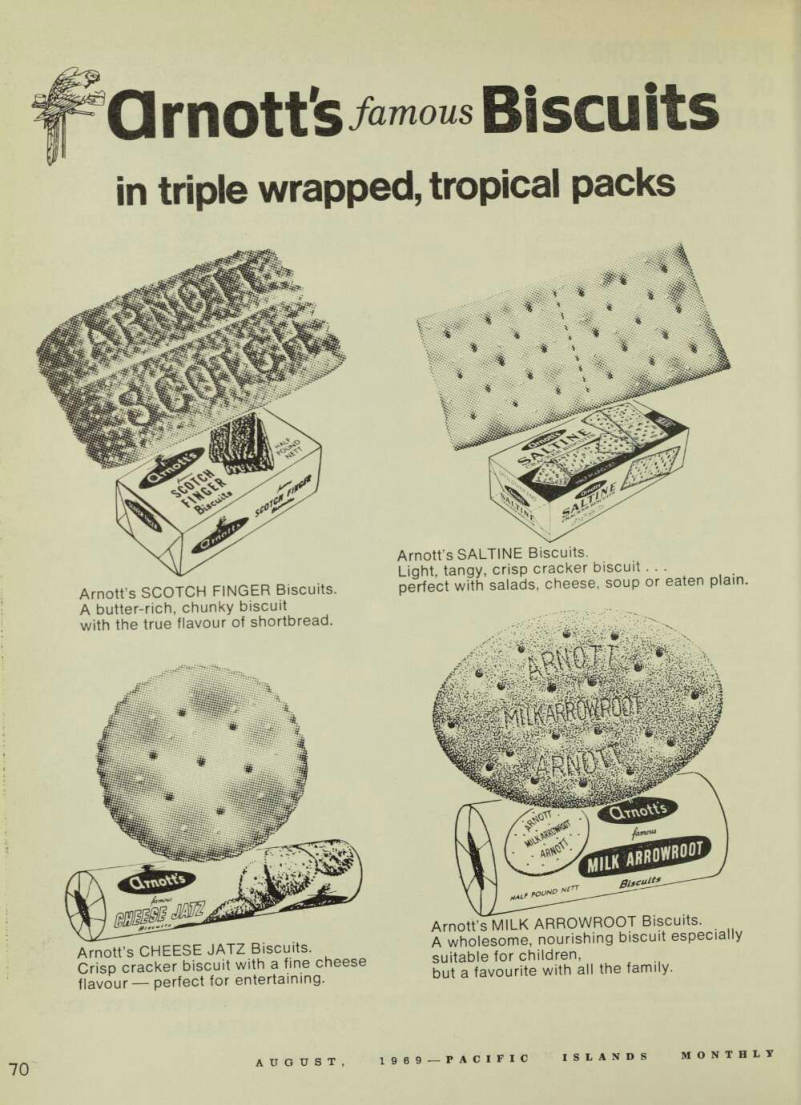 74
74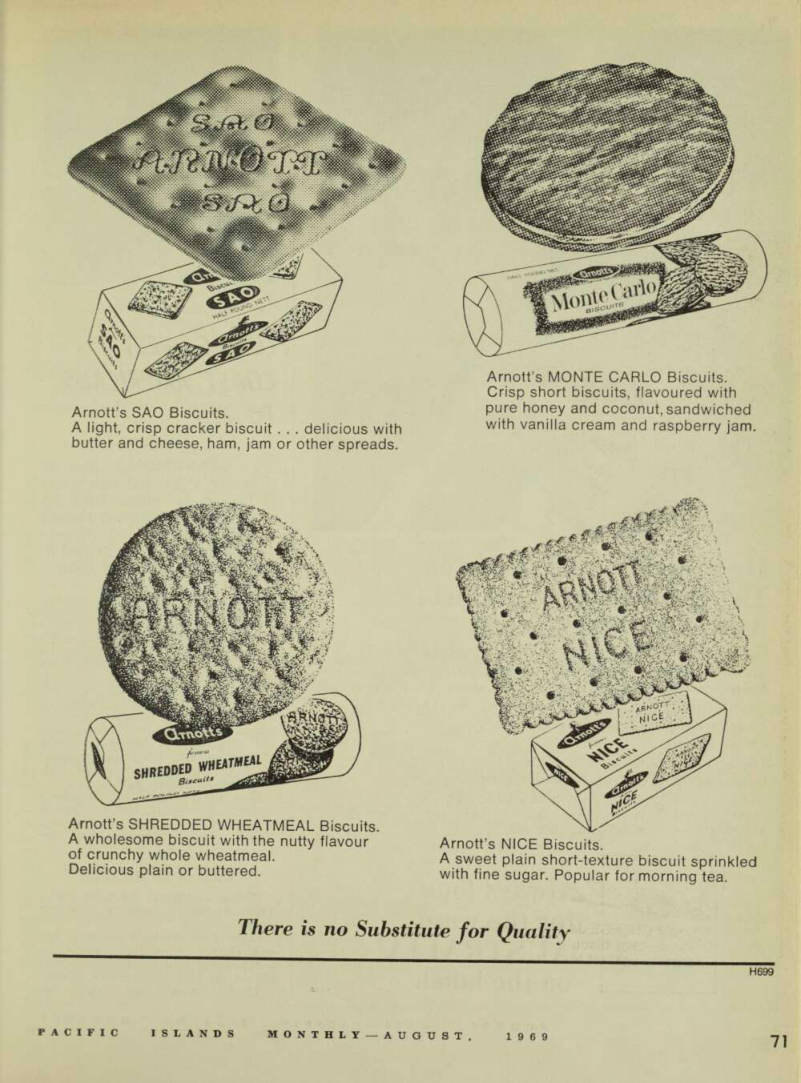 75
75 76
76 77
77 78
78 79
79 80
80 81
81 82
82 83
83 84
84 85
85 86
86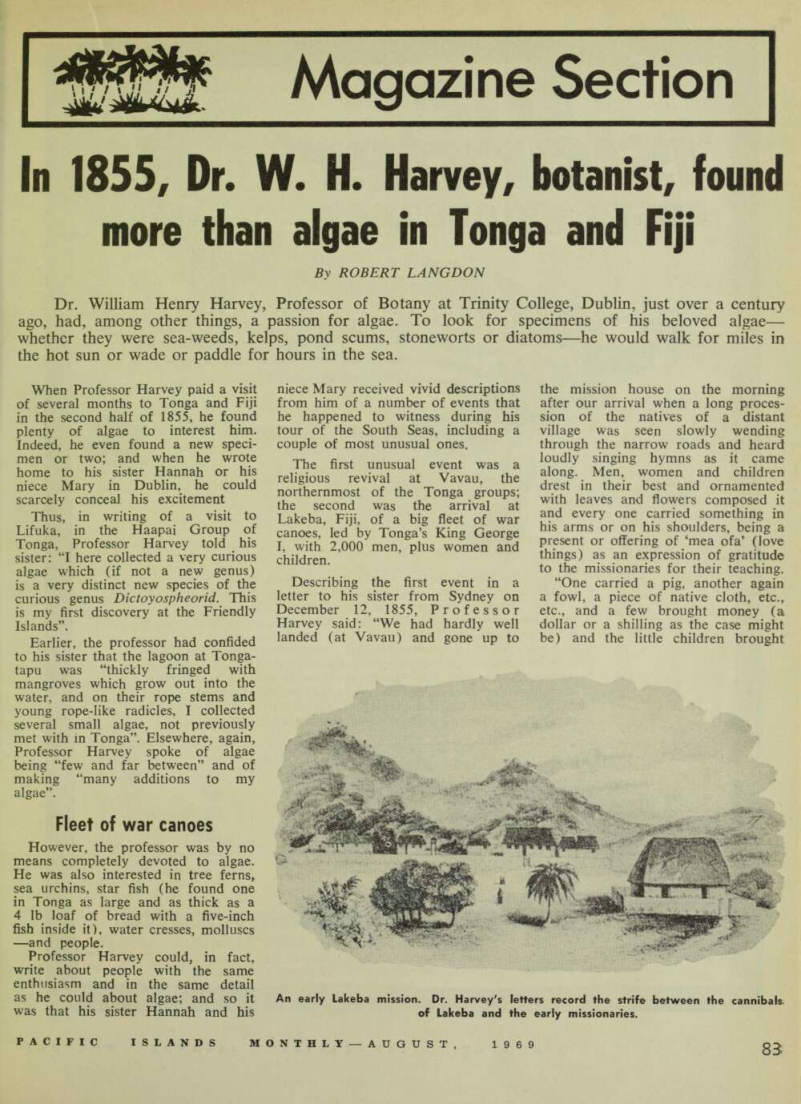 87
87 88
88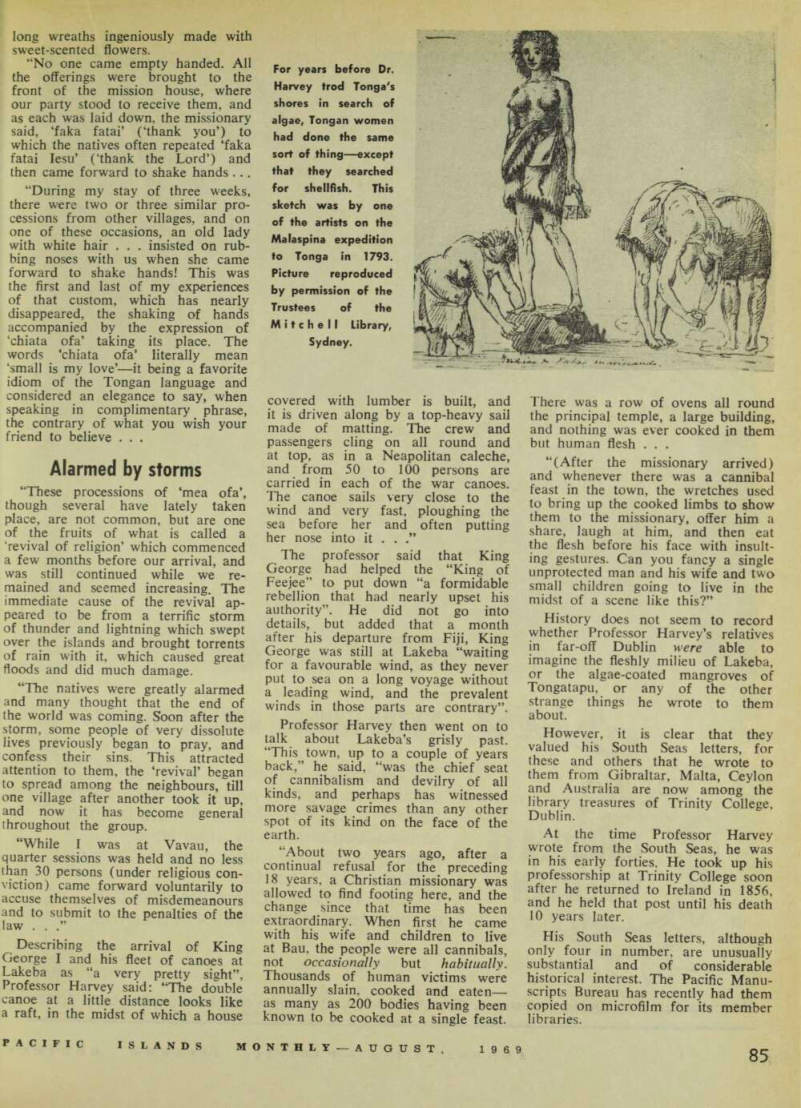 89
89 90
90 91
91 92
92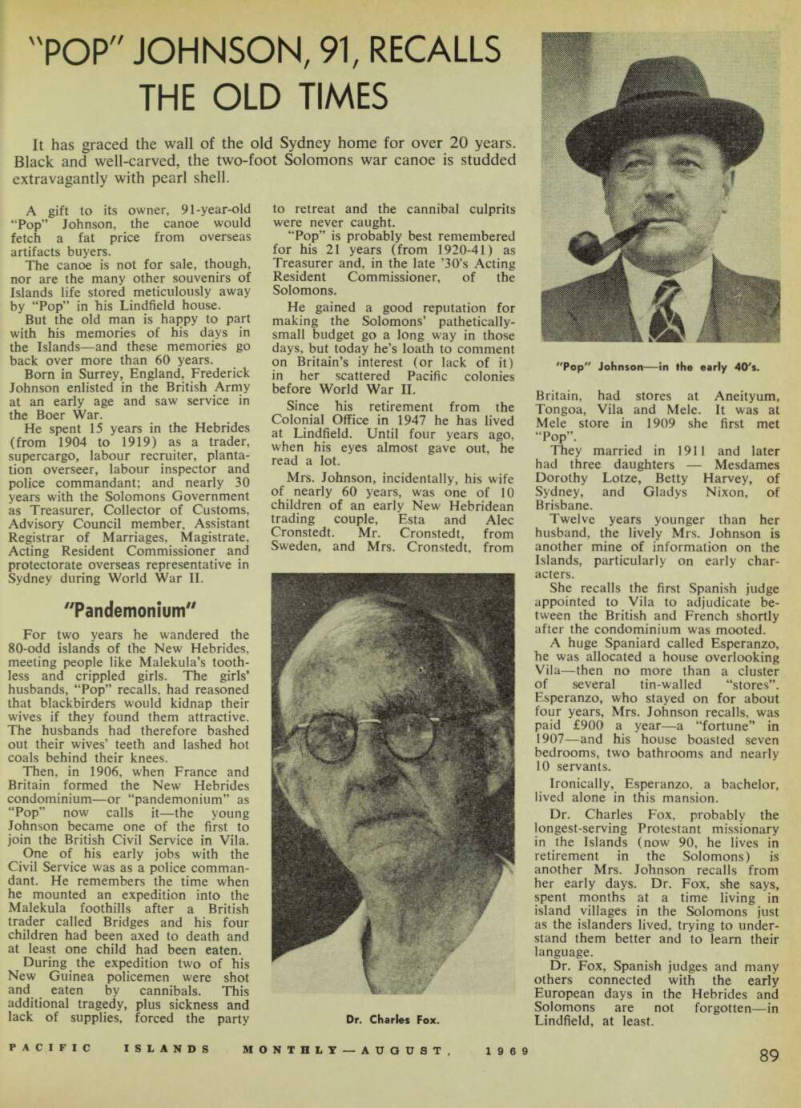 93
93 94
94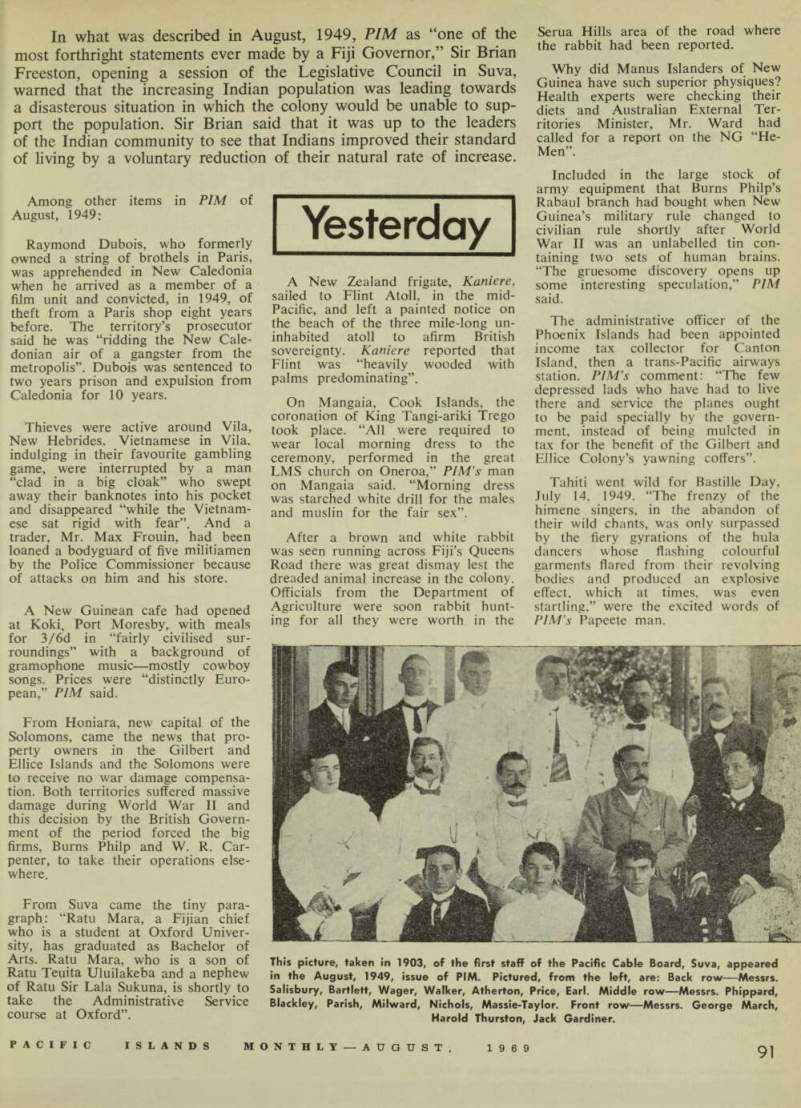 95
95 96
96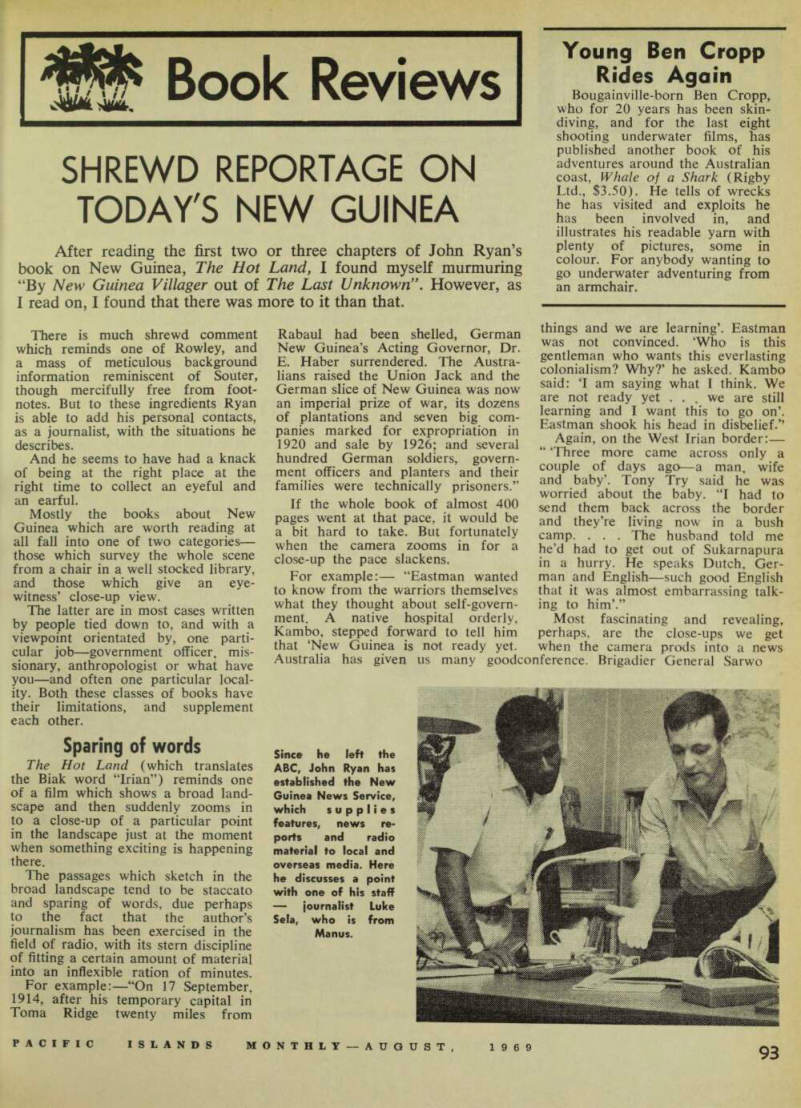 97
97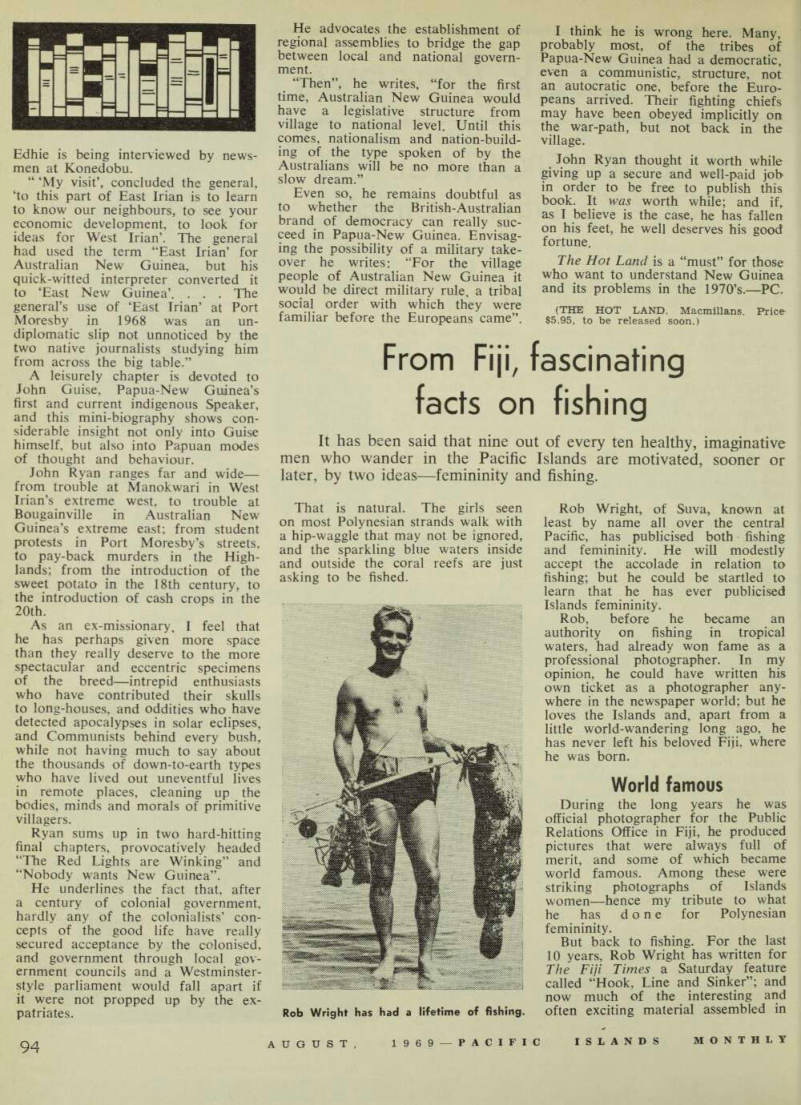 98
98 99
99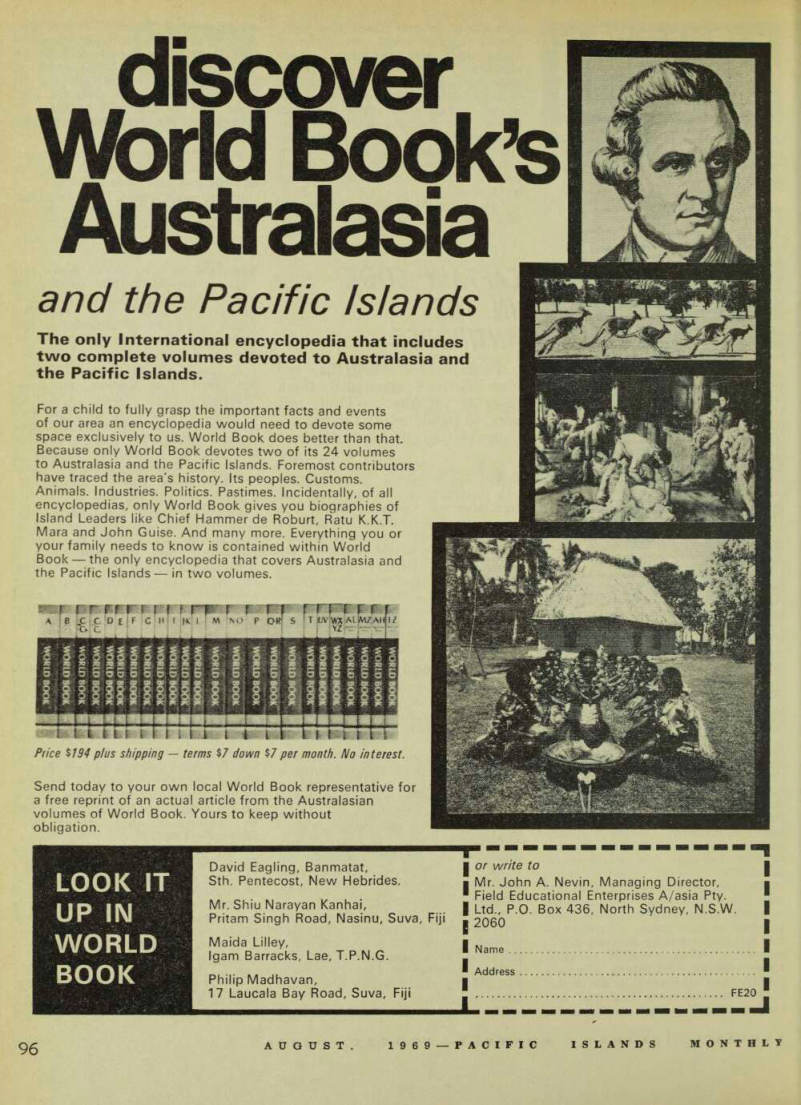 100
100 101
101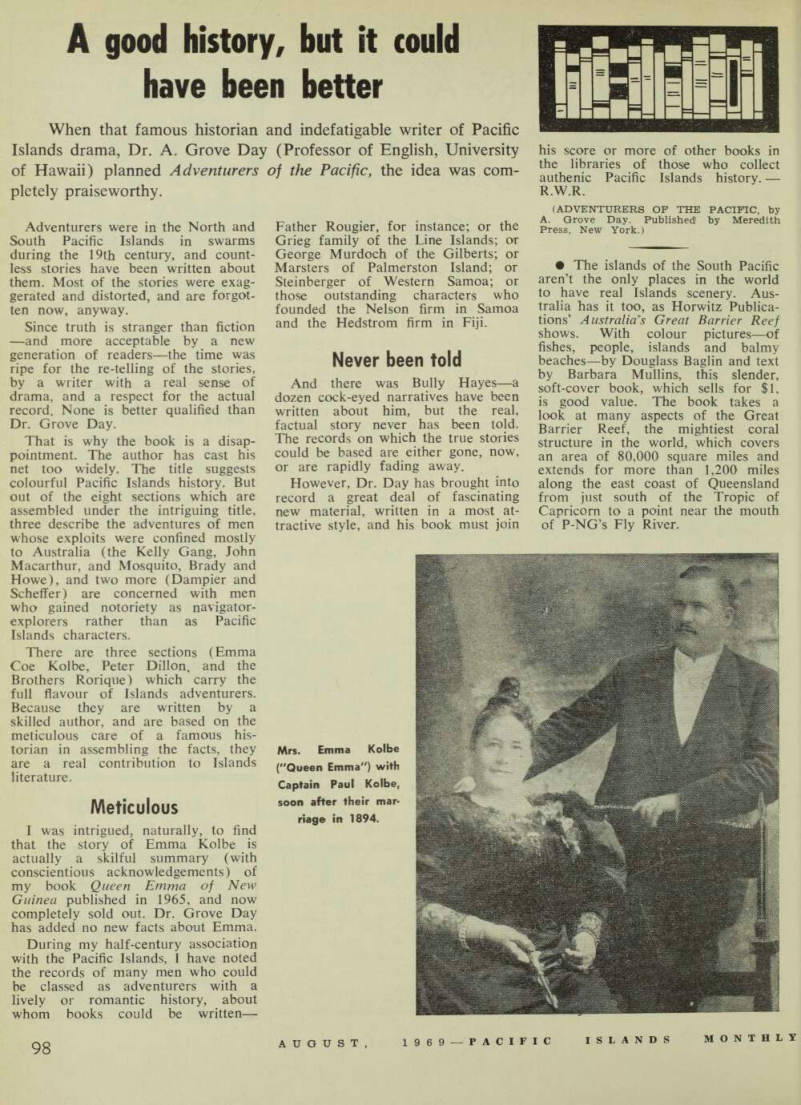 102
102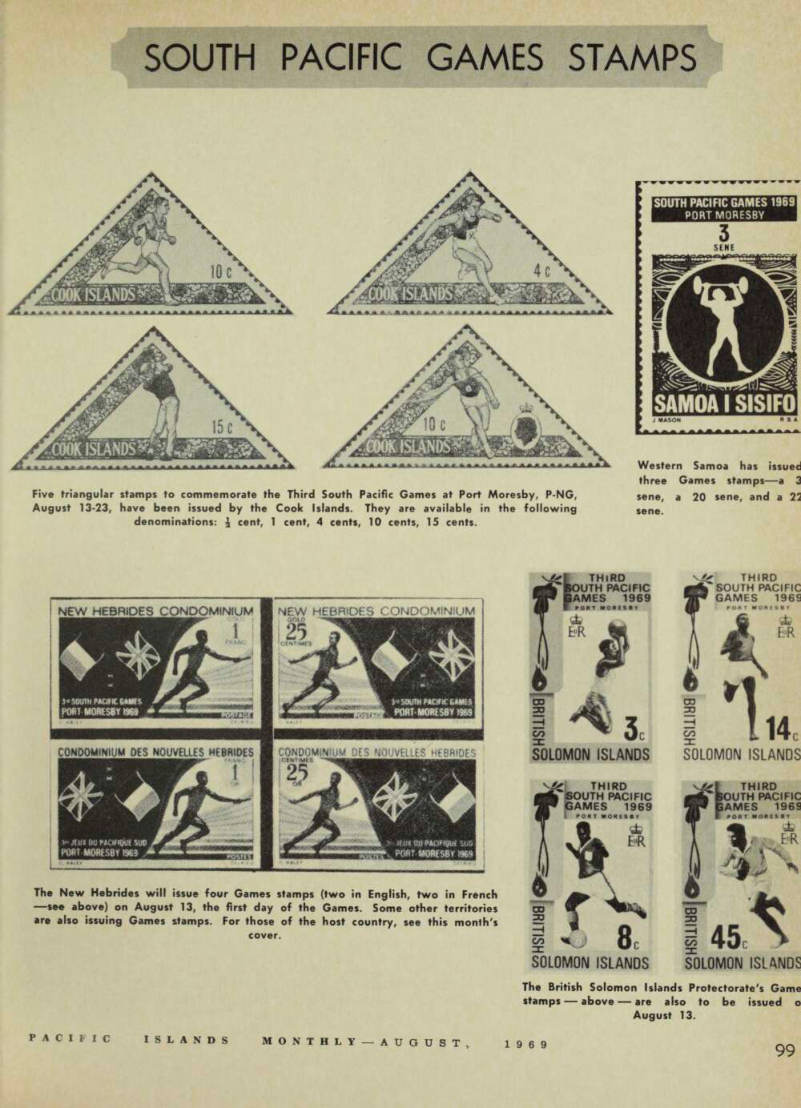 103
103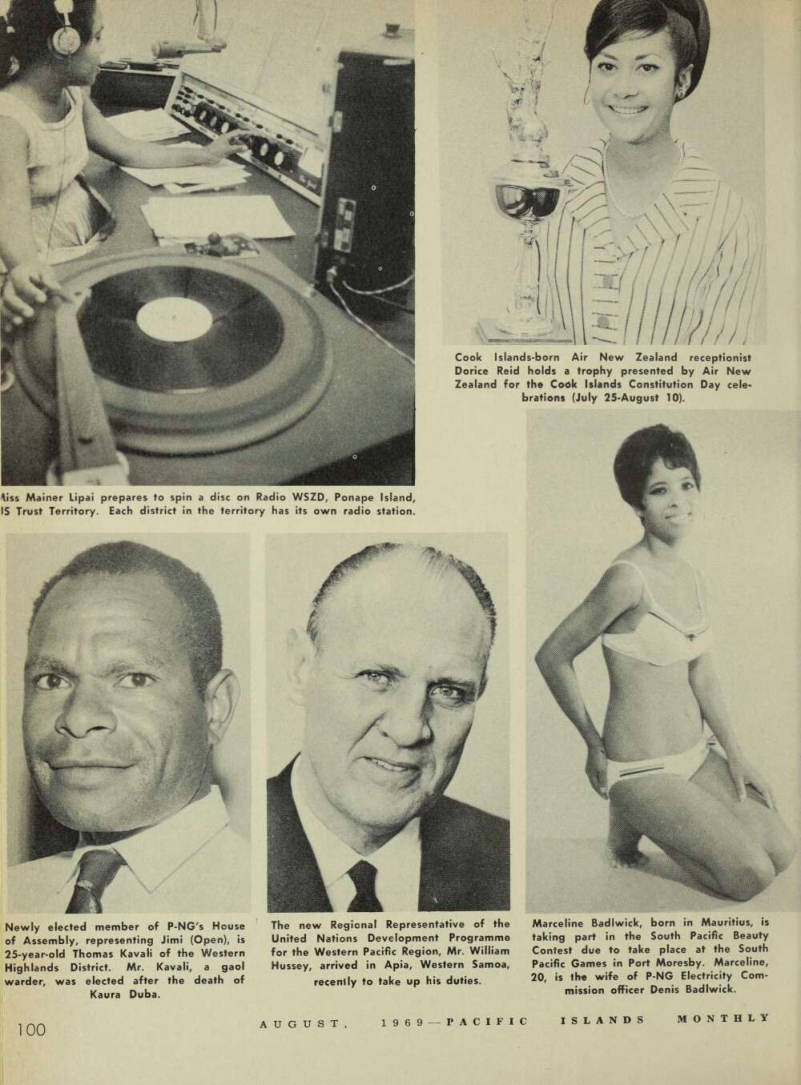 104
104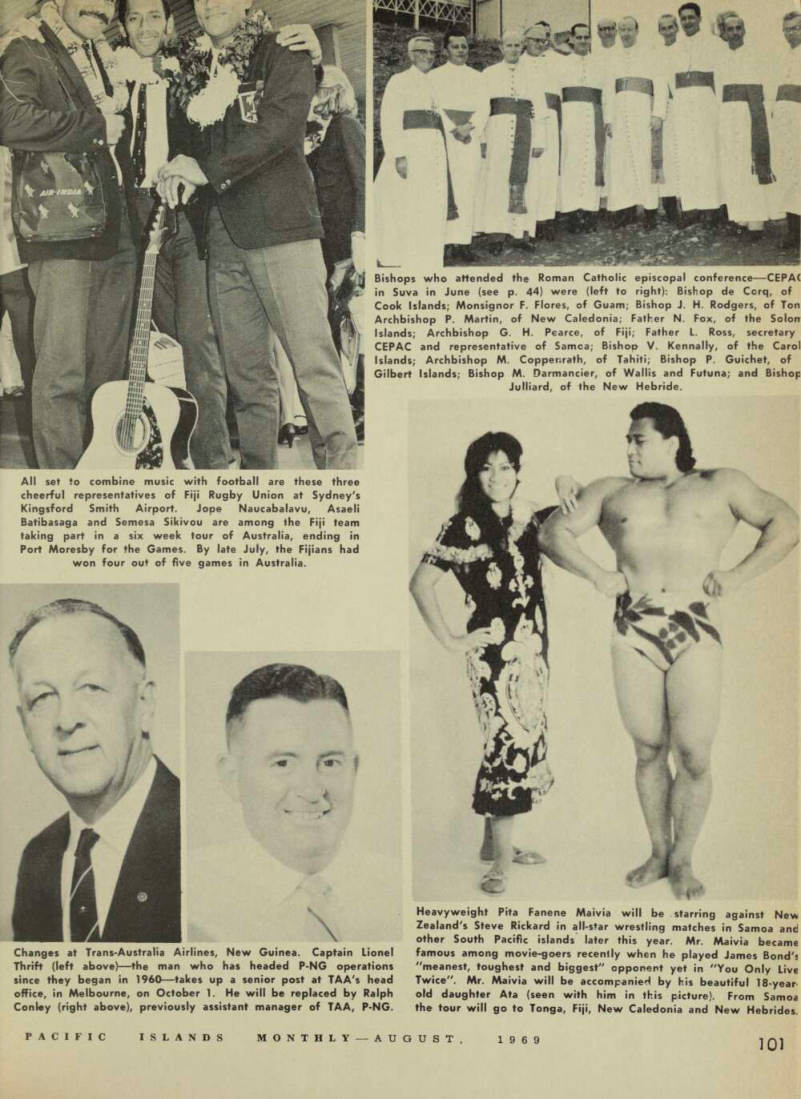 105
105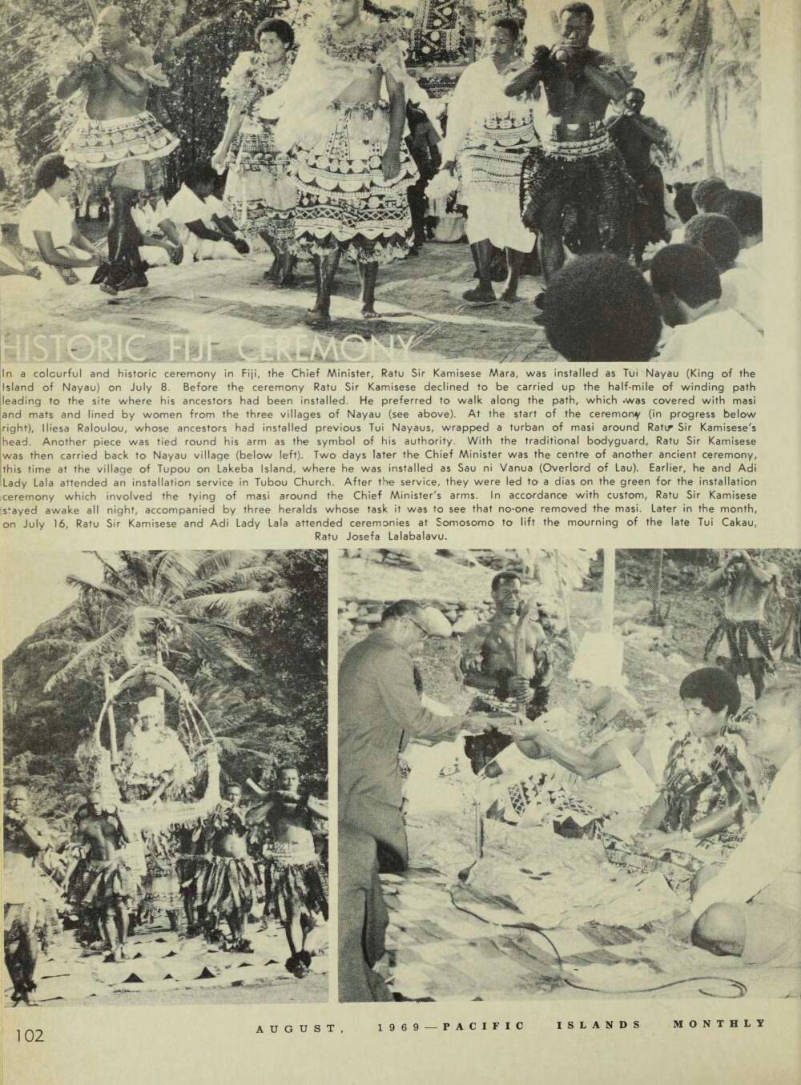 106
106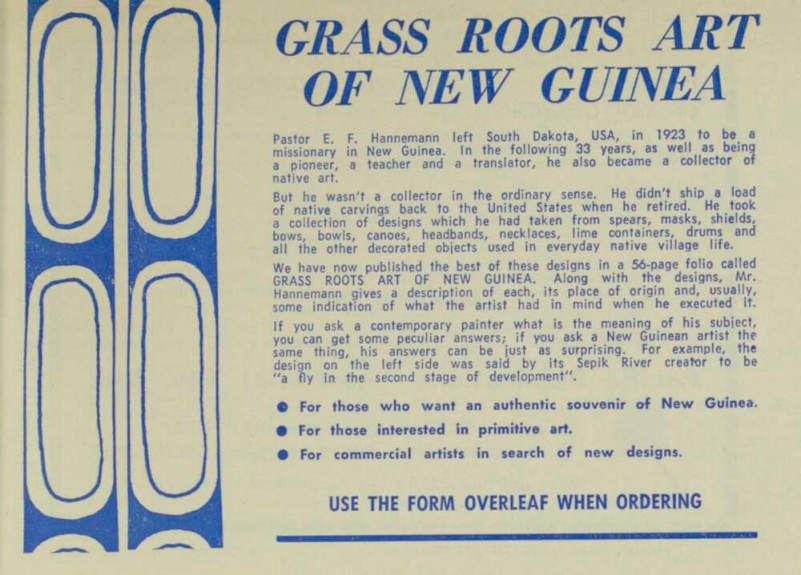 107
107 108
108 109
109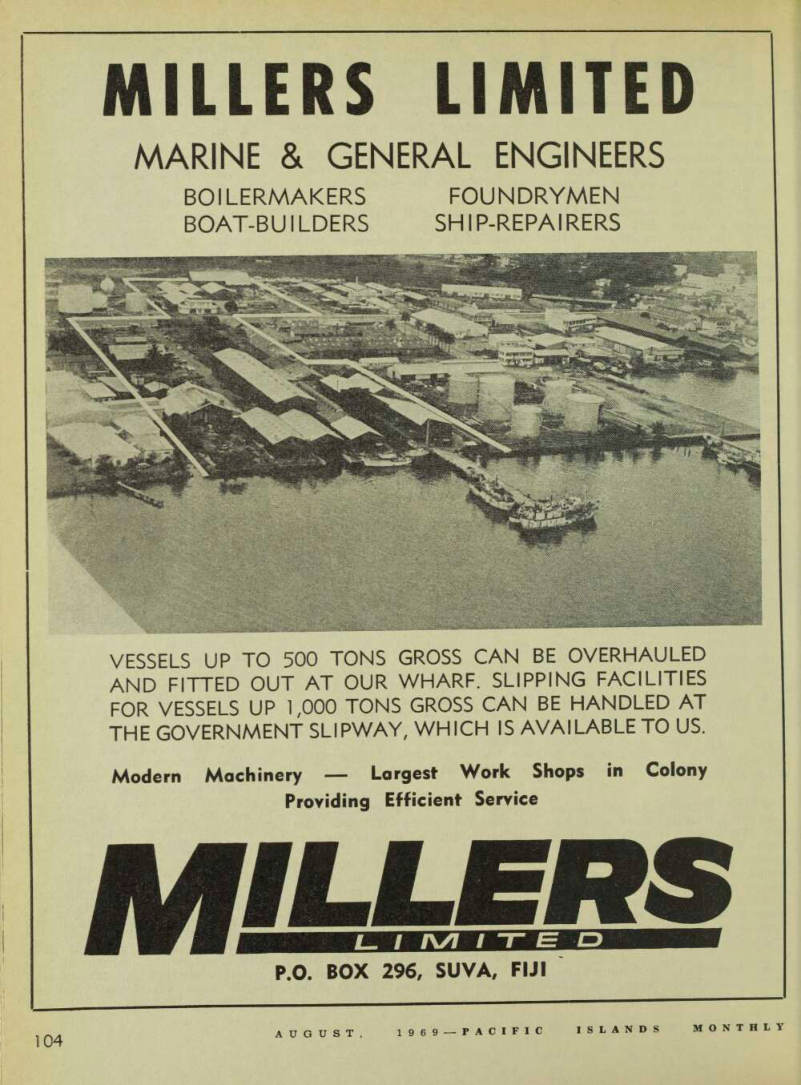 110
110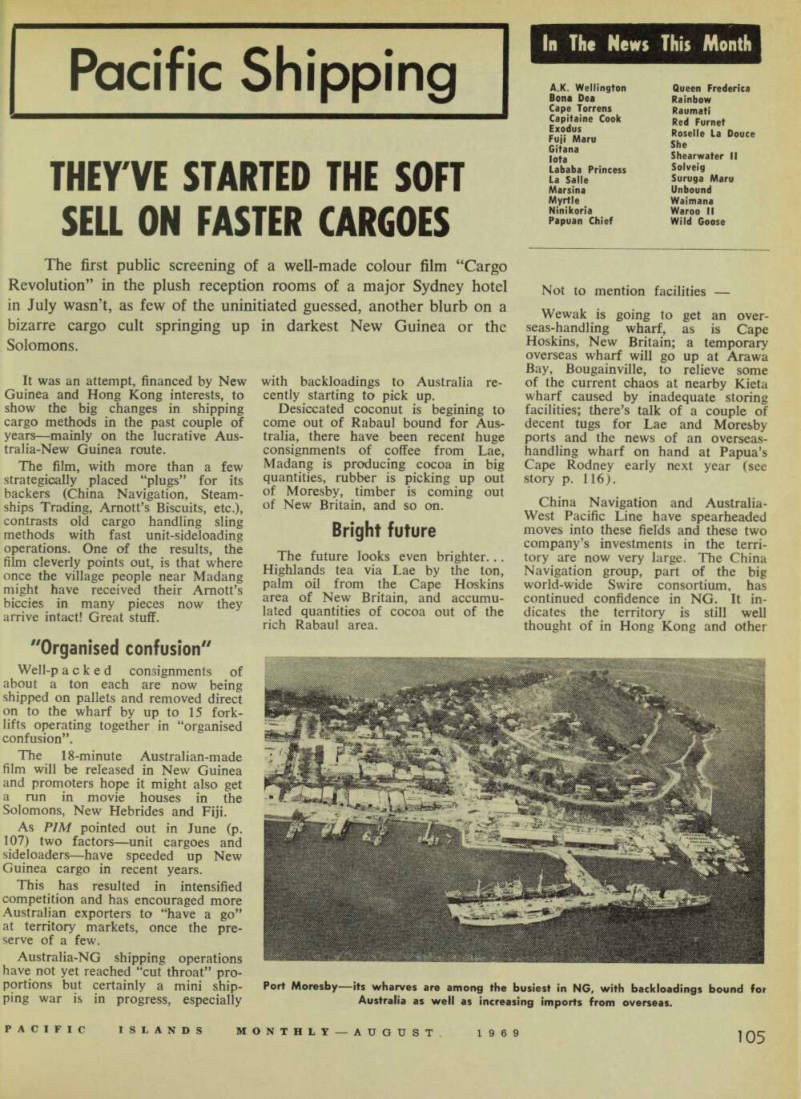 111
111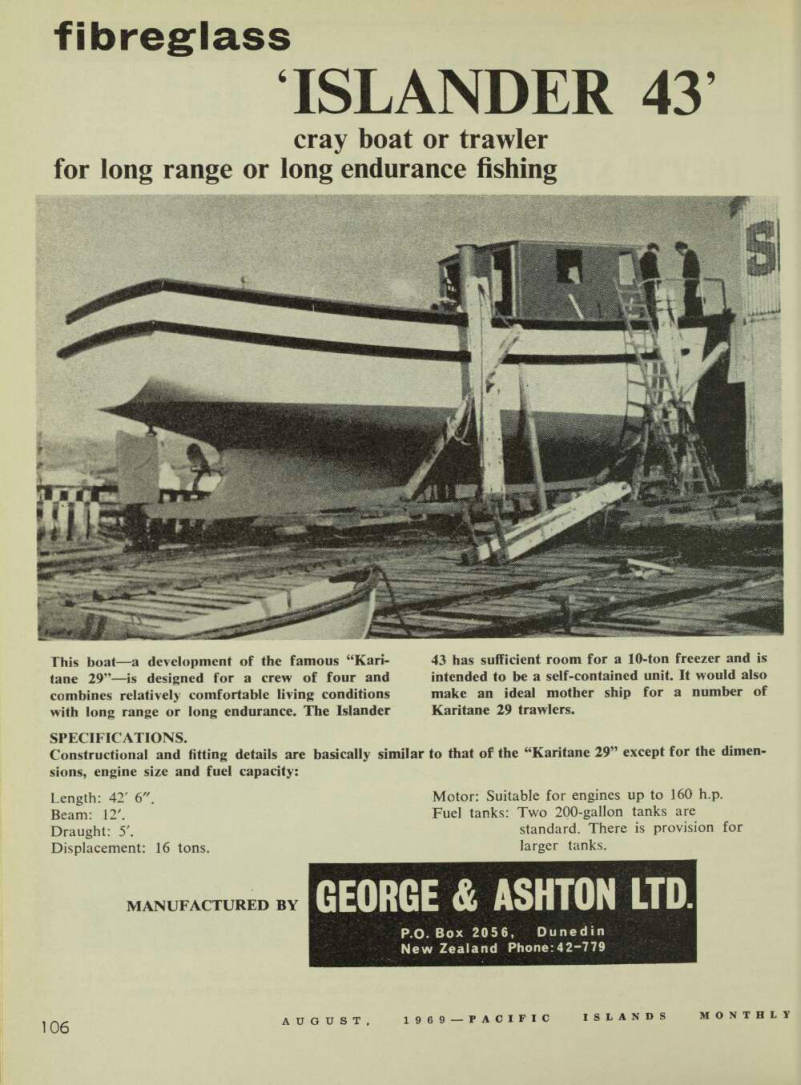 112
112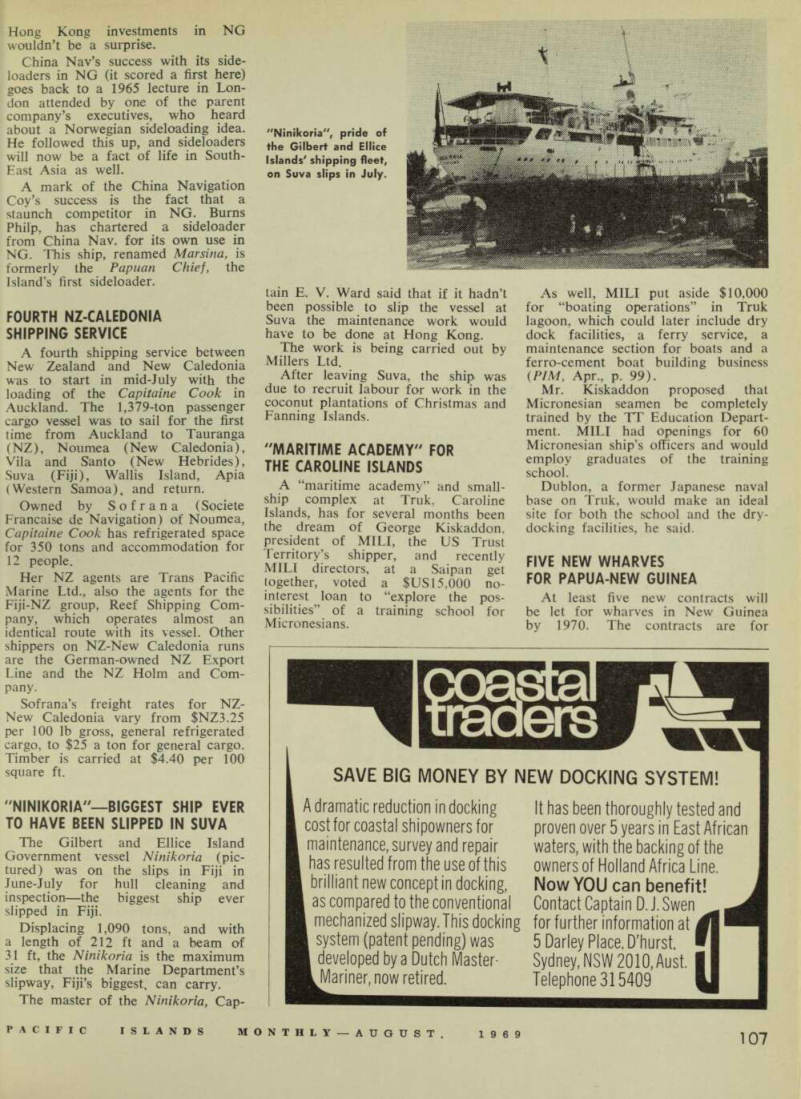 113
113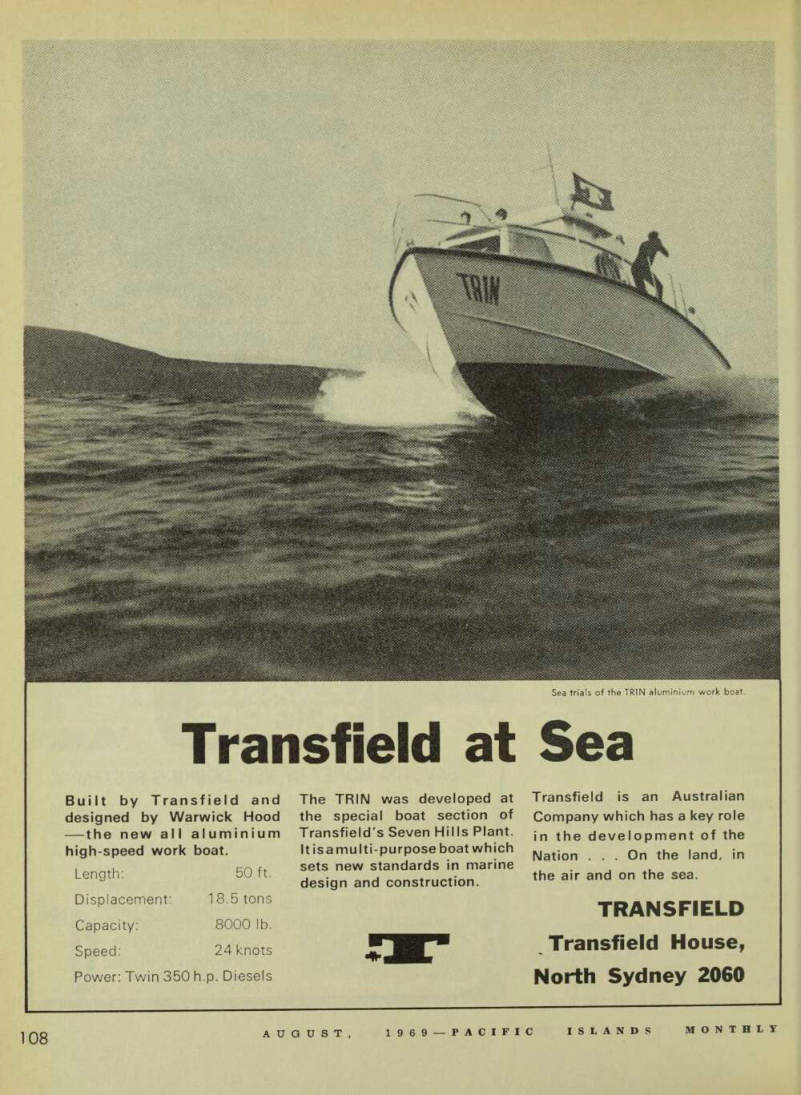 114
114 115
115 116
116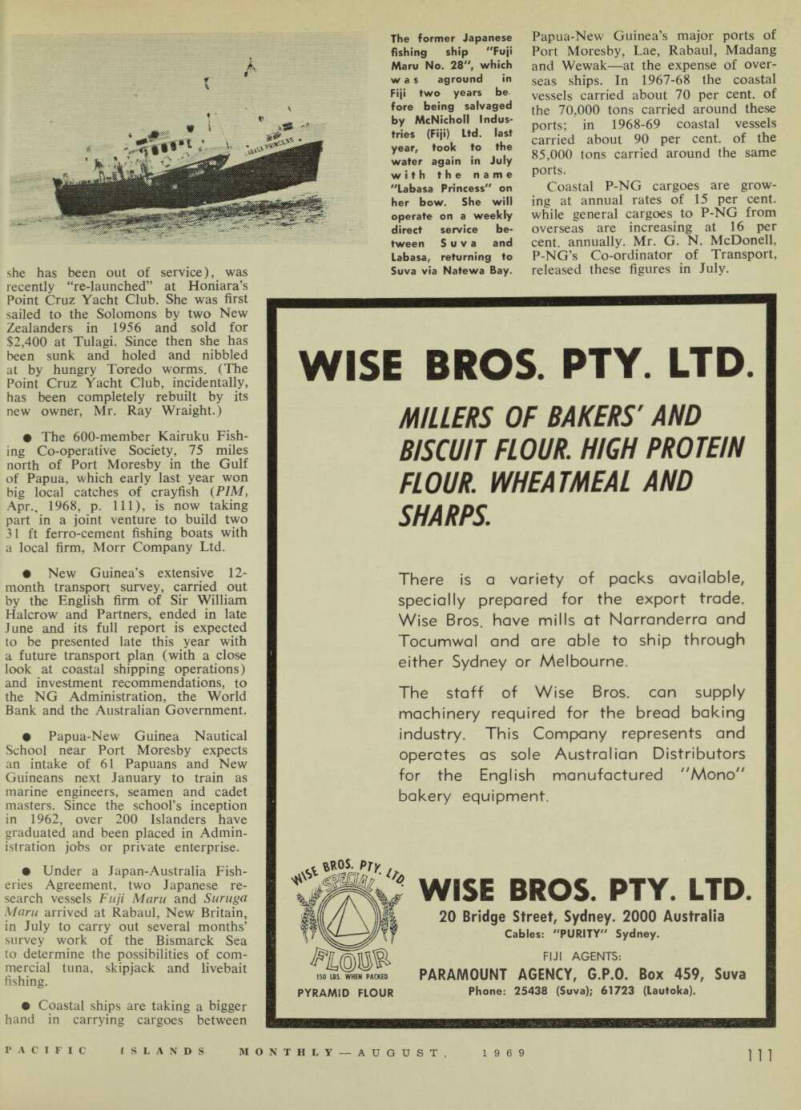 117
117 118
118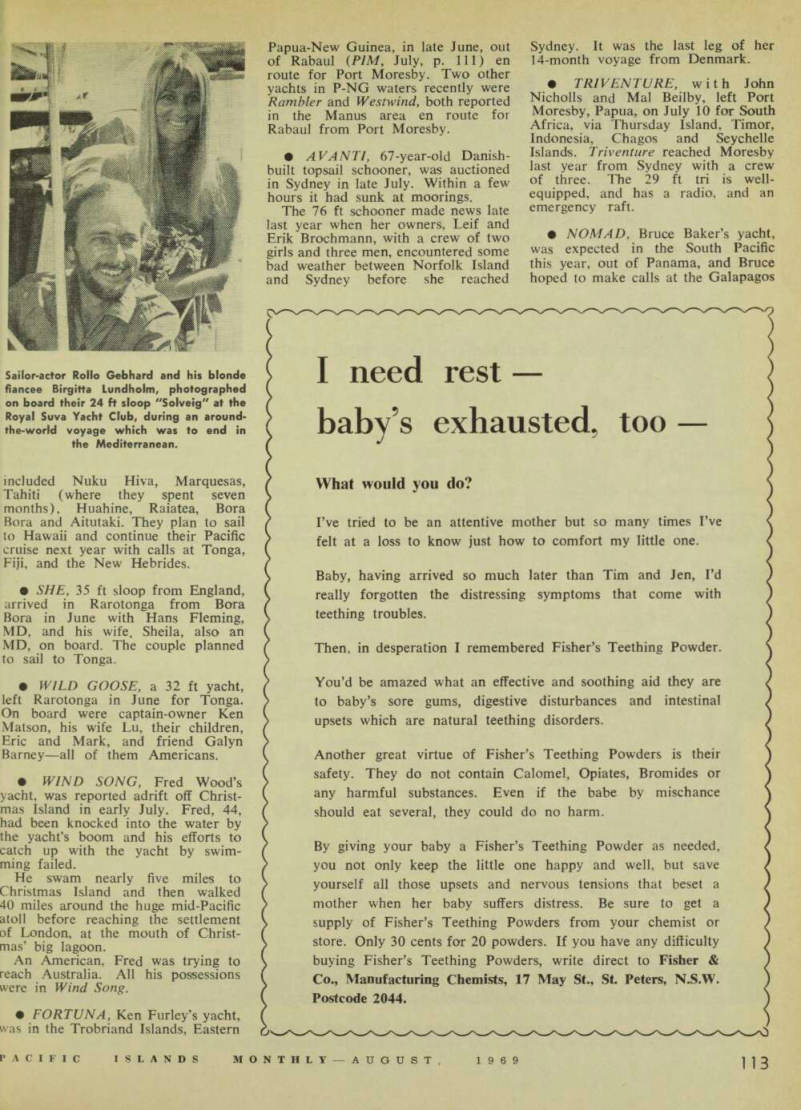 119
119 120
120 121
121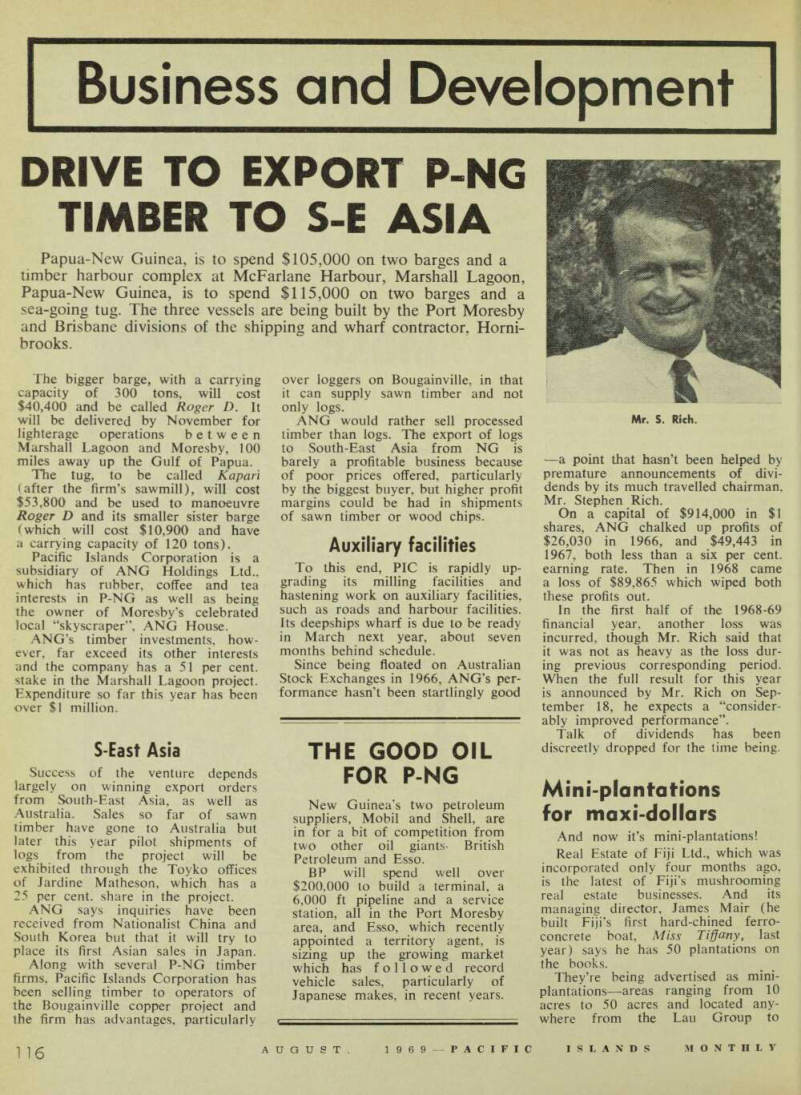 122
122 123
123 124
124 125
125 126
126 127
127 128
128 129
129 130
130 131
131 132
132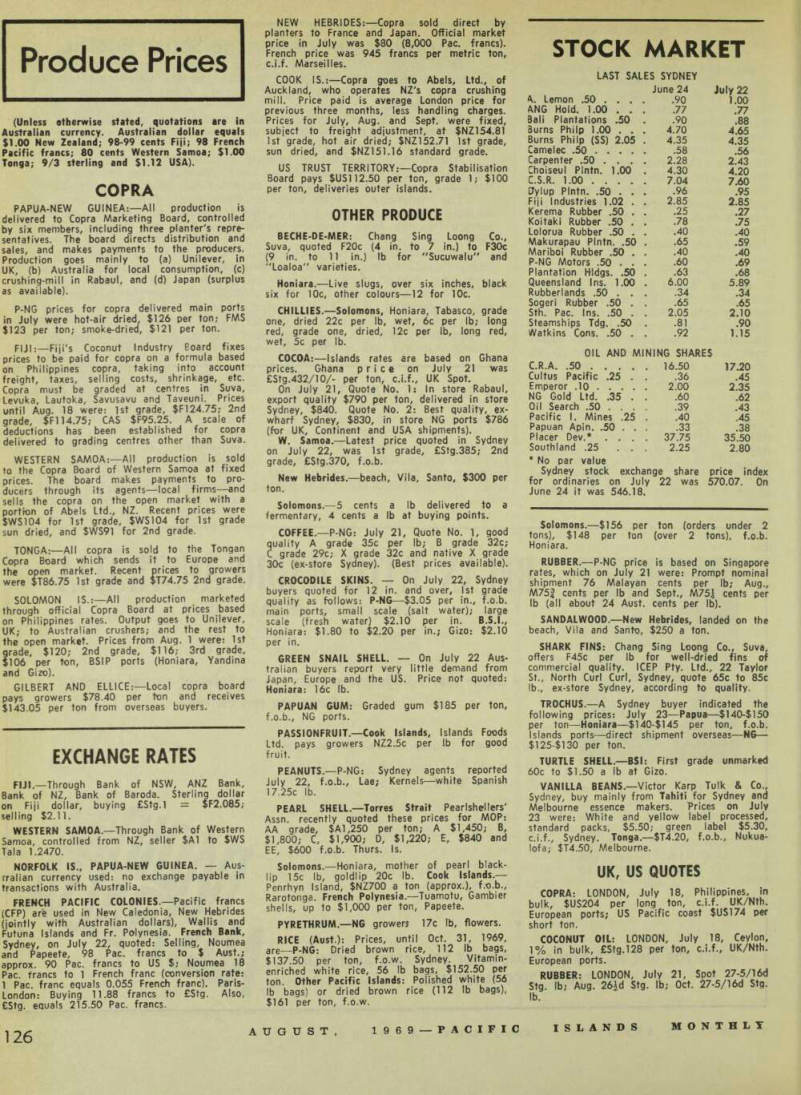 133
133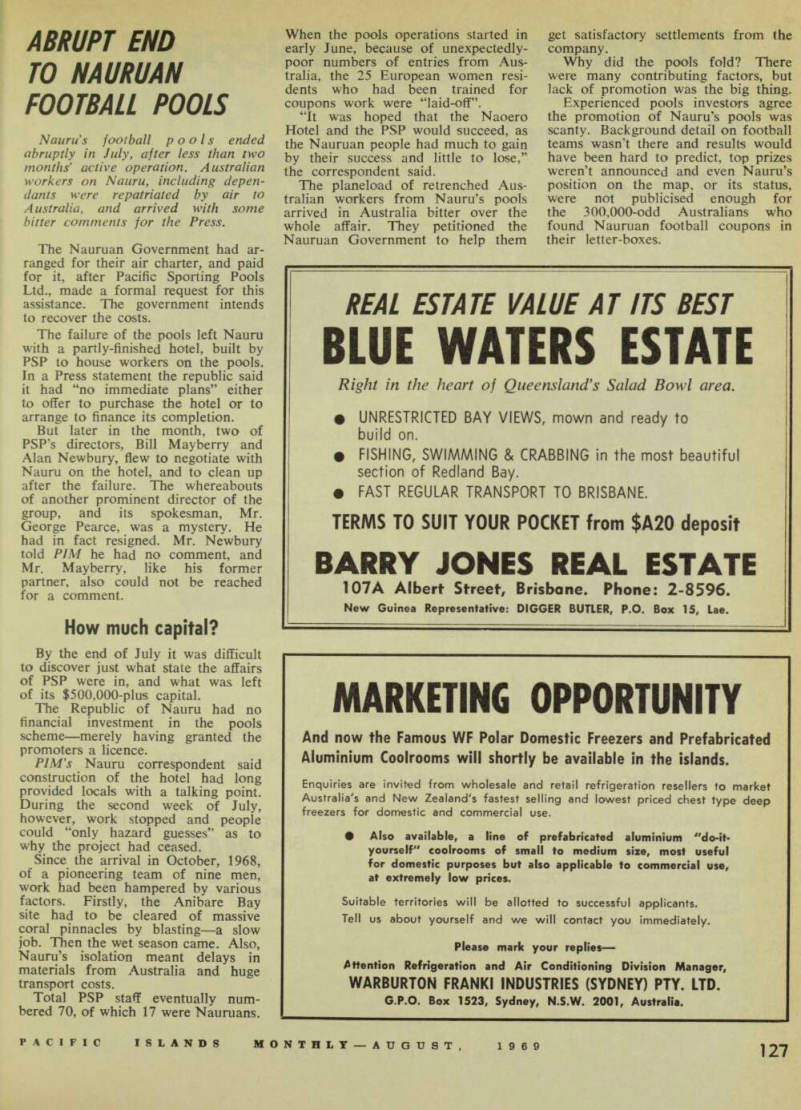 134
134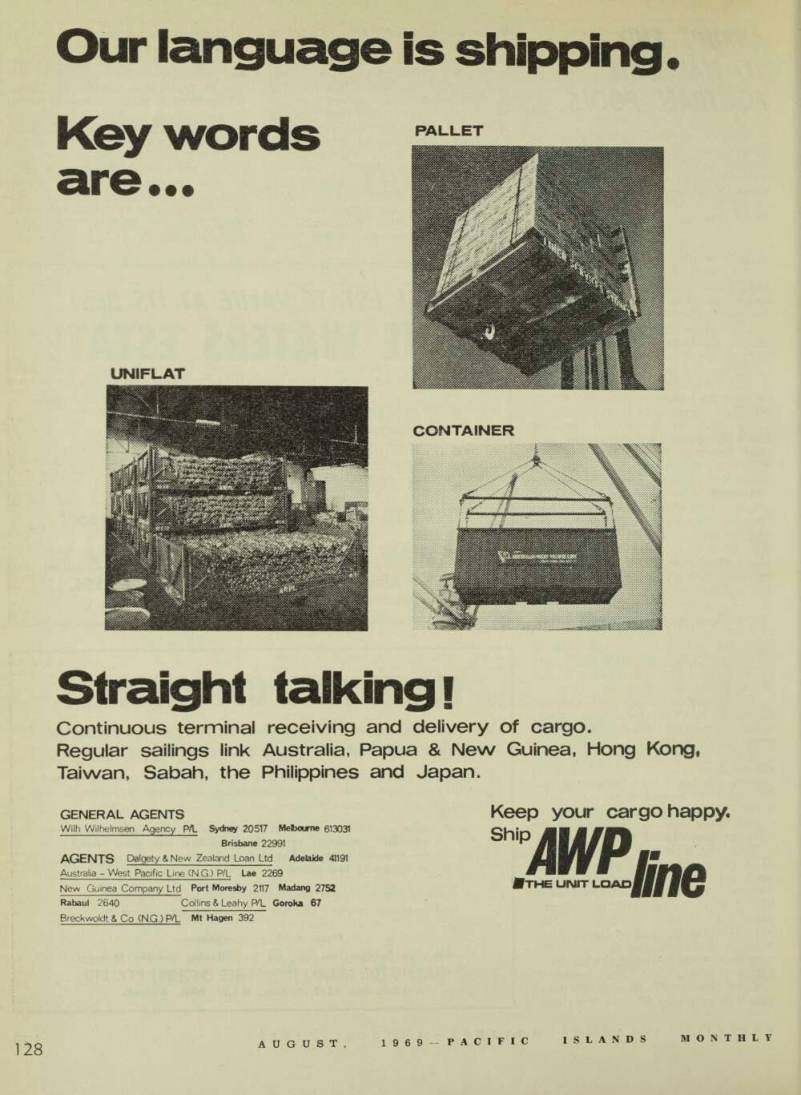 135
135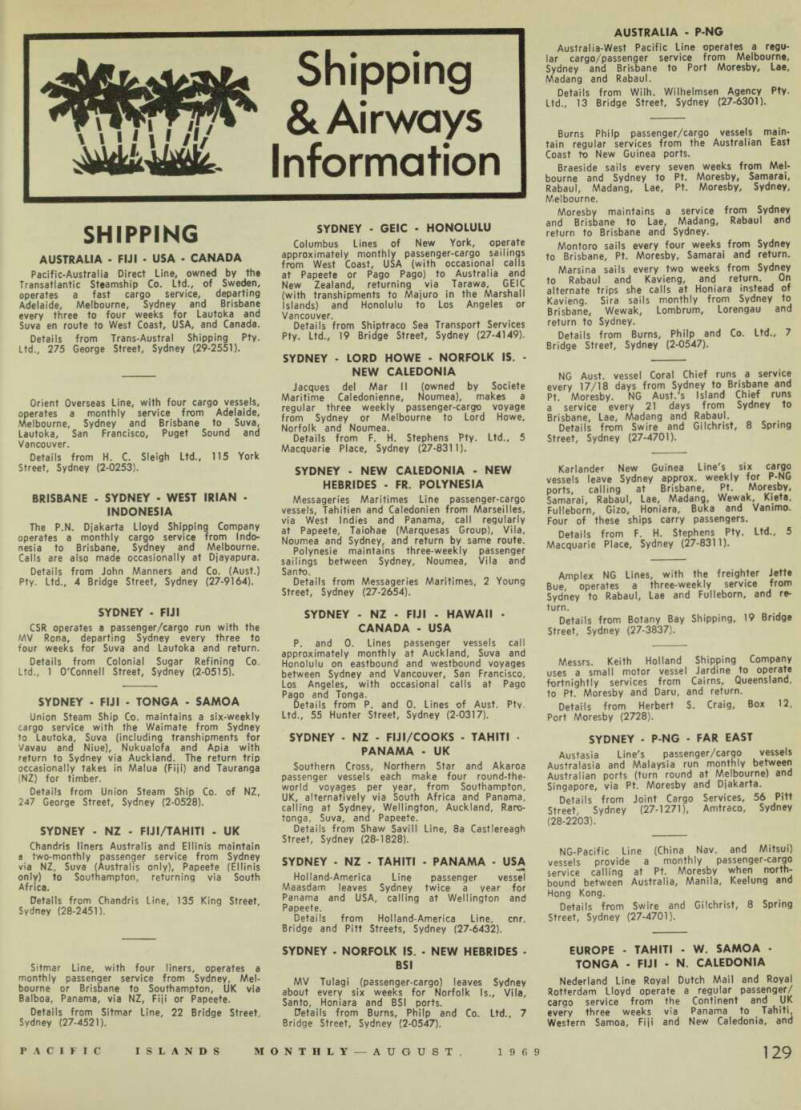 136
136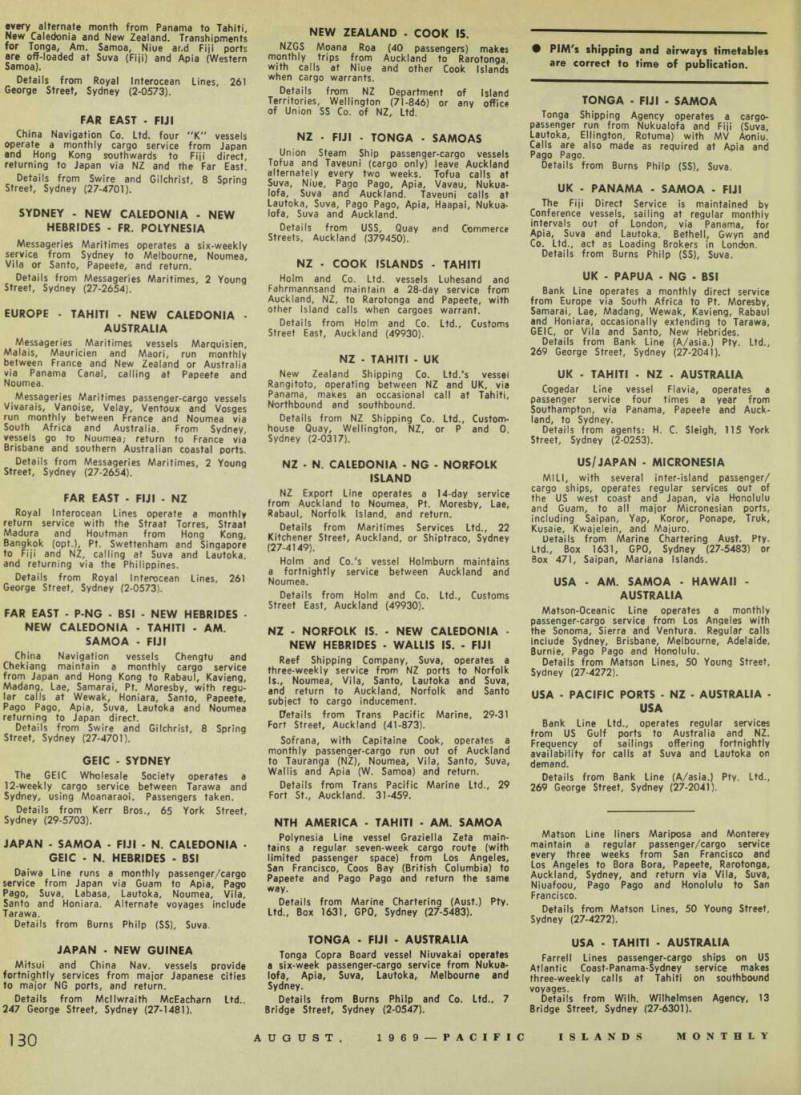 137
137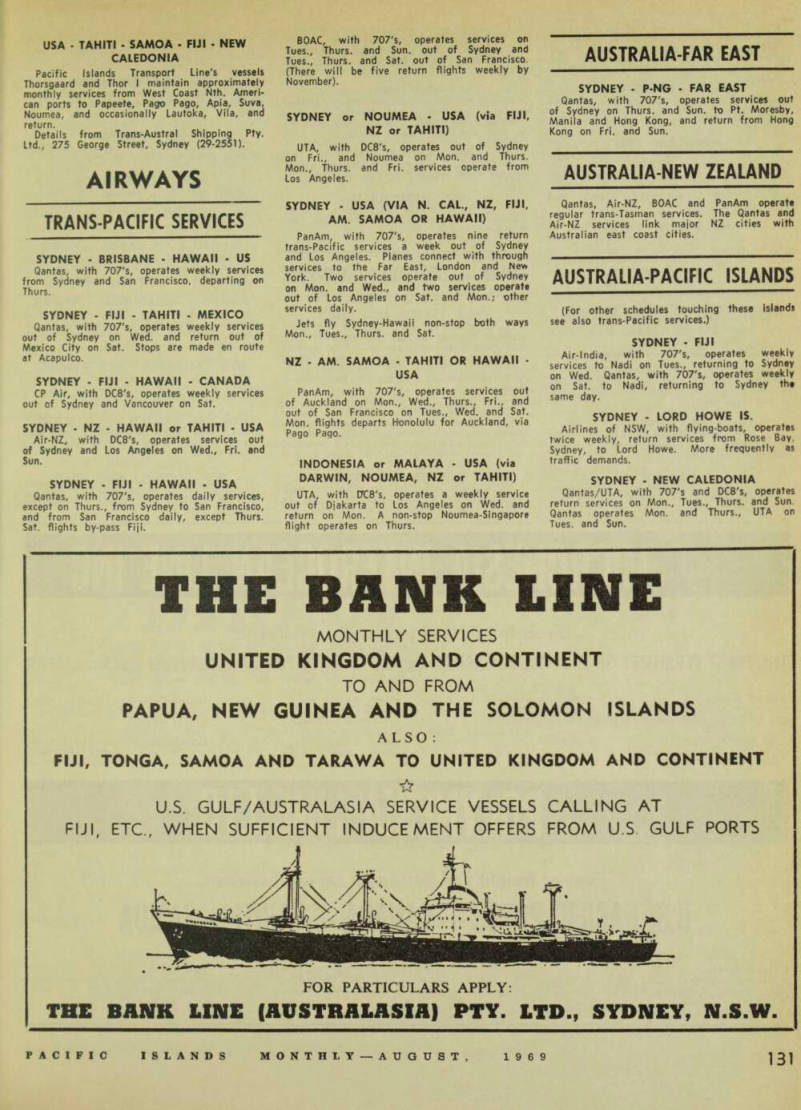 138
138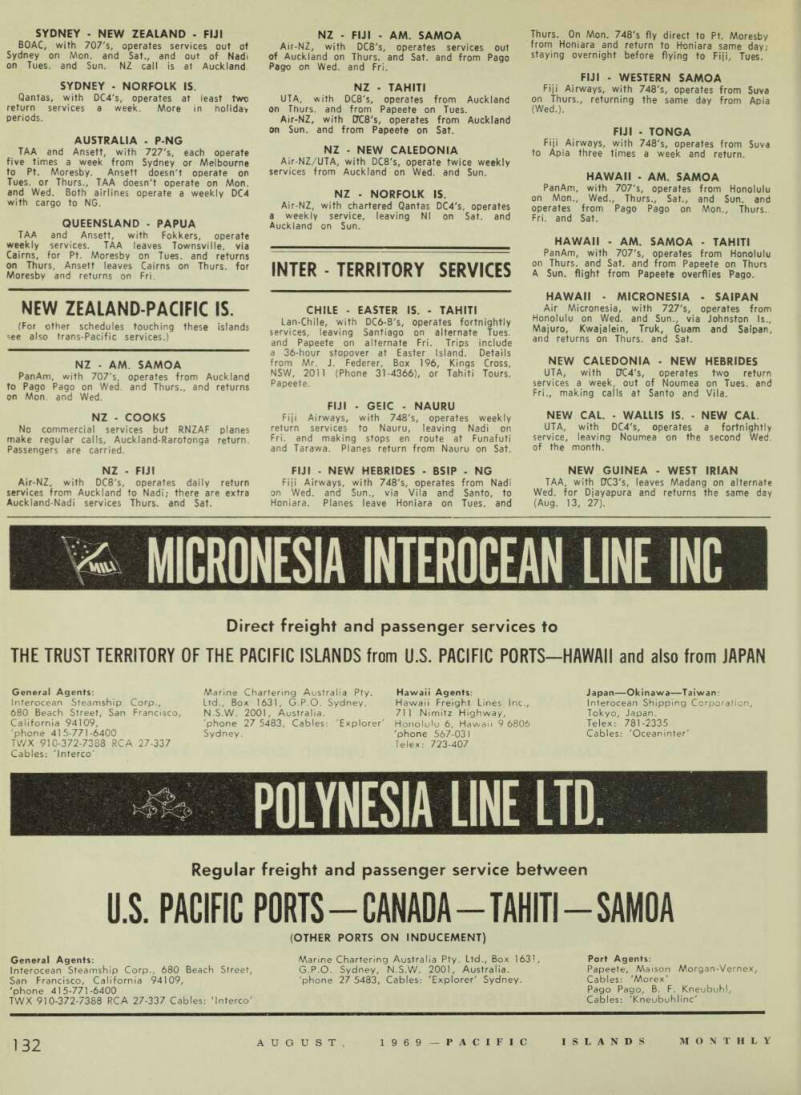 139
139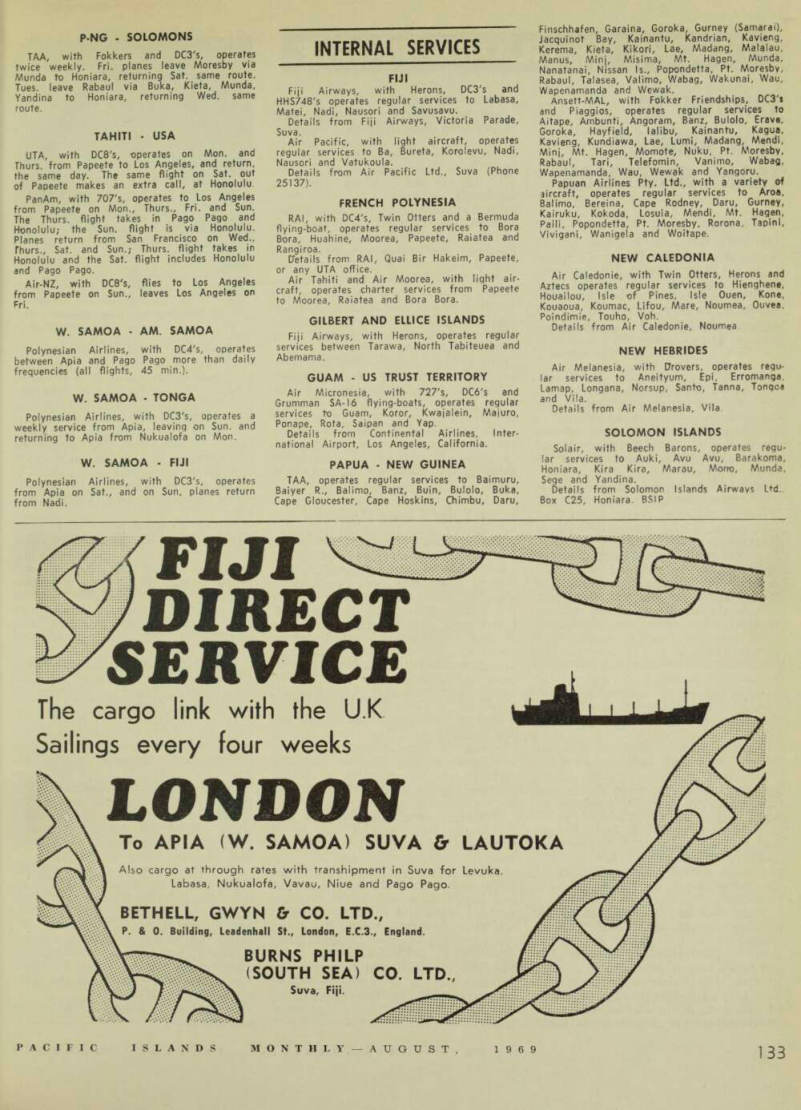 140
140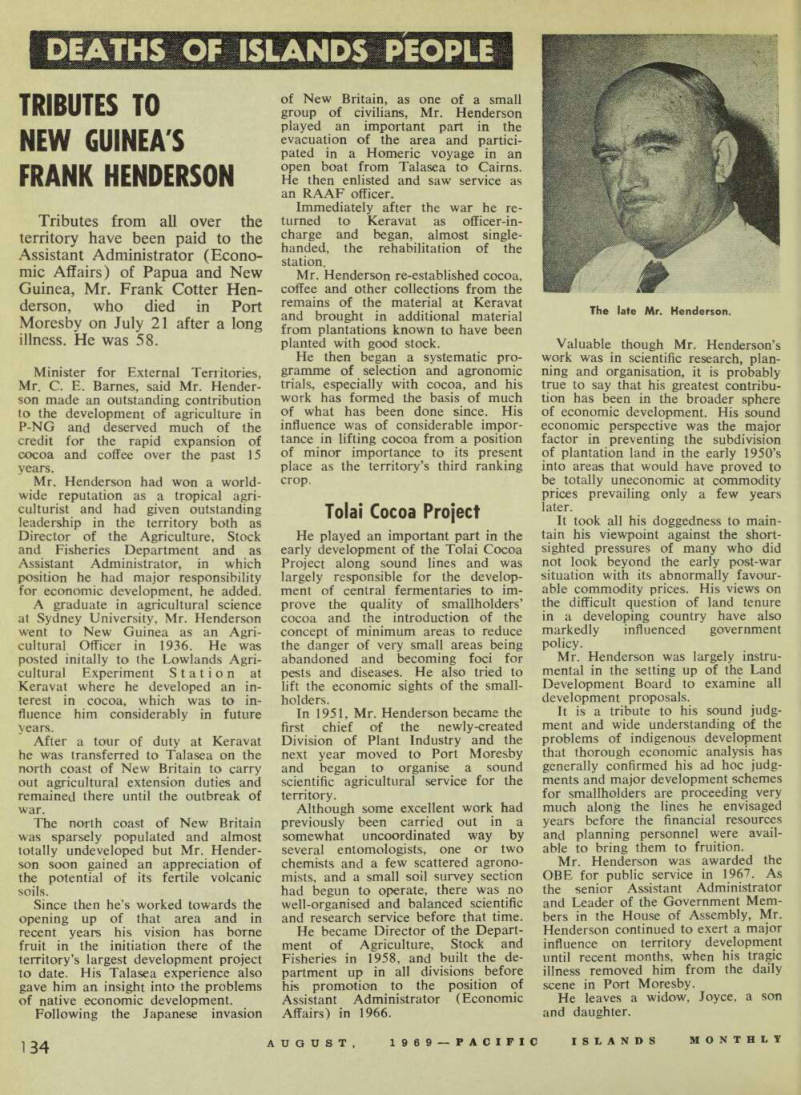 141
141 142
142 143
143 144
144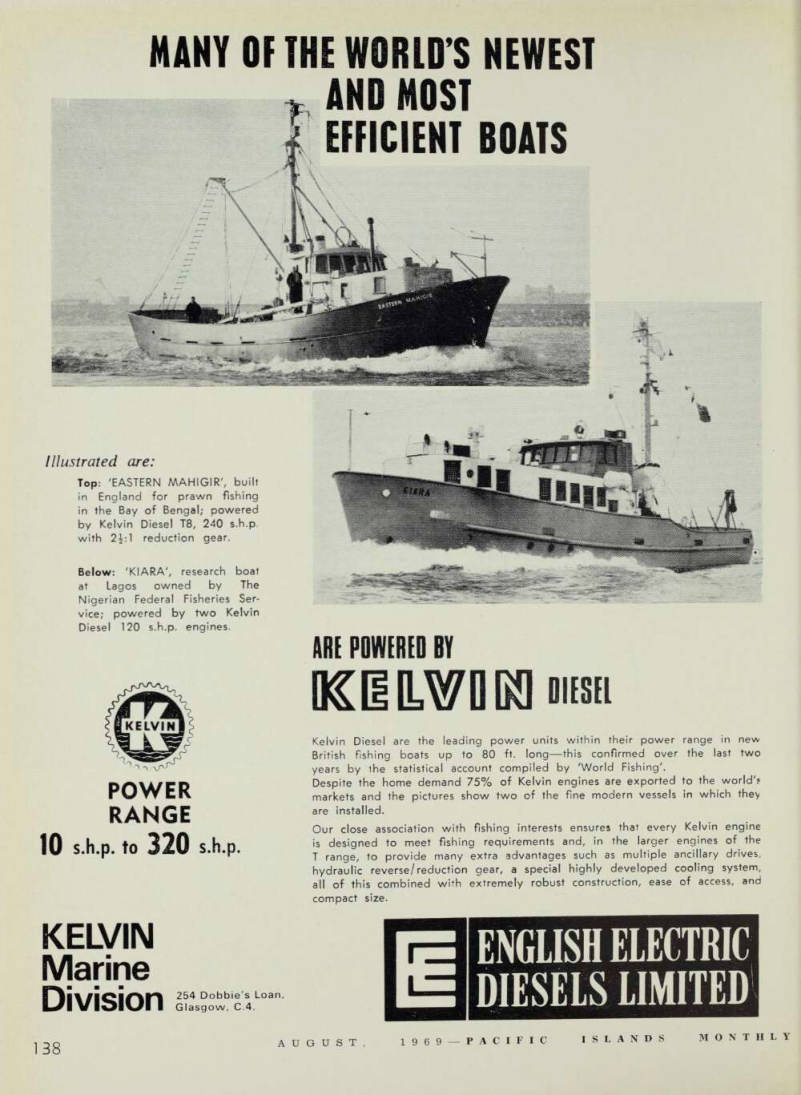 145
145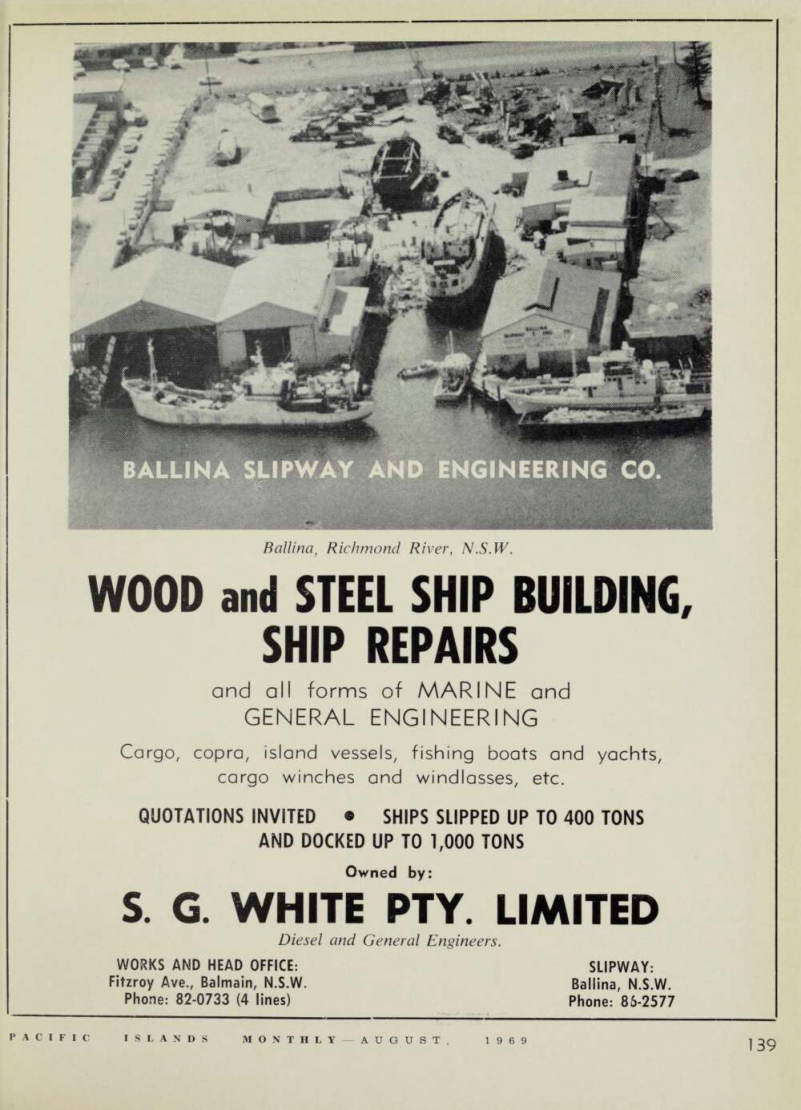 146
146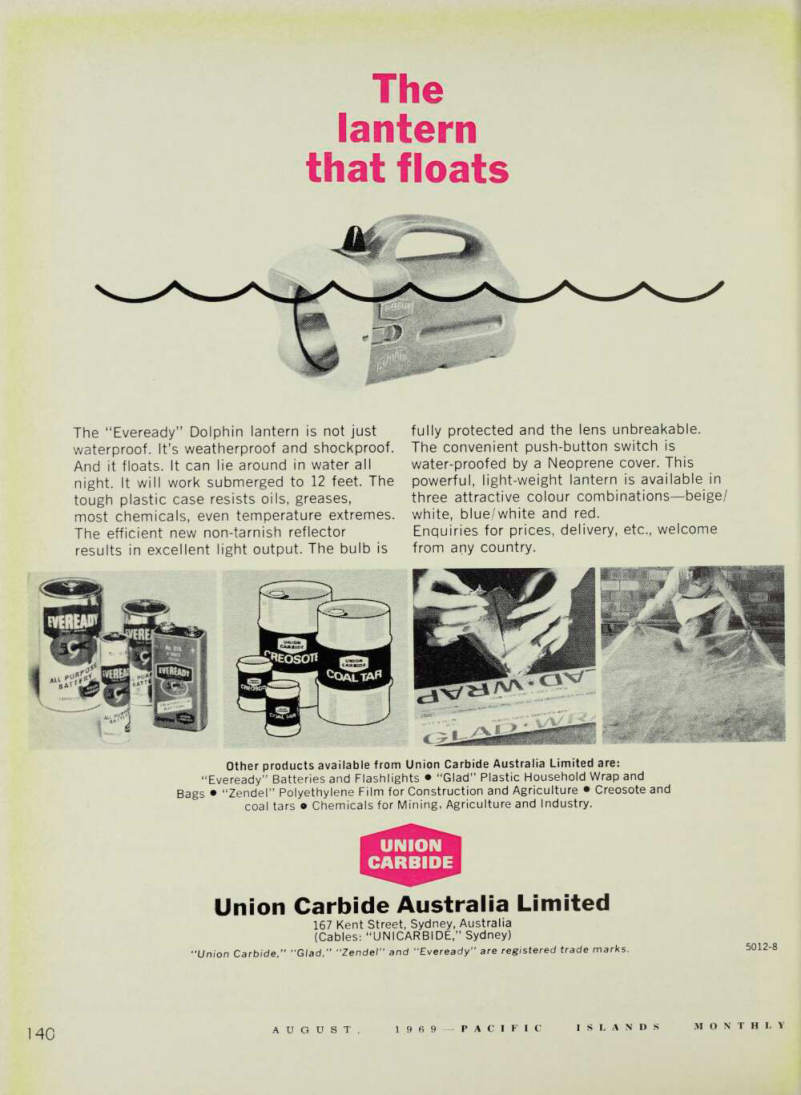 147
147 148
148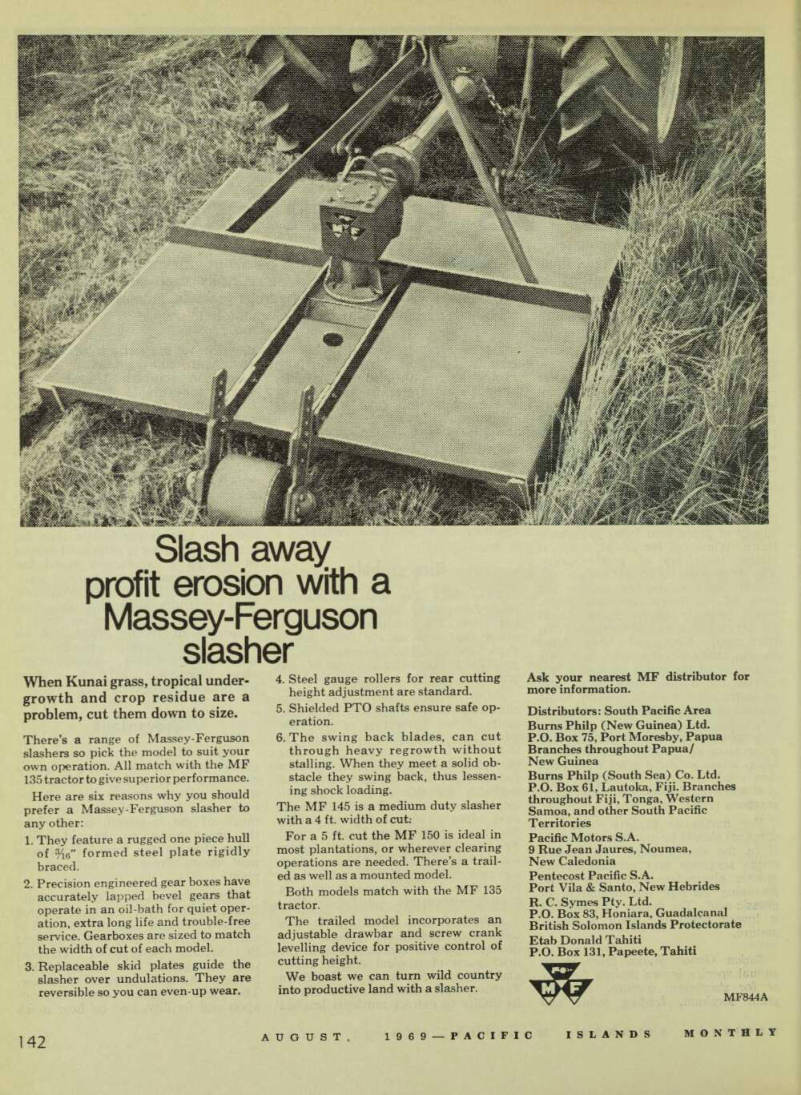 149
149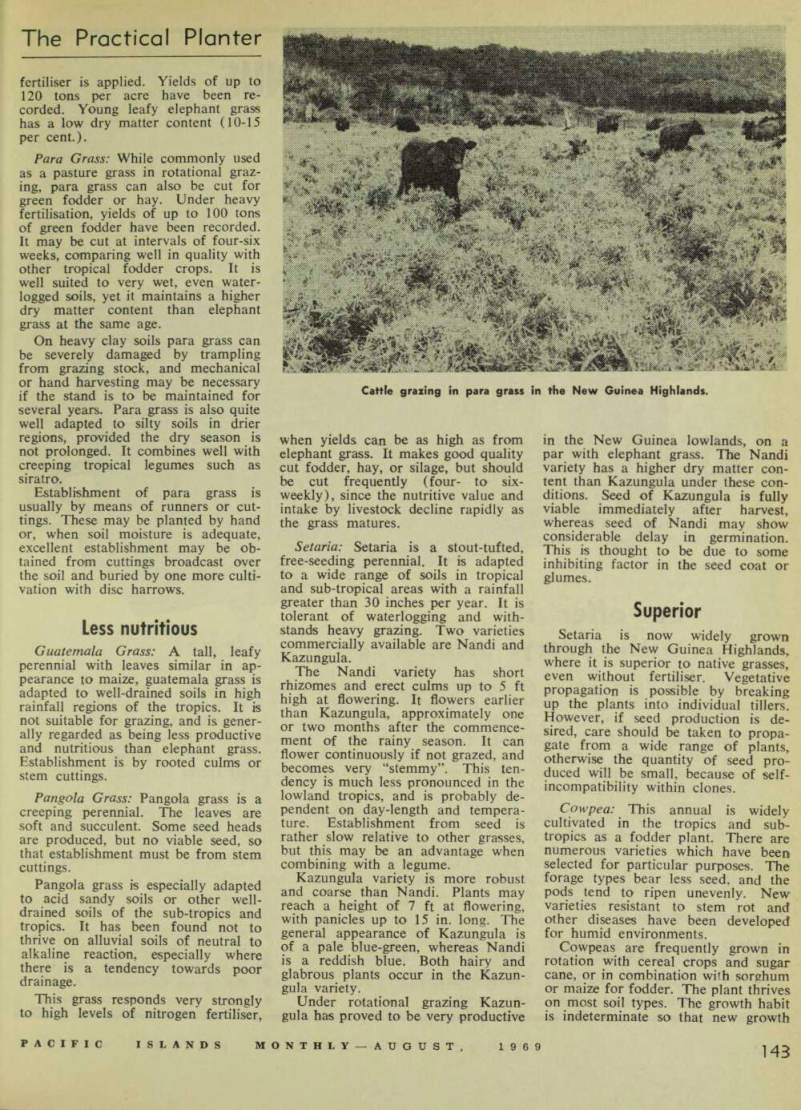 150
150 151
151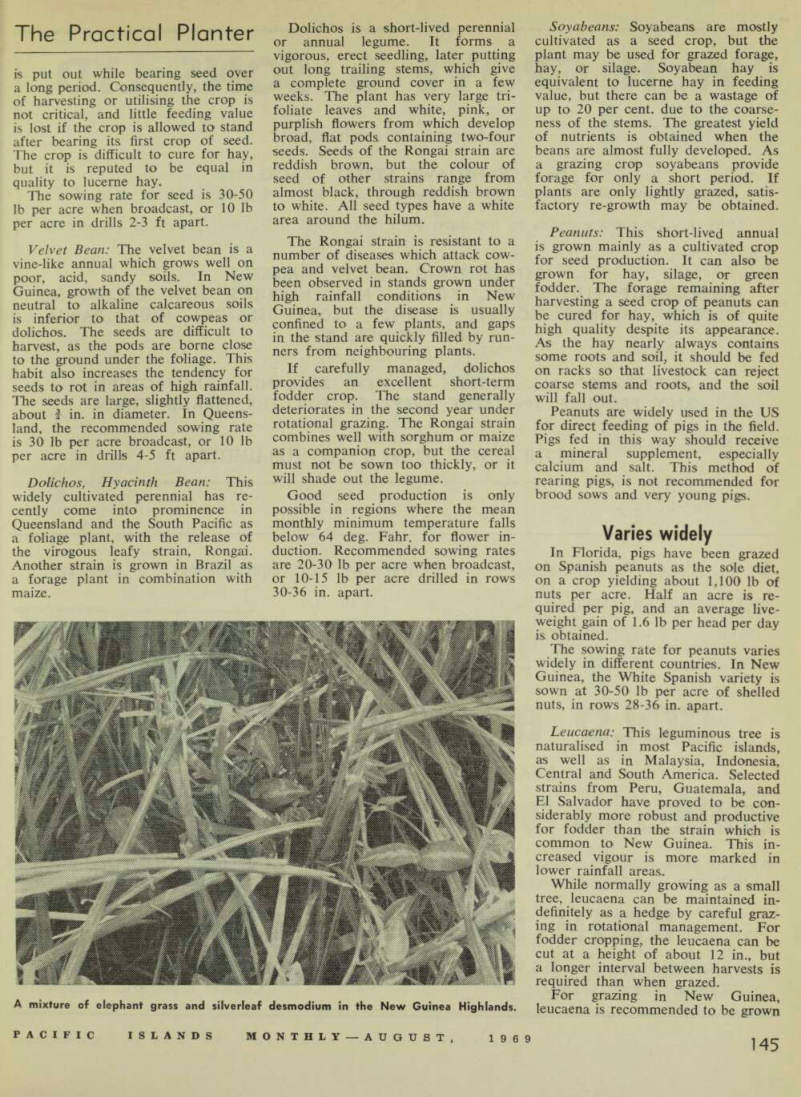 152
152 153
153 154
154 155
155 156
156 157
157 158
158 159
159 160
160 161
161 162
162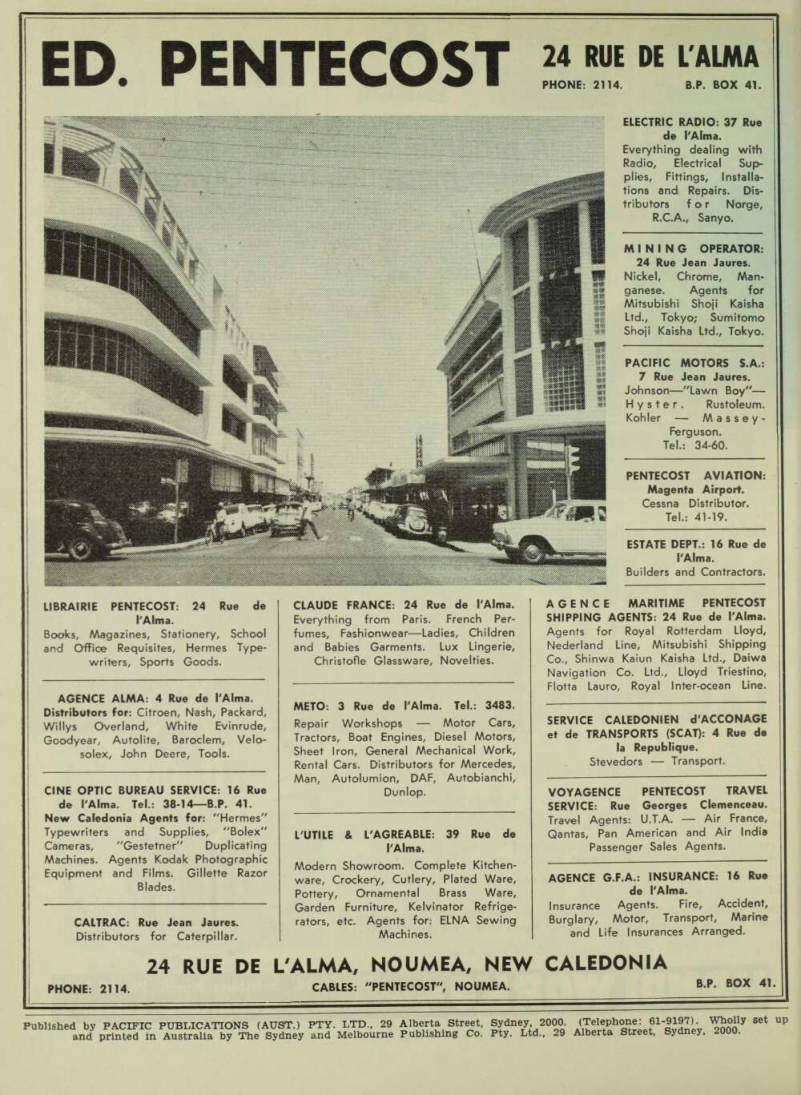 163
163 164
164 165
165 166
166