Yesterday
p. 95 · Read in the full issue
In what was described in August, 1949, PIM as “one of the most forthright statements ever made by a Fiji Governor,” Sir Brian Freeston, opening a session of the Legislative Council in Suva, warned that the increasing Indian population was leading towards a disasterous situation in which the colony would be unable to sup port the population. Sir Brian said that it was up to the leaders of the Indian community to see that Indians improved their standard of living by a voluntary reduction of their natural rate of increase.
Among other items in PIM of August, 1949; Raymond Dubois, who formerly owned a string of brothels in Paris, was apprehended in New Caledonia when he arrived as a member of a film unit and convicted, in 1949, of theft from a Paris shop eight years before. The territory’s prosecutor said he was “ridding the New Cale donian air of a gangster from the metropolis”. Dubois was sentenced to two years prison and expulsion from Caledonia for 10 years.
Thieves were active around Vila, New Hebrides. Vietnamese in Vila, indulging in their favourite gambling game, were interrupted by a man “clad in a big cloak” who swept away their banknotes into his pocket and disappeared “while the Vietnam ese sat rigid with fear”. And a trader, Mr. Max Frouin, had been loaned a bodyguard of five militiamen by the Police Commissioner because of attacks on him and his store.
A New Guinean cafe had opened at Koki, Port Moresby, with meals for 3/6d in “fairly civilised sur roundings” with a background of gramophone music—mostly cowboy songs. Prices were “distinctly Euro pean,” PIM said.
From Honiara, new capital of the Solomons, came the news that pro perty owners in the Gilbert and Ellice Islands and the Solomons were to receive no war damage compensa tion. Both territories suffered massive damage during World War II and this decision by the British Govern ment of the period forced the big firms, Burns Philp and W. R. Car penter, to take their operations else where.
From Suva came the tiny para graph: “Ratu Mara, a Fijian chief who is a student at Oxford Univer sity, has graduated as Bachelor of Arts. Ratu Mara, who is a son of Ratu Teuita Uluilakeba and a nephew of Ratu Sir Lala Sukuna, is shortly to take the Administrative Service course at Oxford”.
A New Zealand frigate, Kaniere, sailed to Flint Atoll, in the mid- Pacific, and left a painted notice on the beach of the three mile-long uninhabited atoll to afirm British sovereignty. Kaniere reported that Flint was “heavily wooded with palms predominating”.
On Mangaia, Cook Islands, the coronation of King Tangi-ariki Trego took place. “All were required to wear local morning dress to the ceremony, performed in the great LMS church on Oneroa,” PlM’s man on Mangaia said. “Morning dress was starched white drill for the males and muslin for the fair sex”.
After a brown and white rabbit was seen running across Fiji’s Queens Road there was great dismay lest the dreaded animal increase in the colony.
Officials from the Department of Agriculture were soon rabbit hunting for all they were worth in the
Serua Hills area of the road where the rabbit had been reported.
Why did Manus Islanders of New Guinea have such superior physiques?
Health experts were checking their diets and Australian External Ter ritories Minister, Mr. Ward had called for a report on the NG “He- Men”.
Included in the large stock of army equipment that Burns Philp’s Rabaul branch had bought when New Guinea’s military rule changed to civilian rule shortly after World War II was an unlabelled tin con taining two sets of human brains.
“The gruesome discovery opens up some interesting speculation,” PIM said.
The administrative officer of the Phoenix Islands had been appointed income tax collector for Canton Island, then a trans-Pacific airways station. PI M’s comment: “The few depressed lads who have had to live there and service the planes ought to be paid specially by the govern ment, instead of being mulcted in tax for the benefit of the Gilbert and Ellice Colony’s yawning coffers”.
Tahiti went wild for Bastille Day, July 14, 1949. “The frenzy of the himene singers, in the abandon of their wild chants, was only surpassed by the fiery gyrations of the hula dancers whose flashing colourful garments flared from their revolving bodies and produced an explosive effect, which at times, was even startling,” were the excited words of PlM’s Papeete man.
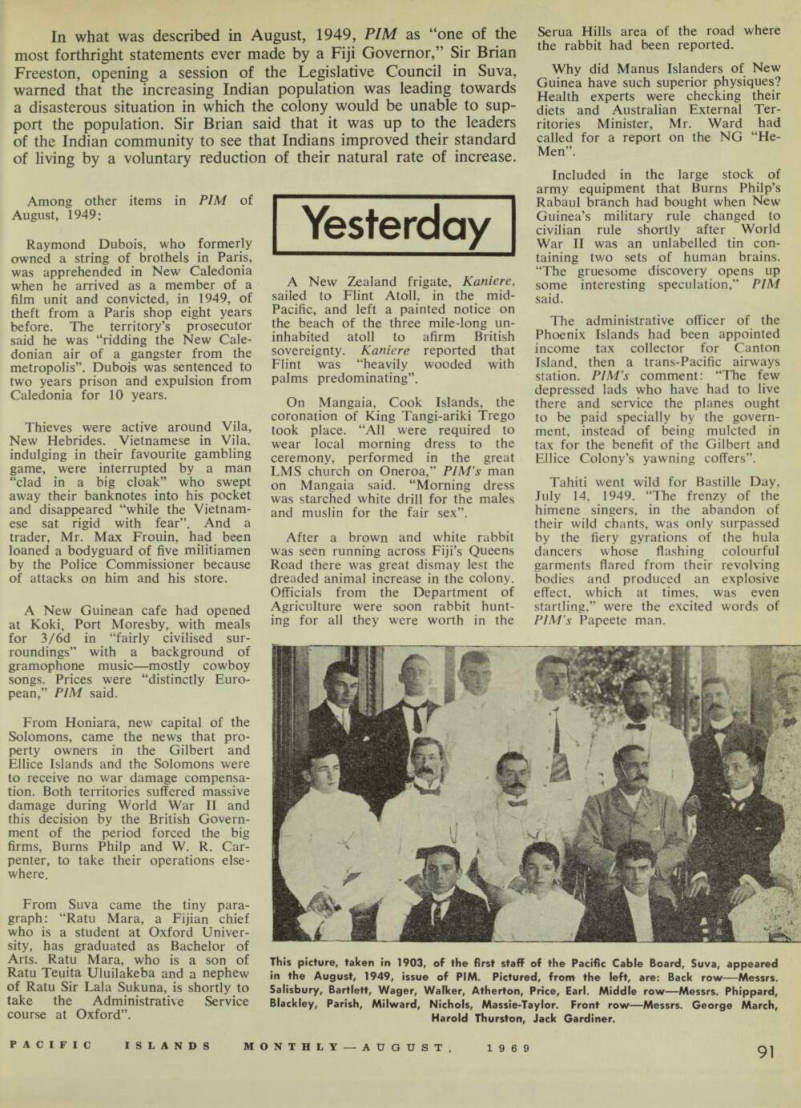
This picture, taken in 1903, of the first staff of the Pacific Cable Board, Suva, appeared in the August, 1949, issue of PIM. Pictured, from the left, are: Back row—Messrs.
Salisbury, Bartlett, Wager, Walker, Atherton, Price, Earl. Middle row —Messrs. Phippard, Blackley, Parish, Milward, Nichols, Massie-Taylor. Front row —Messrs. George March, Harold Thurston, Jack Gardiner.