"Pop" Johnson, 91, Recalls
p. 93 · Read in the full issue
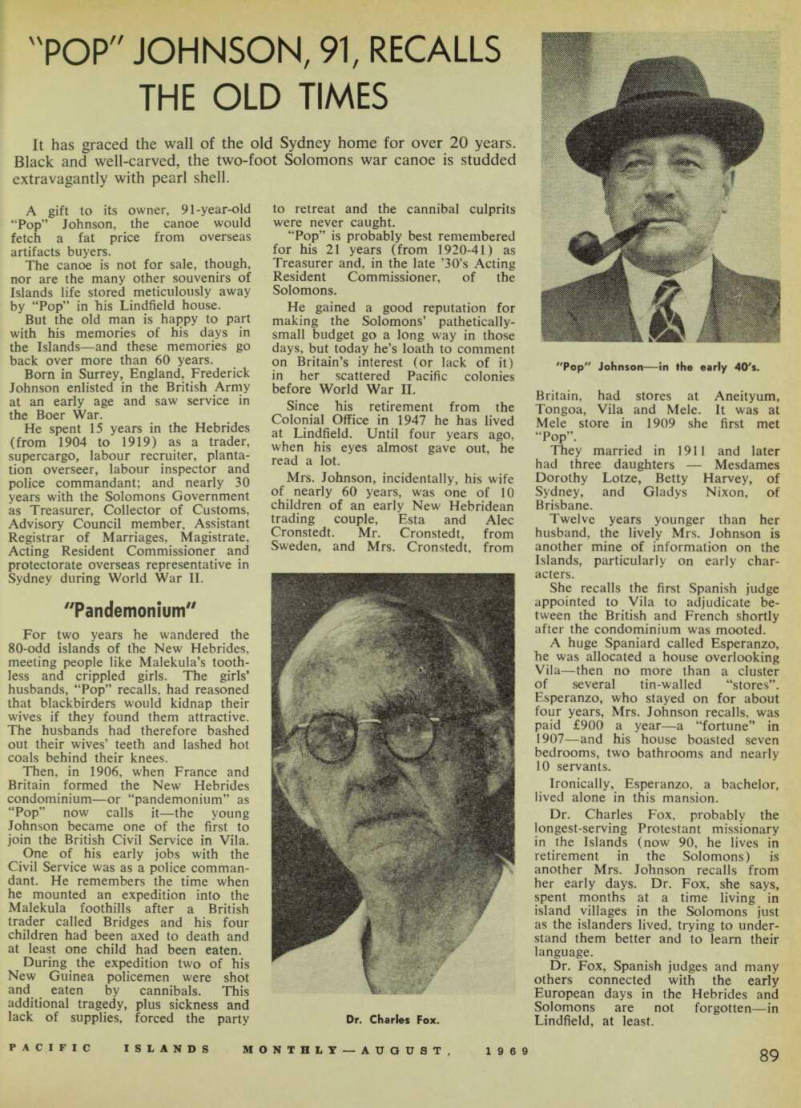
The Old Times
It has graced the wall of the old Sydney home for over 20 years.
Black and well-carved, the two-foot Solomons war canoe is studded extravagantly with pearl shell.
A gift to its owner, 91-year-old “Pop” Johnson, the canoe would fetch a fat price from overseas artifacts buyers.
The canoe is not for sale, though, nor are the many other souvenirs of Islands life stored meticulously away by “Pop” in his Lindfield house.
But the old man is happy to part with his memories of his days in the Islands—and these memories go back over more than 60 years.
Bom in Surrey, England, Frederick Johnson enlisted in the British Army at an early age and saw service in the Boer War.
He spent 15 years in the Hebrides (from 1904 to 1919) as a trader, supercargo, labour recruiter, planta tion overseer, labour inspector and police commandant; and nearly 30 years with the Solomons Government as Treasurer, Collector of Customs, Advisory Council member. Assistant Registrar of Marriages, Magistrate, Acting Resident Commissioner and protectorate overseas representative in Sydney during World War 11.
"Pandemonium"
For two years he wandered the 80-odd islands of the New Hebrides, meeting people like Malekula’s tooth less and crippled girls. The girls’ husbands, “Pop” recalls, had reasoned that blackbirders would kidnap their wives if they found them attractive.
The husbands had therefore bashed out their wives’ teeth and lashed hot coals behind their knees.
Then, in 1906, when France and Britain formed the New Hebrides condominium—or “pandemonium” as “Pop” now calls it—the young Johnson became one of the first to join the British Civil Service in Vila.
One of his early jobs with the Civil Service was as a police comman dant. He remembers the time when he mounted an expedition into the Malekula foothills after a British trader called Bridges and his four children had been axed to death and at least one child had been eaten.
During the expedition two of his New Guinea policemen were shot and eaten by cannibals. This additional tragedy, plus sickness and lack of supplies, forced the party
to retreat and the cannibal culprits were never caught.
“Pop” is probably best remembered for his 21 years (from 1920-41) as Treasurer and, in the late ’3o’s Acting Resident Commissioner, of the Solomons.
He gained a good reputation for making the Solomons’ pathetically small budget go a long way in those days, but today he’s loath to comment on Britain’s interest (or lack of it) in her scattered Pacific colonies before World War 11.
Since his retirement from the Colonial Office in 1947 he has lived at Lindfield. Until four years ago, when his eyes almost gave out, he read a lot.
Mrs. Johnson, incidentally, his wife of nearly 60 years, was one of 10 children of an early New Hebridean trading couple, Esta and Alec Cronstedt. Mr. Cronstedt, from Sweden, and Mrs. Cronstedt, from
Britain, had stores at Aneityum, Tongoa, Vila and Mele. It was at Mele store in 1909 she first met “Pop”.
They married in 1911 and later had three daughters Mesdames Dorothy Lotze, Betty Harvey, of Sydney, and Gladys Nixon, of Brisbane.
Twelve years younger than her husband, the lively Mrs. Johnson is another mine of information on the Islands, particularly on early char acters.
She recalls the first Spanish judge appointed to Vila to adjudicate be tween the British and French shortly after the condominium was mooted.
A huge Spaniard called Esperanzo, he was allocated a house overlooking Vila—then no more than a cluster of several tin-walled “stores”.
Esperanzo, who stayed on for about four years, Mrs. Johnson recalls, was paid £9OO a year—a “fortune” in 1907—and his house boasted seven bedrooms, two bathrooms and nearly 10 servants.
Ironically, Esperanzo. a bachelor, lived alone in this mansion.
Dr. Charles Fox, probably the longest-serving Protestant missionary in the Islands (now 90, he lives in retirement in the Solomons) is another Mrs. Johnson recalls from her early days. Dr. Fox, she says, spent months at a time living in island villages in the Solomons just as the islanders lived, trying to under stand them better and to learn their language.
Dr. Fox, Spanish judges and many others connected with the early European days in the Hebrides and Solomons are not forgotten—in Lindfield, at least.
Dr. Charles Fox.
"Pop" Johnson —in the early 40's.