Anton Meyer grows cabbages
p. 89 · Read in the full issue
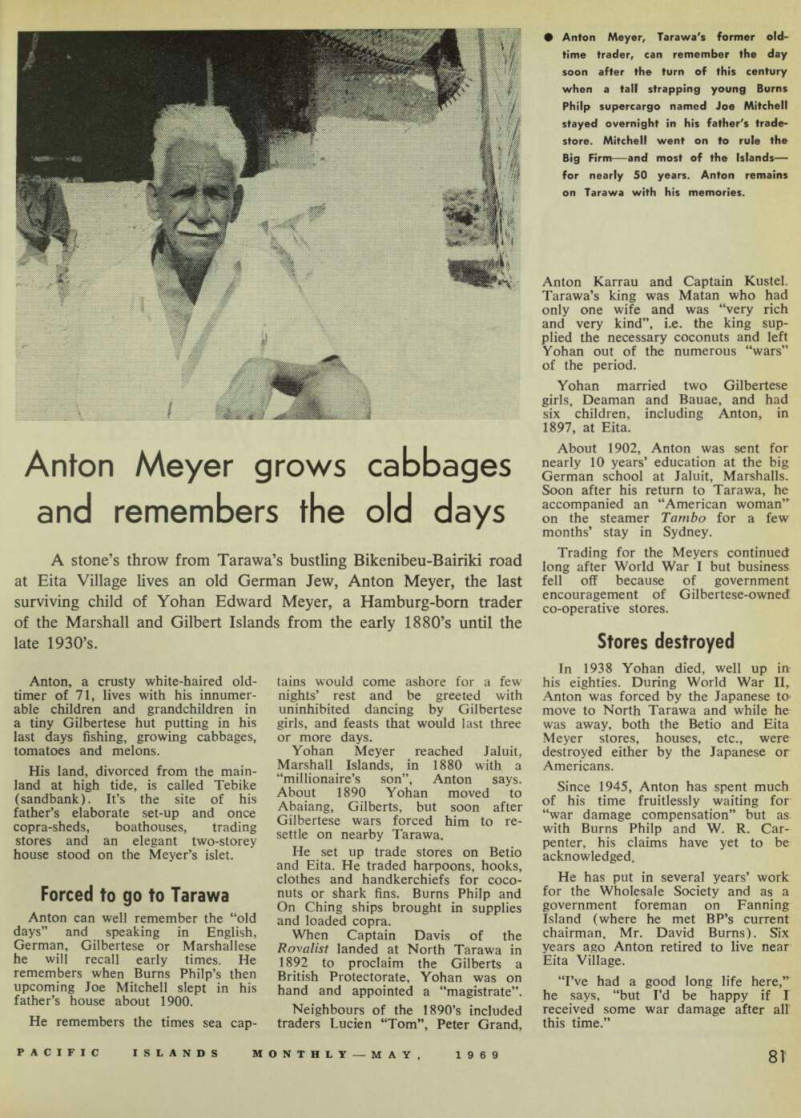
and remembers the old days
A stone’s throw from Tarawa’s bustling Bikenibeu-Bairiki road at Eita Village lives an old German Jew, Anton Meyer, the last surviving child of Yohan Edward Meyer, a Hamburg-born trader of the Marshall and Gilbert Islands from the early 1880’s until the late 1930’5.
Anton, a crusty white-haired old timer of 71, lives with his innumer able children and grandchildren in a tiny Gilbertese hut putting in his last days fishing, growing cabbages, tomatoes and melons.
His land, divorced from the main land at high tide, is called Tebike (sandbank). It’s the site of his father’s elaborate set-up and once copra-sheds, boathouses, trading stores and an elegant two-storey house stood on the Meyer’s islet.
Forced to go to Tarawa
Anton can well remember the “old days” and speaking in English, German, Gilbertese or Marshallese he will recall early times. He remembers when Burns Philp’s then upcoming Joe Mitchell slept in his father’s house about 1900.
He remembers the times sea cap
tains would come ashore for a few nights’ rest and be greeted with uninhibited dancing by Gilbertese girls, and feasts that would last three or more days.
Yohan Meyer reached Jaluit, Marshall Islands, in 1880 with a “millionaire’s son”, Anton says.
About 1890 Yohan moved to Abaiang, Gilberts, but soon after Gilbertese wars forced him to re settle on nearby Tarawa.
He set up trade stores on Betio and Eita, He traded harpoons, hooks, clothes and handkerchiefs for coco nuts or shark fins. Burns Philp and On Ching ships brought in supplies and loaded copra.
When Captain Davis of the Rovalist landed at North Tarawa in 1892 to proclaim the Gilberts a British Protectorate, Yohan was on hand and appointed a “magistrate”.
Neighbours of the 1890’s included traders Lucien “Tom”, Peter Grand,
Anton Karrau and Captain Kustel.
Tarawa’s king was Matan who had only one wife and was “very rich and very kind”, i.e. the king sup plied the necessary coconuts and left Yohan out of the numerous “wars” of the period.
Yohan married two Gilbertese girls, Deaman and Bauae, and had six children, including Anton, in 1897, at Eita.
About 1902, Anton was sent for nearly 10 years’ education at the big German school at Jaluit, Marshalls.
Soon after his return to Tarawa, he accompanied an “American woman” on the steamer Tambo for a few months’ stay in Sydney.
Trading for the Meyers continued long after World War I but business fell off because of government encouragement of Gilbertese-owned co-operative stores.
Stores destroyed
In 1938 Yohan died, well up in his eighties. During World War 11, Anton was forced by the Japanese to move to North Tarawa and while he was away, both the Betio and Eita Meyer stores, houses, etc., were destroyed either by the Japanese or Americans.
Since 1945, Anton has spent much of his time fruitlessly waiting for “war damage compensation” but as with Burns Philp and W. R. Car penter, his claims have yet to be acknowledged.
He has put in several years’ work for the Wholesale Society and as a government foreman on Fanning Island (where he met BP’s current chairman, Mr. David Burns). Six years ago Anton retired to live near Eita Village.
“I’ve had a good long life here,” he says, “but I’d be happy if I received some war damage after all this time.”
Anton Meyer, Tarawa's former old time trader, can remember the day soon after the turn of this century when a tall strapping young Burns Philp supercargo named Joe Mitchell stayed overnight in his father's trade store. Mitchell went on to rule the Big Firm —and most of the Islands — for nearly 50 years. Anton remains on Tarawa with his memories.