Magazine Section
pp. 87-88 · Read in the full issue
Agnes Corrie, Quaint But Tough, Has
Seen Enough Of Life Now
In the late 1800's the low-lying atolls of the Gilbert and Ellice Islands attracted many of the most colourful and bizarre traders to walk the scorched coral beaches of the Central Pacific. Two of them were Tarawa's German-born Yohann Meyer and Maiana's Yorkshire-born Bob Corrie. On a recent visit to the GEIC, staff writer KEN McGREGOR met two of their surviving children, Agnes Corrie and Anton Meyer, who both have yarns to tell of the early days.
She stared at me in amazement. A tiny, withered figure with long strands of grey hair, clothed in a tattered ancient dress. “You mean,” said Agnes Corrie in her quaint English accent, “that you want to hear about me and my father?”
I insisted that I did. Minutes later we were sitting cross-legged on the matted floor of a tiny hut in Teban gitua Village on Maiana in the Gilbert and Ellice Islands Colony.
Agnes, 81 last November, has an excellent knowledge of Maiana—and so she should: she was born there.
The flattered, and flabbergasted, Agnes was only too happy to tell me her life story. After all, she said, it was “a treat” to talk in English.
Most of the time she has to speak Gilbertese—or French, to Maiana’s French Catholic priest.
And so I listened, sipping coconut water generously supplied by per plexed onlookers every time my coconut shell appeared to be half full.
Agnes’ father, Yorkshire-born Robert Corrie was the son of an English couple who emigrated to Sydney in the 1840’s. Robert’s father, Alec Corrie, was drowned when his wool carrying clipper was wrecked off the West Indies about 1845.
A better life
Soon after the death of his father, Robert, then in his twenties, left home to look for a better life aboard a whaleboat headed for the Central Pacific.
About 1850, when the whaler called at Tabiteuea, Southern Gilberts, he jumped ship. Despite a civil war between Tabiteuean tribes,
Corrie stayed there several months, starting his trading activities which were to last for nearly 70 years in the Gilberts.
Good prices for coconut oil, shark fin and beche-de-mer allowed Robert Corrie to extend his business to Butaritari and Marakei before he found a permanent niche on Maiana in 1861.
Maiana had only one European then—an American seadog named Mac—but when trade picked up in the 1880’s and 1890’s two traders.
Mellon and Raymond, arrived and
later a Mexican ship left a seaman, Mike Shea.
The colony’s most famous trader, George Murdoch also put in several months trading on Maiana in the late 1880’s.
Before government came, Corrie sold anything he could lay his hands on to the Maianans, and they sup plied him with coconuts, shark fins and beche-de-mer.
He married twice, first to Taoniti, a vivacious Maianan, and then to Lidia, another attractive Gilbertese from nearby Tarawa.
He had six children by Taoniti— Charles, Fanny, Alec, Mary, Ben and Agnes (all now dead except Agnes and Ben, who lives on Rabi Island, Fiji) and another six by Lidia—May, Sarah, Mita, Charlotte, Ruth and James (all now dead except Mita who lives at Jaluit, Marshall Islands, and Charlotte, at Tarawa).
A one-time agent of Richard Randell, the coconut oil baron of the Gilberts until about 1875, Corrie gained a reputation as a responsible trader, who did not take sides in the Gilbertese wars of the period, and who ran and financed his own schools on Maiana before the missions arrived.
Good times in the coconut oil trade gave him a reported income of over £l,OOO a year.
Abemama’s King Binoka offered him the “governorship” of Maiana in the 1880’s and when Captain
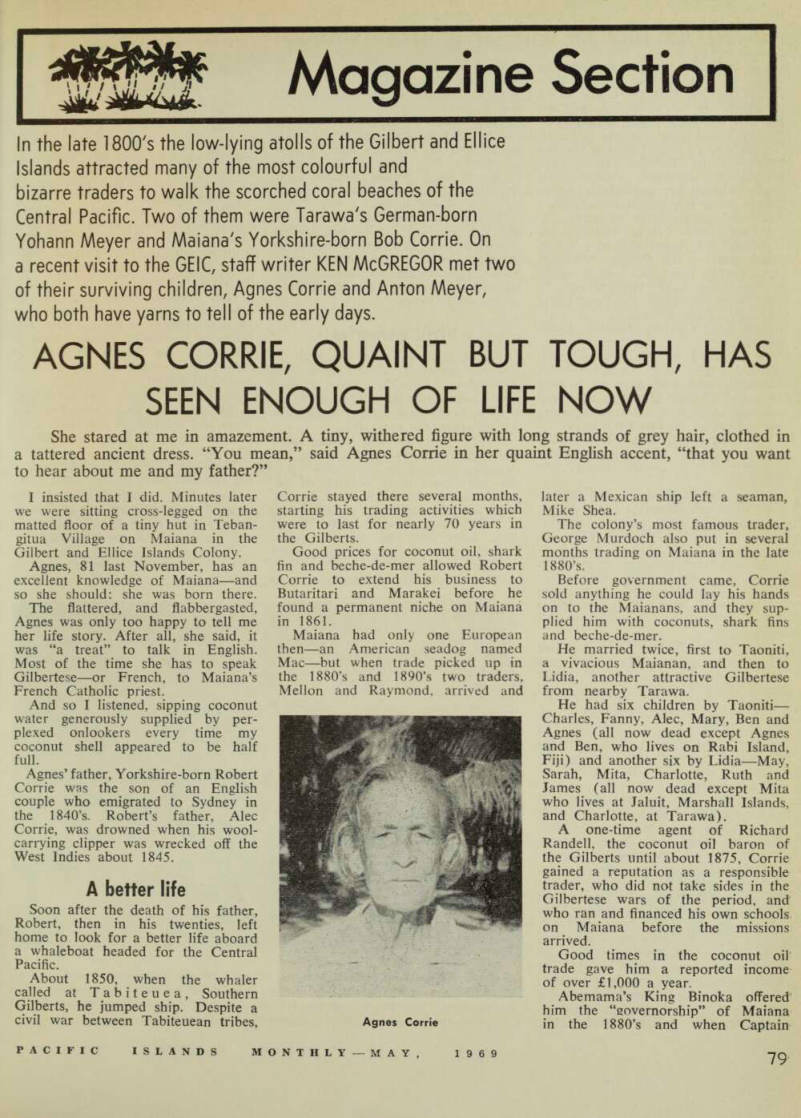
Agnes Corrie
He left his ship for love of a native woman
Davis arrived on the Royalist in 1892 to proclaim a British pro tectorate of the Gilberts, Corrie acted as interpreter and island magistrate.
He had previously been “appointed”
British Vice-Consul for the Gilberts.
Corrie was a close friend of George Murdoch; he called Agnes after Murdoch’s daughter, Agnes, and made Mudoch her godfather. (Agnes Corrie never saw her mother Taoniti, who died giving birth to her).
About 1894 Corrie bundled his eight-year-old Agnes aboard a Burns Philp steamer for Sydney. She was there for 10 years and was educated at Fort Street Girls’ High School.
“I spent most of the time living with my father’s relatives in little rooms near Circular Quay,” Agnes told me.
“I returned to Maiana in 1903.
Aboard the ship was George Murdoch who had gone to Sydney to collect Agnes Murdoch who had reached Australia after completing her education in San Francisco.
“Mr. Murdoch was very excited because Agnes had an American accent and was awfully pretty, you know.
“The two insisted on me staying with them on Abemama for a couple of months. In all it was nine months before 1 met dad again after 11 years away.”
Maiana had scarcely changed in Agnes’ absence, except that Mike Shea was trading. (He had swum off a Mexican ship which was trying to recruit Gilbertese to work in coffee plantations).
“Mr. Shea left the ship for the love of a native woman. My father gave him a house where he lived for about three years with four wives,” said Agnes.
“With my father’s help he began trading and when he was aged 24 he and I went to Tarawa. Mr. Charlie Workman married us there and the certificate cost £l/1-. We returned to Maiana to live.”
In 1917, with his life savings of about £2,000 in gold, Robert Corrie left Maiana in a schooner to visit his son, Ben, on Ocean Island.
Neither the schooner nor its 87-year old Yorkshireman were seen again.
“Three months afterwards natives found oars and pillow-cases on Maiana’s northern beaches. They were from the ship,” Agnes told me.
The Sheas had two sons —John and Charles—and together they ran two of Corrie’s trade stores on Maiana and operated three workboats around the huge lagoon of the atoll, picking up copra.
Agnes, who referred to her late
and only husband as “Mr. Shea”, said that about 1925 her husband went to Tarawa for medical attention for a rupture.
“Mr. Shea’s operation was a success and he returned to me,” she said. “But he brought back a case of whisky. One night he drank four of the whisky bottles and the next morning he was dead on the beach in front of our home.”
Mrs. Shea buried her husband on the now-deserted family cemetry on Tibikera Islet and settled down to running Corrie’s stores. About 1932, when government-encouraged co
operatives proved too-competitive,
these stores closed.
Vivid memories
Agnes spent the War on Maiana, and her memories of the three New Zealanders, “John, Les and Charlie”, who were planted on Maiana as coastwatchers and later rounded up by the Japanese are vivid.
“They were all fine young men, two were 21,” she said. “When the Japanese arrived in 1942 they knew the boys were there because of the radio signals they had been sending out from the atoll.
“John and Charlie were found first. John was tied up with twine and the Japanese commander pushed a bayonet through his right arm.
“Les Speedy kept hiding in a hole
under the ground. His Maianan girlfriend who was just about to have his baby and my son John brought him food.
“The Japanese threatened us and said if Les wasn’t found, we would all be killed. They burned Tora Village.
“Les heard about this and gave himself up. The next day as he was being led down the beach to a Japan ese warship we stopped them for just a moment outside a hut.
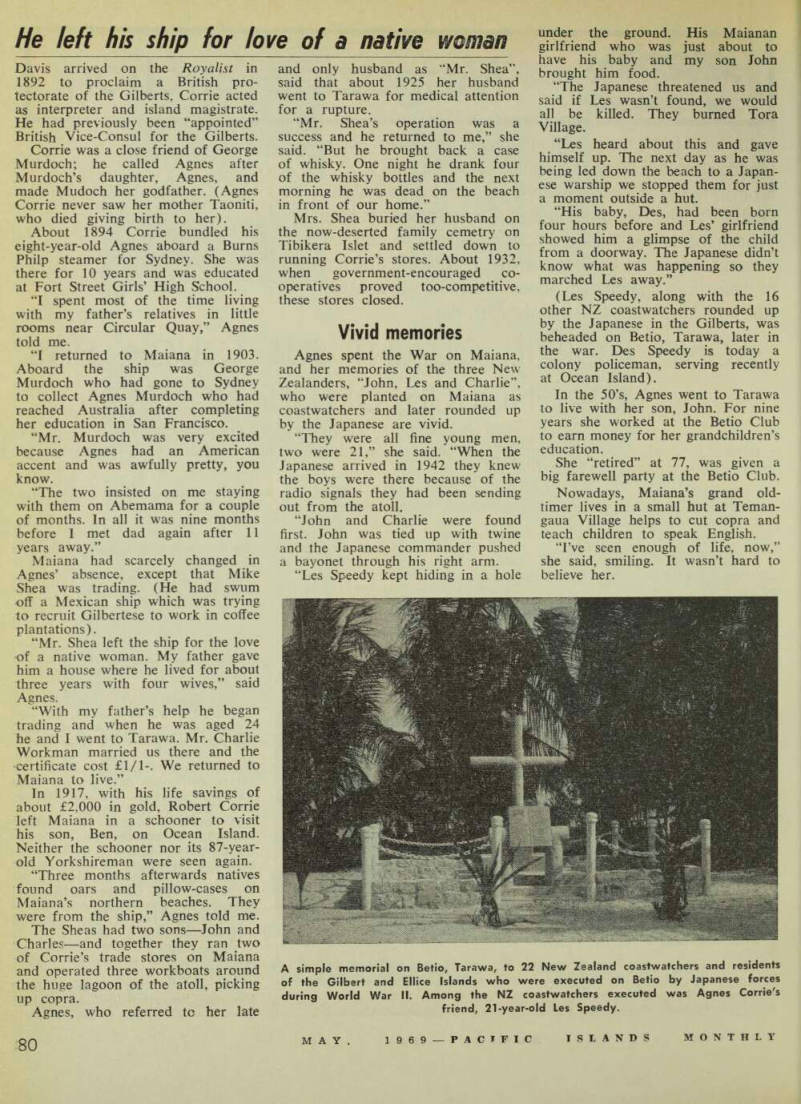
“His baby, Des, had been born four hours before and Les’ girlfriend showed him a glimpse of the child from a doorway. The Japanese didn’t know what was happening so they marched Les away.” (Les Speedy, along with the 16 other NZ coastwatchers rounded up by the Japanese in the Gilberts, was beheaded on Betio, Tarawa, later in the war. Des Speedy is today a colony policeman, serving recently at Ocean Island).
In the 50’s, Agnes went to Tarawa to live with her son, John. For nine years she worked at the Betio Club to earn money for her grandchildren’s education.
She “retired” at 77, was given a big farewell party at the Betio Club.
Nowadays, Maiana’s grand old timer lives in a small hut at Teman gaua Village helps to cut copra and teach children to speak English.
“I’ve seen enough of life, now,” she said, smiling. It wasn’t hard to believe her.
A simple memorial on Betio, Tarawa, to 22 New Zealand coastwatchers and residents of the Gilbert and Ellice Islands who were executed on Betio by Japanese forces during World War II. Among the NZ coastwatchers executed was Agnes Corrie's friend, 21-year-old Les Speedy.