We Japanese
pp. 91-93 · Read in the full issue

Remember
Moll War
By Mary Browning
Makin, Tarawa, Kwajalein, Eniwetok—the great battles of a [uarter-of-a-century ago—are remembered by the Allies as ex remely costly victories. Bronze plaques or concrete monuments iow serve as reminders of the bloodbaths.
Most of the Japanese knew before and that the islands were inde ensible, although a few Japanese ommanders, such as Rear-Admiral Leiji Shibasaki, of Tarawa, boasted hat their strongholds were impregn ble.
The 17,000-plus Japanese killed i the Gilberts and Marshalls actions lied in holding actions that were loomed from the start, and the amilies of those men have now ormed an organisation called the darshall and Gilbert Islands lereaved Families Association.
To honour their dead
About four years ago, the asso iation began an exchange of letters vith the US command on Kwajalein, ti the Marshall Islands. The associa ion’s aim was to honour the Jap inse who died on the islands.
Kwajalein is now a missile testing ite, and, as the western terminal of he Pacific Missile Range, it is under 'ery strict security restrictions. Never heless, the association’s letters were eceived sympathetically, and, when )Ossible, the association’s requests vere met.
In the first exchange of letters, he association was informed that here was a Japanese cemetery on kwajalein which was established (as
a large common grave) almost im mediately after the American occupa tion of the island. It is now fenced, graced with a red “torii” over the entrance and a border of spider lilies.
It is carefully maintained.
The US command said that there was also a Japanese cemetery on Roi- Namur, another island of the Kwaja lein, atoll, and a British anti-aircraft gun, one of four captured at Singa pore and brought to the atoll.
Roi-Namur was used as an air-
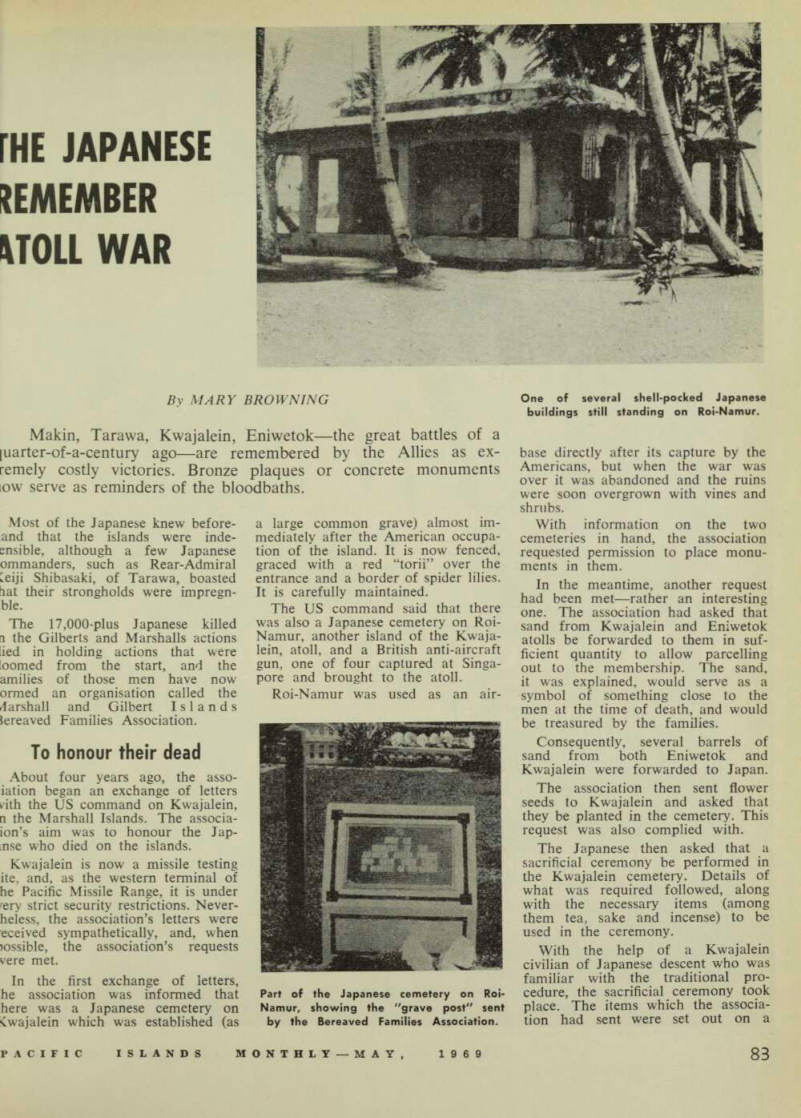
base directly after its capture by the Americans, but when the war was over it was abandoned and the ruins were soon overgrown with vines and shrubs.
With information on the two cemeteries in hand, the association requested permission to place monu ments in them.
In the meantime, another request had been met —rather an interesting one. The association had asked that sand from Kwajalein and Eniwetok atolls be forwarded to them in suf ficient quantity to allow parcelling out to the membership. The sand, it was explained, would serve as a symbol of something close to the men at the time of death, and would be treasured by the families.
Consequently, several barrels of sand from both Eniwetok and Kwajalein were forwarded to Japan.
The association then sent flower seeds to Kwajalein and asked that they be planted in the cemetery. This request was also complied with.
The Japanese then asked that a sacrificial ceremony be performed in the Kwajalein cemetery. Details of what was required followed, along with the necessary items (among them tea, sake and incense) to be used in the ceremony.
With the help of a Kwajalein civilian of Japanese descent who was familiar with the traditional pro cedure, the sacrificial ceremony took place. The items which the associa tion had sent were set out on a
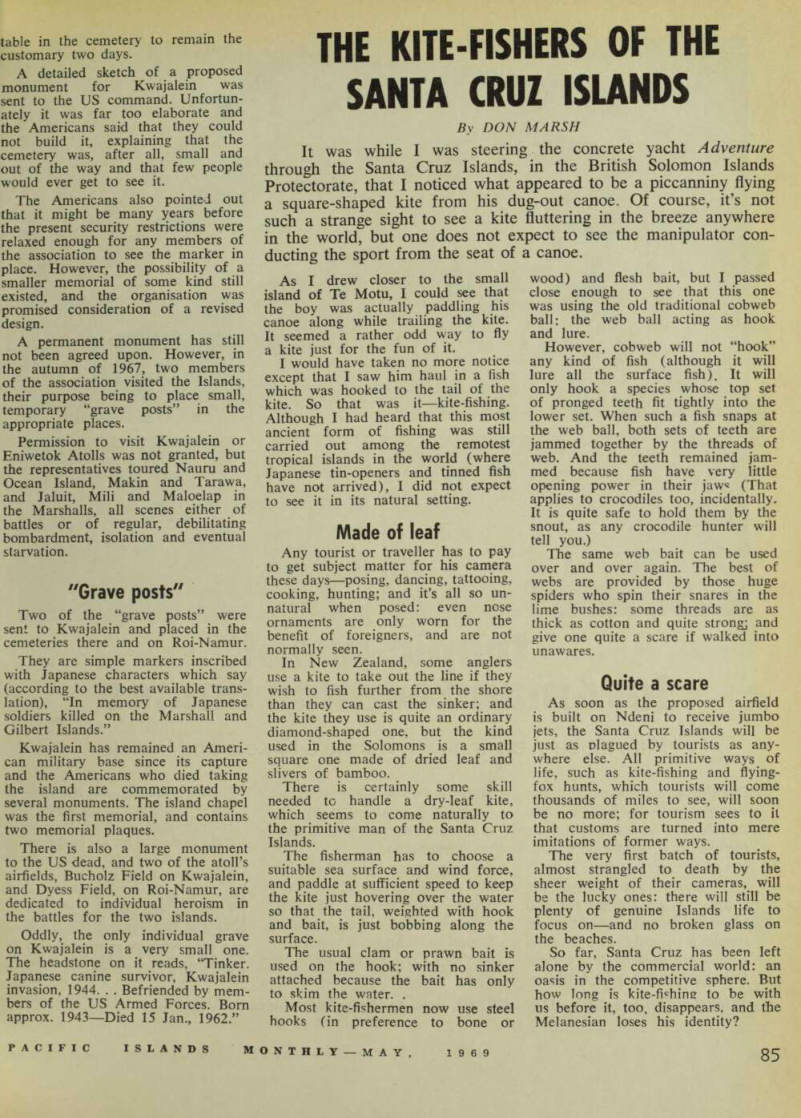
Part of the Japanese cemetery on Roi- Namur, showing the "grave post" sent by the Bereaved Families Association.
One of several shell-pocked Japanese buildings still standing on Roi-Namur.
table in the cemetery to remain the customary two days.
A detailed sketch of a proposed monument for Kwajalein was sent to the US command. Unfortun ately it was far too elaborate and the Americans said that they could not build it, explaining that the cemetery was, after all, small and out of the way and that few people would ever get to see it.
The Americans also pointed out that it might be many years before the present security restrictions were relaxed enough for any members of the association to see the marker in place. However, the possibility of a smaller memorial of some kind still existed, and the organisation was promised consideration of a revised design.
A permanent monument has still not been agreed upon. However, in the autumn of 1967, two members of the association visited the Islands, their purpose being to place small, temporary “grave posts” in the appropriate places.
Permission to visit Kwajalein or Eniwetok Atolls was not granted, but the representatives toured Nauru and Ocean Island, Makin and Tarawa, and Jaluit, Mili and Maloelap in the Marshalls, all scenes either of battles or of regular, debilitating bombardment, isolation and eventual starvation.
"Grave posts"
Two of the “grave posts” were sent to Kwajalein and placed in the cemeteries there and on Roi-Namur.
They are simple markers inscribed with Japanese characters which say (according to the best available trans lation), “In memory of Japanese soldiers killed on the Marshall and Gilbert Islands.”
Kwajalein has remained an Ameri can military base since its capture and the Americans who died taking the island are commemorated by several monuments. The island chapel was the first memorial, and contains two memorial plaques.
There is also a large monument to the US dead, and two of the atoll’s airfields, Bucholz Field on Kwajalein, and Dyess Field, on Roi-Namur, are dedicated to individual heroism in the battles for the two islands.
Oddly, the only individual grave on Kwajalein is a very small one.
The headstone on it reads, ‘Tinker.
Japanese canine survivor, Kwajalein invasion, 1944. . . Befriended by mem bers of the US Armed Forces. Bom approx. 1943—Died 15 Jan., 1962.”