Letters
pp. 58-59 · Read in the full issue
Background To The Kanes
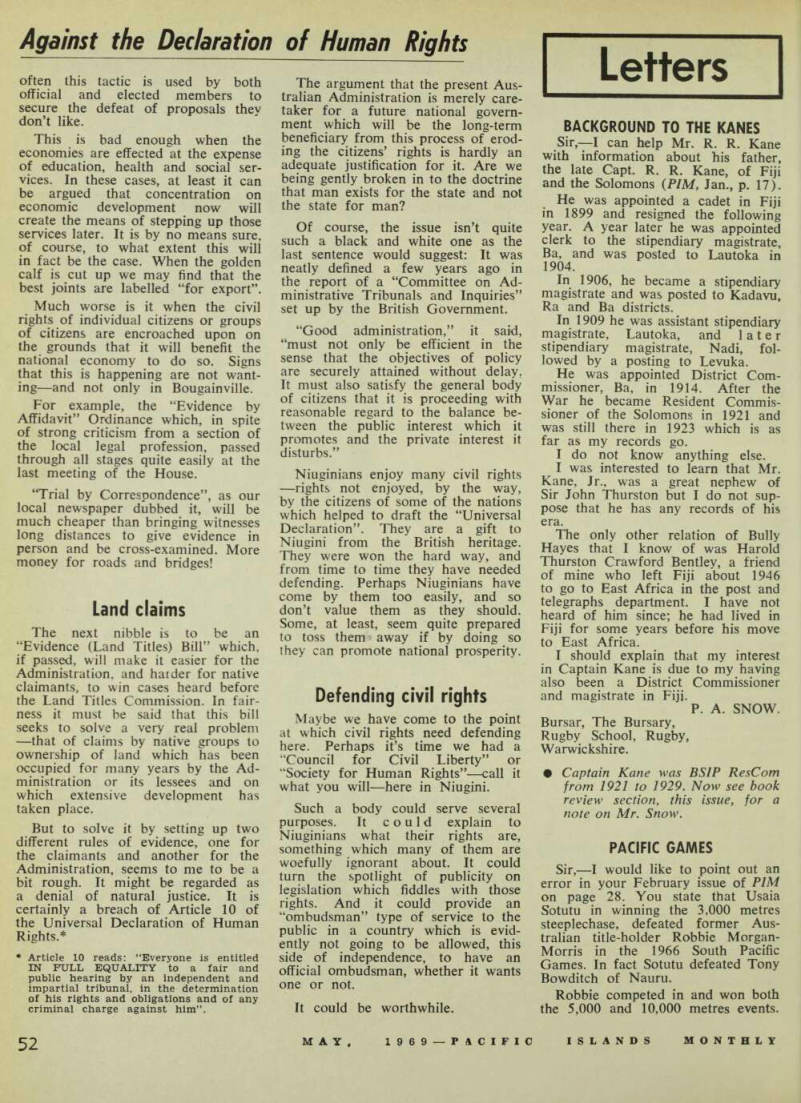
Sir, —I can help Mr. R. R. Kane with information about his father, the late Capt. R. R. Kane, of Fiji and the Solomons (PIM, Jan., p. 17).
He was appointed a cadet in Fiji in 1899 and resigned the following year. A year later he was appointed clerk to the stipendiary magistrate, Ba, and was posted to Lautoka in 1904.
In 1906, he became a stipendiary magistrate and was posted to Kadavu, Ra and Ba districts.
In 1909 he was assistant stipendiary magistrate, Lautoka, and later stipendiary magistrate, Nadi, fol lowed by a posting to Levuka.
He was appointed District Com missioner, Ba, in 1914. After the War he became Resident Commis sioner of the Solomons in 1921 and was still there in 1923 which is as far as my records go.
I do not know anything else.
I was interested to learn that Mr.
Kane, Jr., was a great nephew of Sir John Thurston but I do not sup pose that he has any records of his era.
The only other relation of Bully Hayes that I know of was Harold Thurston Crawford Bentley, a friend of mine who left Fiji about 1946 to go to East Africa in the post and telegraphs department. I have not heard of him since; he had lived in Fiji for some years before his move to East Africa.
I should explain that my interest in Captain Kane is due to my having also been a District Commissioner and magistrate in Fiji.
P. A. Snow.
Bursar, The Bursary, Rugby School, Rugby, Warwickshire. • Captain Kane was BSIP Res Com from 1921 to 1929. Now see book review section, this issue, for a note on Mr. Snow.
Pacific Games
Sir, —I would like to point out an error in your February issue of PIM on page 28. You state that Usaia Sotutu in winning the 3,000 metres steeplechase, defeated former Aus tralian title-holder Robbie Morgan- Morris in the 1966 South Pacific Games. In fact Sotutu defeated Tony Bowditch of Nauru.
Robbie competed in and won both the 5,000 and 10,000 metres events.
This latter event was probably the most dramatic event of the Games.
Tony Bowditch won the 1,500 metres event in a close and exciting finish.
Both athletes are in strict training for the Port Moresby Games.
G. K. Roberts.
Hon. Secretary, Nauru Amateur Sports Assoc.
Cra Again
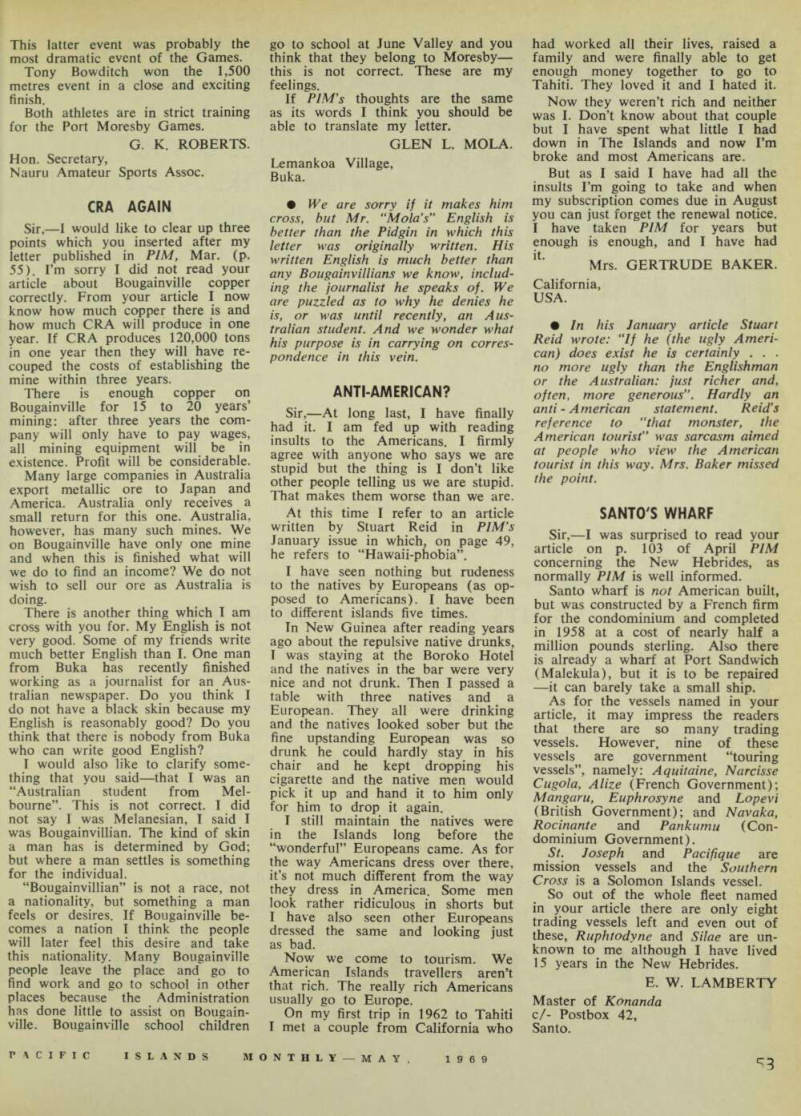
Sir, —1 would like to clear up three points which you inserted after my letter published in PIM, Mar. (p. 55). I’m sorry I did not read your article about Bougainville copper correctly. From your article I now know how much copper there is and how much CRA will produce in one year. If CRA produces 120,000 tons in one year then they will have re couped the costs of establishing the mine within three years.
There is enough copper on Bougainville for 15 to 20 years’ mining: after three years the com pany will only have to pay wages, all mining equipment will be in existence. Profit will be considerable.
Many large companies in Australia export metallic ore to Japan and America. Australia only receives a small return for this one. Australia, however, has many such mines. We on Bougainville have only one mine and when this is finished what will we do to find an income? We do not wish to sell our ore as Australia is doing.
There is another thing which I am cross with you for. My English is not very good. Some of my friends write much better English than I. One man from Buka has recently finished working as a journalist for an Aus tralian newspaper. Do you think I do not have a black skin because my English is reasonably good? Do you think that there is nobody from Buka who can write good English?
I would also like to clarify some thing that you said—that I was an “Australian student from Mel bourne”. This is not correct. I did not say I was Melanesian, I said I was Bougainvillian. The kind of skin a man has is determined by God; but where a man settles is something for the individual.
“Bougainvillian” is not a race, not a nationality, but something a man feels or desires. If Bougainville be comes a nation I think the people will later feel this desire and take this nationality. Many Bougainville people leave the place and go to find work and go to school in other places because the Administration has done little to assist on Bougain ville. Bougainville school children
go to school at June Valley and you think that they belong to Moresby— this is not correct. These are my feelings.
If PlM’s thoughts are the same as its words I think you should be able to translate my letter.
Glen L. Mola.
Lemankoa Village, Buka. • We are sorry if it makes him cross, but Mr. “Mola’s” English is better than the Pidgin in which this letter was originally written. His written English is much better than any Bougainvillians we know, includ ing the journalist he speaks of. We are puzzled as to why he denies he is, or was until recently, an Aus tralian student. And we wonder what his purpose is in carrying on corres pondence in this vein.
Anti-American?
Sir, —At long last, I have finally had it. I am fed up with reading insults to the Americans. I firmly agree with anyone who says we are stupid but the thing is I don’t like other people telling us we are stupid.
That makes them worse than we are.
At this time I refer to an article written by Stuart Reid in PlM’s January issue in which, on page 49, he refers to “Hawaii-phobia”.
I have seen nothing but rudeness to the natives by Europeans (as op posed to Americans). I have been to different islands five times.
In New Guinea after reading years ago about the repulsive native drunks, I was staying at the Boroko Hotel and the natives in the bar were very nice and not drunk. Then I passed a table with three natives and a European. They all were drinking and the natives looked sober but the fine upstanding European was so drunk he could hardly stay in his chair and he kept dropping his cigarette and the native men would pick it up and hand it to him only for him to drop it again.
I still maintain the natives were in the Islands long before the “wonderful” Europeans came. As for the way Americans dress over there, it’s not much different from the way they dress in America. Some men look rather ridiculous in shorts but I have also seen other Europeans dressed the same and looking just as bad.
Now we come to tourism. We American Islands travellers aren’t that rich. The really rich Americans usually go to Europe.
On my first trip in 1962 to Tahiti I met a couple from California who
had worked all their lives, raised a family and were finally able to get enough money together to go to Tahiti. They loved it and I hated it.
Now they weren’t rich and neither was I. Don’t know about that couple but I have spent what little I had down in The Islands and now I’m broke and most Americans are.
But as I said I have had all the insults I’m going to take and when my subscription comes due in August you can just forget the renewal notice.
I have taken PIM for years but enough is enough, and I have had
it.
Mrs. Gertrude Baker.
California,
Usa.
• In his January article Stuart Reid wrote: “If he (the ugly Ameri can) does exist he is certainly . . . no more ugly than the Englishman or the Australian: just richer and, often, more generous”. Hardly an anti - American statement. Reid’s reference to “that monster, the American tourist ’ was sarcasm aimed at people who view the American tourist in this way. Mrs. Baker missed the point.
Santo's Wharf
Sir, —I was surprised to read your article on p. 103 of April PIM concerning the New Hebrides, as normally PIM is well informed.
Santo wharf is not American built, but was constructed by a French firm for the condominium and completed in 1958 at a cost of nearly half a million pounds sterling. Also there is already a wharf at Port Sandwich (Malekula), but it is to be repaired —it can barely take a small ship.
As for the vessels named in your article, it may impress the readers that there are so many trading vessels. However, nine of these vessels are government “touring vessels”, namely: Aquitaine, Narcisse Cugola, Alize (French Government); Mangaru, Euphrosyne and Lopevi (British Government); and Navaka, Rocinante and Pankumu (Con dominium Government).
St. Joseph and Pacifique are mission vessels and the Southern Cross is a Solomon Islands vessel.
So out of the whole fleet named in your article there are only eight trading vessels left and even out of these, Ruphtodyne and Silae are un known to me although I have lived 15 years in the New Hebrides.
E. W. Lamberty
Master of Konanda c/- Postbox 42, Santo.