To the Point
pp. 56-58 · Read in the full issue
IS FEDERATION IN NEW GUINEA THE ONLY
Alternative To Fragmentation?
Early this year the 300 boys and girls at the Kwikila High School, some 50 miles east of Port Moresby, staged a House of Assembly-style election to choose their school captain and prefects. Each voter, as in national elections here, had two votes, one in a “regional” electorate for the school cap tain and a second in one of four “open” electorates for the prefects. There were polling booths, an electoral roll to be marked, and, to add to the verisimilitude, real ballot boxes borrowed from the Electoral Office.
An illustrated leaflet which de scribes this exercise in democratic education concludes with the words, “The new leaders will not have an easy job in representing the students —but then democracy is never easy.”
Too right—it isn’t. And there are clearly stormy waters ahead for Niuginian democracy.
A couple of years ago, when I threw out a hesitant suggestion in this column that the answer might be some sort of federal structure of regions with a fair measure of regional autonomy, I thought I was a lone voice. But if I was (and it may just have been that no one was sufficiently interested either to agree with or contradict me, or perhaps that no one thought me worth con tradicting), I am certainly not a lone voice now, A few weeks ago an old friend of mine with many years experience of residence in New Britain and of close contact with its native people, said that in his opinion some sort of federalism was not merely desirable, it was inevitable. It was, he con sidered, the only alternative to frag mentation.
And now comes to hand the pro gramme of the United Islands Political Society, which has just amalgamated with the United Nmgim Party. The organisation has a fed eral structure of what it calls “states” as one of the planks of its platform.
Whether “state” is really the best word to use is open to question; per haps it carries too many overtones.
The objections usually offered to a federal structure are first that it would endanger national unity, and second that it would be cumbersome and costly. Neither of these objec tions is necessarily valid.
As far as national unity is con cerned, it is endangered already, and is likely to be still more endangered if we persist in our attempts to build national unity, in a colonial hang over which has no natural unity, by means of a unitary structure with a
To the Point with Percy Chatterton
strongly centralised government located in the capital. And this is true whether the capital remains in Port Moresby, or is shifted, as some would like it to be, to Lae or Goroka.
The point has been made that a small number of “states” might pro mote strong regional loyalties at the expense of national loyalty, and this is probably true. The desirable num ber of “states” probably lies some where between the four regions into which the territory is currently divided administratively and the 18
districts into which it is further sub divided.
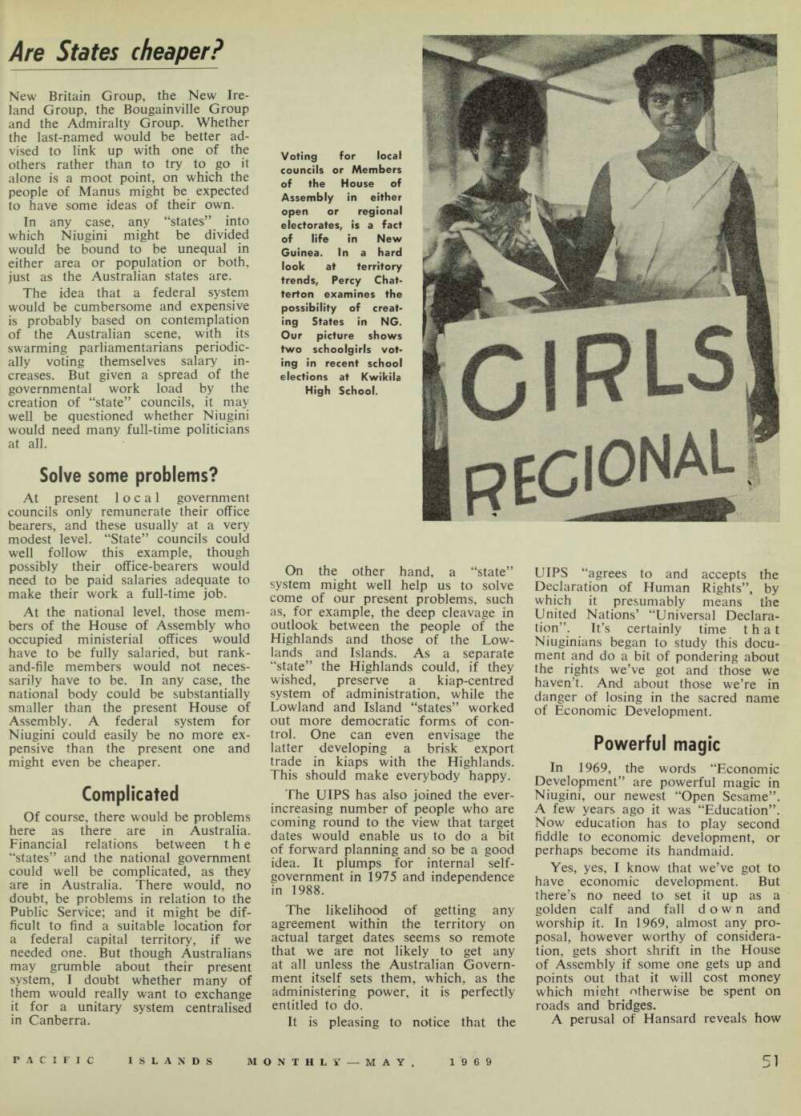
At the risk of sticking my neck out, I will suggest tentatively what they might be. First, in mainland P-NG there might be four—High lands; New Guinea Lowlands (prob ably including the Northern District of Papua); Papuan Lowlands (com prising the present Central, Gulf and Western Districts); and Papuan Islands (comprising the present Milne Bay District).
The UIPS suggests another four for the New Guinea Islands —the
Might a federated NG look like this?
Are States cheaper?
New Britain Group, the New Ire land Group, the Bougainville Group and the Admiralty Group. Whether the last-named would be better ad vised to link up with one of the others rather than to try to go it alone is a moot point, on which the people of Manus might be expected to have some ideas of their own.
In any case, any “states” into which Niugini might be divided would be bound to be unequal in either area or population or both, just as the Australian states are.
The idea that a federal system would be cumbersome and expensive is probably based on contemplation of the Australian scene, with its swarming parliamentarians periodic ally voting themselves salary in creases. But given a spread of the governmental work load by the creation of “state” councils, it may well be questioned whether Niugini would need many full-time politicians at all.
Solve some problems?
At present local government councils only remunerate their office bearers, and these usually at a very modest level. “State” councils could well follow this example, though possibly their office-bearers would need to be paid salaries adequate to make their work a full-time job.
At the national level, those mem bers of the House of Assembly who occupied ministerial offices would have to be fully salaried, but rank and-file members would not neces sarily have to be. In any case, the national body could be substantially smaller than the present House of Assembly. A federal system for Niugini could easily be no more ex pensive than the present one and might even be cheaper.
Complicated
Of course, there would be problems here as there are in Australia.
Financial relations between the “states” and the national government could well be complicated, as they are in Australia. There would, no doubt, be problems in relation to the Public Service; and it might be dif ficult to find a suitable location for a federal capital territory, if we needed one. But though Australians may grumble about their present system, I doubt whether many of them would really want to exchange it for a unitary system centralised in Canberra.
On the other hand, a “state” system might well help us to solve come of our present problems, such as, for example, the deep cleavage in outlook between the people of the Highlands and those of the Low lands and Islands. As a separate “state” the Highlands could, if they wished, preserve a kiap-centred system of administration, while the Lowland and Island “states” worked out more democratic forms of con trol. One can even envisage the latter developing a brisk export trade in kiaps with the Highlands.
This should make everybody happy.
The UIPS has also joined the ever increasing number of people who are coming round to the view that target dates would enable us to do a bit of forward planning and so be a good idea. It plumps for internal self government in 1975 and independence in 1988.
The likelihood of getting any agreement within the territory on actual target dates seems so remote that we are not likely to get any at all unless the Australian Govern ment itself sets them, which, as the administering power, it is perfectly entitled to do.
It is pleasing to notice that the
DIPS “agrees to and accepts the Declaration of Human Rights”, by which it presumably means the United Nations’ “Universal Declara tion”. It’s certainly time that Niuginians began to study this docu ment and do a bit of pondering about the rights we’ve got and those we haven’t. And about those we’re in danger of losing in the sacred name 0 f Economic Development, D r ■
rOWGrfUI ITiaCJIC
In 1969 , he words .- Economic Development” are powerful magic in Niugini, our newest “Open Sesame”, A few years ago it was “Education”, Now education has to play second fiddle to economic development, or perhaps become its handmaid, yes, yes, I know that we’ve got to have economic development. But there’s no need to set it up as a golden calf and fall down and worship it. In 1969, almost any pro posal, however worthy of considera tion, gets short shrift in the House of Assembly if some one gets up and points out that it will cost money which might otherwise be spent on roads and bridges.
A perusal of Hansard reveals how
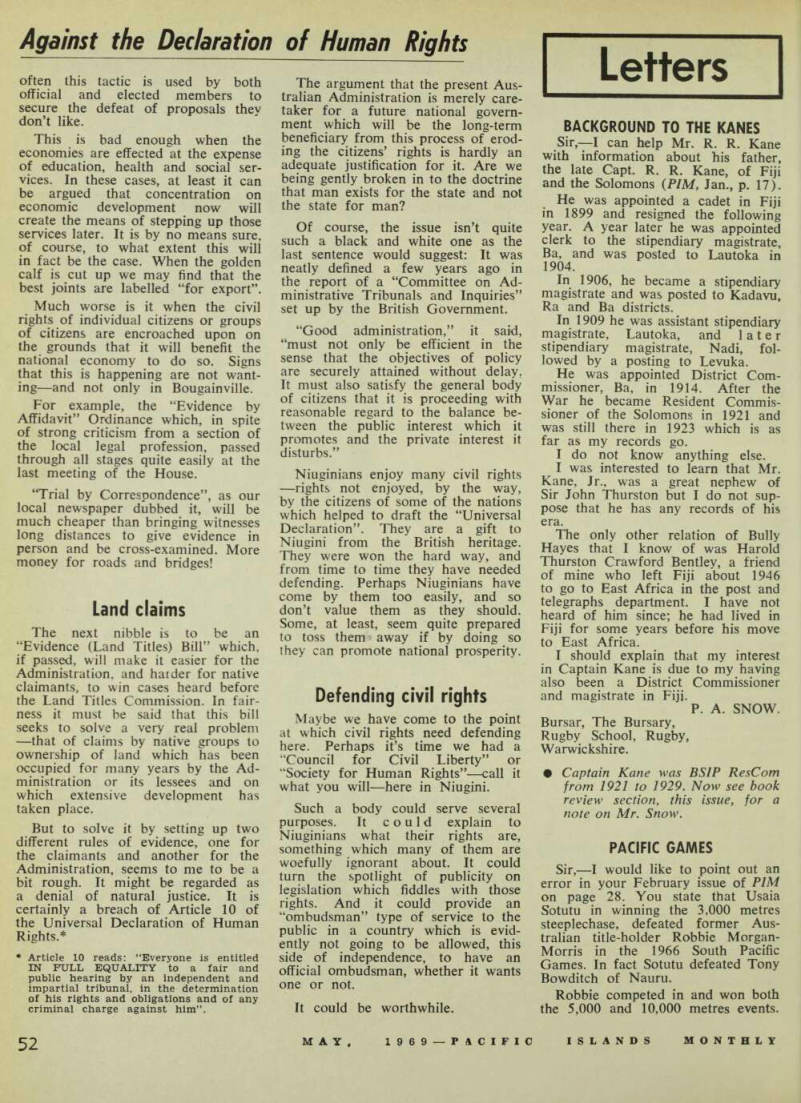
Voting for local councils or Members of the House of Assembly in either open or regional electorates, is a fact of life in New Guinea. In a hard look at territory trends, Percy Chat terton examines the possibility of creat ing States in NG.
Our picture shows two schoolgirls vot ing in recent school elections at Kwikila High School.
Against the Declaration of Human Rights
often this tactic is used by both official and elected members to secure the defeat of proposals they don’t like.
This is bad enough when the economies are effected at the expense of education, health and social ser vices. In these cases, at least it can be argued that concentration on economic development now will create the means of stepping up those services later. It is by no means sure, of course, to what extent this will in fact be the case. When the golden calf is cut up we may find that the best joints are labelled “for export”.
Much worse is it when the civil rights of individual citizens or groups of citizens are encroached upon on the grounds that it will benefit the national economy to do so. Signs that this is happening are not want ing—and not only in Bougainville.
For example, the “Evidence by Affidavit” Ordinance which, in spite of strong criticism from a section of the local legal profession, passed through all stages quite easily at the last meeting of the House. ‘Trial by Correspondence”, as our local newspaper dubbed it, will be much cheaper than bringing witnesses long distances to give evidence in person and be cross-examined. More money for roads and bridges!
Land claims
The next nibble is to be an “Evidence (Land Titles) Bill” which, if passed, will make it easier for the Administration, and haider for native claimants, to win cases heard before the Land Titles Commission. In fair ness it must be said that this bill seeks to solve a very real problem —that of claims by native groups to ownership of land which has been occupied for many years by the Ad ministration or its lessees and on which extensive development has taken place.
But to solve it by setting up two different rules of evidence, one for the claimants and another for the Administration, seems to me to be a bit rough. It might be regarded as a denial of natural justice. It is certainly a breach of Article 10 of the Universal Declaration of Human Rights.* • Article 10 reads: “Everyone is entitled IN FULL EQUALITY to a fair and public hearing by an independent and impartial tribunal, in the determination of his rights and obligations and of any criminal charge against him”.
The argument that the present Aus tralian Administration is merely care taker for a future national govern ment which will be the long-term beneficiary from this process of erod ing the citizens’ rights is hardly an adequate justification for it. Are we being gently broken in to the doctrine that man exists for the state and not the state for man?
Of course, the issue isn’t quite such a black and white one as the last sentence would suggest: It was neatly defined a few years ago in the report of a “Committee on Ad ministrative Tribunals and Inquiries” set up by the British Government.
“Good administration,” it said, “must not only be efficient in the sense that the objectives of policy are securely attained without delay.
It must also satisfy the general body of citizens that it is proceeding with reasonable regard to the balance be tween the public interest which it promotes and the private interest it disturbs.”
Niuginians enjoy many civil rights —rights not enjoyed, by the way, by the citizens of some of the nations which helped to draft the “Universal Declaration”. They are a gift to Niugini from the British heritage.
They were won the hard way, and from time to time they have needed defending. Perhaps Niuginians have come by them too easily, and so don’t value them as they should.
Some, at least, seem quite prepared to toss them away if by doing so they can promote national prosperity.
Defending civil rights
Maybe we have come to the point at which civil rights need defending here. Perhaps it’s time we had a “Council for Civil Liberty” or “Society for Human Rights”—call it what you will—here in Niugini.
Such a body could serve several purposes. It could explain to Niuginians what their rights are, something which many of them are woefully ignorant about. It could turn the spotlight of publicity on legislation which fiddles with those rights. And it could provide an “ombudsman” type of service to the public in a country which is evid ently not going to be allowed, this side of independence, to have an official ombudsman, whether it wants one or not.
It could be worthwhile.